Today’s music video of the day brings back some memories, though admittedly the clubs of Denton could not really match the legendary reputation of Studio 54. Still, the important thing is that everyone’s a legend to someone.
Enjoy!
Today’s music video of the day brings back some memories, though admittedly the clubs of Denton could not really match the legendary reputation of Studio 54. Still, the important thing is that everyone’s a legend to someone.
Enjoy!
Welcome to Late Night Retro Television Reviews, a feature where we review some of our favorite and least favorite shows of the past! On Sunday, I will be reviewing the Canadian series, Degrassi High, which aired on CBC and PBS from 1989 to 1991! The series can be streamed on YouTube!

This week, Wheels breaks another heart.
Episode 1.7 “Just Friends”
(Dir by Kit Hood, originally aired on December 12th, 1989)
Heather Farrell has a crush on Wheels so Erica Farrell helps her throw a party so she can invite Wheels to their house and share a dance with him and maybe discover if he feels the same way about her that she does about him. Of course, Wheels doesn’t feel that way about Heather and is surprised when Snake informs him that Heather obviously has a crush on him. Still, that doesn’t stop Wheels from making out with Heather on her front porch while all of the party guests watch through the front window.
Heather has a boyfriend!
Well, no. Actually, Wheels tells Snake that he still doesn’t like Heather like that and that making out with her is just something that happened. He’s only interested in her as a friend. (AGCK! I mean, don’t get me wrong. This is actually a lot more realistic than what happens on most high school shows but poor Heather!) Wheels is supposed to call Heather when he gets home so that they can talk. Of course, Wheels doesn’t call Heather and he ends up with not one but both of the Farrell twins mad at him and giving him their trademark evil eye.
(Of course, as we all know, Wheels is eventually going to be sent for prison after he runs over a kid while driving drunk so, really, the Farrell twins kind of lucked out here.)
The main problem with any episode that centers around the Farrell twins is that it’s difficult to remember which is which and neither one of them is really that interesting of a character. I spent most of this episode trying to remember whether it was Erica or Heather who had the abortion. I’m pretty sure it was Erica, which explains why Erica freaked out when she saw Heather making out with Wheels. Erica doesn’t want the same thing that happened to her to happen to Heather. But, aside from that, the Farrells have always kind of been boring characters and their party looked kind of lame as well.
Lucy was invited to the party but, instead of going, she instead went to the hospital to visit with L.D., who had just been told that she had Leukemia. Good for Lucy! One of the best parts of Degrassi High has been watching Lucy go from being self-centered and kind of mean to being one of the show’s most genuinely nice characters. To the show’s credit, it’s shown her slowly becoming more emotionally mature as opposed to just having her change overnight. It’s another example of how Degrassi High was realistic in the way that most teen shows were not and still aren’t.
Finally, Kathleen, Melanie, and Diana went to a movie but they didn’t invite their friend Maya (Kyra Levy) because Maya is in a wheelchair. They didn’t think Maya would have been able to take the “streetcar” to the movie and the theater was not wheelchair accessible. The next day, an angry Maya tells them that she could have gotten a ride from her mom and that they could have gone to a different theater that was accessible. Maya angrily tells them not to assume that she can’t do things just because she’s in a wheelchair. Good for Maya! Myself, I’m just happy to see that Kathleen has apparently dumped the abusive Scott and is refusing to speak to him. Good for for Kathleen!
This episode was a good example of how Degrassi High dealt realistically with being a teenager. The Farrell twins are kind of boring but the L.D. and Maya subplots were well-handled. This was a good episode, even if both Joey and Caitlin were noticeably absent.
Needless to say, my heart goes out to everyone who is dealing with wildfires in Los Angeles. My heart also goes out to all the people in North Carolina and Hawaii who are still struggling to rebuild their lives. I’ve heard some infuriating stories about the failure of local and national government to help those effected but I’ve also heard some inspiring stories about ordinary people looking out for their neighbors and bravely helping out in whatever way they can. That’s one reason why I love this country.
Here’s what I watched and listened to this week.

Films I Watched:
Television Shows I Watched:
Music To Which I Listened:
Live Tweets:
Awards Season:
News From Last Week:
Links From Last Week:
Links From The Site:
First released in 1954 and based on a play by Clifford Odets, The Country Girl is centered around the production of a believably terrible stage musical called The Land Around Us.
Director Bernie Dodd (William Holden) is known for his willingness to take risks. One of his previous plays was about a punk-drunk boxer so he cast an actual punch-drunk boxer in the role. For The Land Around Us, Bernie wants to cast Frank Elgin (Bing Crosby), a former singing star who has fallen on hard times. Frank was once a hitmaker but, after the tragic death of his son, his career went downhill. He’s now lucky if he can get a job singing a commercial jingle. Though Frank aces his audition, the show’s producer (Anthony Ross) insists that Frank is just too unreliable and that everyone know that he’s now a drunk. Bernie, however, insists on casting Frank and Bernie, as always, gets his way.
Bernie grew up looking up to Frank and it’s hard for him to see that his idol is now struggling. Bernie squarely puts the blame on Frank’s wife, Georgie (Grace Kelly, wearing glasses and her hair tied back). Whenever Bernie sees Georgie, she seems to be criticizing Frank and micromanaging his life. Bernie tells Frank that Georgie is holding back his career but Frank explains that Georgie is unstable and that, whenever he’s tried to leave her, she’s responded by attempting to commit suicide. Bernie, who seems to have issues with women in general, believes everything that Frank says. Whenever Frank makes a demand during the rehearsal process, Bernie blames Georgie. Whenever Frank seems to be insecure about whether or not he can still be a star, Bernie blames Georgie.
Of course, Bernie’s wrong. As is obvious to everyone watching the film (and as should have been obvious to Bernie from the moment he first saw Frank and Georgie together), Georgie is the the only person who is keeping Frank from totally falling apart. If she seems to be demanding, she knows that it’s because Frank is so desperate to be a star again that he tends to let people walk all over him. If she’s overprotective of Frank, that’s because she knows that Frank is an alcoholic who blames himself for the death of their son. Frank is the one who tried to commit suicide, not Georgie. Georgie has dedicated her life to taking care of Frank and, if she is sometimes overly critical with him, it’s because she alone understands that Frank is throwing his life away.
It’s a sad film. Both Georgie and Bernie are almost fanatically loyal to Frank but it’s hard not to feel that the self-centered and self-destructive Frank doesn’t really deserve their loyalty. That we have any sympathy at all for Frank is due to the performance of Bing Crosby, who plays the role with just enough self-awareness that the audience gets a hint of the man Frank was before he turned to alcohol and self-pity. As usual, William Holden is well-cast as a cynical but ultimately kind-hearted character and he does a good job of hinting at what lies underneath Bernie’s rough exterior. Grace Kelly won her only Oscar for playing Georgie and she does a fairly good job, even if she does seem to be miscast. Georgie is far cry from the glamorous characters that Kelly usually played. Personally, I think she was far more Oscar-worthy in Rear Window, which was released the same year and featured Kelly in a far more interesting role. George Seaton directs the film as if it were a film noir, with Holden, Crosby, and Kelly often acting in the shadows. The Country Girl works best when it contrasts the artificiality of Bernie’s show with the real-life human drama taking place backstage.
The Country Girl was nominated for Best Picture, Director, Actor, and Actress. While Grace Kelly was named Best Actress, the rest of the awards were won by On The Waterfront, with Bing Crosby losing to Marlon Brando.
Welcome to Retro Television Reviews, a feature where we review some of our favorite and least favorite shows of the past! On Sundays, I will be reviewing Homicide: Life On The Street, which aired from 1993 to 1999, on NBC! It can be viewed on Peacock.
This week, Pembleton gets a confession.
Episode 2.3 “Black and Blue”
(Dir by Chris Menaul, originally aired on January 20th, 1994)
In this week’s episode, Pembleton manipulates a man into confessing to a murder that he didn’t commit. Pembleton does it with the full knowledge that the man is innocent and that, if the man is indicted and goes to trial, he will undoubtedly be found guilty as a result of that coerced confession. Pembleton does it to prove a point to Giardello.
The man is Lane Staley (Isaiah Washington), who has been identified (by his grandmother, who was just trying to be helpful) as an eyewitness to the shooting of Charles Courtland Cox. Pembleton is convinced that Cox was shot by a policeman and he only wants to interrogate Staley as a witness. Giardello, who feels that Pembleton is to obsessed with his cop theory and who, as a proud member of the police force, does not want Pembleton to be right, insists that Pembleton treat Staley as a suspect. Pembleton responds by going into the Box and pretending to be sympathetic to Staley’s situation. He and Staley talk about how they’re both expected to always be polite and careful about what they say around white detectives. Pembleton jokes that he always has to be extra polite when he comes to work.
Staley starts to open up to Pembleton and eventually admits that he was present when Cox was shot. That’s when Pembleton starts shouting at Staley, accusing him of being responsible and basically browbeating Staley until Staley is in tears. Pembleton makes Staley feel guilty for not doing more to protect Cox and continues to yell at him until, eventually, Staley feels that Cox’s murder was his fault. Staley finally signs a confession, even though it’s obvious that the sobbing man is not a murderer. Pembleton hands Giardello the confession and reminds him that’s the way that the police have been getting confessions out of young black suspects for years.
It’s a powerful moment and one that took me totally by surprise. Andre Braugher and Yaphet Kotto both gave excellent performances in this episode. The dynamic between Pembleton and Giardello has always been one of the more interesting parts of the show. The fact that both of them are black and both of them are portrayed as being fully aware of the racism surrounding them brings an extra edge to their debate as to whether or not the black Cox was shot by a white policeman. (At one point, Giardello snaps at Pembleton to speak to him as respectfully as he speaks to the white lieutenants and it’s the exact type of moment that most shows would never have the courage or insight to portray.) Pembleton is a great detective because he’s laser-focused on getting a confession, to the exclusion of worrying about anything else. Giardello is a great lieutenant because he’s enough of a pragmatist to understand that some battles are not worth the price of victory. In the end, Giardello comes to realize that Pembleton is right about the shooting but one still has to wonder what would have happened in Giardello hadn’t torn up Staley’s confession. The murder of Cox would have disappeared from the headlines but the innocent Staley would have disappeared into the system.
The scenes with Pembleton and Staley were so electrifying that it made up for the fact that this is yet another episode that features Bolander feeling sorry for himself after his divorce. Fortunately, for Bolander, he meets and befriends a young waitress named Linda (Julianne Margulies) who mentions that she plays the violin. Bolander reveals that he plays the cello — WHAT!? Since when has Bolander, someone who has expressed no interest in art or creativity or even music during his entire time of the show, become a cello player? The episode ends with Bolander and Linda playing their instruments together and it’s a sweet scene but it’s still a bit hard to buy that apparently every woman in Baltimore is instantly attracted to a middle-aged, balding cop who spends all of his time talking about his divorce. Ned Beatty was one of the great character actors but it sometimes feels like Homicide wasn’t sure what to do with his character.
But, hey, maybe Bolander will finally stop being so whiny. That’s my hope. This episode found Munch breaking up with his girlfriend after he accidentally gave her a carnivorous fish that ate all of her other fish. At one point, Munch says that he can’t accept the idea of Bolander being happier than him. Seriously, Munch, don’t jinx this. I’ve been listening to Bolander complain nonstop for 15 episodes. If he’s happy now, let him have it!
Next week …. life on the street continues!
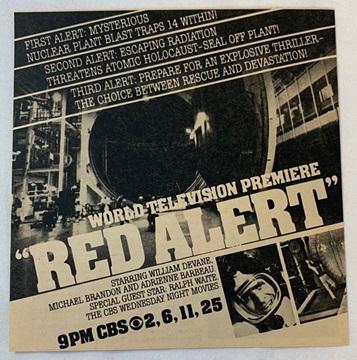
The 1977 made-for-television movie, Red Alert, opens with a man walking through a cemetery on a rainy day. As we watch Howard Ives (Jim Siedow) move amongst the tombstones, we hear his thoughts. He’s a sad and bitter man, wondering why he’s wasted so many years of his life at work. He thinks about someone close to him who has died. He’s obviously very troubled.
(Of course, any horror fans in the audience will immediately recognize Jim Siedow from his role as the Drayton Sawyer in the the original Texas Chainsaw Massacre. He was troubled in that film as well!)
Howard works at the local nuclear power plant. Ominously, when the film cuts to the plant, the first thing we see is a leak of very hot water. I don’t know much about nuclear power plants but I imagine any type of leak is not a good thing. The water leak causes the computer that runs the plant assuming that a nuclear disaster is minutes away from happening. The compound is automatically sealed off, trapping fourteen men (including Howard), inside the reactor. As Commander Stone (Ralph Waite) tries to keep a possible nuclear disaster from occurring, two investigators (played by William Devane and Michael Brandon) try to determined whether the accident was the result of a malfunction or of deliberate sabotage. When the local sheriff (M. Emmet Walsh) informs them that Howard Ives’s wife has committed suicide, the investigators look into the troubled man’s history. Eventually, the two investigators realize that the only way to prevent a nuclear disaster is by risking their lives by entering the sealed-off power plant. The two investigators attempt to do their work under the cover of night and without causing a panic. Needless to say, it doesn’t work. One of them calls his wife (Adrienne Barbeau) and tells her that she needs to leave the area. She tells her mother, who then tells her neighbor and soon the airport is crowded with people looking to get out of town.
Red Alert contrasts the intuitive approach of the two inspector with Commander Stone’s insistence that every bit of a data be fed to his computer before any decisions are made. Stone’s hands are so tied by protocol and red tape that he stands by while the fourteen men who are trapped in the nuclear power plant die. Wisely, though, the film doesn’t turn Stone into a cardboard villain. He’s very much aware of what will happen if the plant suffers a core meltdown. When one of his assistants mentions that he hasn’t been given any instructions on how to evacuate the town in case the plant does explode, Stone tells him that no plans have ever been drawn up because the plans would be useless. There would be no way to evacuate everyone in time.
In the end, Red Alert is scary not because it deals with nuclear power but because it presents us with a world where no one — not even Devane and Brandon’s heroic investigators — seems to know what to do. Everyone is slowed down by a combination of red tape and their own personal angst. Devane is a strong investigator because, as a widower whose only son died in Vietnam, he has no family to worry about. Unlike everyone else in Red Alert, he has nothing left to lose. In the end, the film suggests that the only way to save the world is to cut yourself off from it.
Red Alert is a compelling and intelligent thriller, one that is well-acted by the entire cast and which builds up to strong conclusion. The film’s anti-nuclear message is a bit heavy-handed but I imagine it was an accurate reflection of the fears that people were feeling at the time. Today, the film works best as a warning about bureaucracy and depending too much on AI to make important, life-or-death decisions. In the end, it’s human ingenuity that saves the day and that message is timeless.
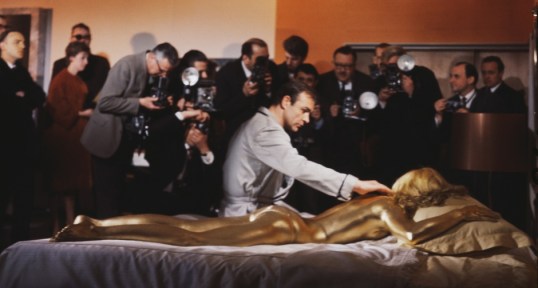
Goldfinger (1964, dir by Guy Hamilton)
It’s Shirley Eaton’s birthday!
Shirley Eaton has since retired but she had a busy acting and singing career in the 1960s. Her best-know role was playing the ill-fated Jill Masterson in the 1964 Bond film, Goldfinger. She was the one who ended up getting suffocated in gold paint after helping Bond expose Goldfinger as a card cheat.
It seems appropriate, therefore, that today’s song of the day should be that film’s title tune. Enjoy Goldfinger, performed by the great Shirley Bassey.
Goldfinger, he’s the man
The man with the midas touch
A spider’s touch
Such a cold finger
Beckons you to enter his web of sin
But don’t go in
Golden words he will pour in your ear
But his lies can’t disguise what you fear
For a golden girl knows when he’s kissed her
It’s the kiss of death from Mister Goldfinger
Pretty girl, beware of his heart of gold
This heart is cold
Golden words he will pour in your ear
But his lies can’t disguise what you fear
For a golden girl knows when he’s kissed her
It’s the kiss of death from Mister Goldfinger
Pretty girl, beware of his heart of gold
This heart is cold
He loves only gold
Only gold
He loves gold
He loves only gold
Only gold
He loves gold
Songwriters: Tim Wheeler
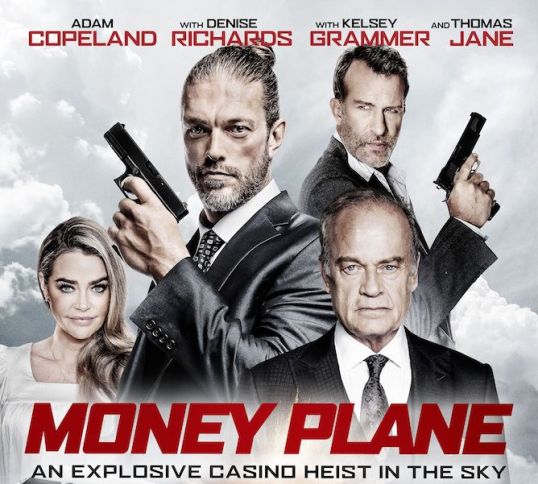
Today is Andrew Lawrence’s birthday!
Who is Andrew Lawrence? He is the director of the greatest film ever made, Money Plane! Today’s scene that I love comes from that 2020 masterpiece. In this scene, Adam Copeland learns that it’s not as easy to take over a plane as one might think. I just love this super-powered co-pilot!
4 Shots From 4 Films is just what it says it is, 4 shots from 4 of our favorite films. As opposed to the reviews and recaps that we usually post, 4 Shots From 4 Films is all about letting the visuals do the talking.
Today, the Shattered Lens wishes a happy birthday to Rob Zombie! It’s time for….
4 Shots From 4 Rob Zombie Films
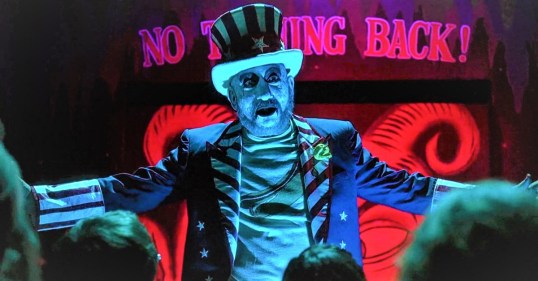
House of 1,000 Corpses (2003, dir by Rob Zombie, DP: Alex Poppos and Tom Richmond)

Halloween II (2009, dir by Rob Zombie, DP: Brandon Trost)

The Lords of Salem (2012, dir by Rob Zombie, DP: Brandon Trost)
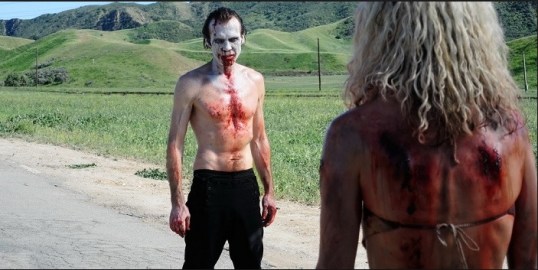
31 (2016, dir by Rob Zombie, DP: David Daniel)
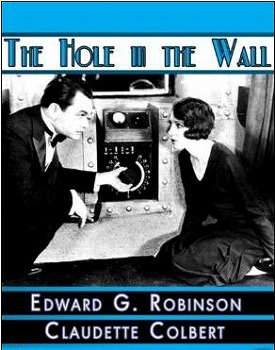
Released in 1929, at the dawn of the sound era, The Hole In The Wall tells the story of The Fox (Edward G. Robinson) and two women known as Madame Mysteria.
The Fox is a con artist, a veteran criminal who takes care of the people working for him. He may not be an upstanding citizen but he seems to truly care about his sidekick Goofy (Donald Meek) and his partner-in-crime, Madame Mysteria (Nellie Savage). Madame Mysteria is a fake psychic. She sits in a chair and does readings while The Fox sends her a series of electric shocks in morse code to let her know what she should say about each victim of their con. They’ve got a pretty good thing going until Madame Mysteria is killed in a train accident.
(Since this film is from 1929, the train accident is recreated with a miniature train that falls off a track in what appears to be a plastic city. Basically, it looks like a primitive YouTube video made by an enthusiastic toy train hobbyist. It may not be convincing but there’s something charming about just how cheap it all is.)
Shortly after Mysteria is killed, Jean Oliver (Claudette Colbert) wanders into The Fox’s shop. Jean is looking for a job and for revenge. As she explains it, she used to have a good job in a department store until her manager accused her of stealing. Though Jean was innocent, she still spent some time in jail. Her life was ruined. Now, she wants to be the new Madame Mysteria and she wants to kidnap the daughter of the woman who accused her. She doesn’t want to get any ransom or anything like that. Instead, she wants to raise the little girl to become a criminal. Fox and Goofy agree, which leads me to wonder if the Fox is really as clever as he thinks he is. Is Jean really the only person they could find to be the new Madame Mysteria? Surely they could find a Madame Mysteria who doesn’t demand they commit a major felony just for her services. Still, kidnap the little girl they do and strangely enough, she never seems to be upset over being taken from her parents. (Even more strangely, we don’t actually see or learn the details of how she was kidnapped. She just suddenly shows up at the Fox’s home.) Goofy becomes a babysitter and Jean becomes Madame Mysteria.
By an amazing coincidence, the reporter (boring David Newell) who decides to write a story on the amazing psychic Made Mysteria just happens to be Jean’s ex-boyfriend! While the Fox falls in love with Jean and the police search for the abducted child, Jean herself starts talking to the dead….
In many ways, The Hole In The Wall is typical of the melodramas that came out during the early sound era. The majority of the supporting actors are still adjusting to acting with sound and the action often feels rather stagey. That said, it’s an entertaining film, largely due to the performance of Claudette Colbert and Edward G. Robinson, both of whom were just starting their careers and on the cusp of stardom. This was Robinson’s first role as a gangster and he snarls with style while Colbert actually keeps the audience guessing at her motivations. The Hole In The Wall is definitely a film from a different era but, for a film that was made nearly 100 years ago, it holds up remarkably well.
 Through the Shattered Lens