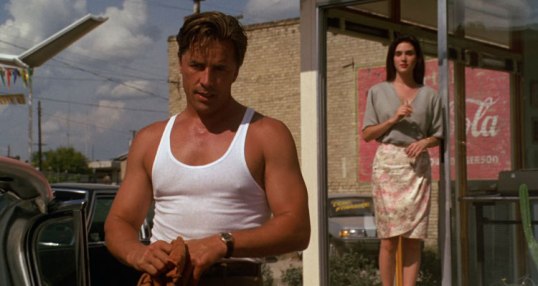
Retro Television Review: Homicide: Life On The Street 3.12 “Partners”


Welcome to Retro Television Reviews, a feature where we review some of our favorite and least favorite shows of the past!  On Sundays, I will be reviewing Homicide: Life On The Street, which aired from 1993 to 1999, on NBC!  It  can be viewed on Peacock.
This week, the bar finally opens!

Episode 3.12 “Partners”

(Dir by John McNaughton, Originally aired January 20th, 1995)

As you can tell by the title, this episode was all about partners.

For instance, Megan Russert realized that her former partner from narcotics, Douglas Jones (Robert Clohessy, with his Bronx accent), has been beating up his wife, Natalie (Lily Knight).  He regularly puts her in the hospital, though Natalie always insists that she either fell down the stairs or walked into a door.  Jones, who is now working homicide during the night shift and under Russert’s command, insists that he would never hurt his wife.  When Russert asks Jones’s former boss if Jones had been having any trouble while working narcotics, he refuses to give her specifics.  It’s a boys club and the boys protect each other.  Eventually, Natalie ends up shooting Jones with his own gun, probably killing him.  (We’re told that he’s barely holding on.)  This storyline was well-acted and well-written but watching it, I was reminded of just how awkwardly this show tends to use Russert.  Because she commands a different shift, she doesn’t really get much interaction with the other main characters.  Her affair with Beau Felton has never really made sense.  From what I understand, Russert was created by NBC demanded more personal drama and some glamour.  Isabella Hofman does about as good a job as anyone could with her often underwritten character but there’s really just not much for her to do.

Meanwhile, with Pembleton under suspension and threatening to quit, Bayliss doesn’t have a regular partner.  His attempt to partner up with Lewis ends in disaster when Lewis’s bad (albeit hilarious) driving leads to Bayliss getting a minor concussion.  Fortunately, Pembleton does return to the Homicide Department, though not before nearly burning down his kitchen while trying to make dinner.  Unfortunately, before Pembleton can return to his job, he has to take the fall for offering to drop the investigation into Congressman Wade’s false kidnapping report.  Andre Braugher perfectly plays the scene in which Pambleton testifies in court.  It’s easy to see the emotional and mental pain that Pembleton feels as he essentially commits perjury, taking the blame and letting Commissioner Harris of the hook.  Pembleton is forced to compromise and it eats away at his soul.  At the same time, he also gets to return to doing what he does best.  Early on in the episode, Giardello acknowledges that he and Pembleton are not friends.  “I’ve never been to your house, I’ve never met you’re wife …. I am not your friend ….” but Giardello explains that Pembleton is a good detective.  He turns “red names black” and that’s why he wants and needs Pembleton to return.

Bayliss, Lewis, and Munch finally open their bar and, at the end of the episode, it looks like the entire city of Baltimore has turned out.  Bolander even looks like he’s having a good time!  Munch raises a glass in a toast to the best partners that anyone could hope for and I got tears in mismatched eyes.  Seriously, I was so happy to finally see that bar open!  It was also nice to see everyone else happy for once.  That doesn’t often happen on Homicide.
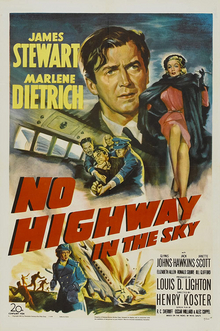
Film Review: No Highway In The Sky (dir by Henry Koster)


In 1951’s No Highway In The Sky, James Stewart stars as Dr. Theodore Honey.

In many ways, Theodore Honey is similar to the other roles that Stewart played after he returned from serving in World War II.  Dr. Honey is intelligent, plain-spoken, and good-hearted.  He’s eccentric and he sometimes has a difficult time relating to other people.  He’s also deeply troubled.  Dr. Honey is an engineer, one who specializes in determining how many hours an airplane can fly before it starts to fall apart.  Dr. Honey is in England, working for an airline and testing his hypothesis that their newest model’s tail will fall off after the plane accumulates a specific number of hours.  As is usually the case with these things, Dr. Honey’s employers are skeptical about his claims.  There’s a lot of money to be made in air travel and the last thing they need is some eccentric American scaring everyone.

When Honey sets out to investigate a recent crash site, he finds himself on the same type of airplane that he’s been testing.  After the plane takes off, Dr. Honey talks to the pilots and discovers, to his horror, that the plane is closing in on the time limit.  While flight attendant Marjorie Corder (Glynis Johns) tries to keep him calm, Dr. Honey explains his theory to a film star named Monica Teasdale (Marlene Dietrich), who just happens to be a passenger on the flight.  Both Marjorie and Monica find themselves falling in love with Dr. Honey and who can blame them?  He may be an eccentric and it may be hard to follow what he’s talking about but he’s still Jimmy Stewart!

I’ve often thought that Stewart was “Jimmy” before World War II but he was definitely James afterwards.  Stewart, unlike a lot of Hollywood stars who enlisted and were then used solely for PR purposes, actually flew several combat missions and saw firsthand the devastation of the war.  He returned to America deeply disturbed by what he had seen and there’s a definite sense of melancholy to be found in all of Stewart’s post-war performances.  That’s certainly the case here.  Dr. Honey is a widower, his wife having been killed by a rocket attack during the war.  He’s raising his 12 year-old daughter on his own and he deals with his sadness by throwing himself into his work.  He’s someone who has seen and experienced great tragedy firsthand and it’s left him more than a little obsessed. There’s a very authentic sadness at the heart of Stewart’s performance and it elevates this film, making what could have been a by-the-book corporate thriller into a character study of a man standing at the dawning of a new age, the post-war era of commercial air travel, and saying, “Well, hold on one minute.”

Unfortunately, Honey’s obsessive nature makes it easy for some to dismiss him.  When Dr. Honey purposefully sabotages the plane to keep it from flying again, he finds himself forced to defend his actions.  Can he prove that his theory is true?  And who will he end up falling in love with?  You can probably guess the answers but it doesn’t matter if the latter half of the film is a bit predictable.  James Stewart’s performance carries the film and keeps you watching.

Late Night Retro Television Review: Check It Out! 3.17 “Fatal Harrassment”


Welcome to Late Night Retro Television Reviews, a feature where we review some of our favorite and least favorite shows of the past!  On Saturdays, I will be reviewing the Canadian sitcom, Check it Out, which ran in syndication from 1985 to 1988.  The entire show is currently streaming on Tubi and Peacock!

This week, Howard is getting sued!

Episode 3.17 “Fatal Harrassment”

(Dir by Alan Erlich, originally aired on January 10th, 1988)

The newest cashier at Cobb’s, Kim Dillard (Lolita Davidovich, in a very early role), is suing Howard for sexual harassment!

Actually …. yeah, I could see that.  Everything about Howard screams lawsuit, if not for sexual harassment than for something else.  The same can be said of the behavior of just about everyone who works at Cobb’s.  One thing I’ve noticed over the years that I’ve spent watching old sitcoms for the site is that, in the 80s and 90s, everyone just harassed everyone else and regularly made comments that would end friendships and lose jobs today.

Anyway, Howard swears that Kim was actually coming onto him and that he’s being set up.  Yeah, whatever, Howard.  No one buys that!  Except, it’s true!  It turns out that Kim has a history of taking jobs and then suing her boss for sexual harassment.  Since most of her bosses settle to avoid the bad publicity that would come with a trial, Kim makes a lot of money without having to prove anything.  Howard, however, threatens to go to court, which cause Kim to drop her suit.  Howard keeps his job, disappointing Christian who was hoping to take over the store.

This episode wasn’t great but it wasn’t terrible.  It was very middle-of-the-road, featuring a lot of obvious jokes that were saved by the cast’s third season chemistry.  That said, it also painted Kim as too obvious a villain and it again left me wondering why Edna is still wasting her time with Howard.  For three seasons now, Edna has been complaining about dating Howard.  Strangely, Edna always says that she’s been dating Howard for “Seven years,” even though three years have passed since she first said that.  Poor Edna!


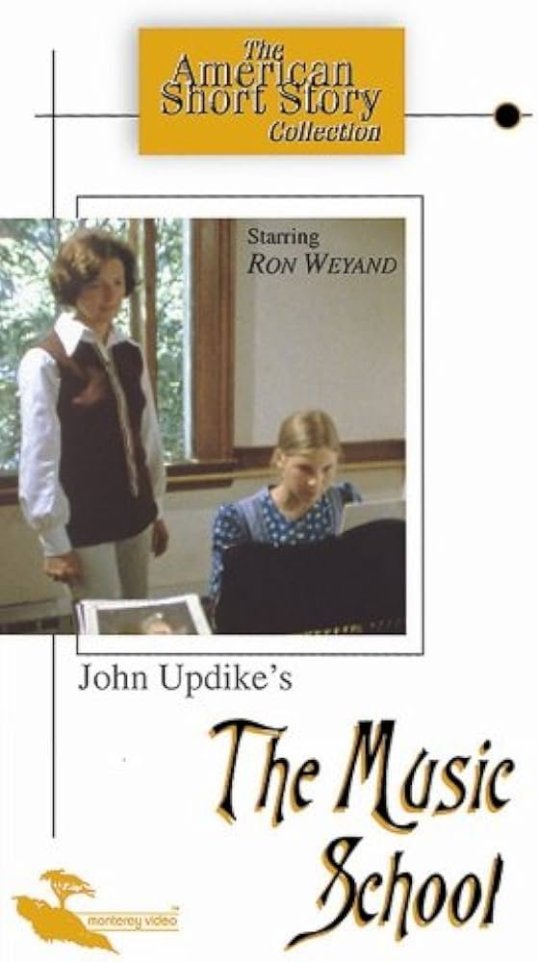
Retro Television Review: The American Short Story 1.1 “The Music School”


Welcome to Retro Television Reviews, a feature where we review some of our favorite and least favorite shows of the past!  On Saturdays, I will be reviewing The American Short Story, which ran semi-regularly on PBS in 1974 to 1981.  The entire show can be purchased on Prime and found on YouTube and Tubi.

Today, we start a new series of reviews with an adaptation of a John Updike short story!

Episode 1.1 “The Music School”

(Dir by John Korty, originally aired on January 1st, 1974)

The first episode of The American Short Story is based on a story by John Updike.  Alfred Schweigen (Ron Weyand) is a writer who sits at his typewriter and who occasionally looks out the window of his office.  His wife playfully sprays the window with a garden hose and the writer thinks about how she’s in therapy because of his affairs.  He remembers taking his daughter to her music school and thinks about the sounds of music floating through the building like ghostly memories.  He thinks about a priest who, while talking to a bunch of “Protestants and non-believers,” explained that it was now permissible to chew the Eucharist wafer instead of waiting for it to dissolve.  He thinks about a friend of his, a computer programmer, who was apparently assassinated by a random sniper while his family watched.  In his mind, Alfred takes the random thoughts and occurrences and builds a story around them.

It’s an interesting episode, even if it doesn’t quite work.  Tasked with bringing Updike’s words to visual life, this episode far too often falls back onto cliche and Ron Weyand often looks more annoyed that sincerely perplexed by life’s mysteries.  (The writer’s narration is provided by Henry Fonda, whose middle-American voice doesn’t quite match Weyand’s petulant performance.)  It’s a midlife crisis type of story, one in which the writer tries to deal with his own ennui and infidelities by turning them into fiction.  Unfortunately, this is a case of what was compelling on the page falling flat when it’s adapted for film.  I appreciated this episode’s ambition, even if it didn’t work in the end.

Next week, the American Short Story interprets a story by Ambrose Bierce!

Live Tweet Alert: Join #ScarySocial for When A Stranger Calls Back!


As some of our regular readers undoubtedly know, I am involved in a few weekly live tweets on twitter.  I host #FridayNightFlix every Friday, I co-host #ScarySocial on Saturday, and I am one of the five hosts of #MondayActionMovie!  Every week, we get together.  We watch a movie.  We tweet our way through it.

Tonight, at 9 pm et, Deanna Dawn will be hosting #ScarySocial!  The movie?  1993‘s When A Stranger Calls Back!  

If you want to join us this Friday, just hop onto twitter, start the movie at 9 pm et, and use the #ScarySocial hashtag!  I’ll be there tweeting and I imagine some other members of the TSL Crew will be there as well.  It’s a friendly group and welcoming of newcomers so don’t be shy.

When A Stranger Calls Back is available on Prime!

See you there!

Song of the Day: My My, Hey Hey (Out of the Blue) by Neil Young


This is the song that gave it’s title to one of Dennis Hopper’s best films.

My my, hey hey
Rock and roll is here to stay
It’s better to burn out
Than to fade away
My my, hey hey.

Out of the blue
and into the black
They give you this,
but you pay for that
And once you’re gone,
you can never come back
When you’re out of the blue
and into the black.

The king is gone
but he’s not forgotten
This is the story
of a Johnny Rotten
It’s better to burn out
than it is to rust
The king is gone
but he’s not forgotten.

Hey hey, my my
Rock and roll can never die
There’s more to the picture
Than meets the eye.
Hey hey, my my.

Songwriters: Neil Young and Jeff Blackburn


Scenes I Love: Bill Paxton and Helen Hunt In Twister


Bill Paxton would have been 70 years old today.

Today’s scene that I love comes from Twister and it features Bill Paxton showing off some wonderful chemistry with Helen Hunt.  One of the great things about Bill Paxton is that he was equally at home in both big blockbusters like Twister and Titanic and low-budget indies like Near Dark.  He was an artist who also happened to be a star.  As a lover of both films and eccentric Texans, I will always miss Bill Paxton.

4 Shots From 4 Films: Special Dennis Hopper Edition


Dennis Hopper (1936–2010)

4 (or more) Shots From 4 (or more) Films is just what it says it is, 4 (or more) shots from 4 (or more) of our favorite films. As opposed to the reviews and recaps that we usually post, 4 (or more) Shots From 4 (or more) Films lets the visuals do the talking.

89 years ago, Dennis Hopper was born in Dodge City, Kansas.

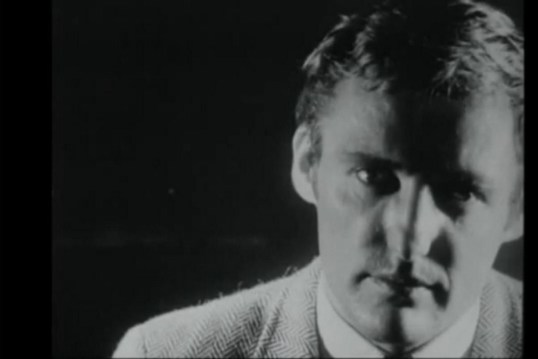
It seems rather appropriate that one of America’s greatest cinematic outlaws was born in a town that will be forever associated with the old west. Dennis Hopper was a rebel, back when there were actual consequences for being one. He started out acting in the 50s, appearing in films like Rebel Without A Cause and Giant and developing a reputation for being a disciple of James Dean. He also developed a reputation for eccentricity and for being difficult on set and he probably would have gotten completely kicked out of Hollywood if not for a somewhat improbable friendship with John Wayne. (Wayne thought Hopper was a communist but he liked him anyways. Interestingly enough, Hopper later became a Republican.) Somehow, Hopper managed to survive both a raging drug addiction and an obsession with guns and, after a mid-80s trip to rehab, he eventually became an almost universally beloved and busy character actor.

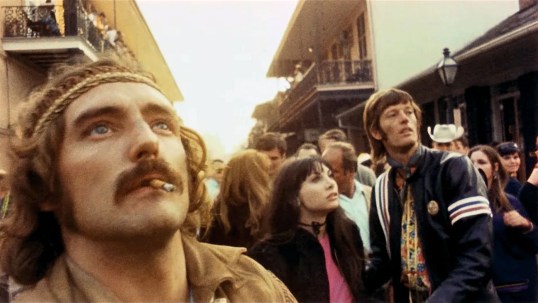
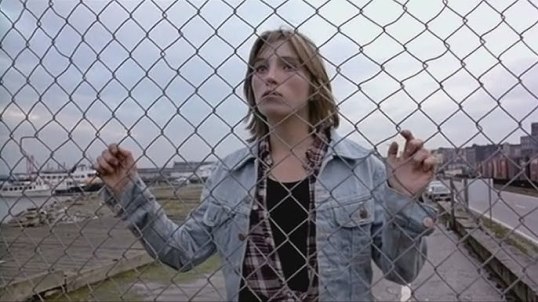
Hopper, however, always wanted to direct. He made his directorial debut with 1969’s Easy Rider, a film that became a huge success despite being an infamously chaotic shoot. The success of Easy Rider led to the Hollywood studios briefly trying to produce counter-culture films of their own. Hopper was given several million dollars and sent to Peru to make one of them, the somewhat dangerously titled The Last Movie. Unfortunately, The Last Movie, was such a bomb that it not only temporarily derailed Hopper’s career but it also turned Hollywood off of financing counter culture films. Hopper spent a decade in the Hollywood wilderness, giving acclaimed performances in independent films like Tracks and The American Friend, even while continuing to increase his reputation for drug-fueled instability. Hopper would eventually return to directing with his masterpiece, 1980’s Out of the Blue. (Out of the Blue was so controversial that, when it played at Cannes, Canada refused to acknowledge that it was a Canadian production. It played as a film without a country. Out of the Blue, however, is a film that has stood the test of time.) Unfortunately, even after a newly cleaned-up Hopper was re-embraced by the mainstream, his directorial career never really took off. He directed 7 films, of which only Easy Rider and Colors were financially successful. Contemporary critics often didn’t seem to know what to make of Dennis Hopper as a director. In recent years, however, Hopper’s directorial efforts have been reevaluated. Even The Last Movie has won over some new fans.

Today, on his birthday, we honor Dennis Hopper’s directorial career with….

4 Shots From 4 Dennis Hopper Films

Easy Rider (1969, dir by Dennis Hopper, DP: Laszlo Kovacs)
The Last Movie (1971, dir by Dennis Hopper, DP: Laszlo Kovacs)
Out of the Blue (1980, dir by Dennis Hopper, DP: Marc Champion)
The Hot Spot (1990, dir by Dennis Hopper, DP: Ueli Steiger)