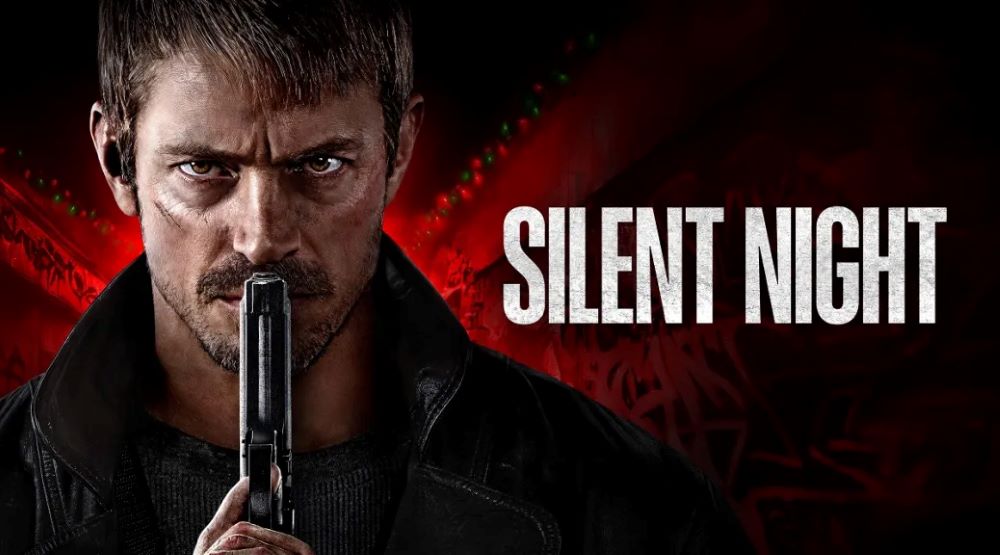
Review: Silent Night (dir. by John Woo)


“I can’t speak, but I’ll make them listen.” — Brian Godlock

Silent Night (2023) finds John Woo making his first American action film in two decades, since the disappointing Paycheck in 2003. While it’s definitely a step up from that sci-fi thriller misfire, Silent Night still doesn’t quite reach the heights of Woo’s Hong Kong classics or even his best Western productions like Face/Off. This latest outing is a lean, mostly dialogue-free revenge thriller that has Woo’s fingerprints all over it—a mix of balletic violence and emotional anguish—but it also shows the limitations of trying to recapture that old Woo magic in a very different cinematic landscape.

The story is simple: Joel Kinnaman plays Brian Godlock, an electrician whose son is killed in a gang shootout on Christmas Eve, and he himself is shot in the throat, losing his voice. The film then follows Brian’s quiet but brutal quest for revenge a year later. The choice to tell this nearly wordless story is a bold gamble, and for much of the film, the absence of dialogue adds power to the emotions and the tension. Kinnaman’s physical performance carries most of the weight—his grief, anger, and determination are all conveyed through body language and expression. This is one of the biggest strengths of Silent Night: Woo’s ability to communicate story and feeling visually, which harkens back to the silent films of early cinema, blending with his signature poetic violence.

That said, the silence also highlights the script’s thinness. The supporting characters, including Brian’s wife (Catalina Sandino Moreno) and a sympathetic detective (Kid Cudi), feel underdeveloped, serving more as plot functions than full people. This narrow focus on Brian’s pain and revenge means the film sometimes feels emotionally shallow beyond the core trauma. Compared to Woo’s earlier work, where secondary characters and relationships added layers of complexity and intensity, Silent Night is more singular and direct, for better and worse.

When it comes to action, Woo shows he still has the chops. The gunfights and hand-to-hand scenes are meticulously choreographed, emphasizing realism with a solid dose of stylized flair. It’s a return to the grounded grit Woo displayed in some of his earlier Hong Kong films, leaving behind some of the higher-octane operatic excess of his best-known Hollywood hits. The violence feels impactful and earned, avoiding cheap spectacle for a more tactile, bone-crunching effect.

Still, Silent Night doesn’t quite have the scope and scale of Face/Off or The Killer. It lacks the grandeur and intricate storytelling that made those films iconic. Instead, it’s a tighter, moodier experience that prioritizes emotional atmosphere over plot complexity. This stripped-down approach is refreshing to a degree, but it can also become monotonous—especially since the lack of dialogue and limited character development demand more patience from the viewer.

Comparing it directly to PaycheckSilent Night is a clear improvement. Paycheck was widely regarded as a forgettable action film that failed to capitalize on Woo’s talents, stuck with a muddled sci-fi plot and lacking the emotional firepower Woo excels at. Silent Night ditches the high-concept sci-fi for a more grounded, personal revenge story, allowing Woo to bring more of his hallmarks to bear—the intense physical performances, a palpable sense of loss, and carefully crafted action sequences.

However, it’s important to temper enthusiasm with the fact that Silent Night is not a full return to Woo’s prime Hong Kong cinema or his best Hollywood days. It’s missing some of the poetry, charm, and iconic bravado of movies like Hard Boiled or Face/Off, where Woo’s characters felt larger than life and the action was operatic and unforgettable. Here, the film often feels restrained, even muted, perhaps reflecting a director adapting to new cinematic expectations but also struggling to fully bring himself back to the forefront in the American industry.

Silent Night is a worthwhile viewing for fans of John Woo and action cinema looking for something different—one part homage to classic revenge tales, one part experiment in silent storytelling. It’s emotionally raw, visually precise, and markedly better than Paycheck, but it also lacks the fire and inventiveness that made Woo a legend. It’s a step forward and a reminder that even the greatest filmmakers can evolve and sometimes falter. If Woo is finding his voice again, it’s decidedly quieter but still unmistakably his own.

Review: Knives Out (dir. by Rian Johnson)


“The family is truly desperate. And when people get desperate, the knives come out.” — Benoit Blanc

After shaking up galaxies far, far away with Star Wars: The Last Jedi, Rian Johnson returned to solid ground in 2019 with Knives Out, a film so self-assured and inventive it practically felt like a director catching his breath while reminding the world what made him exciting in the first place. It was his first movie after that polarizing Star Wars entry, and he used the opportunity not to go bigger, but smarter—to take something intimate, character-driven, and refreshingly old-school and make it gleam again. Knives Out landed as a kind of palate cleanser for both him and the audience: a modern mystery that leaned into genre nostalgia while reinventing it with sharp humor and social bite. The result wasn’t just a change of pace—it was a confident display of craft from a filmmaker unbothered by his critics, operating with absolute control over every frame, every line, and every perfectly timed smirk.

The setup couldn’t be more classic: a wealthy family patriarch, Harlan Thrombey, turns up dead after his 85th birthday, leaving behind a tangled household of suspects, secrets, and strained smiles. His death looks like suicide, but something isn’t right. Enter Benoit Blanc, a Southern gentleman detective hired anonymously to snoop through the wreckage of lies and grievances. The scenario drips with vintage whodunit flavor, but Johnson’s genius lies in retooling that familiarity into something electrifyingly modern. The Thrombeys aren’t just eccentric millionaires—they’re avatars of American entitlement, each convinced of their own superiority while quietly dependent on the man they pretend to revere. By building his mystery around a clan that mirrors contemporary divisions of money, politics, and self-deception, Johnson injects wit and purpose into the genre without ever losing the fun of the game.

Jamie Lee Curtis plays the confident matriarch Linda, Michael Shannon the resentful son Walt, Toni Collette the spiritual grifter Joni, and Don Johnson the smirking son-in-law Richard—all of them playing heightened but recognizable shades of selfishness. Their sniping exchanges during the first act are among the film’s best sequences, packed with fast banter, political jabs, and casual hypocrisy. Johnson directs these moments like a verbal tennis match, letting personalities bounce and clash until the family’s shiny façade cracks enough for true frustrations to spill out. It’s sharp, funny, and chaotic, showing early on that no one in the Thrombey family is as self-made or self-aware as they claim to be.

Amid that colorful ensemble, the performance that most stunned audiences came from Chris Evans as Ransom Drysdale, Harlan’s playboy grandson and the family’s unapologetic black sheep. Coming off years of playing Marvel’s resolutely noble Steve Rogers, Evans dives into Ransom with visible glee, turning him into a figure of charm and mystery whose motives are never quite clear. He’s magnetic from the moment he appears—witty, cynical, a little dangerous—and Johnson clearly relishes using Evans’s clean-cut image to toy with expectations. Ransom strides into the story radiating confidence, but there’s a guarded, almost predatory intelligence behind his grin. His scenes crackle because the audience can’t quite decide where to place him: is he the rare Thrombey who sees through the family hypocrisy, or is he spinning his own kind of manipulation? That tension between self-awareness and deceit gives his every line an edge. Watching Evans in this role feels like a release for him and a thrill for viewers, a testament to both his range and Johnson’s intuitive casting.

Opposite that moral uncertainty stands Ana de Armas’s Marta Cabrera, Harlan’s kind and soft-spoken nurse who suddenly finds herself at the heart of the story. Marta grounds the entire film emotionally, her decency cutting through the Thrombeys’ arrogance like sunlight in a dusty room. She’s the migrant caretaker who everyone claims to love while casually condescending to, a detail Johnson uses to expose how often politeness masks prejudice. Marta’s inability to lie without vomiting, played initially for laughs, gradually becomes symbolic—a kind of moral honesty that makes her unique in a house ruled by deception. De Armas brings layered vulnerability to the role, balancing fear, guilt, and compassion with natural ease. Through her, Johnson turns the whodunit into something more human and emotionally resonant. She isn’t just a witness or a suspect; she’s the beating heart around which all the greed, paranoia, and privilege revolve.

Then there’s Daniel Craig’s Benoit Blanc, whose arrival shifts the film into another gear entirely. His Southern drawl—equal parts poetic and perplexing—sets the tone for what becomes one of Craig’s most playful performances. After years of portraying the stoic James Bond, he’s clearly having the time of his life as a detective who investigates with both intellect and intuition. Blanc operates less like a hard-nosed cop and more like a philosopher; he believes that solving a crime means understanding human weakness as much as evidence. His famous “donut hole” speech perfectly captures the balance Johnson strikes between earnestness and absurdity. Blanc may revel in his own melodrama, but he also brings heart to chaos, observing people’s contradictions without losing his sense of wonder. The result is a detective who’s less about revelation and more about revelation’s moral cost.

Visually, Knives Out belongs to a rare category of films that are so meticulously crafted they could be paused at any frame and still look compelling. Johnson and cinematographer Steve Yedlin transform Harlan’s mansion into a breathing character—an architectural echo chamber of secrets. The walls are lined with strange trinkets, elaborate paintings, and heavy mahogany furniture that suggest old money’s suffocating weight. There’s something both cozy and claustrophobic about the space, which mirrors the tension between family warmth and poisonous resentment. The camera glides through it with purpose, lingering on small details that gain meaning later, and the autumn-colored palette—deep reds, browns, and golds—wraps everything in an inviting melancholy. It’s as much a visual experience as it is a narrative one, and few modern mysteries feel as tactile.

Johnson’s writing keeps that sense of precision. The plot unfolds like clockwork, but the mechanics never feel mechanical. Instead, he keeps viewers off-balance by blending humor with genuine suspense. Instead of relying entirely on high-stakes twists, Johnson builds tension through empathy, giving us access to characters’ doubts and stakes rather than just their clues. The result is a mystery that keeps the audience guessing in emotional and moral dimensions, not just logical ones. Every revelation says as much about character as it does about the crime.

Underneath the quick humor and ornate mystery structure, Knives Out doubles as a satire of class and entitlement. Johnson sketches the Thrombeys as people who talk endlessly about fairness, morality, and self-reliance yet collapse into panic when their material comfort is threatened. Through them, he captures a peculiar American irony: the people most obsessed with earning their status are often those most insulated from real struggle. When the family gathers to argue over wealth and loyalty, Johnson doesn’t need to exaggerate—they expose themselves with every smug phrase and self-justified rant. It’s social commentary that’s biting but never heavy-handed because it plays out through personality instead of sermon.

Nathan Johnson’s score carries the story forward with playful precision, shifting from tension to whimsy in sync with the characters’ shifting loyalties. There’s something almost dance-like about the film’s rhythm: scenes of laughter can spiral into confession, and interrogations can dissolve into comedy without losing a beat. The editing supports that agility, cutting crisply between overlapping dialogue and close-ups that reveal just enough expression to keep us alert. Johnson’s sense of pacing feels theatrical in the best way—it’s about timing and tone rather than spectacle.

As with many of Rian Johnson’s works, contradiction fuels the story’s appeal. Knives Out is cynical about human greed but oddly hopeful about individual decency. It mocks arrogance but rewards empathy. Even when it toys with genre clichés, it does so out of affection, not scorn. Johnson clearly understands that mystery storytelling is as much about character and morality as deduction, and he uses humor and chaos as tools to explore who people become under pressure. The movie’s sophistication lies in how effortless it feels—its layers unfold smoothly, but the craft behind them is razor sharp.

The film’s ending closes with a visual that redefines power without needing words. After a story filled with deceit, pretension, and the scramble to control a legacy, it concludes on an image that says everything about perspective—who actually holds the moral high ground and how quietly dignity can win. Like the rest of the movie, it’s both playful and pointed, leaving you smiling while still turning the characters’ behavior over in your mind.

Looking back, Knives Out stands as a defining moment in Rian Johnson’s career. After the spectacle and dialogue storms of The Last Jedi, this lean, ensemble-driven mystery reaffirmed his strengths as a writer-director who thrives on structure, rhythm, and human contradictions. It’s a film that takes as much pleasure in observation as revelation, brimming with sly humor and performances that sparkle across the moral spectrum. Anchored by Ana de Armas’s poignant sincerity, Daniel Craig’s eccentric brilliance, and Chris Evans’s unpredictable charisma, it became one of the most purely enjoyable movies of its time. Witty without pretense, political without lecturing, and perfectly balanced between cynicism and heart, Knives Out remains proof that the old whodunit can still cut deep—and that Rian Johnson’s sharpest weapon is still his storytelling.

Horror Review: The Long Walk (dir. by Francis Lawrence)


“In this Walk, it’s not about winning. It’s about refusing to be forgotten while the world watches us fade away.” — Peter McVries

Francis Lawrence’s The Long Walk (2025) delivers a relentlessly brutal and unyielding vision of dystopian horror that explores survival, authoritarian control, and the devastating loss of innocence. The film immerses viewers in a grim spectacle: fifty teenage boys forced to participate in an annual, televised event known as the Long Walk. To survive, each participant must maintain a constant pace, never falling below a minimum speed, or else face immediate execution.

At the heart of this bleak narrative is Raymond Garraty, played with earnest vulnerability by Cooper Hoffman. Garraty’s backstory, marked by the tragic execution of his father for political dissent, sets a somber tone from the outset. As the Walk drags on, Garraty forges fragile bonds with fellow contestants, particularly Peter McVries (David Jonsson), whose camaraderie and quiet resilience inject moments of hope and humanity into the harrowing journey. These relationships become the emotional core, grounding the film’s relentless physical and psychological torment in deeply human experiences.

The setting enhances this oppressive atmosphere. The time and place remain deliberately ambiguous, with evident signs that the United States has recently suffered a second Civil War. The aftermath is a landscape ruled by a harsh, authoritarian military regime overseeing a nation economically and politically in decline. Though visual cues evoke a retro, 1970s aesthetic—reflected in military hardware and daily life—the film resists pinning itself to an exact year. This timelessness amplifies its allegorical power, emphasizing ongoing societal collapse and authoritarianism without tying the story to one era specifically. The dystopian backdrop is populated by broken communities and a pervasive sense of hopelessness that mirrors the characters’ internal struggles.

Visually, The Long Walk employs stark, gritty cinematography that traps viewers in the monotonous expanse of endless roads and bleak environments. Lawrence’s direction is unflinching and unrelenting, echoing the merciless march to death and the broader commentary on institutionalized brutality. The atmospheric score complements this oppressive tone, underscoring the emotional and physical exhaustion pacing the narrative.

Performances elevate the film’s emotional stakes significantly. Hoffman’s portrayal of Garraty captures the youth’s evolving vulnerability and determination, while Jonsson’s McVries adds a poignant emotional depth with his steady, hopeful presence. Supporting actors such as Garrett Wareing’s enigmatic Billy Stebbins and Charlie Plummer’s self-destructive Barkovitch bring vital complexity and urgency. Stebbins remains a figure whose allegiance is ambiguous, adding layered mystery to the group dynamics. Judy Greer’s limited screentime as Ginny Garraty, Ray’s mother, stands out powerfully despite its brevity. Each of her appearances is heartbreaking, bringing a wrenching emotional weight to the film. Her panicked, anguished attempts to hold onto her son before he embarks on the deadly Walk amplify the human cost of the dystopian spectacle, leaving a lasting impression of maternal agony amid the surrounding brutality.

Mark Hamill’s role as The Major is a significant supporting presence, embodying the authoritarian face of the regime. The Major oversees the brutal enforcement of the Walk’s rules, commanding lethal squads who execute those who falter. Hamill brings a grim and chilling force to the character, whose cold charisma and unwavering commitment to the ruthless system make him a menacing figure. Despite relatively limited screen time compared to the young participants, The Major’s presence looms large over the story, symbolizing the chilling machinery of power and control that governs the dystopian world.

Yet, the film is stark in its depiction of violence. The executions and suffering are raw and often grotesquely explicit, serving as a damning critique of authoritarian cruelty and the voyeuristic nature of state violence televised as entertainment. This unfiltered brutality can, however, become numbing and exhausting as it piles on relentlessly, occasionally undercutting emotional resonance. The narrative embraces nihilism fully, underscoring the dehumanization and futility within the dystopian world it portrays.

The film’s overall pacing and structure reflect this bleakness but at times suffer from monotony. The heavy focus on walking and survival mechanics leads to a lack of narrative variation, testing the audience’s endurance much like the characters’. There is likewise a noticeable stretch of physical realism—the contestants endure near-impossible physical feats without adequate signs of weariness or injury, which can strain believability.

Character development is another area where the film falters slightly. While Garraty and McVries are well-drawn and immunize emotional investment, other characters tend toward archetypical roles—bullies, outsiders, or generic competitors—diminishing the impact of many deaths or interactions. Similarly, the repetitiveness of the setting and cinematography, relying mostly on basic shots following the walkers, misses opportunities for more creative visual storytelling that might heighten tension or spotlight key emotional beats.

The film’s conclusion, stark and abrupt, offers no real catharsis or closure, reinforcing the overarching theme of unyielding despair. While this resonates with the film’s nihilistic motif, it may alienate those seeking narrative resolution or hope. The visceral shock and bleak tone permeate to the end, leaving the viewer with a lasting impression of relentless suffering and sacrifice.

This demanding yet visually striking and emotionally intense film challenges viewers with its unrelenting bleakness and brutal thematic content. It critiques societal violence, media spectacle, and authoritarianism through starkly powerful performances and an oppressive, immersive atmosphere. Though it excels in evoking emotional rawness in key moments and maintaining thematic consistency, it struggles with pacing, character depth beyond the leads, and occasional narrative monotony. Its ambiguous setting in a post-second Civil War America ruled by a declining authoritarian regime adds a timeless, allegorical layer to its exploration of human endurance and societal collapse.

Ultimately, this film is best suited for viewers prepared for an uncompromising, intense vision of dystopia. It stands as a compelling, if bleak, meditation on youth, survival, and the human spirit under extreme duress, showcasing Francis Lawrence’s aptitude for crafting thought-provoking, provocative horror.

Film Review: From the World of John Wick: Ballerina (dir. by Len Wiseman)


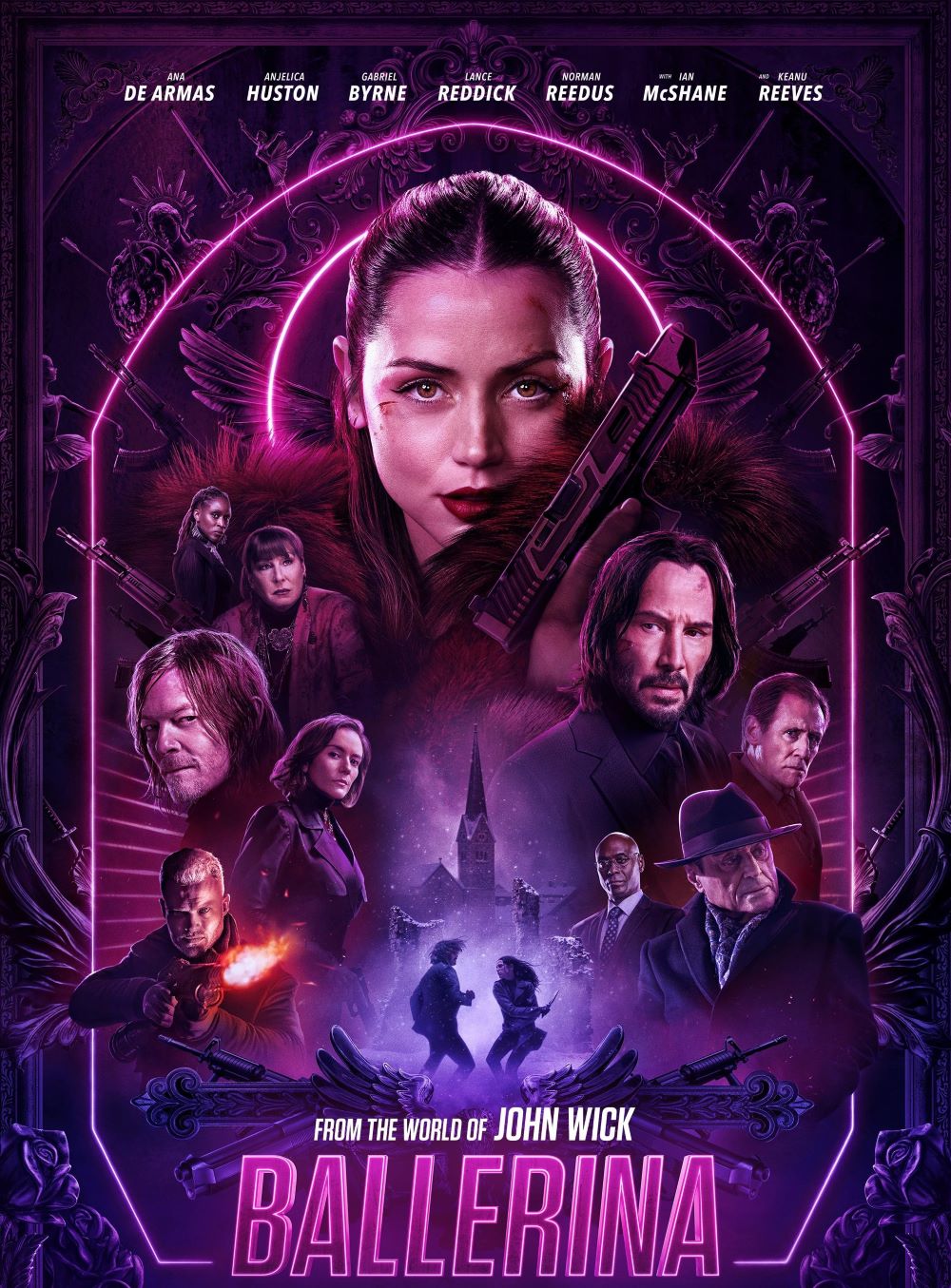
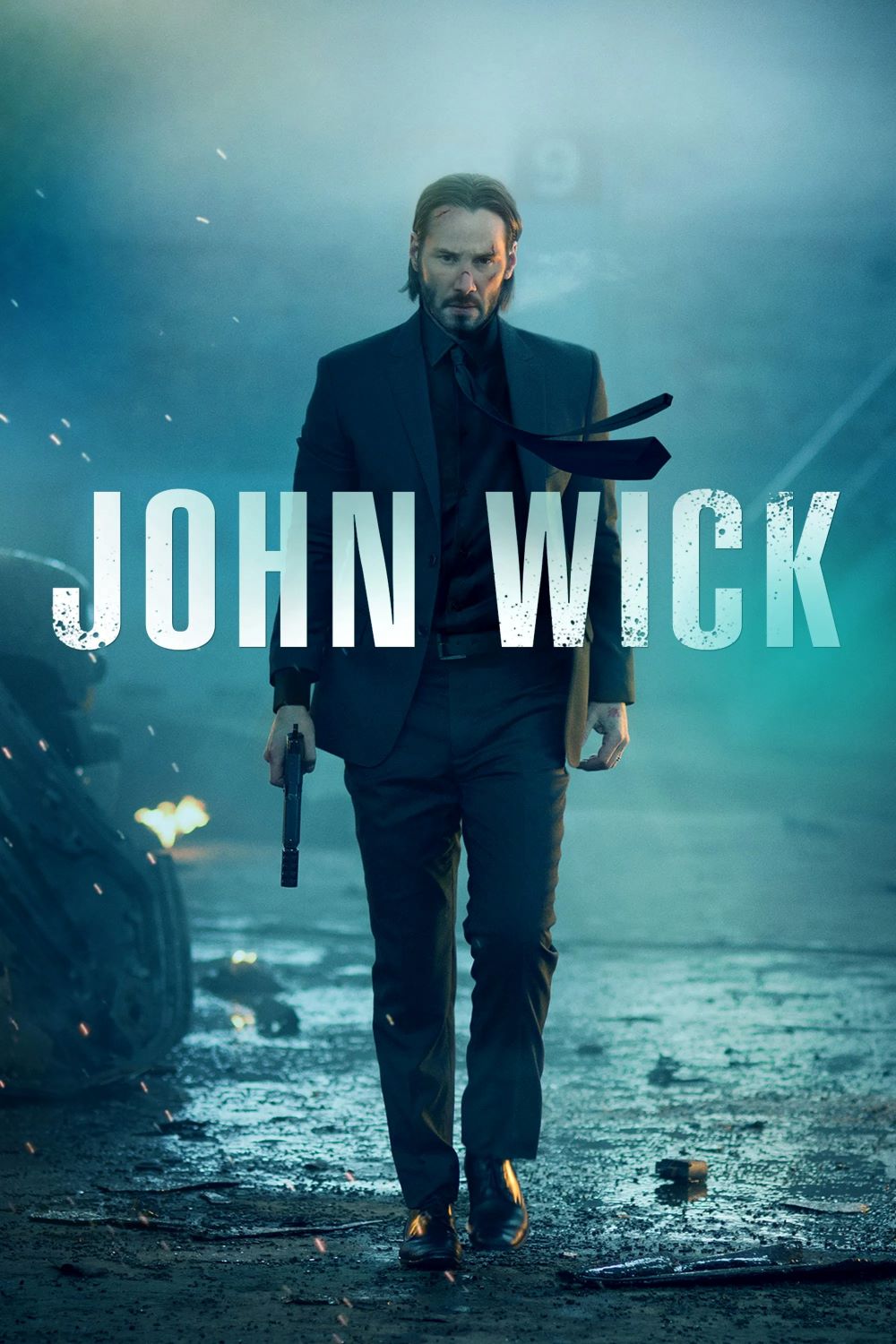
It seems almost inevitable that Ana de Armas would make it into the John Wick franchise. Having worked with Keanu Reeves in multiple films since 2015’s Knock Knock, she has great chemistry with him on camera. De Armas has also proven she can handle action both with 2021’s No Time to Die and 2023’s Ghosted, with the latter also boasting a bit of comedy. From the World of John Wick: Ballerina (or just Ballerina for the sake of this writing) puts Ana in the mix of all the madness as Eve Maccaro. While it doesn’t have the tightest story in the world when compared to the rest of the John Wick saga, Ballerina does hold its own at least as a showcase for the stunt work. If you enjoyed Atomic Blonde or any of the Underworld films, you really won’t have any problems here.

The story for Ballerina takes place during the events of John Wick 3 – Parabellum. As a child, when Eve loses her father to a crew of armed men sporting a brand on their wrists, she is taken in by The Continental’s Winston (Ian McShane). Winston introduces her to the tribe of killers known as the Ruska Roma, lead by The Director (Anjelica Houston), who train her to become like them. Those familiar with the John Wick franchise will recall that the Ruska Roma was John’s tribe before some action caused a split between him and them.

In addition to her pointe practices (which look painful), she’s trained with knives, guns and other tactics. Unlike the assassins that normally frequent The Continental, the Ruska Roma aren’t fully ruthless and can be a force of good. After handling various tests, she discovers a clue leading to the people who killed her father and the man who leads them (ironically played by Point of No Return’s’ Gabriel Byrne, given the film moves in similar circles). Can Eve get her vengeance in the shadow of the legendary Baba Yaga?

While Eve’s story is a still a tale of vengeance as much as Wick’s, there are two distinct differences. As taught by her trainer Nogi (Sharon Duncan Brewster, Dune: Part One), being a girl has some merits and flaws. She might not have the strength to go toe to toe with some of her male opponents (and try telling Ana this, she throws herself deep into the stuntwork), she can move for weakpoints and cheat her way though to victory. “Fight like a girl” becomes the motto. The other difference is that Eve has to work within both the rules of the Ballerinas as well as those the High Table puts on their Hotels. I thought that was an interesting touch to things.

With those stunts, I really would like to know if Ana or any of the stunt team were hurt in any way making this film. Eve goes through a lot and doesn’t have that protective Armani suit of Wick’s. Into walls, over dressers, through glass and even fire, but she keeps getting up and giving that damage right back to her targets. I hope this becomes a contender for the Academy’s new award for stunts. It’s an easy lock for a Nomination.

Casting-wise, you’ll see some familiar faces. Winston and Charon (the late Lance Reddick) are both on hand, as well as stuntman/actor Daniel Bernhardt (The Matrix Reloaded, Nobody, that awesome “ronny/lily’ episode of HBO’s Barry). Some new faces include Norman Reedus (The Walking Dead) and Anne Parillaud (Innocent Blood, La Femme Nikita).

Len Wiseman hasn’t directed a feature film since 2012’s Total Recall, but watching Ballerina you really couldn’t tell. Some of the locales do look like they were borrowed from Wiseman’s Underworld films, but that actually works in Ballerina‘s favor. The film flows well from scene to scene and the action is visible enough that there’s little to miss. There are very few lulls in the action. Though the film was written by both Derek Kolstad and Shay Hatten, who both previously worked on pretty much the entire Wick Franchise along with Nobody, it’s a different flavor to things. You won’t any any major info on the High Table and how all that works, though. This more of a contained story that flutters through the rest of the universe.

I only had one major problem with Ballerina, which was the way in which they chose to cameo Keanu Reeves as John Wick. Unless I’m wrong, I think the story makes a mistake in the John Wick timeline at some point by bringing Wick and Eve face to face (and the trailers already alluded to this). Their meeting appears to occur after Wick’s branding and ex-communication from the Ruska Roma (“You can never come back.”, she told him in John Wick 3), so the events leading up to the meeting didn’t entirely make sense to me (though it was wonderful to watch). It doesn’t mar the film, it’s still enjoyable. It’s just that tiny question that digs in the back of your skull like “If Old Biff gave young Biff the Almanac, and Young Biff changed the future, how did Old Biff exist long enough to return the DeLorean back to a 2015 timeline that shouldn’t exist anymore?” – a question I still ask every now and then.

Overall, Ballerina is a pretty good addition to the John Wick franchise. Ana de Armas gives it her all and deserves all the kudos for that work she puts in. Here’s hoping that we get a bit more of her action (and of that universe) down the road.

Ana de Armas visits the Continental in the Ballerina Trailer!


It seems rather fitting to see Ana de Armas taking the lead in a story within John Wick’s universe. After all, she’s has a knack for action with films like No Time to Die and Ghosted, and she’s worked with Keanu Reeves in both Knock Knock and Exposed. The real question with Ballerina is whether audiences will want to see a John Wick-like film with a female lead. I can already imagine the incel crowd chirping about how John Wick is now tainted with the touch of – (Ick!! Dare I say it….) – Women. That same crowd may also have forgotten about Adrianne Palicki’s assassin in the first film, and Halle Berry’s character with her dogs in the third. Female Assassins are as old at the Kunoichi. Perhaps even far older than that. There are so many tales to be told, especially in this universe.

I’m excited to see how this turns out. With a look that mirrors Le Femme Nikita and Point of No Return, de Armas’ Eve looks to be just as dangerous as her predecessor, possibly as one of the Ballerina assassins referenced in John Wick 3. The trailer has the feel of the other movies, but we’ll have to wait and find out when it releases. Len Wiseman has the directing duties on this one. It’s been a while since he made a movie, but I did enjoy the style of 2012’s Total Recall. Hopefully, he’ll do good here.

The only thing that I find odd is the name – audiences all know it has to do with John Wick. Does it have to have that whole “From the World of John Wick” in the title? I’m pretty sure your average movie viewer will put things together once they see the Continental, Winston (Ian McShane) or Charon (Lance Reddick, in one of his final roles). Also on hand are Norman Reedus (The Bikeriders) and of course, Keanu Reeves, which could just be a cameo.

From the World of John Wick: Ballerina will be in cinemas in 2025.

Vault Hunters rejoice!? The Borderlands trailer is here!


It looks like everyone’s favorite Vault Hunters are taking Pandora by storm in Eli Roth’s trailer for the Borderlands movie. I’m a little biased on this one. Gearbox (the makers of the Borderlands game) once came under fire for supposedly using the funding Sega gave them to make an Aliens game to push Borderlands 2. Sega was left with the terrible Aliens: Colonel Marines. We may forgive, but we haven’t forgotten.

Still, it looks like we have 4 adventures in search of a great treasure while trying to fend off all the dangers in a wasteland. Cate Blanchett (Tár) plays Lilith, with a mix of gunplay and hopefully elemental abilities. Claptrap (Jack Black, Kung Fu Panda 4) is in the mix along with Tiny Tina (Ariana Greenblatt, Barbie) and Kevin Hart (Jumanji) as Roland. I’m kind of curious about what Eli Roth (Thanksgiving) has up his sleeve here, but it definitely feels like they’re dipping in the Guardians of the Galaxy marketing style.

London Has Fallen Official Trailer


London Has Fallen

The White House under siege film Olympus Has Fallen from 2013 was a surprise hit and pretty much took the prize in the match-up between it and the bigger-budgeted White House Down starring Channing Tatum and Jamie Foxx. What the latter didn’t have was the presence of Morgan Freeman, the steadfastness of Aaron Eckhart and the utter badass that is Gerard Butler. Olympus Has Fallen had all three and thus was the better of the two films.

It didn’t take long for the studio who made Olympus Has Fallen to start on a sequel with the three core figures from the first film (Freeman, Eckhart and Butler) back to fight the evil of terrorism on all freedom-loving citizens. I think the studios just thought the audience who saw the first film loved just how much Gerard Butler’s character kept stabbing people in the face.

Here’s to hoping London Has Fallen didn’t try to fix what wasn’t broken…and more Gerard Butler stabbing people in the face.

This Trailer Has Cooties


Cooties

Every year there’s always a few horror films that seem to come out of nowhere that everyone ends up getting hyped for by word of mouth. Zombieland from several years back was one such horror film that worked both as horror and comedy.

This year it looks like Cooties may just be that one horror-comedy that has a chance to surprise an audience that’s become jaded when it comes to their horror entertainment. It definitely wears it’s comedic side on it’s sleeve in the trailer. Now whether it succeeds as a horror-comedy we shall soon find out when it comes out on Sept. 18, 2015.

Trailer: Much Ado About Nothing


There’s finally a trailer out about the little film that Joss Whedon made while doing post on his previous little film called The Avengers.

Much Ado About Nothing is a modern and Whedon’s own interpretation of the classic William Shakespeare comedic play. Filmed over the span of 12 days in Whedon’s own Santa Monica home, the film has a cast of Whedom alumni who either has worked with the writer-director on one of his tv series or in his films. The trailer itself has a coolness factor that has to be part jazz used in the trailer and half seeing all the familiar faces Whedon fans have come to know and love through the years like Amy Acker, Alex Denisof, Nathan Fillion and, more recently, Clark Gregg.

Much Ado About Nothing premiered at the 2012 Toronto International Film Festival  and will make it’s North American wide release on the date of June 7, 2013.