Horror Film Review: Salem’s Lot (dir by Gary Duberman)


The new version of Salem’s Lot, which has finally been released on Max after sitting on the shelf for nearly three years, is not very good.

At the same time, it’s definitely not terrible.  There are a few effective scenes.  The finale, which is a bit different from what happens in the book, is enjoyably berserk.  The film made good use of Gordon Lightfoot’s Sundown and, as a history nerd, I appreciated the fact that the movie used the book’s original 70s setting as opposed to trying to update the whole thing.  When writer Ben Mears (Lewis Pullman) wants to investigate the history of the old Marsten House, he has to go to the library.  People looking up stuff on microfiche is always, from a cinematic point of view, more compelling than them pulling up Wikipedia.

Ultimately, the movie is just kind of forgettable.  It’s mediocre in the bland way that so many recent horror films have tended to be.  The movie’s style has far more in common with David Gordon Green’s unfortunate forays into horror than to anything done by Mike Flanagan.  While it may not have originally been meant for a streaming release, streaming is where it begins because it feels like something that would get dumped on Netflix without much fanfare.

It’s a shame because Salem’s Lot really is one of Stephen King’s better novels, written at a time when King was still embracing his pulpy side and without any of the self-important commentary that’s come to mar some of King’s more recent works.  The novel is essentially a small town soap opera, documenting the often sordid lives of the citizens of Jerusalem’s Lot.  King introduces a vampire to the mix and most of the town’s problems are solved by folks dying and then coming back from the dead.  Ben Mears is a typical King protagonist, a writer from Maine who is trying to deal with a childhood trauma and who discovers that ‘Salem’s Lot has a long and apparently cursed history.  In both the book and the movie, Ben teams up with a group of vampire hunters to battle Kurt Barlow (played here by Alexander Ward) and his human servant, Straker (Pilou Asbaek).

The book works because it takes the time to turn Salem’s Lot into a vivid community and, as such, it’s hard not to feel the loss as the town dies off as a result of Barlow’s vampiric invasion.  Clocking in at less than two hours, the movie really doesn’t have time to do that.  The movie’s version of the town just comes across as being another stereotypical New England town, full of flinty characters and mudrooms.  The community never comes to life and, as such, there’s not much emotional resonance as the community dies off.  (It’s not a coincidence that the most successful adaptation of Salem’s Lot was a miniseries.)  Add to that, the 2024 film features some truly unfortunate acting, which again makes it difficult to accept the town as a community with its own traditions and culture.

There are certain character types and themes that seem to appear in all of Stephen King’s novels and the subsequent adaptations.  At its worst, the new Salem’s Lot feels like it’s quickly going through a checklist of all of the expected Stephen King elements.  It’s like, “Main setting — check!  Writer protagonist — check!  Schoolyard bully — check!  Child in danger — check!”  The end result is a film that feels almost like a parody Stephen King, containing all of his familiar tropes without any of the literary flair that made the original book a classic of vampire literature.

The good thing is that the Tobe Hooper adaptation holds up well and it’s also available on Max.  Check it out this weekend.

Film Review: The Caine Mutiny Court-Martial (dir by William Friedkin)


The Caine Mutiny Court-Martial is a film that I wanted to like more than I actually did.

The movie, which is based on a play by Herman Wouk (which was itself based on a novel by Wouk that was adapted into an Oscar-nominated film in 1954), takes place in a Naval courtroom.  Lt. Steven Maryk (Jake Lacey) is on trial, accused of mutiny against his commanding officer.  Maryk claims that, when the ship sailed into a storm, his commanding officer, Philip Francis Queeg (Kiefer Sutherland), was giving orderss that put the entire ship at risk.  With the support of the officers, Maryk relieved Queeg of command.  Maryk claims that he did so with the knowledge that it would lead to him being court-martialed.

Maryk is assigned Lt. Greenwald (Jason Clarke) as his defense counsel.  Greenwald is not happy with his assignment because he think that Maryk is guilty and he believes in the chain of command.  When Maryk and his fellow officers claim that Queeg was showing signs of mental instability, Greenwald wonders how they came to that conclusion.  Whereas Maryk and his fellow officers, including Keith (Tom Riley) and Keefer (Lewis Pullman), claim that Queeg was dangerously unstable, Greenwald sees an insecure commander who was abandoned by his men.  Greenwald comes to realize that keeping Maryk out of the brig will mean destroying Queeg on the stand.

As I said, I wanted to like this film more than I actually did.  The Caine Mutiny Court-Martial was the final film to be directed by William Friedkin.  Friedkin started his career by directing adaptations of plays like The Birthday Party and The Boys In The Band, so another theatrical adaptation does feel like an appropriate bookend for a legendary career.  Friedkin’s best films featured troubled and somewhat obsessive individuals, people who are almost addicted to taking risks.  That’s certainly an accurate description of several of the characters in The Caine Mutiny Court-Martial, from Queeg to Keefer to even Greenwald himself.  After Friedkin passed away in August, I found myself really hoping that The Caine Mutiny Court-Martial would be one final brilliant Friedkin film.

There’s a lot of good things to be said about The Caine Mutiny Court-Martial, including the fact that Jason Clarke is well-cast as Lt. Greenwald.  But, in the end, The Caine Mutiny Court-Martial is essentially a filmed play and, despite a camera that moves frequently, it all feels rather stagey and, at a time, a bit too theatrical.  As good as Clarke is, some other members of the cast can’t break free of the film’s staginess and their performances often feel disappointingly superficial.  This is especially true of Monica Raymund as the prosecutor and, surprisingly, Kiefer Sutherland as Queeg.  Sutherland, who, when he was younger, would have been the ideal pick for the role of Lt. Keefer, gives an overly mannered performance as Queeg, one that is all tics and nerves but with little of the vulnerability that Humphrey Bogart brought to the role in the 1954 film.

Friedkin’s The Caine Mutiny Court-Martial takes place in 2022, as opposed to the World War II setting of Wouk’s original novel.  This does lead to an interesting subtext, as Friedkin’s version of the story is set during a time when many people are no longer confident in America’s military leadership.  (Wouk’s novel and play came out while America was still feeling confident after the victory of the Allies in World War II.)  Friedkin takes a direct approach to the material, allowing the audience to decide for themselves whether Maryk did the right thing.

It’s a solid enough film but one that never quite escapes its stage origins.  Friedkin’s respect for the material comes through, even if the film isn’t totally successful.

Film Review: Top Gun: Maverick (dir. by Joseph Kosinski)


From the moment it was announced, I had low expectations for Top Gun: Maverick. I figured it was just Tom Cruise milking his other franchise for what it’s worth. I mean, I adore the Mission: Impossible movies, but was there ever really a need to return to the Top Gun Universe? I didn’t believe so, particularly with Joseph Kosinski being involved. I enjoyed Oblivion and I’ll die on the hill that is Tron: Legacy, but also recognize that Tron: Legacy could have been a better film if the writers just didn’t paste the original film and wipe it down with a new coat of paint. I think I may have incorrectly put that on Kosinski, rather than the writers.

Top Gun: Maverick does pretty much the same thing here. If you’ve seen the original Top Gun, you already have the blueprint for the sequel in your head. You could play both films side by side, and not counting for the pacing between them, align each scene with the sequel’s counterpart. Does that even make for a sequel? Did we learn nothing from Star Wars: The Force Awakens?

I don’t know. I didn’t hate Top Gun: Maverick at all. It’s just that odd feeling at having seen it all before and almost completely guessing what’s going to happen next. If you can get past that, it’s a good film. By the end of the movie, I wanted to buy a computer, a Thrustmaster HOTAS set and a copy of DCS to fly with.

Top Gun: Maverick continues the story of ace fighter pilot Pete “Maverick” Mitchell, once the 2nd Best at Top Gun. Now testing special aircraft, he lands himself into trouble again with the Navy, only to be sent back to Top Gun. Yes, he was an instructor there and this new film references this. However, Maverick’s return has him training a team of elite pilots on a special bombing mission requiring some unorthodox maneuvers. In training the pilots, the best will be declared the mission leader. When Maverick discovers that one of pilots is Brad Bradshaw (Miles Teller, Whiplash), son of his deceased Radar Intercept Officer (RIO) Goose, tensions erupt. Can Maverick get the team to improve and be ready for the mission?

Writing wise, Top Gun: Maverick isn’t bad. It gets in, does the job and gets right back out. No scene is drawn out too far, no storyline angle seems to be mulled on. With two main writers and three screenplay writers (including Mission: Impossible‘s Christopher McQuarrie), it’s pretty tight. Again, there’s the problem of using the same story map as the original. There doesn’t appear to be many obstacles for them to hurdle, storywise. Like Underwater, having so many familiar sites and scenes helps. What I did like was that it didn’t point many fingers at any one place. The opposing fighters are “5th Gen” craft, but you don’t really get any kind of feeling of where they’re from. Were they Russian? Serbian? Chinese? Canadian? Unless I missed something in the watch, I didn’t catch who the enemy was. They were just men in planes with missiles and guns.

I liked the cast here. Jon Hamm (Tag)makes for a good opponent to Cruise, and they have good scenes together. There’s also something of a love story to the film, though it’s light. While it would have been cool to have Kelly McGinnis back, Jennifer Connelly (Alita: Battle Angel) made for a good replacement and her character’s okay. For the young pilots, I particularly liked Lewis Pullman’s (Bad Times at the El Royale) Bob and Monica Barbero (NBCs Chicago Justice) Phoenix, along with Glen Powell’s (Everybody Wants Some!) Hangman. Each one brought some style and attitude to the mix.

By far the best entry here is Val Kilmer’s return as Tom “Iceman” Kazansky. The story was written in a way to include his issues with speech, given his cancer diagnosis. He honestly has one of most memorable moments in the film, and I loved how they tied his character back to Maverick’s. I have to give some kudos to Cruise, Kilmer and company for that. If there’s any other reason to see the film other than the planes, that was it.

Oh, the flight and fight scenes! Goodness, what a treat! I usually sit in the front row, where no one ever sits. Since the Regal RPX screen is huge (but not Lincoln Center IMAX beastly), that first row is some distance away. The sense of speed was cool and there were some fantastic shots both in cockpit and out, which had me leaning in my seat with the action with every hard left and right. While I’ve always been more of a fan of the F-14 Tomcat used in the original, there is a legitimate reason for the team to have to use the F-18 Hornet. While the main mission feels a lot like the trench run from Star Wars: A New Hope, it’s a great sequence overall. Watching Maverick make a plane dance is a sight to behold, and there is at least one scene in the film that contained an awesome thrust vectoring moment. Think of thrust vectoring like drifting a plane in midair the way you would drift a car in a turn. It’s hard to describe, but beautiful when seen.

Musically, I don’t have much to say. While Lorne Balfe (Mission: Impossible – Fallout), Hans Zimmer (Dune), Harold Faltermeyer (Top Gun) and Lady Gaga (House of Gucci) all worked on this, I can’t say that any tune other than the original Top Gun Anthem really stood out for me. Not a terrible thing at all, just not extremely memorable. At least with Fallout, I was humming the 2nd half of “Stairs and Rooftops” until I bought the album. Gaga’s “Hold My Hand” is a great piece and ties in pretty well to where it’s used.

Overall, Top Gun: Maverick is a treat, and was better than I expected. It gets a little heavy handed at following the same path of the original, the but the new story is enjoyable enough to have it stand out on it own.

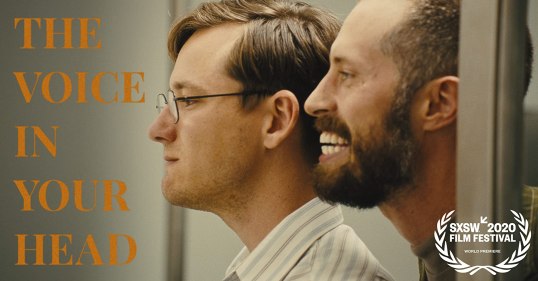
SXSW 2020: The Voice In Your Head (dir by Graham Parkes)


Poor Dan!

As played by Lewis Pullman, Dan seems like a decent enough guy.  He’s a little bit on the dorky side and he seems to be kind of shy.  He’s one of those people who you always see kind of shuffling along with head down.  When he speaks, it’s in such a soft voice that it can be a struggle to hear him.  He’s insecure and anxious and really, it’s understandable once you see what he has to live with.

The thing you have to understand about Dan is that he wakes up every morning and has to deal with the voice of his anxiety (played by Mat Wright), a loud and obnoxious bully who follows him everywhere that he goes and who constantly tells him that everything he’s doing is wrong.  Dan can’t even have a friendly conversation with his co-worker, Julia (Trian Long Smith), without the voice taunting him and telling him that he’s useless.  The voice is everything that Dan is not.  The voice is loud and flashy and obnoxious and totally unconcerned with any feelings that he may hurt.  The voice is every moment of anxiety that anyone in the world has ever felt.  He’s every insecure thought and lingering regret.  He’s ….

Well, there’s actually a bit more to the voice but I’m not going to spoil this short film but revealing all of its secrets.  About halfway through this film’s 13-minute running time, there’s a huge twist and I can’t reveal the details.  I will say that it’s a very clever little twist and it’s one that will take you by surprise.

The Voice In Your Head is a well-directed comedy about anxiety.  Lewis Pullman is sympathetic as Dan while Mat Wright is brilliantly obnoxious in the role of the Voice.  I don’t personally know the director, Graham Parkes, so I won’t speculate on what may or may not have inspired this film but, just from watching, he seems to be someone who not only understands anxiety but who also understands a good deal about human nature.  The things that cause us the greatest anxiety often appear totally different once we actually confront them and that’s something that this film certainly understands.

It’s on Prime, at least through May 6th.  So, be sure to check it out.

Trailer – Top Gun: Maverick


Maverick is back in the skies in Top Gun: Maverick. In the newly released trailer, it looks like Pete Mitchell (Tom Cruise) is still flying after all these years, which explains why he isn’t an Admiral by now. He still has that old motorcycle, though it looks like he rides a newer one and we’re seeing F-18 Hornets in combat, which should be cool. Tomcats are also still in flight, bless the angels.

Not much is known about Top Gun: Maverick save that Christopher McQuarrie (Mission Impossible: Rogue Nation and Mission Impossible: Fallout) has the writing duties here along with a few others. The directing duties are tied to Joseph Kosinski (Tron: Legacy). Kosinski and Cruise also worked together on Oblivion.

Top Gun: Maverick also stars Academy Award Winner Jennifer Connelly, Jon Hamm, Lewis Pullman, Ed Harris and Val Kilmer.

The movie will be released in theatres next Summer.

Enjoy.