Retro Television Review: Fantasy Island 5.8 “Lillian Russell/The Lagoon”


Welcome to Retro Television Reviews, a feature where we review some of our favorite and least favorite shows of the past!  On Tuesdays, I will be reviewing the original Fantasy Island, which ran on ABC from 1977 to 1984.  Unfortunately, the show has been removed from most streaming sites.  Fortunately, I’ve got nearly every episode on my DVR.
Episode 5.8 “Lillian Russell/The Lagoon”

(Dir by Don Weis, originally aired on November 28th, 1981)

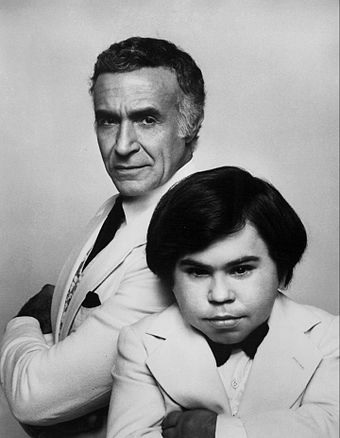
Tattoo is in this episode, which means that Julie only appears long enough to tell Mr. Roarke that she’s going to busy exploring the island with a bunch of hunky professors.  (It says a lot about how poorly the Julie character has been developed that I couldn’t tell if Julie was supposed to be naive or clever when it came to going off with the men.) 

At this point, it’s obvious that Julie was only added to the show to act as insurance in case Herve Villechaize walked off the set.  Early on in the season, when Herve was apparently negotiating for a better contract, Julie had a few episodes where she was Roarke’s main assistant while Tattoo was described as being elsewhere on the island.  But in the episodes where Tattoo is present, Julie always has to go do something else for the weekend.  Ironically, Julie is such a bland and unnecessary character that it actually proves Herve Villechaize’s point about how important Tattoo was to the success of the show.  By having Julie always leave whenever Tattoo is present, the show really only reminds the viewer that Roarke only needs on assistant and it’s Tattoo.

As for this week’s fantasies, they both have to do with the past.

Calvin Pearson (Claude Akin) has just spent years in prison for a crime that he didn’t commit.  He’s finally been released and, understandably, he really doesn’t want to have much to do with the rest of the world.  When he was a child, he spent a summer on a nearby island with his father.  His father was fisherman and Calvin claims that he once caught a fish that could sing.  Calvin wants to spend the weekend on the Island and he wants to catch the same serenading fish.

Sound like a pretty simple fantasy, right?  Well, Calvin is not happy to discover that the he’s not alone on “my island.”  There’s now a trading post, run by Jake Dutton (Broderick Crawford) and his daughter, Mira (Pamela Susan Shoop).  Even worse, there are some recently escaped convicts (led by Glenn Corbett) who want to kidnap Mira!  At first, Calvin refuses to get involved.  He just wants to fish.  But, in the end, he finally does the right thing and saves the Duttons.  

What about the “serenading fish?”  Calvin may not have caught a fish but he did capture the heart of Mira, who hums a tune that she says she once heard out on the lagoon.  Calvin leaves the Island alone but he tells Roarke that he plans to return so that he can work at the trading post with the Duttons.

This fantasy was a bit predictable and you really do have to wonder why Roarke insists on nearly getting his guests killed every week.  It seems like that would lead to a lawsuit.  But the fantasy does feature a good performance from Claude Akin as a man who manages to conquer his own bitterness.

As for the other fantasy, it features Phyllis Davis as a writer named Lilly Martin who wants to write a book about the singer Lillian Russell.  Roarke sends her back to 1890s New York and literally transforms Lilly into Lillian Russell, complete with singing talent and two notorious suitors, “Diamond Jim” Brady (Gene Barry) and Peter Whiting (Craig Stevens).  This fantasy was enjoyable eye candy, with Lilly getting to dress up as Lillian Russell and getting to wear all sorts of jewels.  Unfortunately, it’s also a fantasy that ends with a poker game.  I’ve never been able to follow poker and I always groan a little whenever the plot of a show hinges on the outcome.  Whenever people start talking about “bluffing” and “royal flushes,” and all that, my eyes just glaze over and that was the case here.

That said, at least Mr. Roarke got to take part in Lilly’s fantasy, popping up not once but three times to see how everything was going!  In fact, Mr. Roarke and Tattoo also popped up in Calvin’s fantasy.  It’s always fun when Roarke drops in.

The poker game aside, this was an enjoyable trip to the Island.  Season 5 has been a bit uneven but this was one of the better episodes.
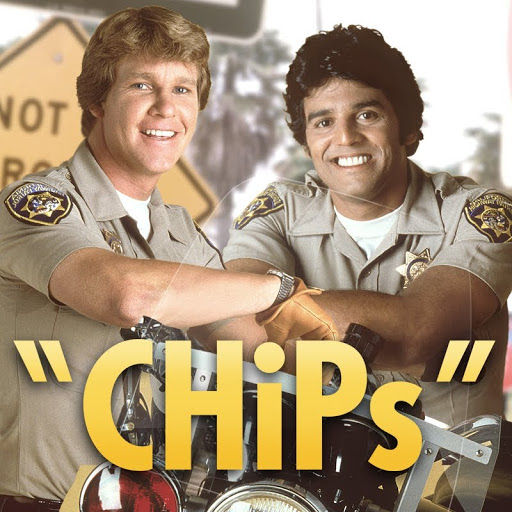
Late Night Retro Television Review: CHiPs 2.2 “The Volunteers”


Welcome to Late Night Retro Television Reviews, a feature where we review some of our favorite and least favorite shows of the past!  On Mondays, I will be reviewing CHiPs, which ran on NBC from 1977 to 1983.  The entire show is currently streaming on Freevee!

This week, we’ve got ourselves a convoy!

Episode 2.2 “The Volunteers”

(Dir by John Florea, originally aired on September 23rd, 1978)

After a high-speed chase causes a robbery suspect to crash his car into a chemical storage facility (which subsequently explodes), three truckers have to get their trucks full of chlorine gas to the next available facility.  Unfortunately, it’s a 170-mile drive over rough terrain and it’s a very hot day.  If the gas gets to hot, it’ll explode.  If It doesn’t get to the storage facility in time, it’ll explode.  In fact, it appears that just about anything can make chlorine gas explode.  Californians might love chlorine for their pool but they don’t want it in the air.

Getraer assigns Ponch, Baker, Baricza, and Jane Turner to escort the trucks to the facility.  Jane Turner (Rana Ford) is a new member of the highway patrol.  She drives a squad car and she’s the first woman and only the second black person who we’ve seen working for the highway patrol on this show.  She doesn’t really do much in this episode and, about halfway through, she breaks off from the main group to help deal with a highway pile-up.  For that matter, Getraer and Baricza end up vanishing as well.  As usual, it’s all on Ponch and Baker.

Despite the danger of a chemical spill killing the population of Los Angeles county, Ponch spends most of this episode trying to get laid.  The episode opens with him leering at a jogging stewardess (Anna Upstrom) and then bragging about how he has a date with her later that night.

“She doesn’t smoke, drink, or dance,” Ponch says.

“What are you two going to do?” Baker earnestly asks.

Ponch arches his eyebrow and grins.

But Ponch is soon distracted by one of the truck drivers, a woman named Robbie Davis (Katherine Cannon), who is quick to yell that not only can she drive a truck but she can vote as well.  Ponch arches his eyebrow and grins.  Baker gets in on the action by saying, “Prettiest little truck driver I’ve ever seen.”

Robbie’s father (Tige Andrews) and the other trucker (Sam Brodie) all totally think Robbie should hook up with Ponch but they’re still amused when, late in the episode, Ponch accepts a ride from a blonde in a convertible.  Ponch arches and eyebrow and grins as he gets in the car.  WE GET IT, PONCH!

It’s not easy transporting chlorine gas.  Along with rough desert terrain, there’s also a group of beer-drinking rednecks who drive by in a pickup truck and threaten to shoot one of the tanks.  All of that drunk driving leads to another multi-car pile-up.  For some reason, one of the vehicles in the pile-up was transporting a tiger, which promptly gets loose and enters a grocery store.  Ponch and Baker grab raw meat from the butcher’s station and use it to trick the tiger into entering an office.  After they shut the door, the owner of the store yells at them for wasting meat.  There’s also a town puts up a roadblock to keep the trucks from coming through because they don’t want chlorine gas getting into the air.  And then there’s an avalanche, which causes chlorine gas to leak out of Robbie’s truck, sending her to the hospital.

Considering everything that happens in this episode, it’s odd that it all feels rather boring.  The best episodes of CHiPs focus on fast motorcycles and beautiful scenery.  This episode featured slow-moving trucks and the desert.  Bleh.  I hate the desert.  This episode also featured a lot of interaction between Robbie, her father, and their friend.  In fact, they were so prominently featured that it wouldn’t surprise me if this episode was meant to be a backdoor pilot for a trucking show.  (This episode aired in 1978, which was a big year for trucker movies.)  But the Davis family just wasn’t that interesting.

This episode didn’t really capture my attention.  Hopefully, next week will see a return of fast bikes and nice scenery.

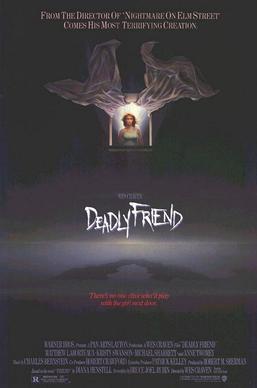
A Movie A Day #277: Deadly Friend (1986, directed by Wes Craven)


Things I learned from watching Deadly Friend:

Girls love nerds who build robots.

In 1986, nerds could build robots that displayed human feelings.

Angry old neighbors hate robots.

If a nerd can build a robot that displays human feelings, then he can also bring his girlfriend back to life by putting a computer chip from the robot in her brain.

Once brought back to life, the girlfriend will start to behave just like the robot.

Basketballs can be used to do anything.

Deadly Friend is best remembered for the scene where the newly revived Samantha (Kristy Swanson) throws a basketball with such force that it causes the head of her neighbor (Anne Ramsey) to explode.  It is also remembered for BB, the big yellow robot that was built by Paul (Matthew Laborteaux).  Deadly Friend starts out as the ultimate nerd fantasy: a beautiful girlfriend. a big robot, and a killer basketball.  By the end of the movie, the fantasy has turned into a nightmare.

Deadly Friend was Wes Craven’s follow-up to A Nightmare on Elm Street.  Craven intended for the film to be a dark love story between a teenage outcast and his zombie girlfriend, with a strong emphasis on the hypocrisy of the adults around them.  Craven said that, in his version of Deadly Friend, people like Samantha’s abusive father were meant to be scarier than Zombie Samantha With A Microchip In Her Brain.  Warner Bros. wanted a film that would appeal to teenage horror fans and demanded Elm Street-stlye nightmares and buckets of more blood.  As a result, Craven practically disowned the finished movie and Deadly Friend is a tonally inconsistent, with sentimental first love scenes competing for space with heads exploding and necks being snapped.  Despite good performances from Laborteaux and Swanson, the final film is too much of a mess to work.  However, I know that I will never look at a basketball the same way again.

Lisa Reviews an Oscar Winner: The Sting (dir by George Roy Hill)


Earlier tonight, as a part of their 31 Days of Oscar, TCM aired The Sting, the film that the Academy selected as being the best of 1973.  I just finished watching it and what can I say?  Based on what I’ve seen of the competition (and there were a lot of great films released in 1973), I would not necessarily have picked The Sting for best picture.  However, the movie is still fantastic fun.

The Sting reunited the director (George Roy Hill) and the stars (Robert Redford and Paul Newman) of Butch Cassidy and the Sundance Kid and told yet another story of likable criminals living in the past.  However, whereas Butch Cassidy largely satirized the conventions of the traditional Hollywood western, The Sting is feels like a loving homage to the films of 1930s, a combination of a gritty, low-budget gangster film and a big budget musical extravaganza.  The musical comparison may sound strange at first, especially considering that nobody in The Sting randomly breaks out into song.  However, the musical score (which is famously dominated by Scott Joplin’s The Entertainer) is ultimately as much of a character as the roles played by Redford, Newman, and Robert Shaw.  And, for that matter, the film’s “let-pull-off-a-con” plot feels like an illegal version of “let’s-put-on-a-show.”

The film takes place in the 1936 of the cultural imagination, a world dominated by flashy criminals and snappy dialogue.  When con artists Johnny Hooker (Robert Redford) and Luther Coleman (Robert Earl Jones) inadvertently steal money from a gangster named Lonnegan (Robert Shaw), Lonnegan has Luther murdered.  Fleeing for his life, Hooker goes to Chicago where he teams up with Luther’s former partner, veteran con man Henry Gondorff (Paul Newman).  Gondorff used to be one of the great con artists but he is now living in self-imposed obscurity, spending most of his time drinking and trying to avoid the FBI.  Hooker wants to get revenge on Lonnegan by pulling an elaborate con on him.  When Gondorff asks Hooker why, Hooker explains that he can either con Lonnegan or he can kill him and he doesn’t know enough about killing.

The rest of the film deals with Hooker and Gondorff’s plan to con Lonnegan out of a half million dollars.  It’s all very elaborate and complicated and a bit confusing if you don’t pay close enough attention and if you’re ADHD like me.  But it’s also a lot of fun and terrifically entertaining and that’s the important thing.  The Sting is one of those films that shows just how much you can accomplish through the smart use of movie star charisma.  Redford and Newman have such great chemistry and are so much fun to watch that it really doesn’t matter whether or not you always understand what they’re actually doing.

It also helps that, in the great 70s tradition, they’re taking down stuffy establishment types.  Lonnegan may be a gangster but he’s also a highly respected and very wealthy gangster.  When Newman interrupts a poker game, Lonnegan glares at him and tells him that he’ll have to put on a tie before he’s allowed to play.  Lonnegan may operate outside the law but, in many ways, he is the establishment and who doesn’t enjoy seeing the establishment taken down a notch?

As entertaining as The Sting may be and as influential as it undoubtedly is (Steven Soderbergh’s Ocean films may be a lot more pretentious — which makes sense considering that Soderbergh is one of the most pretentious directors in film history — but they all owe a clear debt to The Sting), it still feels like an unlikely best picture winner.  Consider, for instance, that The Sting not only defeated American Graffiti and The Exorcist but Ingmar Bergman’s Cries and Whispers as well.  On top of that, when you consider some of the films that were released in 1973 and not nominated — Mean Streets, Badlands, The Candy Snatchers, Day of the Jackal, Don’t Look Now, Jesus Christ Superstar, and The Long Goodbye — it’s debatable whether The Sting should have been nominated at all.  That’s not a criticism of The Sting as much as it’s an acknowledgement that 1973 was a very good year in film.

So, maybe The Sting didn’t deserve its Oscar.  But it’s still a wonderfully entertaining film.  And just try to get that music out of your head!