Retro Television Review: Fantasy Island 7.5 “Roarke’s Sacrifice/The Butler’s Affair”


Welcome to Retro Television Reviews, a feature where we review some of our favorite and least favorite shows of the past!  On Tuesdays, I will be reviewing the original Fantasy Island, which ran on ABC from 1977 to 1984.  Unfortunately, the show has been removed from most streaming sites.  Fortunately, I’ve got nearly every episode on my DVR.
This week, Roarke is haunted by a past love.

Episode 7.5 “Roarke’s Sacrifice/The Butler’s Affair”

(Dir by Cliff Bole, originally aired on November 12th, 1983)

This is an odd episode.  Both of the stories deal with love.  In one of them, Lee Meriwether plays a woman who is in love with her butler, Efrem Zimbalist, Jr.  She comes to Fantasy Island with a group of friends, all of whom are very judgmental about the idea of Meriwether dating a member of the help.  Mr. Roarke deals with the situation by threatening to reveal all of their secrets.  He explains that he does a thorough background check on everyone who comes to Fantasy Island.  I’m not sure if I buy that because some really bad folks have come to the Island.  Anyway, this story ends with Zimbalist starting to loosen up and Meriwether saying that she was going to continue to train him to be her boyfriend once they returned to the mainland.  I’m not sure if this is so much a love story as much as it’s a “I want to have sex with someone who I pay so they can’t ever say no” story.

The other story is a bit more interesting.  Julie Mars (Cyd Charisse, who I adore) is a dancer who walks with a cane.  It turns out that she and Roarke have been in love for years and the implication is that Roarke spent time with her off of the Island.  This is really a big deal.  It goes against everything that has always been implied about Roarke in the past.  Roarke never leaves the Island, that’s what we believed.  It turns out we were wrong.  He’s not only left the Island before but he’s fallen in love.  Julie’s fantasy is to be able to dance again.  Roarke grants her fantasy and Edmond Rome (Cesar Romero) wants to puts her in a show.  Roarke knows that the only way Julie can continue to dance is if she forgets the love that she has for Roarke.  That doesn’t quite make sense but Roarke just goes with it.  She leaves the Island, acting as if Roarke is just a friendly acquaintance as opposed to being the love of her life.

That was sad!  What made it especially sad is that Roarke doesn’t really have anyone to talk about all of this.  Tattoo was close enough to being an equal that Roarke could open up to him.  Lawrence is just a butler.  Some people confide in their butler.  Some people — as seen in this very episode — fall in love with their butler.  Roarke, however, is lost without Tattoo.

Poor Roarke!
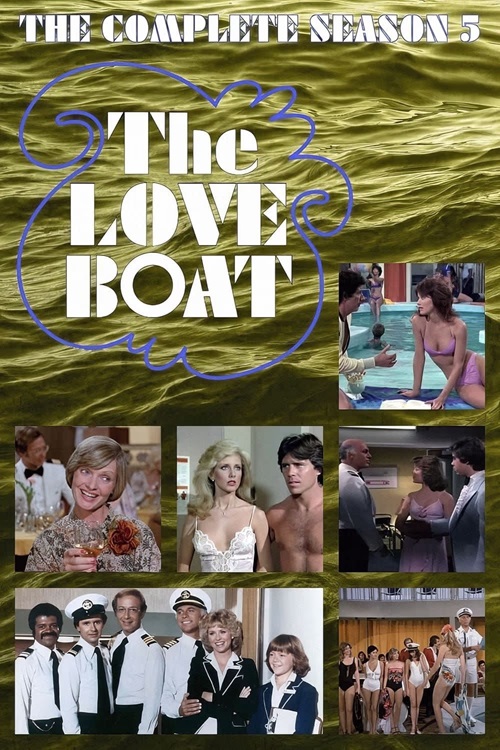
Retro Television Review: The Love Boat 5.14 “Good Neighbors/Captain’s Portrait/Familiar Faces”


Welcome to Retro Television Reviews, a feature where we review some of our favorite and least favorite shows of the past!  On Wednesdays, I will be reviewing the original Love Boat, which aired on ABC from 1977 to 1986!  The series can be streamed on Paramount Plus!

This week, Captain Stubing poses for a portrait.

Episode 5.14 “Good Neighbors/Captain’s Portrait/Familiar Faces”

(Dir by Jerome Courtland, originally aired on January 9th, 1982)

Don York (Sonny Shroyer) is an ad man who is so famous that even Gopher knows who he is.  Don gets really excited when he sees Doris Weldon (Arlene Golonka) boarding the boat.  Don rushes over and starts to hit on her.  He even notices that, according to the tag on her luggage, they live in the same building in Los Angeles!  They’re neighbors!  Too bad Doris refuses to date anyone who lives in the same building as her.  Don spends the entire cruise trying to get Doris to reconsider.  Personally, I suspected that Doris was just using the “neighbor” thing as an excuse to avoid telling Don that he’s very annoying and kind of pushy.  Stuff like that never happens on The Love Boat, though.  Instead, Doris is definitely attracted to Don but she doesn’t want him living next door.   Will things work out for Don and Doris?

Stan (Dean Butler) and Laura Barber (Mary Beth McDonough) are newlyweds.  Stan has the bar exam coming up so he’s brought his law books with him on his honeymoon.  (Boo!  Nerd!)  Stan’s future seems bright until he sees that Frank Jenson (Henry Jones) is also on the cruise.  Frank once owned the liquor store where Stan used to hang out when he was an alcoholic.  Stan apologizes for stealing from the store.  Frank accuses Stan of beating him up, something that Stan says didn’t happen.  Will things work for Stan, Laura, and Frank?

Of course, things will work out for them.  The is The Love Boat and things always work out on The Love Boat!  Both of the stories were okay but they were also kind of boring and predictable.  The more interesting story for this cruise featured Lee Meriwether as Barbara Baden, an artist who has been hired by the cruise line to paint a picture of Captain Stubing.  Apparently, any captain who sticks with the line for ten years gets their picture painted and hung in the corporate offices.

As you can probably already guess, the Captain and the artist end up falling for each other.  And if you didn’t already guess that Barbara’s portrait of the Captain would be a nude portrait that she ends up doing from memory after they become lovers, you’ve really never watched an episode of The Love Boat before.  Fortunately, it’s also an abstract painting and no one knows that they’re looking at a nude painting of the Captain.  In fact, the painting is so abstract that I get the feeling that the cruise line isn’t going to demand its money back.  This story was entertaining due to how uncomfortable Stubing was with being painted.  Gavin MacLeod did a good job portraying his nervousness and his panic when he discovered the painting was about to be unveiled made me chuckle a little.

Overall, this was kind of a bland episode.  But at least the scenery was pleasant.  It still provided a nice hour away from reality.

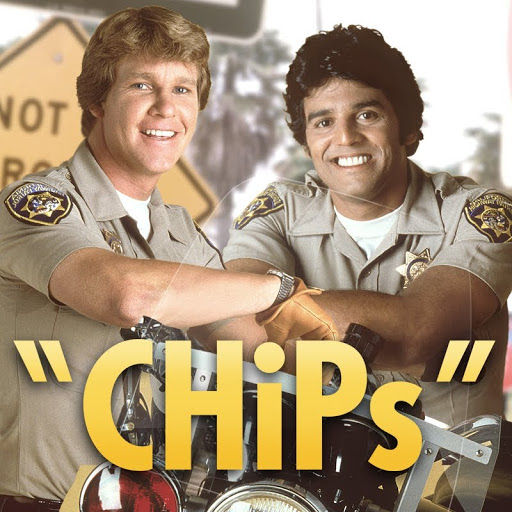
Late Night Retro Television Review: CHiPs 3.1 and 3.2 “Roller Disco”


Welcome to Late Night Retro Television Reviews, a feature where we review some of our favorite and least favorite shows of the past!  On Mondays, I will be reviewing CHiPs, which ran on NBC from 1977 to 1983.  The entire show is currently streaming on Prime!

This week, season three begins with a classic episode!

Episode 3.1 and 3.2 “Roller Disco”

(Dir by Don Weis, originally aired on September 22nd, 1979)

It’s the roller disco episode!

From the moment that I first announced that I would be watching and reviewing CHiPs for this feature, people have been telling me about the legendary roller disco episode.  Having finally reached it, I can say that it lived up to the hype.  You’re not likely to see anything more 70s than the third season premiere of CHiPs.

Now, this was a two-hour episode so there were actually quite a few subplot going on, all of which were typical CHiPs storylines.  In no particular order:

  1. A kid named Mark (Bobby Rolofson) is roller skating around the beach and idolizing three criminals.  Can Baker show him that the good guys always win?
  2. The three criminals are Lita (Helena Kallianiotes), Ty (Fred Williamson), and Romo (Jim Brown).  Lita sets up the targets.  Ty and Romo steal their purses and their wallets and then escape on roller skates.  Ty and Romo are tired of breaking the law.  Lita demands that they continue to steal.  Eventually, it falls to Baker and Ponch to arrest them.
  3. Carlin (Larry Linville) and Franco (Larry Storch) continually cause accidents on the highway.
  4. Rock star Jimmy Tyler (Leif Garrett) is so tired that he sleeps through one of those accidents.  Looking to break free from his well-meaning but overbearing manager (Bill Daily), Jimmy decides to manage his own affairs while staying at Jon Baker’s apartment.

There’s a lot going on but the main plotline is Ponch trying to find celebrities to take part in the annual highway patrol fund raiser.  Even with his big smile, Ponch struggles to charm the celebs.  He pulls over Ed McMahon at one point but fails to recognize him until McMahon drives off.  Gatraer tells Ponch that police work comes first but also tells him that he has to find celebrities.  Gatraer’s been giving Ponch a hard time ever since the first season.  Some things never change.

Fortunately, Jimmy feels guilty for overstaying his welcome at Baker’s apartment and he makes it up to Baker and Ponch by asking his celebrity friends to take part in the fund raiser.  It’s time for a roller disco with the stars!

It all leads to this classic scene:

I recognized a few of the stars, though certainly not all of them.  I recognized Victor French because I’ve been reviewing Highway to Heaven.  I’ve also seen enough old sitcoms that I immediately recognized Robert Mandan, who was apparently the best roller skater in Hollywood.  Melissa Sue Anderson, I knew from Happy Birthday To Me.  Cindy Williams, who got two shout-outs, I knew from American Graffiti.  Is it just me or did Nancy Kulp look kind of lost?  Neither Melissa Sue Anderson nor Cindy Williams seemed to want to talk to her.

The roller disco actually goes on for fifteen minutes, which I appreciated.  The show promised a roller disco and it delivered.  It was like stepping into a time machine and traveling to the 70s.  It was a great way to start season three!

Because of the holidays, this is going to be my final CHiPs review of 2024.  My reviews of this show will return on January 6th!

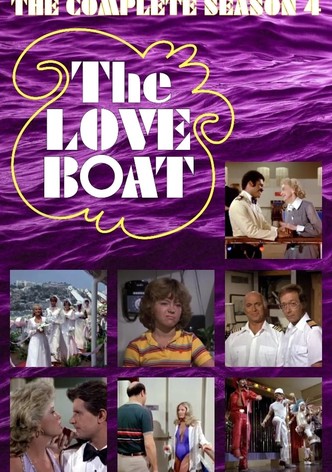
Retro Television Review: The Love Boat 4.21 “Clothes Make The Girl/Black Sheep/Hometown Girl”


Welcome to Retro Television Reviews, a feature where we review some of our favorite and least favorite shows of the past!  On Wednesdays, I will be reviewing the original Love Boat, which aired on ABC from 1977 to 1986!  The series can be streamed on Paramount Plus!

It’s time for another cruise on …. THE LOVE BOAT!

Episode 4.21 “Clothes Make The Girl/Black Sheep/Hometown Girl”

(Dir by Earl Bellamy, originally aired on February 28th, 1981)

This week’s cruise is all about money!

For instance, in this episode, we learn that Doc Bricker is from a small town called Cedar Flats.  Doc was the head of a committee that raised the money necessary to send Mike Lucas (Randy Powell) to medical school so that Mike could return home and serve as the town doctor.  However, when Mike boards the cruise with his fiancée, Tracy (Cindy Morgan), it turns out that he has some bad news.  Tracy’s wealthy father has offered Mike a job working at a Park Avenue clinic in Manhattan.  Mike is planning on taking the job because of the money and the fact that Tracy doesn’t want to live in a small town.  Unfortunately, that will leave Cedar Flats without a doctor.

Doc Bricker, showing that he actually is a man of integrity despite also being a walking HR nightmare, decides that he has no choice but to return to Cedar Flats and serve as their doctor until someone can be found to replace him.  He asks Captain Stubing for a six-month leave of absence.  Stubing agrees but warns that the cruise line might hire someone to take Doc’s place.

Meanwhile, Suzy Marshall (Kyle Aletter) is excited because it appears that her daughter, Anne (Lee Meriwether), has attracted the attention of a wealthy man named Jonathan (Larry Breeding).  Little do they know that Jonathan is actually just Johnny, the ship’s valet.  Johnny is wearing another passenger’s clothes and pretending to be rich.

At one point, Johnny takes Anne back to his cabin, making this the first episode to show us what a low-level employee’s cabin looks like.  It’s small and cramped and located at the bottom the boat, which means it’ll be the first to flood if The Love Boat ever hits an iceberg.  It’s also mentioned that Johnny is not allowed to eat in the main dining room with the passengers.  I have to admit that it’s all a bit disillusioning.  Apparently, the Love Boat is a terrible place to work!

Finally, a passenger named Donald Gray (Robert Ginty) tells the Captain that he works for the Secret Service.  He is on the Love Boat because he hopes to capture a notorious counterfeiter.  But what will happen when that counterfeiter turns out to be Jesse (Demond Wilson), Issac’s ne’er-do-well uncle who claims to have turned a new leaf?  Poor Isaac!

Well, don’t worry.  Everything works out:

1) Mike realizes that he has to honor his commitment to Cedar Flats and, after talking to her father, Cindy realizes that she loves Mike enough that she can be happy in a small town.  (Cindy’s father says some very dismissive things about Cedar Flats but it turns out that he was only doing that to get Mike so outraged that he would have no choice but to return home.  He was doing it as a favor to Doc Bricker.  Can you imagine if that plan didn’t work?  What if Mike just said, “You’re right!  New York, here we come!”)

2) Anne learns the truth when she sees Johnny in his valet uniform.  Luckily, she doesn’t care.

3) It turns out that Donald is actually a criminal who is masquerading as a treasury agent and Uncle Jesse is an undercover government agent!  Isaac is happy to learn this but also agrees to keep Jesse’s secret.  “You’re my favorite nephew,” Uncle Jesse replies.  Awwwww!

This was an okay cruise.  The guest stars weren’t particularly interesting but Bernie Kopell and Ted Lange both got an opportunity to show what they could do when given a real storyline to deal with.  Kopell especially deserves a lot of credit for showing that humanity that lurked underneath Doc’s carefree surface.  This episode kept me entertained and I enjoyed the scenery.  Really, what else can you ask for from The Love Boat?

True Grit: A Further Adventure (1978, directed by Richard T. Heffron)


Warren Oates as the legendary, one-eyed old west lawman Rooster Cogburn?

That was the idea behind True Grit: A Further Adventure, a made-for-TV movie that was meant to serve as a pilot for a potential television series.  The film is a direct sequel to 1969’s True Grit and it features Warren Oates stepping into the role of Rooster Cogburn, the character that John Wayne famously played in the original film and who Jeff Bridges later played in the 2010 remake.  In A Further Adventure, Cogburn is once again hired to escort teenager Mattie Ross (Lisa Pelikan) across the country.  Along the way, Rooster gambles away all their money, meets an attractive widow (Lee Meriwether), and gets a job in a mining town.  With the help of Mattie, he also gets a job as a bounty hunter and the two of them go after a group of wanted outlaws.  Mattie tries to reform Rooster and make him act like more of a traditional western hero while Rooster drinks and gambles and complains.

I am a huge Warren Oates fan but even I have to admit that he’s miscast of Rooster Cogburn.  In both Charles Portis’s original novel and the two films that were adapted from it, Rooster was overweight and physically imposing,  He wasn’t book-smart but he was wise in the ways of the frontier.  Physically, Warren Oates is too slightly built and his trademark nervous energy feels out of place in the role of Rooster.  Wayne and Bridges were both believable as men who would draw first and ask questions later but Oates was a natural-born talker.  That’s one of the things that made him one of the best actors of the 70s but it doesn’t serve him well in the role of Rooster Cogburn.

On the plus side, Lisa Pelikan is a considerable improvement on Kim Darby in the role of Mattie, though she’s nowhere near as good as Hailee Steinfeld would later be in the 2010 film.  Lee Meriwether and Warren Oates shares some good scenes together but the film’s made-for-TV origins makes Meriwether’s overall performance feel like a special guest star diversion.  True Grit: A Further Adventure is a throw-back to the type of formulaic western television programs that were popular in the late 60s.  It’s easy to see why the pilot didn’t get picked up.  It was miscast and it was too late.  If it had aired a few years earlier, it’s possible to imagine Oates and Pelikan traveling to a different town and getting involved in a different story on a weekly basis and perhaps the role would have been changed to better suit Oates’s style of acting.  But, by 1978, television was heading in the direction of Hill Street Blues and the days of the western were over.

Unfortunately. Warren Oates would die just four years after this film aired, a tragically early passing that robbed the world of a unique actor who was in his prime.  Though Oates may not have been right for Rooster Cogburn, he will always be remembered for films like Badlands, Bring Me The Head of Alfredo Garcia, Stripes, Dillinger, and Two-Lane Blacktop.  He was truly a one of a kind talent.

Batman: The Movie (1966, directed by Leslie H. Martinson)


One day, while defending Gotham City, Batman (Adam West) and Robin (Burt Ward) learn that there is a plot to abduct Commodore Schmidlap from his yacht. Quick! To the batcopter! Flying over the ocean, they locate the yacht but it turns out that the whole kidnapping plot was a ruse for a shark to attack Batman!

“Holy sardine!” Robin exclaims!

With the help of porpoise who bravely sacrifices its life to protect the Caped Crusader, Batman manages to escape. Back at police headquarters, Batman, Robin, Commissioner Gordon (Neil Hamilton), and Chief O’Hara (Stafford Repp) wonder which member of Batman’s rogue’s gallery of villainy could have been responsible for the ruse.

Batman says that it was pretty “fishy” what happened and that could possibly mean The Penguin (Burgess Meredith) was involved!

Robin points out that it happened “at sea” and C stands for Catwoman (Lee Meriweather)!

Batman then says that the shark was “pulling my leg” and that might mean it was working for The Joker (Cesar Romero)!

Chief O’Hara says that it all adds up to “a sinister riddle,” which can only mean one thing: The Riddler (Frank Gorshin)!

“The four of them,” Batman says, “working together…”

“Holy nightmare!” Robin exclaims!

As you can probably guess, the tone of 1966’s Batman: The Movie is far different from the tone of more recent Batman films. That’s because Batman: The Movie was based on the light-hearted 60s TV show that made Batman a household name even while transforming the character from being a shadowy vigilante to being a comedic straight arrow, a proud square who regularly lectured the citizens of Gotham about respecting the forces of law and order.

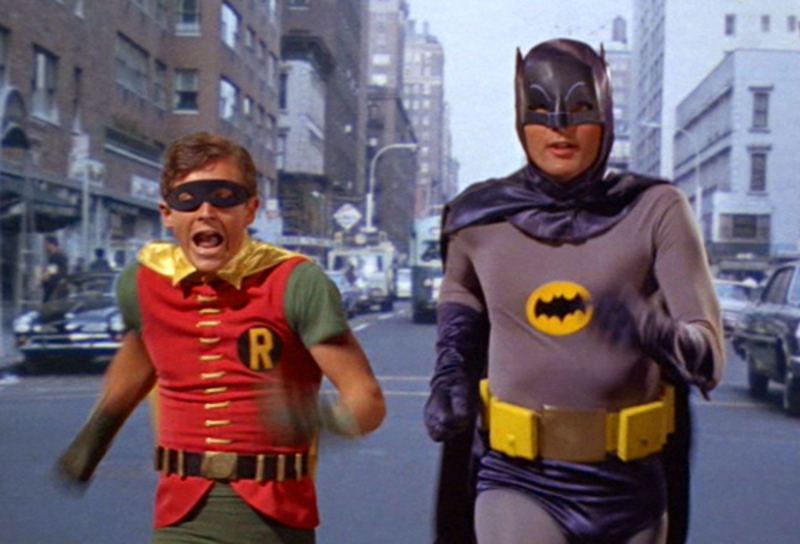
Batman: The Movie was released after the conclusion of the first season of the Batman televisions series and it featured nearly the entire cast of the show. (Lee Meriweather replaced Julie Newman in the role of the purring Catwoman.) The movie feels like an extended episode of the show, still using the same famous music and featuring scenes of Batman and Robin running in place with a street scene projected behind them. The attitude is one of affectionate parody, as opposed to the more cynical campiness of Joel Schumacher’s infamous films from the 90s. Adam West expertly deadpans his way through the main role while the underrated Burt Ward energetically plays the naïve and easily amazed Robin. Of the villains, Lee Meriweather is a sexier Catwoman than Anne Hathaway and there’s never been a better Riddler than Frank Gorshin. (Of the many actors who played Batman’s villains on the TV series, Gorshin was always the only one who seemed to understand that he was supposed to be playing someone dangerous.) At 104 minutes, Batman: The Movie runs out of steam before it ends but there’s still much here to entertain fans of the television show.

Of course, when I was growing up in the 90s, there was no easier way to lose credibility with most diehard Batman films than to admit to liking anything about the television series. The Batman TV series was widely blamed for people thinking that comic books were only meant for kids. Tim Burton was a hero for treating Batman seriously. Joel Schumacher was hated for taking the opposite approach. Batman and Robin was criticized for being too much like the TV show, right down to George Clooney doing a poor man’s Adam West impersonation in the main role. Despite the acclaim that greeted Batman: The Animated Series, It wasn’t until Christopher Nolan took control of the character that the cinematic Batman truly returned to his grim roots.

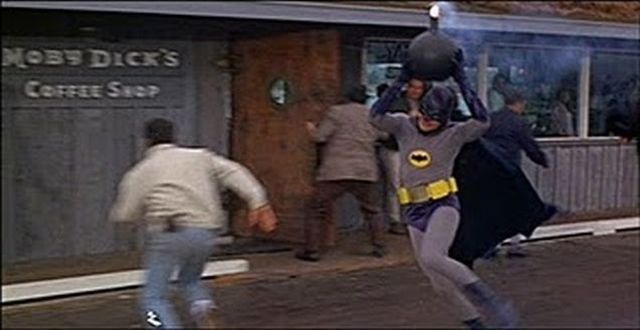
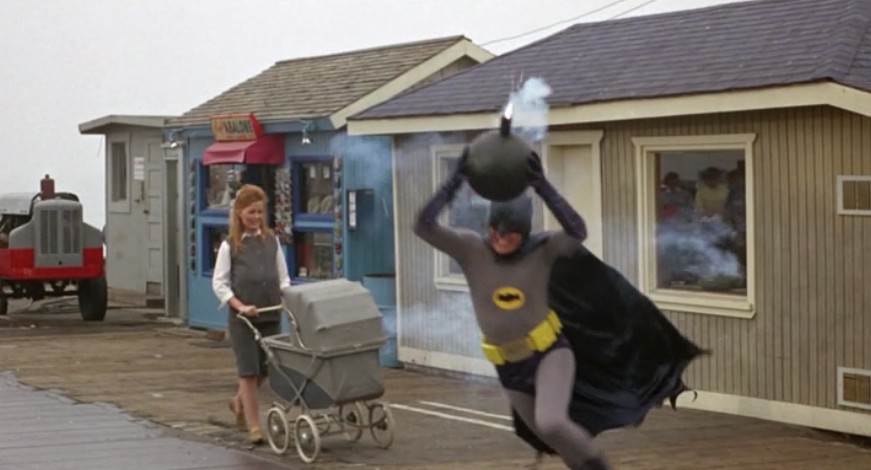
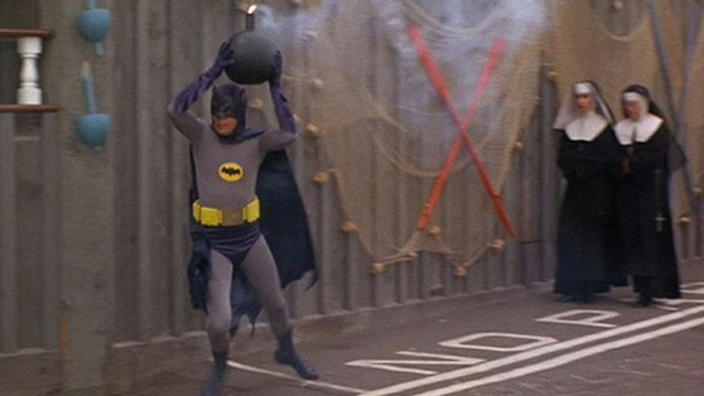
Since the conclusion of Nolan’s Dark Knight trilogy, there have been several versions of Batman. Ben Affleck took over the role for two films. Young Bruce Wayne and his doomed parents briefly appeared in Joker. Robert Pattinson is set to take over the role in The Batman. Now that everyone knows Batman as a grim avenger and countless actors have bragged about how they prepared for their roles in the Batverse by reading either The Killing Joke or The Dark Knight Returns, it’s easier to appreciate the more light-hearted approach of something like Batman: The Movie. After two decades of grim and serious Batmans being used as a metaphor for everything from PTSD to the surveillance state, the sight of a paunchy Adam West trying to find a place to safely dispose of a ridiculously oversized bomb can be a relief.

“Sometimes,” Batman says, “you just can’t get rid of a bomb!”

Tell me about it, Batman.