Retro Television Review: Homicide: Life on The Street 1.7 “A Dog and Pony Show”


Welcome to Retro Television Reviews, a feature where we review some of our favorite and least favorite shows of the past!  On Sundays, I will be reviewing Homicide: Life On The Street, which aired from 1993 to 1999, on NBC!  It  can be viewed on Peacock.
This week, everyone gets something to do!

Episode 1.7 “A Dog and Pony Show”

(Dir by Alan Taylor, originally aired on March 10th, 1993)

Still struggling to accept their failure to get the arraber to confess to the murder of Adena Watson, Bayliss and Pembleton find themselves investigating another mysterious death.  Jake, a healthy and apparently beloved member of the Baltimore police, has been found dead in a park.  No one is sure about the cause of death but Pembleton suspects that Jake may have been poisoned.  When Pembleton asks Jake’s partner (played by Nick Olcott) if Jake had any enemies, he replies, “Maybe just the Pekingese next door.”

Pembleton is determined to solve the mystery of Jake’s death.  Bayliss is less concerned with the case, largely because Jake was a dog.  Of course, as a member of a K-9 unit, Jake was also a member of the force.  Because Jake was a member of law enforcement, the Homicide unit is required to investigate his death.  Bayliss thinks that Pembleton’s interest in the case is just trying to show Bayliss up in front of Giardello but Pembleton claims that his only concer is seeing that justice is done.  Add to that, Pembleton just happens to like dogs.

And Pembleton does solve the case.  It turns out that Jake got loose and was picked up by an overworked animal control officer (Joy Ehrlich) who, back at the pound, mixed Jake up with another dog who was scheduled to be put down.  She only realized her mistake after Jake died.  In a panic, she dumped Jake’s body in the park.  Having solved Jake’s death, Pembleton and Bayliss attend his funeral.  As Jake’s partner dumps Jake’s ashes into a lake, Bayliss suddenly gets emotional.  He explains that he’s thinking about Adena.  Pembleton, for once, shows some sympathy for Bayliss.  It looks like the two are finally starting to bond and become true partners.  All it took was the death of one dog.  (I’m getting teary-eyed just writing that sentence.)

Meanwhile, Bolander continues to stress out about his relationship with Carol, which is a subplot that I find less and less interesting with each episode in which it is featured.  This time, Bolander and Munch take Carol’s teenage son, Danny (Stivi Paskoski), on a ride-along.  Bolander is disturbed at just how excited Danny gets about seeing a dead body.  When Danny says that he’d love to commit a murder and get away with it, Bolander decides that the kid is mentally disturbed.  He also lets Carol know that he thinks Danny is a bit sick in the head.  I get the feeling this relationship is not going to last much longer and that’s fine with me because Bolander’s love life (or lack thereof) is honestly the least interesting part of this show so far.

While all of that is going on, Crosetti tries to comfort the now blind Chris Thormann, who does not react well to the news that his wife (played by Edie Falco) is pregnant.  I’m not really a huge fan of the Thormann storyline, largely because I find it to be almost unbearably depressing.  But I do have to say that Jon Polito, Lee Tergesen, and Edie Falco all really gave great performance in this episode.

Howard and Felton investigate the murder of a drug dealer’s girlfriend.  This storyline was pretty typical of what you’d expect to see on a cop show.  The most interesting thing about it was the presence of Lawrence Gilliard, Jr. as an associate of the suspect.  Years later, Gilliard would play the tragic D’Angelo Barksdale on the first two seasons of The Wire, a show that feels like a direct descendant of Homicide.  (And, indeed, Richard Belzer did have a cameo as John Munch during The Wire‘s final season so the two shows do take place in the same universe, though it should be made clear that Gilliard is not playing D’Angelo in this episode.)

Finally, a retiring shift commander (played by Michael Constantine) warned Giardello that the bosses want to force out all of the veteran commanders so that they can be replaced by younger men.  As usual, Kotto shined in the role of Giardello, playing him as being the ideal boss.  In a police force where almost everyone else seems to be looking out for themselves, Giardello genuinely cares about the people working under him.

After the emotional intensity of the previous episode, A Dog and Pony Show feels a bit more like a traditional crime show.  It’s definitely an ensemble piece, with everyone getting something to do.  (Even Lewis gets to help out Felton and Howard while his usual partner, Crosetti, tends to Thormann.)  Though this episode doesn’t grab the viewer in the same way as the previous few episodes, it still gives the cast a chance to show off their strengths and it still features enough unexpected moments of mordant wit to keep things from getting too bleak.  (It’s hard not to smile at Bayliss and Pembleton bickering over dogs or at Yaphet Kotto’s delivery of the line, “I’m starting to dislike both of you.”)  This episode shows that, even with a somewhat conventional episode, Homicide could still get the job done without sacrificing its own unique identity.

Film Review: Big George Foreman (dir by George Tillman, Jr.)


Big George Foreman is a biopic about …. well, it’s right there in the title, isn’t it?

The film follows George Foreman (Khris Davis), from his poverty-stricken childhood in Houston’s infamous Fifth Ward to his current life as a beloved member of the American pop cultural pantheon.  The film portrays Foreman as someone who learned how to fight early, punching out the children at his school who taunted him by calling him “George Poorman.”  As a teenager, he drops out of high school and attempts to make a living as a mugger.  Spending the night in a sewer and hiding from the police inspires George to try to change his life by joining the Job Corps.  It’s while in Job Corps that he meets Doc Broadus (Forest Whitaker), a former professional boxer who takes George under his wing and teaches him how to work out his anger in the ring.  Foreman marries, gets rich, cheats on his first wife, becomes the world champion, and is then humiliated when he loses his title to Muhammad Ali (played, in a not particularly convincing performance, by Sullivan Jones).  Mired in depression and self-loathing, Foreman has a combination of a heart attack and a religious experience.  He leaves behind boxing to become a preacher but, years later, an alcoholic accountant loses all of Foreman’s money and Big George is tempted to return to the ring at an age when most boxers have long since retired.

Some people know him as a fearsome boxer while others know him as the friendly face who sells grills but, regardless of what he may represent to the viewer, George Foreman’s real-life story is a compelling one and it’s pretty much impossible not to like him, even when he’s being played by an actor who is clearly not George Forman.  (Personally, I’ll always remember George Foreman for his cameo on King of the Hill.  “Novelty grill!?  The fight’s on!”)  Foreman is credited as being an executive producer on Big George Foreman and the film is evenly divided between the life of the young, decadent George who threw money around and cheated on his wife and the older, religious George who is committed to his family, his church, and his community center.

From a cinematic point of view, Younger, self-centered George is more fun to watch than Older, likable George.  That’s because Younger George throws big parties, lives in a big mansion, and owns a fleet of luxury cars.  Everyone around Younger George wears the height of 70s fashion and the soundtrack is full of 70s music.  Younger George does stuff like put an exhibition match where he tries to knock out five fighters in one night night.  Older George may be the better person and it’s good to see that he got his life together but it’s hard not to miss the decadence of the film’s first half once it skips forward in time and focuses on George Foreman as a surprisingly conventional suburban Dad.

Again, Foreman’s real-life story is a compelling one and George Foreman is an inspiring human being but the film itself is a rather conventional biopic, one that hits all of the expected moments without digging too much underneath the surface.  Watching the film, one can respect the biopic’s obvious love for its subject and appreciate Khris Davis’s lead performance while also feeling that an interview with the real George Foreman would have been more compelling.

Shattered Politics #71: Gangs of New York (dir by Martin Scorsese)


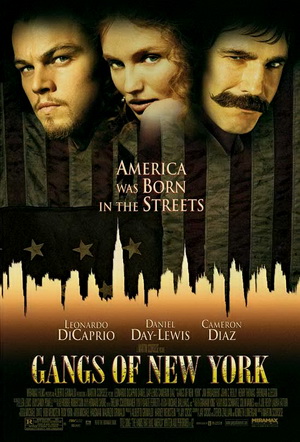
Gangs_of_New_York_Poster

Despite the fact that it was nominated for best picture and marked the start of his fantastically successful collaboration with actor Leonardo DiCaprio, Martin Scorsese’s 2002 film Gangs of New York does not have the best reputation.  It always seems to be regarded as one of Scorsese’s lesser films and, often times, both The Aviator and The Departed are described as representing a comeback of sorts from Gangs.

To a certain extent, I have to agree.  Gangs of New York is a lesser Scorsese movie but then again, a lesser Scorsese film is still a hundred times better than the greatest films from Brett Ratner or Michael Bay.

The flaws of Gangs of New York are many.  The film, which tells the epic story of how an Irish gang led by Leonard DiCaprio battled a nativist gang led by Daniel Day-Lewis in Civil War-era New York City, runs for nearly 3 hours and yet it somehow still feels rushed and incomplete.  Cameron Diaz is far too contemporary of an actress to be truly believable as a 19th century pickpocket.  For that matter, Leonardo DiCaprio gives one of the worst performances of his career, coming across as being one-note and shrill.  If you only knew DiCaprio from his work in Gangs of New York, you would have a hard time believing that he was capable of doing the type of work that he did in Inception or The Wolf of Wall Street.

And yet, Gangs of New York is one of those flawed films that I can’t help but enjoy.

First off, on a purely personal level, how can I not love a film about how terribly the Irish were treated in the 19th Century?  Seriously, the Irish were regarded as if they were somehow subhuman.  They were attacked for being Catholic.  They were viewed as being criminals.  An entire freaking political party — the American party — was formed specifically to keep the Irish out.  But you know what?  We Irish kept coming, we kept fighting for our rights, and now everyone wishes they could be one of us!

Secondly, and this should not a shock when you consider that the film was directed by Martin Scorsese, the film looks absolutely gorgeous!  Despite the fact that it’s takes place in a 19th century slum and most of the characters are poor, Gangs of New York is a visual feast.  I loved the ornate sets and all the colorful clothes.  I loved the attention to detail that was put into everything.

(My favorite visual from the film: Daniel Day-Lewis and his entourage walking down a street while fireworks explode directly over Day-Lewis’s shoulder.)

Third, there’s Daniel Day-Lewis’s performance as Bill “The Butcher” Cutting.  One reason why DiCaprio’s performance is so noticeably bad is because he’s acting opposite Day-Lewis.  Sporting a handle-bar mustache and speaking in an almost satirically exaggerated New York accent, Day-Lewis turns Bill into one cinema’s greatest villains.

Add to that, the great Italian actor Giovanni Lombardo Radice show up for a few minutes, playing Simon Legree in a theatrical production of Uncle Tom’s Cabin!  Scorsese should make more films with Radice.

But, perhaps the main reason why I enjoy Gangs of New York is because, as I’ve mentioned so many times in the past, I really am a big history nerd.  And Gangs of New York deals with a period in American history that really doesn’t get as much attention as it deserves.  While we all know that the Civil War started when the South seceded from the union, what is often forgotten is that the North was not united in their support of Abraham Lincoln and the Union.  In fact, the Mayor of New York, Fernando Wood, was such a strong supporter of the Confederacy that he, at one point, suggested that New York City should secede from the union as well.  And when Lincoln instituted the draft, NYC — and several other cities in the north — exploded into riots.

Of course, Gangs of New York is not a 100% historically accurate.  For one thing, it compresses the time frame of the draft riots and — as films often do — it downplays the culture of Northern racism and instead portrays racists like Bill Cutting as being the exception to the rule.  But, even with that in mind, Gangs of New York still serves as a good starting point for those who want to learn more about American history than what they’ve been told in school.

My favorite parts of Gangs of New York dealt not with how the gangs fought each other but instead how the gangs were used as political foot soldiers.  One of the major supporting characters in Gangs of New York is William “Boss” Tweed (Jim Broadbent), a real-life politician who was at the center of one of America’s first major political scandals.  When we first meet Tweed, he is using Bill Cutting’s gang to fix elections.  However, as the film progresses, Tweed comes to realize that the political future of New York rests with the Irish.  So, Tweed starts using the Irish gang to fix elections.  For those of us who are into political history, the Boss Tweed scenes are a lot of fun.

Gangs of New York has its flaws.  It’s the type of project that, if it were made today, it would probably be a series on HBO and it would win all sorts of awards.  (Actually, it did kinda.  It was called Boardwalk Empire.)  It’s not perfect, but I like it.