October True Crime: Murder So Sweet (dir by Larry Peerce)


1993’s Murder So Sweet, also known a Poisoned By The Love: The Kern County Murders (seriously, try to say that ten times fast), tells the story of Steven David Catlin.

Steven David Catlin lived in Bakersfield, California.  Catlin was a career criminal who was married six times and who found some personal redemption for himself as a member of the pit crew for a professional race car driver in Fresno.  Trust me, I’ve lived in enough small, country towns to know that people will overlook a lot as long as someone knows how to work on a car.

One thing that people noticed about Catlin is that the people around him had a habit of dying of mysterious illnesses.  Multiple wives, his adoptive parents, they all died with fluid in their lungs and they left behind not only a medical mystery but also quite a bit of money for Steven David Catlin.  Catlin would always insist on holding a cremation just days after his loved ones passed away.  Not only did that allow Catlin to move on but also kept anyone from being able to do a thorough autopsy.

Eventually, the police figured out that Catlin was just poisoning anyone who got on his nerves or threatened to divorce him.  He wasn’t even a particularly clever poisoner.  He used paraquet, a highly toxic herbicide and he kept the bottle sitting in plain view in his garage.  He might as well have just labeled it his “Poisoning Thermos.”  Catlin was convicted of multiple murders and he was sentenced to die in 1990.  Of course, this being California, Catlin is sill alive and sitting in San Quentin.  This really is a case of “If you lived in Texas, you’d be dead by now.”

In Murder My Sweet, Catlin is played Harry Hamlin, who steals the film as a dumb but charming redneck who walks with a confident swagger and has no fear of hitting on his ex-wife, even after he realizes that she’s trying to convince the police that he’s a murderer.  Helen Shaver played Edie Bellew, the ex who knows better than to trust Catlin.  Her current husband is played by Terence Knox and there’s plenty of scenes of him telling Edie that she needs to back off and that everyone knows that Steve Catlin isn’t a murderer.  In many ways, this is the ultimate Lifetime film in that Edie Bellew not only gets to put her ex-husband in prison but she also proves that her current husband doesn’t know what he’s talking about.

Murder My Sweet takes place in rural California and, as a result, everyone in the film speaks with a shrill country accent and we spend a lot of time in a really tacky beauty parlor.  Indeed, the film portrayal of country eccentricity is so over-the-top that I was tempted to say that it seemed as if the director was trying to rip-off David Lynch.  However, Lynch may have made films about eccentric characters but he never portrayed them as being caricatures.  Lynch loved his eccentrics while this film takes a bit of a condescending attitude towards them.  Still, it’s worth watching for Harry Hamlin’s sleazy turn as Steve Catlin, a guy who enjoys fast cars and making ice cream.

Just don’t eat that ice cream….

6 Shots From 6 Films: Special Larry Peerce Edition


4 (or more) Shots From 4 (or more) Films is just what it says it is, 4 (or more) shots from 4 (or more) of our favorite films. As opposed to the reviews and recaps that we usually post, 4 (or more) Shots From 4 (or more) Films lets the visuals do the talking.

Today, we wish a happy 91st birthday to Larry Peerce! Now, admittedly Larry Peerce may not be a household name. He got his start in television in the 60s and, after doing a few features and a lot of made-for-TV movies, he pretty much ended his career directing episodes of Touched By An Angel at the turn of the century. Some people might say that’s a comedown from directing movies but there’s a lot of aspiring filmmakers who would love to have an active career spanning three decades. You take your work where you can get it and you do the best that you can with the material that you’ve got available. Nothing will change the fact that, in 1964, Larry Peerce was one of the few directors with the guts to make a film that seriously dealt with racism and interracial marriage. The name of that film was One Potato, Two Potato.

That said, Larry Peerce directed some worthwhile films in his time and, for that reason, it’s time for….

6 Shots From 6 Larry Peerce Films

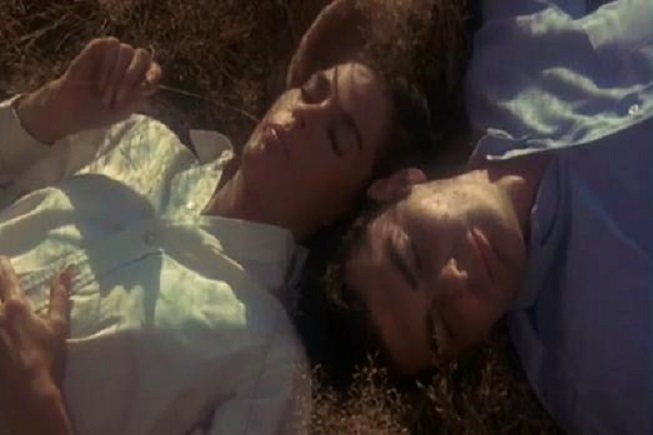
One Potato, Two Potato (1964, dir by Larry Peerce, DP: Andrew Laszlo)
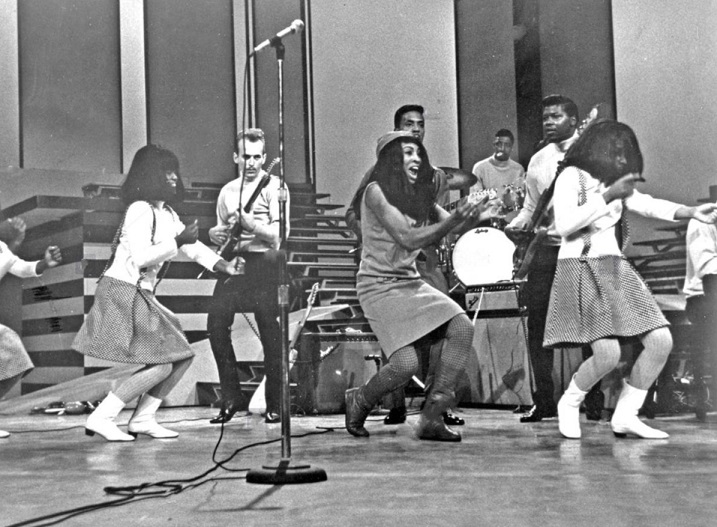
The Big T.N.T. Show (1965, dir by Larry Peerce, DP: Bob Boatman)
The Incident (1967, dir by Larry Peerce, DP: Gerald Hirschfeld)
Goodbye Columbus (1969, dir by Larry Peerce, DP: Enrique Bravo and Gerald Hirschfeld)
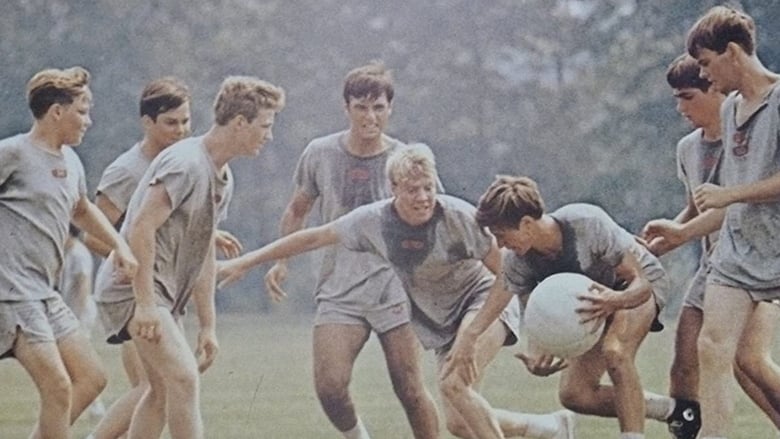
A Separate Peace (1972, dir by Larry Peerce, DP: Frank Stanley)
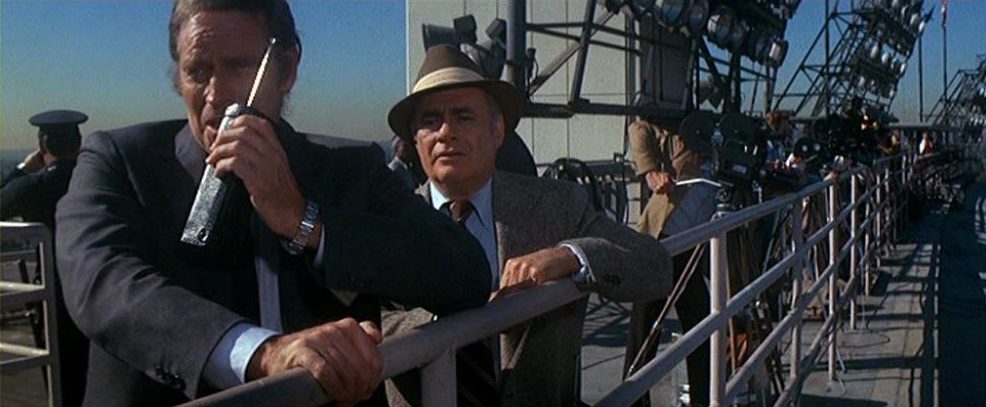
Two-Minute Warning (1976, dir by Larry Peerce, DP: Gerald Hirschfeld)

Film Review: One Potato, Two Potato (dir by Larry Peerce)


The 1964 film, One Potato, Two Potato, is the story of two people who fall in love.

Julie Cullen (Barbara Barrie) was previously married to Joe (Richard Mulligan).  She’s divorced now and raising her daughter, Ellen (Marti Mericka), on her own.  Ellen was barely a year old when Joe abandoned his family and she’s never known her father.  Perhaps that’s for the best because, as we later see firsthand, Joe was an immature and abusive man.

Frank Hamilton (Bernie Hamilton) is quiet, responsible, and mild-mannered.  For the majority of the movie, the only time that we see Frank show any emotion is when he’s playing football with coworkers.  However, he’s obviously a sensitive and intelligent man.  He and Julie begin a relationship, tentatively at first.  But soon, they’re very much in love and planning to get married.

And really, there’s nothing unusual about either one of them.  They’re two genuinely nice people who met and fell in love.  The only thing that sets their romance apart from so many other romances is that Julie’s white and Frank’s black.  For that reason, Frank and Julie get harassed by the police when they try to enjoy a romantic stroll at night.  For that reason, Frank’s parents (played by Robert Earl Jones and Vinette Carroll) object to their relationship, saying that all the love in the world can’t overcome prejudice.  For that reason, when Frank and Julie do get married, hardly anyone comes to the wedding and the one bridesmaid glares at them throughout the ceremony.  Frank and Julie end up living on a farm with Frank’s parents, in love but practically isolated from the world.  (Tellingly, the “friend” who first introduced them doesn’t want to visit them after they marry.)  When Joe suddenly shows up and discovers that Julie has not only remarried but that her new husband is black, he goes to court and demands custody of his daughter.

It’s interesting think that, in 2019, it’s very easy to take interracial relationships (not to mention interracial marriages) for granted.  And yet, it wasn’t until 1967 (three years after the release of One Potato, Two Potato), that the U.S. Supreme Court officially ruled that laws against interracial marriage were unconstitutional.  One Potato, Two Potato was an early independent film, precisely because none of the major studios were willing to deal with an issue as controversial as interracial marriage.  (When the studios finally did deal with it, the end result was Guess Who’s Coming To Dinner, a film that was as safe and mild as One Potato, Two Potato was brave and angry.)  Barbara Barrie did win the best actress award at Cannes and the film itself received an Oscar nomination for Best Original Screenplay but otherwise, it’s a sadly neglected piece of film history.  If I hadn’t recorded it off of TCM, I probably never would have seen or even heard of this film.

And that would have been a shame because, along with being a valuable historical document, One Potato, Two Potato is a compelling and heartbreaking drama.  The film approaches its subject matter with a maturity and an honesty that probably stunned audiences back in 1964.  This film refuses to give into any of the well-intentioned clichés that often dominated films about racism in the 60s and 70s.  There are no sympathetic whites (à la Gregory Peck in To Kill A Mockingbird) willing to argue for Frank and Julie’s right to raise Ellen.  (In fact, the lawyer that they hire gets angry when Frank first approaches him and advises them to leave the state.)  It does Frank no good to be dignified and patient.  The racism in One Potato, Two Potato does not come from a handful of ignorant souls.  Instead, it’s built into the very system to which Frank and Julie are now having to appeal.

One Potato, Two Potato is also a rarity in that it’s a film that allows a black man to get angry about the way he’s being treated, even if it means making whites in the audience uncomfortable.  One need only compare the hopeful ending of Guess Who’s Coming To Dinner with the heart-breaking conclusion of One Potato, Two Potato.  Whereas Guess Who’s Coming To Dinner highlighted Sidney Poitier saying, in his dignified manner, that he has no interest in fighting the battles of the past, One Potato, Two Potato finds a distraught Bernie Hamilton watching a western and finally breaking down as he yells, “Kill that white bastard!”

One Potato, Two Potato ends with a title card that informs us that the story that we’ve seen is fictional but that the laws and the issues discussed in the film are real.  55 years after it was released, One Potato, Two Potato remains a compelling drama and an important historical document.


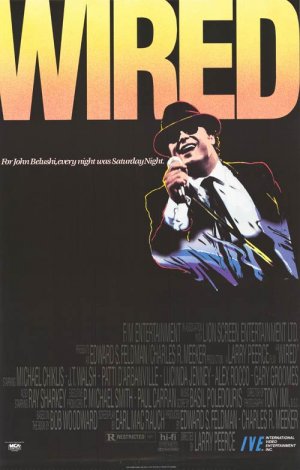
A Movie A Day #70: Wired (1989, directed by Larry Peerce)


Sometimes, you watch a movie and all you cay say, at the end, is “What the Hell were they thinking?”

Wired is one such movie.  Based on a widely discredited biography by Bob Woodward, Wired tells two stories.  In the first story, John Belushi (Michael Chiklis, making an unfortunate film debut) wakes up in a morgue and is told by his guardian angel that he has died of a drug overdose.  Did I mention that his guardian angel is Puerto Rican cabbie named Angel Vasquez (Ray Sharkey) and Angel drives Belushi through a series of flashbacks?  Belushi meets Dan Aykroyd (Gary Groomes, who looks nothing like Dan Aykroyd).  Belushi gets cast on Saturday Night Live.  Belushi marries Judy (Lucinda Jenney).  Belushi uses drugs, costars in The Blues Brothers, dies of a drug overdose in a sleazy motel, and plays a pinball game to determine whether he’ll go to Heaven or Hell.  While this is going on, Bob Woodward (J.T. Walsh) is interviewing everyone who knew Belushi while he was alive.

There are so many things wrong with Wired that it is hard to know where to even begin.  I haven’t even mentioned the scene where Bob Woodward travels back in time and has a conversation with Belushi while he’s dying on the motel room floor.  Wired tries to be a cautionary tale about getting seduced by fame and drugs but how seriously can anyone take the message of any movie that features Ray Sharkey as a guardian angel?  The scenes with Woodward are strange, mostly because the hero of Watergate is being played by an actor best known for playing sinister villains.  (Seven years after playing Bob Woodward, J.T. Walsh was actually cast as Watergate figure John Ehrlichman in Nixon.)  Considering that this was his first movie, Michael Chiklis is not bad when it comes to playing a drug addict named John but he’s never convincing as John Belushi.  He never captures the mix of charisma and danger that made John Belushi a superstar.  Wired wants to tell the story of Belushi’s downfall but never understands what made him special to begin with.

Wired tries to be edgy but it only succeeds for one split second.  During the filming of The Blues Brothers, a director who is clearly meant to be John Landis walks over to Belushi’s trailer.  Listen carefully, and a helicopter can be heard in the background.

As for the rest of Wired, what the Hell were they thinking?

A Movie A Day #33: Two-Minute Warning (1976, directed by Larry Peerce)


mpw-8771

For the longest time, I thought that Two-Minute Warning was a movie about a gang of art thieves who attempt to pull off a heist by hiring a sniper to shoot at empty seats at the Super Bowl.  As planned by a master criminal known as The Professor (Rossano Brazzi), the sniper will cause a riot and the police will be too busy trying to restore order to notice the robbery being committed at an art gallery that happens to be right next to the stadium.

I believed that because that was the version of Two-Minute Warning that would sometimes show up on television.  Whenever I saw the movie, I always through it was a strange plan, one that had too many obvious flaws for any halfway competent criminal mastermind to ignore them.  What if the sniper was captured before he got a chance to start shooting?  What if a riot didn’t break out?  The sniper spent the movie aiming at empty seats but, considering how many people were in the stadium, it was likely that he would accidentally shoot someone.  Were the paintings really worth the risk of a murder charge?

Even stranger was that Two-Minute Warning was not only a heist film but it was also a 1970s disaster film.  Spread out throughout the stadium were familiar character actors like Jack Klugman, John Cassevetes, David Janssen, Martin Balsam, Gena Rowlands, Walter Pidgeon, and Beau Bridges.  It seemed strange that, once the shots were fired and Brazzi’s men broke into the gallery, all of those familiar faces vanished.  When it comes to disaster movies, it is an ironclad rule that at least one B-list celebrity has to die.  It seemed strange that Two-Minute Warning, with all those characters, would feature a sniper shooting at only empty seats.  For that matter, why would there be empty seats at the Super Bowl?

That wasn’t the strangest thing about Two-Minute Warning, though.  The strangest thing was that Charlton Heston was in the film, playing a police captain.  In most of his scenes, he had dark hair.  But, in the scenes in which he talked about the art gallery, Heston’s hair was suddenly light brown.

Recently, I watched Two-Minute Warning on DVD and I was shocked to discover that the movie on the DVD had very little in common with the movie that I had seen on TV.  For instance, the television version started with the crooks discussing their plan to rob the gallery.  The DVD version opened with the sniper shooting at a couple in the park.  In the DVD version, there was no art heist.   The sniper had no motive and no personality.  He was just a random nut who opened fire on the Super Bowl.  And,  in the DVD version, he did not shoot at empty seats.  Several of the characters who survived in the version that I saw on TV did not survive in the version that I saw on DVD.

What happened?

The theatrical version of Two-Minute Warning was exactly what I saw on the DVD.  A nameless sniper opens fire and kills several people at the Super Bowl.  In 1978, when NBC purchased the television broadcast rights for Two-Minute Warning, they worried that it was too violent and too disturbing.  There was concern that, if the film was broadcast as it originally was, people would actually think there was a risk of some nut with a gun opening fire at a crowded event.  (In 1978, that was apparently considered to be implausible.)  So, 40 minutes of new footage was shot.  Charlton Heston even returned to film three new scenes, which explains his changing hair color.  The new version of Two-Minute Warning not only gave the sniper a motive (albeit one that did not make much sense) but it also took out all of the violent death scenes.

Having seen both versions of Two-Minute Warning, neither one is very good, though the theatrical version is at least more suspenseful than the television version.  (It turns out that it was better to give the sniper no motive than to saddle him with a completely implausible one.)  But, even in the theatrical version, the potential victims are too one-dimensional to really care about.  Ultimately, the most interesting thing about Two-Minute Warning is that, at one time, an art heist was considered more plausible than a mass shooting.

tmw

TAMI Part 2: The Big T.N.T. Show (1966, directed by Larry Peerce)


In 1964, American International Pictures released the first concert film, The T.A.M.I. Show.  After the success of T.A.M.I, AIP followed up with a second concert film.  This one would be shot in front of a live audience at Los Angeles’s Moulin Rouge club on the night of November 29th, 1965.  The line-up included Ray Charles, Petula Clark, The Lovin’ Spoonful, Bo Diddley, Joan Baez, The Ronettes, Roger Miller, The Byrds, Donavon, and Ike and Tina Turner.  Phil Spector was recruited to produce the show and he brought with him a live orchestra.  Conducting the orchestra and serving as the night’s emcee was The Man From UNCLE‘s David McCallum.

Originally announced as The T.A.M.I. Show Part II, the title was briefly changed to This Could Be The Night (after a song written by Spector and Harry Nilsson and performed by The Modern Folk Quartet) until AIP finally went with The Big TNT Show, an appropriate title considering the explosive performances that were recorded that night.  The Big TNT Show also recorded the growing division between the rock and roll of the 50s and early 60s and the music of the emerging counter culture, with Ray Charles, Bo Diddley, and Ike Turner sharing the same stage as The Byrds and Donavon.

In one of the show’s best moments, Joan Baez sings You’ve Lost That Loving Feeling while Phil Spector accompanies her on piano.

Other highlights include the Byrds performing Turn, Turn, Turn,

Roger Miller performing his novelty hit King of the Road,

http://www.youtube.com/watch?v=CMrtaMh1soY

Petula Clark singing Downtown,

The Ronettes performing Be My Baby,

Donavon’s Universal Soldier,

and Ike and Tina Turner’s entire set.

At the end of the film, the viewers are told to “be sure to tune in for next year’s show!” but, one year later, both the world and music would be very different.  The Big TNT Show captures that one final moment before things changed forever.

Embracing The Melodrama #22: The Incident (dir by Larry Peerce)


The Incident

The 1967 film The Incident could just as easily have been called Train of Fools.  Much like Ship of Fools, it’s an ensemble piece in which a group of people — all of whom represent different aspect of modern society — find themselves trapped in their chosen mode of transportation and forced to deal with intrusions from the outside world.

That intrusion comes in the form of two sociopaths who have decided to spend the entire ride tormenting their fellow passengers.  The more dominant of the two is Joe (played by Tony Musante, who would later star in Dario Argento’s Bird With The Crystal Plumage), who the film hints might also be a pedophile.  His partner is Artie (Martin Sheen), who is less intelligent than Joe but just as viscous.  (And yes,even though he does a good job in the role,  it is odd to see an intelligent and reportedly very nice actor like Martin Sheen playing a character who is both so evil and so stupid.)

Among the passengers:

Bill (Ed McMahon) and Helen (Diana Van Der Vills) are only on the train because Bill refused to pay the extra money to take a taxi back home. Now, they’re stuck on the train with their young daughter who, in one of the film’s more disturbing scenes, Joe starts to show an interest in.

Teenage Alice (Donna Mills) is on a date with the far more sexually experienced Tony (Victor Arnold).  When Joe and Artie start to harass her, her date proves himself to be pretty much useless.

Douglas McCann (Gary Merrill) is a recovering alcoholic who, before Artie and Joe got on the train, was spending most of his time scornfully watching Kenneth (Robert Otis), a gay man who previously attempted to pick Doug up at the train station and who will eventually fall victim to one of Artie’s crueler jokes.

Muriel Purvis (Jan Sterling) resents her meek husband, Harry (Mike Kellin) and see the entire incident as another excuse to cast doubts upon his manhood.

Sam and Bertha Beckerman (played by Jack Gilford and Thelma Ritter) are an elderly Jewish couple who, over the course of a lifetime, have already had to deal with far too many bullies.  Sam’s attempt to stand up to Joe and Artie results in both he and his wife being trapped on the train.

Arnold (Brock Peters) and Joan (Ruby Dee) are the only black people on the train.  Arnold, at first, enjoys watching the white people fight among each other and even turns down a chance to get off the train because he finds it to be so entertaining.  But finally, Joe turns on him as well.

And then there’s the two soldiers, streetwise Phil (Robert Bannard) and his best friend, Felix (Beau Bridges).  Felix speaks with a soft Southern accent and has a broken arm.

And finally, there’s the bum.  When we first see the bum (Henry Proach) he is asleep.  He doesn’t even wake up when Joe and Artie attempt to set him on fire.

One-by-one, Joe and Artie attack and humiliate every single person on the train.  The other passengers, for the most part, remain passive.  Even when some try to stand up to Joe and Artie, their fellow passengers don’t offer to help.  It’s only when one last passenger finally stands up to the two that the rest of them show any reaction at all and even then, it’s not necessarily the reaction that anyone was hoping for.

The Incident, which shows up on TCM occasionally, is a heavy-handed but effective look at what happens when good people choose to do nothing in the face of evil.  Joe and Artie can be viewed as stand-ins for any number of distasteful groups or ideologies and both Tony Musante and Martin Sheen are believable as dangerous (if occasionally moronic) petty criminals.  For that matter, the entire film is well-acted with the entire cast managing to bring life to characters that, in lesser hands, could have come across as being one-dimensional.  The entire film basically takes place in that one subway car but fortunately, the harsh black-and-white cinematography and the continually roaming camera all come together to keep things visually interesting.

The Incident may not be a great film (it’s occasionally bit too stagey and, after watching the first 30 minutes, you’ll be able to guess how the movie is going to end) but it’s still one to keep an eye out for.

Martin Sheen in The Incident