TV Review: Twin Peaks 1.5 “The One-Armed Man” (directed by Tim Hunter)


It’s all about team work.

Aren’t Lisa and Leonard doing a great job with their Twin Peaks reviews?  Yesterday, I was reading Leonard’s review of Rest In Pain and I immediately thought to myself, “I’m going to have to up my game if I want to keep up.”  That’s what team work does.  It challenges you to work harder and hopefully, it makes you better at whatever it is that you do.

For instance, Twin Peaks is usually thought of as being the “David Lynch show” but actually, there were several different creative voices involved and all of them left their mark on the series.  The show was co-created by veteran TV writer, Mark Frost (whose father, Warren Frost, played Doc Hayward).  Many of the show’s scripts are credited to Harley Peyton, who also wrote the film version of Less Than Zero.  Even Jerry Stahl, of Permanent Midnight fame, is credited with writing an episode.  While Twin Peaks had an easily identifiable style, only six of its 30 episodes were actually directed by David Lynch.  The other episodes were directed by directors like Uli Edel, Todd Holland, and Caleb Deschanel.  Even Diane Keaton directed an episode during season 2.  All of them brought their own talents and perspectives to this show and upped their game.

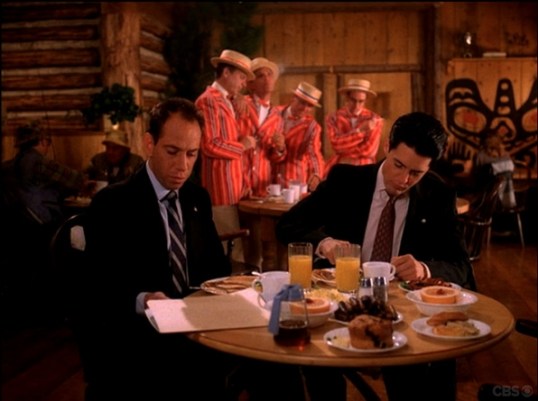
Episode 5, “The One-Armed Man,” was written by Robert Engels and directed by Tim Hunter.  Hunter, who directed two more episodes during the show’s second season, is best known for two sensitive films that he made about teenagers, Tex and River’s Edge.  Of the two, the surreal River’s Edge (which features Dennis Hopper playing a one-legged drug dealer who lives with a sex doll) feels the closest to Twin Peaks.

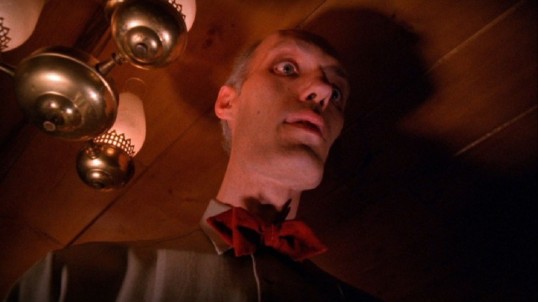
Episode Five opens with Sarah Palmer (Grace Zabriskie) giving a description of Killer BOB (Frank Silva) to Harry (Michael Ontkean) and Andy (Harry Goaz) while Doc Hayward and Donna (Lara Flynn Boyle) listen.  When Leland (Ray Wise) wanders into the room and taunts Sarah about having had two visions, Sarah talks about seeing someone digging up Laura’s necklace, making Donna uncomfortable since she’s the one who buried it in the first place.

(Whenever I see Grace Zabriskie and Warren Frost play a scene together, I am reminded of their later work on Seinfeld, where they played the bitter parents of Susan Ross and Mr. Ross was revealed to have been a former lover of John Cheever.)

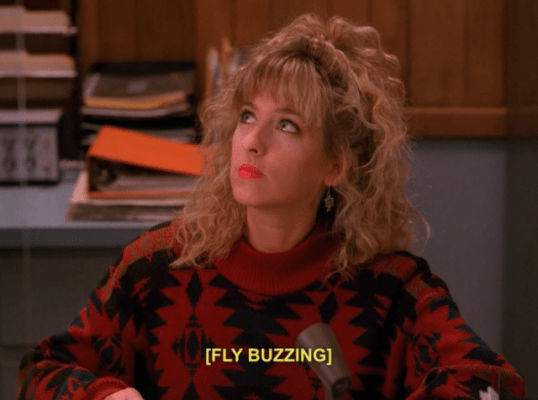
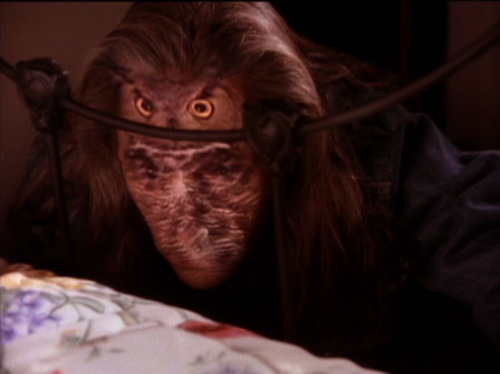
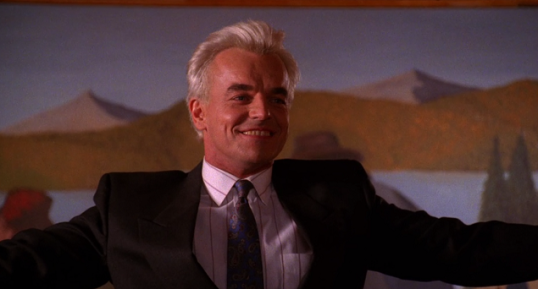
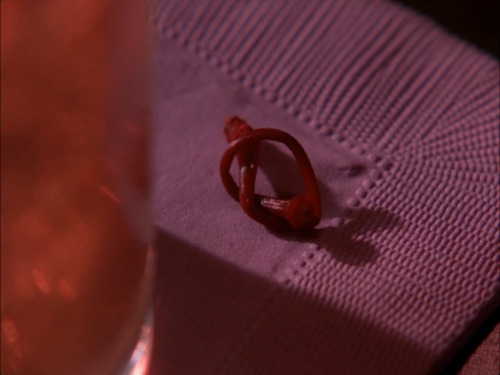
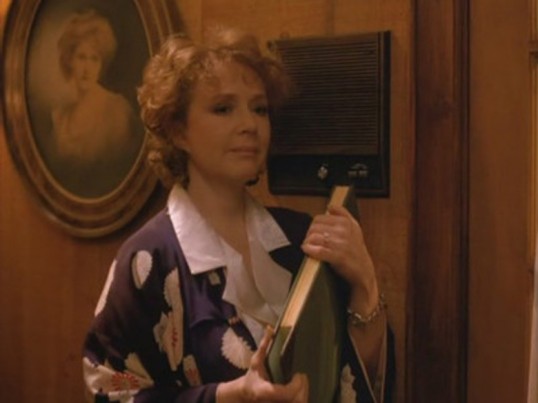
Back at the police station, there’s a happening.  Lucy (Kimmy Robertson) is caught up in the latest episode of Invitation to Love, where the storyline seems to parallel the efforts of Ben Horne (Richard Beymer) and Catherine Martell (Piper Laurie) to run Josie (Joan Chen) out of business.  FBI Director Gordon Cole (voiced by David Lynch, himself) calls in to let them know that Albert has discovered that Laura Palmer was bound by household twine and that the marks on her shoulder came from a bird.  When Harry and Andy show Dale Cooper (Kyle MacLachlan) the sketch of BOB, Cooper identifies him as one of the men from his dream.

Dale also finally interviews everyone’s favorite psychiatrist, Dr. Jacoby (Russ Tamblyn).  Jacoby tries to beat Cooper at his own game, speaking in riddles and comparing the people of Tibet with the native Hawaiians.  Jacoby says that, when it comes to Laura, he can not violate doctor-patient confidentiality but he does share that “Laura was a woman” surrounded by boys and that, on the night Laura was murdered, he was following one of the men that Laura had told him about.  When Jacoby says that the man drove a red corvette, both Harry and Dale realize that he is talking about Leo Johnson (Eric Da Re).

Lucy interrupts to let Dale and Harry know that Deputy Hawk (Michael Horse) has just called.  He has tracked down MIKE, the one-armed man!

At the Timber Falls Motel, Ben and Catherine are having another tryst and discussing their plans for setting the mill on fire and forcing Josie into bankruptcy.  What they do not know is that Josie is sitting outside in her car, taking pictures.

The Timber Falls Motel is also the current home of the one-armed man and, as Harry, Andy, and Dale pull up, they are met by Hawk who tells them that the man is in room 101 and that his full name is Philip Michael Gerard.  (The One-Armed Man shares his name with Richard Kimble’s relentless pursuer on The Fugitive, a show that itself centered around the search for a one-armed man.  This episode aired years before the film version and Tommy Lee Jones reintroduced the world to the character.)

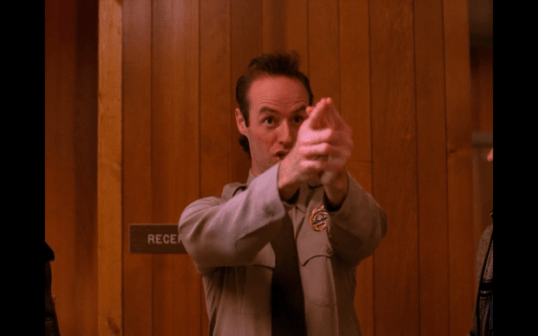
Andy has a Barney Fife moment when, standing outside of Room 101, he accidentally drops his gun and it goes off.  (“Gunplay,” Catherine says in her cabin, “Sounds serious.”)  When not even the sound of gunfire can get Gerard to open the door, Harry and Dale kick it in and discover their one-armed man stepping out of the shower.

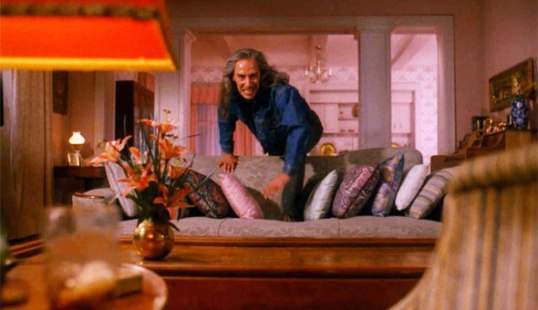
Looking at a the drawing of BOB, Gerard says that he has never seen him before but that he does “look like someone.”  When Cooper asks if he has a friend named Bob, the one-armed man replies, “Bob Lydecker is just about my best friend in the world.”  He says that he’s been at the hospital because Bob, who is apparently the “best veterinarian in the county,” is in a coma.  Gerard is a traveling salesman, selling shoes.  He says that he lost his arm in a car accident.  He admits that he did have a tattoo on the arm that he lost.  In tears, he says that the tattoo said, “Mom.”

Al Strobel was a real-life amputee whose cameo in the pilot, riding in an elevator with Cooper and Harry, was originally meant to be his only appearance, a one-time homage to The Fugitive.  Lynch was so impressed with Strobel that he filmed some additional scenes with him that were used in the version of the pilot that was released theatrically in Europe.  (Those scenes were later incorporated into Cooper’s dream.)  In this episode, Strobel gives a memorable performance that justifies Lynch’s decision to expand his role.

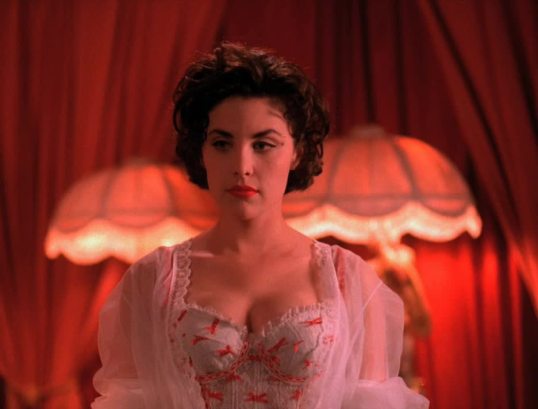
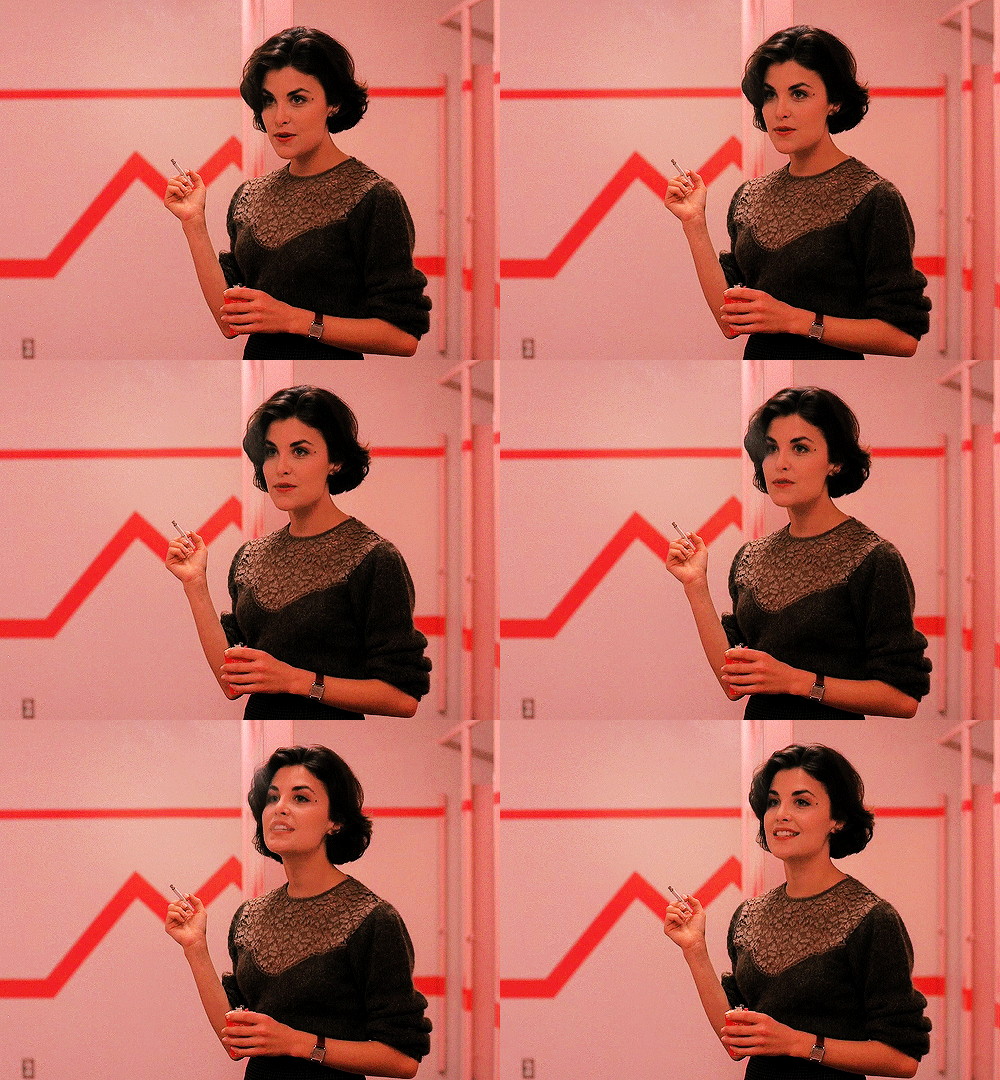
At the high school, Audrey (Sherilyn Fenn) is smoking in the girl’s room and begging Donna to help her investigate Laura’s murder.  Audrey says that if she can solve the murder then maybe Dale will take her away with him.  When Audrey mentions One-Eyed Jacks, Donna proves herself to be just as crushworthy as Audrey by replying, “Isn’t that a western with Marlon Brando?”  Considering that One-Eyed Jacks was a box office flop that was released years before she was born, Donna’s knowledge of Marlon Brando’s filmography is truly impressive.

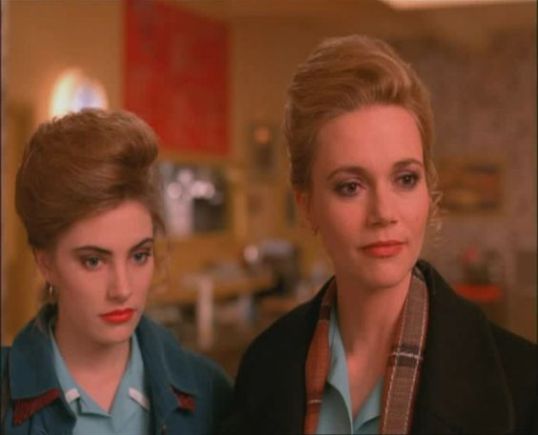
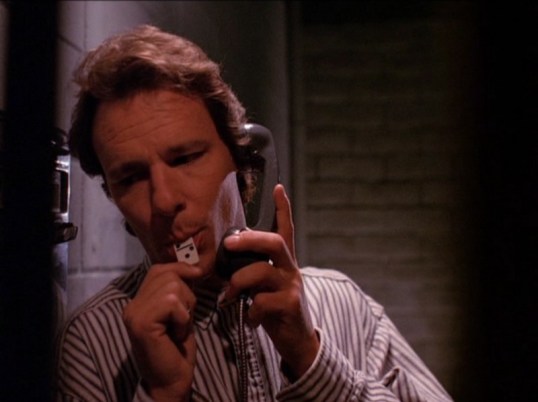
At the prison, Norma (Peggy Lipton) promises the parole board that, if Hank (Chris Mulkey) is released, she will give him a job at the diner and they will live together as “husband and wife.”  That will be interesting considering that Norma is now having an affair with Hank’s former best friend, Ed Hurley (Everett McGill.)

Meanwhile, Dale, Harry, Andy, and Hawk have pulled up in front of Dr. Bob Lydecker’s vet clinic.  Hawk immediately high-fives a biker.  Harry pets a little girl’s rabbit.  Cooper notices that a convenience store is right next to the clinic and sends Andy, who is still shaken up from nearly shooting himself, to discover whether the store sells the type of twine that was used on Laura.

Inside the clinic, Dr. Lydecker’s receptionist says that the sketch of Killer BOB looks nothing like the good doctor.  As a woman leads a llama through the waiting room, Dale asks whether Lydecker had any bird patients.  As Cooper explains to Harry, “The bird that attacked Laura Palmer is a client of this office!”

Meanwhile, back at the Johnson House, Shelly Johnson (Madchen Amick) is fooling around with Bobby Briggs (Dana Ashbrook).  Shelly says that Bobby’s outburst at the funeral really turned her on.  Bobby says that he’s going to “fix” James Hurley.  “Fix me first,” Shelley replies.  Bobby asks when Leo’s coming back and Shelly says that Leo will be gone for hours.  Whenever Shelly says that Leo won’t be back for a while, that is usually Leo’s cue to kick open the door and start yelling.

However, that does not happen this time.  For once, Leo does not show up.  According to Shelly, he is with “creepy Jacques, that Canuck who works at the Roadhouse.”  Realizing that Jacques must be the one supplying Leo with cocaine, Bobby does his innocent act.  He says that he knows that Leo has been selling drugs at the high school, maybe even to Laura.  Now, if only he can find evidence linking Leo to Laura, maybe they can get Leo out of their lives forever.  Shelly helps out by showing Bobby the bloody shirt that she found in Leo’s truck.  She also shows Bobby the gun that she just bought and she asks Bobby to show her how it works.  Hopefully, Bobby’s better with a gun than Andy.

Fan Service, Twin Peaks Style

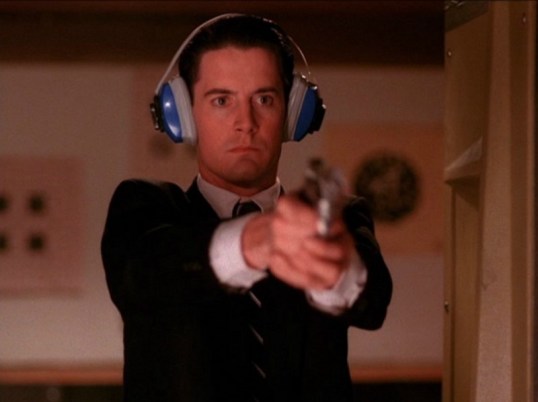
Speaking of which, Andy is still feeling upset over nearly shooting himself so, back at the police station, Andy, Cooper, Harry, and Hawk gather at the shooting range for some gunfire and male bonding.  They all agree that women cannot be understood and they all marvel over Dale’s marksmanship.  Not only does Dale do dream interpretation but he can shoot a man in the nostrils.

At the diner, Norma thanks a man named Toad for his tip.  When Shelly comes in, they bond over their shared experience of being married to loser drug dealers.  Shelly says that she’s ready to get rid of Leo but, after seeing him at the parole hearing, Norma is now less sure about her plan to divorce Hank and marry Big Ed.  She is even more unsure after she gets a phone call telling her that Hank got his parole.  He is coming home.

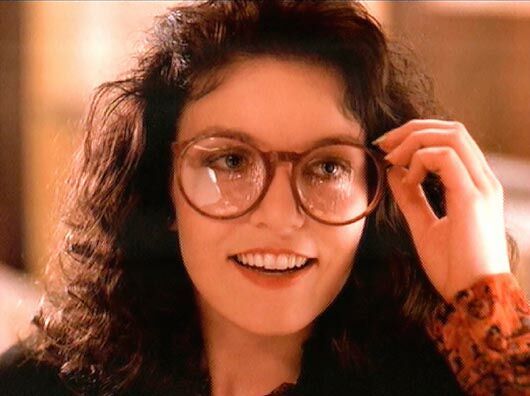
Meanwhile, Ed’s nephew, James (James Marshall), is using the diner’s payphone (remember those?) to call Donna.  However, James is distracted when Maddy (Sheryl Lee), Laura’s look-alike cousin, walks into the diner.  After James approaches her, Maddy explains that she and Laura used to be close but had recently drifted apart.  Maddy says that she lives in Missoula, Montana. Missoula just happens to be the birthplace of David Lynch.

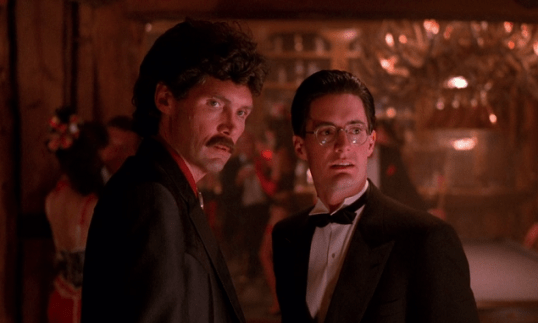
Meanwhile, at the Great Northern, Audrey deftly manipulates her father into giving her a job working at the perfume counter at Horne’s Department Store.  Audrey says that it is because she wants to learn the family business but actually, it’s because both Laura and Ronette Pulaski also worked at the perfume counter.  Ben agrees and then leaves so that he can hire Leo Johnson to burn down the Packard Mill.  Who suggested Leo to Ben?  Hank Jennings!

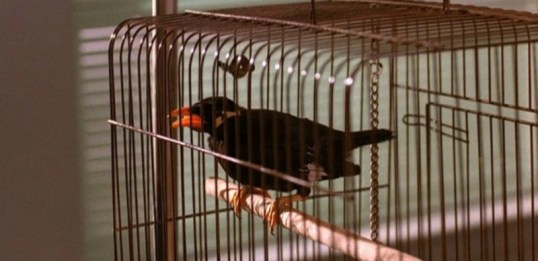
At the police station, Cooper, Harry, and Andy pour over the files on all of the birds treated by Dr. Lydecker.  Albert faxes over a reconstruction of a poker chip from One-Eyed Jacks that was found in Laura’s stomach, along with the information that the bird bites on Laura’s shoulder came from a mynah bird.  At the exact moment, Andy redeems himself by announcing that Jacques Renault owns a mynah bird named Waldo.

When the police show up at Jacques’s apartment, Jacques is not there.  However, Bobby Briggs is.  Bobby runs as soon as the police arrive and manages to escape out a back window.  (Assuming that Bobby is Briggs, Hawk gives chase but loses him in the woods.)  Cooper finds what Bobby was planting the apartment, Leo’s bloody shirt.

In the woods, Donna and James go to the location where Donna buried the necklace and discover that Sarah Palmer’s vision was correct.  Someone followed them and dug up the necklace.  Donna and James agree they have to solve the murder and share a kiss while an owl watches above.

At the mill, Pete (Jack Nance) asks Josie if she would consider entering a fishing competition with him.  Josie and Pete?  That would be an interesting match.  But Josie soon has more to worry about, after she receives a drawing of a domino in the mail.  No sooner has she looked at the drawing then she gets a phone call from a man asking her if she got his message.

Who is on the other line?

The suddenly very important Hank Jennings!

“The One-Armed Man” is a good episode, one that moves the story forward, introduces some new mysteries, and justifies that faith that David Lynch put into collaborators like Tim Hunter and Al Strobel.  As I said at the start of this review, it’s all about team work.

Previous Entries in The TSL’s Look At Twin Peaks:

  1. Twin Peaks: In the Beginning by Jedadiah Leland
  2. TV Review: Twin Peaks 1.1 — The Pilot (dir by David Lynch) by Lisa Marie Bowman
  3. TV Review: Twin Peaks 1.2 — Traces To Nowhere (directed by Duwayne Dunham) by Jedadiah Leland
  4. TV Review: Twin Peaks 1.3 — Zen, or the Skill To Catch A Killer (dir by David Lynch) by Lisa Marie Bowman
  5. TV Review: Twin Peaks 1.4 “Rest in Pain” (dir by Tina Rathbone) by Leonard Wilson
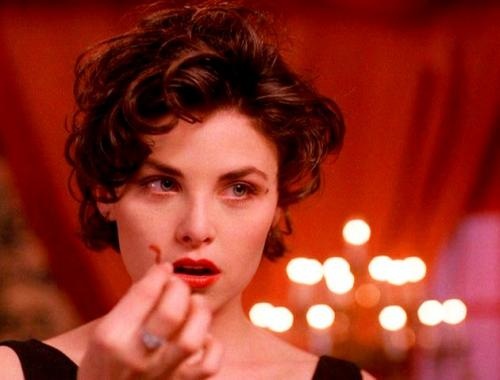
A Movie A Day #88: Where The Day Takes You (1992, directed by Marc Rocco)


This month, since the site is currently reviewing every episode of Twin Peaks, each entry in Move A Day is going to have a Twin Peaks connection.  Where The Day Takes You is a movie that has not just one but two connections to Twin Peaks.

Where The Day Takes You is an episodic film about young runaways living on the streets of Los Angeles.  Led by 22 year-old King (Dermot Mulroney), who ran away from home when he was 16, the runaways form a surrogate family.  While being constantly harassed by both the police and well-meaning social workers, some of the runaways get addicted to drugs while others turn to prostitution in order to survive.  Some find love.  Some find death.  They all go where the day takes you.  (Not sure if that was the movie’s tag line but it should have been.)

Where The Day Takes You is a gritty and often tough film, though it’s effectiveness is undercut by a predictable ending and the presence of too many familiar faces in the cast.  The runaways are made up of a who’s who of prominent young actors from the 1990s.  Balthazar Getty plays King’s second-in-command.  Sean Astin plays an obviously doomed drug addict.  Alyssa Milano and David Arquette play prostitutes.  Ricki Lake and James Le Gros play comedic relief.  Will Smith, in his film debut, plays a wheelchair-bound runaway.  Christian Slater and Laura San Giacomo show up as social workers while the police are represented by Rachel Ticotin and Adam Baldwin.  Everyone gives a good performance but the film would have worked better with unknown actors or even real runaways.  No matter how good a performance Sean Astin gives as a heroin addict, he is always going to be Sean Astin and it is always going to be difficult to look at him without saying, “I might not be able to carry the ring but I can carry you!”

The movie’s first Twin Peaks connection is that Lara Flynn Boyle, who played innocent Donna Hayward on Twin Peaks, plays innocent runaway Heather in Where The Day Takes You.  The role is cliché but Boyle shows the same charm that she showed while playing Donna.

The movie’s second Twin Peaks connection is more unexpected.  Kyle MacLachlan is effectively cast against type as Ted, the drug dealer who keeps most of the runaways hooked on heroin and who is perfectly willing to leave an overdosed junkie in a garbage bin.  Ted is about as far from Dale Cooper as you can get.

TV Review: Twin Peaks 1.4 “Rest in Pain” (dir by Tina Rathbone)


David Lynch loves Dreams.

Whether it’s the nightmare of losing a loved one in Lost Highway, the dreams of being more than what you are in Dune, or the waking nightmare waiting around the corner of a diner  in Mulholland Drive, Lynch has always managed to have a dream sequence be a story driving medium. So, with Episode 3’s fantastic ending, we’re left with some major clues to the truth if they can be deciphered. Imagine living in an age before cell phones and Twitter. An episode like that comes on and the moment you arrive at your workplace (or school), the first conversation on everyone’s lips is “What the heck was that?!” While I don’t quite recall how big the impact was, Twin Peaks was a highly talked about show for its time. A cliffhanger like that was pretty daring, particularly for being only the third episode.

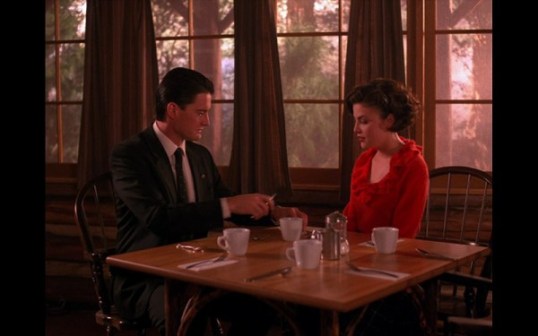
Episode Four, “Rest in Pain” opens at the lodge, with Audrey Horne (Sherilyn Fenn) waiting for Special Agent Dale Cooper (Kyle McLachlan) to make an appearance.  She obviously has a crush on him, and he asks her to join him for breakfast. Though she’s unable to stay for long, Audrey explains that she was the one who left the “Jack with One Eye” note under Cooper’s door. Telling him that Jack’s is something like a brothel (“Men go there….women work there.”), they’re able to piece together that both Laura Palmer (Sheryl Lee) and Ronette Pulaski (Phoebe Augustine) worked for Audrey’s dad at the perfume counter of his store. Is there a connection between the two locales?  Before they can elaborate any further, Sheriff Truman (Michael Ontkean) and Lucy (Kimmy Robertson) enter the dining hall, causing Audrey to excuse herself at Cooper’s suggestion.

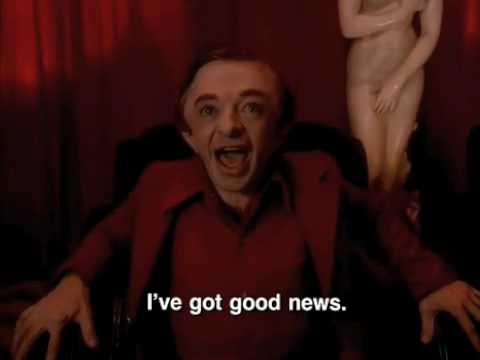
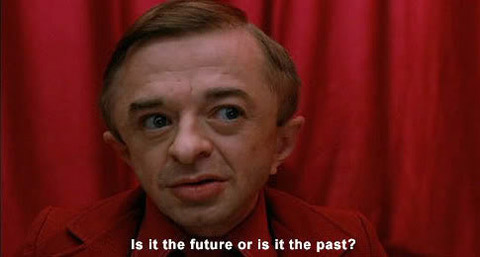
Cooper welcomes his companions and gleefully orders a short stack of griddle cakes, which sounds really good. Now comes the question that has everyone leaning forward in their seats with anticipation. When asked who killed Laura Palmer, Cooper goes over the dream from the night before – of Mike and Bob with the “Fire…Walk With Me” tattoo, the backwards speaking midget (Michael Anderson, Carnivale) and his cousin who looks a lot like Laura. This red room dream sequence may be extra important to the Revival, as it takes 25 years into the future. The cousin mentions she’s filled with secrets and that sometimes, her arms bend back. Additionally, where she’s from, the birds sing a pretty song and there’s always music in the air. The woman whispers the name of Laura’s killer….but Cooper is unable to remember what she said to him.

Dammit, Cooper. You’re an FBI agent, how could you forget something as important as that?!

This, of course, is a good thing, because we really can’t have the mystery solved that quickly, can we?

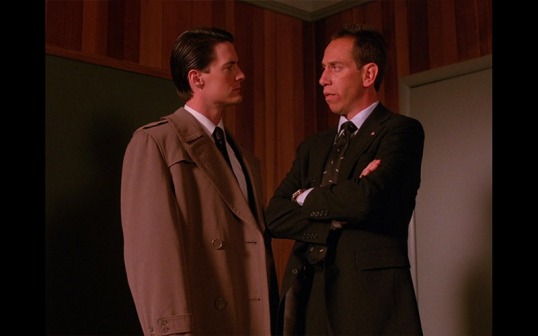
The next scene is one of my favorites in this episode. It has Dr. Hayward and Al Rosenfeld (Miguel Ferrer) fighting over Laura Palmer’s body. Hayward needs to make preparations for the funeral, yet Rosenfeld is determined to perform an autopsy. It doesn’t help that Rosenfeld has a quip for everyone he runs into, clearly displaying his animosity for the small town life and it’s inhabitants. Ferrer was known for playing that guy you just wanted to pop in the mouth, particularly in his roles for Robocop and the really awful Deep Star Six. It wasn’t until TV’s Crossing Jordan that I saw Ferrer could be more of a good guy. It was a treat seeing him here on the show and in researching the Twin Peaks Revival, I found out he was part of the cast before his passing. Film fans will also make the connection to David Lynch’s Dune here, as Lynch worked with Miguel’s father, Jose in that film. The scene ends with Rosenfeld opening his mouth a little too much and getting socked for his troubles by Truman. Cooper intervenes, giving control of Laura’s body to Dr. Hayward but asking Rosenfeld to make his tests quick and with little damage. For a scene that deals with a dead body in the room, it has just enough comedy in it to lighten the mood without turning into something akin to the Naked Gun series.

Back at the Palmer home, Leland (Ray Wise, also in Robocop) is still grieving over Laura when he’s surprised by a visit from Laura’s cousin Maddy (Sheryl Lee). He can’t help but stare at her in disbelief, possibly because of how much of a resemblance she bears to his daughter. We can’t help staring because of the connection to the dream. Is this the “cousin” the midget was referring to? I liked Wise’s reaction of disbelief here. Either way, it was nice small scene.

If there’s one storyline in Twin Peaks that I could care less about, it’s Norma (Peggy Lipton) and Hank (Chris Mulkey, from Michael Crichton’s Runaway). Hank’s parole officer, Mr. Mooney stops by the Double R, and explains that her husband is being released soon and into her care. Having been a model prisoner, the early release brings him back into Norma’s life, who clearly doesn’t want to have him around. She could have moved on after his imprisonment, but her dating life wouldn’t work out with a homicidally jealous ex popping around the shop now and then. It helps to set the tone for Hank’s introduction to the shop, if nothing else.

Cooper and Truman visit the house of Leo Johnson, to ask him about Laura Palmer. He initially states that he doesn’t know her, and then confesses that the heard of her. After Cooper reads him his rap sheet, Leo states that he was on the road and called his wife Shelley (Madchen Amick) from Butte, Montana. Granted that she can support his alibi, that takes him off the suspect list. Damn, I kind of thought he could be the one up to that point, particularly with the football incident in the previous episode.

At Bobby Briggs’ (Dana Ashbrook) house, his father (Don Davis) has a conversation regarding the upcoming funeral, where he tells his son to not be afraid of it. Bobby has other plans for the funeral, which he barks about. “Afraid!! I’m gonna turn it upside down!!!” Truly, I’ve never seen anyone so excited about attending a funeral since Will Ferrell in Wedding Crashers. He could have yelled at his mother for some meatloaf and it would have fit perfectly here.

Cooper and Truman meet up with Rosenfeld, who gives them the breakdown of what he found on Laura. Cocaine was found in Laura’s diary, along with two different kinds of twine. Rosenfeld reveals that the twine used on Laura’s wrists were also the same used on Ronette, and it appears to have come from a railroad car. Laura was apparently tied in two places on her arm. When Rosenfeld demonstrates this, Cooper mutters a line from his dream..”Sometimes my arms bend back.”  Again, an element from the Dream makes an appearance, which lends a great deal of credibility to Agent Cooper’s prowess. Most FBI agents would have relied on extreme forensics work and motives, but here we have an individual whose dreams are possibly taking him in the right direction so far. Rosenfeld mentions he also found industrial strength soap, suggesting that the killer washed his hands on site. Additional clues include what appeared to be bite or claw marks on her shoulder, and a chip of plastic taken from her stomach with the letter “J” on it. There’s that letter “J” again, for Jack’s, perhaps?

So where does this leave us? If the killer washed their hands, they were methodical. The chances they’d leave any other evidence behind other than what was found on the body doesn’t likely. That could also possibly rule out the still missing One Armed Man suspect Hawk is searching for. Additionally, Laura’s clues bring more questions than answers.

On the way out, Rosenfeld pulls Cooper aside and asks him to assist in having assault files brought up on Sheriff Truman. Cooper refuses, letting Rosenfeld know that during his time at Twin Peaks, all he’s seen has been peace and goodwill. Personally, I’m surprised Cooper didn’t hit Rosenfeld at that point, but the forensic scientist leaves empty-handed. Cooper makes a recording note to maybe buy some property in the town of Twin Peaks.

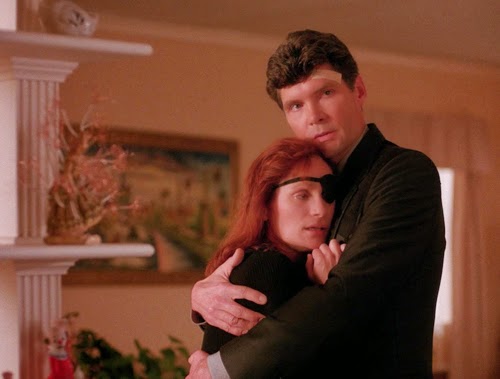
When I originally joined on this project, I started with the episode I was assigned, but it was the next scene that made me jump back to the beginning of the series and continue through it’s conclusion. We have Ed (Everett McGill, Dune), who returns home and receives a hug from his wife Nadine (Wendy Robie). At this point, I stared in shock and then started laughing. I wasn’t aware the two actors were even in this show together. I know the pair from Wes Craven’s The People Under the Stairs, so seeing them in this context (they were a sibling pair in the film) was just weird. I have to go back to that movie at some point to see the chemistry there again.

Anyway, Nadine gushes about her love for Ed, and how she used to watch him in high school with Norma. Ed’s eyes are a bit jaded here, as if his mind is more on Norma than on Nadine, but they’re both interrupted with the arrival of James. Ed informs him that they have to get ready for the funeral, but James tells them they can’t and leaves. It seems Laura’s passing has struck a nerve with everyone in town, but wouldn’t the person who carried half of his sweetheart’s necklace want to be at her funeral to pay his last respects? Unless of course, either the guilt of being with Donna gotten to him, or he has secrets of his own to hide.

Back at The Great Northern, we find Audrey dressed for the funeral. She sneaks into one of the special cubbyholes and peeks in on an adjoining room. She finds Dr. Jacoby (Russ Tambyn, West Side Story) helping to put Johnny (Robert Bauer) in something more suitable for a funeral. She closes the peeking hole and we move along.

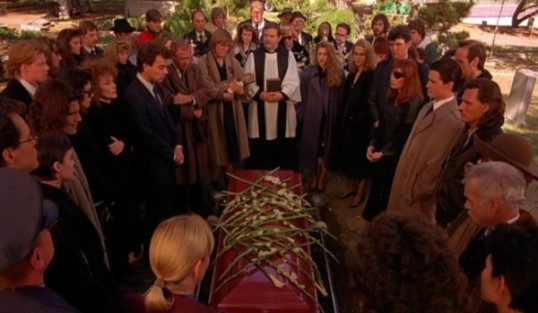
The next scene opens with the swaying of trees. We are all gathered for the funeral of Laura Palmer, and the best scene in the entire episode. The priest gives a small sermon, with everyone close to Laura surrounding her coffin, save for Dr. Jacoby. Cooper, his guard always up, takes notice of Bobby’s disgust at the sudden appearance of James at the funeral. We cut between the major players with the priest’s reflection on Laura, who he also loved in a way “reserved for the headstrong and bold”. Donna seems a little pained at the thought, while Audrey still can’t keep her eyes off of Cooper. They exchange the smallest of smiles before Johnny exclaims an Amen to the crowd. It’s here that Bobby steps up with an even louder “Amen”, ready to actually turn things upside down as he promised. He blames everyone present for Laura’s death, stating that they were all aware she was in trouble, but no one came to her aid. The entire town failed her in his mind, and this causes a brief fight between Bobby and James. The two have to be restrained by separate parties.

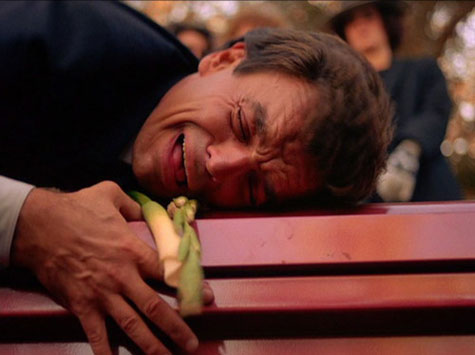
It’s here that something magically weird occurs, because it just wouldn’t be Twin Peaks without something strange. To even think about it makes me laugh, but in the context of the story, I suppose it makes sense. In the middle of the altercation, Leland is so overcome with grief that he throws his arms open and flings himself on top of Laura’s coffin, the result of which damages the hydraulics. The coffin goes down into the hole and rises again slowly, repeating the action. Sarah (Grace Zabriskie) admonishes Leland for his actions. “Don’t ruin this too!”. It takes something somber and totally spins it on its ear. I laugh every time I see it.

By the time you’re done feeling bad about Leland’s actions, we find ourselves at the Double R by night. Shelley is re-enacting the coffin sequence to some laughing patrons. We find Ed, Hawk (Michael Horse) and Truman waiting for Cooper to arrive. Ed is sure that Cooper’s not going to get what’s they’re planning, but Truman takes him up on the wager. After making his order – Huckleberry Pie and Ice Cream with Coffee – Cooper immediately catches the look between Norma and Ed. When he brings this to Ed’s attention, Ed can only sigh. Truman gives him the tab for the Pie and Ice Cream. Truman explains that they’ve been doing some detective work of their own, as some drugs have been smuggled into Twin Peaks. Truman also tells of a secret society that helps to protect Twin Peaks from darker forces for more than 20 years.

Cooper, Ed, Hawk and Truman head over to the Book House Boys, a quasi Dead Poets Society Club. Here they find Bernard Renault, the brother of Jacques Renault. Truman mentions that he was caught with cocaine and they ask him about his connections to his brother. While they’re questioning Bernard, Jacques is about to enter the Book House Boys club when he notices a flickering red light on the roof. This causes Jacques to run to the nearest pay phone (wow, pay phones), where he makes a call to Leo, asking him to get him out there. Leo agrees to meet him and leaves Shelley behind. The scene ends with Shelley removing her gun and hiding it behind a panel in a nearby dresser.

Josie Packard (Joan Chen) and Truman meet back at the lodge later that night. Truman releases that something’s up with her, but she’s not quite ready to share. After pressing the issue, Josie states that Catherine Martell (Piper Laurie, Carrie) and Ben Horne ( Richard Beymer, Free Grass) are out to hurt her. What she doesn’t realize is that Catherine is listing in on her conversation via the intercom system. Josie opens a vault to show Truman the two sets of ledgers that show their books are being cooked, but only one is there. We’re shown that Catherine has the other book under a desk panel in her room. Not much else is said about this, so we can only speculate that more of this will come to light in a later episode.

At the cemetery, we find Dr. Jacoby finally paying his respects. Cooper also makes an appearance. Dr. Jacoby describes the pain of losing Laura as she was the only person who made him feel anything, despite the time he spent listening to others’ issues. We come to find that even he is affected by the loss, and he hopes that she can forgive him for not making an appearance earlier that day.

Josie is fearful that what happened to Andrew may happen to her, and that Catherine and Ben are after the Mill. With the Mill and Josie gone, they’d have the land to do with as they please. Truman promises to protect her, and they have a passionate moment right there on the rug. In the back of my mind, I found myself thinking “Hey, stop that! Catherine can probably still hear all your moaning!”, but of course, they’re unaware of this.

The final scene of this episode brings us back to the Great Western, with Cooper asking Hawk about his belief in the Soul. Hawk mentions there are many souls. In particular, there is the Dream Soul that wanders the land of the dead and brings life to the mind and the body. On whether Laura may be one of these, Hawk assures him that “she’s in the ground”. They raise a toast to their name and drink. Leland, also present at the location, begs for anyone to dance with him while the music plays. To dance the way he did with Laura’s picture in his hands. Cooper offers to take him home, to which Leland concedes. This final part was a little weird to me. Leland’s dance compulsion seems a really quirky thing, but then again, it’s not every day one has to bury their daughter.

So, we have a few answers to the Dream sequence, but even more questions on top of that. We’ll have to see where it all goes.

Previous Entries in The TSL’s Look At Twin Peaks:

  1. Twin Peaks: In the Beginning by Jedadiah Leland
  2. TV Review: Twin Peaks 1.1 — The Pilot (dir by David Lynch) by Lisa Marie Bowman
  3. TV Review: Twin Peaks 1.2 — Traces To Nowhere (directed by Duwayne Dunham) by Jedadiah Leland
  4. TV Review: Twin Peaks 1.3 — Zen, or the Skill To Catch A Killer (dir by David Lynch) by Lisa Marie Bowman

TV Review: Twin Peaks 1.3 “Zen, or the Skill to Catch a Killer” (dir by David Lynch)


“She’s filled with secrets. Where we’re from, the birds sing a pretty song and there’s always music in the air.”

— The Man From Another Place (Michael Anderson) in Twin Peaks Episode 1.3, “Zen, or the Skill to Catch a Killer”

Oh my God, this is the episode with the dream!!!

Okay, a confession.  Originally, this episode was not assigned to me.  Originally, it was assigned to someone else.  However, as soon as I realized that this was the episode that ended with the dream sequence, I begged and begged to be allowed to review it.  I even cried a little.

Seriously, I love this episode.

Of course, when people talk about how “weird” Twin Peaks supposedly was, this is one of the episodes that they usually cite as evidence.  They always mention that little man who speaks backwards and who dances in the room with the red curtains.

However, I think that labeling this episode — or, for that matter, anything else that David Lynch has directed — as merely being “weird” is a major misreading of Lynch’s signature style.  When it comes to examining Lynch, it’s important to remember that, before he became a filmmaker, David Lynch was a painter.  A David Lynch-directed film (or television episode) is essentially a moving painting.  Often times, the plot is not to be found in the dialogue or what actually happens on screen.  The plot is to be found in the mood that Lynch’s visuals create.

I once read an interview with Lynch where he talked about being fascinated by the fact that, if you removed bark from a tree, you could discover a very chaotic world happening underneath an otherwise genteel surface.  All of his work has been about peeling back the outer layers of our world and seeing what lies underneath.  When you think of this episode’s famous dream as just being another layer, one that is hidden until we close our eyes, shut off our assumptions, and go to sleep, you realize that there’s nothing strange about it.

It’s just Twin Peaks.

So, with all that in mind, let’s take a look at the third episode of Twin Peaks, “Zen, or the Skill to Catch A Killer.”

 To say that we start with the opening credits probably sounds like the most obvious thing that I could possibly say conerning this episode but it’s still important to point out.  The opening credits of Twin Peaks — the combination of the mill, the mountains, the road, and Angelo Badalamenti’s beautiful theme music — are absolutely brilliant.  More than just letting you know what show you’re watching, the opening credits of Twin Peaks transport you into the world of this sordid little town.

And what’s happening in Twin Peaks?  It’s the third day of the Laura Palmer investigation.  The homecoming queen who tutored Johhny Horn (Robert Bauer), taught Josie (Joan Chen) how to speak English, and helped organize the local Meals on Wheels program is still dead and a shocked town is still struggling to come terms with it.  It all goes back to what I said earlier about how this show is all about peeling back layers and revealing what lies underneath.  Though each episode may end with Laura’s blandly pretty homecoming photo, the layers underneath are full of chaos and secrets.

The episode opens with an awkward dinner with the Horne family.  It’s Ben (Richard Beymer), Audrey (Sherilyn Fenn), Johnny, and Ben’s wife.  They’re all sitting in a dining room that, like every room in Ben’s hotel, is completely made out of wood.  (Again, you have to remember what Lynch said about the world underneath the bark.)  Nobody speaks.  It’s as awkward as that montage in Citizen Kane, the one where the collapse of Charles and Emily’s marriage is shown over the course of several increasingly strained breakfasts.  But then Ben’s brother, Jerry (David Patrick Kelly), shows up.  Jerry has just returned from Paris and he’s brought bread!

Up until this point, Ben has been a stiff figure, one who was largely defined by his greed.  But when Jerry shows up, Ben’s face lights up and, almost like an animal, he bites into the bread.  Why shouldn’t Ben be happy?  Jerry is as flamboyant and eccentric as Ben was measured and closed off.  (It helps that Jerry is played by David Patrick Kelly, who is one of those actors who can go totally over the top without losing his credibility or his charm.  Before playing Jerry, Kelly achieved pop culture immortality by chanting, “Warriors, come out to play!” in 1979’s The Warriors.)  When Jerry gets depressed at the news that the Norwegian deal fell through and that Laura Palmer’s dead, Ben suggests that they go to everyone’s favorite Canadian brothel, One-Eyed Jacks.

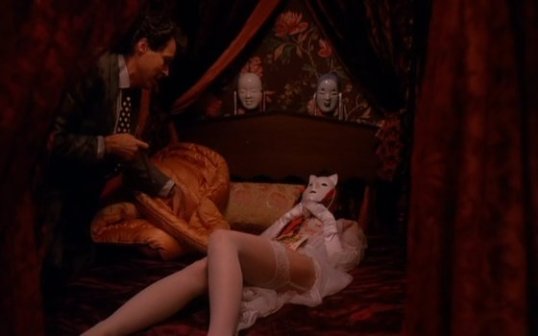
While we watch Ben and Jerry (undoubtedly named for everyone’s favorite Vermont capitalists) flirt with the lingerie-clad prostitutes at One-Eyed Jacks, we’re struck by just how dorky both of them truly are.  The Hornes may be one of the richest and most powerful families in town but, emotionally, Ben and Jerry are children, still trying to impress each other with their stunted masculinity.  The general ickiness of One-Eyed Jacks is nicely contrasted with a genuinely sweet scene of James Hurley (James Marshall) and Donna Hayward (Lara Flynn Boyle), wondering if they should feel guilty for being chastely attracted to each other so soon after Laura’s death.

Back at the hotel, Dale (Kyle MacLachlan) gets a call from Deputy Hawk (Michael Horse), informing him that a one-armed man has been seen wandering around the hospital.  There’s a knock at the door.  When Dale answers it, he finds only a note.  It reads: “Jack with One Eye.”

Meanwhile, the three least likable people on the show — Bobby Briggs (Dana Ashbrook), Leo (Eric Da Re), and idiot Mike (Gary Hershberger) — get to have a scene of the very own.  Bobby and Mike go out to the woods to pick up the drugs that they paid Leo for.  Leo’s waiting for them, of course.  He wants to know if Bobby knows who Shelley’s been cheating on him with.  Since that person would be Bobby, Bobby is quick to say that he has no idea.  It’s tempting to compare Bobby and Mike to Ben and Jerry.  Whereas Ben and Jerry are rich and can pretty much indulge their vices without any fear of retribution, Bobby and Mike are still trying to reach that point.  They still have to deal, on a face-to-face basis, with dangerous people like Leo.  Again, I found myself looking that all trees, all the bark, and all the layers that surrounded Mike, Bobby, and Leo.  Ben and Jerry may be rich but peel away and you’ll find Mike and Bobby.  Mike and Bobby may be football stars but peel away and you’ll find Leo.

The next morning, life in Twin Peaks continues.  Shelley (Madchen Amick), bruised from her latest beating, walks around the curiously unfinished home that she shares with Leo.  When Bobby comes by and says that he’ll kill Leo if he ever hits Shelley again, they kiss and the camera zooms in on the bruise on Shelley’s jaw.  When Ed Hurley (Everett McGill) gets yelled at for accidentally stepping on one of Nadine’s (Wendy Robie) drapes, he goes to the diner to see Norma (Peggy Lipton).

(Of all the minor characters in Twin Peaks, Nadine may seem like the most cartoonish but one should not be too quick to dismiss her.  Her obsession with creating a silent drape runner may seem insane but actually, it’s an attempt to bring a little peace and order to an otherwise chaotic world.  Nadine has become so obsessed with creating that peace that she doesn’t realize that she’s managed to alienate everyone around her.  Her attempts to find perfection have only amounted in creating more chaos.)

It’s all a bit soapy and I don’t want to spend too much time on any of those subplots.  Not in this review, anyway.  What’s important is what Agent Cooper, Harry (Michael Ontkean), Hawk, Andy (Harry Goaz), and Lucy (Kimmy Robertson) are doing during all of this.  If anyone had any doubt that Twin Peaks‘s version of the FBI is a bit different from the real world FBI, those doubts will be erased by the scene in which Cooper displays his investigative technique.

Out in the woods (and again, we’re reminded of the layers under the bark), Cooper has set up a blackboard.  “By way of explaining what we’re about to do, I am first going to tell you a little bit about the country called Tibet…”

Cooper explains the sad history of Tibet and how Communist China forced the Dalia Lama into exile.  “After having a dream three years ago,” Cooper woke up with much sympathy for the plight of the people Tibet and also with the knowledge of a new type of deductive technique.

That deductive skill comes down to throwing rocks at bottles while Sheriff Truman reads the name of every suspect whose name starts with a “J.”  If Dale hits a bottle, Lucy is instructed to put a check mark next to that person’s name.  Andy is sent down to stand near the bottle.

“I’m getting excited!” Andy shouts.

We all are, Andy.

Dale misses when Harry reads the names of James and Josie.  But, when he says, “Lawrence Jacoby!,” the rock hits the bottle but does not break.  “Make a note,” Dale says, regarding to the bottle not breaking, “that’s very important.”

The rest of the throws only lead to Andy getting bonked by a rock.  At least, that is until the final throw.  “Leo Johnson!” Harry says.  Dale throws the rock.  The bottle shatters.

As brilliant as MacLachlan is as Cooper, what really makes this scene work are the reactions of Harry, Hawk, Andy, and especially Lucy.  Harry watches it all with a resigned but respectful skepticism.  Hawk nods sagely as Cooper talks about the importance of being attuned with the spiritual world.  Andy insists that it didn’t hurt when he got hit in the head by a rock.  And Lucy gets totally and enthusiastically caught up in the minutiae of Cooper’s technique.  When Harry says that “Jack with One Eye” is probably a reference to One-Eyed Jacks, Lucy very earnestly explains that she’s going to have to erase Jack With One Eye off of the list of suspects.  By trying to apply logical rules to Cooper’s illogical technique, Lucy serves as a stand-in for the audience.  The pure and sincere earnestness of Kimmy Robertson’s performance is one of the best things about his episode.

At the diner, the Hayward Family eats an after-church lunch when Audrey comes in and plays a song on the jukebox.  Apparently, the jukebox only carries mood music written by Angelo Badalmenti.  Donna and Audrey talk and the scene makes good use of the contrast between the two, Donna being the stereotypical good girl with secrets and Audrey being the artist who has been incorrectly typecast as a bad girl.

Back at the police station, Albert Rosenfield (Miguel Ferrer) shows up and I have to admit that I got a little bit choked up when I saw Ferrer looking so young and healthy.  Albert is a forensic pathologist and he’s as abrasive as Dale is cheerful.  If Dale immediately fell in love with small town life, Albert hates everything about it.  Harry and Albert take an immediate dislike to each other, as well they should.  But the thing with Albert is that it’s impossible to dislike him because he’s played by Miguel Ferrer.  Ferrer could make even the most obnoxious of characters charming.

(Miguel Ferrer was the son of Jose Ferrer.  I just recently watched the 1952 best picture nominee Moulin Rouge, which starred Jose as artist Henri de Toulouse-Lautrec.  If I hadn’t already known they were related, I would have guessed just from looking at Miguel in this episode.  Miguel Ferrer died on January 7th of this year.  He and his immense talent will certainly be missed.)

Night falls in Twin Peaks.  Catherine (Piper Laurie) and Pete (Jack Nance) bicker.  Leland Palmer (Ray Wise) deals with his grief by picking up Laura’s picture and dancing with it while Pennsylvania 6-5000 plays on a record player.  “We have to dance for Laura!” Leland yells.  (This scene is even more disturbing if you’ve seen Twin Peaks: Fire Walk With Me.)

And, back in his hotel room, Dale Cooper is having the dream.

(It’s interesting to note that, when Dale goes to bed, he wears the type of pajamas that you would normally expect to see a suburban dad in a 1950s sitcom wear.  For all of his zen, Cooper truly is a symbol of what we think of as being a more innocent time.)

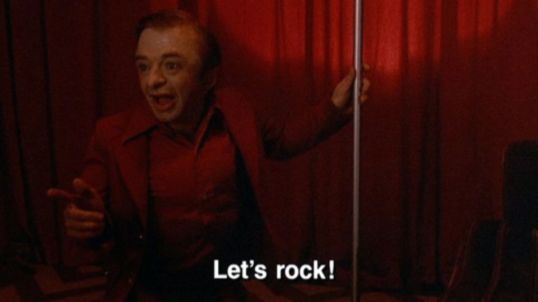
In his dream, a much older, gray-haired Dale Cooper sits in a room with red curtain.  (The old age makeup that was put on MacLachlan for the dream sequence immediately made me think of Keir Dullea watching himself age, at the end of 2001: A Space Odyssey, before being reborn as a new being.)  A little man — credited as being The Man From Another Place (Michael Anderson) — stands in a corner with his back to Dale and shakes in a way that almost seems obscene.  Somewhere, perhaps behind the curtains, a distorted voice chants, “Laura!  Laura!”

There are a succession of quick cuts.  Mrs. Palmer (Grace Zabriskie) runs down the dark staircase in her house.  The character who will eventually be known as Killer BOB (Frank Silva) stares menacingly at the viewer.

The one-armed man, who has wandered through the previous two episodes, appears and recites a poem: “Through the darkness of futures past/ The magician longs to see/ One chants out between two worlds/ Fire Walk With Me.”  The one-armed man says that “we lived among the people.  I think you say convenience store.  We lived above it.”  The man says that he was touched by the “devilish one.”  He has a tattoo on his left shoulder but when the man saw the face of God, he chopped his arm off.  “My name is Mike … his name is BOB.”

(Intentionally or not, we are reminded of another Mike and Bob who live in Twin Peaks.  Could the Mike and BOB of Cooper’s dream but just layers of what lies underneath the two drug-dealing star football players?  Is Cooper dreaming or is he just looking under the bark?)

BOB appears, sitting in what appears to be a boiler room, bringing to mind another film about a dream killer, Wes Craven’s A Nightmare on Elm Street.  BOB, never one for subtlety, announces, “I’ll catch you with my death bag! You may think I’ve gone insane, but I promise, I will kill again!”

The older Cooper is back in the room with red curtains.  The Man From Another Place continues to shake in the corner, his jerky movements almost mimicking masturbation.  Meanwhile, Laura Palmer, in a black dress, sits across from Cooper and smiles.

What follows is one of the best scenes in David Lynch’s legendary career.  When The Man From Another Place finally turns around and starts to talk to Cooper, his voice has been dubbed backwards.  The same is true of Laura when she speaks.  We only know what they say because of the subtitles.  It’s a very disconcerting effect, one that leaves us feeling as if the world is spinning in the wrong direction and might come off its axis at any moment.

The Man and Laura say a lot to Cooper.  Some of what they say we know to be true.  When The Man says that Laura is full of secrets, we know that he speaks the truth.  When he says that Laura is not Laura but is instead his cousin (“but doesn’t she look like Laura Palmer,” he says) we may be confused but lovers of film noir will immediately think of Otto Preminger’s Laurain which a detective thinks he’s falling in love with a dead woman until it’s revealed that the woman who was killed was not actually Laura but instead a look alike.  (It has been suggested that Laura Palmer was specifically named after the title character in Preminger’s film.)  When Laura says that, “Sometimes I feel like her but my arms bend back…,” it’s an obvious reference to the torture she endured in that railway car.

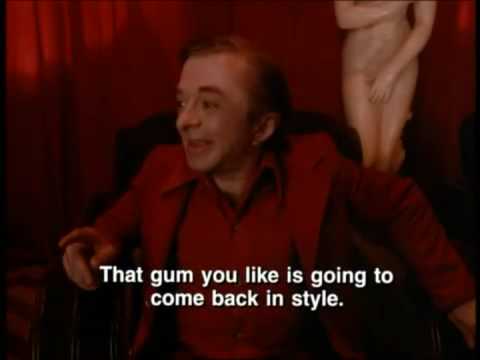
But there are other lines that only make sense if you’re willing to accept that they’re meant to be random.  Why does the Man tells Cooper, “The gum you like is going to come back in style?”  It could be an acknowledgement that the chivalrous and optimistic Cooper is a man out of time.  Or it could just be something that the Man said to make conversation.

And why does the Man From Another Place dance at the end of the dream?  That question gets asked more than any other and the answer is deceptively simple.  If you know anything about the aesthetic of David Lynch, you know that the Man From Another Place dances just because he does.  Things happen and, Lynch suggests, there often is no specific reason.

While the Man dances, Laura kisses Cooper.  As I rewatched this scene, I particularly noticed that creepy way that the previously chaste Cooper smiled as Laura kissed him.  It’s hard not to compare his smile to the somewhat goofy grin that decorated the face of Ben Horne when he visited One-Eyed Jacks at the start of this episode.  Again, another layer has been peeled away and we’ve seen what lurks underneath.

Laura whispers in Cooper’s ear as the episode ends.  What she says will have to wait for our next review.  What’s important, for now, is that Cooper awakes, calls Harry, and announces, “I know who killed Laura Palmer!”

Previous Entries in The TSL’s Look At Twin Peaks:

  1. Twin Peaks: In the Beginning by Jedadiah Leland
  2. TV Review: Twin Peaks 1.1 — The Pilot (dir by David Lynch) by Lisa Marie Bowman
  3. TV Review: Twin Peaks 1.2 — Traces To Nowhere (directed by Duwayne Dunham) by Jedadiah Leland

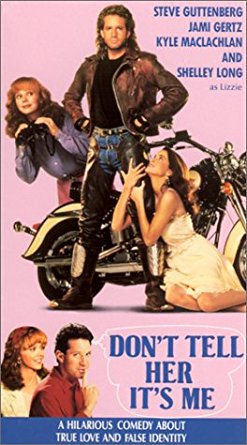
A Movie A Day #86: Don’t Tell Her It’s Me (1990, directed by Malcolm Mowbray)


This month, since the site is currently reviewing each episode of Twin Peaks, every entry in Move A Day is going to have a Twin Peaks connection.  I am going to start things with Don’t Tell Her It’s Me, a movie that I normally would never think of as having anything to do with Twin Peaks or anything else that David Lynch has ever been associated with.

In this very minor romantic comedy, Gus (Steven Guttenberg) is a cartoonist who has just recently beaten cancer.  The treatment has left him bald, overweight, and lonely.  His sister, a popular romance novelist named Lizzie (Shelley Long), sets hm up with her friend, a journalist named Emily (Jami Gertz).  When Emily does not return Gus’s affection, Lizzie decides to transform Gus into every woman’s dream, which in this movie is a rebel named Lobo who comes from New Zealand and rides a motorcycle.  Gus spends a month working out, growing his hair long, and learning how to speak with a New Zealand accent.  Emily falls in love with Lobo, never realizing that he is actually Gus but what will happen when Gus has to finally tell her the truth?  Despite good performances (especially from Shelley Long), Don’t Tell Her It’s Me it too formulaic and predictable to be memorable.  Even if he does have a mullet and is speaking with a different accent, Steve Guttenberg is always going to be Steve Guttenberg and it’s hard to believe that Emily would not be able to see through his act.

Don’t Tell Her It’s Me actually has two Twin Peaks connections.  Kyle MacLachlan, the one and only Dale Cooper himself, plays Trout, who is both Emily’s editor and her cad of a boyfriend.  It’s a nothing role but fans of Twin Peaks will be interested to know that, when Trout is inevitably revealed to be cheating on Emily, the woman that he’s cheating with is played by MacLachlan’s Twin Peaks co-star, Madchen Amick.

If only the Log Lady had been around, Don’t Tell Her It’s Me could have been a much different picture.

TV Review: Twin Peaks 1.2 “Traces to Nowhere” (directed by Duwayne Dunham)


Traces to Nowhere is an episode defined by two accidents.

The first is Pete Martell serving Agent Cooper (Kyle MacLachlan) and Sheriff Truman (Michael Ontkean) fish-tainted coffee while Cooper and Truman are asking Josie (Joan Chen) about Laura Palmer (Sheryl Lee) tutoring her in English.  Pete runs into the room, saying, “Fellas, don’t drink that coffee!  A fish fell into the percolator!”  Hours later, sitting at the Double R Diner, Cooper says that he still has “the taste of that fish-flavored coffee in my mouth.”

The other accident was Killer Bob, who makes his first appearance when Mrs. Palmer (Grace Zabriskie) has a vision of him in the corner of a room.  Bob and his sudden appearances would become one of the best known things about Twin Peaks but, ironically, he wasn’t even a part of the show’s original conception.  Bob was played by Frank Silva, a prop master and set decorator who was working on the pilot episode of Twin Peaks when David Lynch accidentally caught his reflection on camera.  Lynch was so taken by the accidental image that he created the role of Killer Bob specifically for Silva.  Silva made a strong and undeniable impression as the growling Bob but, unfortunately, it would be his only role as an actor.  Silva died of AIDS in 1996, four years after appearing in Twin Peaks: Fire Walk With Me.

Frank Silva as Killer Bob

Traces to Nowhere was the first regular episode of the series, following the pilot.  Probably in order to reassure nervous television executive and viewers who were on the fence about whether or not Twin Peaks was for them, this episode is more quirky than actively strange.  A lot of time is devoted to the show’s more soapy plot threads, like the affairs between Ben Horne (Richard Beymer) and Catherine Martell (Piper Laurie) and Donna Hayward (Lara Flynn Boyle) and James Hurley (James Marshall) and the abusive marriage of Leo (Eric Da Re) and Shelley (Madchen Amick).

There are a lot of first in Traces to Nowhere.  This is the episode where Audrey first talks to Cooper, Cooper first says that the Great Northern serves a “damn fine cup of coffee,” where Cooper first has a slice of cheery pie, and where Cooper first talks about Albert Rosenfield.  This episodes also features the first mention of the Bookhouse Boys and, most importantly for fans of the series, the first appearance of Catherine Coulson as everyone’s favorite Log Lady.  When the Log Lady first shows up and tells Cooper to ask her log who killed Laura Palmer, the character seems like just a throw away joke.  But fans of the show know how important the Log Lady will become.

Catherine Coulson, was passed away in 2015, was the ex-wife of Jack Nance, who played Pete Martell.  Coulson and Nance both worked with David Lynch on his first film, Eraserhead.  It is said that during the shooting of Eraserhead, Lynch looked over at Coulson and said that he had just suddenly had a vision of her holding a log.  (Nance and Coulson were not the only Eraserhead alumni to later appear on Twin Peaks.  Charlotte Stewart, who played the weak mother of Bobby Briggs on Twin Peaks, earlier played Mary X, Nance’s strange girlfriend in Erasherhead.)
Up next: Zen, or the Skill To Catch a Killer!

Previous Entries in The TSL’s Look At Twin Peaks:

  1. Twin Peaks: In the Beginning by Jedadiah Leland
  2. TV Review: Twin Peaks 1.1 — The Pilot (dir by David Lynch) by Lisa Marie Bowman

TV Review: Twin Peaks 1.1 “The Pilot” (dir by David Lynch)


(In anticipation of the upcoming revival on Showtime, we’re rewatching and reviewing every single episode of the original Twin Peaks all through April!  Enjoy!)

“She’s dead, wrapped in plastic.”

— Pete Martell (Jack Nance) in Twin Peaks 1.1 “The Pilot”

When I was thinking about how I was going to open this review of the pilot episode for David Lynch’s iconic (and soon to be revived television series), Twin Peaks, I thought that I would start with this simple statement:

Twin Peaks opens with tears.

Then I rewatched the pilot on Netflix and I discovered that I was actually very incorrect.  Though I always think of the tears whenever I think of Twin Peaks, the pilot does not open with them.  Instead, it opens in a very David Lynch-like fashion — with signs of normalcy while Angelo Badalmenti’s ominous theme music provides hints that all is not as safe as it seems.

Really, it’s silly to try to talk about the pilot of Twin Peaks without including the opening credits because, in their deceptively simple way, they really do provide a road map of what’s to follow:

The opening credits, with their mix of shrouded atmosphere, man-made machinery and seemingly placid nature, are about as Lynchian as you can get.

Then again, the town of Twin Peaks is about as Lynchian as you can get.  Located only a few miles from the Canadian border in Washington State and surrounded by beautiful mountains and glorious wilderness, Twin Peaks is a town that seems strangely out of time.  Twin Peaks takes place in 1990s but, at times, the town seems to be stuck in the 50s.  Not the real 50s, of course.  Instead, it’s the 1950s of television, movies, and the popular imagination.  It’s a town where soulful loner James Hurley (James Marshall) wears a leather jacket and drives a motorcycle while teenage vixen Audrey Horne (Sherilyn Fenn) dresses like Natalie Wood in Rebel Without A Cause and waits until she’s safely at her locker to slip on a pair of red high heels.  Audrey’s father, ruthless Ben Horne (Richard Beymer), makes plans to sell the town to the Norwegians while, at the local diner, wise Norma Jennings (Peggy Lipton) wearily watches over her customers.  It’s a world that could only exist in a dream and what a dream it is.

So no, the pilot of Twin Peaks does not open with tears.  Instead, it opens with Pete Martell (played by Jack Nance, the star of Lynch’s Eraserhead) going out to fish.  He tries to get a kiss from his wife, Catherine (Piper Laurie), but is coolly — but not cruelly — rebuffed.  One gets the feeling that this is a ritual that they go through every morning.  It’s only after Pete has stepped outside that he sees the girl on the shore, naked and wrapped in plastic.

That girl, of course, is Laura Palmer (Sheryl Lee).  The high school homecoming queen.  The girl who did volunteer work.  The girlfriend of football player Bobby Briggs (Dana Ashbrook).  The daughter of Leland Palmer (Ray Wise), Ben Horne’s lawyer.  The best friend of Donna Hayward (Lara Flynn Boyle) and the occasional rival of Audrey Horne.  The secret girlfriend of James Hurley.

It’s after Laura is discovered that the tears begin and those tears dominate the first 30 minutes of this 90-minute pilot.  Deputy Andy (Harry Goaz) is the first to cry.  Laura’s mother (Grace Zabriskie) cries when she gets the news.  Leland cries.  Donna cries.  At the high school, a girl runs by a window, screaming.  The school principal announces that Laura has been found dead and breaks down into tears.  Only a few people don’t cry.  Ben doesn’t cry, knowing that a murder could ruin his business deal.  Bobby doesn’t cry, even when he’s arrested under suspicion of having committed murder.  (He was the last person known to have been with Laura.)  Audrey doesn’t cry and instead, appears to faintly smile at the chaos around her.

And Sheriff Harry S. Truman (Michael Ontkean) doesn’t cry.  However, that’s to be expected.  Harry is the rock on which Twin Peaks is built, both as a show and town.  He’s the least quirky character in the series.  He is law and order.  He’s got a murder to solve and making things even more urgent is that a classmate of Laura’s, Ronette Pulaski, is also missing.

The first 37 minutes of the pilot do a perfect job of establishing both the town and it’s inhabitants.  Everyone has a secret.  Everyone has a motive.  Along with those that I’ve already mentioned, we also meet waitress Shelly (Madchen Amick), who is married to an abusive trucker named Leo (Eric Da Re) and who is having an affair with Bobby.  We meet Bobby’s best friend and fellow football player, a real idiot named Mike (Gary Hershberger).  We meet Donna’s father, Doc Hayward (Warren Frost).  We meet the police dispatcher, the sweetly off-center Lucy (Kimmy Robertson).  We meet Deputy Hawk Hill (Michael Horse) who is as stoic as Andy is emotional.  We meet James’s uncle, Ed Hurley (Everett McGill) and Ed’s one-eyed, drapery-obsessed wife, Nadine (Wendy Robie).  We meet Josie Packard (Joan Chen), who inherited the mill from her late husband and who is secretly Harry’s lover.

And, after Ronette is discovered wandering, zombie-like on a bridge, we meet FBI Special Agent Dale Cooper (Kyle MacLachlan).  More than anything else, Cooper is who people think of whenever they think of Twin Peaks.  MacLalchlan plays the quirky FBI agent with just the right combination of earnestness and eccentricity.  Speaking into his ever-present tape recorder and praising everything from the trees to the pie to the coffee, Cooper quickly establishes himself as the perfect man to figure out what’s going on in Twin Peaks.

David Lynch once famously described his previous collaboration with MacLachlan, Blue Velvet, as being the “Hardy Boys Go To Hell,” and the same can be said of Twin Peaks.  If the first 37 minutes of the pilot were dominated by sadness and secrets, the final 60 are dominated by Dale Cooper’s enthusiasm and cheerful positivity.  The town may be strange but Dale loves the trees.  Dale may be investigating horrible and brutal crimes but at least he’s found a good slice of pie and damn fine cup of coffee.

“You know why I’m whittling?” Dale asks Harry at one point.  “Because that’s what you do in a town where a yellow light means slow down instead of speed up.”  Dale smiles after he says it.  It doesn’t take him long to fall in love with Twin Peaks.

Throughout the rest of the pilot, we get more hints of a world that’s threatening to spin off of its axis.  Dale and Harry run into Dr. Lawrence Jacoby (Russ Tamblyn, who co-starred with Richard Beymer in West Side Story), who was Laura’s psychiatrist and appears to be in need of some therapy himself.  When they look at Laura’s body in the morgue, the lights flicker on and off.  When Dale finds a scrap of newspaper — featuring the letter “R” — underneath Laura’s fingernail, he grins as if he’s just made it through his first Communion.  When Harry and Dale go to the local bank, a moose’s head just happens to be lying on the table in the conference room.  It fell, they’re told.  Despite all the strangeness, they go about their business.  They’ve got a murder to solve.

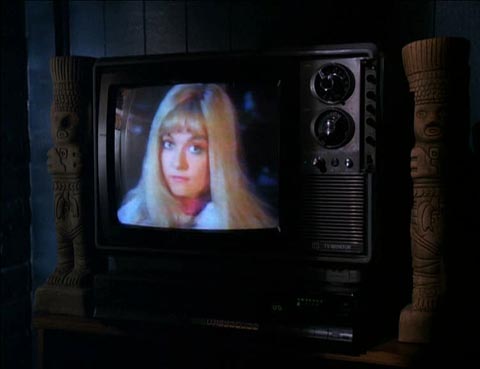
“Mr. Cooper,” Harry says, at one point, “you didn’t know Laura Palmer.”  But, as quickly becomes obvious, no one knew Laura Palmer.  No one, for instance, knew that she was doing cocaine.  And Bobby didn’t know that she was seeing James, or at least he doesn’t until he watches a video that Donna, James, and Laura shot inn the mountains over looking the town.  Laura, who we’ve previously just seen as a dead body, is so happily alive in that video that it’s a bit jarring to see her.  You half expect her to come out of the TV, like the girl in The Ring.  The video ends with her smiling, as if she’s daring both Cooper and the show’s viewers to try to figure out who she actually was.  Only later is it revealed that, in a plot twist reminiscent of Dario Argento’s Four Flies on Grey Velvet, James’s motorcycle is reflected in Laura’s eye.

Life goes on in Twin Peaks.  Audrey, the character to whom I most relate whenever I watch this show, sits in her father’s hotel and penetrates a styrofoam cup of coffee with a pencil.  “What would happen if I pulled this out?” she asks before doing just that.  Audrey walks into the hotel’s conference room and tells the Norwegians that she’s feeling sad because her best friend was just brutally murdered, destroying her father’s business deal.  (“The Norwegians are leaving!  The Norwegians are leaving!” a hotel concierge vainly yells.)

(Perhaps not coincidentally, Norway was also the home of Henrik Ibsen, whose theatrical melodramas often dealt with many of the same themes — greed, infidelity, the corruption that comes with progress — that are present in Twin Peaks.  An Enemy of the People could have just just as easily taken place in the American Northwest.)

Meanwhile, the local police come across the abandoned railroad car where Laura was murdered and Ronnette raped.  Andy calls the sheriff’s office, in tears.  “Tell Harry I didn’t cry,” he begs Lucy, “but it’s so horrible!”  It’s a moment of very real humanity in the middle of this odd and disturbing mystery.  When Andy begs Lucy not to reveal his very human reaction, it’s more than just shame on his part.  It’s an indication that perhaps the only way to solve this mystery is to sacrifice one’s emotions.

And, as Andy said, it is horrible.  When Dale and Harry walk through that railway car, we are reminded that, as quirky at the show may be, a very disturbing crime is still at heart of it.  Among other things, they find a half-heart necklace (the other half is with James) and, written in blood in the debris, a message: “Fire Walk With Me.”  As disturbing as this is in the pilot (and this scene really is Lynch at his best), it’s even more disturbing if you know who will ultimately be revealed to have been Laura’s murderer.  But that information will have to wait for a later review.

It easy to believe that arrogant Bobby Briggs killed Laura but Cooper only has to talk to him for a few minutes to realize that he didn’t do it.  Bobby may be a jerk and a drug dealer.  And Cooper is surely correct when he says that Bobby never loved Laura.  But Bobby is a bully, not a murderer.  When Bobby is released, he and Mike go looking for James.  As unlikable as Bobby is, Mike — with his blonde hair and all-American looks — is somehow even worse.  At least Bobby is open about being an bad guy.  Mike hides his darker instincts behind a carefully cultivated facade of blandness.  Looking at Mike in his red letterman jacket, you really do want someone to claw his eyes out.

Mike and Bobby look for James at the Roadhouse, one of the most important locations in Twin Peaks.  It’s a place where illicit lovers (like Norma and Ed) meet and where Julee Cruise sings haunting songs.  Bobby and Mike may not find James but they do find a fight with Ed.  This leads to Bobby and Mike spending the night in jail, which, ironically, is where they eventually find James.  James has been arrested as a suspect in the death of Laura Palmer.  In their cell, Bobby and Mike start to bark like wild dogs.

And so, a pilot that started with the humanity of tears ends with animalistic howls of anger, hate, and jealousy.

And so, Twin Peaks begins.

If I haven’t already made it clear, I am huge fan of the pilot for Twin Peaks.  Say what you will about where the series eventually went, the pilot was and remains an absolutely brilliant dream of dark and disturbing things.  Having rewatched the pilot, I am definitely looking forward to rewatching the rest of the series for this site and I hope you’ll enjoy the rest of our reviews!

Previous Entries in The TSL’s Look At Twin Peaks:

  1. Twin Peaks: In the Beginning by Jedadiah Leland

Horror on TV: Tales From the Crypt 3.2 “Carrion Death” (dir by Steven E. de Souza)


Tonight’s excursion into televised horror is a pretty good one.  Carrion Death, which originally aired on June 15th, 1991, was the second episode of the third season of HBO’s Tales From The Crypt.

Kyle MacLachlan plays a serial killer named Earl Raymond Digs.  After Earl escapes from custody, he finds himself stuck in the middle of the desert, handcuffed to a corpse.  As Earl walks through the desert, dragging a corpse alongside him, he discovers that he’s being watched…

Carrion Death is a gory, little story that has an enjoyably nasty little ending.  Kyle MacLachlan does a surprisingly good job as the dangerous but none too bright Earl.  And, of course, there’s the bird.  That bird does a great job…

Enjoy!

Worst of the Worst: Mad Dog Time (1996, directed by Larry Bishop)


Mad_dog_time_4841Remember how, in the 1990s, every aspiring indie director tried to rip off Quentin Tarantino by making a gangster film that mixed graphic violence with quirky dialogue, dark comedy, and obscure pop cultural references?  That led to a lot of terrible movies but not a single one (not even Amongst Friends) was as terrible as Mad Dog Time.

That Mad Dog Time was terrible should come as no surprise.  Most directorial debuts are.  What made Mad Dog Time unique was the sheer amount of talent that was assembled and wasted in the effort to bring this sorry movie to life.  As the son of Joey Bishop, director Larry Bishop was Hollywood royalty and was able to convince several ridiculously overqualified actors to play the thinly drawn gangsters and rouges who populated Mad Dog Time.  Much like the Rat Pack movies that his father once starred in, Larry Bishop’s debut film was full of familiar faces.  Some of them only appeared for a few seconds while others had larger roles but they were all wasted in the end.  Hopefully, everyone was served a good lunch in between filming their scenes because it is hard to see what else anyone could have gotten out of appearing in Mad Dog Time.

Mob boss Vic (Richard Dreyfuss) has just been released from a mental hospital.  With the help of his main enforcer, Mick (Jeff Goldblum), and a legendary hitman named Nick (Larry Bishop, giving not only the worst performance in the film but also the worst performance of the 1990s), Vic is going to reassert his control over the rackets.  Vic also wants to find his former mistress, Grace Everly (Diane Lane) but he doesn’t know that Grace is now with Mick and that Mick is also having an affair with Grace’s sister, Rita (Ellen Barkin).

(Grace and Rita are the Everly Sisters!  Ha ha, between that and all the rhyming names, are you laughing yet?)

Anka and Byrne

Ben London (Gabriel Byrne) has taken over Vic’s nightclub and, while singing My Way with Paul Anka, tells Vic that he should take an early retirement because he’s a paranoid schizophrenic.  Before he can deal with Ben, Vic has to kill all of his other rivals, all of whom are played by actors like Michael J. Pollard, Billy Idol, Kyle MacLachlan, Gregory Hines, and Burt Reynolds.  The bodies start to pile up but Jimmy the Undertaker (Richard Pryor, looking extremely frail in one of his final roles) is always around to make sure that everyone gets a proper burial.

And there are other cameos as well.  Joey Bishop is the owner of a mortuary.  Henry Silva is wasted as one the few gangsters to stay loyal to Vic.  Christopher Jones, who previously co-starred with Larry Bishop and Richard Pryor in Wild In The Streets before dropping out of a society, plays a hitman who pretends to be Nick Falco.  Even Rob Reiner shows up a limo driver who talks too much.

Almost every poorly paced scene in Mad Dog Time plays out the same way.  Three or more men confront each other in a room.  Hard-boiled dialogue is exchanged for an interminable length of time until someone finally gets shot.  You would think, at the very least, it would be watchable because of all the different people in the cast but none of the actors really seem to be into it.  Richard Dreyfuss and Jeff Goldblum resort to smirking through their scenes while Gabriel Byrne often appears to be drunk.  Whenever he’s in a scene, Burt Reynolds seems to be trying to hide his face and it is hard to blame him.  There were many terrible movies released in the 90s but none were as bad as Mad Dog Time.

Pixar Does It Again With Inside Out


Inside_Out_(2015_film)_posterInside Out is the latest brilliant film from Pixar’s Pete Docter and it will remind you why you fell in love with Pixar in the first place.

There are no talking cars or lovable monsters in Inside Out.  Instead, it’s the story of a very normal 12 year-old girl named Riley (voiced by Kaitlyn Dias).  Or rather, it’s the story of what goes on in her head.  For most of the movie, Riley deals with experiences to which we can all relate: she moves to a new city, she struggles to relate to her well-meaning parents (voiced by Kyle MacLachlan and Diane Lane), and she tries to fit in at a new school.  Inside Out is a film about the small moments of life and how they all add up to create a bigger picture.

What sets Inside Out apart is the way that it tells its deceptively simple story.  Inside Out takes place almost entirely inside of Riley’s brain.  And it turns out that her mind is gigantic wonderland, one that is so big and complex that not even the characters who live there quite understand how it all works.  Bing Bong (Richard Kind), a pink half-elephant, half-cat, half-dolphin creature, spends his time wandering through the halls of memory and mournfully thinking back to when he was Riley’s imaginary friend.  Whenever Riley goes to sleep, the actors and directors at Dream Productions film a different nightly movie.  Meanwhile, Imagination Land is a fun place to visit but not a good place in which to live and past childhood traumass — like a gigantic stalk of broccoli and a terrifying birthday clown — are locked away deep in Riley’s subconscious, where they are guarded by officious policemen.   Zigzagging through this mental landscape is the literal Train of Thought.

And then, above it all, there’s Headquarters.  This is where five different emotions take turns “steering” Riley through life.  Fear (Bill Hader) is always nervous but, at the same time, keeps Riley safe.  Disgust (Mindy Kaling) prevents Riley from eating broccoli and hanging out with the wrong crowd.  Sadness, meanwhile, hasn’t had much to do over the past 12 years and, as a result, she spends most of her time standing in a corner and feeling … well, sad.  Sadness is voiced by Phyllis Smith, best known for playing Meredith on The Office.  Smith proves herself here to be a strong and empathetic voice artist.

Their unquestioned leader is Joy (Amy Poehler).  As befits her name and job, Joy is always positive, always upbeat, and always optimistic.  For 12 years, Joy has been in charge of steering Riley’s life but that all changes when Riley and her family move to San Francisco.  Suddenly, Joy finds it more difficult to keep Riley permanently happy.  Memories that were formerly color-coded yellow for happy start to turn blue.

When both Joy and Sadness are accidentally expelled from the Headquarters, it’s up to the three remaining emotions to try to keep Riley well-balanced until they can return.  However, the journey back up to the Headquarters is a long and dangerous one, full of some of the most imaginative (and metaphorical) imagery in Pixar’s history.  Joy and Sadness will have to work together to make it.

And really, that’s what makes Inside Out so special.  It’s the rare family film that acknowledges that allowing ourselves to feel sad is often as important as being happy.

Inside Out is a brilliant coming-of-age story and one of the best films of the year.  It’s a film that will make you laugh and cry and will remind you of why you fell in love with Pixar in the first place.  Kids will love the humor and adults … well, adults will probably be trying to hold back the tears.

What a great film!

Thank you, Pixar.