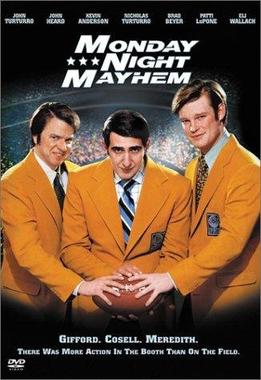
In the late 1960s, television coverage of football is dull and boring. The games are played during the day and the announcers have no personality. An executive at ABC named Roone Arledge (John Heard) changes all of that by convincing the NFL to start scheduling games for Monday night. Arledge launches Monday NightFootball, a broadcast that puts the viewers at home in the stadium. Arledge explains that he wants cameras everywhere. He wants the sidelines and the stands to be mic’d up. And he wants announcers who will make the game interesting. He picks an experienced radio announcer named Keith Jackson (Shuler Hensley), former Dallas quarterback Don Meredith (Brad Beyer), and finally an egocentric, loquacious, and opinionated sports reporter named Howard Cosell (John Turturro). The straight-laced Jackson only lasts a season and finds himself overshadowed by Meredith’s good ol’ boy charisma and Cosell’s eccentricities. Arledge brings in Frank Gifford (Kevin Anderson) as a replacement and changes both sports and television forever. Monday night football becomes huge but so do the egos of the men involved.
Based on a non-fiction book by Bill Carter, MondayNightMayhem is a look at the early days of Monday Night Football, with most of the attention being given to the mercurial Howard Cosell. As a work of history, it’s pretty shallow. There’s a lot of montages set to familiar 70s tunes and there’s plenty of familiar stock footage. Beyer and Anderson do adequate impersonations of Meredith and Gifford without really digging for much under the surface. MondayNightMayhem is dominated by John Turturro’s performance as Howard Cosell. Turturro doesn’t look like Cosell and he really doesn’t sound that much like Cosell but he does capture the mix of arrogance and bitterness that made Howard Cosell such a memorable and controversial announcer. In its breezy manner, the film hits all the well-know points of Cosell’s life and career, from defending Mohammad Ali to considering a run for the Senate to trying to reinvent himself as a variety show host to the controversy when he was though to have uttered a racial slur during one of the games. I wish the film had a bit more depth but John Turturro’s committed but bizarre performance keeps it watchable.
There are a lot of names that get mentioned. Some people give all the credit to U.S. Senator Gaylord Nelson of Wisconsin, who was an environmentalist before it was trendy and who proposed a day-long “teach-in” in 1970. (According to Norman Mailer, Hunter Thompson, and Gary Hart, Gaylord Nelson was also George McGovern’s personal pick for his running mate in 1972 but ultimately, Nelson didn’t get the spot because it was felt people would make fun of his first name. Considering how things went with Thomas Eagleton, one imagines that McGovern probably ended up wishing he had the courage to go with his first instinct.) A peace activist named John McConnell also proposed the idea of an Earth Day in 1969 but there’s some debate whether his proposed Earth Day became the actual Earth Day. Like all things, many people have taken credit for the idea behind Earth Day.
Ira Einhorn was one of those people. A prominent member of Pennsylvania’s counter-culture, Einhorn was a self-styled New Age environmentalist and he did speak at the first Earth Day event in Philadelphia. Einhorn went on to become a prominent guru, providing his services to several corporations that were looking to shake off their stodgy image. He led protests against nuclear energy. He wrote articles about CIA duplicity. He was, for a while, a popular figure and, due to his last name, he was nicknamed “The Unicorn.” He always claimed that he was instrumental in starting Earth Day but the organizers behind the event have always been quick to say that he had little do with it.
It’s understandable that the people behind Earth Day would rather not be associated with Ira Einhorn. Einhorn presented himself as being a quirky, fun-loving hippie but, in private, he was known for having both a violent temper and a misogynistic streak. In 1977, Einhorn’s ex-girlfriend, Texas-born Holly Maddux, disappeared. In 1979, her mummified remains were found in a box that Einhorn kept in his closet. Arrested for her murder and defended in court by future U.S. Sen. Arlen Specter, Einhorn claimed that he was innocent and that he had no idea how Holly Maddux ended up in his closet. (He suggested the CIA might be responsible.) With the help of his wealthy friends, Einhorn fled the United States and ended up in Europe. He lived in Europe for nearly 20 years until he was finally arrested in France. Einhorn’s claim that he was being framed for his anti-nuclear advocacy found a sympathetic audience amongst certain members of the French intellectual community. Eventually, though, Ira Einhorn was extradited to Pennsylvania. He spent the rest of his life in prison, eventually dying in 2020. To the end, he had his supporters despite the fact that he was clearly guilty.
Made for television in 1999, The Hunt For The Unicorn Killer tells the story of Ira (Kevin Anderson), Holly (a pre-MulhollandDrive Naomi Watts), and Holly’s father, Fred (Tom Skerritt). It does a good job of telling the disturbing story of Ira Einhorn and it features good performances from its main stars. Tom Skerritt especially does a good job as a father determined to get justice for his daughter. The film shows how so many of Ira’s friends rationalized his actions, not wanting to admit that their nostalgia for the 60s and the counterculture was blinding them to the monster in their midst. It’s a portrait of how one evil man was able to take advantage of the idealism of others.
The Hunt For The Unicorn Killer‘s original running time was 163 minutes and it was aired over two nights. It was later edited down to 90 minutes for syndication. The uncut version is available on YouTube and that’s definitely the one to see.
Welcome to Retro Television Reviews, a feature where we review some of our favorite and least favorite shows of the past! On Mondays, I will be reviewing Miami Vice, which ran on NBC from 1984 to 1989. The entire show is currently streaming on Tubi!
This week, the second season with a two-hour long premiere! Crockett and Tubbs are going to New York!
Episode 2.1 and 2.2 “The Prodigal Son”
(Dir by Paul Michael Glaser, originally aired on September 27th, 1985)
The second season premiere of Miami Vice opens with a series of set pieces.
In Panama, Crockett and Tubbs visit a secret military base in the jungle and are disgusted to learn how the Panamanian military gets information about drug smugglers. Tubbs and Crockett find one horribly tortured man in a tent. Tubbs gives him a drink of water and gets what information he can from the man. Crockett and Tubbs leave the tent. A gunshot rings out as the involuntary informant is executed. When the shot rings out, both Crockett and Tubbs turn back to the tent in slow motion, stunned by the brutality of their allies in the Drug War. Indeed, it’s hard not to compare the scene to the famous photograph of a South Vietnamese general executing a communist during the Vietnam War.
The Vietnam analogy continues with the next scene. In the Everglades, Crockett, Tubbs, and the entire Vice Squad work with the DEA to ambush the Revilla cousins as they bring drugs into the U.S. Sitting in the swamp, Crockett compares the experience to Vietnam, suggesting that the war on the drugs is just as futile and as costly. And indeed, it’s hard not to notice that every drug dealer that Crockett and Tubbs has taken down over the course of this show has immediately been replaced by another. The Revillas are just another in a long line of people getting rich off of other people’s addictions.
After the bust goes down, Crockett and Tubbs arrives at a celebratory party, just to discover that almost of all of the undercover DEA agents have been murdered and Gina has been seriously wounded. There is something very haunting about this scene, with Crockett and Tubbs rushing through a penthouse and seeing a dead body in almost every room.
At a meeting in a stark office, the head DEA agent explains that his agency has been compromised and all of his undercover agents have been unmasked. Someone has to go to New York and work undercover to take down the Revillas but it can’t be any of his people. Since the Revillas are smuggling their stuff in through Miami, Miami Vice has jurisdiction. Paging Crockett and Tubbs!
Working undercover as Burnett and Cooper, Crockett and Tubbs visit a low-level drug dealer (played by Gene Simmons) who lives on a yacht and who gives them the name of a connection in New York City.
From there, Miami Vice moves to New York City, where Crockett and Tubbs meet a low-level criminal named Jimmy Borges (played by an almost impossibly young Penn Jillette) and they try to infiltrate the Revilla organization. Along the way, Tubbs meets up with Valerie (Pam Grier) and discovers that she has apparently lost herself working undercover. Meanwhile, Crockett has a brief — and kind of weird — romance with a photographer named Margaret (Susan Hess).
(“I like guns,” she says when Crockett demands to know why she stole his.)
With Crockett and Tubbs leaving Miami for New York in order to get revenge for a colleague who was wounded during an operation, The Prodigal Son almost feels like the pilot in reverse. Also, much like the pilot, the exact details of The Prodigal Son‘s story are often less important than how the story is told. This episode is full of moody shots of our heroes walking through New York while songs like You Belong To The City play on the soundtrack. (There’s also a song from Phil Collins, undoubtedly included to bring back memories of the In The Air Tonight scene from the pilot.) It’s all very entertaining to watch, even if the story itself doesn’t always make total sense. Indeed, you really do have to wonder how all of these criminals keep falling for Sonny’s undercover identity as Sonny Burnett. You would think that someone would eventually notice that anyone who buys from Sonny Burnett seems to get busted the very next day.
Stylish as the storytelling may be, this episode actually does have something on its mind. Those lines comparing the War on Drugs to the Vietnam Conflict was not just throwaways. Towards the end of the episode, Crockett and Tubbs follow a lead to the offices of J.J. Johnston (Julian Beck, the ghost preacher from Poltergeist II). The skeletal Johnston is an investor of some sort. He has no problem admitting that he’s involved in the drug trade, presumably because he knows that there’s nothing Crockett and Tubbs can do to touch him. Upon meeting the two cops, he immediately tells them exactly how much money they have in their checking accounts. He points out that they’re poor and they’re fighting a losing war whereas he’s rich and he’s making money off of a losing war. Beck gives a wonderfully smug performance as Johnston and it should be noted that, of all of the episode’s villains, he’s the only one who is not brought to any sort of justice. Val almost loses herself. Tubbs and Crockett don’t even get a thank you for their hard work. The somewhat sympathetic Jimmy Borges ends up dead while the Revillas were undoubtedly been replaced by even more viscous dealers. Meanwhile, J.J. Johnston relaxes in his office and counts his money. This is the No Country For Old Men of Miami Vice episodes.
This episode is also full of familiar faces. Charles S. Dutton, Kevin Anderson, Anthony Heald, Miguel Pinero, James Russo, Bill Smtirovich, Zoe Tamerlis, Paul Calderon, and Louis Guzman, they all show up in small roles and add to show’s rather surreal atmosphere. This is Miami Vice at its most dream-like, full of people you think you might know despite the fact that they’re doing things of which you don’t want to be a part.
As for the title, The Prodigal Son is Tubbs and he is tempted to stay in New York City. But, in the end, he joins Crockett on that flight back to Miami. It’s his home.
The 1992 film, Hoffa, opens in 1975, with two men sitting in the backseat of a station wagon. One of the men is the controversial labor leader, Jimmy Hoffa (Jack Nicholson). The other is his longtime best friend and second-in-command, Bobby Ciaro (Danny DeVito). The two men are parked outside of a roadside diner. They’re waiting for someone who is late. Jimmy complains about being treated with such disrespect and comments that this would have never happened earlier. Jimmy asks Bobby if he has his gun. Bobby reveals that he does. Jimmy asks him if he’s sure that there’s a loaded gun in the diner, as well. Bobby goes to check.
Jimmy Hoffa, of course, was a real person. (Al Pacino just received an Oscar nomination for playing him in The Irishman.) He was a trucker who became a labor leader and who was eventually elected president of the Teamsters Union. He was a prominent opponent of the Kennedys and that infamous footage of him being interrogated by Bobby Kennedy at a Senate hearing seems to sneak its way into almost every documentary ever made about organized crime in the 50s. Hoffa was linked to the Mafia and was eventually sent to prison. He was freed by the Nixon administration, under the condition that he not have anything to do with Teamster business. When he disappeared in 1975, he was 62 years old and it was rumored that he was planning on trying to take over his old union. Everyone from the mob to the CIA has been accused of having had Hoffa killed.
Bobby Ciaro, however, was not a real person. Apparently, he was a composite character who was created by Hoffa’s screenwriter, David Mamet, as a way for the audience to get to know the enigmatic Jimmy Hoffa. Bobby is presented as being Hoffa’s best friend and, for the most part, we experience Jimmy Hoffa through his eyes. We get to know Jimmy as Bobby gets to know him but we still never really feel as if we know the film’s version of Jimmy Hoffa. He yells a lot and he tells Bobby Kennedy (a snarling Kevin Anderson) to go to Hell and he talks a lot about how everything he’s doing is for the working man but we’re never really sure whether he’s being sincere or if he’s just a demagogue who is mostly interested in increasing his own power. Bobby Ciaro is certainly loyal to him and since Bobby is played by the film’s director, it’s hard not to feel that the film expects us to share Bobby’s admiration. But, as a character, Hoffa never really seems to earn anyone’s loyalty. We’re never sure what’s going on inside of Hoffa’s head. Jack Nicholson is always entertaining to watch and it’s interesting to see him play a real person as opposed to just another version of his own persona but his performance in Hoffa is almost totally on the surface. With the exception of a few scenes early in the film, there’s doesn’t seem to be anything going on underneath all of the shouting.
The majority of Hoffa is told via flashback. Scenes of Hoffa and Bobby in the film’s present are mixed with scenes of Hoffa and Bobby first meeting and taking over the Teamsters. Sometimes, the structure of the film is a bit cumbersome but there are a few scenes — especially during the film’s first thirty minutes — that achieve a certain visual poetry. There’s a scene where Hoffa helps to change a man’s flat tire while selling him on the union and the combination of falling snow, the dark city street, and Hoffa talking about the working man makes the scene undeniably effective. The scenes where Hoffa spars with Bobby Kennedy are also effective, with Nicholson projecting an intriguing blue collar arrogance as he belittles the abrasively ivy league Bobby. Unfortunately, the rest of the movie doesn’t live up to those scenes. By the time Hoffa becomes a rich and influential man, you realize that the film isn’t really sure what it wants to say about Jimmy Hoffa. Does it want to condemn Hoffa for getting seduced by power or does it want to excuse Hoffa’s shady dealings as just being what he had to do to protect the men in his union? The film truly doesn’t seem to know.
Hoffa is definitely not an offer that you shouldn’t refuse but, at the same time, it’s occasionally effective. A few of the scenes are visually appealing and the cast is full of character actors like John C. Reilly, J.T. Walsh, Frank Whaley, and Nicholas Pryor. It’s not a disaster like The Gang Who Couldn’t Shoot Straight.Hoffa is an offer that you can take or leave.
 In the late 1960s, television coverage of football is dull and boring. The games are played during the day and the announcers have no personality. An executive at ABC named Roone Arledge (John Heard) changes all of that by convincing the NFL to start scheduling games for Monday night. Arledge launches Monday Night Football, a broadcast that puts the viewers at home in the stadium. Arledge explains that he wants cameras everywhere. He wants the sidelines and the stands to be mic’d up. And he wants announcers who will make the game interesting. He picks an experienced radio announcer named Keith Jackson (Shuler Hensley), former Dallas quarterback Don Meredith (Brad Beyer), and finally an egocentric, loquacious, and opinionated sports reporter named Howard Cosell (John Turturro). The straight-laced Jackson only lasts a season and finds himself overshadowed by Meredith’s good ol’ boy charisma and Cosell’s eccentricities. Arledge brings in Frank Gifford (Kevin Anderson) as a replacement and changes both sports and television forever. Monday night football becomes huge but so do the egos of the men involved.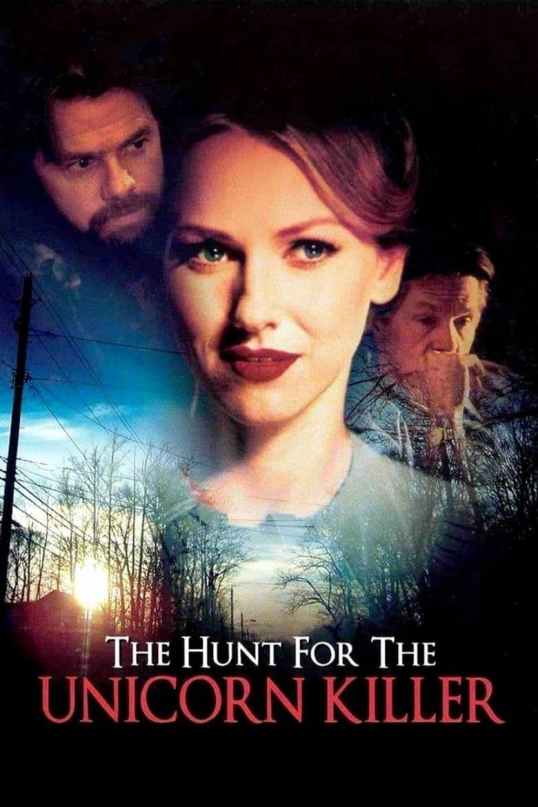


 Through the Shattered Lens