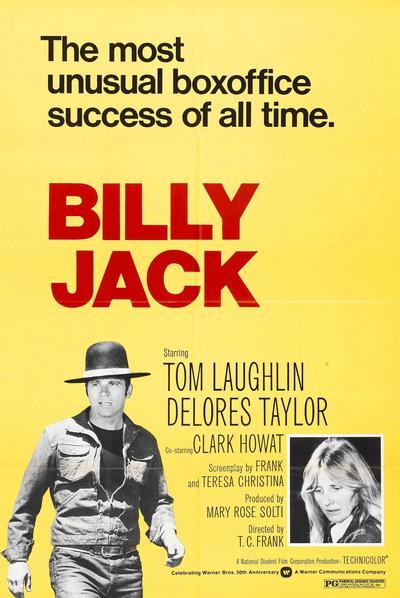
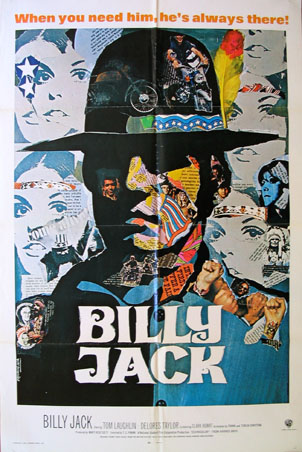
When last we saw Billy Jack, he was dismantling a brood of outlaw bikers in BORN LOSERS . This time around, he’s taking on a whole town’s worth of rednecks as Tom Laughlin’s half-breed ex-Green Beret returns in BILLY JACK, the wildly popular film that combines action with social commentary, and helped kick off the martial arts craze of the 70’s.
BILLY JACK almost never saw the light of day, as Laughlin’s financing was shut off by American-International Pictures. 20th Century-Fox then picked it up, but didn’t think it deserved to be released, so Laughlin went the indie route, under the banner of National Student Film Co. in 1971. Poor distribution and poor reviews caused the film to tank, but the good folks at Warner Brothers saw something in it, and gave it a national release two years later. Young audiences of the day flocked to it in droves, cheering as Billy Jack…
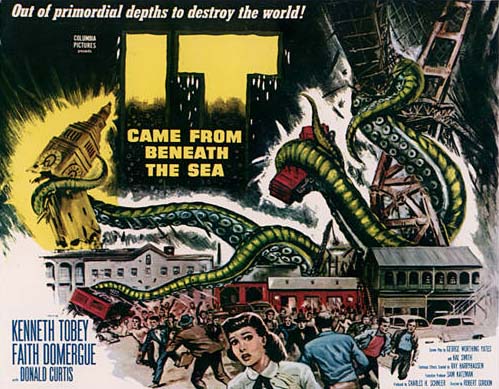
Let’s return to those thrilling days of yore before CGI and enter the wonder-filled world of Special Effects legend Ray Harryhausen! I’ve covered some of Harryhausen’s fantastic work before (ONE MILLION YEARS BC , EARTH VS THE FLYING SAUCERS , THE VALLEY OF GWANGI ), and most of you regular readers know of my affection for his stop-motion wizardry. So without further ado, let’s dive right into IT CAME FROM BENEATH THE SEA.
An atomic submarine picks up a mysterious large object on its sonar. The sub’s hit hard, and radiation is detected in the surrounding area. The damaged sub is taken to Pearl Harbor for repairs, and a substance found on it is determined to be from a “living creature” by eminent scientist Dr. John Carter (Donald Curtis) and beautiful marine biologist Prof. Leslie Joyce (Faith Domergue ). Sub Commander Pete Matthews (Kenneth Tobey ) and Leslie immediately butt heads…
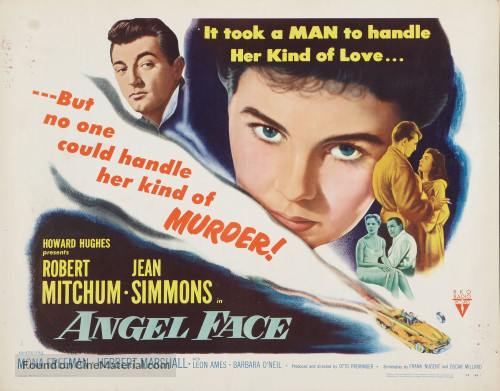
I saved ANGEL FACE for last in this week’s look at RKO/Robert Mitchum films because it’s been hailed as a near-classic by many film noir fans. It’s certainly different from HIS KIND OF WOMAN and MACAO; much darker in tone, and features an unsympathetic performance by Mitchum. It’s more in the noir tradition of bleak films like DETOUR and BORN TO KILL. But better than the other two? That depends on your point of view. Let’s take a look:
An ambulance screams its way to the Tremayne home in ritzy Beverly Hills. The wealthy Mrs. Catherine Tremayne has been subjected to a gas leak of unknown origin. One of the ambulance drivers, Frank Jessup, comes across beautiful Diane playing the piano. She bursts into hysterics, and Frank smacks her, receiving one in return. After she calms down, Frank and his partner Bill head home. Frank has a date with his girl Mary…
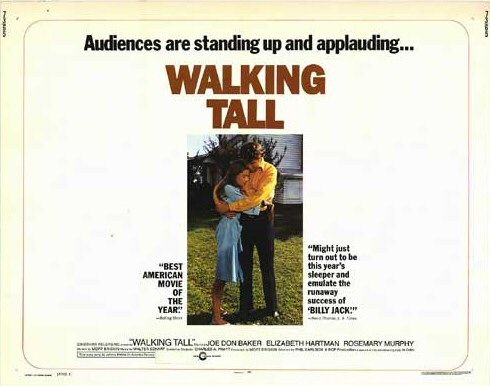
About 50 minutes into the 1973 film Walking Tall (not to be confused with the 2005 version that starred Dwayne Johnson), there’s a scene in which newly elected sheriff Buford Pusser (Joe Don Baker) gives a speech to his deputies. As the deputies stand at attention and as Pusser announces that he’s not going to tolerate any of his men taking bribes from the Dixie Mafia, the observant viewer will notice something out-of-place about the scene.
Hovering directly above Baker’s head is a big, black, almost phallic boom mic. It stays up there throughout the entire scene, a sudden and unexpected reminder that — though the film opens with a message that we’re about to see the true story of “an American hero” and though it was filmed on location in rural Tennessee — Walking Tall is ultimately a movie.
And yet, somehow, that phallic boom mic feels oddly appropriate. First off, Walking Tall is an almost deliberately messy film. That boom mic tells us that Walking Tall was not a slick studio production. Instead, much like Phil Karlson’s previous The Phenix City Story, it was a low-budget and violent film that was filmed on location in the south, miles away from the corrupting influence of mainstream, yankee-dominated Hollywood. Secondly, the phallic implications of the boom mic erases any doubt that Walking Tall is a film about men doing manly things, like shooting each other and beating people up. Buford does have a wife (Elizabeth Hartman) who begs him to avoid violence and set a good example of his children. However, she eventually gets shot in the back of the head, which frees Buford up to kill.
As I said earlier, Walking Tall opens with a message telling us that we’re about to watch a true story. Buford Pusser is a former football player and professional wrestler who, after retiring, returns to his hometown in Tennessee. He quickly discovers that his town is controlled by criminals and moonshiners. When he goes to a local bar called The Lucky Spot, he is unlucky enough to discover that the bar’s patrons cheat at cards. Buford is nearly beaten to death and dumped on the side of the road. As Buford begs for help, several motorists slow down to stare at him before then driving on.
Obviously, if anyone’s going to change this town, it’s going to have to be Buford Pusser.
Once he recovers from his beating, Buford makes himself a wooden club and then goes back to the Lucky Spot. After beating everyone up with his club, Buford takes back the money that he lost while playing cards and $50.00 to cover his medical bills. When Buford is put on trial for armed robbery, he takes the stand, rips off his shirt, and shows the jury his scars. Buford is acquitted.
Over his wife’s objections, Buford decides to run for sheriff. The old sheriff, not appreciating the competition, attempts to assassinate Buford but, instead, ends up dying himself. Buford is charged with murder. Buford is acquitted. Buford is elected sheriff. Buford sets out to clean up his little section of Tennessee. Violence follows…
On the one hand, it’s easy to be snarky about a film like Walking Tall. This is one of those films that operates on a strictly black-and-white world view. Anyone who supports Buford is good. Anyone who opposes Buford is totally evil. Buford is a redneck saint. It’s a film fueled by testosterone and it’s not at all subtle…
But dangit, I liked Walking Tall. It’s a bit like a right-wing version of Billy Jack, in that it’s so sincere that you can forgive the film’s technical faults and frequent lapses in logic. Walking Tall was filmed on location in Tennessee and director Phil Karlson makes good use of the rural locations. And, most importantly, Joe Don Baker was the perfect actor to play Buford Pusser. As played by Baker, Pusser is something of renaissance redneck. He’s a smart family man who knows how to kick ass and how to make his own weapons. What more could you ask for out of a small town sheriff?
In real life, Buford Pusser died in a mysterious car accident shortly after the release of Walking Tall. Cinematically, the character of Buford Pusser went on to star in two more films.
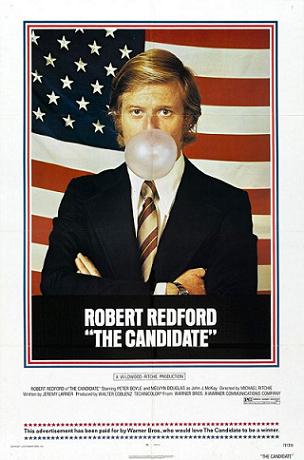
“What do we do now?” — Democratic senate candidate Bill McKay (Robert Redford) in The Candidate (1972)
When I reviewed Advise & Consent, I mentioned that if anyone could prevent billionaire Tom Steyer from winning the Democratic nomination to run in the 2016 California U.S. Senate election, it would be Betty White. Well, earlier today, Tom Steyer announced that he would NOT be a candidate. You can guess what that means. Betty White has obviously already started to set up her campaign organization in California and, realizing that there was no way that he could possibly beat her, Tom Steyer obviously decided to step aside.
So, congratulations to Betty White! (I would probably never vote for her but I don’t live in California so it doesn’t matter.) As future U.S. Senator Betty White prepares for the next phase of her career, it would probably be a good idea for her to watch a few movies about what it takes to win political office in the United States.
For example: 1972’s The Candidate.
The Candidate would especially be a good pick for the nascent Betty White senate campaign because the film is actually about a senate election in California! California’s U.S. Sen. Crocker Jarmon (Don Porter) is a Republican who everyone assumes cannot be defeated for reelection. Democratic strategist Marvin Lucas (a heavily bearded Peter Boyle) is tasked with finding a sacrificial candidate.
The one that Marvin comes up with is Bill McKay (Robert Redford, before his face got all leathery), a 34 year-old lawyer who also happens to be the estranged son of former Governor John J. McKay (Melvyn Douglas, whose wife Helen ran for one of California’s senate seats in 1950). As opposed to his pragmatic and ruthless father, Bill is idealistic and the only reason that he agrees to run for the Senate is because Marvin promises him that he’ll be able to say whatever he wants. Marvin assures Bill that Jarmon cannot be beaten but if Bill runs a credible campaign, he’ll be able to run for another office in the future.
However, Jarmon turns out to be a weaker candidate than everyone assumed. As the charismatic Bill starts to close the gap between himself and Jarmon, he also starts to lose control of his campaign. He soon finds himself moderating his positions and worrying more about alienating potential voters than stating his true opinions. (In one of the film’s best scenes, Bill scornfully mutters his standard and generic campaign speech to himself, obviously disgusted with the vapid words that he has to utter in order to be elected.) The film ends on a properly downbeat note, one that reminds you that the film was made in the 70s but also remains just as relevant and thought-provoking in 2015.
Written by a former political speech writer and directed, in a semi-documentary style, by Michael Ritchie, The Candidate is an excellent film that answer the question as to why all political campaigns and politicians seem to be the same. The Candidate is full of small details that give the film an air of authenticity even when a familiar face like Robert Redford is on screen.
Whenever I watch The Candidate, I find myself wondering what happened to Bill McKay after the film’s iconic final scene. Did he ever regain his idealism or did he continue on the path to just becoming another politician. As much as we’d all like to think that the former is true, it’s actually probably the latter.
That just seems to be the way that things go.
Hopefully, Betty White will learn from Bill McKay’s example.
“Go ahead and hate your neighbor; go ahead and cheat a friend. Do it in the name of heaven; you can justify it in the end. There won’t be any trumpets blowin’ come the judgment day On the bloody morning after, one tin soldier rides away”
— From One Tin Soldier, the theme song of Billy Jack (1971)
Yesterday, we took a look at The Born Losers, the first film to ever feature the character of future U.S. Senator Billy Jack. The Born Losers ended with former Green Beret-turned-gun-toting-pacifist Billy Jack (played, of course, by Tom Laughlin) saving the girl, killing the bad guy, and getting shot in the back by the police. As Born Losers ended, we were left to wonder whether Billy would survive his wounds or would he just be another victim of the establishment.
Well, audiences had to wait five years to find out.
When Laughlin returned to the role in 1971’s Billy Jack, it was revealed that not only had Billy Jack lived but he was now residing in a cave with his wise Native American grandfather. Billy still had little use for civilization but he would occasionally emerge from his cave. Sometimes, it was to protect wild mustangs from being hunted the evil Old Man Posner (Bert Freed) and his sociopathic son Bernard (David Roya). Other times, it was to protect the Freedom School and, even more importantly, the Freedom School’s founder, Jean (played by Laughlin’s wife, Delores Taylor).
The local townspeople viewed the Freedom School with suspicion and whenever the students went into town, they would be harassed by Bernard and his friends. Fortunately, the students could always count on Billy to show up, say a few angry words, and then lose control. Billy may have been a liberal but he was no pacifist. Jean, however, fully embraced nonviolence and she always made it clear that she wasn’t comfortable with Billy providing her kids with a violent example.
Finally, both Jean and Billy’s convictions were put to the test. First off, the bigoted townspeople tried to close the school. Then, Jean was raped by Bernard. And finally, Billy found himself barricaded in an old mission, surrounded by police and national guardsmen. Even as Jean pleaded with Billy to lay down his weapons and to peacefully surrender, Billy made it clear that he was willing to die for his beliefs.
And, as the film ended, you would never guess that Billy Jack would eventually become a member of the U.S. Senate. But, in just a few years, that’s exactly what would happen in Billy Jack Goes To Washington!
Now, of course, Billy Jack is ultimately a product of its time and that’s both a blessing and a curse. To be honest, if anything could transform me from being the socially liberal, economically conservative girl that you all know and love into a card-carrying right-wing extremist, it would be having to spend any time with the students at the Freedom School. They are all so smugly convinced of their own moral superiority that the townspeople almost start to look good by default. Whether they’re attending improv class or disrupting a meeting at town hall, the majority of the students come across like a bunch of rich kids from the suburbs, playing hippy and slumming by hanging out with poor minorities. As you watch them, it’s difficult not to suspect that most of them are going to get bored with rebelling after a year or two and eventually end up growing up to be just like their parents.
Fortunately, the film is saved by the pure sincerity of Laughlin and Taylor. For all the attention that the film gets for the scenes of Billy Jack beating people up, the most compelling scenes are the ones where Jean and Billy Jack debate nonviolence. There’s an honesty and a passion to these scenes, one that proves that Laughlin and Taylor, as opposed to so many other self-styled counterculture filmmakers, were actually serious about their beliefs. Billy Jack is an essential film, not only as a time capsule of the era in which it was made but also as one of the few films to actually make a legitimate attempt to explore what it truly means to embrace nonviolence.
Billy Jack is also a historically important film. When American Independent Pictures withdrew from the production, Laughlin took Billy Jack to 20th Century Fox. When 20th Century Fox looked at the completed film and did not know how to market it, Laughlin distributed the film himself, without the support of a major studio. And, despite what all of the naysayers may have predicted, Billy Jack was a huge hit.
And every indie filmmaker since owes a huge debt of gratitude to Tom Laughlin.
Most of us are a little bit scared of the elderly.
Oh, we try to deny it. We talk about how they’re “real characters” or we attempts to convince ourselves that their eccentricities are actually signs of an incurable zest of life. We tell ourselves that old people remind us of the value of carpe diem but, ultimately, they creep most of us out because, when we look at them, we see our own future. Regardless of what we do today or tomorrow, we’re all going to eventually become old. Perhaps that’s why there’s a whole industry devoted to keeping old people out of sight and out of mind.
Today’s entry in the Daily Grindhouse, the obscure 1974 film Homebodies, is effective precisely because it understands that unpleasant truth.
Directed by Larry Yust, Homebodies tells the story of Mattie (Paula Trueman). Mattie is one of seven elderly retirees who are the sole residents of a condemned apartment building. All around them, buildings are being torn down and replaced with new apartments. When an uncaring social worker (Linda Marsh) shows up and informs them that they’re going to be forcefully relocated to an assisted living facility, Mattie take matters into her own hands. She realizes that every time there’s an accident on a construction site, work stops for a few days. Hence, if there are enough accidents, work will be stopped indefinitely. Mattie and her fellow residents (some reluctantly and some not) are soon murdering anyone they view as a threat. While this is effective initially, things get complicated once Mattie starts to view some of her fellow residents with the same contempt that she previously reserved for construction workers.
Homebodies is one of those odd and dark films that could have only been made in the 70s. When the film begins, one would be excused for expecting to see a heart-warming comedy about a bunch of plucky seniors outsmarting the forces of progress and real estate. After all, the elderly residents of the condemned building are all appropriately quirky and, as played by Paula Trueman, Mattie doesn’t seem like she’d be out-of-place as one of the prankers on Betty White’s Off Their Rockers. Linda Marsh’s social worker and Kenneth Tobey’s construction foreman both seem like the type of authority figures who one would expect to see humiliated in a mawkish 1970s comedy film.
Instead, Homebodies turns out to be an effectively creepy and dark little film. When the elderly residents of the apartment building fight back, they do so with a surprising brutality that’s all the more effective because of the harmless exteriors of Mattie and her fellow residents. Paula Trueman makes Mattie into a truly fascinating and frightening monster. When a few of her fellow residents start to question Mattie’s methods, you truly do fear for them because Mattie has truly proven herself to be capable of just about anything. While Trueman dominates the film, the entire cast is excellent. As a classic film lover, I was happy to see that one of the residents was played by Ian Wolfe, a character actor who will be recognizable to anyone who has ever watched TCM.
(Remember the old man who gave the lecture at the observatory in Rebel Without A Cause? Him.)
I first saw Homebodies on YouTube and I was going to share it below but, apparently, the video has been pulled from the site. That’s a shame because it’s a film that definitely deserves to be seen, if for no other reason than to appreciate the performances from a cast of underrated character actors who, sadly, are no longer with us. Unfortunately, the best I can offer is this Spanish-language trailer for the film.



 Through the Shattered Lens