Film Review: X-15 (dir by Richard Donner)


James Stewart, Charles Bronson, and Mary Tyler Moore!?  All in a film directed by Richard Donner!?

Well, kind of.

James Stewart does not actually appear onscreen in 1961’s X-15.  However, he does provide the narration, explaining to us the origins of the NASA’s X-15 project and why it’s important that America be the first to explore and conquer space.  He talks about the men who risked their lives to test the rocket and the women who supported them and who started every day with the knowledge that they might never see their husband again after he left for work.  There’s something undeniably comforting about hearing Stewart’s voice in this film.  It’s the voice of an idealized America.  It’s a little weary.  There’s definitely a bit of age in the voice.  It’s the voice of a man and a country that has had to survive a lot, especially over the past few years.  But it’s also an incurably optimistic voice.  You hear that voice and you know that everything is going to be okay.

Richard Donner’s directorial debut, X-15 is a docudrama that often plays out like a commercial for the X-15 and America’s young space program.  The film mixes actual footage of the X-15 with scenes of the pilots returning (and sometimes not returning) home.  The emphasis is on each man doing what needs to be done to make the program a success and each woman doing what she has to do to support her man.  Throughout the film, there are scenes where the wives and the girlfriends of the pilots hear sirens and explosions and silently hope that they won’t be the one getting the call.

Making her film debut, Mary Tyler Moore plays Pamela, the girlfriend of pilot Matt Powell (played, in rather dull fashion, by David McLean).  When Pamela first arrives at the base, the wives warn her about overreacting to every explosion.  Major Rinaldi (Brad Dexter) warns her to not even try to get pregnant because that would take Powell away from the program.  (When Rinaldi talks to Pamela, he comes across as more than just being a 50s-style sexist.  That would be expected, considering that the film was made in 1961.  Instead, Rinaldi actually comers across as being rather threatening.  It’s kind of disturbing, to be honest.)  Pamela comes to understand the importance of Matt’s work and Matt …. well, Matt’s kind of dull.

Actually, despite being played by wonderful character actors like James Gregory and Kenneth Tobey, just about every man in this film is kind of boring.  This is one of those films that celebrates the idea of cold, hard professionalism.  No one shows much emotion, even when one of the pilots is killed in an accident.  No one is blamed.  No one is shouted at.  It’s just something that happens and everyone understands the risks.  It’s actually an admirable attitude and one reason why I have a thing for pilots.  But the deliberate blandness of the pilots in X-15 makes it difficult to keep track of who’s who.  The only male actor who makes a real impression is Charles Bronson, playing Lt. Col. Brandon.  Bronson’s incredible screen presence makes up for the fact that his character doesn’t have much of a personality.

That said, it’s a bit of a disappointment that Jimmy Stewart is not onscreen and Mary Tyler Moore has to share her scenes not with Bronson but instead with the dull David McLean.  When the film was released in 1961, it was providing audiences with something that they hadn’t seen before and I imagine it was truly exciting to see a rocket fly, however briefly, into space.  However, modern audiences have seen Top Gun and Top Gun: Maverick.  I’ve seen The Right Stuff, which covers much of the same material as X-15.  As a result, when viewed today, X-15 is a bit dull and features little of the flair that would characterize Richard Donner’s later directorial efforts.  Today, the main reason to watch the film is for Stewart, Moore, and Bronson.  Not having them acting opposite each other feels like a huge missed opportunity.

Airplane! (1980, directed by David Zucker, Jim Abrahams, and Jerry Zucker)


Airplane!, which may be the funniest movie ever made, has made me laugh every time that I’ve watched it.  And I’ve watched it a lot!

Whenever I’m getting ready to travel for my day job, I watch Airplane!  Whenever I’m going to Baltimore or West Virginia for the holidays, I watch Airplane!  Whenever I’m in a bad mood and I need something lighten me up, I watch Airplane!  Whenever I’m in a good mood and I want to be in an even better mood, I watch Airplane!

I can’t remember how old I was when I first saw Airplane! but I know I wasn’t yet ten.  While a lot of the humor went over my head at that young age, it did not matter because I laughed at all the sight gags, like the heart hopping around on the doctor’s desk and the line of passengers waiting to “calm down” the hysterical woman.  I laughed when Ted Stryker (Robert Hays) and Elaine (Julie Haggerty) got covered in seaweed while making out on the beach.  I laughed at the people dying while listening to Ted’s story, even though I didn’t fully understand that it was because of Ted boring them to death.  I loved it when Kareem Abdul-Jabbar got annoyed with the kid in the cockpit, even though young me really didn’t know who Kareem was other than he was a basketball player.  Otto the autopilot was the coolest character around.  Stephen Stucker’s Johnny made me laugh with his nonstop energy.  “Excuse me, stewardess, I speak Jive.”  “And don’t call me Shirley.”  “It looks like I picked the wrong time to stop sniffing glue.”  Every time I heard them, I laughed at all of those lines.  I didn’t have to understand why Lloyd Bridges was suddenly upside down.  I just knew it was funny.

As I got older and rewatched the film, I started to pick up on the humor that earlier went over my head.  I traveled to Turkey when I was twelve and our tour guide spent an hour telling us that Midnight Express was not a fair representation of her country.  After that, I suddenly understood why Captain Oveur (Peter Graves) wanted to know if Joey had ever been to a Turkish prison.  I came to appreciate Julie Hagerty and Lorna Patterson as the two flight attendants.  Airplane! still made me laugh but I came to understand that it was also a love story.  What adolescent boy watching Airplane! didn’t want to be Robert Hays, not only landing the plane but also getting kiss Julie Hagerty at the end of the movie?

And then, as I learned more about the movies, I realized that Airplane! was a pitch perfect parody of the disaster genre and I came to understand the brilliance of casting actors like Lloyd Bridges, Robert Stack, Peter Graves, and especially Leslie Nielsen in this film.  From the first time I saw the movie, Nielsen always made me laugh because he had the best lines and he delivered them with deadpan perfection.  But, as I got older, I came to understand that Nielsen was doing more than just saying funny things.  He was sending up his entire career.  I’m a part of the generation who grew up laughing at Leslie Nielsen the comedy superstar and it’s always strange for me to see him in one of his older, serious roles.  I have Airplane! to thank for that.

There’s so much to say about Airplane!  I could write a thousand words just talking about my favorite jokes and one-liners or how much I enjoyed Stryker’s flashbacks.  It’s my favorite movie and one that still makes me laugh even though I know all of the jokes by heart.  (I’ve always thought Howard Jarvis waiting for Stryker to return to the taxi was one of the best, though underrated, jokes in the movie.)  Airplane! is close to 50 years old and it’s still just as funny today as when I first saw it.

In fact, I think I’ll go watch it right now!

#MondayMuggers – Why DIRTY MARY CRAZY LARRY?


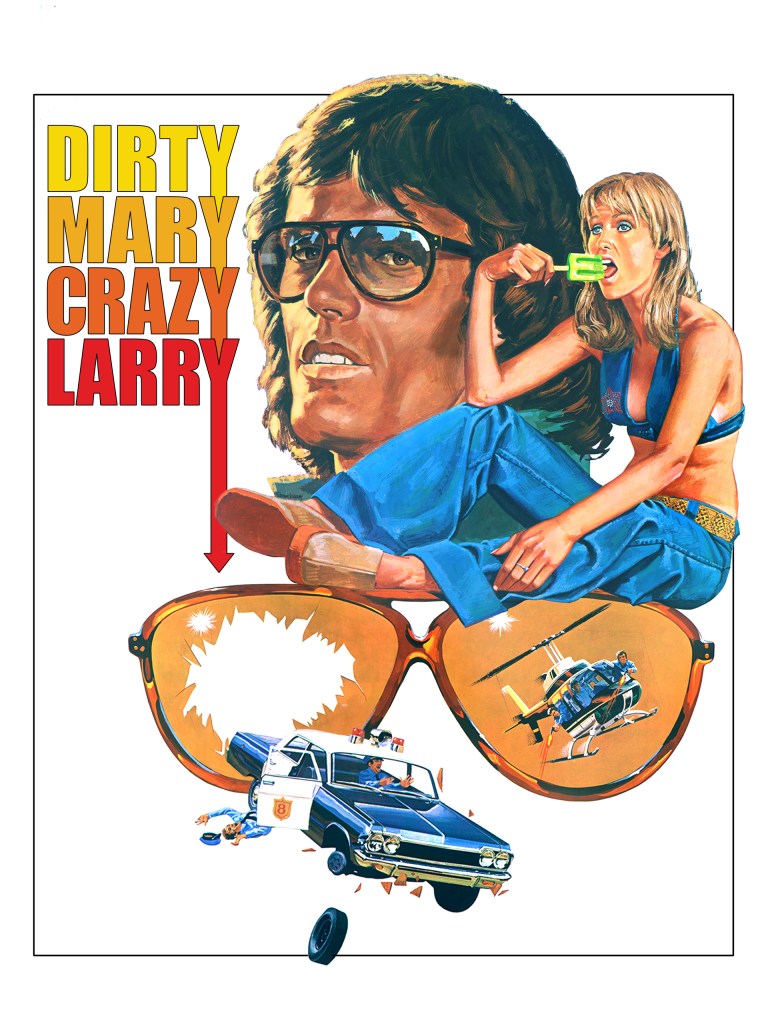
Every Monday night at 9:00 Central Time, my wife Sierra and I host a “Live Movie Tweet” event on X using the hashtag #MondayMuggers. We rotate movie picks each week, and our tastes are quite different. Tonight, Monday December 16th, we’re watching DIRTY MARY CRAZY LARRY starring Peter Fonda, Susan George, Adam Roarke, and Vic Morrow.

So why did I pick DIRTY MARY CRAZY LARRY, you might ask?

  1. I love car chase stunt movies from the 1970’s! We featured WHITE LIGHTNING with Burt Reynolds on here a couple of years ago. This should be another good 70’s car chase movie for the group. I’ve never actually watched the film before today so I’m really looking forward to it.   
  2. I like the cast, especially Susan George. What’s strange is that Susan is in my least favorite Charles Bronson movie of all time, LOLA, but I don’t hold that against her at all. She’s just so beautiful, and with a filmography that includes STRAW DOGS, SONNY AND JED, MANDINGO, and ENTER THE NINJA, what’s not to love?!!
  3. I think it’s cool that Peter Fonda did most of his own driving in the film, often driving over 100 miles per hour. I respect actors who are capable of doing their own stunt work…Jackie Chan, Tom Cruise, and now Peter Fonda!
  4. Quentin Tarantino loves DIRTY MARY CRAZY LARRY! He selected the film for the first “Quentin Tarantino Film Fest” in Austin back in 1996. He also featured a clip from this movie in JACKIE BROWN. It makes it even cooler that the scene in JACKIE BROWN featured Bridget Fonda, Peter’s daughter! If Tarantino loves it, that’s enough for me!

So join us tonight to for #MondayMuggers and watch DIRTY MARY CRAZY LARRY! It’s on Amazon Prime.

Retro Television Reviews: Terror In The Sky (dir by Bernard L. Kowalski)


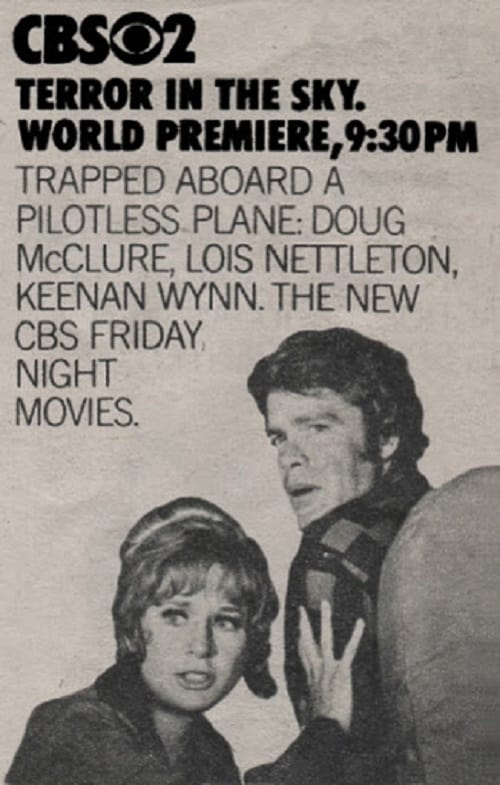
Welcome to Retro Television Reviews, a feature where we review some of our favorite and least favorite shows of the past!  On Sundays, I will be reviewing the made-for-television movies that used to be a primetime mainstay.  Today’s film is 1971’s Terror In The Sky!  It  can be viewed on YouTube.

On a flight heading from Minneapolis to Seattle, several passengers suddenly start to get ill.

Luckily, there’s a doctor on the plane.  Sporting sideburns and wearing a turtleneck, Roddy McDowall is quite chic in the role of Dr. Baird, the dedicated medical professional who comes to realize that the passengers are suffering from food poisoning.  As Dr. Baird explains it to head flight attendant Janet Turner (Lois Nettleton), everyone who had the chicken for dinner is about get severely ill.  Uh-oh …. both of the pilots had the chicken!

Is there anyone on the plane who has any flying experience?  George Spencer (Doug McClure) flew a helicopter in Vietnam but, as George explains, it’s an entirely different type of flying all together.  George has no confidence about his ability to land the plane but he’s the only chance the passengers have.

On the ground, gruff Marty Treleavan (Leif Erickson) has been summoned to the airport so that he can help to talk George through the landing.  Marty explains what all of the instruments do to George.  He tells George that he needs to stay in the air for a few hours so that he can get comfortable with the plane.  But the people on the plane are getting more ill and George says that he might be ding things up a little but he’s going to land this plane!

Does this sound familiar to anyone?

As I watched this film last night, I found myself saying, “Oh my God, this is just a serious version of Airplane!”

And actually, it is.  Terror In The Sky was based on Zero Hour, the 1957 film that also served as the basis for Airplane!  (The directors of Airplane! even bought the rights to Zero Hour so that they freely borrow whatever they wanted to from the film.)  Indeed, much of the dialogue in both Zero Hour and Terror In The Sky also shows up in Airplane!  Even the musical cues in Terror In The Sky and Airplane! are similar.

Terror In The Sky is not a bad film.  It’s an efficient made-for-TV film that features several made-for-television veterans, including Keenan Wynn and Kenneth Tobey.  Doug McClure grimaces heroically in the role of George Spencer and Roddy McDowall is as likable as ever as the doctor who hates to fly.  It’s a very earnest movie about a group of people doing everything that they can to save hundreds of lives.  They’re doing the right thing!

But it’s also totally impossible to take the film seriously because you spend the entire movie waiting for Roddy McDowall to say, “Don’t call me Shirley,” or for Leif Erickson to say that he picked the wrong week to stop sniffing glue.  Every moment and every line makes the viewer think of something funny from Airplane!

Personally, I think they bought their tickets.  They knew what they were getting into.  I say …. well, you get the idea.

And yes, I did rewatch Airplane! as soon as I finished up Terror In The Sky.

Horror Film Review: The Howling (dir by Joe Dante)


The 1981 film, The Howling, takes place at The Colony.

The Colony is a lovely place, a nice resort out in the middle of the countryside.  It’s a place that celebrity therapist George Waggener (Patrick Macnee) sends his clients so that they can recover from trauma.  It’s a bit of a grown-up version of the ranch to which Dr. Phil used to send juvenile delinquents.  Of course, the Colony is full of adults and they’re an eccentric bunch.  I mean, one of them — named Erle Kenton — is actually played by John Carradine!  That’s just how eccentric the place is.  Sheriff Sam Newfield (Slim Pickens) keeps an eye on the place but everyone knows that there’s nothing to worry about when it comes to The Colony.  Dr. Waggner does good work.

Karen White (Dee Wallace) is a Los Angeles news anchor who was held hostage by a serial killer named Eddie Quist (Robert Picardo).  While she was with Eddie, she was forced to not only watch videos of Eddie’s crimes but she also saw something happen with Eddie that terrified her to such an extent that she has blocked it from her mind.  Karen was rescued by the police but she is haunted by nightmares.  Dr. Waggner arranges for Karen and her husband, Bill Neill (Christopher Stone, who was married to Dee Wallace when they co-starred in this film), to spend some time at the Colony.

Bill loves the Colony, especially after he attracts the eye of Marsha (Elisabeth Brooks), the resort’s resident seductress.  Karen, however, is less enamored of the place.  The Colony feels off to her and she’s not happy about the howling in the distance or the fact that Bill has suddenly started to grow distant from her.  Could it be that The Colony is actually crawling with werewolves and that Bill has become one of them?  (It’s totally possible and, to The Howling‘s credit, it doesn’t waste any time letting us know that.)  Karen’s friend, Terry Fisher (Belinda Balanski), and her boyfriend, Chris Halloran (Dennis Dugan), do some research of their own into Eddie Quist, The Colony, and whether or not werewolves exists and they meet a helpful bookstore owner named Walter Paisley (Dick Miller).

To understand the approach that director Joe Dante and screenwriter John Sayles take to The Howling, one needs to only consider the names of some of the characters.  George Waggner.  Bill Neill. Terry (which can be short for Terence) Fisher.  Fred (or is that Freddie) Francis.  Erle Kenton.  Sam Newfield.  Jerry Warren.  All of these characters are named after horror film directors.  This is the type of werewolf film where Chris Halloran has a copy of The Three Little Pigs sitting on his desk.  Veteran actors like Kevin McCarthy, John Carradine, Slim Pickens, and Kenneth Tobey show up in small roles.  Roger Corman mainstay Dick Miller plays yet another character named Walter Paisley and he kicks Forrest J. Ackerman out of his bookstore.  Roger Corman himself plays a man making a phone call.  After a werewolf is shot on live TV, the program immediately cuts to a dog food commercial and we see a blank-faced child telling his unconcerned parents that someone just turned into a wolf.  The Howling was made by people who obviously love B-horror and that love is present in every frame of the film.

Like Dante’s Piranha, The Howling is a film with a sense of humor but it’s not a comedy.  The werewolves are still impressive, even forty-two years after the film was first released.  The character of Eddie Quist (“I’m going to give you a piece of my mind”) is a terrifying monster and the sight of his signature smiley face will fill you with dread, especially when it shows up in a place where it really shouldn’t be.  The film cynically ends on a note of noble sacrifice that will apparently not make much difference, with the suggestion being that human beings are either too distracted or too jaded to realize that there are monsters among them.  The Howling is a fast-paced and well-directed homage to B-horror and it’s still terrifically entertaining.

Retro Television Reviews: The Alpha Caper (dir by Robert Michael Lewis)


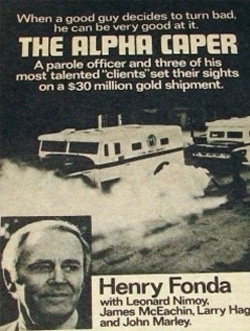
Welcome to Retro Television Reviews, a feature where we review some of our favorite and least favorite shows of the past!  On Sundays, I will be reviewing the made-for-television movies that used to be a primetime mainstay.  Today’s film is 1973’s The Alpha Caper!  It  can be viewed on YouTube!

After years of faithful service and hard work, parole officer Mark Forbes (Henry Fonda) is on the verge of mandatory retirement.  He’s spent his entire career playing by the rules and taking orders and helping recently released criminals go straight.  For all of his service, all he’s gets is a small party and a cheap retirement gift.

Still, Mark is on the job when he gets a call that one of his parolees, Harry (Noah Beery, Jr.), is currently in the middle of a stand-off with the cops.  Mark goes to the crime scene, where he discovers that Harry was trying to rob a warehouse full of weapons.  He also discovers that Harry is dying, as the result of being shot by the police.  Before Harry passes, he tells Mark that he and three other ex-cons were plotting to steal a shipment of gold bars.

Mark decides to carry out Harry’s plan.  Working with Mitch (Leonard Nimoy), Tudor (Larry Hagman), and Scat (James McEachin), Mark comes up with a plan to rob the armored cars that are going to be transporting the gold.  While Tudor and Scat are quick to join up with Mark, Mitch is a bit more hesitant.  In the end, though, they all decide to work together.  The plan they come up with is a clever one but its main strength is that it’s being spearheaded by Mark, a man who no one would ever expect to commit a crime.  No one but his colleague and friend, Lee (John Marley), that is.

I watched The Alpha Caper last night, with my friend Phil, Janeen, and Spiro.  To be honest, I selected the film because the title led me to suspect that it would be a science fiction film of some sort.  I was a little surprised when it turned out to be a crime thriller but I was even more surprised by just how good the film itself turned out to be.  Cleverly plotted and well-acted by the entire cast (and featuring a scruffy Leonard Nimoy playing a role that’s about as far from the coldly logical Mr. Spock as one can get), The Alpha Caper is an entertaining crime film but it’s also surprisingly poignant.  Mark is someone who feels that he’s lived his entire life without taking a single risk and, as a result, he has nothing to show for it.  He compares his situation to the mythical Kilroy of “Kilroy was Here” graffiti fame.  Kilroy will always be remembered, even though no one is really sure who he was.  Mark fears that he’s destined to be forgotten.  The robbery is Mark’s way of announcing that “Mark Forbes was here.”  The film ends on a surprisingly touching, if rather bittersweet, note.

The Alpha Caper originally aired on ABC on October 6th, 1973.  It was apparently meant to be a pilot for an anthology show that would be called Crime.  The series wasn’t picked up but, two years later, The Alpha Caper was theatrically released in Italy.  Today, it can be seen on YouTube.  Like Mark Forbes and Kilroy, the film has not been forgotten.

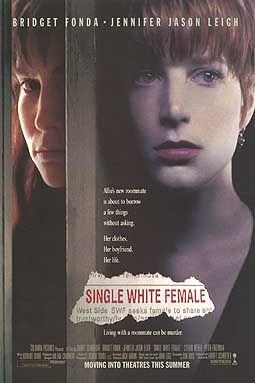
Horror Film Review: Single White Female (dir by Barbet Schroeder)


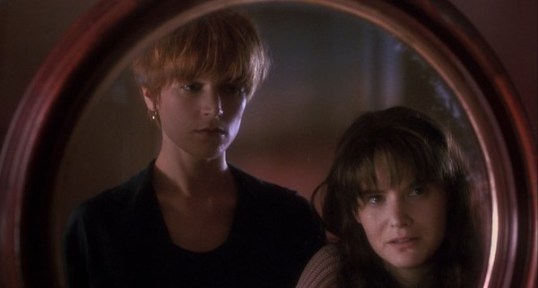
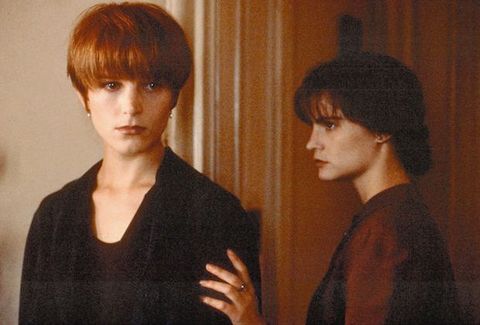
Allie Jones (Bridget Fonda) is an always fashionable software designer who is living in New York City and who has just broken up with her cheating lover, Sam (Steven Weber).  She has pretty hair, a big apartment, a closet full of nice clothes, and a totally devoted gay best friend.

Hedra Carlson (Jennifer Jason Leigh) is shy and socially awkward and in need of someone who will give her a cute nickname like “Hedy.”  She has pretty hair that’s just slightly less pretty than Allie’s, a job at a bookstore, a dead twin sister, a pair of really nice earrings, and a television that only seems to show old black-and-white movies.

Together …. THEY SOLVE CRIMES!

No, actually, they don’t.  Instead, Hedy answers an ad that Allie placed about needing a new roommate.  Even though Allie was thinking of asking another homeless woman to move in with her, Hedy impresses Allie by fixing her sink.  Seriously, how can you turn down a potential roommate who knows how to do simple plumbing?  Allie invited Hedy to live with her and, at first, everything is great.  Hedy even brings home a dog that Allie quickly falls in love with.  However, then Sam shows back up and we quickly discover just how obsessed Hedy has become with her roommate.

Single White Female was originally released way back in 1992 and, even if you’re viewing it for the very first time, you’ll probably feel a sense of deja vu while watching the movie.  This is one of those films that has been so endlessly imitated and has been unofficially remade so many times that you probably already know everything that happens in the film, regardless of whether you’ve actually sat through it or not.  A few years ago, there was a film called The Roommate that basically was Single White Female, just with a college setting and a bit less of a subversive subtext.  As well, I’ve lost count of the number of Lifetime films that have basically ripped off Single White Female‘s plot.  Any time that a new friend proves herself to be excessively clingy, chances are that she’s going to get compared to Jennifer Jason Leigh in this film.


And yet, despite all of the imitations, Single White Female still holds up surprisingly well.  A lot of that is because Single White Female was directed by Barbert Schroeder.  Schroeder started his career as a disciple of the French New Wave and, much like Paul Verhoeven, his American films tend to be genre films with just enough of a subversive subtext to stick in your mind afterwards.

For example, Single White Female is often describes as being a film about “the roommate from Hell” but what always seems to be missed is that, especially during the film’s first half, Allie is often as bad of a roommate as Hedy.  For instance, when Allie comes home late after spending two days with Sam, Hedy is pissed off and waiting for her.  On the surface, the scene is the first indication that Hedy has become obsessed with Allie.  But, at the same time, Hedy actually is making a valid point.  After repeatedly telling Hedy that she wants nothing to do with Sam, Allie runs off and spends two days with him without bothering to call home once.  Though Hedy may have been a bit too quick to yell, she still had every right to be annoyed.

In fact, Allie really is a bit of self-centered character.  She impulsively invited Hedy to live with her and then, just as impulsively, she gets back together with Sam and decides that it’s time for Hedy to move out.  Of course, then Hedy tosses a dog out of a window and you pretty much lose whatever sympathy you may have had for her.

Still, you can’t help but feel that, just as Hedy wants to be Allie, there’s a part of Allie that would like to be Hedy.  Hedy does all the things that Allie’s scared to do.  When Allie is sexually harassed and nearly raped by a client, Hedy’s the one who actually gets revenge.  While Allie tries to get over and suppress her anger at Sam, Hedy’s the one who acts on that anger.  Just Hedy seems to need Allie’s life to be happy, Allie seems to need Hedy’s anger to survive.  In short, there’s a lot more going on underneath the surface of Single White Female than its reputation might lead you to presume.

Not surprisingly, the film is dominated by Jennifer Jason Leigh’s performance.  When Hedy first appears, Leigh plays her as just being slightly off.  She has some obvious confidence issues but, at the same time, she comes across as being so innocent and naive that you can’t help but want to protect her.  You find yourself wondering how she could have possibly survived living in a city like New York.  It’s only as the film progresses that you start to discover that Hedy was never particularly naive and everything that she’s done and said has basically been about manipulating the people around her.  And yet, even after Hedy has started killing dogs and people, you can’t help but feel a strange empathy (though not necessarily sympathy) for her.  There’s an emptiness to Hedy, an emptiness that she attempts to fill by stealing the personalities of the people around her and Leigh does a great job of expressing the pain that would come from not having an identity of your own.  Plus, poor Hedy just seemed so happy with Allie said that she liked her earrings!  I mean, I just can’t imagine being that insecure but I get the feeling it would really suck.

(Fortunately, I’ve also never really had a truly bad roommate situation.  One advantage of having three older sisters is knowing that you’ll always have someone to stay with.)

Despite all of the imitations and rip-offs that have come out over the years, both Single White Female and Jennifer Jason Leigh’s performance hold up remarkably well.  I’d recommend watching it before inviting anyone to come live with you.  If nothing else, you’ll at least learn what stiletto heels are really for.


The Conquering Hero: Baby Blue Marine (1976, directed by John D. Hancock)


The year is 1943 and America is at war.  All young men are expected to join the Marines and fight for their country but the Corps is not willing to accept just anyone.  Marion (Jan-Michael Vincent) wants to continue a family tradition of service but, as his drill sergeant (Michael Conrad) puts it, Marion just is not pissed off enough to be a Marine.  Marion is kicked out basic training and told to go home.  He is given a blue uniform to wear on his jury so that anyone who sees him will know that he couldn’t cut it.

Ashamed of his failure and in no hurry to confront his family, Marion takes the long route home.   While having a drink in California, he meets a Marine (Richard Gere) who did not get kicked out of basic training.  Though not yet 30, this shell-shocked Marine already has a head of gray hair, which he says he got from the horrors of war.  The Marine is due to return to the fighting in Europe but, upon meeting Marion, he sees a way out. When Marion gets drunk, the Marine knocks him out, switches uniforms with him, and goes AWOL.

When Marion comes to, he discovers that everyone that he meets now judges him by his new uniform.  Strangers buy him drinks.  Other servicemen try to pick fights with him.  When he stops off in a small Colorado town, a local waitress (Glynnis O’Connor) falls in love with him and nearly everyone that he meets assumes that he must be a hero.  Marion doesn’t exactly lie about his past.  Instead, he simply allows people to believe whatever they want to believe about him.  It seems like an idyllic situation until three prisoners from a nearby Japanese internment camp escape and the towns people expect Marion to help capture them.

Loosely plotted and sentimental, Baby Blue Marine is a dramatic version of Preston Sturges’s Hail The Conquering Hero.  Though the film has a gentle anti-war message, it’s actually more about nostalgia for a simpler and more innocent time.  If the film had been made at height of the Vietnam War, it might have been more angrier and more cynical.  But, instead, this is one of the many post-Watergate films that wistfully looked back upon the past.  When Marion settles into the town, he finds what appears to be a perfect and friendly home.  Only the nearby internment camp and the town’s hysteria over the escape prisoners serve as reminders that things are never as ideal as they seem.  Jan-Michael Vincent gives one of his best performances as the well-meaning Marion and actors like Richard Gere, Bert Remsen, Katherine Helmond, Dana Elcar, Michael Conrad, Bruno Kirby, and Art Lund all make strong impressions in small roles.

One of the few films to be produced by television mogul Aaron Spelling, Baby Blue Marine is not easy to find but worth the search.

Horror Film Review: The Vampire (dir by Paul Landres)


Headaches are a bitch!

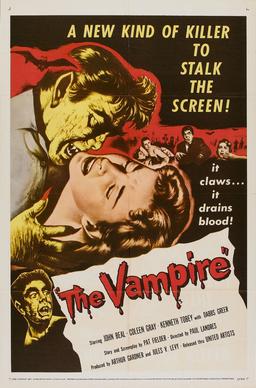
And if you didn’t already know that, you will know it after watching the 1957 film, The Vampire.

Like many films of this kind, The Vampire starts with death.

Actually, I take that back.  Technically, it’s true but it’s also little bit too melodramatic.  And, to be honest, The Vampire starts with a 14 year-old boy, who is very much alive, riding his bicycle down the street of Anytown USA.  He has a box with him, one that has air holes.  On the back of his bike, a cardboard sign reads: “Bobs Pet Zoo!  If Its Alive We Got It!”  Apparently, the kid is smart enough to run his own zoo but not smart enough to know when to use an apostrophe.

Anyway, the kid comes up to a creepy old house, one that looks somewhat out of place in the otherwise pristine suburban neighborhood.  Originally, I thought that maybe Pennywise lived in the house but then I reminded myself that The Vampire was made decades before It.  Instead, the house belongs to Dr. Campbell, a scientist who is doing experiments with blood and who needs a never-ending supply of animal test subjects.  (Boooooo!  Animal testing!  Hiss!)  Apparently, the kid keeps Dr. Campbell supplied with animals.  When the kid enters the house, Dr. Campbell is nowhere to be seen.  It’s not until the kid enters the laboratory that he discovers Campbell, dead and slumped over his desk.

As news spreads of Campbell’s death, his friend, Dr. Paul Beecher (John Beal), searches through Campbell’s belongings and he comes across a mysterious bottle of pills, which he promptly takes home with him.  Dr. Beecher is kindly doctor, the type that we all wish we could deal with whenever we had to go in for a check up.  However, he suffers from terrible migraines.  That night, when he’s literally blinded with a headache, he asks his daughter to get him his pills.  She retrieves a bottle of pills but guess what?  They’re the wrong pills!  They’re not headache pills!  Instead, they’re Dr. Campbell’s vampirism pills!

The pills cause Beecher to blaxk out.  Whenever he comes to, he never has any memory of what he may or may not have done while he was out.  However, strange things are happening to his friends and his patients.  One of his longtime patients dies of fright when he comes by her house.  On her neck, he finds two puncture wounds…

So, it’s not a spoiler for me to tell you that Dr. Beecher has been transformed into a vampire.  And I know what you’re thinking.  Why doesn’t he just stop taking the pills?  The simplest answer is that the pills are addictive.  The more complex answer is that he doesn’t want to.  The pills have brought out his dark side and, now that it’s free, it’s not planning on going anywhere.

In a strange way, The Vampire reminded me of Nicholas Ray’s Bigger Than Life.  In Bigger Than Life, James Mason plays a gentle and good-hearted professor who, after taking steroids, turns into a monster who dreams of creating a master race.  Bigger Than Life was unsettling for the exact same reason that The Vampire is unsettling.  Both suggest that the pills didn’t turn their user into a monster.  Instead, the pills just allowed his true self to come out.

The Vampire was a low-budget film, a B-movie as many would probably call it.  The musical score is overly melodramatic and so are some of the actors.  But I would say that The Vampire is actually a bit of a subversive masterpiece.  This 1957 film suggests that behind the pristine facade of suburbia, there lurked monsters.  Even an outwardly successful and respected man like Dr. Beecher can turn into something totally different behind closed doors, this film is saying.  That’s a message that it as relevant today as it was when this film was first released.  In its own way, The Vampire is a brilliant and important movie.

Horror Film Review: Strange Invaders (dir by Michael Laughlin)


In 1983, two years after the release of Strange Behavior, director Michael Laughlin and Bill Condon teamed up for another “strange” film.  Like their previous collaboration, this film was a combination of horror, science fiction, and satire.

The title of their latest collaboration?

Strange Invaders.

Strange Invaders opens in the 1950s, in a small, all-American town in Illinois.  Innocent children play in the street.  Clean-cut men stop off at the local diner and talk to the waitress (Fiona Lewis, the scientist from Strange Behavior).  Two teenagers (played by the stars of Strange Behavior, Dan Shor and Dey Young) sit in a car and listen to forbidden rock’n’roll music.  A lengthy title crawl informs us that, in the 1950s, Americans were happy and they were only worried about three things: communists, Elvis, and UFOs.  On schedule, a gigantic UFO suddenly appears over the town.

Twenty-five years later, mild-mannered Prof. Charles Bigelow (Paul Le Mat) teaches at a university and wonders just what exactly is going on with his ex-wife, Margaret (Diana Scarwid).  In order to attend her mother’s funeral, Margaret returned to the small Illinois town where she grew up.  When she doesn’t return, Charles decides to go to the town himself.  However, once he arrives, he discovers that the town appears to still be stuck in the 50s.  The townspeople are all polite but strangely unemotional and secretive.  Charles immediately suspects that something strange is happening.  When the towns people suddenly start shooting laser beams from their eyes, Charles realizes that they must be aliens!

Fleeing from the town, Charles checks all the newspapers for any reports of an alien invasion.  The only story he finds is in a cheap tabloid, The National Informer.  The author of the story, Betty Walker (Nancy Allen), claims that she just made the story up but Charles is convinced that she may have accidentally told the truth.  At first, Betty dismisses Charles as being crazy.  But then she’s visited by an Avon lady who looks just like the waitress from the small town and who can shoot laser beams.

Teaming up, Charles and Betty investigate the aliens and try to figure out just what exactly they’re doing on Earth.  It’s an investigation that leads them to not only a shadowy government operative (Louise Fletcher) but also a man (Michael Lerner) who claims that, years ago, he helplessly watched as his family was destroyed by aliens.

Like Strange Behavior, Strange Invaders is a … well, a strange film.  I have to admit that I prefer Behavior to Invaders.  The satire in Strange Invaders is a bit too heavy-handed and Paul Le Mat is not as strong a lead as Michael Murphy was in the first film.  I was a lot more impressed with Nancy Allen’s performance, if just because I related to both her skepticism and her sudden excitement to discover that her fake news might actually be real news.  I also liked Micheal Lerner, so much so that I almost wish that he and Le Mat had switched roles.  Finally, I have to say that Diana Scarwid’s performance was so bizarre that I’m not sure if she was brilliant or if she was terrible.  For her character, that worked well.

Strange Invaders gets better as it goes along.  At the start of the film, there are some parts that drag but the finale is genuinely exciting and clever.  If the film starts as a parody of 1950s alien invasion films, it ends as a satire of Spielbergian positivity.  It’s an uneven film but, ultimately, worth the time to watch.