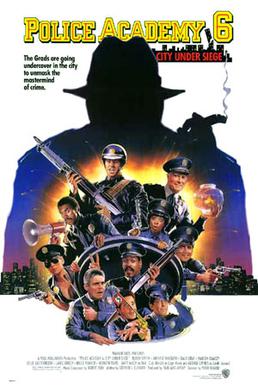
Police Academy 6: City Under Siege (1989, directed by Peter Bonerz)


The sixth Police Academy film opens with another crime wave.  Considering that the Police Academy Class of 1984 was supposedly the best to ever graduate, they don’t seem to have done much to clean up the city.  This time, a series of robberies are being committed in the Wilson Heights neighborhood.  Since Captain Harris (G.W. Bailey) and Lt. Proctor (Lance Kinsey) don’t seem to be capable of upholding the law in their precinct, the Mayor (Kenneth Mars) orders Harris to work with Commandant Lassard (George Gaynes) and the usual gang of Police Academy graduates.

Carey Mahoney is still missing in action but Nick Lassard (Matt McCoy) has transferred up from Miami and has taken Mahoney’s place as the resident smartass.  Also returning are Sound Effects Man (Michael Winslow), Hightower (Bubba Smith), Hooks (Marion Ramsey), Callahan (Leslie Easterbrook), Tackleberry (David Graf), and, after having been absent for the previous two films, Sgt. Fackler (Bruce Mahler)!

I cannot believe I’m saying this but Police Academy 6 turned out to be better than I remembered.  It’s just as stupid as all of the other Police Academy films but everyone seems to be having a good time and Matt McCoy no longer feels out of place as Mahoney’s replacement.  Bruce Mahler’s return as Fackler also means a return to the physical comedy that he excelled at in the first two films and the total incompetence of Harris and Proctor is handled better here than it was in the previous few films.  A welcome addition to the cast is Gerrit Graham, as the childish head of the robbers.  (Whereas the previous few films at least tried to pretend like the criminals were a potentially serious threat, City Under Siege presents them as being as clownish as everyone else in the film.  It’s a better approach because it’s not as if anyone watches a Police Academy film expecting to see something like The French Connection or Fort Apache, The Bronx.Police Academy 6 is a stupid, stupid movie and the jokes are as juvenile as ever but, along with Part 3, it’s still one of the better sequels.

Police Academy 6 was the first Police Academy film to not be a box office hit.  It would be followed by one final sequel, Mission to Moscow, which I’ll take a look at on Saturday.
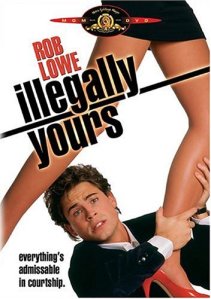
A Movie A Day #213: Illegally Yours (1988, directed by Peter Bogdanovich)


This is really bad.

Richard Dice (Rob Lowe, wearing glasses and running around like a speed freak) is a loser who lives at home with his mother (Jessica James), his younger brother (Ira Heiden), and his mother’s boyfriend (Harry Carey, Jr.).  When he gets called for jury duty, Richard thinks that he will be able to easily get out of it but then he discovers that the defendant is someone from his part, even if she does not remember a thing about him.  Ever since the first grade, Richard has been in love with Molly (Colleen Camp) and now she is on trial for murder.  Richard lies about knowing who she is and gets selected for the jury.  When it starts to look like Molly might be convicted, Richard starts to investigate the murder himself.  His investigation leads him to two teenage blackmail victims (played by Kim Myers and Bodganovich’s future wife, Louise Stratten) and a tape of the murder being committed.  Illegally Yours attempts to be a screwball comedy but it just comes across as being frantic, with Lowe especially going overboard.  The actors all speak quickly but that can not disguise how lame most of the dialogue is.  The movie also comes with a clunky narration, a sure sign of post production desperation.

Made at a time when Peter Bogdanovich was mired in an expensive lawsuit over changes made to his previous film, Mask, Bogdanovich has said that he solely did Illegally Yours because he needed the money.  Bogdanovich has accurately described Illegally Yours as being the worst film that he ever directed.  Coming from the director of At Long Last Love, Nickelodeon, and Texasville, that is saying something.

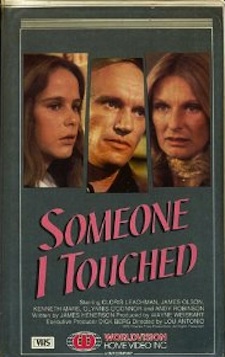
Embracing the Melodrama Part II #53: Someone I Touched (dir by Lou Antonio)


someoneitouch_225In the 1975 made-for-TV venereal disease epic Someone I Touched, there’s a scene of children’s author Cloris Leachman at work.  She’s sitting in her office, typing away on a manual typewriter.  Directly behind her is a crude drawing of a clown.  And to the right of her, there’s a statue of the same creepy clown.  Eventually, her husband (played by James Olson) comes into the office and, after a very long argument, finally forces himself to confess that, as the result of a one-night stand with a grocery store cashier (Glynnis O’Connor), he has syphilis.  And it’s possible that Cloris now has syphilis herself.  And, since Cloris is pregnant, it’s also possible that their baby may be born with syphilis.

And it’s all very serious and very dramatic and certainly, it’s nothing to laugh at.

But, I have to admit, that I could not stop thinking about that creepy clown.  And I have to admit that as Cloris was stumbling back in shock, I started to giggle because I just couldn’t stop thinking about what it must be like to work in an office surrounded by creepy clowns.  It made me think about The Sims and how, if your sims ended up getting depressed, the tragic clown would arrive and just makes things worse.

That’s the thing with Someone I Touched.  It’s a very serious film and yet it’s almost impossible to take that seriously.  Whenever a helpful health worker (Andy Robinson, the Scorpio Killer from Dirty Harry) shows up to dispense statistics or the cashier attempts to track down everyone that she’s ever had sex with or Cloris and Olson start to argue about the sad state of their marriage, you’re very aware that the film is dealing with some serious subject matter.  And yet, you can’t take it seriously because of all the little details.  You find yourself fixated on how ugly 70s interior design truly was.  You watch this tiny vein in Olson’s forehead and you worry if it’s going to explode during some of his more dramatic scenes.  You listen to dialogue like, “It (syphilis) can be a real drag if you don’t take care of it” and “Tramps get Syphilis!”  You realize that Leachman is supposed to be playing someone in her mid-30s, even though she was 49 when the film was made.  You listen as Olson explains his recent one night stand by saying, “I was looking down the barrel of my 40th birthday,” despite the fact that Olson looks like he’s in his mid-50s.  And let’s not forget those creepy clowns…

And you just can’t take the movie seriously.  You know that you should but you just can’t.  How could one well-intentioned film produce so many involuntary giggles?

Now, I know you’re probably thinking to yourself, “I would never watch a movie like that!”  But, if you change your mind, Someone I Touched is currently available on Netflix streaming.


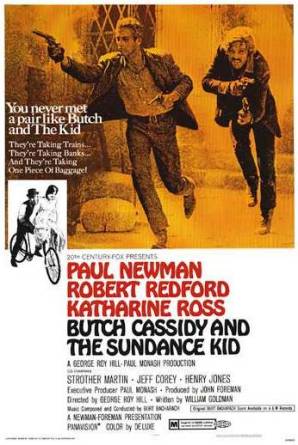
Lisa Watches An Oscar Nominee: Butch Cassidy and the Sundance Kid (dir by George Roy Hill)


Butch_sundance_poster

Should I start this post by ticking everyone off or should I start out by reviewing the 1969 best picture nominee Butch Cassidy and The Sundance Kid?

Let’s do the review first.  I recently watched Butch Cassidy and the Sundance Kid when it aired as a part of TCM’s 31 Days of Oscar.  This was actually my third time to see the film on TCM.  And, as I watched Butch Cassidy and the Sundance Kid for the third time, I was shocked to discover how much I had forgotten about the film.

Don’t get me wrong.  I remembered that it was a western and that it starred Paul Newman and Robert Redford as real-life outlaws Butch Cassidy and the Sundance Kid.  I remembered that it opened and ended with sepia-toned sequences that suggested that Butch and Sundance represented the last gasp of the old west.  I remembered that Butch won a fight by kicking a man in the balls.  I also remembered that they robbed the same train twice and, the second time, they accidentally used too much dynamite.  I remembered that, for some reason, Butch spent a lot of time riding around on a bicycle.  I remembered that Butch and Sundance ended up getting chased by a mysterious posse.  I remembered that Sundance could not swim.  And I remembered that the film eventually ended on a tragic note in South America…

And I know what you’re saying.  You’re saying, “It sounds like you remembered the whole movie, Lisa!”

No, actually I did not.  The thing with Butch Cassidy and the Sundance Kid is that the scenes that work are so memorable that it’s easy to forget that there’s also a lot of scenes that aren’t as memorable.  These are the scenes where the film drags and you’re thankful that Paul Newman and Robert Redford were cast as Butch and Sundance, because their charisma helps you overlook a lot of scenes that are either too heavy-handed or which drag on for too long.  You’re especially thankful for Newman, who plays every scene with a twinkle in his wonderful blue eyes and who is such a lively presence that it makes up for the fact that Redford’s performance occasionally crosses over from being stoic to wooden.  It can be argued that there’s no logical reason for a western to feature an outlaw riding around on a bicycle while Raindrops Keep Fallin’ On My Head plays on the soundtrack but Paul Newman’s so much fun to watch that you can forgive the film.

Newman and Redford both have so much chemistry that they’re always a joy to watch.  And really, that’s the whole appeal of Butch Cassidy and the Sundance Kid, the chance to watch two iconic actors have fun playing opposite each other.  Even though Katharine Ross appears as their shared romantic interest, the film’s love story is ultimately between Butch and Sundance (and, by extension, Newman and Redford).  You can find countless reviews that will give all the credit for the film’s appeal to William Goldman’s screenplay.  (You can also find countless self-satisfied essays by William Goldman where he does the exact same thing.)  But, honestly, the film’s screenplay is nothing special.  This film works because of good, old-fashioned star power.

Now, for the part that’ll probably tick everyone off (heh heh), I think that Butch Cassidy and the Sundance Kid is actually a pretty good pick for a future remake.  All you have to do is pick the right actors for Butch and Sundance.  I’m thinking Chris Pratt as Butch and Chris Evans as Sundance…

Oh, c’mon!  It’ll be great!

Shattered Politics #34: The Parallax View (dir by Alan J. Pakula)


Parallax_View_movie_poster

Judging from the films that the decade produced, the 1970s were truly a paranoid time.  (Of course, 2015 is a paranoid time as well, which is probably why so many of the classic films of the 70s still feel incredibly relevant.)  Some weekend, you should watch a marathon of 1970s films and I guarantee that, by the time Monday rolls around, you will be looking for lurkers in every shadow and automatically distrusting any and all authority figures.  The 1970s were a good time to be paranoid.

And it’s really not surprising at all.  The previous decade was a time of turmoil and upheavel, a time when some people feared protestors and some people feared the establishment but, ultimately, everyone was afraid of someone.  When you think of the 1960s, you think about all the leaders who were violently assassinated — John F. Kennedy, Malcolm X, Martin Luther King, Robert F. Kennedy, and more.  (And that’s just in America!)  And then the 70s came along, with Watergate and the revelations about the CIA partnering up with the Mafia to try to kill Fidel Castro.

The 70s were a good time to be paranoid and the films of the 70s reflected that fact.

Take for instance, 1974’s The Parallax View.  The Parallax View opens and ends with assassination.  In both cases, the victims are U.S. politicians who are running for President and whose ambitions have caused concern for the shadowy and rarely seen leaders of the established order.  In both cases, the official story is that the assassin was a lone gunman, a nut with a gun and absolutely no political or religious motivations.  Of course, both accused assassins were apparently involved with the shadowy Parallax Corporation and, over the course of the film, anyone who knows anything about Parallax ends up dying.  Reporter Joe Frady (Warren Beatty) goes undercover to investigate the group but, as he does so, he grows increasingly paranoid and unstable, until finally  it’s easy to mistake him for any other paranoid madman, ranting in the street and, in many ways, indistinguishable from the accused assassins that he’s been investigating.  In many ways, Joe becomes like a character in a H.P. Lovecraft short story who, upon laying eyes on Cthulhu, is driven mad as punishment.

It’s a good film, one that’s enhanced by Gordon Willis’s trademark shadowy cinematography and the convincing desperation of Warren Beatty’s performance.  In the film’s best scene, Frady applies for a job with the Parallax Corporation.  As a part of his job interview, he’s taken a dark room and he’s told to watch a short film.  His reactions will help to determine what role he could possibly play at Parallax.

Needless to say, The Parallax View feels just as relevant today as it did when it was first released.  We still live in paranoid times and hints of conspiracy are still everywhere to be seen.  Perhaps the only thing that has changed is that, back in 1974, conspiracies could still take people be surprise.

Now, we just take them for granted.