Review: The Devils (dir. by Ken Russell)


“I have been a man. I have loved women. I have enjoyed power.” — Father Urbain Grandier

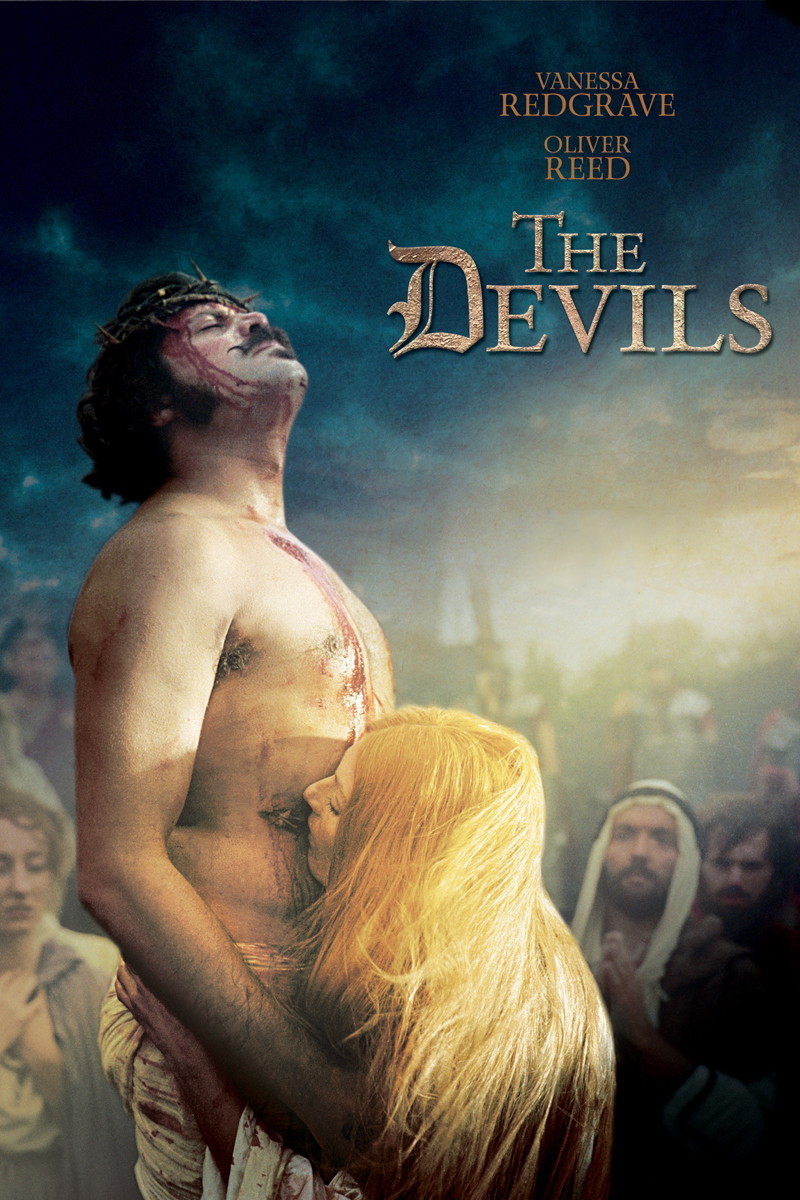
Ken Russell’s The Devils (1971) stands as one of the most provocative and polarizing films in cinema history, a visceral plunge into the hysteria of religious fanaticism and political intrigue set against the backdrop of 17th-century France. Adapted loosely from Aldous Huxley’s historical account The Devils of Loudun and John Whiting’s play The Devils, the film dramatizes the real-life case of Father Urbain Grandier, a charismatic priest accused of witchcraft amid a scandal of supposed demonic possessions at a Loudun convent. Directed with unbridled fervor by Russell, who infuses every frame with operatic excess, the movie challenges viewers to confront the grotesque intersections of faith, sexuality, power, and repression. While its boldness earns admiration for unflinching social commentary, its stylistic indulgences can overwhelm, making it a work that demands both endurance and reflection.

The story unfolds in the walled city of Loudun, a Protestant stronghold under threat from Catholic forces led by the cunning Cardinal Richelieu. Oliver Reed delivers a towering performance as Grandier, portraying him not as a saintly martyr but as a flawed, hedonistic figure—a womanizer who preaches liberty while bedding Madeleine (Gemma Jones), a young Protestant whose quiet devotion contrasts sharply with the surrounding debauchery. Grandier’s defiance of Richelieu’s edict to demolish the city’s walls marks him as a target, but his downfall accelerates through the hysterical claims of Sister Jeanne (Vanessa Redgrave), the hunchbacked prioress of the Ursuline convent. Twisted by unrequited lust for Grandier, Jeanne accuses him of sorcery, sparking a wave of mass possession among the nuns that spirals into public spectacle. Russell draws from historical records to depict these events, emphasizing how personal pathologies fueled institutional corruption.

Visually, The Devils is a tour de force of baroque horror, with production designer Derek Jarman crafting sets that evoke a pristine white monastery defiled by filth and frenzy. Cinematographer David Watkin employs distorted wide-angle lenses and frenetic camera movements to mirror the characters’ unraveling psyches, turning sacred spaces into nightmarish arenas. The infamous “nunsploitation” sequences—where possessed sisters writhe in orgiastic fits, desecrate crucifixes, and simulate blasphemous acts—remain shocking even today, not merely for their explicitness but for their raw psychological intensity. These scenes serve Russell’s thesis: repressed desires, when twisted by authority figures like the witch-hunting Father Barre and Father Mignon, erupt into collective madness. Fairly assessed, these choices underscore Russell’s intent: to expose how power structures weaponize female hysteria, a theme resonant in historical witch hunts and modern reckonings with abuse.

Russell’s direction amplifies this through rhythmic editing and a pounding score by Peter Maxwell Davies, which blends liturgical chants with dissonant percussion to evoke a descent into hell. The film’s opening, with its ritualistic execution of a wise woman amid fireworks and folk rituals, sets a tone of pagan vitality clashing against ecclesiastical oppression. Midway, hallucinatory visions plague Grandier, blurring reality and delusion in a style reminiscent of Russell’s later explorations of ecstatic breakdown. The film unflinchingly depicts torture scenes—a burning at the stake, an afternoon in the rack, headscrews, a douche with boiling water—highlighting its raw confrontation with human cruelty. However, this excess risks tipping into self-parody; moments like the nuns’ simulated levitations or Jeanne’s contortions can strain credulity, prompting questions of balance between provocation and restraint.

Performances anchor the chaos, with Reed’s Grandier embodying defiant charisma undercut by hubris. His courtroom defiance and final quartering—nailed alive to a burning cross—culminate in a crucifixion scene of harrowing power, rivaling traditional passion narratives in emotional weight. Redgrave’s Jeanne is a revelation, her physical deformity symbolizing inner torment; she veers from pitiable to monstrous without caricature. Supporting turns shine too: Dudley Sutton as the impish Baron de Laubardemont, scheming for Richelieu; Max Adrian as the syphilitic priest whose decaying face mirrors moral rot; and Christopher Logue as the predatory Cardinal, whose urbane cruelty chills. The ensemble’s conviction elevates the material, ensuring characters feel flesh-and-blood rather than allegorical pawns.

Thematically, The Devils indicts institutional religion not as anti-faith but as a critique of its perversion by human ambition. Russell draws parallels to scandals where church power intertwines with politics, arguing that true devilry lies in hypocrisy. The film posits sexuality as a battleground: Grandier’s libertinism versus Jeanne’s repression, with the church exploiting both for control. This aligns with Huxley’s original thesis, expanded by Russell into a broader assault on authoritarianism. Politically, it skewers absolutism; Richelieu’s agents manipulate “possessions” for territorial gain, much as witchfinders historically profited from purges. Balanced against this, the film acknowledges Grandier’s flaws—he fathers a child out of wedlock and mocks piety—preventing hagiography. Upon release, it faced cuts in various countries, its controversial rating reflecting discomfort with its uncompromised vision.

Stylistically, Russell risks the “ridiculous” for the sublime. The white-tiled convent, pristine yet prone to vomit and excrement, symbolizes false purity; smashing it in the finale cathartically liberates Loudun from fanaticism. Influences from montage masters appear in crowd scenes, synthesized into a singular fever dream. Pacing falters in the trial’s verbosity, and some anachronistic flourishes—like Louis XIII’s cross-dressing ballet—inject campy levity, diluting gravity at times. Yet these quirks humanize the director’s bombast, reminding us of cinema’s power to provoke laughter amid horror. Compared to Russell’s Women in Love or TommyThe Devils stands as his most structurally coherent assault on repression.

Historically contextualized, the Loudun possessions of 1634 involved Urbain Grandier, executed for allegedly bewitching Ursuline nuns via a pact with Satan. Huxley documented the hysteria, linking it to political machinations under Richelieu, who sought to crush Huguenot resistance. Russell amplifies the carnality for dramatic effect, prioritizing emotional truth over literalism. Restored versions reveal its full ferocity, influencing not just cinema but broader media, including comics like Argentinian artist Ignacio Noé’s The Convent of Hell, which echoes its themes of convent-based depravity and demonic intrigue in vivid, explicit sequential art.

Ultimately, The Devils endures as a lightning rod: a moral film cloaked in immorality, pro-religion by exposing its distortions. Its ugliness—filth-smeared faces, ruptured bodies—serves illumination, urging viewers toward wisdom. For every viewer repulsed by its excesses, another finds genius in its candor. Russell’s gamble pays off; in risking the absurd, he achieves a sublime confrontation with our shadowed souls. At around 109 minutes in its uncut form, it repays multiple viewings, rewarding the brave with insights into faith’s fragility and power’s perils. Not flawless—its hysteria occasionally exhausts—yet undeniably vital, The Devils remains essential cinema, a shattered lens on humanity’s eternal dance with darkness.
Firefox (dir. by Clint Eastwood)


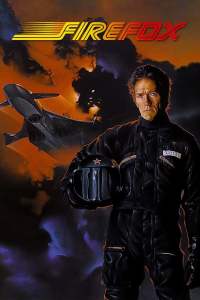
You’d think someone with a face as chiseled as Clint Eastwood’s, he wouldn’t fit in well in the spy game. You’d recognize him almost anywhere in a line up. However, being able to direct your own films means you can still be the best person for a role. There is no finer example of this than with 1982’s Firefox, my submission for the Eastwood birthday celebration on the Shattered Lens. It’s not the strongest spy film, but it plays it’s hand very well, getting in and delivering the short jabs to set the tale and then finishing with an action packed combo in the film’s third act. 1990’s The Hunt for Red October may be more famous film about smuggling a vehicle from Russia to America, but Firefox did it first (Okay, From Russia With Love may have beaten them both, but we’re talking planes and subs, not a cipher box).

I remember first noticing Firefox while driving by the smaller of two movie theatres at the Green Acres Mall over in Valley Stream with my parents. Not every film hit the Sunrise Multipex, so the little Odeon (at least I think it was called an Odeon) held other films. My family caught Predator, Aliens, and Nine Months there to name a few. When I finally saw the movie, I didn’t care for it (to my credit, I was like 10 or 12), but loved the flying sequences. As an adult, the film makes more sense and deserves a watch despite a few tiny flaws here and there. Firefox marks Eastwood’s first production credit, despite The Malpaso Company having made films way before then.

Based on the 1977 novel by Craig Thomas, Firefox focuses on Mitchell Gant (Eastwood), one of the best pilots in the United States Air Force. Despite having some PTSD, Gant is sent on a mission in the height of the Cold War. His job is to sneak in and steal the Mig-31, Codename: Firefox, an experimental aircraft capable of speeds of Mach 5, extreme stealth and a special thought based firing system. He has all the necessary credentials. He can speak the language, has a good build and can fly the plane. After receiving a brief from his superiors (including Freddie Jones, who was in just about everything in the Early 1980s – Dune, Krull, Firestarter, Lifeforce), he’s dropped into Russia for his mission. Can Gant get the plane without getting in trouble? Unlike Top Gun, which used a fictional aircraft in the MiG-28, there was an actual MiG 31 in existence (or introduced to the world) at the time of filming Firefox, known as the “Foxhound”. The real MiG 31 and the films’ one are different. It was just a coincidence, but I know my Dad would point that out if he watched it.

What I loved the most about Firefox is that Gant’s character has to assume multiple roles/characters in order to blend in with the crowd and keep the KGB off of his tail. While we’re all aboard for seeing the plane in action, the real adventure is getting there and the characters that help along the way. One wrong turn, one wrong move could mean the different between success and failure, and it does get pretty tense in places. There’s one particular scene in a shower where I was like “Uhm, get up, get going, they’re on to you!”, but the pacing of the film is pretty good. As a director, Eastwood keeps the film moving without lingering too long in any one scene unless it’s truly necessary. This, along with some quick cuts and getting the most of the cast’s performances, allows the film to make some good use of the 2 hour and 16 minute runtime.

Firefox has a supporting cast that also helps to move the story along. Outside of Freddie Jones, we also have Kenneth Colley (Admiral Piett from The Empire Strikes Back & Return of the Jedi) as the Russian Colonel on Gant’s tail. Warren Clark’s (A Clockwork Orange) gruff character helps Gant to navigate through the city. Both Nigel Hawthorne (Demolition Man) and Ronald Lacey (Raiders of the Lost Ark) play scientists loyal to Gant’s mission. Wulf Kahler (also from Raiders of the Lost Ark) is on hand as a Russian military advisor. Alan Tivern, who played R.K. Maroon in Who Framed Roger Rabbit? is also in this, as is Toy Story’s John Ratzenberger.

One other element I enjoyed was how they resolved the actual flight sequences. Since Gant is in a fighter plane alone, there really isn’t any need to have any communication. The movie uses the black box in the plane both as a recording device for Gant’s actions, and a way for Eastwood to help narrate his intentions through the course of the third act. It helps to fill what would have normally been a near silent sequence (save for the evasive maneuvering). The flight sequences were developed by Star Wars alumni John Dykstra along with Johnathan Erland, who used a special blue screen effect that allowed reflective objects to move in front of lighter backgrounds or matte photography using UV light. It was pretty innovative at the time, even if it may look a little cartoony now.

Maurice Jarre (who I swore was Australian because of his work on the Mad Max films up until a first time watch of Lawrence of Arabia in 2024) scored Firefox, giving the film a mix between dark synths and patriotic tunes. The music definitely sets the tone leading up to the third act, though

Overall, Firefox is a good watch if you’re looking for a bit of late night espionage. As an actor, Eastwood’s Gant plays a mix of the everyman and spy (knowing when to hush, when to move and when to knock someone out) so well that I could easily imagine this as a recurring role for him, if he wanted to go that route. The film’s supporting cast is where it truly shines, as the contacts Gant makes during his mission are key to his success.

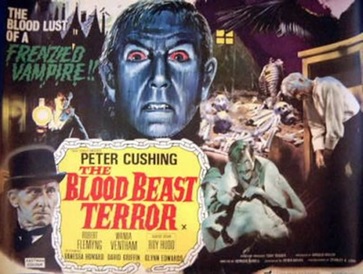
Horror On the Lens: The Blood Beast Terror (dir by Vernon Sewell)


Today’s horror n the lens is the 1968 British film, The Blood Beast Terror!  This film stars the great Peter Cushing and it is perhaps the only film to ever feature a …. WERE-MOTH!

Seriously, how can you resist Peter Cushing and a Were-Moth?

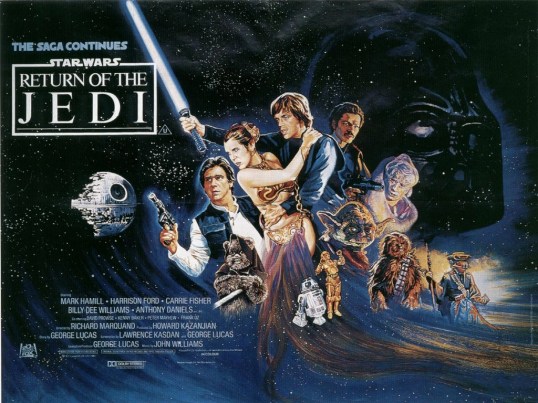
Sci-Fi Film Review: Return of the Jedi (dir by Richard Marquand)


areturn1

As you’ve probably noticed, we’ve devoted this month to science fiction here at the Shattered Lens.  Gary Loggins reviewed THX-1138.  Valerie took a look at everything from The Star Wars Holiday Special to Turkish Star Wars to Return of the Ewok.  Ryan the Trashfilm Guru reviewed such Italian classics as Cosmos: War of Planets and War of the Robots.  Patrick Smith reviewed a terrifying Christmas movie about Santa. Myself, I’ve taken a look at such films as Contamination and 2019: After the Fall of New York.  

We’ve reviewed a lot of science fiction and we’ve got a lot more left to go.  (Keep an eye out for my reviews of Starcrash and The Humanoid over the upcoming few days.)  However, from the beginning, this month has always been centered around Star Wars.  You may have heard that there’s a little movie called Star Wars: The Force Awakens and it’s opening this week.  Apparently, a few people are excited about it.  Since we love reviewing little known art films here at the Shattered Lens, we decided why not review all of the previous Star Wars films during the week leading up to the release of The Force Awakens?  Jeff (a.k.a. the blogger known as Jedadiah Leland) started us off by reviewing The Phantom Menace.  Then Alexandre Rothier took a look at Attack of the Clones, followed by Jeff’s look at Revenge of the Sith.  Leonard Wilson was the next to step up to the plate, reviewing both A New Hope and The Empire Strike Back.

And now, it’s my turn to add my thoughts to this project.  It’s time to review the 1983 film, Return of the Jedi.  And I have to admit that, when I first thought about what I wanted to say in this review, I was totally intimidated.  Unlike my fellow writers here at the Shattered Lens, I’m hardly an expert when it comes to Star Wars.  Don’t get me wrong — I know the basics.  I know that Darth Vader is Luke’s father.  I know that Han Solo flies the Millennium Falcon and that Princess Leia is in love with him.  I know there’s an evil Empire and I know that there are rebels.  I’m not a virgin when it comes to Star Wars but, at the same time, I’m definitely not as experienced (with Star Wars) as most of my friends and fellow movie bloggers.

"Dang, Lisa, get over it!"

“Dang, Lisa, get over it!”

So, late this afternoon, when I sat down to watch Return of the Jedi, it was with more than a little trepidation.  My obvious panic and welling tears convinced Jeff to watch the movie with me and I was happy for that.  He loves Star Wars so I knew he could explain to me what was going on.

Finally, we watched Return of the Jedi and I discovered that I was panicking over nothing.  Return of the Jedi may be the third part of trilogy and I may not be an expert on the films that came before it.  But, even with all that in mind, Return of the Jedi is not a difficult film to figure out.  As opposed to the finales of Harry Potter, The Hobbit, and The Hunger Games, Return of the Jedi keeps things simple.  A good guy has been kidnapped by a bad guy.  The other good guys come to the rescue and then go to another planet so that they can fight an even bigger bad guy.  It’s not complicated.

As I watched Return of the Jedi and realized that I was having absolutely no problem following the film’s plot, I also realized that the Star Wars films are such a huge part of our culture that, regardless of how many of them we’ve actually sat through, everyone has absorbed them by osmosis.  Bits and pieces of it are everywhere, showing up in everything from TV sitcoms to political commentary.  (Remember how everyone used to compare Dick Cheney to Darth Vader?)  The Star Wars franchise is almost biblical in that respect.  At the same time, the fact that everyone knows about these movies makes them a little difficult to review.  You don’t so much watch a Star Wars film as you join in a universal experience.  As a reviewer, you definitely find yourself wondering what you can add to a conversation that everyone else has already had.

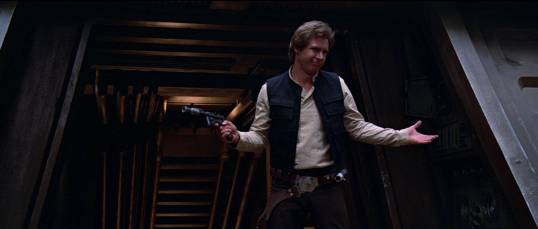
As a stand alone movie, Return of the Jedi is actually three separate films mixed together.  The first film deals with Luke Skywalker (Mark Hamill) showing up at Jabba the Hutt’s palace and rescuing Han Solo (Harrison Ford), Princess Leia (Carrie Fisher), Chewbacca (Peter Mayhew), and two robots from being tossed into a creature called the Sarlacc, which is basically a giant vagina out in the middle of the desert.  The second film deals with the rebels teaming up with a bunch of teddy bears and fighting the Empire on a jungle planet.  And the third film features Luke and Darth Vader (body of David Prowse, voice of James Earl Jones, face of either Sebastian Shaw and Hayden Christensen, depending on which version of the film you’re watching) dealing with their family issues while the Emperor (Ian McDiarmid) cackles in the background.  Some parts of the film work better than others.  The end result is entertaining but definitely uneven.

Star-Wars-Episode-VI-Return-Of-The-Jedi-Darth-Vader-darth-vader-18356239-1050-656

Jedi‘s heart belongs to that third film, the one dealing with Luke and Darth Vader.  I’ve read some pretty negative online comments about Mark Hamill’s performance in New Hope and Empire Strikes Back but, in Return of the Jedi, he brings an almost haunted intensity to the role of Luke.  In theory, it’s easy to be snarky about all the talk about the “Dark Side of the Force,” but, when you look in Hamill’s eyes, you totally understand what everyone’s going on about.  You see the fire and the anger but, even more importantly, you see the struggle between good and evil.  There’s a very poignant sadness to the scenes where he and his father prepare to meet the Emperor.

And speaking of the Emperor, he is pure nightmare fuel!  AGCK!

movies_star_wars_vi_return_of_the_jedi_1

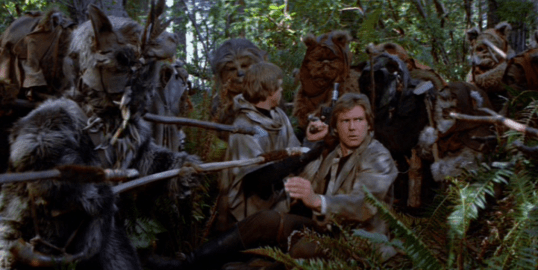
As for the other two films to found within Return of the Jedi, the jungles of Endor didn’t do much for me.  Don’t get me wrong.  I thought the action scenes were handled well and, unlike apparently everyone else in the world, I was not annoyed by the inclusion of the Ewoks, the killer teddy bears who helped to the Rebels to take down the Empire.  I thought the Ewoks were cute and I actually got pretty upset when one of them was killed in battle.  If I had been alive when Return of the Jedi had been released, I probably would have wanted a stuffed Ewok and, I imagine, that was the main reason they were included in the film.  (I also imagine that’s the main reason why a lot of people can’t stand them.)

Return-of-the-Jedi-Ewoks-1024x515

So, no, the Ewoks did not bother me.  What did bother me was that under-construction Death Star floating out in the middle of space.  It bothered me because I really couldn’t imagine any reason why — after the first Death Star was apparently such a colossal failure — the Empire would insist on trying to do the exact same thing all over again.  This, along with the fact that they were rather easily defeated by a bunch of teddy bears, leads me to wonder whether the effectiveness of the Empire was just a little overrated.  I mean, the Emperor was scary but otherwise, everyone involved with the Empire was pretty incompetent.

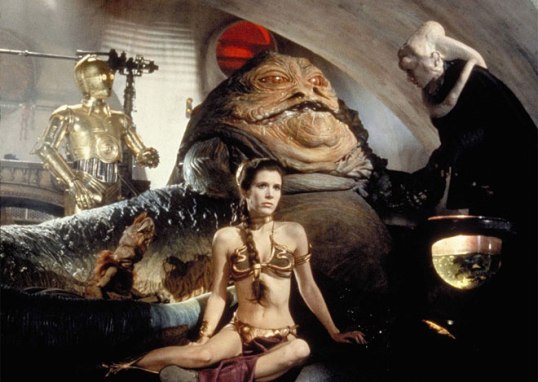
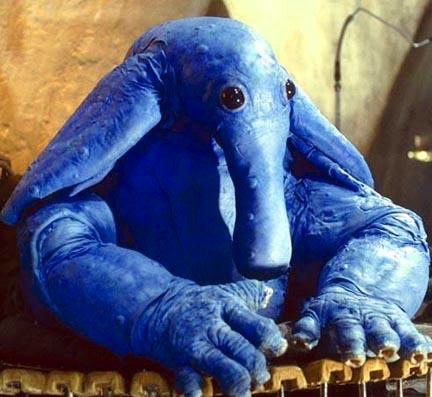
Far more impressive, as far as villains go, was Jabba the Hut.  In fact, Jabba and his decadent entourage were so memorable and colorful and evil and icky that they pretty much overshadowed almost everything else in the film.  I mean, Jabba even had a blue elephant playing music for him!  And I know that I’m supposed to be critical of the film for putting Leia in that gold bikini but you know what?  Leia may have been forced to wear a gold bikini but she never gave up her dignity or her defiance.  And when it came time to take out Jabba, Leia used the tools of her oppression to do so, strangling him with his own chains.  In that one scene, Leia proved herself to be a true rebel.

return01

There’s a lot that’s good about Return of the Jedi but, as I said earlier, it’s definitely an uneven film.  Richard Marquand’s direction is perhaps the epitome of workmanlike.  It’s efficient and it’s dependable and there’s absolutely nothing surprising or particularly challenging about it.

It’s interesting to note that, before Richard Marquand was selected as director, the job was offered to both David Lynch and David Cronenberg, two directors who are all about surprising and challenging the audience.  What would David Lynch’s Return of the Jedi been like?  Well, here’s one possibility:

As for David Cronenberg’s Return of the Jedi, it might have looked something like this:

For better or worse, the world got Richard Marquand’s Return of the Jedi, which I imagine was pretty close to what George Lucas wanted the film to be.

As I sit here finishing up this review and wondering just why exactly I was so intimidated earlier (seriously, this turned out to be one the easiest reviews that I’ve ever written), I estimate that 75% of the people that I know are currently sitting in a theater and watching The Force Awakens.  Keep an eye out for Arleigh’s review in the next few days!

And in closing, here’s that blue elephant that I mentioned earlier.  Dance!

Maxrebo