Retro Television Review: Miami Vice 4.18 “Badge of Dishonor”


Welcome to Retro Television Reviews, a feature where we review some of our favorite and least favorite shows of the past!  On Mondays, I will be reviewing Miami Vice, which ran on NBC from 1984 to 1989.  The entire show can be purchased on Prime!

This week, Crockett and Tubbs battle some corrupt cops.

Episode 4.18 “Badge of Dishonor”

(Dir by Richard Compton, originally aired on March 18th, 1988)

Badge of Dishonor opens with Underworld’s Glory, Glory playing on the soundtrack.  It’s an early electronic tune, one that isn’t quite EDM but still definitely shows hints of what Underworld and a lot of other synth-pop bands would eventually become.  Usually, that would be pretty cool but, unfortunately, the song also has a gospel music feel and I personally gospel music to be excruciatingly dull.

That’s certainly the case here, where the music is played over the opening teaser and the gospel sounds robs it of whatever momentum it might have had.  The episode opens with a drug deal gone wrong.  Tubbs is working undercover when he and his contacts are suddenly busted by four cops, who kill the real dealers and then steal the drugs and the money.  Tubbs barely manages to escape with his life.  It should have been an exciting opening but it had a “been there, done that” sort of feel to it.  This isn’t the first Miami Vice episode to feature an drug deal gone wrong and it’s not even the first to feature corrupt cops.

The cops in question are all originally from Cuba.  Back in Castro’s Hellhole, they were all members of the same street gang.  After coming to Miami and building up lengthy juvenile records, the four men were subsequently hired after a race riot (a real-life event that Castillo discusses in his terse manner) led to demands for a more racially-balanced police force.  Because the force desperately needed some non-redneck cops, no one bothered to do an extensive background check on the four men when they applied to be cops.  Tubbs comments that the corrupt cops are setting “minority hiring back 400 years.”

Crockett and Tubbs’s investigation at first centers on a lieutenant (Reni Santoni) who they think is crooked because he lives on a yacht.  The lieutenant explains that he married well and that he suspects the same four cops as Crockett and Tubbs.  The lieutenant is subsequently murdered by the cops.  It turns out that the corrupt cops are getting their information from an undercover detective named Madison Stone (Michele Shay).  Stone has spent the past few years deep undercover, living in a homeless community on the riverfront.  Stone is not herself corrupt.  She’s just been manipulated and is now in an impossible situation.  At least, that’s the way Tubbs views it.  Myself, I just felt that Madison Stone appeared to be as bad at working undercover as Sonny Crockett.

Technically, this was a well-made episode.  The main problem is that the plot itself just felt so familiar and the four corrupt cops were not particularly interesting.  Compared to the usual flamboyant Miami Vice criminals, the cops were pretty bland.  In typical Miami Vice fashion, it ended on a dark note.  The corrupt cops were defeated but both Madison Stone and their lieutenant were dead.  There’s no happy endings in Miami.
Retro Television Review: Miami Vice 3.5 “The Good Collar”


Welcome to Retro Television Reviews, a feature where we review some of our favorite and least favorite shows of the past!  On Mondays, I will be reviewing Miami Vice, which ran on NBC from 1984 to 1989.  The entire show can be purchased on Prime!

This week, even more innocent lives are destroyed by an unwinnable war on drugs.

Episode 3.5 “The Good Collar”

(Dir by Mario DiLeo, originally aired on October 24th, 1986)

This week’s episode of Miami Vice tells the story of several wars playing out on the streets of Miami.

One of the wars is the skirmish between two street gangs, made up exclusively of teenagers.  Led by Count Walker (Samuel Graham), the Regular Fellas are pushing drugs and even forcing a promising football star named Archie Ellis (Keith Diamond) to deliver a package of black tar heroin for them.  The Regular Fellas are at war with The Apostles.  Among the members of the Apostles is Ramirez (Jsu Garcia), an undercover cop who is actually 23 but who is pretending to be seventeen.

When Crockett and Tubbs bust Archie, all three of them find themselves dragged into the National War On Drugs.  Assistant State Attorney William Pepin (Terry Kinney) wants to take Count Walker down, if just so he can claim a rare victory.  When Archie helps Crockett and Tubbs make a bust and also saves them from getting shot in a back alley, Pepin agrees to drop all the charges against Archie.  But after Ramirez is blown up by the Regular Fellas, Pepin decides that he’s going to go ahead and charge Archie unless Archie wears a wire and gets Count Walker to confess to his crimes.

Crockett, the former football star, is outraged by Pepin’s decision to put Archie in danger.  Crockett even offers to doctor the records so that Archie’s arrest will be dismissed by the courts.  However, Archie refuses.  Archie says that he’s responsible for his own mistakes and he’ll deal with the consequences.  Unfortunately, in this case, the consequences involve Archie being shot and killed by Count Walker, though not before getting Walker to confess on tape.  Walker is arrested and his gang is destroyed but at the cost of Archie’s life.  Pepin is happy.  Ramierz’s supervisor, Lt. Lee Atkins (John Spencer), is happy.  But social worker Ed McCain (Charles S. Dutton) blames Crockett for Archie’s death.  And Archie’s grandmother slams the door in Crockett’s face when he attempts to come by to pay his final respects.

What a dark episode!  However, it does get to the truth of the matter.  There was no way to win the War on Drugs.  Even the victories in this episode feel hollow.  Regular viewers of Miami Vice would have understood that someone else would eventually step into the vacuum left by Walker’s arrest.  Meanwhile, Archie — a good kid with the athletic talent necessary to win a college scholarship and have a chance to escape from the poverty that he grew up in — is shot and killed because a state’s attorney needed to notch up at least one victory.  Miami Vice was at its best when it was cynical and it doesn’t get much more cynical than this heartbreaking episode.

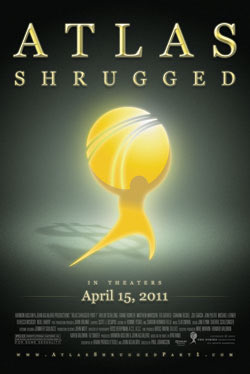
Film Review: Atlas Shrugged, Part One (dir by Paul Johansson)


The year is 2016.  A global depression has crippled the world’s economy.  While the middle class struggles to exist from day to day, the poor are getting poorer and the rich are getting richer.  Across the world, countries are nationalizing their industries, instituting price controls, and passing burdensome regulations.  Though the government officials and the academics claim that all of this is being done “in the name of the people”, it’s hard not to notice that the people are the one who are suffering as a result.  It’s also hard not to notice that most of the regulations seem to result in the bureaucrats getting not only more powerful but also wealthier.  Throughout the world, people who have started businesses or who have otherwise stood up to the government are vanishing without a trace.  In the shadows people ask, “Who is John Galt?”

Because gasoline now costs $37.00 a gallon, railroads have made a big comeback.  But the government, which claims to know what’s best and to be infallible, has done a terrible job maintaining the nation’s railways.  Dagny Taggart (Taylor Schilling), the vice president of Taggart Transcontinental Railways, is determined to rebuild the aging tracks with Rearden Metal, a new type of metal that is somehow both stronger and lighter than steel.  The inventor of the new metal is Hank Rearden (Grant Bowler).  And while that may sound like a good plan that will preserve the the nation’s supply chain, the government is angry that Rearden will not hand Rearden Metal over to them.  When Dagny’s weaselly brother, James (Matthew Marsden), announces that Taggart Railways will continue to use an inferior metal, Dagny goes into business for herself.  Despite the attempts of the government to stop them with bad publicity and excessive regulation, Dagny and Hank construct the John Galt Line.  Unfortunately, the success of the John Galt Line does not matter to Wesley Mouch (Michael Lerner, giving the film’s best performance), the former corporate lobbyist-turned-economics czar.  Mouch only sees the success of others as being a threat to his own power.

Meanwhile, people like oil tycoon Ellis Wyatt (Graham Beckel, giving the film’s second-best performance) continue to ask, “Who is John Galt?”

The first part of a trilogy of films based on the Ayn Rand novel of the same name, Atlas Shrugged Part One was released in 2011.  At that time, it received overwhelmingly negative reviews.  That, in itself, wasn’t really a shock.  There was no way that a Libertarian-themed film released at the height of the “good government” era was going to get positive reviews.  To some, it was a bigger shock that the film itself didn’t do particularly well at the box office but, again, it should have been expected.  I think Libertarians always tend to overestimate the amount of people who have 1) read Ayn Rand and 2) liked what they read.

Myself, I thought the film suffered due to its low-budget and the bland performances of Taylor Schilling and Grant Bowler in the lead roles.  At the same time, I felt that the film accomplished what it set out to do, in that it entertained the anti-government folks while annoying the MSNBC crowd.  (That said, I doubt anyone from the latter group voluntarily watched the film.)  With everything that has happened over the past seven years, it can be easy to forget just how idealized the government was in 2011.  In 2011, we were continually told that the solution to every problem could be found in a government agency populated by wonky bureaucrats.  It was like being trapped in a never-ending Aaron Sorkin fanfic.  Whatever flaws Atlas Shrugged Part One had, there was something enjoyably subversive about the film’s suggestion that the government was staffed by fools and aspiring authoritarians.  The film may have been heavy-handed when it came to portraying the greed and the stupidity of its villains but one could argue that it was no more heavy-handed than the typical Hollywood film.  It’s just, in this case, the villains of Atlas Shrugged Part One were the people who would have been the heroes of any other film.

Of course, when viewed today, Atlas Shrugged lands a bit differently.  Now that we’ve lived through the COVID era, the film’s portrayal of arrogant bureaucrats and politicians barking out orders and claiming that anyone who questions them is an enemy of the people no longer feels quite as over-the-top.  As well, it’s no longer easy to laugh off the idea of corporations working hand-in-hand with the government or the supply chain being disrupted.  The film itself still comes across as being a bit silly with its attempts to recreate the world of the rich and powerful on a very limited budget but it’s definitely more relatable today than it was in 2011.  Much of what originally felt subversive about this film now feels a bit prophetic.  If the film were released today, it would probably appeal to a mix of anti-government activist and transcontinental rail enthusiasts.  The critic wouldn’t be any nicer but it would definitely do better at the box office.

Film Review: Strategic Command (dir by Rick Jacobson)


In the 1997 film, Strategic Command, Richard Norton plays a terrorist named Carlos …. wait for it …. Gruber.  If that last name sounds familiar, that’s because the villain of Die Hard was named Hans Gruber and the bad guy from Die Hard With A Vengeance was named Simon Gruber.  Gruber — the number one name in hostage situations!

Anyway, Carlos Gruber and his fellow terrorists steal a chemical called Bromax from the FBI.  Bromax is a chemical weapon, one that can be used to kill thousands of people.  It’s probably not a good idea for anyone to have Bromax, regardless of whether they are terrorists or the FBI.  What’s the point of Bromax, really?  It only has evil purposes.  Plus, it has a stupid name.

Gruber proceeds to hijack Air Force Two, holding the Vice President (Michael Cavanaugh) and several journalists hostage.  Gruber wants his fellow terrorists to be released from prison and he’s prepared to kill the Vice President if he doesn’t get what he wants.  Perhaps because Gruber realizes how little the Vice President actually does, Gruber is also willing to spray Bromax over America.

Not wanting to see America get Bromaxed, the President sends an elite force of special op. soldiers after Air Force Two.  Captain Rattner (Jsu Garcia, back when he was still using the name Nick Corri) is in charge of the mission and he doesn’t expect there to be any slip-ups.  Accompanying Rattner’s men is Rick Harding (Michael Dudikoff!), the inventor of Bromax!  Along with not wanting to see Bromax sprayed over America, Harding also wants to save the life of his wife, Michelle (Amanda Wyss, who co-starred with Jsu Garcia in the original Nightmare on Elm Street).  Michelle is one of the journalists on the plane.

Strategic Command is stupid, yet strangely likable.  It’s impossible not to admire the film’s attempt to be a huge action epic without actually spending any money.  As a result, Air Force 2 is a commercial airliner.  There’s a surprisingly small number of people involved on both sides of the plot.  The viewer might expect the hostage situation to be one of those big, “all hands on deck” emergencies but, instead, the President is content to send 6 people to get the job done.  Fortunately, there aren’t that many terrorists either.  This is action on a budget.

Adding to the film’s overall strangeness is the miscasting of Michael Dudikoff as a quiet and somewhat nerdy scientist.  This is one of those films where the viewer is meant to assume that a character is smart just because he’s wearing glasses.  Dudikoff is so miscast that, again, it all becomes strangely likable.  He and Richard Norton are so enthusiastic about chewing up the scenery that it’s kind of fun to watch.  Also fun to watch is the legitimate great actor Bryan Cranston, cast here as a vain and cowardly anchorman.  One gets the feeling that this is probably not a film that Cranston brags about but his performance isn’t bad at all.  Every film like this needs to have a self-important reporter who can get humiliated in some fashion and Cranston handles the role like a pro.

Strategic Command is dumb but kind of fun, in the way that many 90s direct-to-video action films tend to be.  It’s a good film for when you want to watch something that won’t necessarily require your full attention.  In fact, the less thought one gives to what happens in Strategic Command, the better.  Watch it for Dudikoff, Norton, and especially the one and only Bryan Cranston!

Horror Movie Review: A Nightmare On Elm Street (dir by Wes Craven)


Damn, this is a scary movie.

That may seem like an obvious point to make when talking about the original A Nightmare On Elm Street but it’s still one that needs to be made.  I always seem to forget just how scary the original is.  I mean, there’s been so many sequels.  And there was that kind of silly movie where Freddy Krueger fought Jason Vooerhees.  And then there was the fairly forgettable reboot.  Freddy Krueger is something of a cultural icon.  Even people who have never watched any of the movies knows who Freddy Krueger is.  Freddy has become so well-known for his quips and his puns and his bad jokes that it’s easy to forget that the reason he put razors on his gloves was so he could kill children.

Despite the fact that Jackie Earle Haley took over the role in the reboot, Freddy Krueger will always be associated with the actor who first played him, Robert Englund.  What’s interesting is that, whenever you watch or read an interview with Englund, he comes across as being literally the nicest guy in the world.  (His autobiography is one of the most cheerful Hollywood memoirs that I’ve ever read.)  Before he was cast as Freddy, Englund was a fairly busy character actor.  It’s always a little odd when he pops up in some old movie on TCM because, inevitably, he’s always seems to be playing a nice and often kinda shy guy.  Supposedly, when Englund auditioned for the role of Freddy, he darkened his lower eyelids with cigarette ash and he purposefully said very little while meeting with director Wes Craven.  Craven, who based Freddy Krueger on a childhood bully, was impressed enough to cast this very likable actor as one of the most evil killers in the history of horror cinema.

And make no mistake about it.  In the first film, Freddy Krueger is terrifying.  He’s not the joker that he would become in later installments of the franchise. When he does laugh, it’s because he’s taunting his latest victim.  This Freddy isn’t quite as quick-witted as the Freddy who showed up in Dream Warriors and other films.  This Freddy keeps things simple, popping up in your nightmares, chasing you, and, once he catches you, killing you.  It’s not just his glove and his burned faced that makes Freddy terrifying in this film.  It’s how determined and relentless he is.  He’s not going to stop until he catches you and, seeing as how he’s already dead, there’s really not much you can do to slow him down.  Englund plays Freddy as being the ultimate bully.  The only joy he gets is from tormenting the rest of us.  It’s a testament to the strength of Englund’s performance that memories of Freddy dominate our thoughts when it comes to A Nightmare of Elm Street, despite the fact that Freddy is only onscreen for seven minutes.

It’s an effective film, not just because of the nightmare scenes but also because of the scenes that take place in the waking world.  The majority of the film follows Nancy (Heather Langenkamp), Glen (Johnny Depp), Tina (Amanda Wyss), and Rod (Jsu Garcia, who is credited as Nick Corri in this film) as they try not to die.  And let’s be honest.  None of these characters are particularly deep.  Rod’s the bad boy.  Tina’s the rebellious Catholic.  Glen’s the nice guy.  Nancy’s the good girl.  They’re archetypes that should be familiar to anyone who has ever seen a slasher film.  And yet, you really do care about them, especially Nancy and Glen.  (Admittedly, everyone that I’ve ever talked to about this film seems to care about Rod the least.)  Langenkamp, Depp, and Wyss all give such likable performances that you really do find yourself worrying about what will happen to them when and if they fall asleep.

I rewatched A Nightmare on Elm Street last night and I was shocked to discover that, even though I knew what was coming, the movie still scared me.  The sight of Freddy straining against the wall over Nancy’s head was still unbelievably creepy.  The gory scene where Freddy attacks Tina still frightened me, as did the famous geyser of blood scene.  Even the much-parodied scene where Freddy’s glove rises up between Nancy’s legs while she sleeps in the bathtub still made me shudder.

It’s easy to take for granted just how good and scary the original Nightmare on Elm Street actually is.  For horror fans, it’s a film that deserves to be watched this October season.  Just don’t fall asleep afterwards.