Retro Television Reviews: Under the Influence (Dir by Thomas Carter)


Welcome to Retro Television Reviews, a feature where we review some of our favorite and least favorite shows of the past!  On Sundays, I will be reviewing the made-for-television movies that used to be a primetime mainstay.  Today’s film is 1986’s Under the Influence!  It  can be viewed on YouTube!

Noah Talbot (Andy Griffith) is an upstanding member of the community.  He owns a hardware store.  He has a large family.  He’s known as a gruff but folky storyteller.  He’s a deacon in his church and helps to collect the offering every Sunday.

He’s also a drunk and a bit of a bully.  His family walks on eggshells around him, fearful of setting him off on one of his benders.  He occasionally spends the night in jail, arrested for trying to drive drunk.  Even when he gets bailed out, his first instinct is to go back to the bar.  The folks at the bar love him, don’t you know.  The people at the bar are always happy to see him and never bother him about whether he’s had too much.  The people at the bar never let him down the way that he feels his family has left him down.

The members of his family each cope in their own individual way.  Noah’s wife (Joyce Van Patten) is in denial and spends a lot of her time popping pills.  His oldest daughter, Ann (Season Hubley), is driven to succeed at work and spends all of her time both hating her father and desperately hoping for his approval.  (When she tells him that she got a raise at work, he berates her for only getting a 6% increase in her salary.  “That’s just a cost of living increase!” he snaps at her.)  His eldest son, Stephen (Paul Provenza), fled to Los Angeles and is trying to make a career as stand-up comedian.  (“You’re no David Letterman,” Noah tells him.)  His youngest daughter, Terri (Dana Anderson), secretly replaces Noah’s liquor with water and food-coloring.  And his youngest son, Eddie (Keanu Reeves), is becoming an alcoholic himself.

Having read all that, you may be wondering just how exactly Keanu Reeves could be the son of Andy Griffith and it’s a fair question.  This was one Keanu Reeves’s first acting roles and he does a pretty good job in the role of Eddie.  That said, he looks so totally different from both Andy Griffith and Joyce Van Patten and the actors playing his siblings that I was half-expecting someone to mention that Eddie had been adopted.  Then again, Paul Provenza doesn’t really bear much of a resemblance to the actors playing his parents either.  Dana Anderson and Season Hubley do, at least, look like sisters.

Lack of family-resemblance aside, all of the actors in Under the Influence do a good job of inhabiting their characters.  For those who are used to seeing Andy Griffith playing friendly Southerners in reruns of The Andy Griffith Show and Matlock, it’s shocking and a little disturbing to see him playing an abusive, alcoholic jerk in Under the Influence.  Noah is someone who would not only destroy his own family to get a drink but who would then blame them for it happening in the first place.  Noah may be under the influence of alcohol but the entire family is suffering because they’re under the influence of Noah.  By the time Noah is spitting up blood and demanding that his youngest son sneak liquor into his hospital room, the viewer knows there is no hope for Noah but hopefully, his family will escape.

It doesn’t make for a particularly happy movie but, speaking as someone who grew up in an alcoholic household, I can attest that it does make for an honest portrayal of what addiction does not just to the addict but also to the people around the addict.  I cringed in sympathy through nearly the entire film, especially as I watched three of the four children react in the same ways that I did.  (Unlike Eddie, I never became much of a drinker and instead developed an aversion to alcohol in general.)  It’s a film that feels real and one’s heart aches for the entire family.  If it could happen to Andy Griffith, it could happen to anyone.

The Martian Chronicles: Episode 2: The Settlers (1980, directed by Michael Anderson)


The first episode of The Martian Chronicles ended with a dying Jeff Spender (Bernie Casey) warning John Wilder (Rock Hudson) that humans settling on Mars would be the worst thing that could ever happen to the once powerful red planet.

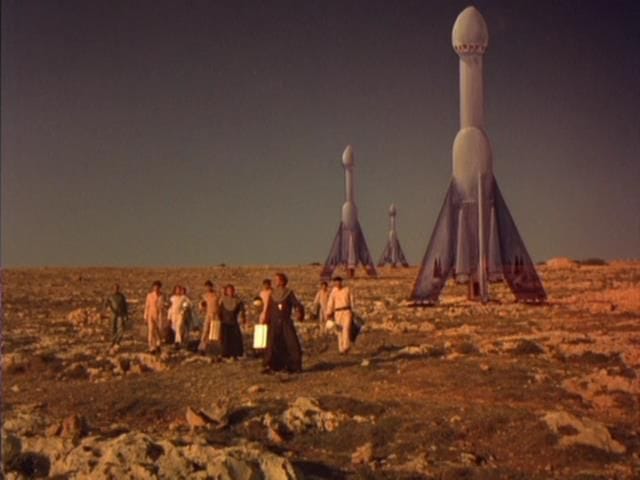
The second episode, called The Settlers, sets about to prove Spender right.  By 2004, humans are desperately leaving the war-torn Earth for a new home on Mars.  They rename all of the Martian landmarks, honoring the men who died exploring the planet.  In one of the few deliberately funny moments of this entire miniseries, it’s revealed that the canal that Briggs threw his beer cans in was eventually named Briggs Canal.  There’s one unfortunate shot of a line of miniature space ships that are supposed to be orbiting Mars and waiting for their chance to land.  The episode then gets down to showing what the settlers do to Mars.

It’s nothing good.  The main town looks like a traveling carnival, full of bars and crime.  Many of the people who come to Mars are people who are fleeing something on Earth and Col. Wilder has his hands full trying to keep the peace.  All of the Martians are believed to be dead but it turns out that there are still a few out there.  Using their mental powers, they disguise themselves as humans.  A large part of the second episode deals with a Martian who approached an elderly couple, disguised as their dead son.  Even though they know that he’s not really their son, they allow him to live in their home.  But, when the Martian goes to the city, he becomes overwhelmed by all the thoughts that bombard his mind.  Everyone sees him as being someone that they care about.  Even the local priest, Father Peregrine (Fritz Weaver), sees the Martian as being Jesus.  (That’s no big deal today but that had to have been controversial in 1980.)  Eventually, the Martian becomes so overwhelmed that he dies while a group of humans gawk at him.

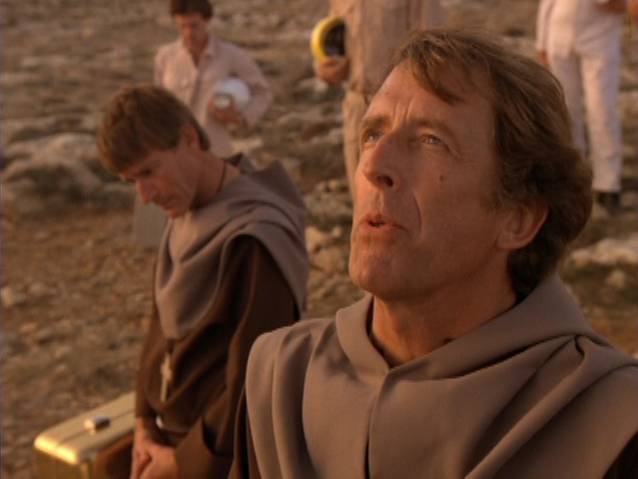
As for Father Peregrine and Father Stone (Roddy McDowall, who spent most of his later years appearing in miniseries like this one), they explore the Martian mountains, searching for three lights that have been reported as hovering in the sky.  When they find the lights, the lights explain that they are ancient Martians who long ago abandoned their corporeal bodies.  They also somewhat implausibly say that they worship the same God as the two priests.  In a departure from Bradbury’s original short stories (in which Bradbury was skeptical about the idea of bringing religion to the Mars), Father Peregrine commits to building a church so that, even on the Red Planet, people can worship.

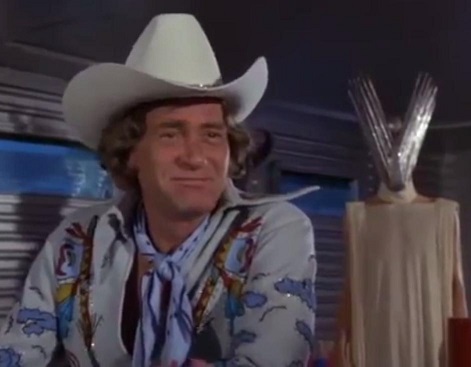
Finally, Sam Parkhill (Darren McGavin) has achieved his dream of building a restaurant on Mars.  He says that, as soon as more Earthlings arrive, he’ll be rich because every trucker will stop off at his place for a bite to eat.  When a Martian suddenly shows up in the diner, Parkhill panics and shoots him.  When more Martians show up, Parkhill flees.  It’s only when the Martians catch up to him does he learn that they’re giving him a grant for half the land on Mars.  “Tonight’s the night,” they tell him, “Prepare.”  Old Sam Parkhill’s pretty excited until he looks through a space telescope and sees that Earth, the home of his future customers, is now glowing with the sure sign of nuclear fire.  I can’t remember how old I was when I first saw this episode on late night Baltimore TV but I do remember being thoroughly freaked out by the scene where Sam watches as a fiery glow encircles the Earth and the planet’s green surface turns brown.  It’s the most powerful moment in the miniseries and a fitting visualization of Bradbury’s concerns about the nuclear age.

As for the rest of The Settlers, it’s good but it’s not as strong or as cohesive as the first episode.  The Martin shapeshifter story is good but the two priests in the mountains felt like they were included to keep religious viewers happy and their segment takes too many liberties with Bradbury’s original material.  Then, Darren McGavin returns to the story. dressed like a cowboy and getting chased by a Martian sandship and The Martian Chronicles goes back to being one of the coolest miniseries to ever be broadcast.

With Earth dead, would Mars follow?  That was the theme of the next episode of The Martian Chronicles, which we’ll look at tomorrow.

18 Days of Paranoia #4: The Falcon and the Snowman (dir by John Schlesinger)


http://www.youtube.com/watch?v=y8HE_mHphZk

The 1985 film, The Falcon and the Snowman, tells the story of two friends.  They’re both wealthy.  They’re both a little bit lost, with one of them dropping out the seminary and the other becoming a drug dealer who is successful enough to have a lot of money but inept enough to still be treated like a joke by all of other dealers.

Chris Boyce (Timothy Hutton) is the son of a former FBI agent (Pat Hingle).  He has a tense relationship with his father.  It’s obvious that the two have never really been sure how to talk to each other.  While his father is sure of both himself and his country, Chris is far more sensitive and quick to question.  While his father plays golf and attends outdoor barbecues, Chris becomes an expert in the sport of falconry and spends a lot of time obsessing about the state of the the world.  While his father defends Richard Nixon during the Watergate investigation, Chris sees it as evidence that America is a sick and corrupt country.  Because his father doesn’t want Chris sitting around the house all day, he pulls some strings to get Chris a job working at the “Black Vault,” where Chris will basically have the ability to learn about all sorts of classified stuff.

Daulton Lee (Sean Penn) was Chris’s best friend in school.  Daulton’s entire life revolves around cocaine.  He both sells and uses it.  He’s managed to make a lot of money but his addiction has also left him an erratic mess.  Daulton’s father wants to kick him out of the house.  Daulton’s mother continually babies him.  Chris and Daulton may seem like an odd pair of friends but they’re both wealthy, directionless, and have a difficult time relating to their fathers.  It somehow seems inevitable that these two would end up as partners.

Chris Boyce and Daulton Lee, together …. THEY SOLVE CRIMES!

No, actually, they don’t.  Instead, they end up betraying their country.  (Boooo!  Hiss!  This guy’s a commie, traitor to our nation!)  After Chris discovers that the CIA has been interfering in the elections of America’s allies (in this case, Australia), he decides to give information to the Russians.  Since Daulton already has experience smuggling drugs over the southern border, Boyce asks Lee to contact the KGB the next time that he’s in Mexico.  Despite being a neurotic and paranoid mess, Lee manages to do just that.

Of course, as Chris soon comes to discover, betraying your country while working with a greedy drug addict is not as easy as it seems.  While Chris wants to eventually get out of the treason game, marry his girlfriend (Lori Singer), and finish up college, Daulton wants to be James Bond.  The Russians, meanwhile, soon grow tired of having to deal with Lee and start pressuring Chris to deal with them directly….

And it all goes even further downhill from there.

Based on a true story, The Falcon and the Snowman tells the story of how two seemingly very different young men managed to basically ruin their lives.  Boyce’s naive idealism and Lee’s drug-fueled greed briefly makes them a powerful duo but they both quickly discover that betraying your country isn’t as a simple as they assumed.  For one thing, once you’ve done it once, it’s impossible to go back to your normal life.  As played by Hutton and Penn, Chris and Daulton are two very interesting characters.  Boyce is full of righteous indignation and sees himself as being a hero but the film hints that he’s mostly just pissed off at his Dad for never understanding him or caring that much about falconry.  Daulton, meanwhile, is a lunatic but he seems to be aware that he’s a lunatic and that makes his oddly likable.  At times, it seems like even he can’t believe that Chris was stupid enough to depend on him.  The film provides a convincing portrait of two men who, because of several impulsive decisions, find themselves in over their heads with no possibility of escape.

The Falcon and the Snowman is an entertaining and occasionally thought-provoking time capsule of a different age.  If the film took place in 2020, Daulton would be hanging out with the Kardashians and Chris would probably be too busy working for the Warren campaign to spy for America’s enemies.  If only the two of them had been born a few decades later, all of this could have been of avoided.

Previous Entries In The 18 Days of Paranoia:

  1. The Flight That Disappeared
  2. The Humanity Bureau
  3. The Privates Files Of J. Edgar Hoover

30 Days of Noir #24: Fourteen Hours (dir by Henry Hathaway)


As a genre, film noir has always been associated with crime: murder, brutish gangsters, seductive femme fatales, and occasionally a cynical private detective doing the right thing almost despite himself.  However, not all film noirs are about criminals.  Some are just about desperate characters who have found themselves on the fringes, living in a shadow-filled world that appears to be monstrously indifferent to all human suffering.

That’s certainly the case with the 1951 noir, 14 Hours.  The film centers around Robert Cosick (Richard Basehart, who previously played a murderer in another classic noir, He Walked By Night).  Robert isn’t a gangster.  He’s not a private detective.  He doesn’t carry a gun and he doesn’t provide any sort of hard-boiled narration.  In fact, for the majority of the film, Robert is defined by less who he is and more by what he’s doing.  Robert Cosick, having earlier checked into a room on the 15th floor of a New York hotel, has climbed out of a window and is now standing on a ledge.  Robert says that he’s going to jump.

What has driven Robert Cosik to consider such an extreme action?  The film never settles on any one reason, though it gives us several clues.  When his father (Robert Keith) and his mother (Agnes Moorehead) show up at the scene, they immediately start bickering about old family dramas.  When Robert’s ex-fiancee (Barbara Bel Geddes) begs him to step in from the ledge, he listens a bit more to her than he did to his parents but he still refuses to come in from the ledge.

But perhaps the real reason that Robert Cosick is out on that ledge can be found in the film’s shadowy visuals.  Directed in a semi-documentary fashion by Henry Hathaway and featuring harsh, black-and-white cinematography that’s credited to Joe MacDonald, Fourteen Hours emphasizes the indifference of the city.  From the menacing landscape of concrete buildings to the crowds gathering below the ledge to see if Robert lives or dies,  New York City is as much as a character in this film as Robert, his family, or the cop (played by Paul Douglas) who finds himself trying to talk Robert into reentering his hotel room.  When night falls, the city may light up but it does nothing to alleviate the shadows that seem to be wrapping themselves around Robert.  For the fourteen hours that Robert is on that ledge, he may be the center of the world but the film leaves little doubt that New York City will continue to exist in all of its glory and its horror regardless of how Robert’s drama plays out.  Whether he lives or dies, Robert appears to be destined to be forgotten.

When the film isn’t concentrating on the cops trying to talk Robert into getting back in the hotel room, it shows us the reactions of the people who see him standing out on that ledge.  (If this film were made today, everyone would be holding up their phones and uploading Robert’s plight to social media.)  Some people are moved by Robert’s struggle.  For instance, a young woman played by Grace Kelly (in her film debut) reaches a decision on whether or not to get a divorce based on what she sees happening on the ledge.  Two office workers (played by Jeffrey Hunter and Debra Paget) even strike up a romance as they wait to see what will happen.  Some people view Robert as being a madman.  Others see him as being a victim.  And then there’s the many others who view him as being either a minor distraction or a piece of entertainment.  For them, it’s less important why Robert’s on the ledge or even who Robert is.  What’s important to them is how the story is going to end.

It’s not a particularly happy film but it’s made watchable by Hathaway’s intelligent direction and the performances of Paul Douglas and Richard Basehart.  With its theme of instant fame and hollow indifference, it’s a film that remains as relevant today as when it was initially released.

Griffith Gets Serious: Winter Kill (1974, directed by Jud Taylor)


Eagle Lake, a mountain resort town in California, has a problem.  It’s almost tourist season and there is a sniper stalking through the night, using his rifle to pick off citizens and painting messages like “The First” and “The Second” in the snow.  It’s up to police chief Sam McNeill (Andy Griffith) to figure out the killer’s motives and capture him before the vacation season begins!  To catch the killer, McNeill is going to have to investigate his friends and neighbors, all of whom have secrets that they don’t want to have revealed.
1974 was a busy year for Andy Griffith.  Best-known for playing the folksy and reassuring Sheriff Taylor for over ten years on The Andy Griffith Show, Griffith tried to change his image by appearing in three unexpectedly dark made-to-TV movies.  In Pray For The Wildcats and Savages, Griffith played the villain.  In Winter Kill, he’s back in a more familiar role.  He is once again playing a lawman, though this one carries a gun and doesn’t have time to sit on his porch and play the guitar while Aunt Bea makes dinner.  Instead, he’s getting pressure from all sides to capture a psycho sniper who, at the start of the movie, shoots an old woman after throwing pebbles at her bedroom window.  Eventually, the sniper even ends up kidnapping Chief McNeill’s girlfriend!  This never happened in Mayberry!

Winter Kill is a pretty good mystery.  It’s not strictly a horror film but the sight of the masked sniper, making his way through the night and coldy gunning down unsuspecting victims is scary enough that it might as well be.  Andy Griffith was surprisingly tough and gritty as Chief McNeill.  He might be a good guy in this movie but you still know better than to mess with him.  The rest of the cast is made up of television regulars but keep an eye out for a youngish Nick Notle playing a cocky ski instructor.

Winter Kill was actually meant to be a backdoor pilot for a show where Chief McNeill would battle crime on a weekly basis.  Though that didn’t happen, the concept was later retooled and became a short-lived series called Adams of Eagle Lake.

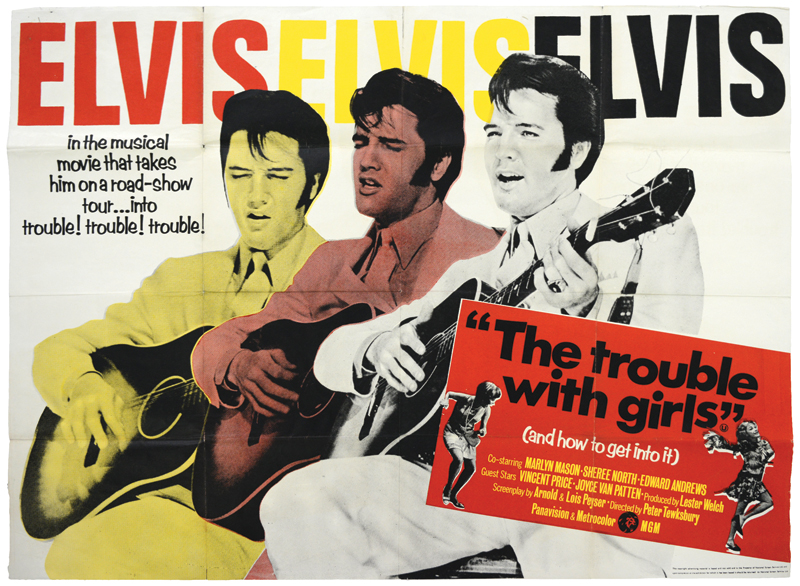
Happy Birthday Elvis!: THE TROUBLE WITH GIRLS (MGM 1969)


gary loggins's avatarcracked rear viewer

twg1

Elvis Aron Presley was born on this date in 1935. The King of Rock’N’Roll got the older generation “All Shook Up” when he burst on the national scene in 1956 with hits like “Heartbreak Hotel” and “Hound Dog”. He also made his first film that year, the Western LOVE ME TENDER, and was an immediate box office sensation. His following three films, LOVING YOU, JAILHOUSE ROCK , and KING CREOLE, were well done, but after his stint in the Army, and the success of 1961’s BLUE HAWAII, Presley’s 60’s movies followed a strict formula, thanks to manager Col. Tom Parker, with interchangeable titles like KISSIN’ COUSINS, HARUM SCARUM, and DOUBLE TROUBLE.

By the late 60’s, things had changed. The Beatles  were top of the pops, the psychedelic revolution was in full effect, and Elvis hadn’t had a hit record in a few years. The movies were still profitable, but lacked energy. Presley’s 1968…

View original post 697 more words