1985’s Revolution opens on July 4th, 1776. The Declaration of Independence has just been published. The streets are full of people celebrating. A statue of King George is pulled down. In her carriage, the wealthy Mrs. McConnahay (Joan Plowright) turns up her nose to the enthusiastic rebels, including the fanatical Liberty Woman (Annie Lennox). Mrs. McConnahay’s daughter, Daisy (Nastassja Kinski) is intrigued by this idea of freedom and equality.
Fur trader Tom Dobbs sails his boat into Hudson Harbor. Tom is Scottish, illiterate, and very much a man of the 18th Century. However, he’s played by Al Pacino, who was none of those things. After Revolution was released to desultory reviews, Pacino took four years off from the movies and watching this film, one can see why. Pacino is miscast as Dobbs and, as a result, he gives the type of truly bad performance that can only be given by a great actor. Unable to disguise the fact that he had the accent of a modern-day New Yorker, Pacino resorts to mumbling the majority of his lines. Tasked with playing a character who has no idea how to deal with the history-making events in which he finds himself, Pacino alternates between a blank look and with bulging his eyes like a madman, proving that it’s far more difficult to play an uneducated character than an educated one. Why cast Pacino, who can be one of our most exciting actors, as a character who can barely speak and who has neither the intensity of Michael Corleone or the subversive wit of Tony Montana? Due to Pacino and Kinski having zero chemistry, the scenes where Tom falls in love with Daisy are almost painful to watch.
The film follows Tom as he and his son, Ned (Simon Owen when the film begins, Dexter Fletcher by the time the action moves to Valley Forge), as they find themselves conscripted into the Revolutionary Army. Eventually, Ned is abducted into the British army and serves as a drummer boy under the sadistic watch of Sgt. Major Peasy (Donald Sutherland). The idea behind the film isn’t a bad one. It attempts to portray the American Revolution through the eyes of the average citizen. Instead of focusing on the Founding Fathers, Revolution tries to tell the story of the everyday people who found themselves in the middle of the war. Tom loses his boat and (temporarily) he loses his son. Fortunately, this is one of those films where people are constantly running into each other by chance, regardless of whether it makes any sense or not. Daisy goes from seeing Tom in New York to randomly coming across him in a field to eventually finding him in Valley Forge. It’s not because she’s specifically looking for him. Instead, he just happens to be there.
Why does Revolution fail? A lot of it comes down to Pacino’s performance, though Pacino certainly isn’t the only talented actor to give a not-quite good performance in Revolution. (Donald Sutherland has never been more wasted in a film.) The script is full of dialogue like, “My mouth belongs where I place it.” (Pacino gets stuck with that one.) Hugh Hudson directs in a leaden manner. Towards the end of the film, there is one brilliant sequence where Tom wanders through the streets of New York and, for a few minutes, the film comes to like with a spontaneity that was previously lacking. Unfortunately, it’s just one sequence in a very long movie,
To be honest, we could use some good films about the American Revolution and I’m not talking about elitist nonsense like Hamilton. No taxation without representation. It’s still a good message for us all.
2024’s Devil’s Knight opens in the kingdom of Veroka. A group of thieves all discuss what they’ve stolen over the course of the day. The leader of the thieves is named Orwell. Another thief — played by Daniel Baldwin — is named Camus. The group is joined by as stranger named Sigurd (John Wells), a man who has only one eye. He tells them the story of how he and his friends — The Lost Blades — were hired to vanquish the fearsome Bone Devil….
Yep, it’s one of those type of movies. There’s a lot of sword fights. There’s a lot of monsters. There’s a hint of sorcery, though not as much as you might expect from a movie like this. The thieves are named after philosophers. The huge cast is full of streaming stars and a handful of actors who are known for appearing in just about anything. Kevin Sorbo plays Baldur, the noble head of the king’s guards. Angie Everhart plays the Duchess who speaks French despite living in a mythical kingdom. Eric Roberts shows up as Lord Sussex. He only onscreen for a few minutes, though he does get a few funny lines. Sadly, Roberts doesn’t even get to fight a monster. At least Sorbo gets a big battle scene.
Here’s the thing, though. Taken on its own terms, Devil’s Knight is a lot of fun. You can tell it was made by people who have a genuine love for the sword and sorcery genre and there’s enough intentional humor to keep things interesting. With the exception of some blood splatter, there’s also a definite lack of CGI. The monsters are played by actual actors wearing costumes and under makeup and it’s surprisingly effective. The film’s plot is not always easy to follow. In the tradition of many medeival legends, the film’s story really is just one random incident after another, the majority of which lead to a fight and at least a few deaths. The cast is huge but few of the characters are still alive by the end of the movie. Monsters aren’t something to mess with and I actually appreciated that the film was willing to even kill off the characters who usually survive a film like this. It really did create the feeling that anyone could die if they ran into a monster in a hallway. (Even the stereotypical princess-who-wants-to-be-a-warrior character was taken in a surprising direction.) The film moves quickly with a lot of energy and enthusiasm. I enjoyed it.
Previous Eric Roberts Films That We Have Reviewed:
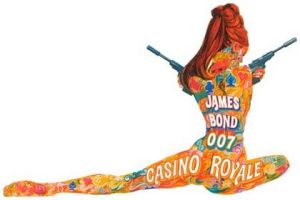
As you probably already know, we here at the Shattered Lens have been counting down the days until the American release of Skyfall by reviewing every single film in the James Bond franchise. Today, we take a look at the first non-EON Bond film, the epic, psychedelic 1967 spoof Casino Royale.
Where to begin?
When Ian Fleming’s first James Bond novel, Casino Royale, was published in 1953, veteran Hollywood producer Charles K. Feldman bought the film rights. However, Feldman didn’t buy the rights to Fleming’s subsequent novels and was forced to sit by and watch as Albert Broccoli and Harry Saltzman had unexpected success with Dr. No and the subsequent EON-produced Bond films. Much as Kevin McClory did with Thunderball, Feldman first attempted to co-produce a serious adaptation of Casino Royale with Broccoli and Saltzman. However, when Feldman, Broccoli, and Saltzman couldn’t come to an agreement on how each side would be compensated in the proposed production deal, Feldman decided to make Casino Royale on his own. He also decided that, instead of trying to compete with EON by making a “straight” James Bond film, his version of Casino Royale would be a satirical extravaganza.
Feldman’s vision of James Bond is apparent from Casino Royale’s opening credits. While the credits are definitely based on the iconic openings of the EON Bond films, they’re also designed to play up the fact that Casino Royale — in the grand tradition of the Hollywood studios at their most excessive — is meant to be a big budget, all-star extravaganza.
Casino Royale actually starts out with a pretty clever premise. It seems that the name “James Bond,” is simply a code name that has been assigned to several British spies over the years. As M (played by John Huston, who also directed the first third of the film), explains it, the name “James Bond” strikes such fear in the hearts of Britain’s enemies that the name must be kept alive.
(Speaking for myself, this is an idea that I kinda wish that the official James Bond series would adopt. If nothing else, it would certainly explain how Pierce Brosnan and Daniel Craig could possibly be the same person.)
The original James Bond (played by David Niven) has long since retired to his stately country estate, where he spends his time playing the piano and complaining about how the agents who have inherited his name are sullying his reputation with excessive womanizing and violence. It turns out the Sir James Bond is a man renowned for his “celibate image.” At the start of the film, Bond is asked to come out of retirement by not only M but the heads of the CIA, KGB, and French secret service as well. SMERSH, an organization of female assassins that’s led by the mysterious Dr. Noah, has been eliminating agents worldwide and only the original (and very chaste) Bond can defeat them. Bond, however, refuses and M responds by ordering a mortar attack on Bond’s estate. The estate is blown up but so is M and Bond soon finds himself returning to London as the new head of MI6.
Interestingly enough, David Niven was one of the actors who was considered for the role of James Bond in Dr. No. Reportedly, Ian Fleming was quite enthusiastic for Niven to take the role but, by the time that Dr. No went into production, Niven was considered to be too old. There’s a nice bit of irony here in seeing David Niven playing a retired James Bond who spends a good deal of the film complaining about the men who have subsequently assumed his name.
Once Niven takes over MI6, he orders that, in order to confuse SMERSH, all British agents (including female agents) will be known as James Bond. The rest of the film is divided into episodes that feature these new James Bonds battling SMERSH and the mysterious Dr. Noah.
Among these agents, there’s the handsome Coop (played by Terrence Cooper) who has been trained to resist all sexual temptations.
There’s Mata Bond (Joanna Pettet), the daughter of Sir James Bond and Mata Hari.
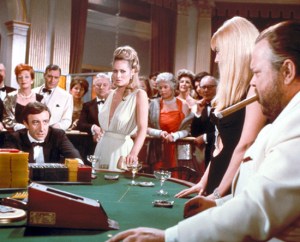
There’s Vesper Lynd (Ursula Andress) who is sent to seduce and recruit the expert gambler Evelyn Tremble (Peter Sellers) so that Tremble can beat SMERSH agent Le Chiffre (Orson Welles) at the Casino Royale.
Best of all, there’s Sir James Bond’s nephew, Jimmy Bond. Jimmy Bond is played by Woody Allen and … well, let’s just take a look at Jimmy’s first scene in the film:
Casino Royale had a notoriously troubled production history and most of those troubles seemed to center on Peter Sellers. While the film was designed to be a broad, slapstick comedy, Sellers reportedly insisted on trying to play his role straight and even rewrote his lines to make his scenes more dramatic. Welles eventually grew so disgusted with Sellers that he refused to be in the same room with him. This caused quite a bit of difficulty since Sellers was in almost every scene that featured Welles. Eventually, Sellers walked off the film and the film had to be hastily (and awkwardly) rewritten to account for his sudden absence.
When one watches Casino Royale today, it’s hard to escape the conclusion that Sellers was essentially correct. While most of Casino Royale often feels disjointed and incoherent, the scenes featuring Sellers, Andress, and Welles are some of the strongest in the film. Sellers’ dramatic approach doesn’t negate the film’s comedy. If anything, it makes the comedy even stronger because Sellers actually seems to be invested in the reality his character, regardless of how ludicrous a situation that character may find himself in.
When I watched Casino Royale, I was struck by the stark contrast between the parts of the film that worked and the parts that didn’t. This is a movie that truly swings from one extreme to another. Either the film’s satire is working brilliantly (mostly in the scenes featuring Woody Allen and Peter Sellers) or it’s falling completely flat (like in an extended sequence that features Deborah Kerr as a SMERSH assassin).
I found myself laughing more at the little scenes than the big set pieces. For instance, I loved it when David Niven embraces Miss Moneypenny (Barbara Bouchet) just to be then told that she’s actually the daughter of the original Miss Moneypenny. I don’t know much about the actor Terrence Cooper (though, according to Wikipedia, he was also a contender to take the role of James Bond in the official series) but I enjoyed the brief sequence where Moneypenny “tests” him to see if he can take on the Bond identity. Unfortunately, the film doesn’t really have enough of these small, clever moments.
Ultimately, I found that Casino Royale works best when viewed as a time capsule. Casino Royale was made at a time when the established major Hollywood studios (and veteran producers like Charles K. Feldman) were struggling to remain relevant. Foreign films (including, it must be said, the James Bond films) were challenging the common assumptions of what could and what couldn’t be shown on-screen and the studio system reacted by trying to make films that would appeal to younger audiences while also reassuring older audiences that the movies hadn’t really changed that much. The end result were films like Casino Royale that featured the occasional psychedelic sequence along with cameos from old (and safe) Hollywood stars like George Raft, William Holden, and Charles Boyer. Casino Royale is the type of self-indulgent film that could only have been made in 1967 and, as such, it’s a valuable time capsule for all of us cinematic historians.
I also have to admit that, as excessive as Casino Royale may be, I happen to love excess. Casino Royale might be overlong and occasionally incoherent but the costumes are simply to die for. The film is a visual feast, if nothing else.
Casino Royale was released to scathing reviews and terrible box office but, in the years since, it has become something of a cult favorite. Our own Trash Film Guru has identified Casino Royale as his favorite Bond film. Myself, I found the film to be extremely flawed and yet oddly fascinating to watch. Casino Royale is a total mess and that is both its greatest flaw and greatest strength.
Tomorrow, we’ll return to the official James Bond series by taking a look at You Only Live Twice.
The Company Men is the first film to be directed by veteran television producer and writer John Wells. Previously, Wells worked on ER, The West Wing, Southland, Third Watch, and a whole host of other shows that I’d rather die than ever have to actually sit through. With The Company Men, Wells attempts to tell the story of the current economic recession and what its like to go from being a high-paid executive to just another unemployed statistic. The end result is a deeply uneven film that comes so very close to succeeding but ultimately fails.
The film opens in 2008 and indeed, most of the film takes place in ’08. It always amuses me how any film that comes out now that deals with either the economy or the wars in the Middle East (the Hurt Locker being an obvious example), the filmmakers always go out of their way to let us know that their movie is taking place during the Bush administration and not the Obama Administration. Some people would call that “ass kissing” but I just find it to be amusing.
Anyway, getting back on track here, the films follows three corporate executives who all work for a fictional company called GTX. There’s a rich, white guy played by Ben Affleck. And then there’s a richer, white guy played by Chris Cooper. And then finally, I guess to add some variety to the mix, there’s a white guy who is really, really rich and he’s played by Tommy Lee Jones. Anyway, Affleck, Cooper, and Jones are all cheerfully doing their thing until one day, the recession hits and boom! Suddenly, Affleck is told that he has become “redundant.” He’s given a severance package and sent off on his merry way. Meanwhile, Cooper worries that he’s about to face the same fate while Jones — who is one of the company’s vice presidents — tries to keep GTX’s satanic CEO from putting anyone else out of work.
It’s Affleck and his story that commands most of the film’s running time and, to his credit, Affleck actually gives a surprisingly good performance here as he starts out as smug and self-centered before eventually becoming desperate and insecure until finally, by the end of the film, he’s reached a state of acceptance. A lot of this has to do with the fact that he finally humbles himself into accepting a job with his blue-collar brother-in-law, a homebuilder played by Kevin Costner.
A word about Kevin Costner in this film: I could have done without him. First off, I understand his character is supposed to be a blue-collar, plain-spoken, salt-of-the-Earth type but honestly, he just comes across like a overlymacho asshole who probably voted for Lyndon LaRouche at some point in the past. I guess he’s supposed to be John Wells’ version of the noble savage or something.
But with that one glaring exception, The Company Men is a remarkably well-acted film. Even though Jones and Cooper are saddled playing predictable characters, they both bring a real unexpected poignancy to their portrayals. Cooper, especially, is strong and always sympathetic even though you know everything that’s going to happen to him from the minute he first shows up on-screen. Rosemarie DeWitt has the rather thankless role of being Affleck’s wife but she brings a lot of strength to a thinly written character and she and Affleck have a real chemistry. When they’re on-screen together, you believe in their marriage which is more than you can say for most screen couples.
The cast of The Company Men is such a strong ensemblethat you really find yourself hoping (and sometimes even believing) that the overall film will succeed as well. But, alas, the film fails and it manages to fail for all the obvious reasons. John Wells is best known for his work in television and The Company Men never really shakes that made-for-TV feeling. For every scene that offers up an unexpected insight or a subtle piece of characterization, there’s a hundred more that feel glib, smug, and ultimately forced. For every honest note, there’s a false one waiting right around the corner to pounce on it and beat it into submission. This is the type of movie where Tommy Lee Jones walks around a deserted shipyard and delivers a monologue about the way things use to be to a character who has absolutely no logical reason for being there beyond the fact that Wells needed to find an excuse for Jones to deliver the whole long speech to begin with. Don’t get me wrong — Jones delivers the words beautifully but so what? The scene still feels safe, predictable, and ultimately false.
And what’s the deal with Maria Bello in this film? She plays Sally Wilcox who is apparently in charge of “downsizing” at GTX. She’s also having an adulterous affair with Tommy Lee Jones despite the fact that all Jones ever does is criticize her for even existing. Never mind the fact, of course, that Jones is a part of the entire corporate culture that’s responsible for the Sally Wilcoxes of the world to begin with. It’s hard not to feel that her character is there to largely let Jones off the hook. It’s not Jones’s fault that everyone who works under him ends up unemployed and, in one really obvious plot development, dead. No, it’s that evil Sally Wilcox with her blonde hair and black lingerie. And what you can’t blame on Sally, put the blame on Jones’s wife and toss Cooper’s wife in there as well since they’re both portrayed as being heartless wenches (as opposed to DeWitt who is a good wife because she supports Affleck no matter what). The Company Men is full of sympathy for depressed, self-pitying white guys but it has next to none for the women who have to live with them.
Wells is obviously trying to say something about the Recession but what? Obviously, he lays a lot of the blame at the doorstep of greedy CEOs like the one played, in this film, by Craig T. Nelson. Unfortunately, you get the feeling that Wells seems to think that he’s the only person in the world who has managed to figure out that excessive corporate greed can be a bad thing. He may think that he’s educating but really all he’s doing is preaching and the only ones listening are the choir.

 Through the Shattered Lens