“He’s a walking contradiction, partly truth, partly fiction” –
Kris Kristofferson, The Pilgrim
He was a football star at USC who also starred on the debate team. A primitive that could quote Shakespeare, Keats, and Churchill with ease. A two-fisted, hard drinker who was adept at chess and bridge. A man some called racist whose three wives were all Hispanic. To his friends, he was Duke Morrison, but to the world he was known as John Wayne. This definitive, well researched biography by Scott Eyman was released in hardcover in 2014, and is now available in trade paperback form. Eyman, who also wrote the definitive book on John Ford (1999’s PRINT THE LEGEND: THE LIFE AND TIMES OF JOHN FORD), spent years to make this the last word on John Wayne, separating the man from the myth, in this in-depth study of how the boy from Winterset, Iowa became…
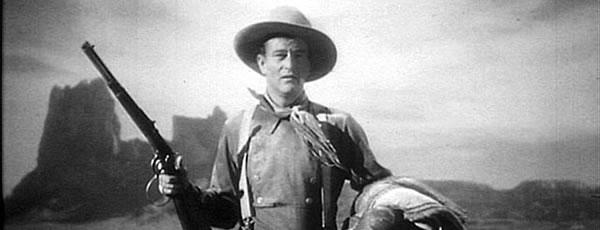
My all-time favorite actor was born Marion Mitchell Morrison on May 26, 1907 in Winterset, Iowa. But John Wayne the movie star was born in 1930 when, after years of bit parts, he landed the lead role in Raoul Walsh’s THE BIG TRAIL. The movie flopped at the box office, but it got Wayne noticed. After scuffling along in low-budget, juvenile B-Westerns for most of the 30’s, Wayne was cast as The Ringo Kid in John Ford’s blockbuster STAGECOACH , and his career took off like a wild stallion.
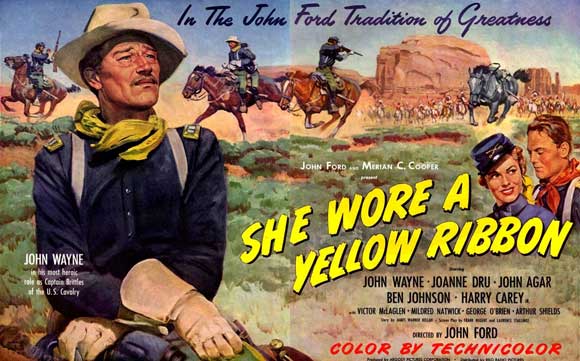
“The Duke” (a nickname he picked up as a kid) was an A-Lister now, the biggest star at Republic Pictures. Wayne and Ford continued their film collaborations throughout the 40’s. At the end of the decade RKO released the second of the Wayne/Ford “Cavalry Trilogy”, SHE WORE A YELLOW RIBBON. The film was a smash hit, a rousing adventure bolstered by Wayne’s portrayal of…
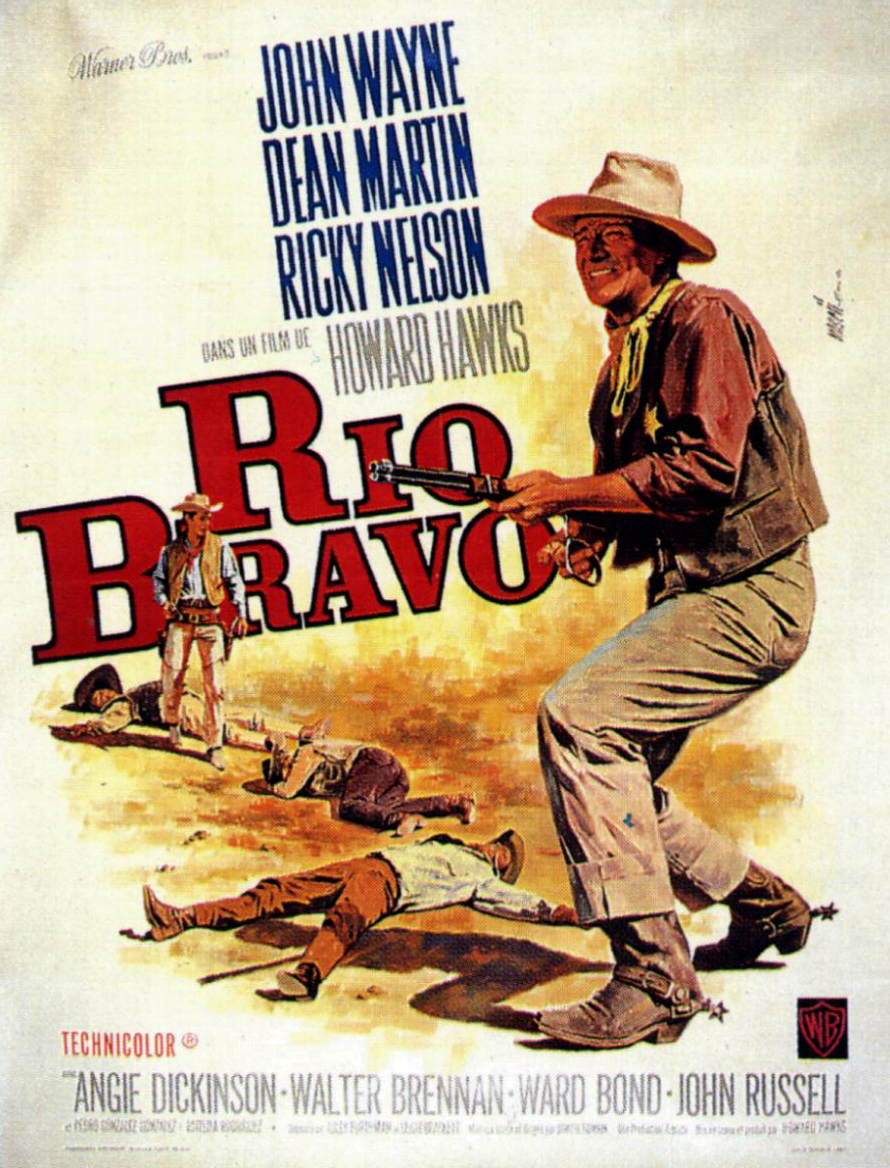
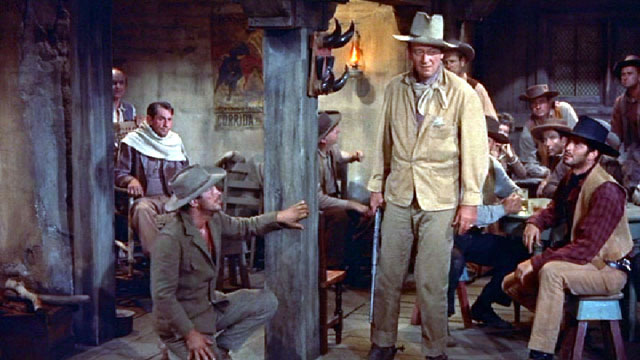
If there’s such a thing as the quintessential “John Wayne Movie”, RIO BRAVO may very well be it. Producer/director Howard Hawks created the perfect blend of action and humor, leading an all-star cast through this tale of a stand-off between the good guys and the bad guys. RIO BRAVO’s theme has been done over many times, most notably by John Carpenter in 1976’s ASSAULT ON PRECINCT 13. Hawks himself remade the film, with Wayne again starring, as EL DORADO and RIO LOBO, but the original remains the best of the bunch.
The plot itself is pretty basic. When disgraced deputy Dude (called Borrachon, Spanish for ‘big drunk’) walks into a saloon looking for booze, no-good Joe Burdette tosses a silver dollar into a spittoon for kicks. Sheriff John T. Chance stops Dude from embarrassing himself, only to receive a whack in the head for his efforts. Dude goes after Joe and a fight breaks out, and Joe kills…
THE SHOOTIST is John Wayne’s valedictory statement, a final love letter to his many fans. The Duke was now 69 years old and not in the best of health. He’d had a cancerous lung removed back in 1964, and though the cancer was in remission, Wayne must’ve knew his days were numbered when he made this film. Three years later, he died from cancer of the stomach, intestines, and spine. There were worries about his ability to make this movie, but Wayne loved the script and was determined to do it. The result is an elegy to not only the aging actor, but to the Western genre as a whole.
The movie begins with footage of older Wayne westerns (EL DORADO, HONDO, RED RIVER, RIO BRAVO) narrated by Ron Howard (Gillom). “His name was J.B. Books…he wasn’t an outlaw. Fact is, for a while he was a lawman…He had a credo that…
If you think the characters and Western tropes in STAGECOACH are familiar, you’re right. But let’s be clear… STAGECOACH introduced many of these now-clichéd devices to film, and is one of the enduring classics of the American West. Director John Ford was well versed in Westerns, having cut his professional teeth on them during the silent era. This was his first sound Western and Ford was determined to reinvent the genre, with much more adult themes than the usual Saturday matinée kiddie fare. He succeeded with a daring story featuring an outlaw and a prostitute as his heroes, and exceeded his goal by creating a brand new Hollywood star in the process: John Wayne.
Wayne had been a football player for the USC Trojans when an injury caused him to lose his scholarship. Through some university connections, he was able to gain employment in the film industry as a prop…
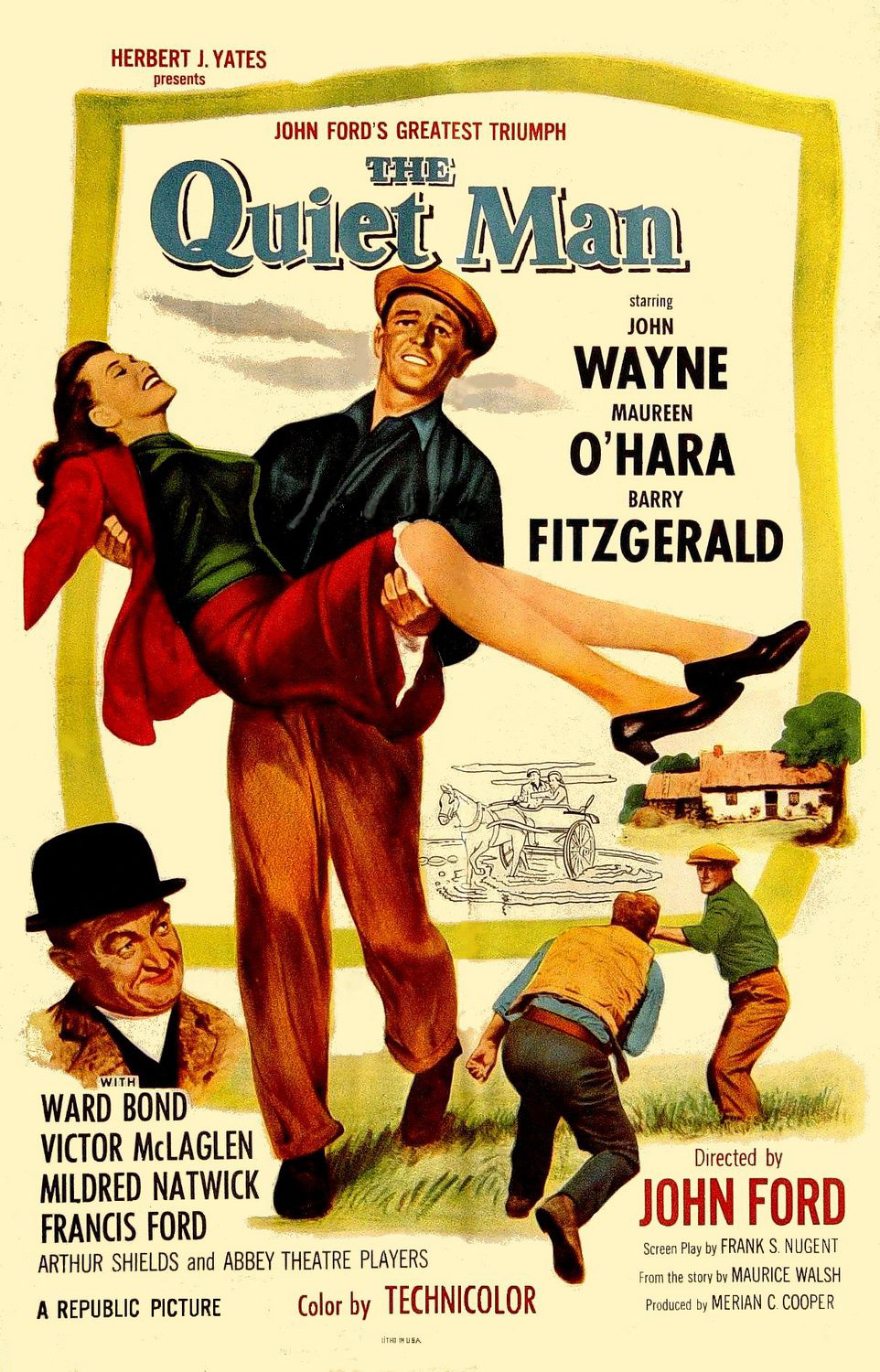
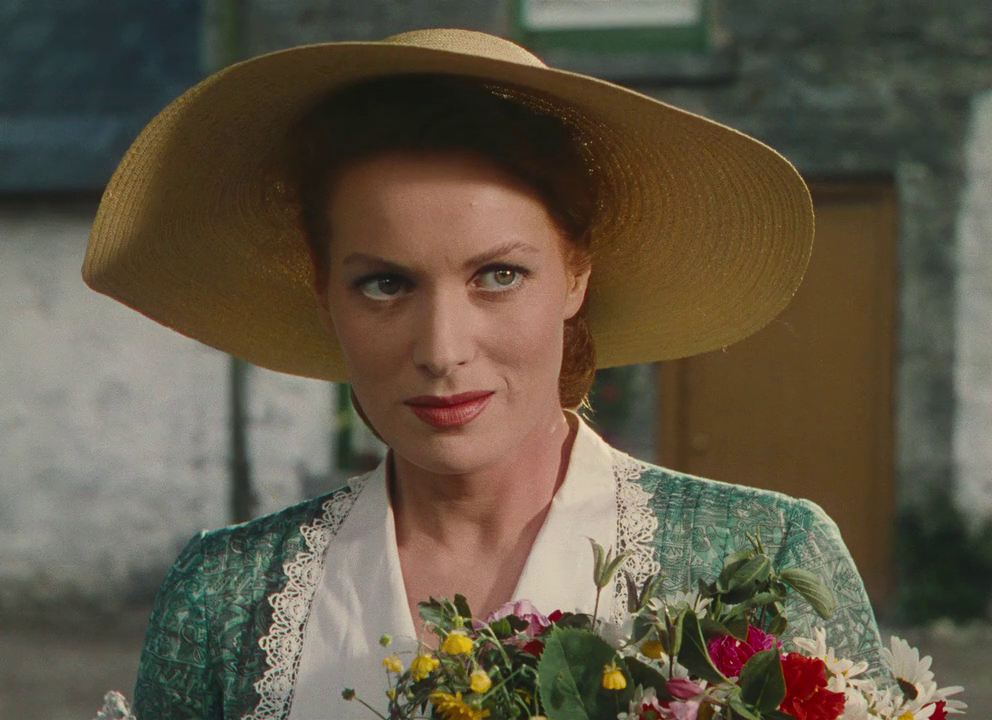
With the passing of screen legend Maureen O’Hara today, I’ve decided to put aside my Halloween Havoc! series this evening to take a look at one of my favorite Maureen movies, THE QUIET MAN. Paired once again with John Wayne and director John Ford, Maureen shines as Mary Kate Danneher, a feisty, hot tempered colleen who refuses to honor her marriage vows until she gets her “fortune” from brutish brother Red Will Danneher (perennial big lug Victor McLaglen). Mostly filmed in Ireland by Winton Hoch, the countryside scenery is breathtaking in vivid Technicolor, with Maureen radiant as ever.
The story concerns American ex-boxer Sean Thornton (Wayne), returning to his Emerald Isle birthplace of Innisfree after accidentally killing an opponent in the ring. When he first sets eyes on Mary Kate herding sheep, he’s immediately smitten. Sean buys his family homestead from the Widow Tillane (Mildred Natwick), outbidding Danneher, who knows how…
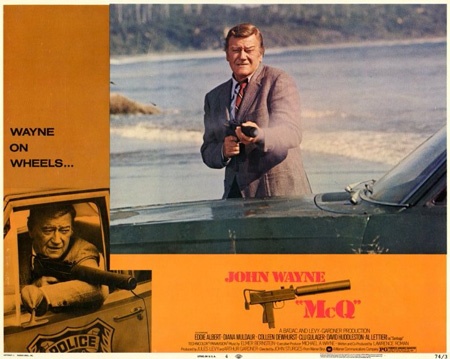
John Wayne didn’t get off his horse very often in the latter part of his career. The Duke hadn’t done a non-Western since 1969’s HELLFIGHTERS, but cop pictures were in style in the early 70s due to the success of movies like THE FRENCH CONNECTION and DIRTY HARRY. Wayne was actually offered the part of Dirty Harry Callahan and turned it down. But in 1974, Big John traded in his horse for a Pontiac Firebird in the action packed MCQ, directed by veteran John Sturges (GUNFIGHT AT THE OK CORRAL, THE MAGNIFICENT SEVEN, THE GREAT ESCAPE).
Wayne plays tough cop Lon McQ, who quits the force to investigate the murder of his former partner. He gets tangled up with drug dealers and corrupt officials, car chases and shootouts. Sound formulaic? It is, but the action scenes make up for a lame script. Duke basically plays the same character he did in most all his films, tough but tender, fair but firm. It’s kind of jarring to see Wayne in his (pretty bad) hairpiece instead of the usual cowboy hat, and tooling around the streets of Seattle in a muscle car rather than the dusty trail on his horse. He’s surrounded by a supporting cast full of familiar faces (Eddie Albert, Diana Muldaur, Colleen Dewhurst, Al Lettieri, David Huttleston, Clu Gulager), all of whom do their best with the clichéd script. MCQ plays like a TV movie of the week, which isn’t necessarily a bad thing, and fans of 70s action flicks will dig it.
John Wayne only made three more films after MCQ, including another cop movie, BRANNIGAN, and his swan song, 1976’s THE SHOOTIST, before succumbing to cancer in 1979. The Duke made much better movies then MCQ, but for a look at the star without his spurs and six-gun, it’s definitely worth watching.
(This post originally appeared, in slightly altered form, on the 2015 TCM Summer of the Stars Blogathon, hosted by Journeys in Classic Film)
“When the legend become fact, print the legend.” — Maxwell Scott (Carleton Young) in The Man Who Shot Liberty Valance (1962)
Though I understand and respect their importance in the history of both American and Italian cinema, I have never really been a huge fan of westerns. Maybe its all the testosterone (“A man’s got to do what a man’s got to do…”) or maybe it’s all the dust but westerns have just never really been my thing.
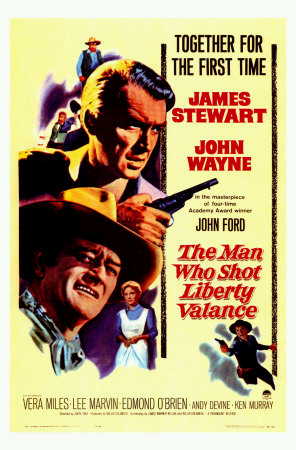
However, I will always make an exception for The Man Who Shot Liberty Valance, which is not just a great western but a great film period.
But you already knew that. It’s a little bit intimidating to review a film that everyone already knows is great. I even opened this review with the exact same quote that everyone uses to open their reviews of The Man Who Shot Liberty Valance. To a certain extent, I feel like I should have found a quote that everyone hasn’t already heard a thousand times but then again, it’s a great quote from a great film and sometimes, there’s nothing wrong with agreeing with the critical consensus.
The Man Who Shot Liberty Valance opens with a train stopping in the small western town of Shinbone. The residents of the town — including newspaper editor Maxwell Scott (Carleton Young) — are shocked when Sen. Rance Stoddard (James Stewart) and his wife Hallie (Vera Miles) get off the train. Sen. Stoddard is considered to be a front-runner to become the next Vice President of the United States. Scott is even more shocked to discover why the Stoddards are in town. They’ve come to Shinbone to attend the funeral of an obscure rancher named Tom Doniphon (played, in flashback, by John Wayne).
Sitting in the funeral home with Doniphon’s coffin (and having reprimanded the local mortician for attempting to steal Tom’s boots), Rance tells Scott why he’s come to pay respect to Tom Doniphon. We see, in flashback, how Rance first came to Shinbone 25 years ago, an idealistic lawyer who — unlike most of the men in the west — refused to carry a gun. We see how Rance was robbed and assaulted by local outlaw Liberty Valance (a wonderfully intimidating and bullying Lee Marvin), we discover how Rance first met Hallie while working as a dishwasher and how he eventually taught her how to read, and we also see how he first met Tom Doniphon, the only man in town strong enough to intimidate Liberty Valance.
At first, Rance and Doniphon had an uneasy friendship, epitomized by the condescending way Doniphon would call Rance “pilgrim.” Doniphon was in love with Hallie and, when he attempted to teach Rance how to defend himself, he was largely did so for Hallie. Rance, meanwhile, was determined to bring law and society to the west.
And, eventually, Rance did just that. When Shinbone elected two delegates to the statehood convention in the territory’s capitol, Rance attempted to nominate Doniphon for the position but Doniphon refused it and nominated Rance instead, explaining that Rance understood “the law.” When Liberty Valance attempted to claim the other delegate spot, Rance and Doniphon worked together to make sure that it instead went to newspaper editor Dutton Peabody (Edmond O’Brien). And when Liberty Valance attempted to gun Rance down in the street, Rance shot him.
Or did he?
That’s the question that’s at the heart of The Man Who Shot Liberty Valance. However, as a film, The Man Who Shot Liberty Valance is far less interested in gunfights than it is in politics. Perhaps the most important scene in the film is not when Rance and Liberty meet out on that dark street. Instead, it’s the scene at the statehood convention where the reformers (represented by Rance) and the cattlemen (represented by John Carradine) battle over who will be the territory’s delegate to Washington. Between John Carradine orating, the horses riding in and out of the hall, Edmond O’Brien drinking, James Stewart looking humble, and John Wayne glowering in the background, this is one of the best political scenes ever put on film.
When Rance first arrives in the west, there is no political system in place. With the exception of the ineffectual town marshal (Andy Devine), there is no law. The peace is kept by men like Tom Doniphon and, oddly enough, by Liberty Valance as well. (Whether he realizes it or not, Shinbone’s fear of Liberty has caused the town to form into a community.) What little official law there is doesn’t matter because the majority of the Shinbone’s citizens can’t read.
When Rance arrives, he brings both education and the law. He makes Shinbone into a town that no longer needs Liberty Valance but, at the same time, it no longer need Tom Doniphon either. Hence, it’s Rance Stoddard who goes from dishwasher to U.S. Senator while Tom Doniphon dies forgotten. Rance represents progress and unfortunately, progress often means losing the good along with the bad things of the past.
(It’s no coincidence that when Rance and Hallie return to Shinbone, the first person that they see is the former town marshal, who no longer wears a star and who, we’re told, hasn’t for years. Time has passed by.)
It’s a bittersweet and beautiful film, one that features four great performances from Stewart, Wayne, Marvin, and Vera Miles. Personally, I like to think that maybe Sen. Stoddard had a daughter who married a man named Smith and maybe they had a son named Jefferson who later made his way to the Senate as well.
During my sophomore year of college, I was acquainted with a bearded sociology major who would tell anyone that he met that he was a communist. He also insisted that he was a revolutionary in the tradition of Che Guevara though, for the most part, he never seemed to do much more than hang out in the lobby of Bruce Hall and yell at the top of his lungs. When he wasn’t attacking George W. Bush and Dick Cheney, he was busy quoting Karl Marx and telling people about how communism would fix all of America’s problems. He would also get very upset if you called him a socialist. “No,” he would say, “I’m a communist and I’m proud of it!”
I have to admit that I usually went out of my way to avoid him and I would cringe whenever I would hear him shouting my name and inviting me to come sit down next to him so he could attempt to give me my daily indoctrination while he stared at my breasts. I could never summon up much enthusiasm for his ideology or his idolization of Hugo Chavez. It all sounded rather dreary and boring to me.
I recently found myself thinking about those days in Bruce Hall lobby after I watched the 1952 anti-communist melodrama, Big Jim McLain.
Produced by and starring John Wayne, Big Jim McLain was made at the height of the red scare. Produced in full cooperation with the infamous House Un-American Activities Committee, Big Jim McLain was meant to be an answer to all those weak-willed liberal types who claimed that the committee was going too far in its hunt for communist subversives.
Big Jim McLain starts out with a thunderstorm. While stock footage of lightning illuminates the screen, a medley of patriotic songs play on the soundtrack and a somber-voiced narrator quotes The Devil Vs. Daniel Webster.
Suddenly, the scene changes. We’re in Washington D.C. and we’re watching a meeting of the House Un-American Activities Committee. A shifty little man with a beard is being interrogated by the members of the committee. They ask him if he’s ever been a communist. He takes the fifth amendment. He’s asked if he would ever take up arms against the United States. Again, he pleads the fifth.
The camera pans back to reveal two remarkably tall men listening to the man’s testimony. They both share the same look of disgust, a look that leaves no doubt how they feel about this sleazy little subversive and his constitutional rights. They are Big Jim McLain (John Wayne) and his partner, Mal Baxter (James Arness) and they fight communists.
Suddenly, we hear the familiar sound of John Wayne’s determined drawl on the soundtrack and we realize that Big Jim McLain was using multiple voice-overs long before Terrence Malick even made his first film.
Wayne, speaking in character as Big Jim, explains that he and Mal have spent the last few months proving that the witness is a communist. And now, they have no choice but to watch as he hides behind the constitution. We’re told that this communist will be able to return to his position of teaching economics at an unnamed “north eastern college.”
That opening scene pretty much tells you everything that you need to know about the ideological outlook of Big Jim McLain. The government is looking out for our best interests, outsiders are dangerous, and good men know the importance of following orders.
HUAC sends Big Jim and Mal to “the territory of Hawaii,” where they hand out a lot of subpoenas, conduct a smattering of illegal wiretaps, and try to figure out who is actually in charge of the local communist party. Along the way, Big Jim meets and romances a naive secretary named Nancy (played by Nancy Olson). Nancy just happens to work for a communist doctor but we know that she’s okay because she’s the widow of a serviceman.
Big Jim McLain is a real curiosity piece, a true product of its time. Perhaps not surprisingly, the film really does feel like a time capsule. Full of simplistic characters and nonstop speech-making from John Wayne, it’s easy to laugh at and dismiss a film like this.
Then again, the main idea behind Big Jim McLain seems to be that the government is justified in doing anything to fight its enemies and that anyone who openly questions or disagrees our leaders most be either evil or mentally incompetent. Just how much has our culture changed since then? How different is anti-communist crusader Big Jim McLain from those who today continually assure us that we have nothing to fear from the NSA? One gets the feeling that if this film were made today, Big Jim would be hunting down Edward Snowden and directing drone strikes against America’s enemies.
Perhaps for obvious reasons, Big Jim McLain is a fairly obscure film. I first found out about it from reading J. Hoberman’s Army of Phantoms. Oddly enough, within a day or two of my reading about it, Big Jim McLain turned up on TCM. It’s not a very good film but, in the best exploitation tradition, it is a document of its time and therefore, worth seeing as a piece of history.
As for the communist of Bruce Hall, he ended up dropping out at the end of the semester and, apparently, he later turned up in New York doing the whole Occupy Wall Street thing. I’ve been told that he was recently spotted in Austin, still wearing his Che Guevara t-shirt.
One thing’s for sure.
Big Jim McLain would have taken him out with one solidly placed right hook.






 Through the Shattered Lens