The TSL’s Grindhouse: The Amityville Murders (dir by Daniel Farrands)


Ronald DeFeo, Jr. may not be a household name but he’s someone who was indirectly responsible for a lot of cinematic schlock.

Of course, that’s the least of DeFeo’s crimes. When the 69 year-old DeFeo passed away in March, he was serving a life sentence in the state of New York. That’s because, back in 1974, the 23 year-old DeFeo grabbed a rifle and killed his entire family while they slept. When he was brought to trial, DeFeo claimed that he heard Satanic voices that urged him to kill his parents and his siblings. His lawyers tried for an insanity defense, though the prosecution successfully argued that DeFeo was lying about the voices and that he was in full control of his actions on the night that he killed his family. After being convicted and sentenced to life imprisonment, DeFeo sometimes claimed that he had been possessed by the devil and sometimes said that he committed the murders in self-defense and then other times, he said that he did it because he was hoping to inherit his father’s money. Out of all the excuses that he gave for his brutal crimes, DeFeo’s claims of being demon-possessed were the claims that everyone remembered.

Years later, the DeFeo house — which sat in Amityville, New York — was purchased the George and Kathy Lutz. The Lutzes made a small fortune by claiming that the house was haunted and that they had been forced to leave their new home by demonic spirits. (Their claims were apparently supported by paranormal investigators Ed and Lorraine Warren of Conjuring fame.) The Lutzes told their story to Jay Anson, who wrote a book called The Amityville Horror. That book was later turned into a movie and the success of that movie led to a series of sequels and spin-offs. At last count, there’s been at least ten books written about the Amityville case and there have been 30 films that, in one way or another, claim to be connected to the Amityville haunting. Few of those films share much, other than a haunting and the word “Amityville” in the title. There’s not a great deal of continuity to be found in the Amityville films.

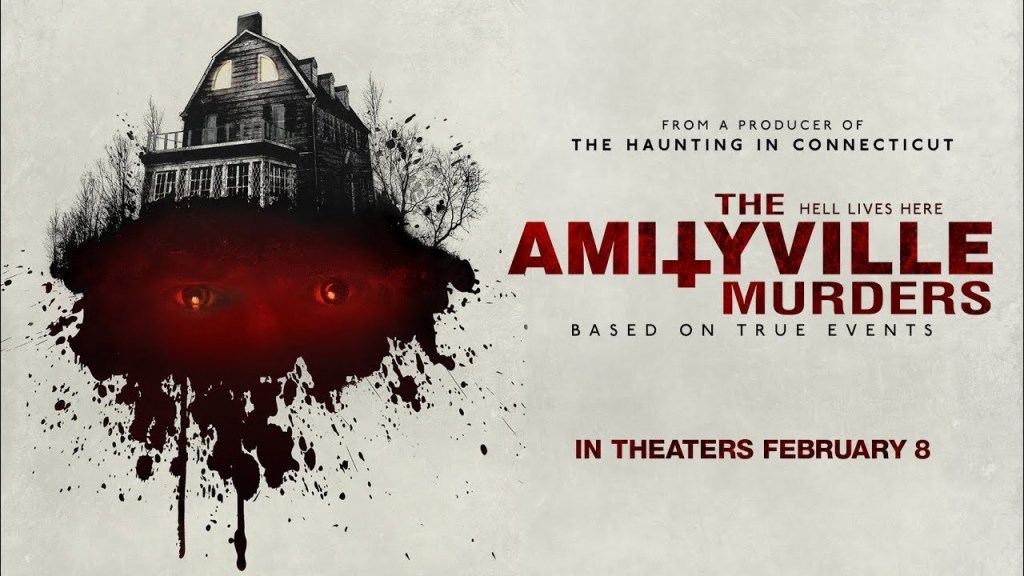
One of the latest of the Amityville films, 2018’s The Amityville Murders, deals with the actual murders that supposedly started off the whole cycle of possession and violence. (1982’s Amityville II: The Possession also dealt with the murders, albeit with Ronald DeFeo renamed Sonny Montelli. Two of the stars of that film — Burt Young and Diane Franklin — appear in The Amityville Murders.) John Robinson plays the bearded and withdrawn Ronald DeFeo, Jr. Chelsea Ricketts plays his concerned sister. Paul Ben-Victor plays their abusive father. The film covers the general facts of the DeFeo murders while trying to have it both ways as to whether or not Ronald was in control of his actions. Ronald DeFeo is portrayed as being genuinely unbalanced but, at the same time, potentially demon-possessed as well. The talented John Robinson does a good job of playing Ronald and there’s a few effective shots of his looking unbalanced but, for the most part, there’s nothing here that you haven’t seen in a dozen other Amityville-influenced horror films. As well, since you know from the start that Ronald is going to end up murdering his family, there’s really not any suspense to be found in the film. Instead, the entire movie is just about waiting for Ronald to pick up that rifle and start shooting people, including two children. It’s more than a bit icky, to be honest.

Whenever it comes to an Amityville prequel, the main question is always just how stereotypically the DeFeos are going to be portrayed. It only takes five minutes for DeFeo, Sr. to admonish Ronald with, “Oh! Watch how you talk to your mother!” Every cliché about Italian-American family life is present in The Amityville Murders, from the father hulking around in his undershirt to the mother decorating the house with religious iconography to the superstitious grandmother. Watching the film, I found myself imagining Tony Soprano watching a cheap Amityville film and exclaiming, “Oh! The mouth on this fucking kid over here, like he’s possessed by the devil or something!” The Amityville Murders hints that the DeFeos themselves may have had mafia connections. Indeed, before he decided to blame demonic possession for his crimes, Ronald DeFeo, Jr. claimed that his family had been taken out by hitmen from New York.

This film was directed by Daniel Farrands, who also directed The Haunting of Sharon Tate and The Murder of Nicole Brown Simpson. The Amityville Murders is neither as well put-together as the Sharon Tate film nor as offensive as the Nicole Simpson film. It’s somewhere in between, just another link in the endless chain of Amityville films. I will say that I personally think Farrands is a talented director and I’d like to see what he could do with a budget and a decent script. The Amityville Murders has its share of impressive shots, even if the end result isn’t exactly the last word in Amityville horror.

Lisa Reviews An Oscar Nominee: The Longest Day (dir by Ken Annakin, Andrew Marton, Bernhard Wicki, Gerd Oswald, and Darryl F. Zanuck)


As my sister has already pointed out, today is the 73rd anniversary of D-Day.  With that in mind, and as a part of my ongoing mission to see and review every single film ever nominated for best picture, I decided to watch the 1962 film, The Longest Day!

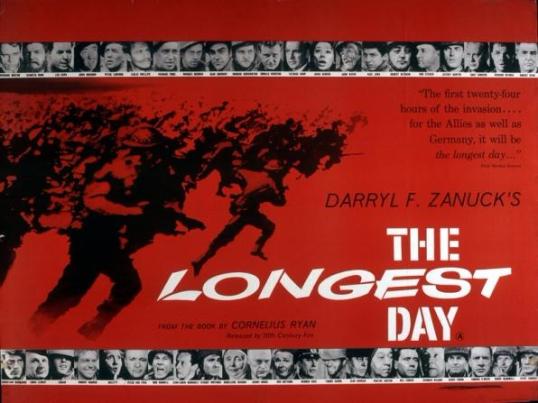
The Longest Day is a pain-staking and meticulous recreation of invasion of Normandy, much of it filmed on location.  It was reportedly something of a dream project for the head of the 20th Century Fox, Darryl F. Zanuck.  Zanuck set out to make both the ultimate tribute to the Allied forces and the greatest war movie ever.  Based on a best seller, The Longest Day has five credited screenwriters and three credited directors.  (Ken Annakin was credited with “British and French exteriors,” Andrew Marton did “American exteriors,” and the German scenes were credited to Bernhard Wicki.  Oddly, Gerd Oswald was not credited for his work on the parachuting scenes, even though those were some of the strongest scenes in the film.)  Even though he was not credited as either a screenwriter or a director, it is generally agreed that the film ultimately reflected the vision of Darryl F. Zanuck.  Zanuck not only rewrote the script but he also directed a few scenes as well.  The film had a budget of 7.75 million dollars, which was a huge amount in 1962.  (Until Steven Spielberg’s Schindler’s List, The Longest Day was the most expensive black-and-white film ever made.)  Not only did the film tell an epic story, but it also had an epic length.  Clocking in at 3 hours, The Longest Day was also one of the longest movies to ever be nominated for best picture.

The Longest Day also had an epic cast.  Zanuck assembled an all-star cast for his recreation of D-Day.  If you’re like me and you love watching old movies on TCM, you’ll see a lot of familiar faces go rushing by during the course of The Longest Day.  American generals were played by actors like Robert Mitchum, Robert Ryan, Henry Fonda, and John Wayne.  Peter Lawford, then the brother-in-law of the President of the United States, had a memorable role as the Scottish Lord Lovat, who marched through D-Day to the sounds of bagpipes.  When the Allied troops storm the beach, everyone from Roddy McDowall to Sal Mineo to Robert Wagner to singer Paul Anka can be seen dodging bullets.  Sean Connery pops up, speaking in his Scottish accent and providing comic relief.  When a group of paratroopers parachute into an occupied village, comedian Red Buttons ends up hanging from the steeple of a church.  When Richard Beymer (who is currently playing Ben Horne on Twin Peaks) gets separated from his squad, he stumbles across Richard Burton.  Among those representing the French are Arletty and Christian Marquand.  (Ironically, after World War II, Arletty was convicted of collaborating with the Germans and spent 18 months under house arrest.  Her crime was having a romantic relationship with a German soldier.  It is said that, in response to the charges, Arletty said, “My heart is French but my ass is international.”)  Meanwhile, among the Germans, one can find three future Bond villains: Gert Frobe, Curt Jurgens, and Walter Gotell.

It’s a big film and, to be honest, it’s too big.  It’s hard to keep track of everyone and, even though the battle scenes are probably about an intense as one could get away with in 1962 (though it’s nowhere near as effective as the famous opening of Saving Private Ryan, I still felt bad when Jeffrey Hunter and Eddie Albert were gunned down), their effectiveness is compromised by the film’s all-star approach.  Often times, the action threatens to come to a halt so that everyone can get their close-up.  Unfortunately, most of those famous faces don’t really get much of a chance to make an impression.  Even as the battle rages, you keep getting distracted by questions like, “Was that guy famous or was he just an extra?”

Among the big stars, most of them play to their personas.  John Wayne, for instance, may have been cast as General Benjamin Vandervoort but there’s never any doubt that he’s playing John Wayne.  When he tells his troops to “send them to Hell,” it’s not Vandervoort giving orders.  It’s John Wayne representing America.  Henry Fonda may be identified as being General Theodore Roosevelt II but, ultimately, you react to him because he’s Henry Fonda, a symbol of middle-American decency.  Neither Wayne nor Fonda gives a bad performance but you never forget that you’re watching Fonda and Wayne.

Throughout this huge film, there are bits and pieces that work so well that you wish the film had just concentrated on them as opposed to trying to tell every single story that occurred during D-Day.  I liked Robert Mitchum as a tough but caring general who, in the midst of battle, gives a speech that inspires his troops to keep fighting.  The scenes of Peter Lawford marching with a bagpiper at his side were nicely surreal.  Finally, there’s Richard Beymer, wandering around the French countryside and going through the entire day without firing his gun once.  Beymer gets the best line of the film when he says, “I wonder if we won.”  It’s such a modest line but it’s probably the most powerful line in the film.  I wish The Longest Day had more scenes like that.

The Longest Day was nominated for best picture of 1962 but it lost to an even longer film, Lawrence of Arabia.

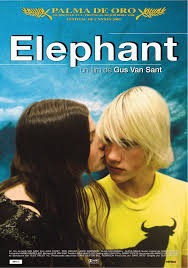
Back to School #62: Elephant (dir by Gus Van Sant)


http://www.youtube.com/watch?v=SC8ogZ4Jsuw

Gus Van Sant’s dream-like 2003 film Elephant is not an easy film to review.  Working with a non-professional cast and avoiding any easy answers or traditional narrative tricks (and indeed, the film ends with the fates of most of the characters still unknown), Elephant is ultimately a disturbing and nightmarish film.  It’s also an important film, one that examines the violence that runs through our current culture.

I’m one of the lucky ones.  I managed to get through all 12 years of my public education without ever getting shot at.  There’s quite a few people my age who can’t make the same claim.  I’d be lying if I said that I spent a lot of time in school obsessing over whether or not someone was going to start shooting but now, when I look back, I sometimes wonder how close I may have come.  One of the scarier things about the typical profile of school shooter is that we’ve all known somebody who fits it.  Sometimes, I can’t help but wonder if I just got lucky.  Maybe the guy who was planning on shooting up my school couldn’t get his hands on a gun.  Maybe, at the last moment, he changed his mind and decided to leave his gun in his locker instead of taking it out before the start of second period.  We come into contact with thousands of people over the course of our lives and we can never for sure what any of them are truly thinking or planning.

According to Wikipedia, there were a dozen school shootings in the U.S. during the time I was in high school.  Thankfully, none of them happened at my high school but, as I looked over the list, I couldn’t help but wonder why my classmates and I were spared the trauma of random violence while the students at Rocori High School in Cold Springs, Missouri were not.  Were we somehow better or more deserving than the students at Rocori?  Had they done something wrong or had we done something right?  Why were they forced to deal with violence while I was spared?  It all just seems so random.

And that’s the terrifying thing about random violence — it is, in the end, all so random.  We always tend to look for explanations afterward.  We try to assign blame and we try to come up with a reason because we know that, if we can explain random violence, then we can do something about it.  But, far too often, there are no reasons.

Elephant perfectly captures this randomness.  The film’s ensemble of characters spend what for many of them will be their final hours randomly wandering through their high school and their lives. Three mean girls eat lunch and then duck into toilet stalls where all three of them proceed to throw up.  John (John Robinson) searches for his drunk father (Timothy Bottoms) who may be wandering around the campus.  Awkward Michelle (Kristen Hicks) goes from her gym class to the library, little aware that she will soon be the first to be confronted by the gunmen.  Once the shooting starts, silent jock Bennie (Bennie Dixon) walks through the body-strewn halls, a potential hero until he is randomly shot.  The film is full of flash forwards and flashbacks, in which we see Alex (Alex Frost) and Eric (Eric Duelen) planning their rampage and we’re given clues as to their motives but we’re not given any answers.

Perhaps most memorable of all, at least to me, is the character of Eli (Elias McConnell), an aspiring photographer who gets one picture of Alex and Eric as they enter the library.  Up until that moment, the entire film has pretty much centered on Eli.  We’ve gotten to know him.  We’ve come to like him.  And yet, when Eli is shot, it happens almost as an afterthought.  One minute, he’s standing in the background and the next moment, he’s gone.  And we’re left to wonder if he survived or if it was even him who got shot.  Ultimately, what we realize is that, in that one split second, Eli ceased to be.  Even if he does survive being shot, he’ll never be the same person we saw earlier.  Even if he wasn’t shot, he’ll always be one of the students who went to that school.  In the end, we may have cared about Eli but none of that could stop the random violence.

Elephant is not an easy film to watch but then again, it shouldn’t be.  (If you want to read a bunch of comments from some people who just don’t get it, you can go read the simple-minded comments that some of them have posted over on the movie’s page at the imdb.) Elephant is a dark and troubling film, one that gave me nightmares after I saw it.  It’s a film so effective and powerful that one viewing is more than enough.

(Incidentally, one of Elephant‘s credited producers was JT Leroy, the pen name of Laura Albert whose books inspired a similarly difficult but powerful film, Asia Argento’s The Heart is Deceitful Above All Else.)

images

Embracing the Melodrama #52: The Heart is Deceitful Above All Things (dir by Asia Argento)


600full-the-heart-is-deceitful-above-all-things-poster

Based on a controversial collection of short stories by JT LeRoy (which was a pen name used by the writer Laura Albert), The Heart is Deceitful About All Things covers three years in the life of Jeremiah and his dug addict mother Sarah.  Over the course of the film, Jeremiah is played by thee different actors — Jimmy Bennett at age 7 and, at age 10, Cole and Dylan Sprouse.  Sarah is fearlessly played by the film’s director, Asia Argento.

Partially in response to her extremely religious upbringing, Sarah spends most of her time drinking, smoking meth, and moving from man to man, the majority of whom treat both her and her son badly.  It looks like things are going to get better when Sarah marries the seemingly stable Emerson (Jeremy Renner) but, when Sarah suddenly abandons both her husband and her son so that she can go to Atlantic City, Emerson rapes Jeremiah.

Jeremiah is sent to live with his grandfather (Peter Fonda) and grandmother (Ornella Muti) who, it turns out, are members of an ultra-religious cult.  Thought Jeremiah initially manages to bond with his cousin Buddy (Michael Pitt), life in the cult proves to be no safer than life with his mother.  After three years with the cult, Jeremiah is standing on a street corner and yelling that everyone is going to go to Hell unless they repent when he is suddenly approached by Sarah.  Sarah grabs him and carries him over to a nearby truck that is being driven by her current boyfriend.

Sarah now supports herself as a dancer and as a prostitute.  When she realizes that the presence of her son is making men reluctant to pay for her, Sarah grows out Jeremiah’s hair and starts to dress him in her old clothes so that she can pass him off as being her younger sister.

Eventually, Sarah and Jeremiah find themselves living with amiable but slow-witted meth addict Jackson (Marilyn Manson) and that’s when things really start to head down hill…

In some ways, The Heart Is Deceitful About All Things is a difficult film to recommend because it is so extremely dark and depressing.  Much as in her debut film, Scarlet Diva, Asia Argento refuses to compromise on the bleakness of her vision.  She set out to make a realistic portrait of what it’s like to live on the fringes of American society and that’s exactly what she did.  If the end result is depressing…well, the fringes aren’t exactly a happy place.  In the end, you’re actually happy that the film is full of familiar actors like Argento, Michael Pitt, Peter Fonda, and Winona Ryder because you need that reminder that, ultimately, you’re watching a movie and that everyone was able to go home after they finished filming.

The Heart Is Deceitful Above All Things may not be easy to enjoy but it is a film that, as a result of its uncompromising vision,  ultimately wins your respect.

heart-is-deceitful-above-all-things-0