Now that the awards for the best of 2025 have been handed out, it’s time to think about what might be nominated next year!
Below are my first set of Oscar predictions for 2026! What am I basing these predictions on? Nothing but instinct, wild guesses, and hopeful thinking. Take them with a grain of salt. If nothing else, we’ll look back on these a year from now and we’ll laugh. Or, we’ll be amazed at my cognitive abilities.
Clark Duke, from Glenwood, Arkansas, made his directorial debut back in 2020 in a movie that’s appropriately titled ARKANSAS. The film has a hell of cast (Liam Hemsworth, John Malkovich, Vince Vaughn, etc.) and focuses on the southern drug industry. You wouldn’t know it from today’s video, but it’s a color film, and it’s a good film. If you haven’t seen it, I recommend it (and so does Lisa – Arkansas Review)!
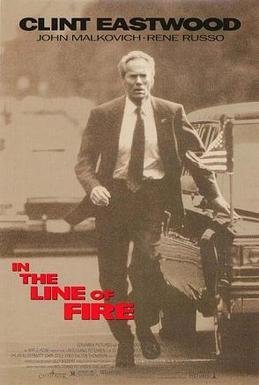
Some of the best scenes in Eastwood’s 1993 film IN THE LINE OF FIRE include John Malkovich’s assassin and Clint Eastwood’s secret service agent engaging in intense conversations over the phone. I love the movie and these scenes.
Check this one out, and take note, it’s definitely NSFW!
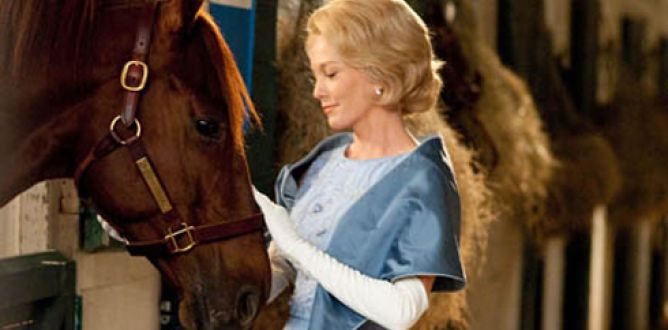
Since every horse in this weekend’s Kentucky Derby is a descendant of legendary racehorse Secretariat, I thought I would share the scene from the 2010 movie where the super horse wins the first leg of the Triple Crown. It’s good stuff!
I’ll admit that I’m not a huge fan of horse racing, although I will periodically go to the Oaklawn Racetrack in Hot Springs, AR, and watch them run. I did enjoy the horse racing movie SEABISCUIT (2003) when I saw it a decade or so ago, and I always enjoy driving past the beautiful horse farms in Lexington, KY, when I’m on my way to see my wife’s family in West Virginia. This weekend was the Kentucky Derby, and I saw a stat that every horse running is a descendant of the 1973 triple-crown winner, Secretariat. I thought that was pretty cool stuff. I told my wife about it, so we decided to watch the movie SECRETARIAT (2010) this morning.
The film centers on Penny Chenery Tweedy (Diane Lane), a Boulder, CO housewife who takes over the management of her dad’s horse stables in Virginia when his health gets so bad that he can no longer handle it himself. The business is facing a lot of financial problems, and her husband just wants her to sell everything and come on back home. But Penny doesn’t want to sell, especially when the stable acquires a young colt that just may have to the right combination of speed and stamina to become a great racehorse. Wanting to see her horse get a chance to run, she hires eccentric trainer Lucien Laurin (John Malkovich) and the aggressive jockey Ron Turcotte (Otto Thorwarth) in order to give “Secretariat” a chance to reach his potential. And boy does he ever, ultimately becoming the first “Triple Crown” winner in 25 years.
I’ll go ahead and say that I pretty much got exactly what I was expecting with SECRETARIAT. It’s a “feel-good” movie that made me happy at the end. Outside of him being a triple crown winner, I didn’t know much about Secretariat’s story, so it was fun just seeing how dominant he truly was during his legendary run in 1973. And the performances from the leads are very good. Diane Lane is beautiful and convincing as the housewife determined to give every thing she has to make Secretariat a winner. John Malkovich’s eccentric horse trainer is the kind of role he excels in, and he’s both funny and emotionally engaging. I liked Otto Thorwarth and Nelson Ellis as Secretariat’s jockey and groomer, respectively. Each of them had their individual moments to shine. I also wanted to mention how impressive the camerawork is during the racing sequences. For a film like this to be exciting, the races have to be exciting and director Randall Wallace and cinematographer Dean Semler deliver in spades. If I had any complaint about the film, it would probably be the oversimplification of some of the supporting characters. For a film based on a true story, it was odd to see the owner of Secretariat’s primary competition reduced to almost a comic book villain in his behavior. That aside, I enjoyed the film and I’m glad I watched it.
2016’s Deepwater Horizon tells the story of the 2010 explosion that led to the biggest oil spill in American history.
Owned by British Petroleum, the Deepwater Horizon was an oil rig sitting off the coast of Louisiana and Texas. A series of explosions, which were found to be the result cost-cutting and negligence on the part of BP, killed eleven men, injured countless others, and led to an 87-day oil spill that leaked 210 million gallons of oil into the Gulf of America (or the Gulf of Mexico, as it was known back then. I know, it can be heard to keep track). I can still remember when the disaster happened. It was seen as an early test of the “government-can-fix-anything” philosophy of the Obama era and it pretty much proved the opposite. Private citizens (including Kevin Costner) offered to help and were rebuffed. The governor of Louisiana was criticized for ordering the construction of barrier islands, even though they were more effective than was that the federal government was offering up. The CEO of British Petroleum issued a self-pitying apology. For a generation coming of political age in 2010, witnessing the government’s ineffective attempts to deal with the oil spill was as radicalizing a moment as the COVID lunacy would be for people coming of age in 2020.
In all the chaos surrounding the oil spill, it was often overlooked that 11 people died in the initial explosion. In all the rightful criticism that was directed towards British Petroleum, the heroic efforts of the workers on the Deepwater Horizon, all of whom risked their lives to try to prevent the disaster from getting worse, were also often overlooked. To an extent, Deepwater Horizon corrects that oversight, paying tribute to the men on that rig while also portraying the extent of the environmental disaster caused by BP’s negligence.
The film centers of Jimmy Harrell (Kurt Russell) and Mike Williams (Mark Wahlberg), two engineers who attempt to warn BP execs like Donald Virdrine (John Malkovich) that cutting costs on safety will inevitably lead to disaster. Russell, Wahlberg, and Malkovich are all ideally cast, with Russell and Wahlberg capturing the spirit of men who try to do their job well and who live their life by the philosophy of not leaving anyone behind. Malkovich is playing a corporate stooge, the man who many people blamed for the disaster. But, to his credit, Malkovich is able to turn Virdrine into a complex character. Virdrine makes terrible mistakes but he never becomes one-dimensional corporate villain. Though Deepwater Horizon is dominated by its special effects and the explosion is an undeniably intense scene, the film doesn’t forget about the human cost of the disaster. Russell, Wahlberg, and Malkovich are supported by good performances from Ethan Suplee, Gina Rodriguez, and Kate Hudson. (Hudson, in particular, deserves a lot of credit for making her thinly-written role into something compelling.) Kurt Russell does such a good job of capturing Jimmy’s quiet confidence and his expertise that, the minute he’s injured by the explosion, the audience knows that Deepwater Horizon is doomed. If even Kurt Russell can’t save the day, what hope is there?
Director Peter Berg specialized in films about ordinary people who found themselves caught up in extraordinary situations. His well-made and earnest films — like Lone Survivor, Patriots Day, and this one — were rarely acclaimed by critics, many of whom seemed to take personal offense at Berg’s unapologetically patriotic and individualistic vision. Personally, I appreciate Berg’s pro-American aesthetic. At a time when we were being told that individuals didn’t matter and that everyone should be content with merely being a cog in a bigger machine, Berg’s films came along to say, “This is what team work actually means.” It’s been five years since Berg’s last film. Hopefully, we will get a new one soon.
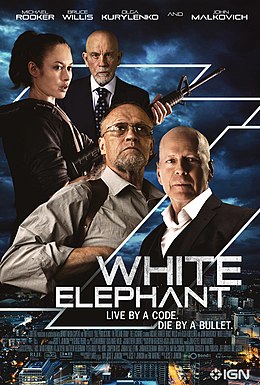
White Elephant is not that bad. In fact, for a B-action movie it’s actually pretty good. If nothing else, it featured one of Michael Rooker’s best performances.
It’s important to start out this review by making that clear because I think a lot of people are going to be tempted to judge this film based solely on the fact that this was one of the last films that Bruce Willis made before his family announced that he would be retiring from acting due to health reasons. When the big story was published in the L.A. Times about Willis’s recent struggles and how those struggles led to him accepting countless roles in straight-to-video fare like American Siege, several people who worked on White Elephant were quoted, with many saying that Willis always did his best but that he was definitely not the Willis that they all remembered. The film’s director, action maestro Jesse V. Johnson, publicly stated that he would not make another film with Willis because “the arrangement felt wrong” and that Willis deserved a better end to his career.
And it must be said that Bruce is obviously not himself in White Elephant. As with many of his recent films, Bruce is cast as a villain in this piece. He’s a crime lord named Arnold and he spends the majority of his time taking meetings and giving order to his underlings. Eventually, he does pick up a gun and fire it but there’s very little of the cocky attitude and swaggering charisma that made Bruce Willis into a superstar. He still has the physical presence to play a tough guy. Bruce Willis still looks intimidating and the film uses him sparingly, never allowing us to spend too much time focusing on how different he seems from the Bruce Willis who starred in Die Hard and Pulp Fiction. One never gets the feeling that Bruce is being deliberately exploited in White Elephant, that alone sets it above some of the other recent films that have featured Willis. But, at the same time, Arnold is a fairly generic bad guy.
Fortunately, the majority of the film follows Michael Rooker in the role of a far more interesting criminal. Rooker plays Gabe Tancredi, a former Marine turned hitman. He’s about as ruthless as they come but he still has enough of a code of ethics that he realizes that he can’t kill a police officer named Vanessa (Olga Kurylenko), no matter how much Arnold wants her dead. Ordered to kill her, Gabe instead protects her, which leads to Arnold sending all of his men after them. It leads to several shootouts and explosions as Gabe puts his life at risk to finally do the right thing.
It’s a simple story but it’s told well. Jesse V. Johnson started out as a stuntman and he clearly knows his way around an action scene and the final shootout in genuinely exciting. The film is also helped by Michael Rooker, who brings a good deal of unexpected depth to the role of Gabe. Even though Rooker obviously knew that White Elephant was a B-movie, he still refuses to phone in a single minute of his performance and, instead, he turns Gabe into a surprisingly complex killer. Gabe’s relationships with his agent Glen (John Malkovich), his protegee Carlos (Vadhir Debrez), and Vanessa are all genuinely interesting. I especially liked the early scenes between Rooker and Debrez, in which the two actors wonderfully play off of each other and we get the feeling Carlos is almost like a son to Gabe. Of course, being genre savvy, we know that Carlos is eventually going to be assigned to take Gabe down but, because their friendship seemed so real, we find ourselves dreading that confrontation. White Elephant is a B-movie but, much like last year’s Corrective Measures and Gasoline Alley, it’s a B-movie with a heart.
Earlier today, it was announced that director Wolfgang Petersen had passed away. He was 81 years old and had been suffering from pancreatic cancer. Though Petersen started his career making films in his native Germany (and his 1981 film, Das Boot, remains the most Oscar-nominated German film of all time), Petersen eventually relocated to Los Angeles and established himself as a very successful director of thrillers and star-filled action films.
Last month, I watched one of Petersen’s films. First released in 1993, In The Line of Fire stars Clint Eastwood as Frank Horrigan. Frank is a veteran member of the Secret Service, still serving at a time when almost all of his colleagues have either retired or died. When we first meet Frank, he and his new partner, Al (Dylan McDermott), are arresting a gang of counterfeiters and Frank (and the then 63 year-old Eastwood) is proving that he can still take down the bad guys.
But is Frank still up to protecting the President? Of the agents that were with President Kennedy when he was assassinated in 1963, Frank Horrigan is the last one standing. He’s the only active secret service agent to have lost a president and he’s haunted by what he sees as being his failure to do his job and the feeling that America has never recovered from Kennedy’s death. Also obsessed with Frank’s history is a mysterious man who calls himself Booth. Booth (played by John Malkovich, who received an Oscar nomination for his performance) starts to call Frank. He informs Frank that he’s planning on assassinating the president, who is currently traveling the country as a part of his reelection bid. Booth views Frank as being a worthy adversary and Frank, looking for redemption, requests to be returned to the Presidential Protective Division.
While Frank struggles to keep up with both the President and the younger agents, Booth slowly and methodically puts his plan in motion. He builds his own wooden gun and tries it out on two hunters who are unfortunate enough to stumble across him. Making a heart-breaking impression in a small role, Patrika Darbo plays the bank teller who, unfortunately, comes a bit too close to uncovering Booth’s secret identity. Booth is friendly and sometimes apologetic and he quickly shows that he’s willing to kill anyone. It’s a testament to both the skill of Malkovich’s performance and Petersen’s direction that the audience comes to believe that there’s a better than average chance that Booth will succeed. He just seems to have such a strong belief in himself that the audience knows that he’s either going to kill the President or that he’s going to willingly die trying.
Meanwhile, no one believes in Frank. The White House Chief of Staff (Fred Dalton Thompson, later to serve in the Senate and run for President himself) views Frank as being a nuisance. The head of the detail (Gary Cole) thinks that Frank should be put out to pasture. Only Lilly Raines (Rene Russo), another agent, seems to have much faith in Frank. While Frank is hunting Booth, he falls in love with Lilly and she with him. (Fortunately, even at the age of 63, Eastwood still had enough of his old Dirty Harry charisma that the film’s love story is credible, despite the age difference between him and Russo.) The hunt for Booth reawakens something in Frank. Just as Booth has a psychological need to be pursued and challenged, Frank needs an enemy to which he can re-direct all of his guilt and self-loathing. Frank becomes a stand-in for everyone who fears that, because of one particular incident or tragedy, America will never regain the strength and promise that it once had. (In Frank’s case, that strength is symbolized by his idealized memories of JFK.) Defeating Booth is about more than just saving America. It’s about redeeming history.
It all makes for an very exciting thriller, one in which Eastwood’s taciturn style of acting is perfectly matched with Malkovich’s more cerebral approach. Just as the two characters are challenging each other, Eastwood and Malkovich also seem to challenge each other as actors and it leads to both men giving wonderful performances. Wolfgang Petersen not only does a good job with the action scenes but also with generating some very real suspense. The scene in which Malkovich attempts to assemble his gun under a table is a masterclass in directing and evidence that Petersen had not only watched Hitchcock’s films but learned from them as well.
As directed by Petersen and performed by Malkovich and Eastwood, In The Line of Fire emerges as a film that was more than just an exciting thriller. It was also a mediation on aging, guilt, love, redemption, and the national traumas of the past. It’s a film that stands up to multiple rewatches and as a testament to the talent of the man who directed it.
You know, everyone, the truth of the matter is that you just never know where John Malkovich is going to pop up nowadays. He’s done the serious actor bit and now, he’s enjoying the career of a prestige actor who appears in action and direct-to-video films. And you now what? Good for him!
Seriously, the man deserves to make some of that Christopher Walken/Bruce Willis money.
Here’s John Malkovich in the trailer for The Survivalist!
Ava tells story of Ava Faulkner (Jessica Chastain), who has a troubled past, a turbulent present, and an uncertain future.
As we learn via a series of still frames during the film’s opening credits, Ava was the valedictorian of her high school class but her bright future was derailed by her own alcoholism. She killed two of her friends while driving drunk and, presumably to avoid prison, she instead went into the army. In the army, she was noted for being an efficient killer while, at the same time, being a bit unstable. She has issues with authority. Well, don’t we all? When she got out of the army, she was recruited by Duke (John Malkovich), who taught her how to be an international assassin!
Unfortunately, since Ava screwed up her last mission and has gotten into the habit of talking to her targets before she kills them, Simon (Colin Farrell) wants her dead. Simon also used to be a student of Duke’s but now he is Duke’s boss or something. It’s all a bit vague and, to be honest, I found myself spending way too much time trying to figure out the corporate structure of whatever group it was that everyone was supposedly working for. Apparently, Duke works for Simon but Simon still has to get Duke’s permission before trying to kill Ava or, failing that, try to kill Duke so that Duke won’t complain about it. Duke spends a lot of time fishing and Simon spends a lot of time with his adorable family. I liked Simon’s house.
Anyway, Ava has returned to Boston, where she’s trying to reconnect with her family. It turns out that teenage Ava discovered that her father was cheating on her mom and that’s what set Ava on her downward spiral. Mom (Geena Davis) is now a hypercritical semi-recluse. Meanwhile, Ava’s sister, Judy (Jess Wexler), is a singer in a band and she’s engaged to Michael (Common, who, for some reason, keeps getting cast in all of these extremely wimpy roles), who just happens to be Ava’s ex-boyfriend. And Michael is a gambling addict who owes a ton of money to Toni (Joan Chen). It’s hinted that Toni and Ava also have a past but then again, everyone in the film has a past with Ava. It’s get a little bit difficult to keep track of it all.
Ava gets off to a bad start by making us sit through one of Ava’s jobs. She kills an accountant but first she asks him a lot questions about why anyone would want him dead because apparently, she’s an ethical assassin. The scene goes on forever and it features Jessica Chastain trying to speak with an Arkansas accent. Things picked up a bit during the opening credits, which was largely made up of still frames from Ava’s past. However, once the credits ended and the film’s actual story got started, things quickly went back downhill.
The main problem with Ava is one of sensibility. Both Jessica Chastain and director Tate Taylor have totally the wrong sensibility for a film like this. Ava is essentially a work of pulp fiction but Chastain takes herself far too seriously to actually bring a sense of fun to the title role. Meanwhile, Tate Taylor directs as if he’s never had a single subversive thought in his life. (In Taylor’s defense, he was a last minute replacement for the film’s original director, Matthew Newton.) Ava is a film that cries out for a star like Gina Carano and a director like John Stockwell, people who have no hesitation about totally digging in and embracing the silliness of it all. Instead, we get Chastain and Taylor trying to give us a semi-realistic look at a woman battling her addictions and trying make peace with her past. Malkovich, Farrell, and Chen all seem to get the fact that Ava should be a fun B-movie, unfortunately, Taylor and Chastain apparently didn’t get the memo. (Of course, Chastain produced the film so maybe it was her co-stars who didn’t get the memo. Who knows?)
Ava commits the sin of taking itself too seriously. Check out John Stockwell’s In The Blood or Phillip Noyce’s Saltinstead.



 Through the Shattered Lens