Playing Catch-Up: Carol (dir by Todd Haynes)


Carol_(film)_POSTER

(Minor Spoilers Below)

Carol is the best film of 2015.

I say that without a hint of hesitation or doubt.  2015 was a wonderful year for movies and I would say that there were at least 20 film released that I would call great.  And, out of those 20, Carol is the best.

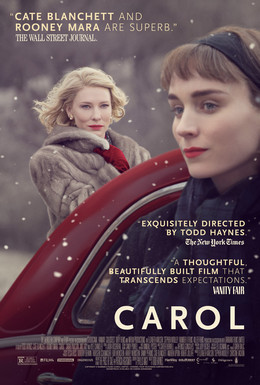
Carol opens in 1952.  Therese Belivet (Rooney Mara) is young, lonely, and living in New York City.  She’s an aspiring photographer who can’t afford a decent camera, a secret bohemian living in a world where morality and culture are defined by the bourgeoisie.  She has a boyfriend named Richard (Jake Lacey) and he’s eager to marry her and move to France but, try as she might, Therese simply cannot bring herself to feel the same way about him that he feels about her.  Though she lives with him, she refuses to have sex with him.  At one point, she asks him if he’s ever heard of men being attracted to other men and she asks if he thinks the same can be true of women.  Richard says sure, before adding that it’s always the result of “something wrong” psychologically.

It’s Christmas.  Therese gets a temporary job, working at a department store in Manhattan.  From the moment we see Therese surrounded by the Christmas crowds, we realize that she feels totally out-of-place among the rest of the world.  She is withdrawn and quiet and rarely looks anyone in the eye.  That is until she meets Carol (Cate Blanchett).

Carol is searching for a gift for her daughter and accidentally leaves her gloves behind at the store.  When Therese arranges for the gloves to be returned to Carol, Carol thanks her by taking her out to lunch.  Soon, Carol is inviting Therese to spend Christmas at her house in New Jersey and a jealous Richard is complaining that Therese has a “crush” on the older woman.

Carol is going through a difficult divorce.  Her alcoholic husband, Harge (Kyle Chandler), is demanding full custody of their children.  Harge knows that years ago, Carol had a brief affair with her best friend, Abby (Sarah Paulson), and he can’t handle it.  When he stops by, drunk and belligerent, on Christmas, he discovers Therese visiting Carol and he freaks out even more.

(With all the attention being paid to the exquisite performances of Blanchett and Mara, now would be good place to mention that Kyle Chandler does a great job playing a loathsome character.  With his performance here and his role in The Spectacular Now, Chandler has cornered the market on playing abusive alcoholics.)

For New Year’s, Carol and Therese go on a trip and they finally consummate their relationship (in Iowa, of all places).  But what they don’t know is that Harge has hired men to follow them and to get proof of their relationship.  If Carol wants to see her daughter again, she knows that it means seeing a psychotherapist for help with her “problem” and never seeing Therese again…

Carol is an amazing and beautiful film, a portrait of both forbidden love and the struggle to survive in a society that demands total and complete conformity.  In many scenes, director Todd Haynes pays homage to the masters of 50s melodrama, filmmakers like Mark Robson, Douglas Sirk and Nicholas Ray.  The film’s lushly vibrant colors and attention to detail feels reminiscent of the films that Sirk made for MGM, with Cate Blanchett often made up to resemble Lana Turner.  Meanwhile, Rooney Mara often resembles Natalie Wood from Rebel Without A Cause.  One shot in particular, with the shadows of a window bar falling across Blanchett’s face like the bars of a prison cell, immediately brought to mind the end of Ray’s Bigger Than Life.

For the longest time, I have complained about Rooney Mara’s performance in David Fincher’s rehash of The Girl With The Dragon Tattoo.  Well, I’m prepared to stop complaining because Mara is brilliant in Carol.  Her blossoming as an actress mirrors Therese’s blossoming as a woman.  Rooney Mara is being promoted for best supporting actress but make no mistake.  There’s nothing “supporting” about Rooney Mara’s performance.  Carol is all about Therese and it works because of Mara’s wonderful performance.

Regardless of what may or may not happen with the Oscar nominations on Thursday, Carol is the best film of 2015.  It’s a film that we will still be talking about decades from now.

mara_blanchett_carol

Playing Catch-Up: The Big Short (dir by Adam McKay)


The_Big_Short_teaser_poster

The Big Short is a film that is so critically acclaimed and that has been so passionately embraced by those who enjoyed it that it’s a bit intimidating to admit that it really didn’t do much for me.  (It’s even more intimidating for me to admit that I nearly included it on my list of the 16 worst films of 2015.)  It’s a big, angry movie and, even though it’s not really that good, it definitely taps into the zeitgeist.  It captures the anger, the frustration, and the fears that people (including me) are feeling right now.  It didn’t do much for me but I can understand why others have so passionately embraced it.

As for the film itself, it’s about the housing collapse and the financial crisis of 2008.  The main characters are all people who realized that the economy was about to collapse and who managed to make a profit off of the crisis.  For the most part, everyone gets at least two scenes where they get to rail about how angry they are that they’re making a profit off of other people’s misery.  However, they all still collect their money at the end of the film.

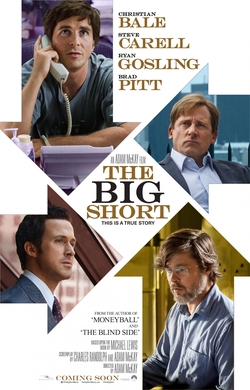
For the most part, our main characters are the type of quirky eccentrics who always tend to pop up in ensemble films like this.  They’re all played by recognizable actors and they all have an identifiable trait or two so we can keep them straight.  For instance, Christian Bale has trouble relating to people socially, plays drums, and looks like he probably has terrible body odor.  Steve Carell has a bad haircut and spends a lot of time yelling at people.  He’s also haunted by the suicide of his brother and he’s married to Marisa Tomei but she only gets to appear in two scenes and doesn’t really do much because this is a film about menfolk, dagnabit.  (I love Steve Carell but this is probably the least interesting performance that he’s ever given.)  John Magaro and Finn Wittrock are two young investors and they especially get upset when they realize that the economy is about to collapse.  Their mentor is played by Brad Pitt.  Since this is an important film, Brad Pitt plays his role with his important actor beard.

And then there’s Ryan Gosling.  Gosling plays a trader and he also narrates the film.  And really, Gosling probably gives the best performance in the film, perhaps because his character is the only one who is actually allowed to enjoy making money.  I think we’re supposed to be outraged when he brags about making money while people lose their houses but Gosling’s so charismatic and the character is so cheerful that it’s hard to dislike him.

(Of course, listening to Gosling’s narration, it’s impossible not to be reminded of The Wolf of Wall Street.  And it’s appropriate because The Big Short is kind of like The Wolf of Wall Street for people who don’t want to have to deal with ambiguity or nuance.)

The film has gotten a lot of attention for Adam McKay’s direction, which is flashy and always watchable but, at the same time, also rather shallow.  For the most part, McKay’s directorial tricks only served to remind me of other movies.  The narration, of course, made me think about The Wolf of Wall Street.  The scenes where characters look straight at the camera and say, “This isn’t the way it really happened,” only reminded me of how much more effective it was when the same thing happened in Michael Winterbottom’s 24 Hour Party People.

And then there’s the celebrity cameos.  These are the scenes where a special guest celebrity is brought on screen to explain to us how Wall Street actually works.  The first time, it’s Margot Robbie in a bubble bath and it works well because it admits the debt that The Big Short owes to Wolf of Wall Street.  (Plus, it ends with Robbie telling the viewers to “fuck off,” which is probably what I would do if a huge group of strangers interrupted my bubble bath.)  If McKay had limited himself to just doing it once, it would have been brilliant.  But McKay drags out three more celebs and, with repeated use, the technique gets less and less interesting.

But I guess it’s debatable whether any of that matters.  The Big Short taps into the way people are feeling now.  It’s a zeitgeist film.  People are rightfully angry and The Big Short is all about that anger.  A decade from now, it’ll probably be as forgotten as Gabriel Over The White House.  But for now, it’s definitely the film of the moment.

Embracing the Melodrama Part II #108: The Brave One (dir by Neil Jordan)


Brave_one_2007For our next entry in Embracing the Melodrama Part II, we take a look at Jodie Foster in the 2007 film The Brave One.  And…

Well, how to put this delicately?

I hate hate hate hate HATE this movie, with every last fiber of my being.  I hated it the first time that I saw it and I hated it when I recently rewatched it and right now, I’m hating the fact that I even decided to review this damn film because it means that I’m going to have to think about it.  I’m going to try to get this review over with quickly because, with each minute that I think about this film, I doubt my commitment to cinema.  That’s how much I hate this movie.  If I’m not careful, I’m going to end up joining a nunnery before I finish this review…

http://www.youtube.com/watch?v=6yh8l6ztvAE

So, in The Brave One, Jodie Foster plays Erica Bain.  Erica lives in New York and hosts one of those pretentious late night radio shows that are always popular in movies like this but which, in real life, nobody in their right mind would waste a second listening to.  Erica spends her time musing about life in the big city and hoping that we can all just love one another and expressing a lot of other thoughts that sound like they’ve been stolen from an automated twitter account.

Erica also has a boyfriend.  His name is David and he’s played by Naveen Andrews.  That means that he looks good and he has a sexy accent and when he first shows up, you hope that he’ll stick around for a while because otherwise, you’re going to have to listen to move of Erica’s radio monologues.  But nope — one night, while walking through Central Park, David and Erica are attacked.  David is killed.  Erica is raped.  And their dog is taken by the gang!

(And the film doesn’t seem to know which it thinks is worse…)

When Erica gets out of the hospital, she is, at first, terrified to leave her apartment.  Or, at least, she’s terrified to leave her apartment for about five minutes.  But then she does find the courage to go outside and, of course, the first thing she does is buy a gun.  At first, she’s buying the gun for her own state of mind but, almost immediately after purchasing her firearms, she happens to stumble across a convenience store robbery.

Bang!  Bang!  Erica’s a vigilante now!

But, of course, she’s not really sure if that’s what she wants to be.  Even though she eventually ends up sitting on a subway and waiting for a guy to approach her so she can shoot him, Erica is still never really that comfortable with the idea of seeking vengeance.  And this is why I hated The Brave One.  The film is so damned wishy washy about Erica’s motivations.  Instead of allowing Erica to get any sort of satisfaction or emotional fulfillment out of her actions, The Brave One has her constantly doubting whether or not violence is the answer.  And don’t get me wrong, I’m not saying that violence is the answer.  But if you’re going to make a film about a female vigilante who is out looking for vengeance, why don’t you at least allow her to get some sort of empowerment out of her actions?  That doesn’t mean that the film itself can’t be ambiguous about what she’s doing.  But by having Erica constantly questioning her actions, it makes her into a weak character and it lets the men who raped her and the ones who subsequently threaten to do the same off the hook.  It allows them to be seen as victims, as opposed to products of a society where men are raised to believe that women will never fight back.

There’s a far superior New York-set film that has almost the same plot as The Brave One.  The title of that film was Ms. 45.  It was made for a hundred times less money than The Brave One and, at the same time, it was and remains a hundred times better.  (I previously wrote about Ms. 45 and The Brave One in my essay, Too Sordid To Ever Be Corrupted.)

The difference between the two films can be summed up by the film’s tag lines.  The Brave One was advertised with, “How many wrongs to make it right?”  Ms. 45 was advertised with: “She was abused and violated … IT WILL NEVER HAPPEN AGAIN!”   Ms. 45 features a vigilante who never doubts her actions and, as a result, she becomes a symbol not of violence but of empowerment.  Meanwhile, Jodie Foster is so constantly wracked with guilt and doubt that the film almost seems to be criticizing her for not staying in her apartment and trusting the police (represented by Terrence Howard and Nicky Katt) to do their job.

Oh!  And, of course, at the end of the film, Erica gets her dog back.  Because nobody ever permanently loses their dog in a big budget studio film…

And really, that’s why The Brave One is such a failure.  It takes a subject that was tailor-made for the grindhouse and attempts to give it the slick and self-important studio approach.  And part of that approach is that no one can be offended.  This is a film that both wants to celebrate and condemn at the same time.

And that’s why I say, “Give me Ms. 45!”

At least that movie knows what it wants to say…

Film Review: Unbroken (dir by Angelina Jolie)


Ultimately, Unbroken is a victim of expectations.

From the start of last year, Oscar watchers and other film critics were united in fully expecting Unbroken to be a great film.  No sooner had 12 Years A Slave won best picture then we were all predicting that Unbroken would be named the best film of 2014 and that Angelina Jolie would be the 2nd woman to win an Oscar for best director.

And can you blame us?

Unbroken seemed to have everything that you would expect to add up to Oscar glory.  Not only was it directed by a celebrity (and, ever since Argo, everyone has been under the impression that all performers can also direct) but it starred an exciting and up-and-coming actor.  It was not only a war film but it was a war film that took place during the only war that everyone agrees was a good one, World War II.  It was based on a true story and what a story!  Louis Zamperini was an Olympic medalist whose athletic career was put on hold when he joined the U.S. Air Force.  After a plane crash, he and two other survivors spent 47 days floating in a lifeboat.  They were finally captured by the Japanese and Louis spent the rest of the war as POW.  During that time, he survived terrible torture.  When the war finally ended, Louis set aside his anger and publicly forgave those who had nearly killed him.  When he was 80 years old, he returned to Japan and carried the Olympic torch.  It’s an incredibly touching story and it should have made for a great movie.

And, ultimately, that’s Unbroken‘s downfall.  It has all the ingredients for being a great movie but instead, it’s only a good one.

That’s certainly not the fault of Jack O’Connell, who plays Louis and gives a strong and sympathetic performance.  Actually, the entire film is well-acted, with everyone fully inhabiting his role.  Perhaps the film’s best performance comes from Miyavi, who plays “The Bird,” the sadistic head of both of the POW camps where Louis is held prisoner.  The dynamic between The Bird and Louis is an interesting one, with the film emphasizing that The Bird is in many ways jealous of Louis’s previous fame and Miyavi plays the character as if he were a high school bully who has suddenly been left in charge of the classroom.

That the cast does well should not be a surprise.  Actors-turned-directors can usually get good performances but often times, they seem to struggle with shaping a narrative and this is where Unbroken struggles.  It’s not that Unbroken doesn’t tell a worthy story.  It’s just that it tells it in such a conventional and predictable way.  The entire film is full of scenes that seem like they were lifted out of other, more memorable movies.  The scenes with Louis growing up and competing in the Olympics feel like they could have come from any “inspiring” sports biopic.  (It doesn’t help that Louis’s brother and coach has been given dialogue that sounds like it should be surrounded by air quotes.)  When Louis is joking around with the guys in the plane, it feels like a hundred other war films.  When Louis is floating in the ocean, it’s hard not to compare the film’s static and draggy approach to what Ang Lee was able to do with Life of Pi or J.C. Chandor with All Is Lost.  Miyavi brings a feeling of real menace and danger to the POW scenes but it’s not enough.  Jolie’s direction is competent but there’s not a single moment that feels spontaneous or truly cinematic.

In fact, I sat through Unbroken totally dry-eyed, which is somewhat amazing considering how easily I cry at the movies.  However, towards the end of the film, there was a clip of the real-life, 80 year-old Louis running down the streets of Tokyo with the Olympic Torch and, at that moment, his story became real for me.  And that’s when the tears came.

I really wish Unbroken had been better because Louis Zamperini seems like someone who deserved to have a great film made about him.  Angelina Jolie’s heart was in the right place but, ultimately, it’s just not enough to make Unbroken the film that it deserves to be.