Horror Film Review: X: The Man With X-Ray Eyes (dir by Roger Corman)


X: The Man With The X-Ray Eyes (1963, dir by Roger Corman, DP: Floyd Crosby)

Eyes.  They’re one of the most important parts of our body but they’re also frightening easy to damage. Unlike the heart or the liver or the brain, they don’t have a protective covering of skin and bone.  They sit exposed and  are easily injured.  They can be ripped out of one’s head, which is a scary thought.  As well, they tend to grow weaker over time.  I love my multi-colored eyes and I think they’re one of my best features but I still spend a lot of time wishing that they weren’t quite as vulnerable as they are.  I often say that I’m blind without my contacts or my glasses.  That’s not quite true, of course.  I can see enough to get by if I forget to put in my contacts but I still have to do a lot of squinting, enough so that most people can take one look at me and say, “You forgot to put in your contacts, didn’t you?”  In my case, my eyesight has definitely gotten even worse over the past few years.  I’ve been told that’s normal but it still freaks me out.  I worry about waking up one day and not being able to see anything at all.

Director Lucio Fulci, a diabetic who was slowly going blind during the final years of his life, was infamous for including scenes of eyes being either pierced or gouged out in his films.  The New York Ripper even featured one scene where an eye was slit in half with a razor blade.  (This occurred in a close-up, no less!)  In Joe D’Amato’s Beyond the Darkness, there’s a scene where a mad taxidermist replaces the eyes of his dead fiancée with glass and for me, that’s one of most disturbing elements of the film.  Horror directors understand the vulnerability of the eyes and the sadness when life is extinguished from those eyes.  Eyes are said to be the windows to soul and when those eyes are lifeless, it’s a reminder that a living soul is a fleeting thing.

Perhaps that’s why 1963’s X: The Man With The X-Ray Eyes is such an effective work of art.  Directed by Roger Corman, the film tells the story of Dr. James Xavier (Ray Milland), a doctor who has developed eye drops that, when taken, allow one to have x-ray vision.  Dr. Xavier claims that the eye drops will allow doctors to more easily diagnose their patients and certainly, he has a point there.  His friend, Dr. Sam Brant (Harold J. Stone), points out that the eyes are directly connected to the brain and that using experimental eye drops on them could potentially drive a person mad.  Dr. Xavier proves Dr. Brant’s point by losing his tempter and accidentally pushing him out of a window.

Ah, x-ray vision.  It all starts out fun.  Dr. Xavier is performing miracle surgeries and seeing what everyone looks like naked.  (The swinging jazz party scene is a classic example of how 60s B-movies teased audiences while never quite showing everything.) But once he’s forced to go on the run from the police, Xavier finds himself making a living as a carnival psychic while still trying to refine his eyedrops.  Xavier’s sleazy manager (Don Rickles) tries to turn Xavier into a faith healer but, with Xavier’s x-ray vision growing more erratic and more intense, Xavier ends up running off to Vegas with a former colleague, Dr. Diane Fairfax (Diana Van der Vils).

And again, it’s all fun and games as Xavier uses his powers to cheat at cards.  But then the megalomania kicks in and, after Xavier basically announces that he’s cheating, he finds himself being chased through the desert by a police helicopter and freaking out as more and more of the universe is revealed to him.  Much like a Lovecraftian protagonist who has been driven mad by the sight of the Great Old Ones, Xavier finds himself overwhelmed by the center of the universe.  At a tent revival, a preacher shouts, “If thine eye offends thee, pluck it out!”

The film’s final image is a shocking one and it stays with you.  (There were rumors that the film originally ended with Xavier shouting, “I can still see!” but Corman himself said that never happened.)  Even without that final image, this would be one of Corman’s best films, a surprisingly intelligent and rather sad story about a man who, in trying to see what is usually hidden, was driven mad by what he discovered.  Ray Milland was well-cast as Dr. Xavier and watching him go from being a somewhat stiff but good-hearted scientist to a raving madman at a revival is quite an experience, a testament to the vulnerability that all humans share.  In the name of science, Xavier goes from being a respected researcher to being chased through the desert by a helicopter.  The man who wanted to be able to see everything finds himself wishing to be forever blinded.  Sometimes, the film suggests, it’s best not to be able to see everything around us.  Sometime, the mysteries of the universe should remain mysteries and the rest of us should respect our own vulnerabilities.
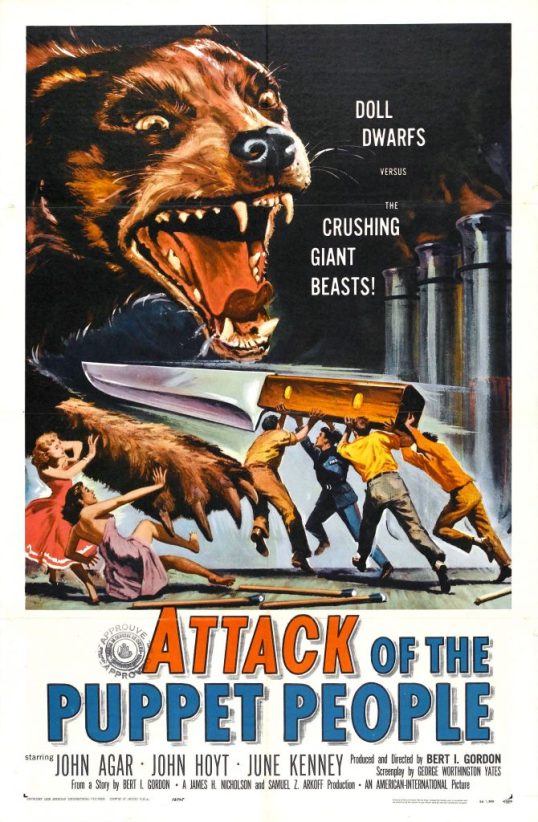
Horror Film Review: Attack of the Puppet People (dir by Bert I. Gordon)


At the start of the 1958 film, Attack of the Puppet People, Sally Reynolds (June Kenney) is looking for a job.  Fortunately, Dolls, Inc. is hiring!  Dolls, Inc. is owned by Prof. Franz (John Hoyt), who is the world’s greatest dollmaker.  In fact, he’s got an entire display case full of very lifelike dolls.  Why, the dolls are so authentic that it almost seems as if they could be alive.  Is it possible that Franz had been shrinking people and then sticking them in his display case?

It’s not only possible but it’s also exactly what Franz has been doing.

Soon, Sally and her boyfriend, Bob (John Agar), have been shrunk down to dollsize and are living with the other dolls in the display case.  It turns out that Prof. Franz’s motives aren’t really malicious.  He just tends to get lonely and he’s decided that they best way to keep people around is to shrink them and then imprison them.  Fortunately, getting shrunk doesn’t seem to lead to any health complications or anything like that.  It just means that you’re now very small and vulnerable to dogs and cats.

Franz even allows the dolls to come out of the display case at night.  Much like the toys from Toy Story, the Doll People throw a party every night and pretend to just be inanimate objects whenever anyone steps into the store.  That said, the puppet people don’t necessarily want to spend the rest of their lives on display.  Can they figure out how to escape from the store and how to reverse the shrinking process?

It’s a pretty silly film but then again, what else would you expect from something called Attack of the Puppet People?  There are a few amusing scenes where the puppet people have to deal with maneuvering around and dealing with giant furniture and, at one point, a really big door knob.  And, of course, there’s the inevitable scene in which a curious dog spots two of the puppet people trying to make their escape.  It’s a 50 B-movie, dumb but undeniably fun.  John Hoyt appears to be having a lot of fun as the doll-loving mad scientist and John Agar is his usual stolid but oddly likable self.

Attack of the Puppet People was directed by Bert I. Gordon, who also did The Amazing Colossal Man and War of the Colossal Beast.  (At one point, Bob and Sally got to a drive-in that’s show The Amazing Colossal Man and Gordon shares a few minutes of his previous film.)  Gordon specialized in films about giant lizards, giant insects, giant ants and sometimes even giant people.  In fact, his nickname was “Mr. Big,” both because of his initials and the subject matter of his films.  Attack of the Puppet People is a unique Gordon film in that it deals with shrinking instead of growing.  It’s also one of his more entertaining films.  Bert I. Gordon, incidentally, is still with us.  He turned 100 years old on September 24th.

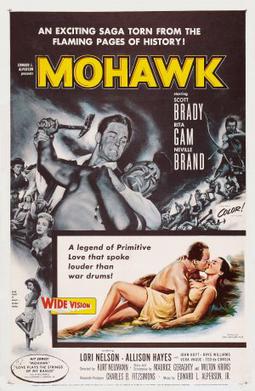
Mohawk (1956, directed by Kurt Neumann)


In the late 18th century, Boston socialite Cynthia Stanhope (Lori Nelson) travels to Fort Alden in upstate New York to visit her fiancé, a painter named Jonathan Adams (Scott Brady), who has been commissioned to paint the local scenery.  As soon as Cynthia and her mother arrive, they are shocked to discover that not only Jonathan has been painting pictures of the members of the Native local tribes but that he is also now flirting with a barmaid named Greta.  Greta is played by Allison Hayes so who can blame him?  Cynthia wants to return to their normal upper class life in Boston but Adams has fallen for the untamed wilderness of the frontier.

When Onida (Rita Gam), the daughter of Iroquois chief Kowanen (Ted de Corsia) is captured during a raid on the fort, Adams is assigned to escort her back to her tribe.  Leaving behind Cynthia and Greta, Adams falls in love with Onida over the course of the journey.  When he meets the Iroquois, he earns the respect of her father and the entire tribe when he agrees to paint the chief’s portrait.

Meanwhile, a haughty settler named Butler (John Hoyt) is trying to play the army and the Iroquois against each other, feeding both of them false information in an attempt to spark a war.  Butler is hoping that a war will lead to both sides wiping each other out so that he can once again have the valley to himself.  When it turns out that his words might not be enough to spark a war, Butler resorts to murder.  When Kowanen’s son is killed, the Iroquois prepare for war while Adams is framed for the crime and finds himself tied to a stake.

Mohawk is a standard B-western, with a plot that is largely lifted from John Ford’s Drums Along The Mohawk.  Unfortunately, Adams is about as sympathetic hero as you would expect someone manipulating three different women to be and, when it comes to depicting the Iroquois, Mohawk resorts to too many clichés.  This is one of those westerns where the Native characters speak broken English, even when they are just talking to each other.

Mohawk does have three things to recommend it.  Number one, John Hoyt was a master at playing haughty villains and Butler is easy to root against.  You will look forward to seeing him get his comeuppance.  Number two, Allison Hayes was a force of nature and that’s true even in this film, where she’s not given nearly enough to do.  Number three, one of Iroquois braves is played by Neville Brand.  A highly decorated World War II veteran, Brand built a long career playing tough guys.  In Mohawk, it only takes one look at Neville Brand to know that this isn’t someone you want to mess with.  Anyone watching would want to stay on Neville Brand’s good side.

Otherwise, Mohawk is forgettable.  Two years after it was released, Mohawk’s director Kurt Neumann, would be responsible for the much more memorable The Fly.

30 Days of Noir #17: Loan Shark (dir by Seymour Friedman)


The 1952 film, Loan Shark, opens with a familiar film noir situation.

A man walks down a dark city street.  Judging from the way that the man keeps looking over his shoulder, he’s obviously nervous about something.  Suddenly, we hear two sets of footsteps approaching him and it quickly becomes apparent that the man has good reason to be so nervous.  The man is being pursued by two gangsters.  (We know that they’re gangsters because of the suits and the fedoras.)  The gangsters toss the man in an alley and proceed to beat the Hell out of him.

The local tire factory has a problem.  Though its employees are highly valued, they’re not highly paid.  In order to make ends meet, many of them have resorted to gambling.  Plant foreman Charlie Thompson (Russell Johnson) always seems to have the latest tip on a sure thing.  Interestingly enough, the tips never seem to pan out and, as a result, the workers are forced to go to the local loan shark, Lou Donelli (Paul Stewart).  Lou always loans them the money but he charges exorbitant interest and, when the workers can’t pay back the loans, he sends his thugs to beat them up.  The factory’s management knows that they have to do something to take this loan shark out of commission.

Now, what would you do if you were a part of management?  Would you go to the police and maybe see if they could arrange to put a trained undercover cop in your factory?  Or would you hire an ex-con and tell him to just take care of it on his own?

The ex-con in question is Joe Gargen (George Raft).  He’s just been released from prison, though the film is quick to point out that Joe didn’t really do anything that bad.  He just hit a guy who was being obnoxious.  The guy fell back and hit his head and, as a result, Joe was charged with assault with a deadly weapon.  (As Joe explains it, he’s a former boxer and, as a result, his fists are legally considered to be deadly weapons.)  When Joe is first offered the clandestine job at the tire factory, he turns it down.  As he explains it, he’s not looking to get in any more trouble with anyone.  But then when the loan sharks kill his brother-in-law, Joe reconsiders.

Soon, Joe is working at the tire plant.  (If you’ve ever wanted to see, in meticulous detail, how a tire is made, this is the film to watch.)  After Charlie gives him a bad tip on a horse, Joe finds himself in debt to Donelli.  However, when Joe manages to beat up the thugs that Donelli sends to collect, Joe finds himself with another job offer.  Soon, Joe is working for the loan sharks!  Because he can’t reveal that he’s undercover, everyone — from the administrative assistant (Dorothy Hunt) who he once took dancing to his own sister (Helen Westcott) — is disgusted by Joe’s actions.  Joe finds himself a pariah but he’s still determined to discover the identity of Donelli’s boss.

With it’s combination of the mob and exploited blue collar workers (not to mention it’s use of an ex-boxer as its protagonist), Loan Shark lightly treads on the ground that would later be covered, in a far more exacting manner, by On The Waterfront.  Unfortunately, Loan Shark suffers a bit from the miscasting of George Raft in the lead role.  Raft was a charismatic actor but, when he made Loan Shark, he was 51 and looked about 9 years older.  When Raft shares what is meant to be a romantic dance with Dorothy Hart, he looks more like a proud father dancing with his daughter at a wedding reception than anything else.  Loan Shark is one of those films that calls out for a younger actor, a William Holden or maybe a John Garfield.  That said, Raft was a genuine tough guy and, despite his advanced age, he still looked like he could go a few rounds.

That said, Loan Shark is a tough and shadow-filled film, one that features some genuinely exciting fight scenes.  Miscast or not, when George Raft throws a punch, you believe it.

Horror On TV: Kolchak: The Night Stalker 1.20 “The Sentry” (dir by Seymour Robbie)


Tonight on Kolchak….

There’s something on the loose underneath Chicago!  Could it be a …. killer lizard!?  Kolchak’s on the story!

Sadly, all good things must come to an end and this was the final episode of Kolchak: The Night Stalker.  Darren McGavin, of course, would later go on to epitomize the ideal middle American father when he played The Old Man in A Christmas Story.

This finale originally aired on March 28th, 1975.

I hope you have enjoyed this October’s trip down Kolchak Lane!

Lisa Cleans Out Her DVR: The Girl In the Red Velvet Swing (dir by Richard Fleischer)


(Lisa is currently in the process of cleaning out her DVR!  How long is it going to take?  Forever!  For instance, she recorded 1955’s The Girl In the Red Velvet Swing off of FXM on February 1st and has now gotten around to actually watching and reviewing it.)

The story of Evelyn Nesbit is an interesting one, even if it is now a largely forgotten one.

In 1901, Evelyn Nesbit was a showgirl in New York City.  While she always claimed that she was 16 at the time, there are some historians that think it more likely that she was only 14.  One night, the beautiful Evelyn was introduced to Stanford White.  At the time, White was 47 years old and the most successful and prominent architect in New York City.  White was also a notorious womanizer and Evelyn soon became his latest mistress.  He moved her into one of his many apartments.  Years later, when the details of their relationship became public knowledge, people were shocked to hear that Stanford White kept a red velvet swing in the apartment and that he enjoyed watching Evelyn swing back and forth.  They would be even more scandalized by the news that Stanford also had a “mirror room.”  As Evelyn would later testify, she “entered the room a virgin” but did not come out as one.

Though Evelyn occasionally claimed that she and Stanford were truly in love, she never married him.  (Indeed, Stanford White apparently never married anyone over the course of his life.)  Instead, she ended up meeting and marrying Harry K. Thaw.  Harry was the heir to a 40 million dollar fortune.  He also had a long history of mental illness.  When he learned that, before meeting him, Evelyn had lost her virginity to Stanford White, he was outraged.

(It’s debatable how well Stanford and Harry knew each other.  Some historians claim that they were barely acquainted.  Other accounts claim that Harry and Stanford were business rivals even before Evelyn Nesbit arrived in New York.)

In 1906, Harry and Evelyn ran into Stanford White at Madison Square Garden.  Harry promptly pulled out a pistol and, in front of hundreds of witnesses, shot Stanford dead.

Harry’s subsequent trial was reportedly the first to ever be described as being “the trial of the century.”  Because hundreds of people had seen Harry Thaw shoot Stanford White and the Thaw family was adamant about not publicizing Harry’s history of mental illness, Harry’s defense team attempted to make the trial about Stanford White.  The defense attempted to portray Stanford as being such a depraved predator that Harry really had no other option but to shoot him in cold blood.  Evelyn took the stand and testified to every single detail of her relationship with Stanford White.  The details appeared in every major newspaper in America.

In the end, Harry was found not guilty by reason of insanity and was committed to the  Matteawan State Hospital for the Criminally Insane.  (Reportedly, due to his great wealth, he had the best room in the hospital.)  Meanwhile, Evelyn became one of America’s first reality stars.  Her notoriety led to her appearing in several silent films.  It’s a fascinating story, one that very much feels ahead of his time.  If Evelyn was a star in 1906, just imagine how famous she would be today.

The Girl in the Red Velvet Swing is about Evelyn Nesbit and her relationships with both Stanford White and Harry Thaw.  It’s a shame that the film isn’t as interesting as the real life story.  Ray Milland plays Stanford White.  Farley Granger is Harry Thaw.  Joan Collins is Evelyn Nesbit.  They all give good performances, especially Farley Granger.  But the film itself is just so bland.  Perhaps because it was made in the 1950s, it leaves out the majority of the sordid details that made the story so fascinating to begin with.  For instance, the red velvet swing appears but, in this film, no time is spent in the mirror room.  This true life story is pure tabloid material but The Girl In The Red Velvet Swing is way too respectful for its own good.  By refusing to come down firmly on the side of Harry Thaw or Stanford White, the film feels shallow and a bit empty.  (All good melodramas — even fact-based ones — need a good villain.)  And poor Evelyn Nesbit!  In real life, she was a savvy self-promoter who knew exactly how to manipulate the press.  In this film, she’s just an innocent ingenue.  Considering the facts of the case, the film version is unforgivably dull.

So, I don’t recommend The Girl In The Red Velvet Swing but I do recommend Paula Uruburu’s fascinating 2008 biography, American Eve: Evelyn Nesbit, Stanford White, The Birth of the ‘It’ Girl, and the ‘Crime of the Century.’  It goes into all of the fascinating details that were left out of this film.

A Movie A Day #126: Baby Face Nelson (1957, directed by Don Siegel)


The place is Chicago.  The time is the era of Prohibition.  The head of the Chicago Outfit, Rocca (Ted de Corsia), has arranged for a career criminal named Lester Gillis (Mickey Rooney) to be released from prison.  A crack shot and all-around tough customer, Gillis has only two insecurities: his diminutive height and his youthful appearance.  Rocca wants to use Gillis as a hit man but Gillis prefers to rob banks.  When Rocca attempts to frame Gillis for a murder, Gillis first guns down his former benefactor and then goes on the run with his girlfriend, Sue Nelson (Carolyn Jones).  Because they are both patients of the same underworld doctor (played by Sir Cedric Hardwicke), Gillis eventually meets public enemy number one, John Dillinger (Leo Gordon).  Joining Dillinger’s gang, Gillis becomes a famous bank robber and is saddled with a nickname that he hates: Baby Face Nelson.
While it is true that Lester “Baby Face Nelson” Gillis was an associate of John Dillinger’s and supposedly hated his nickname, the rest of this biopic is highly fictionalized.  The real Baby Face Nelson was a family man who, when he went on the run, took his wife and two children with him.  While he did get his start running with a Chicago street gang, there is also no evidence that Nelson was ever affiliated with the Chicago Outfit.  (The film’s Rocca is an obvious stand-in for Al Capone.)  In real life, it was Dillinger, having just recently escaped from jail, who hooked up with Nelson’s gang.  The film Nelson is jealous of Dillinger and wants to take over the gang but, in reality, the gang had no leader.  Because Nelson killed three FBI agents (more than any other criminal), he has developed a reputation for being one of the most dangerous of the Depression-era outlaws but, actually, he was no more violent than the typical 1930s bank robber.  Among the era’s outlaws, Dillinger was more unique for only having committed one murder over the course of his career.  In this film (and practically every other film that has featured Baby Face Nelson as a character), Nelson is a full on psychopath, one who even aims his gun at children.

Baby Face Nelson may be terrible history but it is still an excellent B-movie.  Don Siegel directs in his usual no-nonsense style and Mickey Rooney does a great job, playing Baby Face Nelson as a ruthless but insecure criminal with a perpetual chip on his shoulder.  As his fictional girlfriend, Carolyn Jones is both tough and sexy, a moll that any gangster would be lucky to have waiting for him back at the safe house.  B-movie veterans like Thayer David, Jack Elam, Elisha Cook Jr., and John Hoyt all have colorful supporting roles but the most unexpected name in the cast is that of Cedric Hardwicke, playing an alcoholic surgeon with broken down dignity.

Don’t watch Baby Face Nelson for a history lesson.  Watch it for an entertaining B-masterpiece.


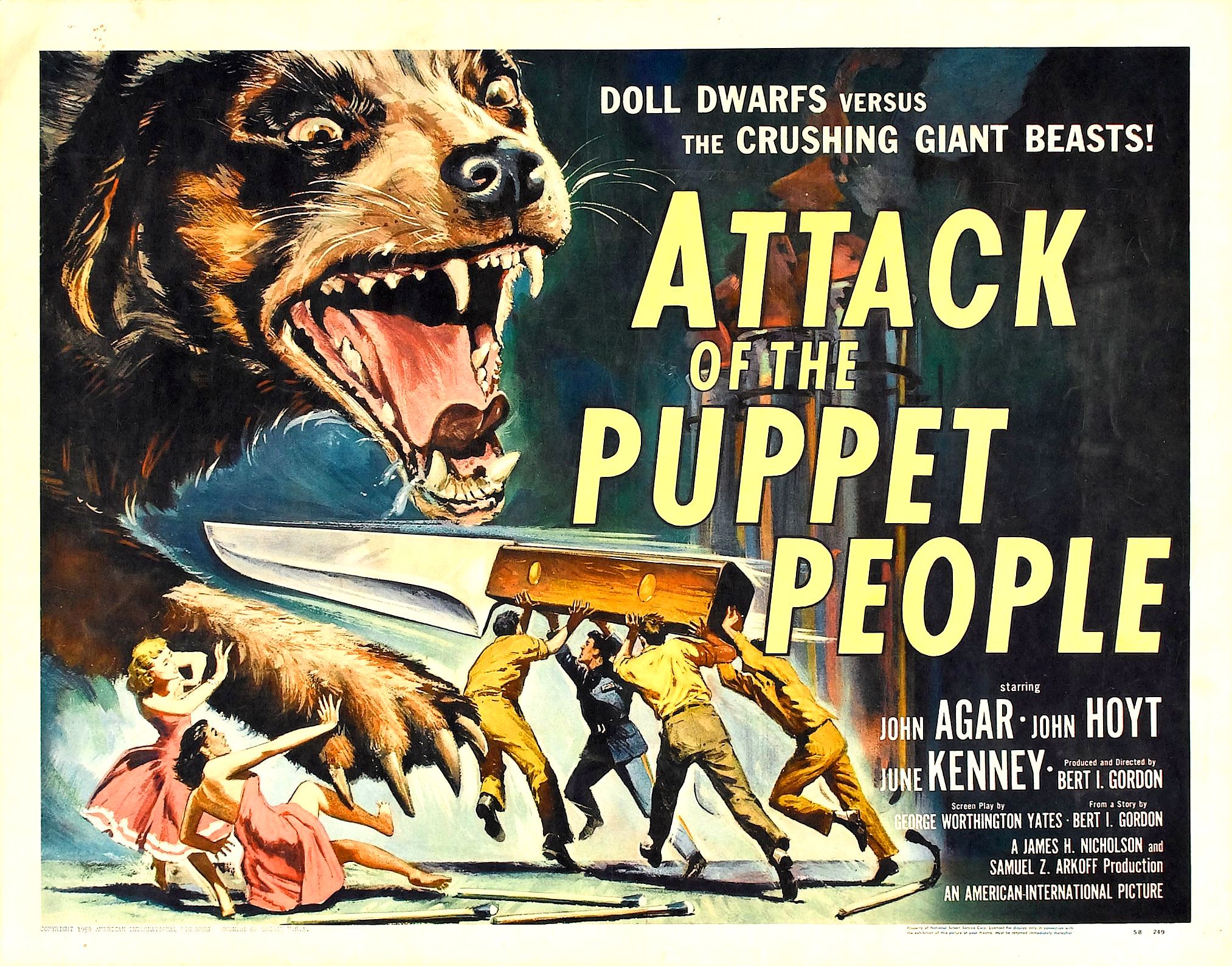
My Living Doll: ATTACK OF THE PUPPET PEOPLE (AIP 1958)


gary loggins's avatarcracked rear viewer

attack1

Oh boy. TCM is running a salute to AIP every Thursday this month. Now I’ll never get that DVR cleaned out! American International Pictures released some of my favorite films of the 50’s, 60’s, and 70’s, and TCM’s showing everything from Vincent Price/Roger Corman/Edgar Allan Poe horrors to outlaw biker flicks to Beach Party teen shenanigans. Expect to see lots of AIP posts in the near future, starting right now with 1958’s ATTACK OF THE PUPPET PEOPLE.

One of my earliest movie memories is watching this on the local “Four O’ Clock Movie Matinee” when I was about five years old. For some strange reason, it resonated with me. I haven’t seen it in years, and my recent re-viewing had me wondering just why it did. Maybe I was a strange kid! Anyway, ATTACK OF THE PUPPET PEOPLE was the brainchild of Mr. B.I.G. himself, producer/director/effects wizard Bert I. Gordon. Well, maybe…

View original post 640 more words

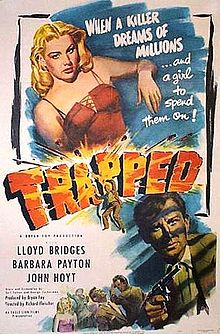
The Fabulous Forties #6: Trapped (dir by Richard Fleischer)


220px-Trapped_1949

After being disappointed with Guest In The House, I decided to go ahead and watch the sixth film in Mill Creek’s Fabulous Forties box set and I’m glad that I did.  1949’s Trapped turned out to be an entertaining little discovery.

Much like Port of New York, Trapped opens with documentary footage of the government at work and an official sounding narrator explaining to us that we are about to see a film about the hardworking agents of the Treasury Department.  In fact, the narrator goes on for so long about the Treasury Department that he starts to sound downright worshipful.  There’s nothing that the Treasury Department cannot do!  Who protects the President?  The Treasury Department!  Who tracks down counterfeiters?  The Treasury Department!  Who protects the coast?  The Coast Guard but guess what? The Coast Guard is actually a part of The Treasury Department!  The tone of the narration is so worshipful that it could almost pass for a Scientology recruiting film.  Just as only the Sea Org can protect us from Evil Lord Xenu, only the Treasury Department can stop phony money pushers!

Eventually, the narration ends and the actual movie begins.  Fortunately, the rest of Trapped more than makes up for that awkward introduction.  The film opens with a bunch of Treasury agents looking over a phony twenty-dollar bill.  The bill is almost perfect and the agents believe that it was printed using plates designed by one of the world’s greatest counterfeiters, Tris Stewart (Lloyd Bridges).  The only problem is that Stewart is in prison.  Obviously, someone else has gotten their hands on Stewart’s plates.

Stewart is upset that someone is getting rich off of his work.  So, he strikes a deal with the Treasury Department.  In return for being released, he will help them track down his plates.  The Treasury Department agrees and arranges for Stewart to “escape” during a phony prison break.

However, Stewart has plans of his own.  As soon as he’s out of jail, he knocks out his handler and escapes for real.  Tris is not only planning on tracking down his plates but he’s also going to go back into business printing and passing phony money.  He also reunites with his girlfriend, nightclub hostess Meg Dixon (Barbara Payton).

When he meets Meg, he discovers that she has a new admirer.  Johnny Hackett (John Hoyt) likes to hang out whenever Meg’s working.  Even though Johnny appears to have a thing for Meg, he and Tris still become friends.  Tris is even willing to bring Johnny in on the operation but, what Tris doesn’t realize, is that Johnny Hackett is actually Treasury agent John Downey (John Hoyt)…

Needless to say, violence, betrayal, and death follows.

Shot on location in some of the seediest parts of 1940s Los Angeles, Trapped is a fast-paced and exciting film noir.  (This is one of those films, like The Black Book, where shadows are literally everywhere.)  Lloyd Bridges (who, as a young man, could have passed for Kirk Douglas’s brother) gives a great performance as the charming but ultimately cold-hearted Tris Stewart while John Hoyt does a fairly good job as the conflicted Downey.  Barbara Payton, one of the more tragic figures from Hollywood’s Golden Age, does such a good job as Meg that it’s even more tragic to consider that, just a few years after making Trapped, her career would be destroyed by alcoholism and personal scandal and she would eventually end up as a homeless prostitute on Sunset Boulevard.

Trapped was a good discovery and you can watch it below!

Embracing the Melodrama Part II #26: Cleopatra (dir by Joseph L. Mankiewicz)


Cleopatra_posterWhile watching the 1963 best picture nominee, Cleopatra, I had many thoughts.  The film lasts over 4 hours so I had a lot of time to think.

For instance, I often found myself impressed by the sheer size of the production.  I marveled at the recreation of ancient Greece and Rome.  I loved looking at the ornate costumes.  I loved feeling as if I was taking a look back at what Rome may have actually looked like at the height of the Roman Empire.  Making it all the more impressive was that this film was made in the days before CGI.  When the film’s Romans walked through the streets of Rome, they weren’t just actors standing in front of a green screen.  They were walking down real streets and surrounded by real buildings.  It reminded me of the awe and wonder that I felt when I was in Italy and I was visiting the ruins of ancient Rome.

(I don’t know if any of the cast accidentally flashed everyone like I did when I visited during Pompeii on a windy day but considering how short some of the skirts on the men were, it wouldn’t surprise me if they did!)

And, as I marveled at the recreation of Rome, I also thought to myself, “How long is this freaking movie?”  Because, seriously, Cleopatra is an amazingly long movie.  It’s not just the film is over four hours long.  It’s that the film feels even longer.  Gone With The Wind, The Godfathers Part One and Part Two, Once Upon A Time In America; these are all long films but, because they’re so great, you never find yourself checking the time while watching.  Cleopatra is the opposite of that.  Cleopatra is a film that, at its slowest, will make you very much aware of how many seconds are in a minute.

I found myself marveling at the lack of chemistry between Elizabeth Taylor and Richard Burton.  If anything, this is the most shocking thing about Cleopatra.  If Cleopatra is famous for anything, it’s famous for being the film where Elizabeth Taylor (cast in the role of Cleopatra) first met Richard Burton (who was playing Mark Antony).  Their affair dominated the gossip headlines.  (If TMZ and YouTube had been around back then, there would be daily videos of Richard Burton punching out paparazzi.)  Cleopatra was the first of many big-budgeted, overproduced films that Taylor and Burton co-starred in.

(Then again, they also starred in Who’s Afraid of Virginia Woolf, a film that is almost the exact opposite of Cleopatra.)

In the role of Mark Antony, Burton spends most of the film looking absolutely miserable.  Elizabeth Taylor, meanwhile, seems to be having a lot more fun.  It’s almost as if she understood what Cleopatra was going to become so she went out of her way to give the type of over-the-top performance that the film deserved.  The same can also be said about Rex Harrison, who plays Julius Caesar and who, perhaps because he appears to have shared her attitude, actually does have some chemistry with Taylor.

Actually, if anyone gives a truly great performance in Cleopatra, it’s Roddy McDowall.  McDowall plays the future Emperor Augustus with a mesmerizing intensity.  Again, McDowall’s performance is not exactly subtle but Cleopatra is not a film that demands subtlety.

As the film finally neared its end, I found myself wondering how Joseph L. Mankiewicz went from directing two close to perfect films, A Letter To Three Wives and All About Eve, to directing this.  Even more amazing, Mankiewicz had previously directed one of the best Roman Empire films ever, 1953’s Julius Caesar.  (When compared to Cleopatra, the low-key and thoughtful Julius Caesar appears to have been filmed on an entirely different planet.)  Well, in Mankiewicz’s defense, he was not the original director.  He was brought in to replace Rouben Mamoulian, who had previously attempted to make the film with Joan Collins, Ben-Hur‘s Stephen Boyd, and Peter Finch.  When Mankiewicz was brought in, the cast was replaced with Taylor, Burton, and Harrison.  Between the expensive stars, the troubled production, and all of the offscreen romantic melodrama, Mankiewicz probably did the best that he could.

Today, Cleopatra is mostly interesting as an example of a film from the “Only Gigantic Productions Will Save Us From Television!” era of Hollywood filmmaking.  Cleopatra started out as a $2,000,000 production and ended up costing $31,000,000.  It was the number one film at the 1963 box office and it still nearly bankrupted 20th Century Fox.  While the film does have some kitsch appeal, the critics hated it and it’s easy to see why.

And yes, it was nominated for best picture of the year, a tribute to the size of the production and the determination of 20th Century Fox to get something — anything — in return for their money.

Cleopatra is a bit of a chore to sit through but it can be fun if you’re in a snarky mood.  It’ll do until the inevitable Angelina Jolie remake comes along.