Late Night Retro Television Review: Friday the 13th: The Series 3.11 “Year of the Monkey”


Welcome to Late Night Retro Television Reviews, a feature where we review some of our favorite and least favorite shows of the past! On Fridays, I will be reviewing Friday the 13th: The Series, a show which ran in syndication from 1987 to 1990. The entire series can be found on YouTube!

This week, Friday the 13th features an international adventure!

Episode 3.11 “Year of the Monkey”

(Dir by Rodney Charters, originally aired on January 15th, 1990)

Mushashi (John Fujioka) is a modern-day samurai who owns a cursed tea kettle.  When Jack, Micki, and Johnny come by his dojo in search of the kettle, Mushashi says that he will give it to them if they can prove that they are “honorable” by retrieving three cursed monkey statues that are currently in the possession an elderly businessman named Tanaka (Robert Ito).

Tanaka, however, has given the three wise monkey statues (“See No Evil,” “Hear No Evil,” and “Speak No Evil”) to his three children, Michiko (Tia Carrere), Koji (Leonard Chow), and Hitoshi (Von Flores).  Tanaka explains that each statue will challenge it’s owner.  Those who react in an honorable way will inherit Tanaka’s fortune.  Those who are dishonorable will get nothing.

Jack, Micki, and Johnny split up to retrieve the monkeys.  Johnny goes to New Yok to get Hear No Evil from Hitoshi.  Micki goes to Hong Kong to retrieve See No Evil from Koji.  Jack gets to stay in Canada (or Chicago or wherever this show is supposed to be taking place) so that he can retrieve Speak No Evil from Michiko.  What they don’t know is that Tanaka is several hundred years old.  Every time one of his children fails a monkey test, Tanaka gets a little bit younger.

It’s all about honor and dishonor and the code of the samurai in this week’s episode.  To be honest, it’s a bit of a mess.  First off, the title refers to the Chinese Zodiac but, other than our three regulars, all of the characters are meant to be Japanese.  Secondly, it’s never really clear how the cursed monkeys decide what is honorable and what is dishonorable.  Hitoshi uses his monkey to hear the thoughts of those around him and to take advantage of them.  That’s definitely dishonorable.  But then Koji is declared to be dishonorable even though his monkey did something on its own, without Koji telling it to.  Michiko refuses to use her monkey to her own advantage and is judged to be honorable.  She is told that it is now her duty to kill her father but instead, she commits suicide because killing her father would be dishonorable.  Then, Tanaka is eventually judged to be dishonorable because he stabs Musashi while Mushasi is not holding a weapon but that’s just because Mushashi dropped his sword at the very least minute.  It seems like Mushashi should be the dishonarable one for going out of his way to trick Tanaka.

My point is that this was a confusing episode.  The monkey were actually kind of cute but their powers made no sense.  I’m also not sure why experienced world traveler Jack decided to send Micki to Hong Kong instead of going himself.  In the end, this episode was pretty silly, despite the cool monkeys and the samurai-themed finale.

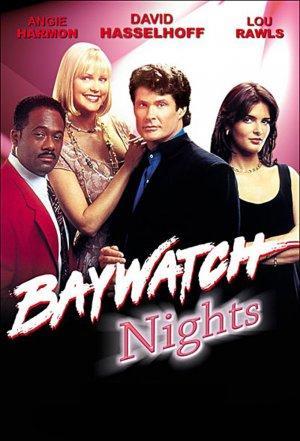
Late Night Retro Television Review: Baywatch Nights 1.17 “Code of Silence”


Welcome to Late Night Retro Television Reviews, a feature where we review some of our favorite and least favorite shows of the past!  On Tuesdays, I will be reviewing Baywatch Nights, a detective show that ran in Syndication from 1995 to 1997.  The entire show is currently streaming on You tube!

This week, the stars align and David Hasselhoff finally meets …. THE YAKUZA!

Episode 1.17 “Code of Silence”

(Dir by Charles Bail, originally aired on March 16th, 1996)

While her mother has a desperate conversation on a nearby payphone, young Mariko (Nicole Iiada) wanders onto the beach and spots a sea gull who has gotten tangled up in a fishing net.  Fortunately, Mitch Buchannon drives up in his red Baywatch jeep and is able to set the sea gull free.  Unfortunately, no sooner has the sea gull flown away then a bunch of Yakuza pull up and promptly kidnap Mariko’s mom.

Is there a detective in the house?

Why, yes, there is!

Well, kinda….

This is yet another episode of Baywatch Nights in which Mitch gets involved in a case as a result of being a lifeguard as opposed to being a private investigator.  Indeed, if not for the presence of Angie Harmon, there would be little to distinguish this from an episode of Baywatch.  While watching the last few episodes of Baywatch Nights‘s first season, you really can tell that the producers were desperate to bring over the audience that was watching just plan Baywatch.  If the first half of the first season was all about David Hasselhoff wearing suits and providing hard-boiled narration, the second half is more about getting everyone onto the beach as quickly as possible.

As for this week’s case, it turns out that the kidnapped woman is a geisha who has a computer disk that the Yakuza wants.  While the members of the Yakuza are busy threatening her with all sorts of violence, Mitch is teaming up with her grandfather (played by Soon-Tek Oh) and trying to discover where she’s being held.  When Garner and Mitch find out about the Yakuza’s secret headquarters, they launch an assault.  You might think that this would be difficult, seeing as how the members of the Yakuza are all ruthless martial artists.  Well, it turns out that karate is no match for Mitch’s fists.  The ancient art of combat falls before the power of the Hoff.

Somewhat inevitably, the episode ends with Mitch being given two samurai swords by Soon-Tek Oh.  When Mitch says that he can’t accept such an expensive gift, Soon-Tek Oh says that no one gets the swords as a gift.  Instead, they must be earned by truly displaying the spirit of the samurai.  Mitch looks truly touched while Angie Harmon suppresses a laugh.

David Hasselhoff vs. The Yakuza!  Well, we all knew it was going to have to happen at some point.  That said, I don’t think the Hoff was dealing with first-grade Yakuza.  It seems like the Yakuza sent the B-team to California.  Well, that was their mistake.  It didn’t take much effort for the Hoff to track them down and defeat them and in fact, it felt almost too easy.  The Yakuza probably thought the Hoff would be too busy recording a new album to care.  Again, their mistake.

Never underestimate the Hoff!

Late Night Retro Television Reviews: Highway to Heaven 1.22 “An Investment In Caring”


Welcome to Late Night Retro Television Reviews, a feature where we review some of our favorite and least favorite shows of the past!  On Thursdays, I will be reviewing Highway to Heaven, which aired on NBC from 1984 to 1989.  The entire show is currently streaming on Freevee and several other services!

This week, Jonathan encourages everyone to violate federal law.

Episode 1.22 “An Investment In Caring”

(Dir by Michael Landon, originally aired on March 13th, 1985)

Helen Spencer (Eileen Heckart) is an annoying old busy body who lives in one of those charming city neighborhoods that are only found on shows like Highway to Heaven.  Even since her husband died, she has kept herself active by working as a cleaning lady at the Halstead Corporation, which is the same company that wants to not only tear down her neighborhood but also turn the local cemetery into a condo subdivision.

Fortunately, Helen’s new boarders just happen to be Jonathan Smith and Mark Gordon.  Jonathan encourages Helen to rally the neighbors to take a stand against Halstead.  He also encourages Paul Tarsten (Dane Clark), who was recently laid off from Halstead for being too old, to help Helen out.  With Jonathan’s guidance, Helen goes through the trash at Halstead, finds some stock reports that really should have been put through a shredder, and then use that insider information to buy and sell a bunch of stock until soon, she and her friends are the majority stockholders.

“Only in America,” Ms. Zabenko (Elsa Raven) exclaims not once but five times, just in case you were wondering how heavy-handed this episode was.

Helen is able to save her neighborhood, save the cemetery where her husband is buried, and also take over the company.  She also finds hints of romance with Paul, who is himself a widower.  Their mission accomplished, Jonathan and Mark leave town….

…. which is good because I don’t see anyway that Paul, Helen, and Ms. Zabenko aren’t eventually going to end up in federal prison.  Just about every piece of advice that Jonathan gave Helen led to her doing something illegal, from insider trading to corporate espionage to stealing from the office.  Only in America, Ms. Zabenko?  In America, we have laws against stock market manipulation.

This episode just irked me.  Whenever people talk about Highway to Heaven being an unrealistic and cheesy show, this is the type of episode that they’re thinking of.  It takes a lot to make a heartless corporation sympathetic but the overacted and rather smug neighborhood activists in this episode managed to do just that.  In previous episodes, Jonathan and Mark have appealed to businessmen to get them to change their ways.  In this episode, the head of Halstead isn’t given that opportunity.  Instead, Jonathan — acting on authority from GOD — encourages a bunch of people with no business experience and no way of knowing any better to commit a bunch of federal crimes.  Helen takes over the company but what does Helen know about running a company?  When Halstead goes bankrupt, a lot of people who had nothing to do with the former CEO’s plans will end up losing their jobs.  Way to go, God.

Finally, I should note that this episode begins with Helen’s former boarder telling her that he’s moving out because a voice in his head told him to move to Alaska.  It’s only because he leaves that Helen has the room to rent to Jonathan and Mark.  So, basically, promoting insider trading wasn’t enough for Jonathan.  He also had to ruin some poor schmuck’s life by telling him to move to a state that he knows nothing about.  Not since the Book of Enoch has an angel behaved so unethically.

Film Review: The Last Flight of Noah’s Ark (dir by Charles Jarrott)


I recorded the 1980 film, The Last Flight of Noah’s Ark, off of TCM because I looked at the title and the fact that it starred Elliott Gould and I figured that it would be a film about an expedition to recover the actual Noah’s Ark.  I figured that it would feature scenes of Elliott Gould and Christopher Plummer (who I just assumed would be in the movie) climbing Mount Ararat and having comical disagreements about all of the snow.  I also assumed that the movie would end with the real Noah’s Ark sliding down the mountain while Gould and Plummer tried to steer it.

Seriously, it sounded like fun!

Of course, it turned out that I was wrong.

http://www.youtube.com/watch?v=YwA4JZAcmlE

It turns out that The Last Flight of Noah’s Ark is about an out-of-work pilot named Noah Dugan (Elliott Gould) who has a gambling problem and owes a lot of money to the mob.  Normally, you’d be worried that this means Dungan has a contract out on his life but instead, it just means that a bald guy named Benchley (Dana Elcar) keeps popping up and saying that Dugan’s got a week to come up with the money.

Since this film was made before our current socialist moment, Dugan is forced to get a job.  Unfortunately, the only one that he can get involves flying a missionary (Genevieve Bujold) and a bunch of animals to a South Pacific island.  Dugan agrees but, because the plane is an old World War II bomber, he ends up having to make an emergency landing on a remote and uncharted desert isle.

Of course, it quickly turns out that Dugan, the missionary, and the animals aren’t alone!  First off, it turns out that two orphans (played by Ricky Schroder and Tammy Lauren) stowed away on the airplane.  And then, we discover that there are two Japanese soldiers stranded on the island as well!  They’ve been there since World War II!  Fortunately, one of them is named Cleveland (John Fukioka) and can speak English.

(As for Christopher Plummer, he’s nowhere to be seen because he’s not in the movie.)

Anyway, can you guess what happens?  If you think that Noah and the gang turn the plane into a big boat, you’re on the right track.  If you think that cynical Noah turns out to actually have a soft spot when it comes to children, you’re right.  If you think that Noah and the missionary embark on the most chaste romance in movie history …. oh my God, have you seen this movie before!?

Here’s the thing with The Last Flight of Noah’s Ark — the animals are cute.  I mean, the animals really are adorable.  There’s this one duck who has more screen presence than every human in this movie.  And normally, I’d say that cute animals can save just about any movie but this might be the exception to the rule.

I mean, I get it.  This was a movie for kids and that’s great.  But my God, this is a slow movie.  We start with Dugan getting threatened by the gamblers and then it’s another 25 minutes before Dugan even starts the engine on that plane.  I get that this is a family film but I imagine that even families in 1980 would have been bored to death by it.  Elliott Gould certainly seems to be bored, as he gives a performance that all but screams, “Where’s my paycheck!?”

What would have improved The Last Flight of Noah’s Ark?

Christopher Plummer, dammit.

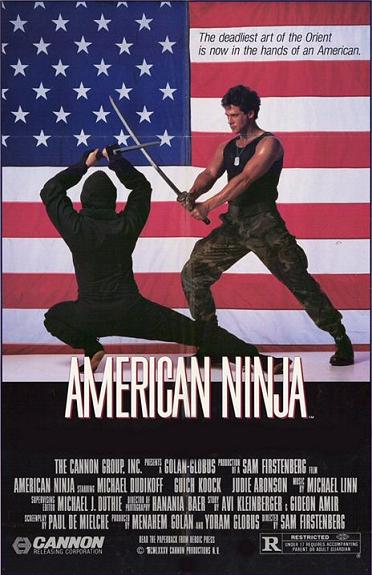
A Movie A Day #132: American Ninja (1985, directed by Sam Firstenberg)


Hell yeah!

From Yoram Globus and Menahem Golan, the duo who were responsible for producing the coolest films of the 1980s, comes American Ninja!

Private Joe Armstrong (Michael Dudikoff) is the newest arrival on an American army base in the Philippines.  A former member of a street gang, he has been forced to enlist in the army in order to keep himself out of jail.  Because he keeps to himself, the other soldiers do not like him.  Colonel Hickock (Guich Kook) is angry that his daughter, Patricia (Judie Aronson), likes Joe and conspires to have Joe court martialed.  Joe’s only friend is Corporal Jackson (Steve James), who starts out as an enemy but changes his ways after Joe shows off some sweet martial arts moves.  Because Joe is an amnesiac, he does not know where or why he learned how to fight.  He just knows that he can.

It’s good that he can because the local black marketer, Ortega (Don Stewart) has hired the legendary Black Star ninjas to help him steal supplies from the base.  Ortega has even allowed the ninjas to set up a training camp in his back yard.  When Joe prevents the ninjas from kidnapping Patricia, the ninjas swear revenge.

As if there could possibly be any doubt, American Ninja was made and distributed by Cannon Films.  It is about as pure an example of the Cannon aesthetic as anyone could hope to find.  Find a star — in this case, Michael Dudikoff — who was credible without being expensive.  Give him a love interest who was easy on the eyes and who could get held hostage during the film’s climax.  Toss in slow motion stunt work, big explosions, and Steve James.  Come up with a title that would appeal to both NASCAR-loving patriots and drive-in movie fans.  End result: American Ninja!

As a film, American Ninja get the job done and then some.  The fights are well-choreographed and the movie does not allow things like character development or subtext to get in the way of showcasing plenty of ninja action.  There are enough weird details, especially after Joe dons the black pajamas of the American Ninja, to keep the move interesting.  At one point, a ninja literally vanishes and what’s cool is that no one acts surprised when it happens.  Long before Crouching Tiger, Hidden Dragon, American Ninja showed that there’s nothing a ninja can’t do!

One final note: Keep an eye out for my favorite scene, in which a slow-moving jeep bumps into a tree and explodes with all the force of a planet that’s just been zapped by the Death Star.

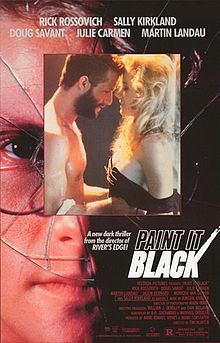
A Movie A Day #89: Paint It Black (1989, directed by Tim Hunter)


This month, since the site is currently reviewing every episode of Twin Peaks, each entry in Move A Day is going to have a Twin Peaks connection.  Paint In Black was directed by Tim Hunter, who directed three episodes of Twin Peaks, including the one that I reviewed earlier today.

Jonathan Dunbar (Rick Rossovich) should have it all.  He is an acclaimed sculptor but he’s being cheated financially by his dealer and sometimes girlfriend, Marion Easton (Sally Kirkland).  Things start to look up for Jonathan after he has a minor traffic accident with Gina (Julie Carmen).  Not only are he and Gina immediately attracted to each other but it turns out that Gina is the daughter of Daniel Lambert (Martin Landau), who owns the most prestigious art gallery in Santa Barbara.  It appears that Jonathan is finally going to get the big show that he has always dreamed of, but only if he can escape from Marion’s management.

One night, Jonathan helps out a man who was apparently mugged outside of an art gallery.  The man, Eric (Doug Savant), says that he’s an art collector and that he is a big fan of Jonathan’s work.  When Jonathan opens up about his problems with Marion, Eric decides to return Jonathan’s favor by killing Marion and anyone else who he feels is standing in the way of Jonathan’s success.  Because of the way that Eric artistically stages the murders, the police suspect that Jonathan is the murderer.

Depending on the source, Paint It Black’s original director was either fired or walked off the project and Tim Hunter was brought in to hastily take his place.  According to Hunter, he spent the production “shooting all day and rewriting all night.”  Paint it Black is a standard late 80s, direct to video thriller but it is interesting as a tribute to Alfred Hitchcock.  Hunter taught a class on Hitchcock at the University of California at Santa Cruz and Paint it Black is full of shout outs to the master of suspense.  Marion’s murder is staged similarly to a murder in Frenzy.  There are frequent close-ups of scissors, a reference to Dial M For Murder.  Probably the most obvious homage is the character of Eric, who appears to be based on Robert Walker, Jr’s character from Strangers on a Train.

Rick Rossovich was best known for playing cops, firemen, and soldiers in movies like Top Gun, Navy SEALS, and Roxanne.  He’s not bad in Paint it Black but he is still not the most convincing artistic genius.  Doug Savant and Sally Kirkland were better cast and more enjoyable to watch.  In fact, Kirkland is killed off too early.  The movie loses a lot of its spark once she is gone.

Paint It Black may not live up to being named after one of the best songs that the Rolling Stones ever recorded but Tim Hunter took unpromising material and shaped it into something that is far more watchable than anyone might expect.