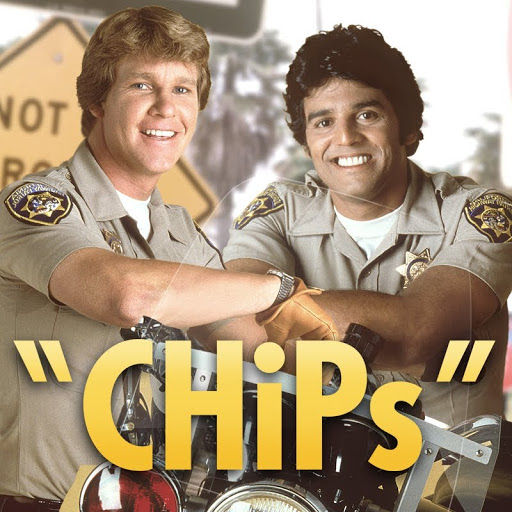
Welcome to Late Night Retro Television Reviews, a feature where we review some of our favorite and least favorite shows of the past! On Mondays, I will be reviewing CHiPs, which ran on NBC from 1977 to 1983. The entire show is currently streaming on Prime!
This week …. hey, what is this!?
Episode 5.12 “Mitchell & Woods”
(Dir by Bernard L. Kowalski, originally aired on December 18th, 1981)
When an old high school friend of Michell’s is murdered, Mitchell and Woods uncover a male prostitution ring. Along with bringing the guilty to justice, they also help Chickee (Pamela Susan Shoop) find the courage to leave her abusive relationship….
No, there’s not much motorcycle action. No, there’s no slow motion car crashes. Yes, this is an episode of CHiPs. Well, kind of.
It’s actually a backdoor pilot for a show about Mitchell and Woods. Ponch and Baker show up at the start of the show to wish Mitchell and Woods luck. Ponch and Baker return halfway through the show so that Ponch can tell Mitchell and Woods about an informant named Avrom (Tony Burton). And, finally, Ponch and Baker return at the end of the episode and give our erstwhile detectives a parking ticket.
Backdoor pilots at the worst! You’re all prepared to spend 40 minutes with people you know and suddenly, a bunch of new folks show up and start demanding your attention. It doesn’t help that Mitchell & Woods is a terrible pilot and I’m not really surprised that it didn’t become an actual series. Can Mitchell and Woods prove that woman can be good detectives? Will they ever impress their new boss (Paul Gale)? I don’t really know the characters so I don’t care.
I swear, they could have at least brought back Caitlyn Jenner for this episode.
In 1977’s The Fifth Floor, Dianne Hull plays Kelly McIntyre.
Kelly is a college student by day and a disco dancer by night! Unfortunately, after someone spikes her drink at the discotheque and she suffers an overdose, she becomes a full-time patient at a mental asylum. Neither the head doctor (Mel Ferrer) nor the head nurse (Julia Adams, who once swam with The Creature From The Black Lagoon) believes her claim that her drink was spiked. Judged to be suicidal and delusional, Kelly is sent to the Fifth Floor!
While her boyfriend (John David Carson) tries to convince the authorities that she’s not insane, Kelly adjusts to life on the Fifth Floor. She befriend Cathy (Patti D’Arbanville). She encourages her fellow patients to dance and enjoy themselves. She tries to escape on multiple occasions. She draws the unwanted attention of a male orderly named Carl (Bo Hopkins, giving a wonderfully sinister performance). A sadist equipped with down-home country charm, Carl has got all of his co-workers convinced that he’s a great guy. The patients, though, know that Carl is a petty authoritarian who enjoys showing off his power. (“I’m just doing my job,” is the excuse whenever he’s challenged.) Carl takes an obsessive interest in Kelly and soon, Kelly is not only trying to get her life back but also trying to escape from Carl’s cruel intentions.
Most film directories list The Fifth Floor as being a horror film and certainly, there are elements of the horror genre to be found in the film. The smooth-talking and nonchalantly cruel Carl is certainly a horrific character and Kelly’s attempts to escape from the asylum capture the very primal fear of not having any control over one’s life. That said, The Fifth Floor owes greater debt to One Flew Over The Cuckoo’s Nest than to the typical slasher film. Kelly is a rebel who brings the patients in the ward together. Much as in Cuckoo’s Nest, the nurses and the orderlies use the threat of electro-shock treatment to keep the patients under control.
It’s not a bad film, though it definitely has its slow spots and I do wish the film had embraced its own sordidness with a bit more style. I’m a history nerd so I appreciated the fact that The Fifth Floor was so obviously a product of its time. Any film that features the heroine showing off her disco moves before being taken to a mental hospital is going to hold my interest. That said, the most interesting thing about the film are some of the familiar faces in the cast. For instance, Earl Boen — who played so many authority figures over the course of his career and appeared as a psychiatrist in the early Terminator films — plays a patient who wears a NASA jacket. The always intimidating Anthony James plays the most violent patient. Michael Berryman and Tracey Walter appear as background patients.
And then you’ve got Robert Englund, cast here as Benny. Benny is the most gentle of the patients, a prankster who befriends Kelly. It’s always so interesting to see the type of roles that Englund played before he was cast as Freddy Krueger in A Nightmare On Elm Street. In this film, Englund is so goofy and friendly that you actually find yourself worrying about something happening to him. Englund’s role is small but his amiable nerdiness definitely makes an impression.
The Fifth Floor opens and ends with a title card telling us that the film is based on a true story. Sure, it was.
In the 1976 film StayHungry, Jeff Bridges plays Craig Blake.
When we first meet Craig, he doesn’t have much of a personality, though we still like him because he’s played by Jeff Bridges. Living in Alabama, he’s a young rich kid who, after the death of his parents, divides his time between his nearly empty mansion and his country club. Craig suffers from a good deal of ennui and seems to spend a lot of time writing letters to his uncle in which he promises that he’s going to eventually get his life together. Craig eventually gets a job at a real estate firm that is managed by Jabo (Joe Spinell). We know that the real estate firm is shady because Joe Spinell works there.
Craig is assigned to handle the purchase of a small gym so that he can eventually close the place and allow it to be torn down to make room for an office building. However, Craig soon falls for the gang of colorful eccentrics whose lives revolve around the gym and bodybuilder Joe Santo (Arnold Schwarzenegger, who gets an “introducing” credit, even though this was his fourth film). The friendly Franklin (Robert Englund) is Santo’s “grease” man. Anita (Helena Kallianiotes) is tough and can kick anyone’s ass. The receptionist, Mary Tate (Sally Field), is a free spirit with whom Craig soon falls in love. In fact, the only less than likable person at the gym is the former owner, Thor Erickson (R.G. Armstrong), a heavy-drinking perv who has a hole in the floor of his office that he uses to peek down at the women’s locker room.
There’s not much of a plot here. Instead, the film plays out in a rather laid back manner, with Santo befriending Craig and showing him the joy of embracing life. Arnold Schwarzenegger actually won an award (well, a Golden Globe) for his performance here and it must be said that he’s very good as the gentle and easy-going Santo. Because he’s huge and he’s Schwarzenegger, we expect him to be intimidating. Instead, he’s a soft-spoken guy who is quick to smile and who doesn’t even get upset when he finds out that Mary Tate and Craig are now involved. There’s even a surprising scene where Joe Santo picks up a fiddle and starts playing with a bluegrass band. Schwarzenegger is so likable here that it’s easy to wonder where his career might have gone if he hadn’t become an action star. Even early in his career (and when he was still speaking with a very thick accent), Schwarzenegger shows off a natural comic timing. He’s fun to watch.
In fact, he’s so much fun that the rest of the film suffers whenever he’s not onscreen. The cast is full of talented people but the film’s loose, plotless structure keeps us from truly getting too invested in any of them. (Santo is training for Mr. Universe so at least he gets an actual storyline.) Sally Field and Jeff Bridges are cute together but their romance is never quite as enchanting as it seems like it should be. The main problem with the film is that, when it ends, one still feels like Craig will eventually get bored with the gym and return back to his mansion and his country club. One doesn’t get the feeling that Craig has been changed so much as Craig just seems to be slumming for the heck of it.
There are charming moments in StayHungry. I’m a Southern girl so I can attest that the film captured the feel of the South better than most films. If you’re a Schwarzenegger fan, you have to see this film because it really does feature Arnie at his most charming and natural. Unfortunately, despite all that, the film itself never really comes together.
Ants are interesting creatures. On the one hand, they work hard and they can design and build a complex home in just a matter of hours. They’re loyal to the other members of their tribe and they all happily do whatever needs to be done to keep their community healthy and moving forward. They’re family-orientated. They take care of their children. They eat earth worms. They fight other ants. They can carry several pounds over their own weight. They like to move in a single-file line. These are all things that people, in general, admire. If you had to hire someone to do some yardwork, you would want someone who had the attitude of an ant.
At the same time, ants also have no respect for privacy, they tend to get everywhere, and they bite you and leave behind those ugly red marks that take forever to go away and that can itch like heck. I was once outside barefoot, helping someone wash his car, when I suddenly felt a really intense pain in my foot. I looked down and saw that I had stepped straight into an ant hill. It was not only an ant hill but it was a FIRE ANT HILL! I grabbed a hose and I washed all of the ants off my foot but it was still one of the most painful experiences of my life. Ants are hard-working and industrious but they’re also kind of mean and they really don’t like humans. (Maybe they would like us more if people stopped kicking ant hills and using magnifying glasses to set them on fire.) Ants will break into your house and then bite you when you tell them to go away. My point is that you might like ants but ants do not like you and you better remember that!
The 1977 film, Empire of the Ants, is all about humanity’s mixed feelings towards ants. Joan Collins plays a shady real estate agent who leads a group of potential home buyers into the bayou because she wants to trick them into buying some worthless property on a nearby island. What Collins and her clients don’t know is that a barrel of radioactive waste was recently dumped off of a nearby boat and when the waste washed on shore, a bunch of ants got into it and it caused them to become giant ants! The giant ants are industriously creating their own sugar-based society but they’re also attacking and brainwashing humans!
Needless to say, this is a Bert I. Gordon film. Gordon took his “Mr. Big” nickname quite literally and, as a result, he spent almost his entire career making movies about animals and occasionally humans who were turned into giants by radiation. Apparently, radiation can do anything! Empire of the Ants is a typical Gordon film, in that the special effects are just bad enough to be kind of charming. The ants are either awkwardly super-imposed into the scene or they are clearly made out of plastic. There’s a scene where an ant grabs a man by his neck and it would be really terrifying if not for the fact that the ant’s head appears to have been made from Styrofoam. Unfortunately, even though the special effects are bad in an amusing way, Empire of the Ants is still a pretty boring film. Gordon devotes way too much time to the people heading out to look at Joan Collins’s beachfront property. No one is watching a film like this for human drama.
This movie is based on a short story by H.G. Wells. Wells, reportedly, considered it to be the worst thing he had ever written.
1976’s Creature From Black Lake tells the story of two students at the University of Chicago. Pahoo (Dennis Fimple) and Rives (John David Carson) decide that they want to spend their Spring Break on the Arkansas/Louisiana border, researching the legend that a Bigfoot-like creature that lives in the bayous. (The creature is obviously based on the legendary Fouke Monster, who was also the subject of the 1972 documentary, The Legend of Boggy Creek.)
Pahoo and Rives head down South, looking to interview anyone who has seen the Creature From Black Lake. Some people are willing to talk to them and they tell stories involving the Creature causing cars to crash, killing dogs, and attacking fisherman. The Creature does not sound nice at all. Still, the majority of the people in town don’t really feel like opening up to two Yankee monster hunters. They’re worried that Pahoo and Rives are only in town because they want to portray everyone as being a bunch of ignorant rednecks who are scared of things that go bump in the night.
And really, they have every right to be concerned. I grew up all over the South and the Southwest. My family briefly lived in Fouke, the home of the Fouke Monster. (No, I never saw or heard the monster, mostly because the monster doesn’t exist.) When I was a kid, I lived in both Louisiana and Arkansas, among other states. From my own personal experience, I can tell you that there is no one more condescending than a Northerner who is visiting the South for the very first time. “Why is it so hot?” “Why is everyone down here so polite?” “Why can’t I find a Wawa!?” Seriously, it gets old really quickly. Now, to their credit, Pahoo and Rives are actually pretty polite and considerate when talking to the people who think that they have seen the Creature From Black Lake. But still, one can understand why the town isn’t exactly thrilled to have them asking about monsters.
Anyway, after interviewing both Jack Elam and Dub Taylor about their experiences with the monster and getting yelled at by the local sheriff (played by Bill Thurman), Pahoo and Rives head out to the local swamp, hoping to find the creature themselves. That, of course, turns out to be a huge mistake on their part.
Creature From Black Lake is a deliberately-paced film, which is a polite way of saying that it’s a bit slow. Obviously inspired by The Legend of Boggy Creek, a good deal of the film is taken up with scenes of Pahoo and Rives interviewing people about their encounters with the monster. That said, the film definitely picks up when Pahoo and Rives head into the swamp themselves and their eventual meeting with the monster is well-directed. I have to admit that I spent this entire film dreading the moment when it would be revealed that the Monster was actually misunderstood and peaceful and I appreciated that the film did not go that route. The creature turns out to be no one’s friend and is genuinely menacing.
The cast is full of familiar county character actors, all of whom do a good job bringing their characters to life. Dennis Fimple and John David Carson are likable as the two students. This film was also an early credit for cinematographer Dean Cudney and, just as he would later do for John Carpenter, Cudney creates a perfectly ominous atmosphere of isolation. Creature From Black Lake may start out slow but, ultimately, it’s an effective creature feature.
Welcome to Retro Television Reviews, a feature where we review some of our favorite and least favorite shows of the past! On Sundays, I will be reviewing the made-for-television movies that used to be a primetime mainstay. Today’s film is 1972’s Call Her Mom! It can be viewed on YouTube!
While all of the other college campuses across America are in turmoil with protests and student walk-outs, Beardsley College remains at peace. It’s a place where the 50s never ended. Everyone is perfectly behaved. No one is into politics. Fraternity Row is a peaceful place, largely due to the elderly housemothers who keep the frats in order.
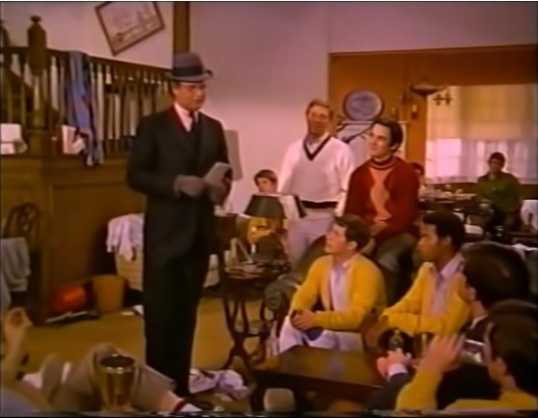
Except for Alpha Phi Epsilon, that is. The A.P.E. House is known for being the wildest house on campus and every housemother that they get walks out on them. If they can’t find a new housemother, they’ll lose their charter. President Chester Hardgrove (Van Johnson) and Assistant Dean Walden (Charles Nelson Reilly) are practically salivating at the possibility of kicking A.P.E. off of campus. And who can blame them? Take a look at how wild these guys are:
These guys are crazy! They wear yellow sweaters! They play tennis indoors! Occasionally, they leave a towel or two hanging on the bannister. A.P.E. is out of control!
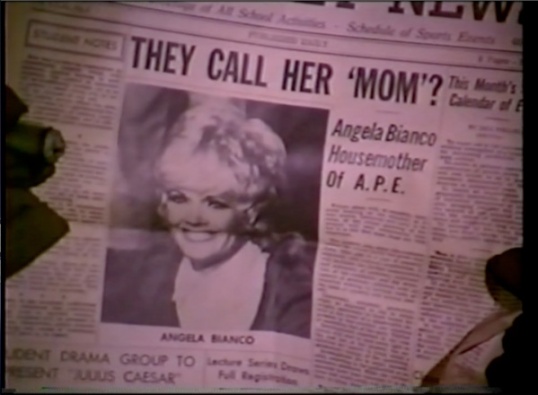
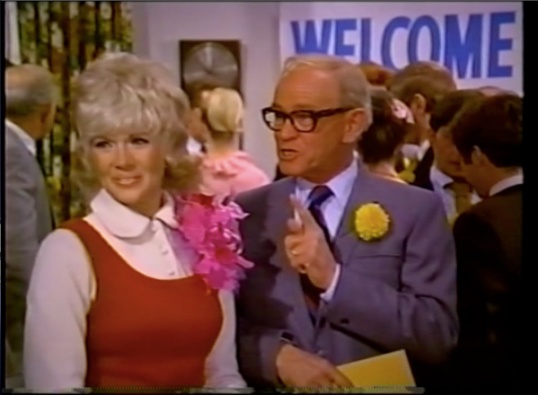
A.P.E. tries to find a new housemother but the word is out that A.P.E. is no good. Not a single elderly woman in town is willing to work with them. However, when the members of the frat realize that there’s not actually an age requirement for housemothers, they offer the job to Angie Bianco (Connie Stevens), who works as a waitress at the local pizza place. Angie accepts the job.
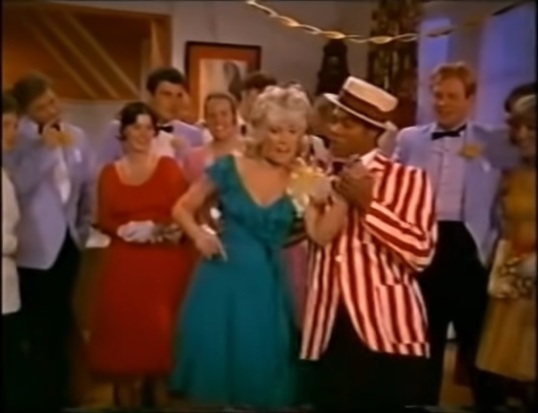
It’s a scandal! All of the older folks say that Angie is too young and too attractive to be trusted as the housemother for A.P.E. Angie, however, proves herself to be a lot tougher than anyone was expecting. The members of the frat soon come to respect her. However, President Hardgrove is determined to force her out of the job and off of the campus. Rumor has it that she’s encouraging the A.P.E. brothers to hold rollicking 20s style parties and she’s also allowing them to dance!
Check out this decadence!
The attempts to force Angie out of her job makes national news. Soon, Angie and the frat brothers are featured in Time Magazine. President Hardgrove points out that he’s never appeared in Time Magazine. While an group of middle-aged women march outside of the A.P.E. House and demand that Angie be fired, the younger female students rally to Angie’s side. Suddenly, Beardsley College is home to a protest! (The protest is about as a wild as the 20s dance party at the A.P.E. House.) President Hardgrove realizes that keeping Angie at the A.P.E. House will actually lead to the college getting more donations but Angie has decided that she has to quit. Not only is she in love with A.P.E.’s sponsor, Prof. Calder (Jim Hutton), but a member of the fraternity has decided that he’s in love with her and he’s going to drop out of school to be with her.
Can A.P.E. convince Angie to come back?
Call Her Mom is a silly movie that was obviously meant to serve as a pilot for a television show, one in which I imagine Angie would have solved the fraternity’s problems on a weekly basis. Seen today, it’s mostly memorable for its thoroughly innocent portrayal of college life. A.P.E. House is the wildest frat on campus but no one is ever seen drinking. Certainly no one is indulging in anything stronger than perhaps a Coke or a Pepsi. I imagine this show was an accurate portrayal of what most parents hoped college was like. That said, Connie Stevens and Jim Hutton made for a cute couple. Hopefully, there were many good times in the future for the residents of A.P.E. House.
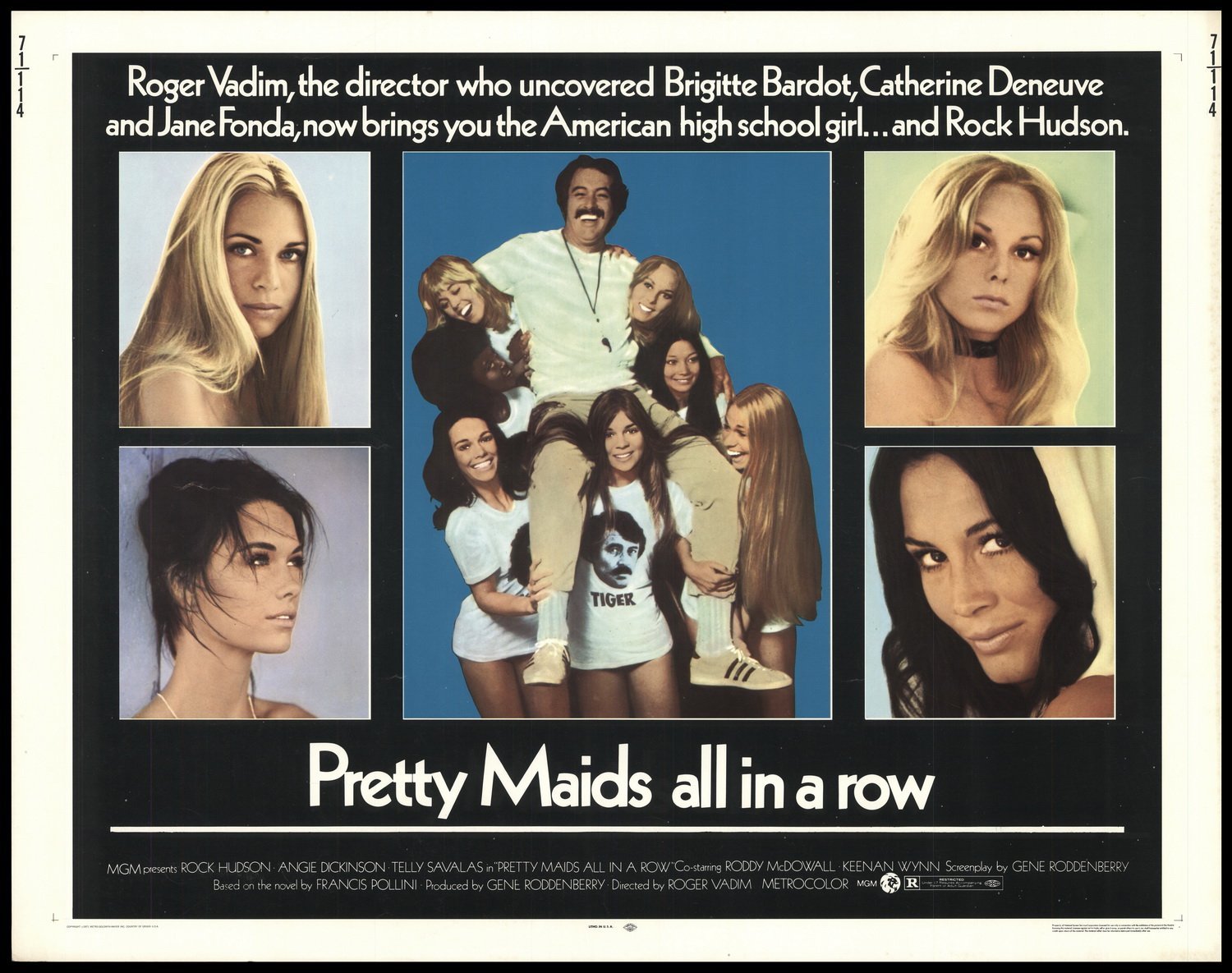
Gene Roddenberry’s post-STAR TREK career had pretty much gone down the tubes. The sci-fi series had been a money loser, and Roddenberry wasn’t getting many offers. Not wanting to be pigeonholed in the science fiction ghetto, he produced and wrote the screenplay for PRETTY MAIDS ALL IN A ROW, a black comedy skewering the sexual revolution, with French New Wave director Roger Vadim making his first American movie. The result was an uneven yet entertaining film that would never get the green light today with its theme of horny teachers having sex with horny high school students!
All-American hunk Rock Hudson was in the middle of a career crisis himself. After spending years as Doris Day’s paramour in a series of fluffy comedies, his box office clout was at an all-time low. Taking the role of Tiger McGrew, the guidance counselor/football coach whose dalliances with the cheerleading squad leads to murder…
Pretty Maids All In A Row, which — as should be pretty obvious from the trailer above — was originally released in 1971, is a bit of a historic film for me. You see, I love movies. And, as a part of that love, I usually don’t give up. Regardless of how bad a movie may turn out to be, once I start watching, I stick with it. I do not give up. I keep watching because you never know. The film could suddenly get better. It could turn out that what originally seemed like a misfire was actually brilliant satire. If you’re going to talk or write about movies, you have an obligation to watch the entire movie. That was a rule that I had always lived by.
And then, one night, Pretty Maids All In A Row popped up on TCM.
Now, I have to admit that I already knew that Pretty Maids was going to be an extremely 70s film. I knew that it was probably going to be more than a little sexist. I knew all of this because the above trailer was included on one of my 42nd Street Forever DVDs. But I still wanted to see Pretty Maids because the trailer hinted that there might be an interesting hiding underneath all of the cultural baggage. If nothing else, it appeared that it would have some sort of worth as an artifact of its time.
(If you’re a regular reader of this site, you know how much I love my cinematic time capsules.)
So, the film started. I logged onto twitter so that I could live tweet the film, using the hashtag #TCMParty. And from the moment the film started, I knew it wasn’t very good. It wasn’t just that the film’s camerawork and music were all extremely 70s. After all, I like 70s music. I don’t mind the occasional zoom lens. And random psychedelic sequences? WHO DOESN’T LOVE THOSE!? No, my dislike of the film had nothing to do with the film’s style. Instead, it had to do with the fact that there was absolutely nothing going on behind all of that style. It wasn’t even style for the sake of style (which is something that I usually love). Instead, it was style for the sake of being like every other “youth film” that came out in the 70s.
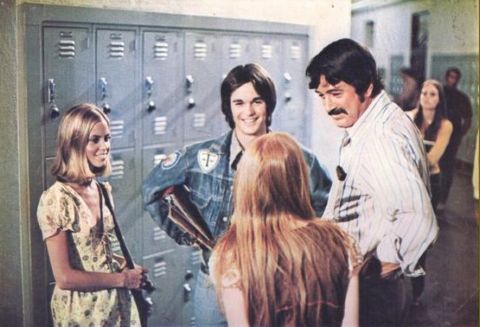
And then there was the film’s plot, which should have been interesting but wasn’t because director Roger Vadim (who specialized in stylish decadence) had no interest in it. The film takes place at Oceanfront High School, where the only rule is that apparently nobody is allowed to wear a bra. We meet one student, Ponce De Leon Harper (played by an amazingly unappealing actor named John David Carson), who is apparently on the verge of having a nervous breakdown because, at the height of the sexual revolution, he’s still a virgin.
(Because, of course, the whole point of the sexual revolution was for losers like Ponce to finally be able to get laid…)
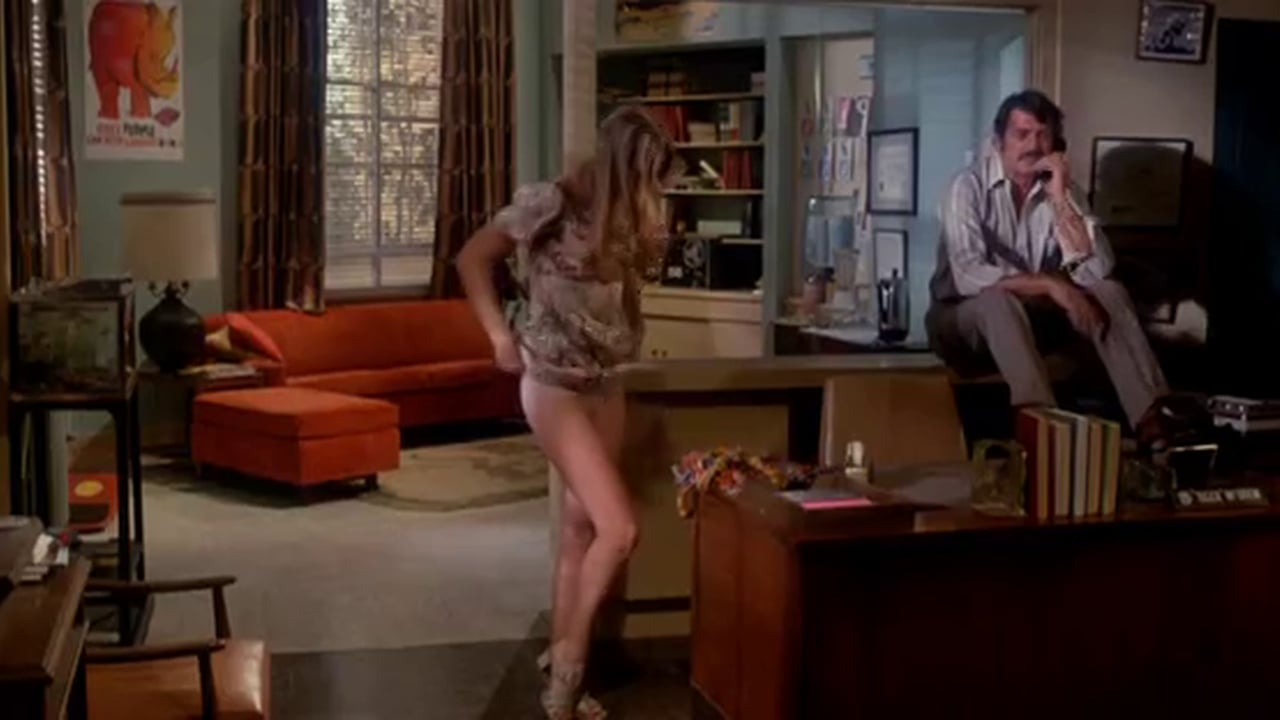
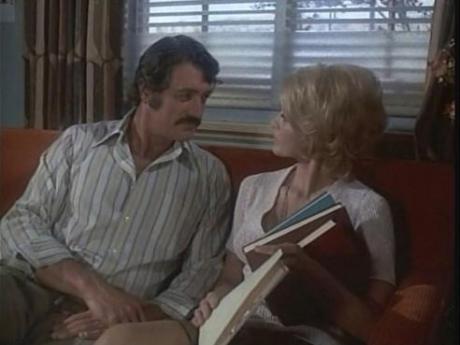
Ponce is taken under the wing of high school guidance counselor Tiger McDrew (Rock Hudson, complete with porn star mustache). Quickly figuring out exactly what Ponce needs, Tiger sets him up with a teacher played by Angie Dickinson. However, Tiger has other concerns than just Ponce. Tiger, it turns out, is a sex addict who is sleeping with nearly every female student at the school. But, American society is so oppressive and puts so much pressure on the American male that Tiger has no choice but to kill every girl that he sleeps with…
This is one of the only film I can think of that not only makes excuses for a serial killer but also presents him as being a heroic character. And, while it’s tempting to think that the film is being satirical in its portrayal of Tiger and his murders, it’s actually not. Don’t get me wrong. The film is a very broad comedy. The high school’s principal (Roddy McDowall) is more concerned with the football team than with all of the girls turning up dead at the school. The local sheriff (Keenan Wynn) is a buffoon. The tough detective (Telly Savalas) who investigates the murders gets a few one liners.
But Tiger, most assuredly, is the film’s hero. He’s the only character that the audience is expected to laugh with, as opposed to at. He is the character who is meant to serve as a mouthpiece for screenwriter Gene Roddenberry’s view on America’s puritanical culture. If only society was less hung up on sex, Tiger wouldn’t have to kill. Of course, the film’s celebration of Tiger’s attitude towards sex is not extended towards the girls who sleep with him. Without an exception, they are all presented as being empty-headed, demanding, shallow, and annoying, worthy only of being leered at by Vadim’s camera until Tiger finally has to do away with them.
(The film’s attitude towards women makes Getting Straight look positively enlightened.)
Rock and Angie
ANYWAY! I spent about 40 minutes watching this movie before I gave up on it. Actually, if you want to be technical about it, I gave up after 5 minutes. But I stuck with it for another 35 minutes, waiting to see if the film was going to get any better. It didn’t and finally, I had to ask myself, “Why am I actually sitting here and wasting my time with this misogynistic bullshit?” So, I stopped watching and I did so with no regrets.
What I had forgotten is that I had set the DVR to record the film while I was watching it, just in case I later decided to review it. So, last week, as I was preparing for this series of Back to School posts, I saw Pretty Maids All In A Row on my DVR. I watched the final 51 minutes of the film, just to see if it ever got better. It didn’t.
However, on the plus side, Rock Hudson does give a good performance in the role of Tiger, bringing a certain seedy desperation to the character. (I’m guessing that this desperation was Hudson’s own contribution and not an element of Roddenberry’s screenplay, which more or less presents Tiger as being a Nietzschean superman.). And beyond that, Pretty Maids serves as evidence as to just how desperate the Hollywood studios were to makes movies that would be weird enough to appeal to young people in the early 70s.
Watching the film, you can practically hear the voices of middle-aged studio executives.
“What the Hell are we trying to do with this movie!?” one of the voices says.
“Who cares!?” the other voice replies, “the kids will love it!”


 Through the Shattered Lens