Doctor Who — Destiny of the Daleks, City of Death, The Creature From The Pit, Nightmare of Eden, Horns of Nimon, Shada


Remember when I was writing about classic Doctor Who for Halloween?  Let’s get back to that with a look at the 17th season of the original series.  This season is a controversial one.  It featured some of the show’s worst serials but also one of its best.  Today, it’s remembered for introducing Lalla Ward as the second Romana and for featuring Douglas Adams as the script editor.

One frequent complaint about this season is that, under Adams’s influence, the season featured more comedy than before and it sometimes felt more like a version of Hitchhiker’s than Doctor Who.  There’s some truth to that but Adams’s influence also made Season 17 into a season unlike any other.  Many of Adams’s ideas didn’t work but he did give us City of Death.

Destiny of the Daleks (1979, directed by Kim Grieve)

Destiny of the Daleks will always have a place in my heart because it opens with Romana regenerating into Lalla Ward.  I will admit right now that, as a kid watching Doctor Who on PBS, I had a huge crush on Lalla Ward.  So did Tom Baker.  He ended up marrying Ward, though the marriage did not last for long.  The relationship between Baker and Ward often seemed to reflected in the relationship between The Doctor and Ward’s Romana.  Long before the Doctor Who reboot had people buzzing about the Doctor and Rose, fans of the original series knew that the Doctor and Romana were in love.

Destiny of the Daleks opens with Lalla Ward’s Romana cheerfully informing the Doctor that she’s decided to regenerate because she was bored and she’s decided to look like Princess Astra.  The Doctor points out that Princess Astra is a real person and Romana can’t just take on her appearance.  Romana then tries out several other appearances before The Doctor tells her to go with Astra.  This goes against everything that the show had established about Time Lords and regeneration but at least we end up with Lalla Ward as Romana.

It’s too bad that the rest of the serial itself isn’t that interesting, even if it does feature the first appearance by the Daleks since Genesis of the Daleks.  Davros returns as well, though he’s now more or less just another generic villain.  The Daleks have a new enemy, a group of robots called the Movellans.  The war between the Daleks and the Movellans are at a standstill because both are governed by logic.  That goes against everything we know about the Daleks.

This was Terry Nation’s final script for Doctor Who.  Reportedly, he was angered when Douglas Adams extensively rewrote the script.  Nation moved to America and later created the original MacGyver.

City of Death (1979, directed by Michael Hayes)

City of Death is a Doctor Who classic.  Romana and the Doctor visit modern-day Paris and the BBC found the money to allow the production to shoot on location.  The Doctor and Romana walk around Paris, hand-in-hand.  Count Scarlioni (Julian Glover) is actually an alien who wants to steal the Mona Lisa so that he can use it to fund his time travel experiments.  Countess Sacrlioni (Catherine Schell) is a classic femme fatale.  An American private investigator named Duggan (Tom Chabdon) wears a trench coat and solves problems by punching first and asking questions later.  John Cleese and Eleanor Bron appears as museum patrons who think the TARDIS is a work of modern art.  Douglas Adams later reworked bits of his script into Dirk Gentley’s Holistic Detective Agency.

Even people who cannot stand the rest of season 17 will agree that City of Death is one of the best of Tom Baker’s serials.  City of Death balances humor and drama and it features an excellent villain in the form of Julian Glover.  Tom Baker and Lalla Ward are at their best, the story is genuinely interesting, and — much like Jago and Lightfoot from The Talons of Weng-Chiang — Duggan deserved his own spin-off.

The Creature From The Pit (1979, directed by Christopher Barry)

This serial features the season’s first appearance by K-9, who is now voiced by David Brierley.  Though this serial was third to be aired, it was the first to be filmed.

It’s not much of a serial.  The TARDIS materializes on yet another feudal planet where Lady Adastra (Myra Frances) rules through fear.  Lady Adastra’s critics are thrown in the pit, which is said to be home to a great monster.  Instead, it’s home to a gentle blob that was sent to the planet as an ambassador.  The Doctor helps the blob gets its freedom while Romana and K-9 are briefly detained by a group of bandits.  Whatever potential the story had is short-circuited by the very unconvincing monster.

Nightmare of Eden (1979, directed by Alan Bromley and Graham Williams)

Two ships materialize in the same location and end up locked together.  Then the TARDIS materializes and the Doctor offers to find a way to unlock the two ships.  One of the ships is a luxury space liner and the passengers are soon being menaced by clawed monsters that look like stuntmen in rubber suits.  The other ship is a trade ship that the Doctor comes to suspect is involved in a drug-running operation.

Once again, the monsters were not at all convincing but the Doctor investigating the interstellar drug traffic was at least something different.  Much like City of Death, Nightmare of Eden, with its luxury spaceliner, had a few moments of satire that worked.  Unlike City of Death, the supporting characters were not that interesting and Tom Baker himself just seemed to be going through the motions.  Nightmare of Eden was better than a lot of Season 17 but it still ultimately comes across as being rather muddled.

The Horns of Nimon (1979 — 1980, directed by Kenny McBain)

The Horns of Nimon, is it terrible or is it great?  Some defend it because of its allusions to Greek mythology, its deliberate humor, and the over-the-top performance of Graham Crowden as Soldeed, the leader of the Skonnan Empire.  Others, like me, point out the turgid pacing, the bad creature effects, and the fact that the majority of the serial is just people walking around.  Based on the myth of the minotaur, The Horns of Nimon looks and feels cheap.  Crowden splits his pants at one point and I guess there was no time to stitch them back up.  The whole thing is just too slapdash.

Shada (2018, directed by Pennant Roberts and Charles Norton)

For decades, Shada was the Holy Grail of Doctor Who.  The final serial of the 17th century, Shada was in the process of filming when the BBC’s technicians went on strike.  With 50% of the serial filmed, production was suspended and eventually canceled.

Afterwards, Shada developed a legendary reputation.  It was often described as being a potential masterpiece, despite the fact that Season 17 was not one of Doctor Who‘s best.  Footage of the Doctor and Romana visiting Cambridge was widely released and even used in The Five Doctors.  The footage itself did look good but that was because it was mostly just Tom Baker and Lalla Ward relaxing and trading funny quips.  There was very little of the actual plot to be found in those scenes.

Finally, in 2017, Shada aired.  Animation was used for the unfilmed sequences and a white-haired Tom Baker even returned to shoot some new linking scenes.  Shada was finally broadcast in the U.S.  And, it wasn’t bad.  It may not have been the masterpiece that so many assumed it would be but it was certainly an improvement on The Creature From The Pit, Nightmare on Eden, and the Horns of Nimon.  

The Doctor and Romana travel to Cambridge to help out another timelord, Prof. Chronitis (Denis Carey).  After Chronitis is apparently killed, The Doctor and Romana discover that space criminal Skagra (Christopher Neame) is seeking a Time Lord named Salyavin who is somewhere on the prison planet, Shada.  Things get muddled once the Doctor actually travels to Shada but the Cambridge scenes are a definite highlight of the serial, a very British diversion for a very British show.  Much as with City of Death, the best moments are the ones where Tom Baker and Lalla Ward just get to play off of each other without having to deal with any sort of intergalactic menace.  Also, as with City of Death, Douglas Adams would borrows bits and pieces of Shada for Dirk Gentley’s Holistic Detective Agency.

Shada may not have been a masterpiece but it would have been a decent end for the seventeenth season.


Silverado (1985, directed by Lawrence Kasdan)


In the old west, a cowboy named Emmet (Scott Glenn) teams up with a reformed outlaw named Paden (Kevin Kline) and they bust Emmet’s wild younger brother, Jake (Kevin Costner), out of jail.  After Mal (Danny Glover) helps the three of them escape from a posse, they all end up going to the town of Silverado, where all four of them have business.  Emmett and Jake want to protect their sister from the corrupt son (Ray Baker) of a cattle baron who was previously killed by Emmett.  Mal wants to save his sister Rae (Lynn Whitfield) from an evil gambler (Jeff Goldblum).  Paden discovers that Cobb (Brian Dennehy), his former partner-in-crime, is now the sheriff of Silverado and working for the cattle barons.  When Paden tries to protect the new settlers (including Rosanne Arquette), it leads to a confrontation with his former partner.

In the 80s, when he wasn’t directing films like The Big Chill and The Accidental Tourist, Lawrence Kasdan specialized in paying homage to the films of Hollywood’s golden age.  He started his directorial career with Body Heat, a modern film noir.  He worked on the screenplays of both Empire Strikes Back and Raiders of the Lost Ark.  With Silverado, Kasdan tried to resurrect the western.

Silverado is a traditional western with a few modern touches, like casting Jeff Goldblum as a gambler and John Cleese as the sheriff who wants to execute Kevin Costner.  Silverado also has more humor than a typical western, largely thanks to Kevin Kline.  Silverado starts out as a comedy before turning serious and grim once the four heroes finally reach Silverado.

Kasdan’s love of the genre is obvious in every frame of Silverado but, in trying to tell multiple stories at once, the movie spreads itself too thin.  I like that Kasdan tried to shake things up by casting actors who most people wouldn’t expect to see in a western but both Kevin Kline and Brian Dennehy seem miscast in their roles and their final confrontation never becomes the epic moment that it needs to be.  Scott Glenn and Kevin Costner are far more believable in their roles.  Danny Glover is also believable but his character is underused.

Silverado was obviously a labor of love for Kasdan and it shows that, if nothing else, Kasdan understood the appeal of the genre and the beauty of the wide open frontier.  The movie has its flaws but fans of westerns will appreciate his effort.

The Strange Case Of The End Of Civilization As We Know It (1977, directed by Joseph McGrath)


It should have been so much funnier.

After someone is obviously meant to be Henry Kissinger (played by Ron Moody) is assassinated when he loses his diary and extends the wrong greeting to a welcoming party in the Middle East, someone claiming to be a direct descendant of the infamous Prof. Moriarty sends a letter to the U.S. President (Joss Ackland) taking responsibility and claiming that it’s the first step in a plan to control the world.

Who better to stop the descendant of Moriarty than the descendant of Moriarty’s greatest enemy?  Arthur Sherlock Holmes (John Cleese) operates out of Baker Street with Dr. Watson (Arthur Lowe), who is bionic, and their housekeeper, Miss Hudson (Connie Booth).  Holmes solution to bringing out Moriarty is to host a gathering of the world’s greatest detectives and to dare Moriarty to try to take them out with one fell swoop.  Soon, everyone from Sam Spade to Columbo to McCloud is showing up at Baker Street.

This is a joke-a-minute comedy.  The jokes that work are funny but, unfortunately, there aren’t many of them.  Some bits, like Joss Ackland’s impersonation of Gerald Ford, start off well and then go on for too long.  Other bits, like the famous TV detectives showing up at Baker Street, have potential but fail due to poor execution.  Unfortunately, much of the humor is just not that clever to begin with, which is not something that anyone would expect from a script co-written by John Cleese.  As an actor, John Cleese is funny but underused, playing Sherlock Holmes as being an even denser version of Basil Fawlty.  Arthur Lowe’s comedic befuddlement is consistently amusing but I wish the script has done more with the idea of him being bionic.  Connie Booth is both funny and sexy and the best reason to watch this misfire.

Resolution Help From Monty Python’s Flying Circus


As the first day of 2022 comes to a close, now is a good time to stop, take a look back over the past 24 hours, and determine how many of your resolutions have already been broken.  Have you broken one or two of them?  How about all of them?  Or did you forget to make a resolution all together?

Well, don’t worry!  Seriously, New Year’s resolutions are the worst!  Every new year, people resolve to make changes and it rarely happens.  Instead, people almost immediately break their resolutions and then they spend the next 12 months feeling like a failure.  The amount of pressure that people put on themselves to try to change their lives for the better, it’s not fair, to be honest.  If you’ve already broken your resolution, don’t feel bad about it.  As long as your resolution wasn’t to stop doing something terrible and illegal, I forgive you if you’ve already totally failed to keep your promise to yourself.  Take some comfort in that.

(My own resolution for 2022 was to be nicer to my friends and stop putting so much pressure on myself.  I think that was last year’s resolution as well and we all know how well that went.  I think my most successful resolution was from 2004.  That was when I resolved to survive any serious car accidents that I got involved with and to go to college and I managed to keep both of those resolutions.  BOOM!)

We always hear that change is good but sometimes it isn’t.  And here to illustrate that point are John Cleese and Michael Palin from Monty Python’s Flying Circus!  Below is one of my favorite sketches from that famous show.  Palin is a chartered accountant who wants to be a lion tamer.  He has no experience but he does have his own hat!  Cleese shows him the error of his ways, including revealing that Palin has long been mistaking anteaters for lions.  Who hasn’t made the same mistake?

(I have to admit that my favorite Monty Python moments often involved Palin somehow getting on Cleese’s nerves.  Palin’s eagerness to please and his way with a deceptively passive statement was always the perfect foil for Cleese’s slightly more aggressive style of comedy.  Perhaps not coincidentally, I’ve read on numerous occasions that Cleese’s main motivation for getting involved with what would become Monty Python was so he could work with Michael Palin.)

My favorite line from this particular vignette: “Yes, yes, yes, I do follow, Mr Anchovy, but you see the snag is… if I now call Mr Chipperfield and say to him, ‘look here, I’ve got a forty-five-year-old chartered accountant with me who wants to become a lion tamer’, his first question is not going to be ‘does he have his own hat?'”

Think of this whenever you fear that you’re not living up to your resolutions!  After all, sometimes there’s more to changing one’s life than merely having the right hat (though, I imagine it does help).

The Unnominated: Monty Python and the Holy Grail (dir by Terry Gilliam and Terry Jones)


Though the Academy of Motion Picture Arts and Sciences claim that the Oscars honor the best of the year, we all know that there are always worthy films and performances that end up getting overlooked.  Sometimes, it’s because the competition too fierce.  Sometimes, it’s because the film itself was too controversial.  Often, it’s just a case of a film’s quality not being fully recognized until years after its initial released.  This series of reviews takes a look at the films and performances that should have been nominated but were,for whatever reason, overlooked.  These are the Unnominated.

Really, Academy?

No nominations for one of the most influential and widely-quoted films ever to be released?

Well, actually, I get it.  Monty Python and the Holy Grail was first released in 1975 and 1975 was an unusually good year for cinema.  Back in the 70s, of course, the Academy only nominated five films for Best Picture and, as a result, a lot of good films were not nominated that year.  There just wasn’t room for them.  Check out the five films that were nominated and ask yourself which one you would drop to make room for a different nominee.

Would you drop:

Barry Lyndon, which was directed by Stanley Kubrick was considered to be the most realistic recreation of the 18th Century to ever be captured on film,

Dog Day Afternoon, in which director Sidney Lumet brilliantly mixed comedy and drama and which featured wonderful performances from Al Pacino, John Cazale, Chris Sarandon, and Charles Durning,

Jaws, the Steven Spielberg-directed hit that changed the face of Hollywood,

Nashville, Robert Altman’s sprawling and ambitious portrait of a country tying to find itself after a decade of trauma,

or

One Flew Over The Cuckoo’s Nest, in which Milos Forman paid tribute to individual freedom and Jack Nicholson gave perhaps the best performance of his legendary career?

I mean, those are five great films.  Even the weakest of the nominees (which, in this case, I think would be the eventual winner, One Flew Over The Cuckoo’s Nest) is still stronger than the average Best Picture nominee.

So, I can understand why there wasn’t room for an episodic and rather anarchistic British comedy, one that largely existed to parody the type of epic and period filmmaking that the Academy tended to honor.  If there had been ten nominees in 1975 and Monty Python and the Holy Grail had been snubbed to make room for something like The Other Side of the Mountain, my feelings might be different but there weren’t.

That said, even if there wasn’t room in the Best Picture slate, what to make of the lack of nominations for a script that is so full of quotable lines and memorable incidents that even people who haven’t seen Monty Python and the Holy Grail are familiar with them?  No nominations for the costumes, the production design, or the cinematography, all of which are surprisingly good for a low-budget film that was directed by not one but two untested neophyte directors?  No nominations for the thrilling music or the Camelot song?  How about a special award for the killer rabbit?

How about at least a best actor nomination for Graham Chapman, who played King Arthur not as a comedic buffoon but instead as being well-intentioned but also increasingly frustrated by the fact that his subjects cared not about his quest or his royal title?  Though 1975 may have been a strong year for movies, it appears that the Academy still struggled to find five best actor nominees and they resorted to giving a nomination for James Whitmore’s performance as Harry Truman in a filmed version of his one-man stage show, Give ‘Em Hell Harry.  Nothing against James Whitmore or Harry Truman but I think we all know that spot belonged to Graham Chapman and his performance as King Arthur.

Monty Python and the Holy Grail is often described as being a satire of the Arthurian legends.  I think, even more than being a film about King Arthur, it’s a film about a group of people trying to make an epic despite not having the resources or the patience to do so.  Python humor has always featured characters who were both foolishly confident and stubbornly aggressive and both of those traits are on wide display in Monty Python and the Holy Grail.  The production can’t afford horses so Arthur and his knights hit two coconuts together to duplicate the sound of the hooves on the ground and when they’re confronted about it, they attempt to change the subject.  Can’t afford to shoot in a real castle?  Simply declare Camelot to be a silly place and walk away.  Can’t afford to get permits to film on a certain location? Film illegally and run the risk of getting arrested just when you’re about to start the film’s climatic battle scene.  Can’t afford to hire God for a cameo?  Use a cut-out.  Can’t afford a real knight?  Just hire some people who get carried away and then hope one of them doesn’t kill the local academic who has shown up to explain the film’s historical context.

“I just get carried away,” John Cleese’s Lancelot says more than once and he has a point.  But the entire movie is about people getting carried away.  The Black Knight is so carried away in his belief in himself that he continues to fight despite having neither arms nor legs.  The villagers are so carried away in their desire to burn a witch that they cheer when it’s discovered that she weighs the same amount as a duck.  (“It’s a fair cop,” the witch, played by Connie Booth, admits.)  Eric Idle’s Sir Robin is so carried away in his ability to answer questions that he doesn’t consider that he might be asked about the capitol of Assyria.  The Knights of the Round Table as so carried away in their dancing and their singing that no one wants to go to the castle.  Even the film’s animator gets carried away, suffering a heart attack and saving Arthur and his surviving knights from a fate worse than death.

Monty Python and the Holy Grail is a very funny film, of course.  We all know that.  (I once read a story about a woman who, having learned she only had a few weeks to live, decided to watch this film everyday until she passed.  I don’t blame her.)  But what I truly love about this film is that, in scene-after-scene, you can literally see the Pythons realizing that they were actually capable of making a real movie.  Michael Palin, especially, seems to be having so much fun playing the eternally pure Sir Galahad that it’s impossible not to get caught up in his happiness.  There’s a joie de vivre that runs through Monty Python and the Holy Grail, even at its darkest and most cynical.  The Pythons are having fun and it’s impossible not to have fun with him.

And, while the Oscars may have snubbed Monty Python and the Holy Grail, the Tonys did not.  When the film was later turned into Spamalot, it received 14 Tony nominations and won three.

Previous entries in The Unnominated:

  1. Auto Focus 
  2. Star 80

Cleaning Out The DVR: And Now For Something Completely Different (dir by Ian MacNaughton and Terry Gilliam)


A tall, dark-haired British man sits behind a desk that is rather oddly sitting in the middle of a field.  He wears a dark suit and he looks quite serious as he says, “And now, for something completely different….”

Cut to a short film about a man with a tape recorder up his nose, followed by another short film about man who has a tape recorder up his brother’s nose.

A Hungarian man tries to buy cigarettes while using an inaccurate English phrasebook.  The publisher of the phrasebook is later brought before the court.

Poor old Arthur Pewty goes to marriage counseling and can only watch impotently as the counselor seduces his wife.  Having filed to stand up for himself, Pewty is crushed by 16-ton weight.

A self-defense instructor teaches his students how to defend themselves when they are attacked by a man with a banana.

A loquacious man in a pub says “nude nudge” and “wink wink” until his drinking companion is finally forced to slam down his drink.

A man who sees double recruits a mountaineer to climb the two peaks of Mt. Kilimanjaro.  Hopefully, they’ll be able to find last year’s expedition, which was planning on building a bridge between the two peaks.

There’s bizarre, almost Dadaist animation, featuring classic works of art interacting with cartoonish cut-outs.

Uncle Sam appears to explain how communism is like tooth decay.  A toothpase commercial explains how taking care of your teeth is like racing a car.  A motor oil company shows how it can destroy darkness and grim.

A prince dies of cancer but the spot on his face flourishes until it falls in love and moves into a housing development.

A man tries to return a dead pigeon.  The store clerk insists the pigeon is merely stunned and then sings about wanting to be a lumberjack.

A general complains that things have gotten much too silly.

The narrator appears randomly, announcing, “And now for something completely different….”

Okay, okay, you get the idea.  First released in 1971, And Now For Something Completely Different was the first film to be made featuring all of the members of Monty Python’s Flying Circus.  It was their initial attempt to break into the American market, a collection of surreal sketches that they had previously performed on television for the BBC.  Unfortunately, at the time, no one in America really knew who Monty Python was and the film failed at the box office, to the extent that many in the UK advised against Monty Python even allowing their program to later air on PBS because it was felt that Americans just wouldn’t get it.  Of course, Americans did eventually get it.  The show remains popular to this very day.  Countless Americans are convinced that they can speak in a perfectly convincing British accent, as long as they’re quoting a line from Monty Python.  The previous 4th of July, when the town band played John Philip Sousa’s Liberty Bell, I saw hundreds of people stamping down their feet at the end of it.  As for And Now For Something Completely Different, it was re-released in 1974 and became a bit of a cult favorite in the States.

That said, the members of Monty Python were never particularly happy with the film.  They were convinced to make the film by Victor Lownes, who was the head of Playboy’s UK operation.  Lownes, however, alienated the members of the group by trying to exert control over the material.  He particularly objected to the character of Ken Shabby, a perv who probably had a stash of sticky Playboys back at this flat.  Lownes also put up very little money for the production, meaning that the Pythons had to resort to shooting the film, without an audience, in a deserted factory.  Apparently, even the deliberately cheap-looking special effects of the television show were considered to be too expensive to recreate for the film.  Michael Palin and Terry Jones both later complained that the film itself was series of scenes featuring people telling jokes while sitting behind desks.

Of course, Lownes’s biggest sin was trying to insinuate that he was somehow the Seventh Python.  (One can only imagine how many people were guilty of the sin over the years.  Claiming to be the Seventh Python was probably a bit like claiming to be the Fifth Beatle.)  When Terry Gilliam was animating the film’s opening credits, the names of the cast were shown in blocks of stone.  Lownes insisted that his name by listed the same way.  Gilliam reluctantly acquiesced but then redid the names of the Pythons so that they were no longer in stone.  Fortunately, Victor Lownes would not involved in the subsequent Python films.

All that said, there’s no denying that And Now For Something Completely Different is a funny movie.  I mean, it’s Monty Python.  It’s John Cleese, Michael Palin, Graham Chapman, Eric Idle, Terry Jones and Terry Gilliam, all youthful and at the heights of their considerable comedic talents.  Even if all of the sketches are familiar from the show, they’re still funny and it’s impossible not to enjoy discovering the way that the movie threads them together.  (Combining the Lumberjack song with the dead parrot sketch worked out brilliantly.  “What about my bloody parrot!?” Cleese is heard to shout as Palin walks through the forests of British Columbia.)  Personally, my favorite Python is Eric Idle but I also love any sketch that involves Michael Palin getting on John Cleese’s nerves.  Everyone knows the dead parrot sketch, of course.  But I also like the vocational guidance counselor sketch.  It’s hard not to get caught up in Palin’s excitement as he discusses his lion tamer’s hat.  Almost as wonderful as Palin’s turn as Herbert Anchovy, accountant was Michael Palin’s turn as the smarmy host of Blackmail.  Actually, maybe Michael Palin is my favorite Python.  I guess it’s a tie between him and Eric.

And Now For Something Different has been on my DVR for quite some time.  I’ve watched it several times.  I’m not planning on deleting it any time soon.

Horror Film Review: Mary Shelley’s Frankenstein (dir by Kenneth Branagh)


http://www.youtube.com/watch?v=GFaY7r73BIs

Oh my God, this is an exhausting movie.

Directed by and starring Kenneth Branagh, the 1994 film Mary Shelley’s Frankenstein sticks pretty closely to the plot (if not the tone) of Mary Shelley’s original novel.  What that means is that this movie includes a lot of the good stuff that often seems to get left out of other Frankenstein adaptations.  For instance, we learn more about the life of Victor Frankenstein (Kenneth Branagh) before he created his monster.  We find out about his family and his troubled romance with Elizabeth (Helena Bonham-Carter).  Victor’s good friend Henry Clerval (Tom Hulce) is included and so is Professor Waldman (John Cleese) and Captain Robert Walton (Aidan Quinn).

It also means that we get to watch as the Monster (Robert De Niro) flees into the wilderness and later befriends a kindly blind man (Richard Briers).  The Monster, as always, is happy until mankind interferes and treats him unfairly.  The Monster learns to speak and, after it learns to read, it discovers who created it and it sets out for revenge.  We watch as everyone that Victor Frankenstein cares about dies, all as a result of his desire to play God.

And yet, while you have to respect the fact that Branagh tried to stay (more or less) true to the plot of the original novel, Mary Shelley’s Frankenstein is a bit of a chore to sit through.  A huge part of the problem is that Kenneth Branagh cast himself to play Victor Frankenstein.  In the book, Victor is a rather sickly character and his desire to create life is probably as much inspired by his own poor health and the death of the people close to him.  In the film, Branagh plays Victor as being almost a Byronic figure, with the camera emphasizing his flowing hair and his muscular physique.  Even when Victor does push himself to the point of death in his research, you never really believe it because Branagh the director isn’t willing to let Branagh the actor look weak or malnourished.  However, turning Victor into an alpha male also turns him into a jerk.  Unlike say Colin Clive or Peter Cushing in The Curse of Dracula, you never find yourself sympathizing with Kenneth Branagh’s Victor.

And then you have Robert De Niro as the Monster.  Now, really, I imagine that — in 1994 — the idea of De Niro playing the Monster seemed like an obvious one.  I mean, the Monster is a great role and De Niro’s one of the greatest actors who ever lived so if anyone could find a new and interesting way to play Frankenstein’s Creation, it would have to be De Niro, right?

But no.  First off, De Niro may be a great actor but it’s hard to accept the idea that a monster created in Germany would speak with a New York accent.  Even under tons of makeup, De Niro does an okay job of projecting the Monster’s rage but, unlike Karloff or Christopher Lee, De Niro never seems to really connect with the character.  You never forget that you’re watching a heavily made-up Robert De Niro.  De Niro often seems to be rather detached from what’s happening on screen.

Branagh’s directs in a manner that can only be called operatic, which turns out to be a mistake.  The story is already dramatic enough without Branagh spinning the camera around every few moments.  There’s not a subtle moment to be found in the film but unfortunately, Frankenstein is a story that needs just a little bit of subtlety.  It all gets to be a bit overwhelming and, by the time the Monster is literally ripping a heart out of a body, you’re just like, “Enough already!”

It’s just a really tiring movie.

Scenes That I Love: Dennis Moore And His Horse Concorde


dennis moore

So, what did you do on Sunday night?

Myself, I watched The Adventures of Robin Hood on TCM.  There I was, watching the film and posting comments on twitter about how superior Errol Flynn’s Robin Hood was to Russell Crowe’s when suddenly I realized that a lot of very strange tweets were appearing on my timeline.

One person tweeted, “WHAT THE FUCK, GAME OF THRONES!?”

Another tweeted: “OMG!  #GoT”

And my personal favorite: “no, no, no, no, no #GameOfThrones.”

Later, I discovered that these people were reacting to the Red Wedding on Game Of Thrones.  I have been using twitter since 2009 and I have never before seen so much anger and sadness as I did last night after the Starks were massacred on HBO.

Don’t get me wrong.  I enjoy Game Of Thrones and I DVR every episode but, at that moment, I was really happy to be watching The Adventures of Robin Hood.

Whenever I watch The Adventures of Robin Hood, I think about one of my favorite Monty Python skits, the story of Dennis Moore, the highwayman who attempts to steal from the rich and give to the poor and discovers that the redistribution of wealth isn’t as easy as he originally figured.

Or, as the Dennis Moore theme song puts it: “He steals from the poor and gives to the rich … Stupid bitch!”

In honor of The Adventures of Robin Hood, I figured why not share this classic skit?  If nothing else, maybe a little absurdist comedy is just what the doctor ordered for those of you who still haven’t recovered from the Red Wedding…

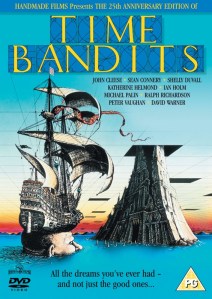
Quick Review: Time Bandits (dir. by Terry Gilliam)


My parents used to have some strange movies growing up. Time Bandits is one of those films that I kind of stumbled on, but grew to be one of my favorite British films. It was my gateway drug to all things Monty Python.

Produced by former Beatle George Harrison and his company, Hand Made Films and running off the success of Monty Python’s Life of Brian, Time Bandits runs off of a simple premise. The Supreme Being once had a map of all the points in time on Earth. A group of his servants steal this map in order to travel through time and use it to plunder various historical figures of their loot. Granted, it’s a strange story, but if you’ve watched anything Gilliam’s done, this film actually works (or did for me when I saw it).

Our story opens with a boy named Kevin (Craig Warnock), who dreams of a more interesting life than the one he shares with his parents while watching tv. One night, a set of little people dressed in steampunk attire climb out of his closet and threaten him bodily harm unless he tells them how to escape his dimension. They manage to locate an exit, only to be pursued by The Supreme Being, who warns them to return the map they’ve stolen from him. If I remember nothing else from this film, that one scene will always stay with me.

The crew, led by Randall (David Rappaport) arrive during Napoleon’s time (played quite convincingly by Ian Holm) and manage to become generals in his army after impressing him with a rendition of “Me and My Shadow”. This, coupled with their size helped out, I’m sure. As thanks for being part of his army, they get Napoleon drunk until he passes out and collect most of his loot before finding another time portal and leaping into Robin Hood’s time. Unfortunately for the Time Bandits, Robin Hood (John Cleese) assumes they’ve arrived to give their ill begotten goods to the poor and promptly gives it all away to them.

In the midst of figuring out their next step, the Bandits run into The Supreme Being again and distract him, giving Kevin a chance to escape on his own. However, when two portals open before him, he chooses the wrong one and ends up in Ancient Greece with King Agememnon (Sean Connery), who adopts Kevin as a Prince. Before he can fully enjoy it, however, the Bandits show up and “free” from the time period he doesn’t belong in.

There’s more to the tale, but let’s just say that the Evil Genius (one of David Warner’s best roles in my opinion – he had a knack for playing bad guys) gets wind of the Map and hatches his own plan to acquire it and use it for nefarious deeds.

The beauty of Time Bandits is the world it creates. Though grounded in real time periods, the fantasy elements are pretty interesting, much like Brazil was. Giants who wear ships on their heads, Ogres and creates with cow skulls for heads make up some of the strange visions Terry Gilliam brings to this story. Overall, it’s a fun and unique tale that’s good for at least a late night viewing, and one that I return to from time to time.

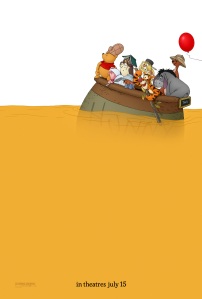
Quick Review: Winnie the Pooh (dir. by Stephen J. Anderson & Don Hall)


With Harry Potter and the Deathly Hallows Part 2 running at full steam, and Captain America: The First Avenger opening this weekend, Winnie the Pooh still remains an option for younger kids who may not be ready for these two films (at least until The Smurfs is released). There’s really very little in the way of negative comments that I can give to Winnie the Pooh, expect perhaps that running at just 69 minutes, it’s very short. It’s for kids.

Working off the original story by A.A. Milne, Winnie the Pooh re-introduces us to the title character, along with his friends from the Hundred Acre Wood – Tigger, Rabbit, Piglet,  Kanga and her son Roo, Owl, and Eeyore. They are the treasured toys of Christopher Robin, who has an active imagination.

One of the cute elements of this story, narrated by John Cleese is how everyone breaks the fourth wall and occasionally has interactions with the paragraphs of the story. Stepping on a few words here, using a few as a ladder, it came across as being quite worthy of a few smiles.

I used to watch “The New Adventures of Winnie the Pooh” on Saturday Mornings, and it was a treat to return to these characters. For the movie, we are given the “Busy Backson” story, where Eeyore has lost his tail and the team come up with ideas on new and interesting ones for him. Each character has their own way of figuring this out. Of course, Pooh has something of a difficult time with his constantly rumbling tummy, but he manages to help in his own way. In their search, Owl misreads a note left behind by Christopher Robin stating that he’ll be busy, but will be back soon. This conjures up the great and terrible “Backson” in everyone’s imagination, responsible for everything from stealing your left socks to making your milk spoil. The team decides to set a trap for the Backson, with wild results. The scenes with the Backson maybe a little frightening to the youngest of viewers, but it’s not that bad. We’re not dealing with Heffalumps or Woozles here.

In the end, as always, everything turns out well. I liked that Friendship was the big factor here. All of Eyeore’s friends tried to help him find his tail, and Pooh even puts his honey chasing ways on hold (as best he can, anyway) to aid his friend. Those familiar with the animated series will instantly recognize Jim Cummings as the voice of both Winnie the Pooh and Tigger. I would have liked to have seen Peter Cullen come back as Eyeore, but he was pretty busy voicing Optimus Prime while the movie was being made. All of the other voice actors are new, including late night tv host Craig Ferguson as Owl. The kids won’t even care.

Musically, there are a few interesting songs. Actress / Singer Zooey Deschanel lends her voice to the title song, along with a few others. Most of the other songs are sung by the cast themselves, and the kids may find themselves singing along (at least I could hear singing in my audience, anyway). The film moves fast, extremely fast. By the time the antsy factor kicks in, the movie’s done, which makes that a treat by itself.

Overall, Winnie the Pooh may not have the magnificence of say a Kung Fu Panda 2 or How to Train Your Dragon, but for very young viewers, it should do just the trick.