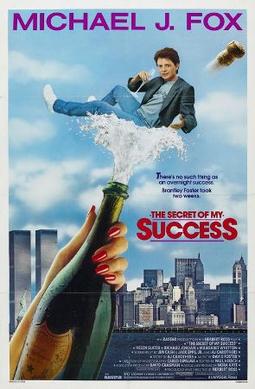
The Secret of My Success (1987, directed by Herbert Ross)


ȋ‚˜é

Brantley Foster (Michael J. Fox) heads to New York City with his business degree from the University of Kansas and the promise of an entry-level job as a financier.  He arrives to discover that the company that hired him no longer exists and that Brantley is out of a job.  New York is a harsh town for someone who is down on his luck and all of out of money.  Brantley eventually gets a job working in the mail room of a company owned by his wealthy uncle (Richard Jordan).  His uncle doesn’t even know who he is but soon, Brantley becomes just as rich and successful as he always dreamed.

What’s the secret of Brantley’s success?

Screwing his Aunt Vera (played by Margaret Whitton).

What’s the other other secret of his success?

Pretending to be named Carlton Whitfield and claiming that he’s a new executive at the corporation.

I remember when Kramer did the same thing on Seinfeld.  It didn’t work out for Kramer.  He got fired after turning in his first report.

“This is gibberish,” his boss said, “It’s almost as if you have no business training at all.  I’m afraid we have to let you go.”

“I don’t actually work here,” Kramer replied.

“That’s what makes this so hard.”

Seinfeld, never topped.

Back to The Secret of My Success, this is the most 80s film ever made, complete with montages of Brantley exploring New York and a saxophone playing on the soundtrack.  Brantley’s all about TCB, taking care of business.  He screws his aunt but falls in love with Christy Wills (Helen Slater).  Brantley doesn’t learn anything but he gets the best office and becomes a success without actually doing any real work.  It’s the ultimate fantasy and, like many fantasies, The Secret of My Success is superficially appealing.  Michael J. Fox is likable as Brantley.  Margaret Whitton is outrageously sexy as Vera.  Helen Slater is pretty and boring, traits that made her the ideal “good” girlfriend for Brantley’s story.

The Secret of My Success is your ticket to the 80s.

Film Review: The Doors (dir by Oliver Stone)


I like The Doors.

That can be a dangerous thing to admit, about both the band and Oliver Stone’s 1991 film.  Yes, both the band and the film could be a bit pretentious.  They both tended to go on for a bit longer than necessary.  They were both centered around a guy who wrote the type of poetry that I used to love back in my emo days.  It’s all true.

But, with The Doors as a band, I find that I can’t stop listening to them once I start.  Even if I might roll my eyes at some of the lyrics or if I might privately question whether any blues song really needs an organ solo, I can’t help but love the band.  They had a sound that was uniquely their own, a psychedelic carnival that brought to mind images of people dancing joyfully while the world burned around them.  And say what you will about Jim Morrison as a poet or even a thinker, he had a good voice.  He had the perfect voice for The Doors and their rather portentous style.  From the clips that I’ve seen of him performing, Morrison definitely had a stage presence.  Morrison died young.  He was only 27 and, in the popular imagination, he will always look like he’s 27.  Unlike his contemporaries who managed to survive the 60s, Morrison will always eternally be long-haired and full of life.

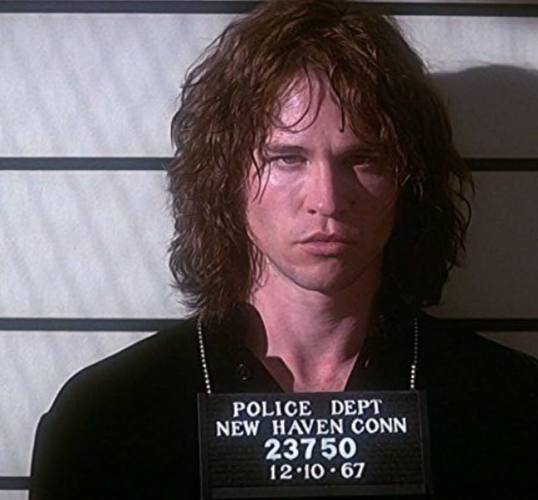
As for The Doors as a movie, it’s definitely an Oliver Stone film.  It’s big.  It’s colorful.  It’s deliberately messy.  Moments of genuinely clever filmmaking and breath-taking visuals are mixed with scenes that are so heavy-handed that you’ll be inspired to roll your eyes as dramatically as you’ve ever rolled them.  Stone loved the music and that love comes through in every performance scene.  Stone also loves using Native Americans as symbols and that can feel a bit cringey at times.  Why would Jim Morrison, whose was of Scottish and Irish ancestry, even have a Native American spirit guide?  At its best The Doors captures the chaos of a world that it’s the middle of being rebuilt.  The 60s were a turbulent time and The Doors is a turbulent movie.  I’ve read many reviews that criticized The Doors for the scene in which Morrison gets involved in a black magic ceremony with a journalist played by Kathleen Quinlan.  I have no idea whether or not that scene happened in real life but the movie is so full of energy and wild imagery that the scene feels like it belongs, regardless of whether it’s true or not.  Stone turns Jim Morrison into the warrior-artist-priest that Morrison apparently believed himself to be and the fact that the film actually succeeds has far more to do with Oliver Stone’s  enthusiastic, no-holds-barred direction and Val Kilmer’s charismatic lead performance than it does with Jim Morrison himself.

The Doors spent several years in development and there were several actors who, at one time or another, wanted to play Morrison.  Everyone from Tom Cruise to John Travolta to Richard Gere to Bono was considered for the role.  (Bono as Jim Morrison, what fresh Hell would that have been?)  Ultimately, Oliver Stone went with Val Kilmer for the role and Kilmer gives a larger-than-life performance as Morrison, capturing the charisma of a rock star but also the troubled and self-destructive soul of someone convinced that he was destined to die young.  Kilmer has so much charisma that you’re willing to put up with all the talk about opening the doors of perception and achieving a higher consciousness.  Kilmer was also smart enough to find the little moments to let the viewer know that Morrison, for all of his flamboyance, was ultimately a human being.  When Kilmer-as-Morrison winks while singing one particularly portentous lyric, it’s a moment of self-awareness that the film very much needs.

(When the news of Kilmer’s death was announced last night, many people online immediately started talking about Tombstone, Top Gun, and Top Secret.  For his part, Kilmer often said he was proudest of his performance as Jim Morrison.)

In the end, The Doors is less about the reality of the 60s and Jim Morrison and more about the way that we like to imagine the 60s and Jim Morrison as being.  It’s a nonstop carnival, full of familiar faces like Kyle MacLachlan, Michael Madsen, Crispin Glover (as Andy Warhol), Frank Whaley, Kevin Dillon, and a seriously miscast Meg Ryan.  It’s a big and sprawling film, one that is sometimes a bit too big for its own good but which is held together by both Stone’s shameless visuals and Val Kilmer’s charisma.  If you didn’t like the band before you watched this movie, you probably still won’t like them.  But, much like the band itself, The Doors is hard to ignore.

Retro Television Reviews: Lookwell 1.1 “The Pilot”


Welcome to Retro Television Reviews, a feature where we review some of our favorite and least favorite shows of the past!  On Thursdays, I will be reviewing Lookwell, which aired on NBC in 1991.  The entire show is currently streaming on YouTube!

Adam West is an actor who solves crimes …. kind of.

Episode 1.1 “Lookwell”

(Dir by E.W. Swackhamer, originally aired on July 28th, 1991)

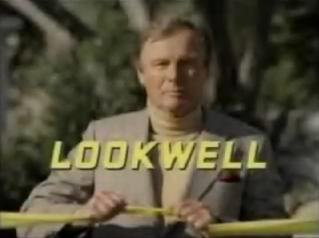
Ty Lookwell (Adam West) was once the biggest star in Hollywood.

Well, maybe not the biggest star.  But, in the 70s, he did have his own cop show.  It was called …. BanacekMannix?  No, that’s not it.  Oh …. BRANNIGAN!  Ty Lookwell starred on a show called Brannigan and he was even given his own honorary police badge in 1972.  It was presented to him at a ceremony in Television City.

However, nearly 20 years later, things have changed.  Brannigan is no longer on the air and Ty Lookwell has been reduced to wearing a wig and a leather jacket in an attempt to get a role in a revival of Happy Days.  (He not only doesn’t get the role but he doesn’t even get to audition.)  When he returns to his home, he is informed that his favorite hairspray has been discontinued (“Those fools!”) and that all the messages on his machine are for his nephew.  Kevin Costner calls looking for Lookwell’s nephew.  Francis Ford Coppola calls for Lookwell’s nephew and leaves a message in which he promises to call back.  No one calls for Ty Lookwell.

Lookwell, however, still has a steady gig teaching an acting class and his students not only look up to him  but also help him out whenever he decides that there’s a crime he has to solve.  This apparently happens frequently as Lookwell takes his honorary badge very seriously.

“Remember how we talked about how you don’t have to come around here?” Detective Kennery (Ron Frazier) asks Lookwell at one point.

The pilot follows Lookwell as he investigates a series of car thefts.  Helping him out is his favorite student, Jason (played by future director Todd Field).  Lookwell’s investigative techniques are not particularly complicated.  He puts on a disguise and attempts to go undercover.  It never quite works, largely because everyone that Lookwell meets is smarter than Lookwell.  Lookwell’s attempt to disguise himself as a Grand Prix racer fails because the security guard takes one look at him and sees that he’s obviously not a Grand Prix racer.  His attempt to conduct a stakeout on a fancy diner is nearly thwarted by his bizarre decision to disguise himself as a hobo.  His attempt to go undercover at a garage is thwarted by the other mechanics misunderstanding his leading questions.

(“Who beat you up, Mr. Lookwell?” his students ask at the start of class.)

As the investigation continues, Jason wonders if they’re just wasting time.

“You do not waste time,” Lookwell corrects him, “Time wastes you.”

Lookwell was written by Conan O’Brian and Robert Smigel, long before either one of them became famous, and the humor is definitely the humor of a generation who grew up watching network television, especially the cop shows of the 70s and the 80s.  While the dialogue is clever and definitely funny, it’s really Adam West who makes the pilot work.  West delivers all of his line with such conviction and confidence that it doesn’t matter that he only plays a peripheral role in solving the case and, in fact, usually makes things worse for everyone involved.  As played by West, Lookwell is so confident in his abilities and so blithely unaware of his limitations that it’s hard not to admire his spirit.

Unfortunately, the spirit was not admired by NBC and Lookwell only aired once.  But it has since developed a cult following.  Adam West described it as being his favorite of the various shows that he did.  I enjoyed the pilot, though I do think the premise was perhaps a bit too thin to support an actual series.  (It would have made a great recurring SNL bit, though.)  Thanks to YouTube, everyone can now watch what NBC passed up.

The Hard Way (1991, directed by John Badham)


Lt. John Moss (James Woods) is a cop with a problem.  A serial killer who calls himself the Party Crasher (Stephen Lang) is killing people all across New York and he has decided that he will be coming for Moss next.  However, Moss’s captain (Delroy Lindo) says that Moss is off of the Party Crasher case and, instead, he’s supposed to babysit a big time movie star named Nick Lang (Michael J. Fox)!

Nick is famous for playing “Smoking” Joe Gunn in a series of Indiana Jones-style action films.  However, Nick wants to be taken seriously.  He wants to play Hamlet, just like his rival Mel Gibson!  (That Hard Way came out a year after Mel Gibson played the melancholy Dame in Franco Zeffirelli’s 1990 adaptation of Shakespeare’s play.)  Nick thinks that if he can land the lead role in a hard-boiled detective film, it will give him a chance to show that he actually can act.  To prepare for his audition, he’s asked to spend some time following Moss on the job.  Mayor David Dinkins, always eager to improve New York’s reputation, agrees.  (David Dinkins does not actually appear in The Hard Way, though his name is often mentioned with a derision that will be familiar to anyone who spent any time in New York in the 90s.)  Of course, Moss isn’t going to stop investigating the Party Crasher murders and, of course, Nick isn’t going to follow Moss’s orders to just stay in his apartment and not get in his way.

The Hard Way is a predictable mix of action and comedy but it’s also entertaining in its own sloppy way.  Director John Badham brings the same grit that he brought to his other action films but he also proves himself to have a deft comedic touch.  Most of the laughs come from the contrast between James Woods playing one of his typically hyperactive, edgy roles and Michael J. Fox doing an extended and surprisingly convincing impersonation of Tom Cruise.  Woods and Fox prove to be an unexpectedly effective comedic team.  One of the best running jokes in the film is Woods’s exasperation as he discovers that everyone, from his girlfriend (Annabella Sciorra) to his no-nonsense boss, are huge fans of Nick Lang.  Even with a serial killer running loose in the city, Moss’s captain is more concerned with getting Nick’s autograph.

Woods and Fox are the main attractions here but Stephen Lang is a good, unhinged villain and Annabella Sciorra brings some verve to her underwritten role as Moss’s girlfriend.  Viewers will also want to keep an eye out for familiar faces like Penny Marshall as Nick’s agent, a very young Christina Ricci as Sciorra’s daughter, and Luis Guzman as Moss’s partner.

With its references to David Dinkins, Mel Gibson’s superstardom, and Premiere Magazine, its LL Cool J-filled soundtrack, and a plot that was obviously influenced by Lethal Weapon, The Hard Way is very much a period piece but it’s an entertaining one.

A Movie A Day #13: Ringmaster (1998, directed by Neil Abramson)


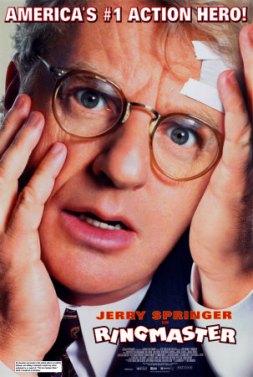
ringmaster-posterJerry Springer has been many things over the course of his long life.  Lawyer.  Anti-war activist.  Adviser to Bobby Kennedy.  Congressional candidate.  City councilman.  Brothel aficionado.  Mayor.  Journalist.  Commentator.  Talk show host.  Destroyer of culture.  Scourge of humanity.  Twice, he was a highly recruited candidate for the U.S. Senate but, both times, it was decided that there was no way a morally questionable television personality could actually win high political office in the United States.

(Yeah, about that…)

There is one thing that Jerry Springer has never been and that is a movie star.  However, that’s not for lack of trying.  At the height of his talk show’s popularity, Jerry Springer starred in Ringmaster.  Though he played a character named Jerry Farrelly and his show was retitled The Jerry Show, there was never any doubt that Jerry Springer was meant to be playing himself.

Who is Jerry Springer, according to Ringmaster?  He’s a sad and weary man who sleeps with his guests and worries that his raunchy show will be his only legacy.  After one show, he tells his staff that he will never again be elected to political office.  His staff laughs but Jerry didn’t sound like he was making a joke.  Why does Jerry do it?  Because he cares about America!  When a man in his audience starts yelling that Jerry and his guests are all going to Hell, Jerry gets in his face and let him know that his show is providing a voice for the people who live in the real America.

In Ringmaster, the real America is made up of people like trailer park nymphomaniac Angel Zorzak (Jaime Pressly) and her mother, Connie (Molly Hagan).  Angel and Connie appear on The Jerry Show after Angel sleeps with her stepfather (Michael Dudikoff, the American Ninja himself) and Connie gets revenge by sleeping with Angel’s boyfriend.  Also on the show is Demond (Michael Jai White), who cheated on his girlfriend with her two best friends and, the night before the show, cheats with Angel too.  Thanks to the show, Demond gets his comeuppance and Angel and Connie’s relationship is repaired.  The movie ends with mother and daughter back in the trailer park, talking about how their new neighbor has big feet.

Pressly and Hagan are the best thing about Ringmaster.  The worst thing is undoubtedly Jerry Springer.  For someone who has made a career in both politics and television, Jerry Springer turns out to be a terrible actor.  He sleepwalks through the movie with a please-kill-me look on his face, keeping his head down and muttering the majority of his lines.

According to Wikipedia, Ringmaster had a budget of $20,000,000 and grossed back less than half of that.  Why would people pay money to watch what they could see on TV for free?  Jerry Springer never became a senator or a movie star.  He continues to host his talk show and probably will until the end of time.