October True Crime: The Chase (dir by Paul Wendkos)


When he died in 1988, Phillip Hutchinson was only 24 years old.

Born in Virginia, Phillip Hutchinson served in the U.S. Marines before he was discharged for desertion.  He went on to become a career criminal and a violent one at that.  By the time he was 24, he already had a long criminal record.  In Texas, he was convicted of aggravated assault and ended up with a life sentence.  He escaped from prison by stealing a truck.  (It was his third escape attempt.)  Fleeing Texas, he eventually ended up in Denver.  He is alleged to have robbed four banks in Denver before holding up the Rio Grande Operating Credit Union.  The 18 year-old teller was able to set off a silent alarm and Hutchinson ended up leading police on a chase through Denver.  Following Hutchinson in the air was a news helicopter.  At one point, Hutchinson crashed into an unmarked police car, killing Detective Bob Wallis.

After crashing his own car, Hutchinson continued to run on foot.  Eventually, he reached a trailer park.  He took John Laurienti as a hostage and forced the 73 year-old man to drive him past the police in his pick-up truck.  When the men in the news helicopter realized that the police didn’t realize that Hutchinson was in the truck, they dived down and blocked the truck from moving forward.  The cops, realizing their mistake, surrounded the truck and opened fire, killing Hutchinson while the cameraman in the helicopter continued to film.  John Laurienti escaped from the truck, uninjured.

Phillip Hutchinson really had no one but himself to be blame.  If he hadn’t robbed the credit union, he would have had the cops chasing him to begin with.  If he hadn’t rammed into the unmarked car and killed Bob Wallis, it’s possible that the police would have been more willing to negotiate before opening fire on him.  You can wonder what led to someone, by the age of 24, becoming a hardened criminal and that is something that should always be investigated.  In the end, actions do have consequences.

Phillip Hutchinson is one of those criminals who would probably be forgotten today if not for the fact that his death was not only captured on camera but also broadcast across the television airwaves.  Hutchinson has gone on to have a significant afterlife in various “documentaries.”  Remember World’s Wildest Police Videos?  (I’ve also read that the shoot-out is a popular video on various “forbidden” and “dark” websites but I’m not going to look to find out.)

1991’s The Chase was a made-for-television movie about Phillip Hutchinson and his final ride.  Casey Siemaszko plays Phillip Hutchinson as being a psycho redneck, which is probably not the far from the truth.  Siemaszko gives a good performance as Hutchinson but the majority of the film deals with the people who came into contact with Hutchinson on the final day of his life.  Ricki Lake plays the teller who set off the silent alarm.  Ben Johnson gives a moving performance as the old man who Hutchinson took hostage.  Barry Corbin plays Bob Wallis.  Megan Follows plays a drug addict who narrowly escapes Hutchinson.  Robert Beltran plays the man in the helicopter.  They all give good performances.  At the same time, for a film called The Chase, the Chase itself doesn’t actually start until we’re 70 minutes into the movie and it’s over pretty quickly.  If you’re watching this film for the action, you’ll probably be disappointed.

This film was written by Guerdon Trueblood, who also directed one of my favorite grindhouse films, The Candy Snatchers.  Trueblood’s script follows the standard disaster formula, in that there are a lot of subplots and filler leading up to the big event.  In other words, The Chase isn’t a film for everyone.  I’ll admit, though, that I teared up a little at the end.  Phillip Hutchinson may have been a violent criminal but his death brought a community together.

Retro Television Review: Miami Vice 4.16 “Honor Among Thieves”


Welcome to Retro Television Reviews, a feature where we review some of our favorite and least favorite shows of the past!  On Mondays, I will be reviewing Miami Vice, which ran on NBC from 1984 to 1989.  The entire show can be purchased on Prime!

This week, a man kills for his dolls.

Episode 4.16 “Honor Among Thieves?”

(Dir by Jim Johnston, originally aired on March 4th, 1988)

A serial killer named Paul Delgado (John Bowman and no, we’re not related as far as I know) is killing girls in Miami.  He believes that he’s being ordered to kill by his collection of dolls and, when he’s speaking as a doll, he uses a high-pitched voice.  He picks women up at carnivals or on the beach and he kills them by injecting them with 100% pure cocaine.  He poses their bodies with a doll beside them.

Because of the cocaine connection, homicide detective Jarrell (Dylan Baker) approaches Castillo.  Castillo explains that his best men are working deep undercover, trying to take down a drug lord named Palmo (Ramy Zada).  That’s right, this is yet another episode where Crockett pretends to be Burnett and Tubbs pretends to be Cooper and somehow, they’re able to get away with it despite the fact that their cover has been blown in almost every previous episode.

Delgado works for Palmo and things get even more complicated when it turns out that Delgado is Crockett and Tubbs’s connection inside Palmo’s operation.  When Palmo discovers that Delgado is the killer, he puts Delgado on trial.  The jury is made up of other drug dealers.  Since Crockett is pretending to be a lawyer, he’s assigned to serve as Delgado’s defense counsel.  Palmo tells Crockett that, unless he’s acquitted by the drug dealer jury, he’ll reveal that Crockett and Tubbs are working undercover….

This was a weird episode,  It didn’t really work because Delgado was a bit too cartoonish to be taken seriously.  Perhaps if the show had just made him a serial killer who killed women with cocaine, it would have worked.  But the show had to go the extra step and have him talk to his dolls in a high-pitched voice.  As well, this was yet another episode where we were forced to wonder if people in the Miami underworld just don’t communicate with each other.  After all the drug lords that have been busted by Crockett and Tubbs, you would think that word would eventually get out about “Burnett” and “Cooper.”  I mean, their cover gets blown in nearly every episode.  Frank Zappa put a bounty on Crockett’s head in season 2!  And yet somehow, Crockett and Tubbs are still able to walk into a drug lord’s mansion, introduce themselves as Burnett and Cooper, and not automatically get shot.

There were some definite problems with this episode but it was weird enough to at least hold one’s attention.  As opposed to the episodes with the aliens and the bull semen, this episode didn’t seem like it was trying too hard to be weird.  Instead, it just was genuinely weird.  It was watchable and, as far as the fourth season of Miami Vice is concerned, that definitely counts as an accomplishment.

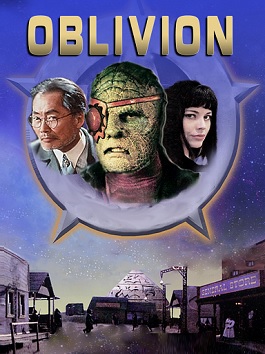
Oblivion (1994, directed by Sam Irvin)


In the far, far future, Earth has set up colonies all across the universe.  One of those colonies is the dusty town of Oblivion, which looks just like an old west town except the deputy is a cyborg and there’s an ATM outside the saloon.  A humanoid lizard named Red Eye (Andrew Divoff, covered in green scales) comes to town and kills the marshal.  Red Eye and his gang take over Oblivion, planning to turn it into their own personal pleasure palace.

The marshal’s son, Zack (Richard Joseph Paul), comes to town for the old man’s funeral.  Everyone thinks that Zack is a coward because he refuses to avenge his father’s death.  Zack, however, is no coward.  He’s just an empath who can’t handle the negative emotion that are generated by violence.  But seeing as how his father is dead, his best friend Buteo (Jimmie F. Skaggs) is being tortured in the town square, and lovely Mattie Chase (Jackie Swanson) wants Red Eye and his gang to get out of town, Zack knows that he’s going to have to do the right thing and conquer his empathy.

Oblivion is a haphazard mix of comedy, science fiction, and the western genre.  Some of the ideas come close to being clever but it never makes sense why an Earth colony in 3031 would resemble a one-horse town from a singing cowboy movie.  (The film probably would have worked better if it had been about Red Eye invading an actual Old West town in the 1800s instead of a colony designed to look like one.)  Andrew Divoff is entertaining as he hams it up as the main desperado but, as far Old West charisma is concerned, Richard Joseph Paul is no John Wayne or Henry Fonda.  Quite a few familiar names were somehow roped into appearing in this low-budget space oater, though most of them only appear for a few minutes and don’t contribute much to the overall story.  George Takei plays the alcoholic town doctor.  Julie Newmar is Miss Kitty, the owner of Oblivion’s “social” club.  In a nod to her most famous role, Newmar hisses at Red Eye and his gang but that’s all she gets to do.  It feels like a waste of a cameo.  Isaac Hayes and Meg Foster also make appearances, though again neither really gets to do anything interesting.

The idea of a space western isn’t a bad one and there actually have been a few good ones.  (Outland, for example.)  But Oblivion can never escape the drag of its low budget and its bland lead.

The TSL’s Horror Grindhouse: Puppet Master (dir by David Schmoeller)


Since there’s been like 200 Puppet Master films made over the past 30 years — goddamn, 30 years of killer puppets! — I figured that maybe I should finally sit down and actually watch one of them.  I decided to go with the original film that started the entire franchise, 1989’s Puppet Master!

So, basically, this is a movie about little puppets that kill full-sized people.  Obviously, there’s a bit more to the plot but let’s be honest.  No one who watches this movie is going to be watching it for the specifics of the plot.  They’re going to be watching it because they want to see tiny puppets go on a rampage.  I have to say that the puppets themselves are pretty cute.  I mean, they’re murderous and a little bit pervy but they’re still really cute.  I understand that all of the puppets have their own specific names but, while watching the film, I just made up names of my own.

For instance, there’s Hooky, who has a hook for one hand and a knife for the other and looks like he should be the lead singer of an aging Prog Rock band.  And then there’s Drilly, who has a drill on his head.  He can be really dangerous, especially if you’re stupid enough to crawl around on the floor and just stay there, on all fours, while he’s running straight at you.  I mean, if you just stood up, you probably wouldn’t get that badly injured but …. well, what do I know, right?  And then there’s Leechy, who is a female puppet who spits up leeches.  What’s interesting is that she never runs out of leeches but I have to wonder, if you have that many leeches, why not just send them out on their own instead of stuffing them all into some poor little puppet?  I felt bad for Leechy.  She seemed kinda sad.  And then there’s Handy, who has big hands and Facey, who can assume several different facial expressions at once.  They’re all really adorable, to be honest.

Anyway, Puppet Master is about a bunch of psychics who all spend the night in a California hotel that was once home to the “last alchemist,” Andre Toulon (William Hickey).  Toulon had the power to bring inanimate creatures — like puppets! — too life but, when the Nazi spies were closes in on him, Toulon killed himself.  Many years later, a psychic named Neil Gallagher (Jimmie F. Skaggs) discovered Toulon’s hiding place in the hotel but then shot himself as well.  So now, Neil’s former colleagues are all trying to get Toulon’s power for themselves.  Or something.  As I said, following the plot is not always easy.  The main appeal here is watching the cute puppets do really bad things.

That said, who knew that a group of psychics and witches would prove to be so stupid?  I mean, you would think that — when all of you are having constant premonitions of death and destruction — you would be smart enough to take extra precautions or maybe just leave the hotel all together.  For instance, Dana (Irene Miracle) casts a protection spell over someone else but not on herself.  Meanwhile, Frank (Matt Roe) and Clarissa (Kathryn O’Reilly) make the rookie mistake of having sex in a horror film while our nominal hero, Alex (Paul Le Mat, looking like he’s trying to figure out how he went from American Graffiti to this), wanders around in a daze.

And yet, watching the film, I could see why it became so popular.  The puppets are memorable and well-designed and the backstory, with Toulon and all the rest, is actually pretty interesting.  Puppet Master is one of those films that defines “stupid but fun.”  No wonder the puppets came back!

Film Review: Cutthroat Island (dir by Renny Harlin)


Today is Talk Like A Pirate Day which, let’s just be honest, is an extremely stupid holiday that mainly exists to remind us that “doubloon” is a deeply silly word.

Doubloons were a currency that were popular in Europe and South America back in the 18th century and pirates were always looking for doubloons.  If you listen to enough pirate talk, you’ll quickly discover that there’s a lot different ways to say the word doubloon.  Some people put the emphasis on the fist syllable while others emphasize the second.  Some people say Due-bloon while others say Duh-bloon.  Either way, it’s impossible to listen to pirates talk about doubloons without thinking that they sound very, very silly.  The secret behind the success of The Pirates of the Caribbean franchise is an understanding that it’s impossible to take pirates seriously.

Unfortunately, I chose not to watch The Pirates of the Caribbean for Talk Like A Pirate Day.  Instead, I watched 1995’s Cutthroat Island.

Cutthroat Island is a story of pirates, a lost treasure, and one big sea battle that literally seems to go on and on.  There is occasional talk of doubloons, though not enough for my liking.  Instead, most of the film deals with the efforts of Morgan (Geena Davis) to find a hidden treasure before her uncle, Dawg (Frank Langella), discovers it.  Morgan has one-third of a map.  It was originally tattooed on her father’s head.  After he died, she scalped him and took over his boat.  She also purchased a swashbuckling slave named Shaw (Matthew Modine) because Shaw is capable of reading Latin, the language in which the map is written.  Needless to say, Shaw and Mogan fall in love while Dawg teams up with corrupt colonial officials to not only track down the treasure but to also capture his niece.

The film starts out as a romance with a dash of comedy before eventually transforming into a standard action movie.  That means that boats get blown up and there’s a lot of scenes of people fencing.  There’s also a lot of slow motion footage of bodies plunging into the ocean.  The climatic battle goes on forever and it actually features Morgan hissing, “Bad dawg!” at her uncle.

(Amazingly, “Bad Dawg” isn’t the worst of the dialogue to be heard in Cutthroat Island.  Morgan has a habit of saying stuff like, “I will maroon you on a rock the size of this table, instead of splattering your brains across my bulkhead” and “Since you lie so easily and since you are so shallow, I shall lie you in a shallow grave.”)

Throughout the film, there are hints of what Cutthroat Island could have been, if it hadn’t been such a by-the-numbers action flick.  The fact that it was Morgan who was continually rescuing Shaw was a nice change-of-pace from the usual damsel-in-distress clichés that one finds in most pirate movies.  When Morgan effortlessly breaks the neck of a soldier and sets free her crew, it’s a great moment, comparable to Angelina Jolie taking out Liev Schreiber in Salt or Milla Jovovich kicking zombie ass in a Resident Evil film.  Unfortunately, director Renny Harlin (who was married to star Geena Davis, at the time) is usually too concerned with getting to the next action set piece to truly take advantage of the film’s subversive potential.

Frank Langella is smart enough to bellow his way through his villainous role while Matthew Modine appears to be so amused by the film’s terrible dialogue that it’s impossible not to like him.  Geena Davis is convincing when she’s breaking necks and swinging swords but she delivers her dialogue like someone who has already figured out that the movie was a bad idea and resigned herself to the fact that her film career will never recover.  She doesn’t appear to be having any fun, which kind of defeats the purpose of being a pirate.

Cutthroat Island was a huge and notorious box office flop and it’s still considered to be one of the biggest financial disasters in film history.  Apparently, Hollywood was so traumatized that it would be another 8 years before there was another major pirate production.  That production, of course, was Pirates of the Caribbean, a film that captured the fun that was so lacking in Cutthroat Island.

A Movie A Day #122: The Lost Capone (1990, directed by John Gray)


Chicago.  1915.  Up-and-coming gangster Al Capone (Eric Roberts) berates his younger brother, Jimmy (Adrian Pasdar), for not being aggressive enough in a street fight.  Not wanting to follow his brothers into a life of organized crime, Jimmy runs away from home and eventually finds himself in Harmony, Nebraska.  Claiming to be a World War I vet named Richard Hart, Jimmy impresses everyone with both his marksmanship and his incorruptible nature.  Soon, the new Richard Hart has been named town marshal.  While Al Capone is taking over the Chicago rackets, Richard is keeping the town safe with his Native American deputy, Joseph Littlecloud (Jimmie F. Skaggs), and starting a family with the local school teacher, Kathleen (Ally Sheedy).  When illegal liquor from Chicago starts to show up on a nearby Indian reservation, Richard Hart comes into conflict with the Chicago Outfit and his secret is finally revealed.

There is a sliver of truth to this made-for-TV movie.  Al Capone really did have a brother named James, who ended up changing his name to Richard Hart and working as a prohibition agent in Nebraska.  Otherwise, the movie changes so many facts that it is hard to know where to begin.  In real life, Al and James Capone grew up in New York.  James, who was actually several years older than Al, ran away from home not to escape Al’s bullying but because he wanted to join the circus.  (Al was only 9 when James ran away.)  James changed his name to Richard Hart not to keep people from realizing that he was related to Al but because he admired silent screen cowboy William S. Hart.  Though James did work in law enforcement, he never came into conflict with Al Capone’s organization and, in fact, regularly visited Chicago.

The Lost Capone is a forgettable mix of western and gangster clichés, featuring a notably stiff performance from Adrian Pasdar in the lead role.  It does feature two of the strangest performances that I have ever seen.  Eric Roberts, complete with a phony scar, playing Al Capone is just as weird as it sounds, while Ally Sheedy plays a wholesome and always smiling teacher but delivers her lines in the same halting tone of voice that she used as the “basket case” in The Breakfast Club.

There is probably a good movie that could be made about the life of James Capone/Richard Hart but The Lost Capone is not it.