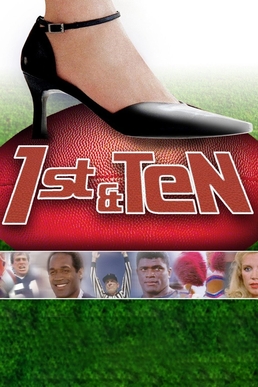
Welcome to Late Night Retro Television Reviews, a feature where we review some of our favorite and least favorite shows of the past! On Wednesdays, I will be reviewing 1st and Ten, which aired in syndication from 1984 to 1991. The entire series is streaming on Tubi.
This week, an injury leads to the promise of sex …. or does it?
Episode 1.5 “Play Me Or Trade Me”
(Dir by Bruce Seth Green, originally aired on December 23rd, 1984)
Carl Whitherspoon, the star running back who is always demanding more money, is injured while filming a commercial for a rental car company. (“Call OJ,” the commercial’s director says when it becomes obvious that Carl won’t be able to jump over any more luggage.) The Bulls are struggling and Coach Denardo wants a championship but his star player is out for four weeks!
It’s time to trade! Unfortunately, the only way that the Bulls are going to be able to get the running back they want is by trading their aging quarterback, Bob Dorsey. Dana is upset about losing Bob but then she realizes she can finally have sex with him if he’s no longer a Bull and she decides that she’s okay with the trade.
But then the running back that the Bulls were hoping to trade for is injured so the trade is called off. So, Dana can’t have sex with Bob. But Bob still leads the team to victory. Actually, the team wins because Bubba (Prince Hughes) blocks a field goal with his oversized ass. (That’s not me being rude. Bubba’s weight and the size of his ass is a running theme on this show.) The Bulls are now 5-3 and I guess they don’t need a running back after all.
The main theme of this episode seemed to be that Dana needs to get laid. I liked the chemistry between Delta Burke and Geoffrey Scott. And the scene where Carl injured himself made me laugh just because of Sam Scarber’s over-the-top facial expressions as he crashed into a table. Otherwise, this episode was pretty forgettable.
Welcome to Late Night Retro Television Reviews, a feature where we review some of our favorite and least favorite shows of the past! On Wednesdays, I will be reviewing 1st and Ten, which aired in syndication from 1984 to 1991. The entire series is streaming on Tubi.
This week, cocaine comes to the locker room. Actually, cocaine was probably already there. Now, there’s more cocaine. Football, right?
Anyway….
Episode 1.4 “The Slump”
(Dir by Bruce Seth Green, originally aired on December 16th, 1984)
This week’s episode starts off with some full front nudity as wide receiver Mace Petty (Marshall R. Teague) takes a shower with a blonde woman. Suddenly, a bearded man steps into the shower, accuses Mace of seducing his wife, and points a gun at him. OH MY GOD, IS MACE GOING TO DIE!? (And who is Mace, anyway?)
Oh wait, it’s a prop gun. Ha ha, it’s practical joke. Those crazy Bulls.
With the required HBO nudity out of the way, the plot kicks off. The Bulls are in a slump. They’ve lost their past two games! In order to turn things around, Diane makes a trade for a talented wide receiver. (Ha! TAKE THAT, MACE!) Butch Cassidy (Michael Toland) may be a good athlete but guess who has a cocaine addiction!? Butch is soon snorting in the men’s room. When he has to take a drug test, he uses a groupie’s urine instead. When the results come back, it’s announced that Butch is pregnant. Butch is kicked off the team. Maybe the Sundance Kid can take his place….
The good news is that The Bulls still win their next game, breaking the slump. And Bob Dorsey earns Diana’s trust by telling her that Butch has a drug problem. And the Arcola Brothers attempt to keep the Bulls from serving beer at the stadium is thwarted when Diana has a bunch of helicopter fly in the beer. (That way, no one has to cross the picket line that the Arcolas have set up outside the stadium.) Finally, Carl Witherspoon gets a new contract and the rest of the team gets jealous because Carl is now a “millionaire” but then Carl points out that he’s a terrible negotiator and he actually got screwed over on the contract. He then agrees to take the team to Hawaii. No wonder they won that game!
This episode was actually better than the previous three. That doesn’t mean it was particularly good but still it wasn’t terrible. (And that’s what we mean by “damning by faint praise.”) If nothing else, Michael Toland gave a good performance as the cocky but self-destructive Butch Cassidy. I also kind of like the chemistry between Geoffrey Scott and Delta Burke. They’re good together. As far as episodes of bad shows go, this was a good one.
Welcome to Late Night Retro Television Reviews, a feature where we review some of our favorite and least favorite shows of the past! On Wednesdays, I will be reviewing 1st and Ten, which aired in syndication from 1984 to 1991. The entire series is streaming on Tubi.
This week, the Bulls are on the road!
Episode 1.3 “All Roads Lead to Dayton”
(Dir by Bruce Seth Green, originally aired on December 9th, 1984)
The Bulls are playing their second game in Dayton! It’s a road game and Coach Denardo tells all of the players that they are expected to conduct themselves like gentlemen on the road.
“Booooo!” the team replies.
Denardo replies, “I know but the owner’s a broad now….”
Speaking of Dana Barrow, she has a lot to deal with. The Arcola Brothers are still trying to muscle their way into the team’s business. Meanwhile, her ex-husband, Paul (now played by Ben Cooper), is determined to get his team back. At the hotel in Dayton, he and his sleazy lawyer arrange for Dana’s drink to be drugged so that the hotel’s assistant manager can rape Dana while being filmed by a camera hidden behind a two-way mirror. They plan to leak the tape to the press and claim that Dana is a nymphomaniac who shouldn’t be allowed to own an NFL team. Fortunately, quarterback Bob Dorsey stops by Dana’s hotel room to discuss an offer he’s gotten to become a sports commentator and he proceeds to beat the hell out of the assistant manager, shatter the mirror, and give the camera the finger. And he wins the game!
Take that, Dayton!
He even scores an extra touchdown, just so the Mafia won’t make any money on their bets.
Take that, Arcola Brothers!
The episodes of 1st & Ten that are on Tubi are apparently a combination of episodes that were edited for syndication and the original HBO episodes. The version that I saw of All Roads to Dayton was clearly the HBO original, as there was significant amount of cursing and quite a bit of nudity. I get the feeling that those were the two main reasons that 1st and Ten found success when it first aired. It certainly wasn’t for the acting or the storylines, neither of which were especially noteworthy. That said, I’m from Dallas and I’ve heard all the stories about the Cowboys and Jerry Jones so I imagine that this episode’s depiction of a football team on a road trip was probably fairly tame when compared to the real thing.
As for this episode, Dana was a bit too naive to be believed. Delta Burke actually gives a good performance as Dana but the scripts continually let her down. We’re only three episodes in and Roger, the team’s general manager, has planted drugs in her house, caused Bob to get seriously injured during practice, and drugged her so that she could be raped in her hotel room. I would seriously be looking for a new general manager at this point. On the plus side, I do like Geoffrey Scott’s performance as Bob Dorsey. He’s charming without being smarmy about it.
Welcome to Late Night Retro Television Reviews, a feature where we review some of our favorite and least favorite shows of the past! On Wednesdays, I will be reviewing 1st and Ten, which aired in syndication from 1984 to 1991. The entire series is streaming on Tubi.
This week, the football season begins!
Episode 1.2 “The Opener”
(Dir by Bruce Seth Green, originally aired on December 2nd, 1984)
The opening game of the season is approaching. The Bulls have trader their former quarterback (who was played, briefly, by Robert Logan in the pilot) for a new quarterback, Bob D0rsey (Geoffrey Scott). Bob Dorsey is a notorious womanizer and a veteran player with a strong arm and a bad knee. So, basically, he’s just like their former quarterback except he’s played by Geoffrey Scott instead of Robert Logan.
Dana has decided that Bob will start on opening day, instead of the quarterback that they drafted out of BYU, the ultra-religious Bryce Smith (Jeff East). (Opening Day, quarterback, drafted — look at me using all the football terminology!) Bryce is fine with not starting because he feels that it is God’s will for Bob to start.
However, the Mafia (represented by Michael V. Gazzo and Robert Miranda) is not happy! It turns out that general manager Roger Barrow has been doing business with the Arcola Brothers. He’s been giving them tickets and allowing the Arcolas to scalp them in return for a 20% commission. Dana puts an end to that, saying that all the tickets will now be sold through the box office as opposed to being held for VIPs. The Mafia wants Roger to make sure that Bob does not start. Roger convinces one of the other players to injure Bob during practice so that Bryce will be the starter.
Uh-oh! Bob injures his knee. Bryce is going to have to play …. except, right before the team hits the field, the team doctor suddenly says that Bob’s knee is at 80% and he can play if he wants to. Of course, Bob wants to! Bob takes the field and, after several minutes of stock footage, we’re told that the Bulls have won the game.
This show feels so strange. On the one hand, I get the feeling that this episode probably was realistic about the physical toll that playing football takes on a player. Bob is 35 and can barely walk. I imagine that the episode’s portrayal of the locker room being a mx of stupidity and testosterone was probably accurate as well. I’ll even give the episode credit for showing that all of the players resent the team’s owner and that Coach Denardo uses that to his advantage when it comes to motivating them. Everyone — well, almost everyone — resents their boss. (Not me! I love everyone I’ve ever worked with!)
On the other hand, the first two episodes have been so low-budget that it appears there’s only five or six players on the team and the mix of comedy and drama feels rather awkward. Dana’s friend Mona (Ruta Lee) starts drinking in the morning and tossing out pithy one liners. Meanwhile, the Mafia is threatening to kill Roger. It really doesn’t fit together. The whole thing just looks and feels cheap.
Originally released in 1988, Pumpkinhead has always struck me as being one of those films that more people remember hearing someone else talk about it than have actually sat down and watched.
I think that’s because it has such a great title. Pumpkinhead! That’s not a title that you’re going to forget and it conjures up all sorts of scary images. If you hear someone mention that title, it stays in your head. It’s an easy title to remember and it’s also an easy title to turn into a macabre joke. If, on Halloween night, you and your friends hear a sound in the house, you can always say, “It must be Pumpkinhead!” Everyone will laugh, regardless of whether they’ve seen the film or not. It’s kind of like how everyone knows what the Great Pumpkin is, even if they’ve never actually watched the old cartoon.
As for the actual film, it’s a mix of monster horror and hick revenge flick. It’s one of those movies where a bunch of dumb city kids do something stupid while driving through the country and, as a result, they end up having to deal with a curse and a monster.
Ed Harley (Lance Henriksen) is a widower who owns a grocery store that is pretty much sitting out in the middle of nowhere. Seriously, you look at his little store sitting off the side of a country road and you wonder how he makes enough money to feed his family. Of course, the store’s location isn’t the only problem. The other problem is that Ed seems to instinctively mistrust the few people who do stop off at the place. Even if I lived near there, I probably wouldn’t want to shop at that store because I know Ed would glare at me and make me feel like I was doing something wrong.
However, a group of dumbass dirt bikers do stop off at the store. And then they decide to drive their dirt bikers around the store while another member of the group takes pictures. Unfortunately, the dirt bikers run over Ed’s son, little Billy. The dirt bikers flee the scene, heading to their cabin. Ed meanwhile goes to the local witch and asks her to summon …. PUMPKINHEAD!
After a lengthy ceremony, Pumpkinhead shows up. Because Pumpkinhead was directed special effects maestro Stan Winston, he’s a very impressive creature. He looks something like this:
You may notice that Pumpkinhead doesn’t actually have a pumpkin for a head but no matter! It’s still a good name and when your monster looks like that, he can call himself whatever he wants.
Anyway, Pumpkinhead tracks down and starts to kill the people responsible for the death of Billy. Unfortunately, it turns out that Ed experiences each murder along with Pumpkinhead and he quickly has a change of heart. The witch tells him it’s too late. Pumpkinhead will not stop until everyone’s dead and if Ed tries to interfere, Ed will die as well.
It’s a clever-enough idea, a filmed version of one of those old legends that you occasionally hear about in the country. It’s a good thing that the monster is really, really scary because his victims are pretty much forgettable. Some of them feel bad about killing Ed’s son and some of them don’t but it’s hard to keep straight which is which. They’re just too bland. As a result, their deaths don’t really generate any sort of emotion, good or bad. They’re just there to be victims. The only person your really care about is Ed but that’s mostly because he’s played by Lance Henriksen and Henriksen is one of those actors who can bring almost any character to life, regardless of how thinly-drawn that character may be. Henriksen has a built-in authenticity. Since he’s clearly not a product of the Hollywood publicity machine but is instead someone who obviously lived an interesting life before he ever auditioned for his first film, you believe in Henriksen’s performance even when the script betrays him. You believe that he owns that store, even though the store seems to be in the worst location ever. When he mourns Billy, you believe it. When he tries to stop Pumpkinhead, you believe that as well. What little humanity that there is to be found in the film is almost totally the result of Henriksen’s performance.
So, give it up for Lance Henriksen and give it up for the scariness of Pumpkinhead and also give it up for director Stan Winston, who came up with enough horrific visuals that it almost made up for his apparent lack of interest in the film’s human characters. Give it up to for a little-known character actress named Florence Schauffer, who is properly creepy as the local witch. Pumpkinhead is a good film to watch with your friends on Halloween, even if the title monster doesn’t really have a pumpkin for a head.
“This is Lawrence. This is Lawrence, Kansas. Is anybody there? Anybody at all?”
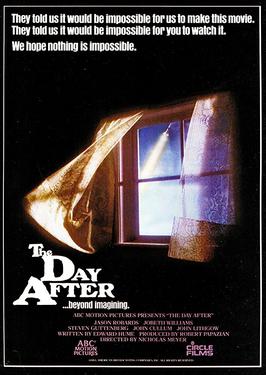
The words of Joe Huxley (John Lithgow) hang over the ending of The Day After, a 1983 film that imagines what the aftermath of a nuclear war would be like not on the East or the West Coasts but instead in the rural heartland of America. Huxley is a professor at the University of Kansas and, as he explains early on in the film, Kansas would be an automatic target in any nuclear war because it houses a number of missile silos. When he explains that, it’s in an almost joking tone, largely because the missiles haven’t been launched yet. Instead, the only thing we’ve heard are a few barely noticed news stories about growing tensions between America and Russia. About halfway through The Day After, the bombs go off and there are suddenly no more jokes to be made.
When the bombs drop over Kansas, we watch as cities and field and people burst into flames. In a matter of minutes, several thousands are killed. I’m almost ashamed to admit that I was probably more upset by the image of a horse being vaporized than I was by the death of poor Bruce Gallatin (Jeff East), the college student who was planning on marrying Denise Dahlberg (Lori Lethin). I guess it’s because horses — really, all animals — have nothing to do with the conflicts between nations. Humans are the ones who take the time to build bigger and better weapons and The Day After is one of the few films about war that’s willing to acknowledge that, when humans fight, it’s not just humans that die.
The bombing sequence is lengthy and I have to admit that I was a bit distracted by the fact that I recognized some of the footage from other movies. A scene of panicked people running through a building was taken from Two-Minute Warning. A scene of a building exploding and a construction worker being consumed by flames was lifted from Meteor. As well, there’s some stock footage which should be familiar to anyone who has ever seen a documentary about the early days of the Cold War. Still, despite that, it’s an effective sequence simply because it’s so relentless. Some of the film’s most likable characters are vaporized before our eyes. Steve Guttenberg, of all people, is seen ducking into a store.
Guttenberg plays Stephen Klein, a pre-med student who manages to survive the initial attack and takes shelter with the Dahlberg family at their ranch. At first, it’s a bit distracting to see Steve Guttenberg in a very serious and very grim film about the nuclear apocalypse but he does a good job. The sight of him losing both his teeth and his hair carries a punch precisely because he is reliably goofy Steve Guttenberg.
If the film has a star, it’s probably Jason Robards, the doctor who witnesses the initial blast from the safety of his car and then treats the dying in Lawrence, Kansas. He does so, despite the fact that he doesn’t know if his wife, son, and daughter are even still alive. He continues to do so until he also falls ill with radiation poisoning. Knowing that he’s dying, he heads home just to discover that there is no home to return to.
Home is reccuring theme throughout The Day After. Everyone wants to return to their home but everyone’s home has been wiped out. “This is my home,” Jim Dahlberg (John Cullum) tries to explain before he’s attacked by a group of feral nomads. Home no longer exists and trying to pretend like life can go back to the way it once was is an often fatal mistake.
Real happy film, right? Yeah, this isn’t exactly a film that you watch for fun. I have to admit that I made a joke about how I wouldn’t want to die while wearing the unfortunate blue jumpsuit that Jason Robards’s daughter chooses to wear on the day of the nuclear attack and I felt guilty immediately. (Well, not that guilty. Seriously, it was a terrible fashion choice.) The Day After is a film that gives audiences zero hope by design. It was made at a time when it was generally assumed that nuclear was inevitable and it was designed to scare the Hell out of everyone watching. And while I can’t attest to how audience may have reacted in 1983, I can say that, in 2020, it’s still a powerful and disturbing film.
“Is anybody there? Anybody at all?” Joe Huxley asks and by the end of the film, the answer doesn’t matter. The damage has already been done.
Today’s horror on the lens is a 1978 made-for-TV movie that was directed by Wes Craven. Originally entitled Stranger In Our House, it was retitled Summer of Fear when it was released into theaters in Europe. Personally, I think Summer of Fear is a better title. It has a fun R.L. Stine feel to it.
As for the film itself, it tells the story of what happens when the recently orphaned Julia (Lee Purcell) moves in with her cousins in California. At first, Julia fits right in with her new family but, slowly and surely, her cousin Rachel (Linda Blair) comes to suspect that Julia might be a witch. And hey, who can’t relate to that? Seriously, everyone has that one cousin…
And, it’s actually pretty good. Working within the confines of what could and could not be shown on TV in the late 70s, Craven managed to make an effective little thriller.


 Through the Shattered Lens