Film Review: The Chase (dir by Arthur Penn)


The Chase, a small-town Texas melodrama from 1966, opens with Robert Redford escaping from prison.

Redford is playing Bubber Reeves. Bubber, we’re told, has spent the last few years in a tough Texas prison, convicted of a murder that he didn’t commit. Now, he’s on the run and he’s probably returning to his hometown. His wife, Anna (Jane Fonda), still lives there, though Anna is now having an affair with Jake Rogers (James Fox). Jake is the son of the most powerful man in town, Val Rogers (E.G. Marshall). Jake also used to be Bubber’s best friend but now, he’s wracked with guilt about his affair with Anna.

Meanwhile, the townspeople are all worried that Bubber is going to seek revenge on the people who were responsible for him going to prison. Some of them know that he was actually innocent and some of them think that he’s actually the killer that he’s been made out to be but what they all have in common is that they’re worried about what Bubber’s gong to do when he shows up. Maybe they should have thought about the possibility of him getting mad and vengeful before they gave him a nickname like Bubber.

Anyway, Sheriff Calder (Marlon Brando) is convinced that Bubber is innocent but the townspeople still want him to allow them to gun Bubber down as soon as they see him. Sheriff Calder, however, is determined to keep the peace and make sure that the law prevails. He’s a man of unimpeachable integrity, working in a town full of people who are too cowardly to concern themselves with doing the right thing.

As everyone waits for Bubber to arrive. tempers come to the surface, a good deal of alcohol is consumed, and secrets are revealed. It all ends in tragedy, of course. One of the final scenes clumsily recreates the assassination of Lee Harvey Oswald. The Chase wouldn’t be an achingly self-serious film from 1966 if it didn’t.

There’s a few obvious problems with The Chase, the main one being that Robert Redford, who was 30 years-old when The Chase was released, looks surprisingly good for someone who has spent the last few years locked away in a tough Texas prison. Redford manage to escape from prison and run through a swamp without getting one single hair out of place. There’s nothing particularly dangerous about Redford in this film, which is surprising when you consider that The Chase was made just three years before Redford’s convincing turn as a laconic (if charming) killer in Butch Cassidy and the Sundance Kid. For The Chase to work, Bubber Reeves would have to be a force of nature but, whenever Redford’s on screen, you just find yourself wondering how someone who looks that good got stuck with a nickname like Bubber. The townspeople talk about Bubber like he’s a wild outlaw but Redford is just too laid back to pull it off. He comes across less like a wanted criminal and more like a California surfer who has somehow found himself in rural Texas.

As for the rest of the cast — well, there’s a lot of them. It’s a big ensemble film and good luck to anyone trying to keep track of who is related to who. Surprisingly enough, Marlon Brando is very convincing as a Texas sheriff, never allowing Sheriff Calder to turn into a stereotype. Less surprising is the fact that Robert Duvall, playing an frustrated husband, is also convincing in his role. Brando and Duvall, of course, would both go on to co-star in The Godfather. (Supposedly, when shooting of The Godfather began, Duvall was the only member of the cast with no fear of joking around with Brando, largely because they had bonded while working on The Chase.) Unfortunately, as good as Brando and Duvall are, they’re both let down in the hair department. Brando gets stuck with a hairpiece while Duvall is forced to go with a comb-over.

Some of the other performers are good and some of them are bad but none of them are particularly convincing as the residents of a small Texas town. James Fox, for instance, is very British. Jane Fonda and Angie Dickinson (cast as Calder’s wife) seem to be bored. E.G. Marshall is believably rich but never believably Southern. The other performers all tend to overact, especially once the people in town start drinking, shooting, hitting, and, in some cases, dancing. Somehow, Shelley Winters is not in the film, even though it seems like she should be.

The Chase was directed by Arthur Penn and written by Lillian Hellman. (The screenplay was based on a play and novel by Horton Foote.) Penn would follow up The Chase with Bonnie and Clyde and Alice’s Restaurant, two films that also dealt, for more successfully, with The Chase‘s themes of violence, community hypocrisy, and outlaw romanticism. Jane Fonda would go on to play Lillian Hellman in the 1977 film, Julia. For Julia, Fonda was nominated for an Oscar. For The Chase, she was not.

The Chase is one of those films that wants to say something important but doesn’t seem to be quite sure what. It’s a long and dramatic movie that doesn’t really add up to much. In the end, I think the main lesson to be learned here is not to allow your children to get a nickname like Bubber. There’s just no escape from a bad nickname.

30 Days of Noir #24: Fourteen Hours (dir by Henry Hathaway)


As a genre, film noir has always been associated with crime: murder, brutish gangsters, seductive femme fatales, and occasionally a cynical private detective doing the right thing almost despite himself.  However, not all film noirs are about criminals.  Some are just about desperate characters who have found themselves on the fringes, living in a shadow-filled world that appears to be monstrously indifferent to all human suffering.

That’s certainly the case with the 1951 noir, 14 Hours.  The film centers around Robert Cosick (Richard Basehart, who previously played a murderer in another classic noir, He Walked By Night).  Robert isn’t a gangster.  He’s not a private detective.  He doesn’t carry a gun and he doesn’t provide any sort of hard-boiled narration.  In fact, for the majority of the film, Robert is defined by less who he is and more by what he’s doing.  Robert Cosick, having earlier checked into a room on the 15th floor of a New York hotel, has climbed out of a window and is now standing on a ledge.  Robert says that he’s going to jump.

What has driven Robert Cosik to consider such an extreme action?  The film never settles on any one reason, though it gives us several clues.  When his father (Robert Keith) and his mother (Agnes Moorehead) show up at the scene, they immediately start bickering about old family dramas.  When Robert’s ex-fiancee (Barbara Bel Geddes) begs him to step in from the ledge, he listens a bit more to her than he did to his parents but he still refuses to come in from the ledge.

But perhaps the real reason that Robert Cosick is out on that ledge can be found in the film’s shadowy visuals.  Directed in a semi-documentary fashion by Henry Hathaway and featuring harsh, black-and-white cinematography that’s credited to Joe MacDonald, Fourteen Hours emphasizes the indifference of the city.  From the menacing landscape of concrete buildings to the crowds gathering below the ledge to see if Robert lives or dies,  New York City is as much as a character in this film as Robert, his family, or the cop (played by Paul Douglas) who finds himself trying to talk Robert into reentering his hotel room.  When night falls, the city may light up but it does nothing to alleviate the shadows that seem to be wrapping themselves around Robert.  For the fourteen hours that Robert is on that ledge, he may be the center of the world but the film leaves little doubt that New York City will continue to exist in all of its glory and its horror regardless of how Robert’s drama plays out.  Whether he lives or dies, Robert appears to be destined to be forgotten.

When the film isn’t concentrating on the cops trying to talk Robert into getting back in the hotel room, it shows us the reactions of the people who see him standing out on that ledge.  (If this film were made today, everyone would be holding up their phones and uploading Robert’s plight to social media.)  Some people are moved by Robert’s struggle.  For instance, a young woman played by Grace Kelly (in her film debut) reaches a decision on whether or not to get a divorce based on what she sees happening on the ledge.  Two office workers (played by Jeffrey Hunter and Debra Paget) even strike up a romance as they wait to see what will happen.  Some people view Robert as being a madman.  Others see him as being a victim.  And then there’s the many others who view him as being either a minor distraction or a piece of entertainment.  For them, it’s less important why Robert’s on the ledge or even who Robert is.  What’s important to them is how the story is going to end.

It’s not a particularly happy film but it’s made watchable by Hathaway’s intelligent direction and the performances of Paul Douglas and Richard Basehart.  With its theme of instant fame and hollow indifference, it’s a film that remains as relevant today as when it was initially released.

Cannes Film Review: Missing (dir by Costa-Gavras)


The 1982 film Missing takes place in Chile, shortly after the American-backed military coup that took out that country’s democratically elected President, Salvador Allende.

Of course, the film itself never specifically states this.  Instead, it opens with a narrator informing us that the story we’re about to see is true but that some names have been changed “to protect the innocent and the film.”  The film takes place in an unnamed in South America, where the military has just taken over the government.  Curfew is enforced by soldiers and the sound of gunfire is continually heard in the distance.  Throughout the film, dead bodies pile up in the streets.  Prisoners are held in the National Stadium, where they are tortured and eventually executed.  Women wearing pants are pulled out of crowds and told that, from now on, women will wear skirts.  The sky is full of helicopters and, when an earthquake hits, guests in a posh hotel are fired upon when they try to leave.  About the only people who seem to be happy about the coup is the collection of brash CIA agents and military men who randomly pop up throughout the film.

Again, the location is never specifically identified as Chile.  In fact, except for the picture of Richard Nixon hanging in the American embassy, the film never goes out of its way to point out that the film itself is taking place in the early 70s.  If you know history, of course, it’s obviously meant to be Chile after Allende but the film itself is set up to suggest that the story its telling is not limited to one specific place or time.

Charlie Horman (John Shea) is an American who lives in the country with his wife, Beth (Sissy Spacek).  Charlie is a writer who occasionally publishes articles in a local left-wing newspaper.  In the aftermath of the coup, Charlie is one of the many people who go missing.  All that’s known is that he was apparently arrested and then he vanished into the system.  The authorities and the American ambassador insist that Charlie probably just got lost in the confusion of the coup and that he’ll turn up any day.  Even though thousands have been executed, everyone assumes that Charlie’s status as an American would have kept him safe.  As brutal as the new government may be, they surely wouldn’t execute an American….

Or, at least, that’s what Ed Horman (Jack Lemmon) believes.  Ed is Charlie’s father, a businessman from New York who simply cannot understand what’s going on.  He can’t understand why his son and his daughter-in-law went to South America in the first place.  He can’t understand why his government is not doing more to find his son.  And, when he eventually arrives in South America himself, Ed cannot understand the violence that he sees all around him.

Working with Beth, Ed investigates what happened to his son.  At first, Ed blames Beth for Charlie’s disappearance and Beth can barely hide her annoyance with her conservative father-in-law.  But, as their search progresses, Beth and Ed come to understand each other.  Beth starts to see that, in his way, Ed is just as determined an idealist as Charlie.  And Ed learns that Charlie and Beth had good reason to distrust the American government…

Costa-Gavras is not exactly a subtle director and it would be an understatement to say that Missing is a heavy-handed film.  The Embassy staff is so villainous that you’re shocked they don’t all have mustaches to twirl while considering their evil plans.  When, in a flashback, Charlie meets a shady American, it’s not enough for the man to be a CIA agent.  Instead, he has to be a CIA agent from Texas who heartily laughs after everything he says and who brags on himself in the thickest accent imaginable.  When Charlie talks to an American military officer, it’s not enough that the officer is happy about the coup.  Instead, he has to start talking about how JFK sold everyone out during the Bay of Pigs.

As the same time, the film’s lack of subtlety also leads to its best moments.  When Beth finds herself out after curfew, the city turns into a Hellish landscape of burning books and dead bodies.  As Beth huddles in a corner, she watches as a magnificent white horse runs down a dark street, followed by a group of gun-toting soldiers in a jeep.  When Ed and Beth explore a morgue, they walk through several rooms of the “identified” dead before they find themselves in a room containing the thousands of unidentified dead.  It’s overwhelming and heavy-handed but it’s also crudely effective.  While the film itself is a bit too heavy-handed to really be successful, those scenes do capture the horror of living under an authoritarian regime.

(Interestingly, Missing was a part of a mini-genre of films about Americans trapped in right-wing South American dictatorships.  While you can’t deny the good intentions of these films, it’s hard not to notice the lack of films about life in Chavez’s Venezuela or the political dissidents who were lobotomized in Castro’s Cuba.)

Missing won the Palme d’Or at the 1982 Cannes Film Festival (an award that it shared, that year, with the Turkish film Yol) and it also received an Oscar nomination for best picture of the year.  (It lost to Gandhi.)

Film Review: Kid Blue (1973, directed by James Frawley)


KidBlueFor the past week and a half, I have been on a major Warren Oates kick.  The latest Oates film that I watched was Kid Blue, a quirky western comedy that features Warren in a small but key supporting role.

Bickford Warner (Dennis Hopper) is a long-haired and spaced-out train robber who, after one failed robbery too many, decides to go straight and live a conventional life.  He settles in the town of Dime Box, Texas.  He starts out sweeping the floor of a barber shop before getting a better job wringing the necks of chickens.  Eventually, he ends up working at the Great American Ceramic Novelty Company, where he helps to make ashtrays for tourists.

He also meets Molly and Reese Ford (Lee Purcell and Warren Oates), a married couple who both end up taking an interest in Bickford.  Reese, who ignores his beautiful wife, constantly praised Greek culture and insists that Bickford take a bath with him.  Meanwhile, Molly and Bickford end up having an affair.

Bickford also meets the local preacher, Bob (Peter Boyle).  Bob is enthusiastic about peyote and has built a primitive flying machine that he keeps in a field.  The town’s fascist sheriff, Mean John (Ben Johnson), comes across Bob performing a river baptism and angrily admonishes him for using “white man’s water” to baptize an Indian.

Bickford attempts to live a straight life but is constantly hassled by Mean John, who suspects that Bickford might actually be Kid Blue.  When Bickford’s former criminal partner (Janice Rule) shows up in town and Molly announces that she’s pregnant, Bickford has to decide whether or not to return to his old ways.

Kid Blue is one of a handful of counterculture westerns that were released in the early 70s.  The film’s biggest problem is that, at the time he was playing “Kid” Blue, Dennis Hopper was 37 and looked several years older.  It’s hard to buy him as a naïve naif when he looks older than everyone else in the cast.  As for Warren Oates, his role was small but he did great work as usual.  Gay characters were rarely presented sympathetically in the early 70s and counter-culture films were often the worst offenders.  As written, Reese is a one-note (and one-joke) character but Warren played him with a lot of empathy and gave him a wounded dignity that was probably not present in the film’s script.

Kid Blue plays out at its own stoned pace, an uneven mix of quirky comedy and dippy philosophy.  Still, the film is worth seeing for the only-in-the-70s cast and the curiosity factor of seeing Dennis Hopper in full counterculture mode, before he detoxed and became Hollywood’s favorite super villain.

o_kid-blue-dvd-dennis-hopper-warren-oates-5cdc

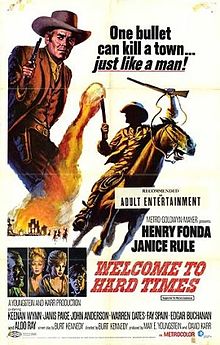
Film Review: Welcome to Hard Times (1967, directed by Burt Kennedy)


220px-WelcomehardtimesWelcome to Hard Times is a western that used to frequently turn up on TV when I was a kid.  I remembered that I had always enjoyed it but otherwise, I had largely forgotten about it when I saw that it was airing on TCM earlier today.  I rewatched it to see if I would still enjoy it.  Welcome To Hard Times has its flaws but it is still an above average addition to the genre.

Based on a novel by E.L. Doctorow, Welcome to Hard Times takes place in the small western settlement of Hard Times, Nevada.  When the mysterious Man From Bodie (Aldo Ray) shows up, he terrorizes everyone in the town.  When the town founder, Mr. Fee (Paul Birch), attempts to stand up to him, the Man from Bodie shoots him dead.  When the local undertaker, Mr. Hansen (Elisha Cook, Jr.) tries to stop the Man from stealing one of his horses, the Man silently guns him down.  As the town’s mayor, Will Blue (Henry Fonda), stands by and helplessly watches, The Man rapes and murders Fee’s girlfriend and also kills the local saloonkeeper, Avery (Lon Chaney, Jr.).  The Man burns down the town and finally leaves.

Thought most of the surviving townspeople abandon Hard Times, Will Blue stays behind and tries to rebuild.  He adopts Fee’s son, Jimmy (Michael Shea).  Also staying behind is Jimmy’s mother, Molly Riordan (Janice Rule), a former saloon girl who was also raped by the Man and who constantly taunts Will for not being able to stand up to him.  New settlers arrive and the town starts to rebuild.  Zar (Kennan Wynn) and his four girls reopen the saloon and serve the workers at a nearby mine.  Isaac Maple (John Anderson) reopens the general store.  Under Will’s leadership, Hard Times starts to thrive.

A drifter named Leo Jenks (the great Warren Oates) also moves in.  When Molly discovers that Leo is a crack shot, she gets him to teach Jimmy how to handle a shotgun.  Both she and Will know that the Man is going to return in the spring.  Molly is obsessed with vengeance and Will fears that Jimmy is going to be consumed by her hatred.

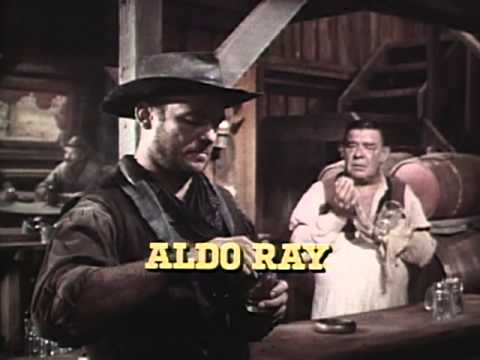
Aldo Ray  Welcome to Hard Times (1967)Of course, the Man does eventually return.

Welcome to Hard Times works best at the beginning and the end, when Aldo Ray is on-screen.  As the sadistic Man from Bodie, Ray gives a classic western bad guy performance.  He’s intimidating, he’s violent, and he guns down the citizens of Hard Times with even more casual arrogance than Lee Marvin, Jack Palance, and Lee Van Cleef combined!  The middle section of the film drags and it is hard to ignore Jane Rule’s shaky Irish accent.  It is obvious that Welcome to Hard Times is trying to say something about Will Blue’s humanistic approach but it does not seem to know what.

Director Burt Kennedy was best known for directing comedic westerns.  Welcome to Hard Times was a rare dramatic film for him.  It’s not a great western but, thanks to Aldo Ray’s performance and the excellent work of cinematography Harry Stradling, Jr., it’s still a worthy addition to the genre.


Aldo Ray

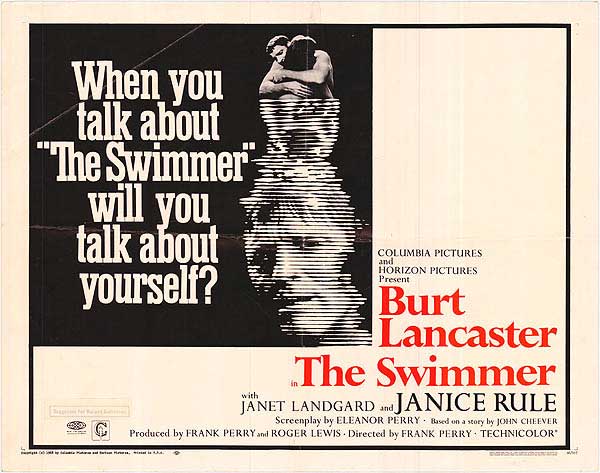
Embracing the Melodrama #23: The Swimmer (dir by Frank Perry)


The Swimmer

The 1968 film The Swimmer opens with Ned Merrill (Burt Lancaster) emerging from the woods that surround an affluent Connecticut suburb.  He’s a tanned, middle-aged man and, because he spends the entire film wearing only a bathing suit, we can tell that he’s still in good shape for a man in his 50s.  When Ned speaks, it’s with the nonstop optimism of a man who has found and claimed his part of the American Dream.  In short, Ned appears to be ideal American male, living in the ideal American community.

However, it gradually starts to become apparent that all is not well with Ned.  When he mysteriously shows up at a pool party being held by a group of his friends, they all seem to be shocked to see him, commenting that it’s been a while since Ned has been around.  Ned, however, acts as if there’s nothing wrong and instead talks about how beautiful the day is and says that he’s heading back to his home.  He’s figured out that all of his neighbor’s swimming pools form a “river” to his house and Ned’s plan is to swim home.

And that’s exactly what Ned proceeds to do, going from neighbor to neighbor and swimming through their pools.  As he does so, he meets and talk to his neighbors and it becomes more and more obvious that there are secrets hidden behind his constant smile and friendly manner.  As Ned gets closer and closer to his actual home, the neighbors are far less happy to see him.

At one house, he runs into Julie (Janet Landgard) who used to babysit for his daughter.  Julie agrees to swim with Ned and eventually confesses that she once had a crush on him.  When Ned reacts by promising to always protect  and love her, Julie gets scared and runs away.

At another house, Ned comes across another pool party.  A woman named Joan (played by a youngish Joan Rivers) talks to him before a friend of her warns her to stay away from Ned.

When Ned reaches the house of actress Shirley (Janice Rule), it becomes obvious that Shirley was once Ned’s mistress.  They discuss their relationship and it quickly becomes apparent that Ned’s memories are totally different from Shirley’s.

And, through it all, Ned keeps swimming.  Even when he’s offered a ride to his house, Ned replies that he has to swim home.

The Swimmer is a film that I had wanted to see ever since I first saw the trailer on the DVD for I Drink Your Blood.  (That’s an interesting combination, no?  I Drink Your Blood and The Swimmer.)  I finally saw the film when it showed up on TCM one night and, when I first watched it, I have to admit that I was a little disappointed.  Stylistically, the film itself is such a product of the 1960s that, even though suburban ennui and financial instability are still very relevant topics, The Swimmer felt rather dated.  I mean, I love a good zoom shot as much as anyone but, often times during the 60s, they seemed to be used more for the sake of technique than the sake of story telling.

However, the second time I sat through The Swimmer, I appreciated the film a bit more.  I was able to look past the stylistic flourishes of the direction and I could focus more on Burt Lancaster’s excellent lead performance.  Lancaster plays Ned as the epitome of the American ideal and, as a result, his eventual collapse also mirror the collapse of that same ideal.  The Swimmer is based on a short story by John Cheever and, quite honestly, the film’s story is a bit too much of a literary conceit to really work on film.  That said, The Swimmer — much like the character of Ned Merrill — is an interesting failure, which is certainly more than can be said of most failures.