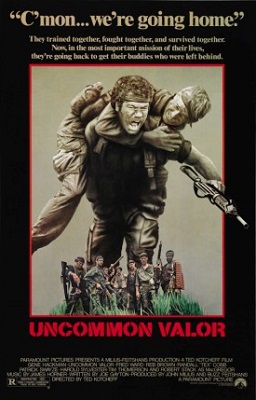
Uncommon Valor (1983, directed by Ted Kotcheff)


Retired Marine Colonel Jason Rhodes (Gene Hackman) and oilman Harry MacGregor (Robert Stack) share a tragic bonf.  Both of them have sons that served in Vietnam and are listed as being MIA.  Believing that their sons are still being secretly held in a POW camp in Loas, Rhodes and MacGregor put together a team to sneak into Southeast Asia and rescue them.

With MacGregor supplying the money and Rhodes leading the mission, the team includes Blaster (Red Brown), Wilkes (Fred Ward), Sailor (Randall “Tex” Cobb), and Charts (Tim Thomerson), all of whom served with Rhodes’s son.  Also joining in his helicopter pilot Curtis Johnson (Harold Sylvester) and former Marine Kevin Scott (Patrick Swayze), whose father was also listed as being MIA in Vietnam.  After a rough start, the group comes together and head into Laos to bring the prisoners home!

Uncommon Valor is one of the many movies released in the 80s in which Vietnam vets returned to Asia and rescued those who were left behind.  In the 80s, there was a very strong belief amongst many Americans that soldiers were still being held prisoner in Vietnam, Cambodia, and Laos and Hollywood was quick to take advantage of it.  The box office success of Uncommon Valor set the stage for films like Rambo and Missing In Action, film in which America got the victory that it had been denied in real life.

What set Uncommon Valor apart from the films that followed was the cast.  Not surprisingly, Gene Hackman brings a lot more feeling and nuance to his performance as the obsesses Col. Rhodes than Sylvester Stallone and Chuck Norris brought to their trips to Vietnam.  The film surrounds Hackman with a quirky supporting cast, all of whom represent different feelings about and reactions to the war in Vietnam.  Fred Ward’s character suffers from PTSD.  Randall “Tex” Cobb, not surprisingly, is a wild man.  Patrick Swayze’s character is trying to make the father he’ll never know proud.  Robert Stack and Gene Hackman represent the older generation, still trying to come to terms with everything that was lost in Vietnam and still mourning their sons.  The raid on the POW camp is exciting but it doesn’t feature the type of superhuman action that’s present in other POW-rescue films.  Col. Rhodes and his soldiers are ordinary men.  Not all of them survive and not all of them get what they want.

Uncommon Valor started out as a screenplay from Wings Hauser, though he’s not present in the cast of the final film and he was only given a “story” credit.  John Milius served as producer. Director Ted Kotcheff is best-known for First Blood, another action film about America’s struggle to come to terms with the Vietnam War.
Retro Television Review: St. Elsewhere 1.13 “Family History”


Welcome to Retro Television Reviews, a feature where we review some of our favorite and least favorite shows of the past! On Fridays, I will be reviewing St. Elsewhere, a medical show which ran on NBC from 1982 to 1988.  The show can be found on Hulu and, for purchase, on Prime!

Usually, I review this show on Friday but, yesterday, my week of visiting Lake Texoma in freezing weather finally caught up with me and I spent most of the day congested and curled up in bed.  As a result, St. Elsewhere got preempted until today.  Now, let’s see what’s happening at St. Eligius….

Episode 1.13 “Family History”

(Dir by Kevin Hooks, originally aired on February 8th, 1983)

After being a background character for the past few episodes, Dr. Wendy Armstrong (Kim Miyori) finally gets her time in the spotlight with this episode.  When Charlie Heller (Keenan Wynn) comes into the ER with a chronic nosebleed, Dr. Armstrong is too quick to assume that it’s nothing serious.  Dr. Westphall, who is in an especially crappy mood this episode, reprimands her for not getting a family history before making her diagnosis.  A chastened Armstrong gets Charlie’s family history and comes to suspect that he has a rare blood condition that only seems to effect Jewish men.  A very expensive test confirms Armstrong’s diagnosis.  Armstrong is excited.  “I was right!” she says.  Westphall again reprimands her, telling her that she now needs to tell Charlie that he has a chronic condition and will have to take medicine for the rest of his life.

Seriously, Westphall was not in a good mood during this episode!  But I don’t blame him.  From her first appearance on the show, Dr. Armstrong has been complaining nonstop.  No matter what happens in the hospital, she seems to take it as a personal affront.  Now, after several episodes of complaining about the other doctors, Armstrong fails to do a simple thing like get a family history.  No wonder Westphall was all like, What are you bragging about?

That said, even if his mood was understandable, I would not want to get on Westphall’s bad side.  Even after Armstrong makes the correct diagnosis, Westphall takes the time to say, “Next time, do what I told you to do.”  Agck!

While Westphall was dealing with whatever was eating away at him, Dr. Chandler was getting annoyed by John Doe’s refusal to try to remember anything about his past.  Even when John Doe’s real father showed up and explained that Doe was his son, Dave Stewart, he refused to try to remember anything.  Eventually, Chandler snapped at Dave for refusing to even try.  Chandler, of course, is played by a young Denzel Washington so, when he gets mad, it’s like having the voice of God call you out.  After Chandler’s reprimand, Dave finally makes an effort to remember his past.  He realizes that, when he was shot, he had a vision of his deceased mother welcoming him to heaven.  Awwww!

Dr. Craig’s friend has his gender affirmation surgery.  Crag met his friend’s lover, a trans man.  Needless to say, this episode featured a lot of scenes of Craig rolling his eyes as he struggled to come to terms with everything he was learning about his old friend.  It was all pretty predictable but William Daniels did a great job playing up Craig’s confusion and single-mindedness.

And finally, Peter was happy because his wife wanted to get back together.  I get the feeling any happiness Peter feels is destined to always be temporary.

This episode was a bit uneven.  Armstrong’s story would have been compelling if Armstrong herself was a more interesting character.  The highlight of the episode were the scenes between Denzel Washington’s doctor and Tom Hulce’s amnesiac.  It’s always enjoyable to watch two good actors perform opposite of each other.

Next week, the great Norman Lloyd takes center stage as Auschlander’s cancer returns.


Retro Television Review: St. Elsewhere 1.12 “Release”


Welcome to Retro Television Reviews, a feature where we review some of our favorite and least favorite shows of the past! On Fridays, I will be reviewing St. Elsewhere, a medical show which ran on NBC from 1982 to 1988.  The show can be found on Hulu and, for purchase, on Prime!

This week, things get dark.

Episode 1.12 “Release”

(Dir by Victor Lobl, originally aired on February 1st, 1983)

The gunshot victim (Tom Hulce) who was saved by Samuels last week has woken up but he has no idea who he is.  He is labeled John Doe #12, meaning there’s at least eleven other people at St. Eligius who are suffering from amnesia!  That’s a scary thought.  There’s a lot of things that I don’t want to suffer from and amnesia is high on the list.  I can’t imagine how frightening that would be, not having any idea who you are or where you belong.

Dr. Chandler tries to help John Doe #12 get his memory back but, in this episode at least, neither has any luck.  Even an attempt at hypnosis reveals that John can’t remember anything before being rolled into the ER.  At one point, an older couple step into the room to discover if John is their son, who has been missing for two years.  He’s not, which leaves the couple in tears.

As serious and as heart-breaking as this all is (and both Washington and Hulce give outstanding performances in this episode), there is one moment where Dr. Westphall makes a reference to a “Lt. Gerard,” who is searching for John’s parents.  It seems like a throw-away reference, unless you’re familiar with either the 1950s television show The Fugitive or the subsequent 1993 film adaptation.  Lt. Gerard was the name of the detective who was hunting for that show’s main character, Dr. Richard Kimble.  Ed Flanders delivers the line solemnly and it occurs at a serious moment.  There’s no winking at the audience.  Instead, it’s simply a reward for the pop culture-literate who might be watching the episode.

For the most part, this was a grim episode.  After losing a patient to cancer, Dr. Peter White was ordered to talk his family into signing a release for an autopsy.  The autopsy was largely to protect the hospital from getting sued.  The family didn’t want an autopsy.  Peter didn’t feel the autopsy was necessary.  But, having been bullied by his superiors, Peter proceeded to bully and manipulate the dead man’s son into signing the release.  In the end, it turned out that Peter was correct.  The man did die of cancer.  The autopsy was not necessary.  Upset over the whole process, Peter said that he felt like he had “raped” a mourning family.  The doctor who ordered Peter to get the release merely smiled and said he would see Peter at rounds the next day.

Meanwhile, Dr. Craig was shocked and angered when he discovered that his old friend (played by Andy Romano) had checked into the hospital for gender-affirming surgery.  This led to the episode final scene, in which Craig talked about not liking the way the world had changed since he was a young man.  The scene was well-acted by William Daniels, who was one of the best when it comes to giving a monologue of frustration.

And finally, Dr. Samuels and Dr. Paxson disagreed on how to treat a patient and this storyline would have been interesting if either Samuels or Paxson had been an interesting character.  But they’re not.  I don’t care about them.  I don’t care about their boring relationship.  And, knowing that neither is going to be around once this season ends, I really didn’t care that much about their storyline.  With all of the interesting stuff that happened in this episode, I groaned whenever I realized I was going to waste a few minutes watching Samuels and Paxson argue.

This episode left me feeling pretty depressed.  Between Peter bullying that family and John Doe searching for his identity, there wasn’t much hope to be found.  Still, I have faith that John Doe will find his identity and maybe Peter will even become a better doctor.  (He certainly can’t get much worse.)  If Lt. Gerard could find Richard Kimble, then anything’s possible!


Retro Television Review: St. Elsewhere 1.11 “Graveyard”


Welcome to Retro Television Reviews, a feature where we review some of our favorite and least favorite shows of the past! On Fridays, I will be reviewing St. Elsewhere, a medical show which ran on NBC from 1982 to 1988.  The show can be found on Hulu and, for purchase, on Prime!

This week, a handful of doctors save two patients and lose one.

Episode 1.11 “Graveyard”

(Dir by Victor Lobl, originally aired on January 18th, 1983)

It’s the graveyard shift at St. Eligius.  The halls and the cafeteria are dark.  The ER is oddly calm.  There are only a few patients to be looked after and most of the doctors are playing poker and talking about the rather boring subject of Dr. Samuels’s love life.

Only a handful of the series regulars make an appearance in this episode but that’s fine.  This episode actually provides a nice break from having to keep track of where everyone is.  Unfortunately, as I already said, a lot of this episode is centered around the character of Dr. Samuels.  Nothing against the late David Birney, who did a perfectly acceptable job in the role, but Dr. Ben Samuels is just not that interesting of a character.  He’s a dedicated surgeon who feels too much, drinks too much, and wants to sleep with his colleagues.  That’s fine but I grew up watching General Hospital.  I’ve seen a hundred doctors just like Samuels on television.

To me, the far more interesting characters are the people like David Morse’s Jack Morrison or Ed Begley, Jr’s Victor Ehrlich or even Terence Knox’s Peter White.  They’re doctors who screw up and aren’t always brilliant and sometimes say the wrong things.  They feel like real people whereas Dr. Samuels just feels like a cliche, a holdover from some other medical show.  Samuels is not a particularly compelling character and, when I did some research, I was not surprised to discover that David Birney only appeared on one season of the show.

G.W. Bailey’s Hugh Beale also only appeared in the first season and that’s a shame because Bailey’s performance as Beale has been one of the first season’s real pleasures.  Bailey plays Beale as a compassionate man who often pretends to be more naive than he is.  As a Southerner, he’s an outsider on this Boston-set show and, being an outsider, he can often relate to the patients in the psych ward.  Of course, that still doesn’t stop Dr. Beale’s main patient, Ralph the Birdman, from throwing himself off the roof of the hospital in this episode.  To be honest, I already suspected things weren’t going to go well for Ralph on this show but his suicidal jump still upset me.  As annoying as the character was, he was also finally making some progress.  He finally admitted he wasn’t a bird.  And then he proved it by showing that he couldn’t fly.

While Ralph plunged to his death, Dr. Samuels saved a gunshot victim (played by Tom Hulce).  And Jack allowed the father (James Hong) of one of his comatose patients to perform a Chinese ritual that led to the patient waking up and eventually walking into the cafeteria, where the doctors were playing poker.  “Who ordered the Chinese?” Fiscus asked and …. ugh.  Not cool, Fiscus.

It was a night of triumph and tragedy.  Ralph died but Dr. Samuels and Dr. Paxton agreed to give their relationship another try which …. eh.  I don’t care about Samuels and Paxton.  For the most part, though, I liked this episode.  The smaller cast made it easier to keep track of things and the poker game banter reminded me that the doctors are all people too.  Still, I have to feel bad for Ralph.  All he wanted to do was fly.

The Things You Find On Netflix: 6 Balloons (dir by Marja Lewis-Ryan)


Poor Katie (Abbi Jacobson)!

All she wants to do is throw a surprise party for her new boyfriend and enjoy the 4th of July.  Is that too much to ask?  However, things are never easy.  Her friends are ruthless in their critique of what she’s planning to wear.  Her mother (Jane Kaczmarek) keeps pressuring her to go down to CVS and buy more makeup.  As for her father (Tim Matheson) — well, he’s just too damn good-looking.  All of her friends want to know if it was difficult for Katie to grow up with a “hot dad.”  Katie says it was.

You know what’s even more difficult though?

Trying to throw a surprise birthday party while also trying to take care of your niece and your junkie brother!

From the minute we meet Seth (Dave Franco) it’s obvious that he’s on something.  As soon as Katie orders him to roll up his sleeves, we know that this is not a new thing with Seth.  Seth is a junkie, the type who shoots up in grocery store bathrooms and who buys his heroin from a man who lives in a yellow tent.  Seth isn’t one of those charming junkies, either.  He’s not Ewan McGregor in Trainspotting.  He’s a manipulative, self-centered asshole who agrees to go to detox but only if Katie agrees to pay for it and not tell anyone that he’s using again.  He’s the type who thinks nothing of begging his sister to leave the party that she’s spent weeks planning because he needs a ride to get one last hit before “getting clean.”

6 Balloons is a short film, one that takes place over the course of one long night.  While the party goes on without her, Katie drives Seth around the city.  Whenever Katie objects to what Seth is asking her to do, Seth guilts her.  He continually assures her that he just needs to get high one last time and then he’ll be able to do detox.  Meanwhile, Seth’s daughter sits in her car seat and begs to be taken home.

The acting is okay.  Both Dave Franco and Abbi Jacobson are best known for their comedic work so it’s interesting to see them taking on such dramatic roles here.  At the same time, it sometimes seems like both of them are trying too hard.  The same could be said of  6 Balloons.  This is a film that could have used a little dark humor.  Instead, it’s relentlessly grim and serious and, as a result, a bit of a chose to sit through.  For a 70 minute film, 6 Balloons seems to go on forever.

The problem with films about junkies is that, for the most part, hardcore junkies are dull people and not much fun to be around.  Christiane F, Trainspotting and several of the films influenced by them dealt with this problem by featuring a propulsive soundtrack and some imaginative cinematography.  (Trainspotting also wisely devoted more screen time to Mark and Sick Boy than to Spud.  Just imagine how difficult it would be to watch Trainspotting if the entire film had centered on Spud getting high and crawling underneath cars.)  With its hand-held camerawork and it’s subdued soundtrack, 6 Balloons takes more of a documentary approach.  The film will leave you with no doubt that heroin is bad and it’s not good to be an enabler but, at the same time, it’ll probably also inspire you to glance at the time and ask yourself, “Is this thing over yet?”

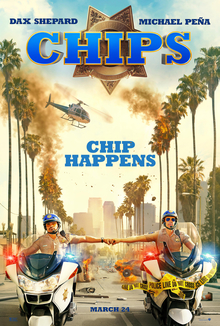
A Movie A Day #322: CHiPs (2017, directed by Dax Shepard)


Based on the campy 70s cop show that will live on forever in syndication, CHiPs is about two unlikely partners who, after a rough beginning, work together to catch a cop’s killer and capture a gang of armed robbers.
Officer Jon Baker (Dax Shepherd) is a flaky former motocross champion who joins the California Highway Patrol to try to impress his estranged wife (Kristen Bell).  Baker pops painkillers like candy, throws up whenever he enters an unfamiliar house, and has a knee that randomly goes out.  Baker can’t shoot, fight, or think but he sure can ride a bike.

Officer Francis Llewelyn “Ponch” Poncherello (Michael Pena) is actually an FBI agent named Castillo who has been assigned to work undercover to investigate corruption in the CHP.  Ponch is a sex addict who is obsessed with yoga pants and who keeps accidentally shooting his former partner (Adam Brody).

Both Baker and Ponch are given one identifying characteristic.  Baker’s thing is that he always says the wrong thing and then apologizes.  Ponch’s thing is that he always says the wrong thing and then doesn’t apologize.  That is about as deep as things get.

I’m not really sure who this movie is supposed to appeal to.  Michael Pena and Dax Shepard have been good in other productions but they’re both awful here, let down by a script that does not have much to offer beyond tepid bromance and dick jokes.  The humor is too deliberately lowbrow and raunchy to appeal to the people who were fans of the quaintly innocent TV show but it’s also neither meta nor clever enough to appeal to the audience that made hits out of 21 and 22 Jump Street.  I guess the ideal audience for this film would be people who still find gay panic jokes to be hilarious because CHiPs is full of them.  If the last movie you saw was made in 1999 and starred Adam Sandler and David Spade, CHiPs might be right up your alley.

CHiPs is a terrible fucking movie but what really distinguishes it from other terrible movies is the amount of contempt that it seems to have for its source material.  The Jump Street movies might have poked fun at the TV series that inspired them but it was still obvious that the films were being made by fans.  CHiPs can’t even be bothered to use the original’s theme music as anything other than a way to punctuate a few cheap jokes.  Erik Estrada, the original Ponch, does have a cameo but only so he and the new Ponch can talk about eating ass in Spanish.  Otherwise, there is nothing that links the movie to the TV show.  A more accurate title would have been Two Assholes On Motorcycles, except the motorcycles really are not that important to the film.  So, I guess the title would actually just have to be Two Assholes.  That sounds about right to me.

CHiPs proves that not every stupid cop show needs a movie version.  Now, excuse me while I get back to work on my T.J. Hooker spec script…

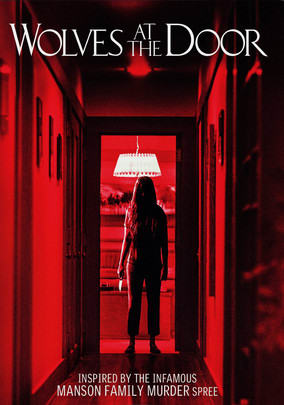
The TSL’s Horror Grindhouse: Wolves at the Door (dir by John Leonetti)


I’m really not sure what to make of Wolves at the Door.

I knew the film was inspired by the crimes of Charles Manson and his family before I watched the film.  Not only was Wolves at the Door specifically advertised as being “Inspired by The Infamous Manson Family Murder Spree” but just check out the plot description that was provided by Warner Bros:

Four friends gather at an elegant home during the Summer of Love, 1969. Unbeknownst to them, deadly visitors are waiting outside. What begins as a simple farewell party turns to a night of primal terror as the intruders stalk and torment the four, who struggle for their lives against what appears to be a senseless attack.

The Manson Family have inspired a countless number of films, so that’s not really an issue.  Almost all of those films either presented Manson and his followers as being the epitome of evil or they told stories that were heavily and obviously fictionalized.

Wolves at the Door, however, is different.  Other than in some news footage that is shown during the end credits, Manson is not seen in the film.  For that matter, the members of the Family don’t get much screen time either.  Mostly, they’re just seen as shadows, creeping down hallways and sometimes materializing in a doorway before vanishing.  There’s no mention of Helter Skelter or the Beatles.  I’d have to rewatch the film to say for sure but I think it’s possible that we only hear them say one or two words over the course of the entire movie.

Instead, Wolves at the Door spends most of its running time with the victims of the Manson Family, following them as they are unknowingly stalked inside of a Los Angeles mansion.  Usually, in a film like this, you would expect the names to be changed but, for some reason, that doesn’t happen in Wolves At The Door.

So, Katie Cassidy plays a pregnant actress who is named Sharon.

Elizabeth Henstridge plays a coffee heiress who is named Abigail.

Adam Campbell plays Abigail’s Polish boyfriend, who is named Wojciech.

Miles Fisher plays a hairdresser who is named Jay and who just happens to be Sharon’s ex-boyfriend.

And, finally, Lucas Adams plays a teenager stereo enthusiast named Steven, who just happens to be in the wrong place at the wrong time.

Speaking as someone who loves horror and who has defended some of the most critically derided films of all time, everything about Wolves at the Door just feels icky, tacky, and wrong.  Many grindhouse horror films have been inspired by actual crimes but most of them at least changed the names of the victims.   You really have to wonder just what exactly the filmmakers were thinking here.

(Then again, just two years ago, NBC greenlit a show called Aquarius, which could have just as easily been called “The Adventures of Young Charlie Manson.”)

It’s not just that Wolves at the Door is offensive.  In fact some of the best movies of all time were specifically designed to be offensive.  The problem with Wolves at the Door is that it’s also just a very shoddy film.  (In fact, if the film had been well-made, it wouldn’t be quite as offensive.)  Though the actors may be talented, they’re let down by a script that’s full of some of the clunkiest dialogue that I’ve ever heard.  Though the soundtrack may feature some good songs, they’re still the same damn songs that show up in every movie set in 1969.  (Judging from the movies, everyone in 1969 just listened to the same five songs over and over again.)  Though the movie itself is only 73 minutes long, it is so abysmally paced that it feels much, much longer.

Sadly, this film was directed by John Leonetti, who did a pretty good job with Annabelle.  Again, I’m not sure what exactly he or anyone else was thinking with Wolves at the Door, which I’m going to go ahead and declare to be the worst film of 2017.  I know that the year isn’t over yet but I just can’t imagine anything as bad as this.