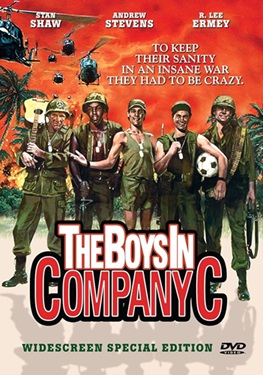
The Boys In Company C (1978, directed by Sidney J. Furie)


In 1967, a group of young men arrive at the Marie Corp. Recruit Depot in San Diego.  Tyrone Washington (Stan Shaw) is a drug dealer from Chicago who tells everyone not to mess with him and who soon emerges as a natural born leader.  Dave Brisbee (Craig Wasson) is a long-haired hippie who tried to feel to Canada and who shows up for induction in handcuffs.  Vinny Fazio (Michael Lembeck) is a cocky and streetwise kid from Brooklyn.  Billy Ray Pike (Andrew Stevens) is a country boy from Texas.  Alvin Foster (James Canning) is an aspiring writer who keeps a journal of his experiences.  Sgt. Loyce (R. Lee Ermey, making his film debut) molds them into a combat unit before they leave for Vietnam, where they discover that all of their training hasn’t prepared them for the reality of Vietnam.

The Boys In Company C has the same basic structure as Stanley Kubrick’s Full Metal Jacket, right down to R. Lee Ermey playing the tough drill sergeant.  The sharp discipline of basic training is compared to the chaos of Vietnam.  Ermey always said that he was playing a bad drill sergeant in Full Metal Jacket because he tore down the recruits but never bothered to build them back up.  In The Boys In Company C, Ermey plays a good drill sergeant, one who is tough but fair and who helps Washington reach his potential.  It doesn’t make any difference once the company arrives in Vietnam, though.  Both The Boys In Company C and Full Metal Jacket present the war in Vietnam as being run by a collection of incompetent officer who have no idea what it’s like for the soldiers who are expected to carry out their orders.

Of course, The Boys In Company C is nowhere near as good as Full Metal Jacket.  Full Metal Jacket was directed by Stanley Kubrick and it’s a chilling and relentless look at the horrors of combat.  The Boys In Company C was directed by Sidney J. Furie, a journeyman director who made a lot of movies without ever developing a signature style.  The basic training scenes are when the film is at its strongest.  When the company arrives in Vietnam, Furie struggles with the story’s episodic structure and it can sometimes be difficult to keep track of the large ensemble cast.  The Vietnam sequences are at their best when the emphasis is on the soldiers grumbling and bitching as their officers send them on one pointless mission after another.  The soccer game finale tries to duplicate the satire of the football game that ended Robert Altman’s M*A*S*H but it does so with middling results.  The Boys in Company C is a collection of strong moments that never manage to come together as a cohesive whole.

The movie is still important as one of the first major films to be made about the war in Vietnam.  However, it’s since been overshadowed by The Deer Hunter, Apocalypse Now, Platoon, and, of course, Full Metal Jacket.


The Unnominated: The Long Riders (Dir by Walter Hill)


Though the Academy of Motion Picture Arts and Sciences claim that the Oscars honor the best of the year, we all know that there are always worthy films and performances that end up getting overlooked.  Sometimes, it’s because the competition too fierce.  Sometimes, it’s because the film itself was too controversial.  Often, it’s just a case of a film’s quality not being fully recognized until years after its initial released.  This series of reviews takes a look at the films and performances that should have been nominated but were, for whatever reason, overlooked.  These are the Unnominated.

First released in 1980, The Long Riders is one of the many films to tell the story of the James/Younger Gang.

A group of former Confederate guerillas who became some of the most notorious bank robbers to roam post-Civil War America and who were based in Missouri, the brothers who made up the James/Younger Gang were hunted by the Pinkertons and beloved by the citizens who viewed them as being 19th Century Robin Hoods.  Following a disastrous attempt to rob a bank in Northfield, Minnesota, the Younger brothers were captured by the government while Jesse and Frank James made it back to Missouri.  Jesse was shot in the back by Bob Ford while Frank subsequently surrendered to authorities and made a good living on the lecture circuit.

The Long Riders tells the story of the gang, from their first encounter with the heavy-handed Pinkertons to the Northfield raid to Frank’s eventual surrender.  Director Walter Hill both celebrates the legend of the James/Younger Gang while also emphasizing that all the members of the gang were also individual humans who had their strengths and their flaws.  Hill emphasizes the idea of the gang being a group of post-war rebels, still fighting a war against a government that is more interested in protecting banks than looking after people.  The Long Riders deconstructs the legend while also celebrating it.

The main thing that sets The Long Riders apart from other films about the James/Younger Gang is the fact that the brothers are played by actual brothers.  David, Keith, and Robert Carradine plays the Youngers.  Randy Quaid plays Clell Miller while Dennis Quaid assumes the role of the cowardly Ed Miller.  Nicholas and Christopher Guest make a memorably creepy impression as Charley and Bob Ford.  And finally, Jesse and Frank James are played by James and Stacy Keach.  (The Keaches also worked on the film’s script).  And while Stacy is definitely the more charismatic of the Keach brothers, the film makes good use of James’s rather stoic screen presence.  While the rest of the gang enjoys the outlaw life, James Keach’s Jesse is rigid, serious, and ultimately too stubborn and obsessive for his own good.

Now, the casting might sound like a gimmick but it works wonderfully.  When Clell chooses the gang over Ed, it carries an emotional weight because we’re watching real brothers reject each other.  The comradery between the Carradines carries over to the comradery between the Youngers and it also informs their occasional rivalry with the better known James brothers.  While it is Stacy Keach and David Carradine who ultimately dominate the film, every brother in the cast makes a strong impression.  Also giving a memorable performance is Pamela Reed as a defiantly independent Belle Starr, who loves David Carradine’s Cole Younger but marries Sam Starr (James Remar).  The knife fight between Carradine and Remar is one of the film’s highlights, as is the violent and disastrous attempt to rob the bank in Northfield.

The Long Riders is an exciting and ultimately poignant western but sadly, it received not a single Oscar nomination, not even for the stunning cinematography or Ry Cooder’s elegiac score.  Fortunately, just like the legend of the James/Younger Gang, The Long Riders lives on.

Previous entries in The Unnominated:

  1. Auto Focus 
  2. Star 80
  3. Monty Python and The Holy Grail
  4. Johnny Got His Gun
  5. Saint Jack
  6. Office Space
  7. Play Misty For Me

Late Night Retro Television Reviews: Highway to Heaven 1.11 “Dust Child”


Welcome to Late Night Retro Television Reviews, a feature where we review some of our favorite and least favorite shows of the past!  On Thursdays, I will be reviewing Highway to Heaven, which aired on NBC from 1984 to 1989.  The entire show is currently streaming on Tubi and several other services!

This week, Jonathan offers up some clues about his past.

Episode 1.11 “Dust Child”

(Dir by Victor French, originally aired on November 28th, 1984)

Mark and Jonathan’s latest mission finds them in a small California town.  It seems like a nice and welcoming  community …. or, at least, it does if you’re an American.  If you are one of the many refugees from Vietnam who have recently settled in the town, it’s a far less welcoming place.

When Mark goes into a gas station, he witnesses the owner refusing to give change to two Vietnamese kids.  When Mark demands to know why, he’s told that the refugees are coming over and stealing everyone’s jobs.

“It’s a sickness worse than the plague,” Jonathan later says, “But the cure is in every one of us …. love!”  And that may sound a bit simplistic but Michael Landon delivers the line with such conviction that he totally makes it work.

Working as house painters, Jonathan and Mark get a job remodeling the home of Richard Gaines (James Whitmore, Jr.), a Vietnam vet who has just discovered that, as the result of a wartime romance, he has a daughter named Nguyen (Denice Kumagai).  15 year-old Nguyen comes over to America to live with Richard and his wife (Jenny Sullivan) and his teenage son, Brad Gaines (Billy Jacoby).  From the minute she arrives in the town, Nguyen finds herself facing prejudice.  The other kids at school taunt her with derogatory slurs.  Brad resents both the attention that Nguyen gets and the fact that his best friend, Larry (K.C. Martel), now refuses to talk to Brad because Larry’s father was killed while serving in Vietnam.

Eventually, Jonathan introduces himself to Larry and we discover a little bit about who Jonathan was before he became an angel.  Jonathan says that he served in Vietnam with Larry’s father and he goes on to explain that Larry’s father died while protecting a group of South Vietnamese orphans from the Viet Cong.  As Jonathan explains it, Larry’s father viewed the orphans as his own children.  That’s all it takes for both Larry and Brad to see the errors of their ways and to welcome Nguyen into the neighborhood.

(Is Jonathan telling the truth about serving in Vietnam with Larry’s father?  Jonathan’s an angel so I assume that he is.  That, of course, means that this episode’s mission was not to help Nguyen feel at home in America but instead to help Larry overcome his own prejudice.)

As Jonathan and Mark prepare to leave for their next assignment, two kids on bicycles ride by and shout a slur at Nguyen.  They immediately fall of their bicycles and, when they try to get back on, they fall off yet again.  Mark laughs and says that God probably won’t object to Jonathan making that happen.  Of course, if Mark read about what happened to the Canaanites, he would know those two kids got off easy.

Especially when compared to last week’s odd episode, this was an admirably straight-forward episode.  There weren’t any great surprises to how the story unfolded but the story was told with such obvious sincerity that it worked.  It can be easy to laugh at this show’s lack of subtlety but, in an episode like this, the lack of subtlety worked to the show’s advantage.  Personally, I’ve gotten so used to snarky entertainment that it can be a bit of a pleasant surprise to watch something like this that is totally earnest and well-intentioned.  This was a heartfelt episode and, in its old-fashioned way, it still holds up today.

Did You See The Sun Rise? (1982, directed by Ray Austin)


Ivan (Bo Svenson) is a KGB colonel who, working under the guise of being a diplomat, has set up operations on Hawaii.  During the Vietnam War, Ivan tortured and brainwashed an American POW named TC (Roger E. Mosely), placing a hypnotic suggestion in his brain on just the off-chance that Ivan would need a Manchurian candidate to do some dirty work at some point in the future.  With the help of another former POW, Sebastian Nuzo (James Whitmore, Jr.), Ivan plans to activate TC and then use him to assassinate the visiting prime minister of Japan.  What Ivan hasn’t counted on is that TC has two friends looking out for him, a club owner named Rick (Larry Manetti) and a laid-back, Hawaiian-shirt loving private investigator named Magnum (Tom Selleck).

Did You See The Sun Rise?  Is it a movie or is it just a two-hour episode of the original Magnum P.I.?  I think it’s both because, while it’s definitely an episode of TV series (it was, in fact, the premiere episode of Magnum‘s third season and the fact that it was a special, extra-long episode shows how popular Magnum was back in the 80s), it’s also good enough that it can stand on its own and be viewed and appreciated even by those who have never seen any other episodes of the show.  For the most part, Magnum P.I. was a breezy detective show that mixed comedy and mystery-solving.  Occasionally, though, the show would do a more serious episode and, more of than not, that episode would deal with Magnum, T.C., and Rick’s time in Vietnam.  (At the time it premiered, Magnum was unique in that it was one of the only shows to feature characters who had served in Vietnam without portraying them as being unhinged, unemployable, or potential threats to society.  Magnum and his friends had been effected by their experiences in Vietnam but, unlike someone like Rambo, they were not solely defined by their status as being veterans of what was then America’s least popular war.)  Of those serious shows, Did You See The Sun Rise? is the best example.

There’s a lot to recommend Did You See The Sun Rise?  It’s well-acted by series regulars Selleck, Manetti, Mosely, and John Hillerman.  Bo Svenson plays a great villain and even his Russian accent is more credible than you’d probably expect it to be.  The Vietnam flashbacks are handled well.  The episode has an unexpected twist, one that daringly kills off one of the show’s semi-regular supporting characters.  Even the entire Manchurian candidate plot, even if it is a little more out there than Magnum usually got, is handled well.

And then there’s that final scene.  Did You See The Sun Rise? ends with a freeze frame of Magnum doing something that TV show heroes didn’t normally do in 1982.  You can’t blame him, of course.  It’s a satisfying ending but it still leaves you knowing that nothing is ever going to be same for any of these characters ever again.  In that final scene, Did You See The Sun Rise? takes things further than most shows would have the guts to do.  The ending may not seem as shocking today but you have to remember that this episode aired long before networks like HBO regularly challenged the assumptions of what a show’s main character could or could not do on television.

The original Magnum P.I., including Did You See The Sun Rise?, is available for free on Amazon Prime.


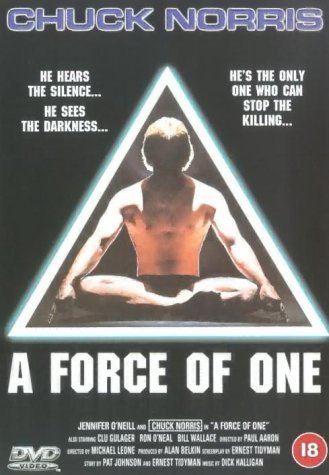
A Force of One (1979, directed by Paul Aaron)


Someone is targeting a squad of undercover narcotics detectives, killing them by taking them by surprise and breaking their necks before they even have a chance fight back.  Lt. Dunne (Clu Gulager) doesn’t like seeing his best detectives getting murdered so he orders all of them — including Mandy Rust (Jennifer O’Niell) and Rollins (Superfly himself, Ron O’Neal) — to take martial arts training so that they can defend themselves.  And who better to train them than karate champ and dojo owner, Matt Logan (Chuck Norris)?  The no-nonsense Logan teaches the detectives a few moves and even starts a tentative romance with Mandy.  But when his adopted son (played by future director Eric Laneuville) is murdered by the drug dealers, Logan goes from being a teacher to being an avenger.

Since today is Chuck Norris’s 80th birthday, it only seems appropriate to review one of Chuck Norris’s better films.  A Force of One was made at a time when Chuck was still trying to make the transition from being the karate instructor to the star to being a star himself.  Norris had been disappointed by his previous few starring vehicles, all of which strangely played down Norris’s martial arts skills.  After his friend and student, Steve McQueen, told Chuck that he needed to specialize in playing strong, silent types, Norris followed his advise with A Force Of One, which features considerably less dialogue than Norris’s previous films but also a lot more fighting.

Though the character may be named Matt Logan, Chuck Norris is basically playing himself in A Force of One.  In the scenes where he’s training the detectives and talking about why he’s personally so opposed to drugs, Chuck comes across as so earnest that it doesn’t matter that he’s not much of an actor.  What he’s always lacked in range, Chuck makes up for in general badassery and A Force Of One features him at his most badass.  Chuck’s final fight with the ninja assassin is one of his best.

Jennifer O’Neill got top billing in A Force Of One and she and Chuck actually have decent romantic chemistry.  She seems to bring him a little bit out of his shell and she’s also actually believable as a tough cop.  Because this was early in Chuck’s career and the script was co-written by police procedural specialist Ernest Tidyman, A Force Of One spends as much time following round the other cops as it does with Chuck and the squad’s camaraderie is believable.  The cops are all played by good character actors like Ron O’Neal, Clu Gulager, Pepe Serna, and James Whitmore Jr. and they all give pretty good performance while, at the same time, not upstaging Chuck.

One final note: There’s a scene where Chuck and Jennifer O’Neill are in an evidence room.  Keep an eye out for a box that is labeled K. Reeves.  That’s a reference to director Paul Aaron’s stepson, Keanu Reeves, who worked as a production assistant on this film.

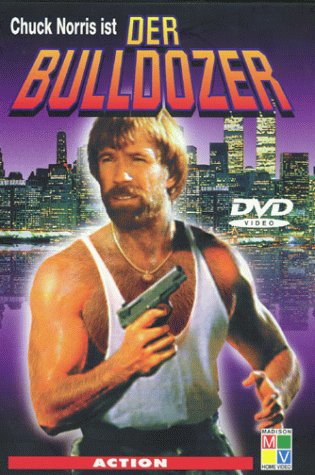
The German version of A Force Of One