Welcome to Retro Television Reviews, a feature where we review some of our favorite and least favorite shows of the past! On Saturdays, Lisa will be reviewing The American Short Story, which ran semi-regularly on PBS in 1974 to 1981. The entire show can be purchased on Prime and found on YouTube and Tubi.
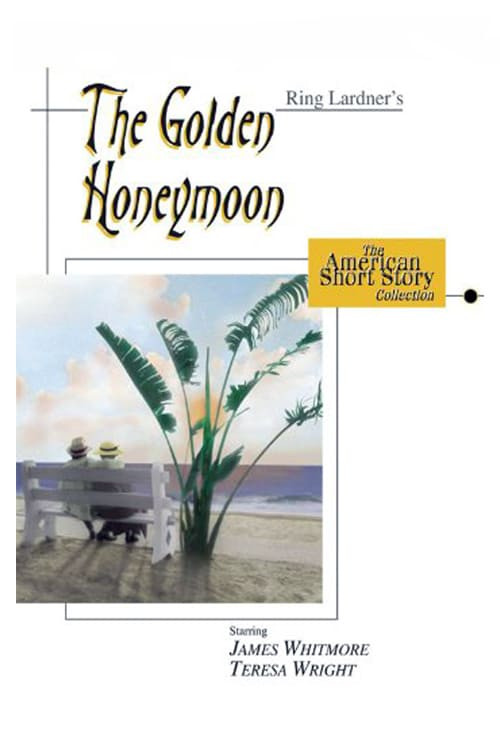
Episode #10: The Golden Honeymoon (1980, directed by Noel Black)
Hey, guest reviewer here! Don’t worry, Lisa will return next week. Next week’s episode has got Eric Roberts in it and she told me there’s no way she’s going to miss that!
This episode is an adaptation of a short story by the author Ring Lardner, who was a member of the Algonquin Round Table and whose son won an Oscar for writing the script for the movie version of M*A*S*H. TheGoldenHoneymoon about an old couple (James Whitmore and Teresa Wright) who celebrate their 50th anniversary by going on a “golden honeymoon” to Florida. While there, they meet the wife’s old flame (Larry Loonin) and Whitmore feels like he has to win his Wright all over again. Whitmore and Loonin play a lot of different games, like shuffleboard and checkers. You know you don’t want to get between a group of elderly people playing checkers! Wright gets frustrated with Whitmore but they make up by the end of the episode. They bicker but they love each other.
I have not read the original short story on which this episode is based. Ring Lardner was famous for his wit and he probably could have found a lot of comedic moments in two old romantic rivals having an intense checkers game. The episode itself reminded me of those films that my high school English teachers would always show in class. “You are going to love this,” the teacher always says and then the members of the class sit there in stony silence as they watched the slowest, most visually static program imaginable. This episode was not just boring. It was PBS boring.
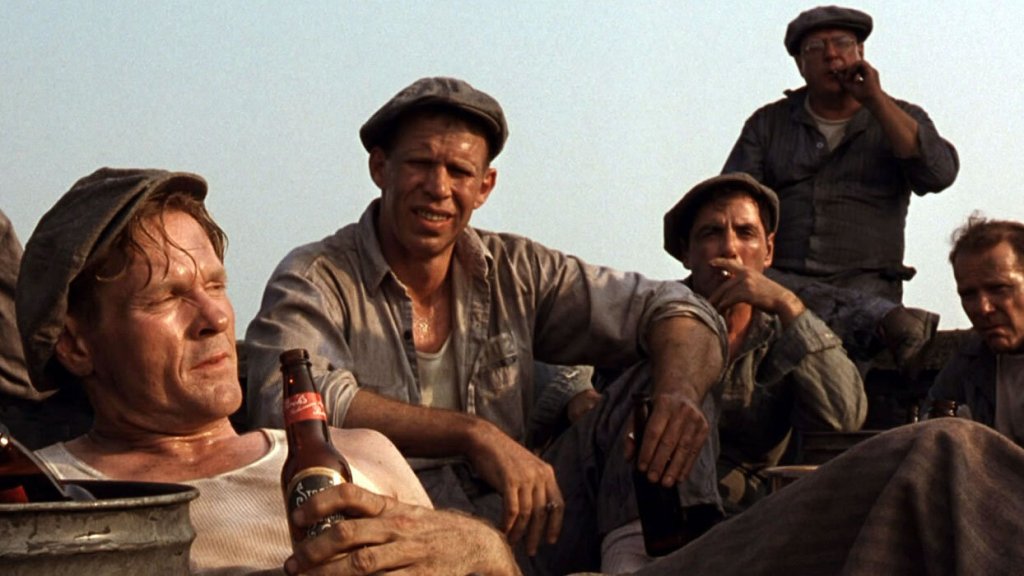
I don’t want to be to negative, though. I like both James Whitmore and Teresa Wright. Whitmore was the elderly prisoner in The Shawshank Redemption. Teresea Wright was in several classic Golden Age films. In The Golden Honeymoon, they were believable as an old married couple, who constantly argue but still clearly love each other.
Episode 7 begins with two drunk cowboys, who work for Rufe Ryker (Bert Freed), raising cane and deciding they’ll go harass some sodbusters just for the hell of it. On this day, they ride over to Ira Jackson’s (Jason Wingreen) ranch, where Marian Starett (Jill Ireland) is there visiting Ira’s daughter Elizabeth (Catherine Ferrar). As the cowboys ride around the house, hooping and hollering and shooting off their guns, a frustrated Ira opens the door and fires a blast from his shotgun. The cowboys shoot back toward the house, hitting a kerosene lamp in the kitchen and starting a fire. Ira gets the ladies out of the house and then commences to fighting with the cowboys, who now realize what they’ve done and are wanting to help put out the fire. While the men and Marian are distracted with the fight, Elizabeth runs back into the house to try to save her calico cat, where she is engulfed by the flames and dies.
We move on to Elizabeth’s funeral and see Shane (David Carradine) ride up with Reverend Harry Himber (James Whitmore). Rufe Ryker is there and he tells Shane and the Reverend that he’s sorry about what happened, that he had nothing to do with it, and that he doesn’t want any trouble. Shane isn’t in much mood to listen to Ryker so he moves on. Reverend Himber, who we will come to find out is a pacifist, begins the service by saying that Elizabeth would want everyone there to remember the good times they had together with her, as well as look inward to find forgiveness and understanding. Hellbent on revenge, Ira just screams “No!”
That night, after chewing his two cowhands out, Ryker decides he’s going to pay them two months wages and send them out of town. He would rather lose a couple of good cowboys as fight a war with Ira. As one of the men, the young Hoke (Dee Pollock), is on his way out of town, Ira shoots him down from the hillside with his rifle. The remainder of the episode consists of Shane and Tom Starett (Tom Tully) trying to protect Ira and the other local farmers from the wrath of Ryker and his men, while Reverend Himber tries to get everyone to talk it out to avoid more killings in the valley.
In episode 7, the character of Rufe Ryker takes center stage, along with Shane and the visiting Reverend Himber, played here by guest star James Whitmore in an incredible performance. This is probably the deepest episode we’ve dealt with thus far, with each character showing some level of moral complexity. Neither Shane or Ryker want a fight, but they both prepare to get bloody for different reasons. Ryker makes it clear that he will protect his men and fight for them even when they’re wrong. Shane makes it clear that he will fight for the sodbusters against powerful men like Ryker even when he thinks they’re wrong. And then there’s Reverend Himber, the pacifist who is willing to do whatever it takes to stop a fight. During the episode we find out that he had been forced to kill six enemy soldiers when they raided the hospital he was working at during the war. This episode drives home the fact that a man’s ideals will at times contrast harshly with the realities of the positions they find themselves in. Each of these three men finds himself in a situation that has grown bigger than him, with both Ryker and Shane recognizing the deal and preparing for the worst. Reverend Himber, on the other hand, tries to take control of the situation, only to be the catalyst for more tragedy. We have all been in situations where we hope for the best, but we’re smart enough to prepare for the worst, because some of the biggest fools alive are the ones who think they can control other people.
Overall, the “Day of the Hawk” is a strong episode that has a surprisingly powerful and emotional conclusion. The storyline belongs to Shane, Ryker and the Reverend, so Shane’s relationship with Marian takes a back seat this time around. I don’t think they look at each other longingly a single time, which did make me a little sad. Here’s hoping they’ll double that up in Episode 8!
One of the most enjoyable things about being a dad is introducing your favorite things to your kids. I taught my son Hank the sports of basketball, baseball, and golf, and even now there’s nothing we enjoy doing more together than playing a round of golf. Of course, as one of the world’s biggest Charles Bronson fans, I’ve introduced him to many films starring my cinematic hero. It seems that two movies have stood the test of time and have gone on to become two of his favorite movies. The fact that THE DIRTY DOZEN (1967) is one of his favorites isn’t a big surprise as he’s always enjoyed playing video games set during World War II. The other, CHATO’S LAND (1972), was more of a surprise. A few years ago, when Hank was home from college, I asked him if there was a movie he wanted to watch. It could have been any movie in the world, and I was honestly a little surprised when he said he’d been wanting to watch CHATO’S LAND again. Needless to say, this dad was very proud.
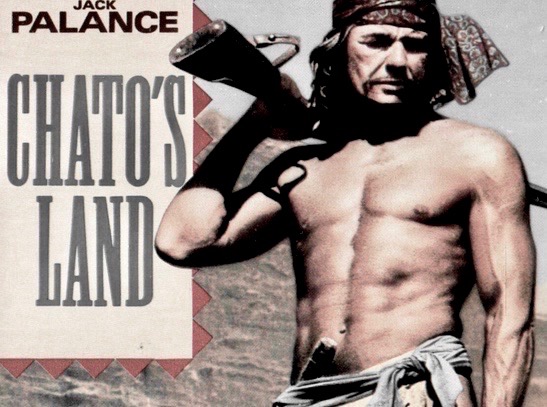
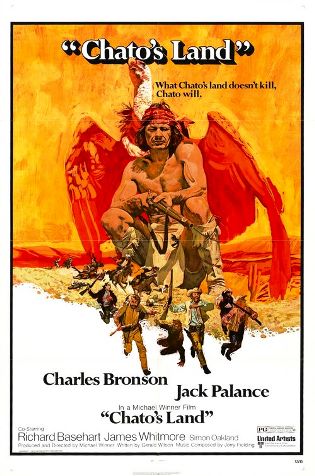
Charles Bronson is Pardon Chato, a half breed Apache who’s minding his own business and having a drink in the saloon, when a small-town sheriff decides to give him hell just for being a “breed.” Forced to kill the racist POS in self-defense, Chato heads out of town a day ahead of the posse led by the former confederate Captain Quincey Whitmore (Jack Palance). Whitmore may be leading the posse, but the Hooker Brothers (played by Simon Oakland, Ralph Waite, and Richard Jordan) are just as bigoted as the sheriff who was killed, and they set about bullying their neighbors into joining their hunt for Chato. A couple of the guys who go along because it’s “expected of them” are Joshua Everette (James Whitmore) and Gavin Malechie (Roddy McMillan). When the posse comes across Chato’s home and woman, some of the members decide the wise thing to do is rape her and tie her up as bait. This is clearly not going to work out well for the posse, even those who tried to stop the rape. Using his sneaky Indian skills and the help of a fellow Indian, Chato is able to create a diversion and rescue his woman, but his friend is killed in the process. With his friend murdered and his woman brutalized and raped, Chato is no longer willing to just run away. From this point forward, the hunters will become the hunted as he leads them all further into CHATO’S LAND.
There are several things that I find interesting about CHATO’S LAND. This is the first of six films that director Michael Winner and Charles Bronson would make together. They would all be financially successful films with THE MECHANIC (1972) and the original DEATH WISH (1974) standing out as true 70’s classics. Charles Bronson’s last number one box office hit would be DEATH WISH 3 (1985), which would also be his final film with Winner. It should also be noted that the character of Chato would be an early precursor of the kind of character Bronson would go on to embody almost exclusively throughout the rest of his career, that of the quiet but deadly man of action. Chato only says 13 lines in the entire movie and most of those are in a Native American dialect. Chato doesn’t have that much actual screen time either, but his presence dominates every scene. He’s like the angel of death hanging over the entire proceedings waiting to strike, and Winner continues to build on this tension as the film moves towards its inevitable conclusion. It’s an incredible, physical performance that can only be delivered by an actor like Bronson. Finally, the film has an outstanding cast, a cast that Winner himself would call “as good a cast as I ever assembled.” In addition to Bronson, Jack Palance is excellent as the confederate captain who’s never gotten over losing the war, and who now finds himself losing the battle to control the men in the posse. James Whitmore and Roddy McMillan are solid as a couple of decent men who went along because they felt it was their duty to their neighbors, who now find themselves caught up in a bad situation with even worse men. And finally, Simon Oakland, Ralph Waite & Richard Jordan are the kind of men you love to hate as the ignorant and bigoted Hooker brothers. It doesn’t hurt your feelings at all to see those guys get what’s coming to them.
Overall, CHATO’S LAND is a very good western, dominated by Bronson’s presence in the same way that JAWS (1975) is dominated by a giant killer shark. It was also a hugely profitable film upon its initial release, guaranteeing that Bronson would continue to get starring roles in films backed by American studios. Bronson liked to work with the same directors once he felt comfortable with them, and his collaboration with Winner would prove to be extremely fruitful and help turn him into one of the biggest box office stars in America. Thanks, Michael!
I sent our son a text the other day and asked him if he had an answer for the question “What’s your favorite movie?” I thought I knew the answer but it turns out I was only half right. I expected his answer to be THE HATEFUL EIGHT. Rather, the answer I received back was “The Hateful Eight or Shawshank Redemption!” Since I recently wrote about the time that he and I attended THE HATEFUL EIGHT roadshow in Dallas, I decided I would write about THE SHAWSHANK REDEMPTION this time around. It doesn’t hurt that it’s one of my favorite movies as well. It also doesn’t hurt that it’s the very top rated film on the Internet Movie Database.
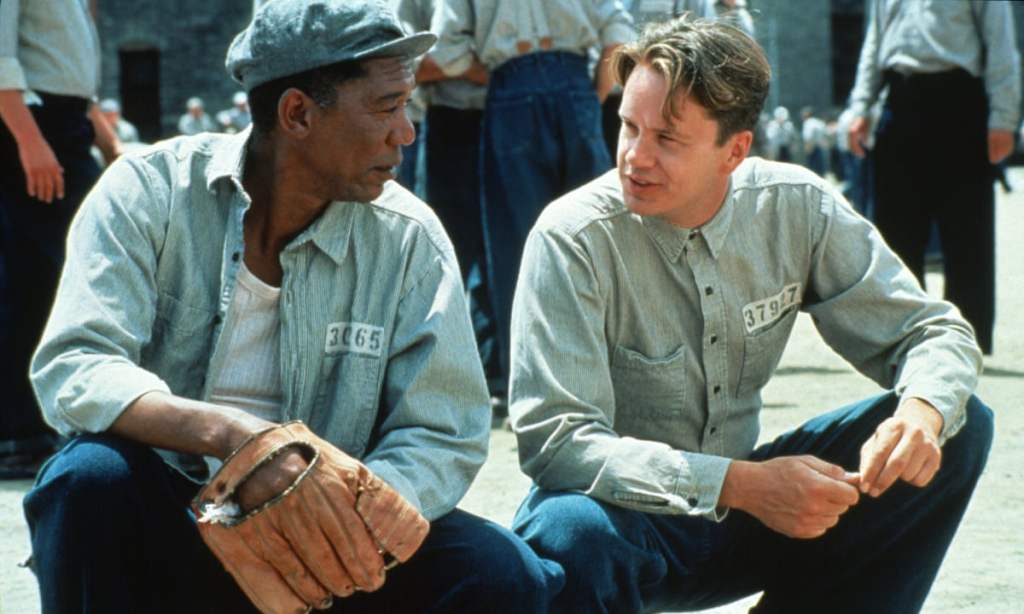
Based on Stephen King’s “Rita Hayworth and Shawshank Redemption,” the story is well known… hot shot banker Andy Dufresne (Tim Robbins) is convicted of the murder of his wife and her lover, and gets sentenced to life at the Shawshank prison. Once on the inside, we meet a variety of characters that you expect in a prison movie. We meet Warden Norton (Bob Gunton), the hypocrite who speaks of the Bible while hiding a corrupt, evil spirit. We meet Captain Hadley (Clancy Brown), the brutal chief prison guard, who rules over the inmates with intimidation and a real willingness to inflict violence and pain on anyone who shows the least bit of independence. We meet Red (Morgan Freeman), the long-time inmate who has the ability and connections to get you anything you need. We meet other inmates like Heywood (William Sadler), the inmate who seems like a jerk when you first meet him but turns out to be a pretty good fella; Tommy (Gil Bellows), the young guy who comes into prison and may know something that proves Andy’s innocence; Brooks (James Whitmore), the old man who gets released after almost a lifetime in prison, and doesn’t know how to adjust to life on the outside; and Bogs (Mark Rolston), the sadistic prisoner who wants to force himself on Andy, and is willing to kill to get what he wants. Life isn’t easy at all in Shawshank, but Andy’s intelligence and ability to prove himself useful to Warden Norton and Captain Hadley allows him to finds ways to make life more bearable for him and his friends. After nineteen years in prison, even though he maintains his innocence, it appears that Andy is content to live out his remaining years in prison. Or is he??
I’ll never forget the first time I saw the movie THE SHAWSHANK REDEMPTION. I didn’t see it until a year or two after its initial release in 1994. I was one of those guys who figured a movie that praised by the critics was probably not something that I would like that much. Plus, at the time, the title of the movie just seemed kind of weird. But I kept hearing about how great it was, so I finally decided to give it a viewing. I agree with my son, I think THE SHAWSHANK REDEMPTION is one of the most emotionally uplifting movies ever made. Why is that you might ask? My answer would be because there’s something profoundly satisfying about people who persevere through the worst times imaginable and continue to find hope where most of us would be hopeless. Prison life is shown as horrific. One prisoner is literally beaten to death by Captain Hadley on his first night in prison for crying. Andy fights off the sadistic Bogs as much as he can, but he is unable to completely fight off his advances. But no matter what he goes through, Andy Dufresne is able keep moving forward, and he does not allow the prison life to completely crush his spirit. He keeps finding ways to persevere. Andy’s actions and endurance turn simple acts like listening to Mozart or having a beer into overwhelming emotional highs for us as the audience. The film also maintains a realistic sense of humor, which might seem difficult under the circumstances. This sense of humor is found in such mundane tasks as creating a prison library, providing tax prep services for the guards, or attending multiple parole hearings over the years. These comedic moments are earned by the way the movie takes it’s time letting us really get to the know the characters and then laugh with them as the individual moments occur. And the friendship between Andy and Red is something that deeply resonates with me. I think we all would like to have that kind of friendship. These kinds of friendships aren’t built overnight, and often they require a level of shared experience that is almost impossible to find. But they find it behind Shawshank’s prison walls, and it connects them for life. In my opinion, the friendship between these two characters leads to one of the most emotionally satisfying endings to any film, ever.
Director Frank Darabont was able to obtain some of career-defining performances from his cast. As good as Tim Robbins is as an actor, in my opinion, he has never been better than he was as Andy Dufresne. And I say this knowing full well he won an Oscar for MYSTIC RIVER. He maintains his dignity against all odds and only appears to break down a time or two. Morgan Freeman is great as always as Red, but his character is so important because we see him go from a hopeless skeptic, to a man who truly has hope thanks to his friendship with Andy. Freeman seems to handle this transition effortlessly. I’m going to give a shoutout to James Whitmore as well. With a career going all the way back to the 1940’s, his performance as Brooks Hatlen is one of the more touching and heartbreaking performances of the film. I haven’t seen all of his work, but I have never seen him better than he was in THE SHAWSHANK REDEMPTION. Each additional cast member, from Bob Gunton, Clancy Brown and Mark Rolston, to Willam Sadler and Gil Bellows all have powerful moments that add to the overall effect of the film.
Looking back now, it’s hard to believe that THE SHAWSHANK REDEMPTION did not win the Academy Award for best film. It lost to FORREST GUMP when the awards were handed out in 1995. It’s even harder to believe that the film did not win a single Academy Award even though it received seven nominations. But at the end of the day, that doesn’t really matter to me. I just know that it’s a great film, and it reaches emotional heights that very few movies, if any, have ever reached before. That’s a pretty damn good legacy.
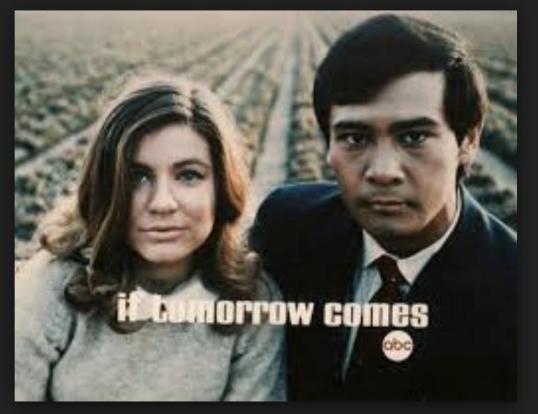
Welcome to Retro Television Reviews, a feature where we review some of our favorite and least favorite shows of the past! On Sundays, I will be reviewing the made-for-television movies that used to be a primetime mainstay. Today’s film is 1971’s If Tomorrow Comes! It can be viewed on YouTube.
If Tomorrow Comes tells the story of a forbidden marriage.
In 1941, Eileen Phillips (Patty Duke) meets David Tayanaka (Frank Liu) and the two of them quickly fall in love. David asks Eileen to marry him and Eileen says yes, even though they both know that it won’t be easy. Eileen’s father (James Whitmore) and her brother, Harlan (Michael McGreevey), are both prejudiced against the Japanese and David’s parents (played by Mako and Buelah Quo) would both rather than David marry someone of Japanese descent. Eileen and David decide to elope first and tell their parents afterwards.
On December 7th, Eileen sneaks out of the house and joins David at his church. They are married by Father Miller (John McLiam), who agrees to keep their secret. Eileen and David then drive over to the church attended by Eileen’s family but no sooner have they arrived than the local sheriff (Pat Hingle) pulls up and announces that the Japanese have bombed Pearl Harbor. The sheriff instructs everyone to return home and to listen to their radios. David slips his wedding ring off his finger. Telling the parents will have to wait.
Eileen’s father and brother are convinced that every Japanese person in town, even though the majority of them were born in America and have never even been to Japan, is a subversive. David and his family are harassed by government agents like the oily Coslow (Bert Remsen). One morning, they discover that all of their farm animals have been killed and someone has written “REMEMBER PEARL HARBOR” with their blood. When Franklin D. Roosevelt orders the internment of the Japanese, David’s father is among those taken away. When Harlan continues to harass David, it eventually leads to not just one but two tragedies.
If Tomorrow Comes is a real tear-jerker, one that features a great performance from Frank Liu and a good one from Patty Duke. Though it may seem a tad implausible that David and Eileen would get married just an hour before Japan attacked Pearl Harbor (and considering the attack occurred on a Sunday morning, I’m a little curious how they found a priest who was free to secretly marry them), the film does a good job of showing how fear can lead to otherwise good people doing terrible things. One of the film’s strongest moments comes as David’s father is taken away to an internment camp and the Japanese prisoners try to prove their loyalty by spontaneously singing America, The Beautiful. It’s a moment that reminds us of the danger of letting our fear destroy our humanity.
It’s a film that still feels relevant today, with its portrayal of heavy-handed government agents searching for subversives and ignoring the Constitution in order to save it. When David visited his father at the internment camp, I thought about how, at the heigh of the COVID pandemic, it was not unusual to see people demanding that the unmasked and the unvaccinated by interned away from the rest of the world. If Tomorrow Comes is a love story and a melodrama and tear-jerker but, above all else, it’s a warning about the destructive power of fear and prejudice.
During a reception on the steps of U.S. Capitol, an assassin kills Contra leader Col. Martinez (Geno Silva) and seriously wounds Sen. Terry Fallon (Harry Hamlin), an up-and-coming politician from Texas. An eager media catapults Fallon to national stardom and the beleagued President (James Whitmore), who is facing a tough reelection bid, is pressured to replace the current vice president (Mitchell Ryan) with Fallon.
The FBI only assigns two of their agents to investigate the assassination, a sure sign that someone wants the investigation to just go away. Nick Mancuso (Robert Loggia) is a crusty, hard-drinking veteran agent whose career is nearly at an end. David Ross (Lance Guest) is his young and idealistic partner. When Mancuso and Ross discover that Martinez was injected with the HIV virus just two days before the assassination, it becomes obvious that there is a bigger conspiracy afoot. It all links back to Sally Crain (Linda Kozlowski), who is Fallon’s legislative aide and also his lover. (Fallon has a wife but she’s locked away in a hospital.) Sally has an interest in bondage, as Ross soon finds out.
Favorite Son was originally aired as a 3-night, 4 and a half-hour miniseries. It was later reedited and, with a running time of less than two hours, released theatrically overseas as Target: Favorite Son. As a miniseries, Favorite Son is an exciting conspiracy-themed film that is full of scheming, plotting, interesting performances, and pungent dialogue. Target: Favorite Son, on the other hand, is disjointed and, unless you know the original’s plot, almost impossible to follow. If you’re going to watch Favorite Son, make sure you see the original miniseries. My mom taped it off of NBC when it originally aired. That was the only way that I was able to originally see the film the way that it meant to be seen. The entire miniseries has also been uploaded, in three parts, to YouTube.
Hopefully, the original miniseries will get an official release someday because it’s pretty damn entertaining. Harry Hamlin isn’t really dynamic enough for the role of Fallon but otherwise, the movie is perfectly cast. Robert Loggia is so perfect for the role of Nick Mancuso that it almost seems as if the character was written for him. (Loggia did later star in a one-season drama called Mancuso, FBI.) Linda Kozlowski seems to be destined to be forever known as Crocodile Dundee’s wife but her performance as Sally shows that she was a better actress than she was given credit for. The supporting cast also features good performances from Jason Alexander, Ronny Cox, Tony Goldwyn, John Mahoney, Kenneth McMillian, Richard Bradford, and Jon Cypher.
Favorite Son may be over 30 years old but it’s still relevant today. In the third part, John Mahoney gives a speech about how American voters are often willfully ignorant when it comes to what’s going on behind the scenes in Washington and it’s a killer moment. Melodramatic as Favorite Son may be, with its portrayal of political chicanery and an exploitative national media, it’s still got something to say that’s worth hearing.
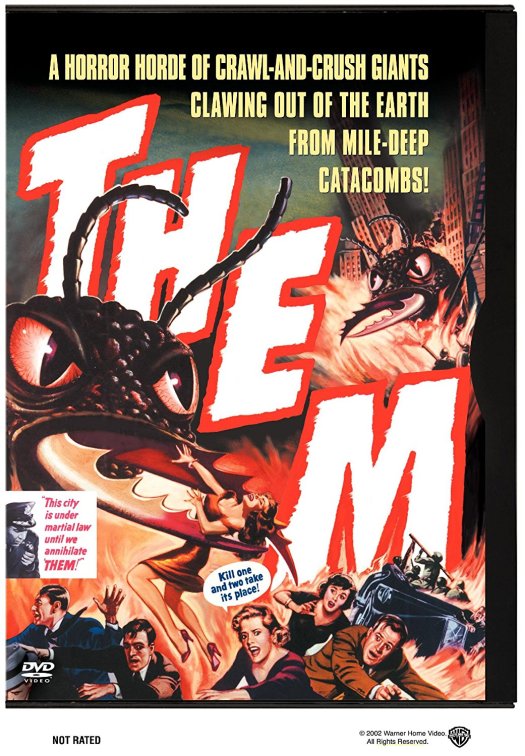
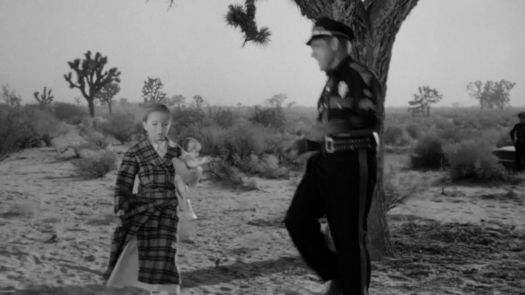
The iconic, bloodcurdling scream of little Sandy Descher heralds the arrival of THEM!, the first and best of the 50’s “Big Bug” atomic thrillers. Warner Brothers had one of their biggest hits of 1954 with this sci-fi shocker, putting it up there with Cukor’s A STAR IS BORN, Hitchcock’s DIAL M FOR MURDER, and Wellman’s THE HIGH AND THE MIGHTY as their highest-grossing films of the year. Not bad company for director Gordon Douglas , previously known for his work with Our Gang and Laurel & Hardy! THEM! was also Oscar nominated that year for its special effects (and should’ve been for Bronislaw Kaper’s terrific score).
The movie begins with the look and feel of a noir mystery courtesy of DP Sidney Hickox’s (DARK PASSAGE, THE BIG SLEEP , WHITE HEAT) brooding shadows and sandstorm-battered landscape. New Mexico policemen Ben Peterson and Ed Blackburn come across a little girl wandering…
That’s the main lesson that can be taken away from Chato’s Land. In this western, Bronson plays Chato, an Apache who enters the wrong saloon and is forced to shoot a racist sheriff in self-defense. Former Confederate Captain Quincey Whitemore (Jack Palance) forms a posse to track Chato down but soon discovers that his posse is not made up of the best and brightest. Instead, most of them are sadistic racists who just want to kill Apaches. Despite Whitemore’s efforts to stop them, the posse rapes Chato’s wife and kills his best friend. Chato trades his white man’s clothes for a loin cloth and sets out for revenge.
Chato’s Land is historically significant because it was the first of many films that Charles Bronson made with Michael Winner. The most famous Bronson/Winner collaboration was Death Wish, which also featured Charles Bronson as a man who seeks revenge after his wife is raped. What is surprising about Chato’s Land is how little screen time Bronson actually has. Most the film is spent with the posse, which is full of familiar faces (Richard Jordan, Simon Oakland, Victor French, Ralph Waite, and James Whitmore all report for duty). It actually works to the film’s advantage, making Bronson even more intimidating than usual. There’s never any doubt that Chato is going to kill every member of the posse but since almost every member of the posse is loathsome, that’s not a problem.
It’s possible that Chato’s Land was meant to be an allegory for the Vietnam War, which is probably giving Michael Winner too much credit. (In an interview, the author of Death Wish, Brian Garfield, once shared an anecdote about Winner inserting a shot of three nuns into Death Wish and bragging about how the shot was meaningless but that it would fool the critics into thinking he was making a grand statement about something.) Like most of Winner’s films, Chato’s Land is good but not great. There are parts of the movie that drag and Jack Palance and Charles Bronson don’t get to share any big scenes together, which seems like a missed opportunity. Bronson, who was always underrated as an actor, gives one of his better performances as Chato. Chato does not say much but Bronson could do more with one glare than most actors could do with a monologue. In Europe, Bronson was known as Il Brutto and Chato’s Land features him at his most brutal.
A U.S. spy satellite has crashed onto an uninhabited island in the Pacific Ocean. Both the United States and an unnamed communist country (described as being “a fifth-rate China,” but obviously meant as a stand-in for not only China but North Korea and North Vietnam as well) have both lay claim to the satellite. To prevent a possible war, the two countries agree to a compromise. One American and one communist will be dropped off on the island and will fight to the death. The survivor gets the satellite. The communists send the disciplined Yuro (Mako). The American select Jacob Galley (Darren McGavin), a grizzled Vietnam veteran-turned-mercenary. Jacob is armed with the latest advancements in weaponry, including a double-barreled sub-machine gun. Yuro is armed mostly with his wits and an endless supply of booby traps. Jacob and Yuro fight to a stand still, growing to respect each other even as each tries to kill the other. However, both countries are willing to cheat to win the challenge.
Originally made for television, this is one of the many films to have been credited to Alan Smithee, the pseudonym that directors used to use whenever they felt that the finished film, usually because of studio interference, did not properly represent their vision. According to the imdb, The Challenge was actually directed by veteran television directed George McGowan, whose other credits includes episodes of shows like Fantasy Island, Starsky and Hutch, and Charlie’s Angels. I am surprised that McGowan chose to take his name off of The Challenge because, for a television movie, it’s not bad. The Vietnam analogy is laid on a little thick but the action is exciting and both McGavin and Mako give excellent performances as the two very different combatants.
The Challenge can be viewed on YouTube. Keep an eye out for a very young Sam Elliott, in the role of America’s insurance policy.
The Split is one of the many films to be based on one of Donald Westlake’s Parker novels. A classic antihero, Parker was a ruthless professional criminal who was only partially redeemed by being so much better at his job than all the other lowlifes around him. In the movies, Parker has been played by everyone from Lee Marvin to Robert Duvall to Mel Gibson to Jason Statham. In The Split, Parker is renamed McClain and he is played by Jim Brown.
McClain and his partner, Gladys (Julie Harris), have a plan to rob the Los Angeles Coliseum during a football game. (Actual footage of the Rams playing the Falcons was used.) McClain personally recruits a crew of criminals to help him pull off the heist. Harry Kifka (Jack Klugman) is the getaway driver. Bert Clinger (Ernest Borgnine) is the muscle. Marty Gough (Warren Oates) is the electronic expert. Dave Negli (Donald Sutherland) is the sharpshooter.
After pulling off the robbery, McClain stashes the money with his ex-girlfriend, Ellie (Diahann Carroll). When her landlord, Herb Sutro (James Whitmore), finds out that Ellie has the money, he murders her and steals it. When homicide detective Walter Brill (Gene Hackman) solves Ellie’s murder, he kills Herb and takes the money for himself. Meanwhile, Gladys and the crew are convinced that McClain knows where the money is. With everyone out to kill him, McClain tries to find the money.
The Split is mostly interesting because of its cast. For all of his physical presence, Jim Brown was never much of an actor but the large supporting cast more than makes up for his limitations. It’s fun to watch Sutherland, Borgnine, Harris, and Klugman compete to see who can steal the most scenes. Meanwhile, a youngish Gene Hackman is as cantankerous as ever. Then there’s the great Warren Oates. Warren Oates was one of the greatest actors of all time and he spent his far too brief career stealing movies like The Split.
(The Split was released a year after Jim Brown, Ernest Borgnine, and Donald Sutherland had all appeared in The Dirty Dozen. A year after The Split, Warren Oates and Ernest Borgnine would both be members of The Wild Bunch while Hackman and Brown would costar in Riot.)
The Split has some historical significance as the first film to ever be given an R rating. Though tame by today’s standards, at the time of its release, The Split was considered to be extremely violent and audiences were also shocked by a brief flash of nudity. Seen today, The Split is a conventional heist movie but it still shows what a group of good actors can do with so-so material.


 Don’t mess with Charles Bronson.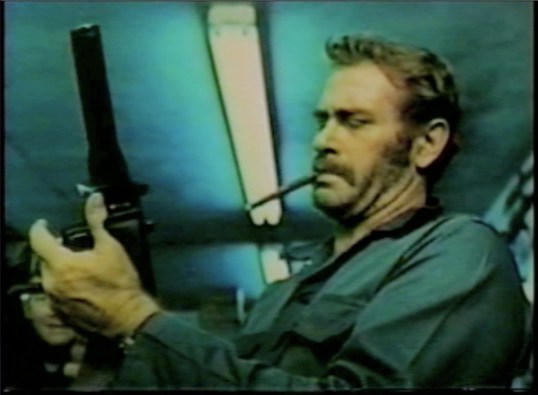


 Through the Shattered Lens