Killdozer (1974, directed by Jerry London)


Six construction workers (played by Clint Walker, Carl Betz, Neville Brand, James Wainwright, James A. Watson, and Robert Urich) are boated to an isolated island off the coast of Africa.  An oil company has assigned them to build an airstrip on the island.  On the first day of work, they come across a meteorite buried in the ground.  When one of the men tries to pick up the meteorite with the bulldozer, a blue light envelops the bulldozer and, at the same time, fatally injures Robert Urich.  Possessed by the meteorite, the bulldozer starts to track the remaining workers down, killing them one-at-a-time.  It’s a killdozer!

Based on a short story by Theodore Surgeon and made-for-television, Killdozer asks the question, “Have you ever seen a big, bulky bulldozer attempt to sneak up on someone?”  Given that Killdozer is not fast and it’s not very agile, it should be easy to escape it but the construction keep doing dumb things, like getting drunk or trying to hide inside a copper tube instead of just running away.  The surviving men wonder how they are going to make it until help eventually arrives.  Maybe if you hear Killdozer coming, you should could just step to the side or maybe you could even run behind Killdozer.  Instead, the construction workers keep trying to fight it head-on.  Every time Killdozer pauses from noisily rolling across the island and sits still because it senses one of the workers might be nearby, I’m reminded that Killdozer is an absolutely ludicrous film but that it’s also wonderfully strange and that it’s also impossible to enjoy it on some level.

The cast is good and, for the most part, so is the straight-forward, waste-no-time direction.  The Killdozer deserved an Emmy and maybe its own series but instead, it just had to settle for cult stardom.

Film Review: Joe Kidd (dir by John Sturges)


1972’s Joe Kidd opens with the title character (played by Clint Eastwood) in jail.  Joe is a New Mexico rancher and apparently, someone with a long history of getting in trouble with the law.  This time, he’s been arrested for poaching and disturbing the peace.  Given a choice between a fine and ten days in jail, Joe goes for the ten days.  Cowardly Sheriff Mitchell (Gregory Walcott) says he’s going to put Joe to work.  Joe Kidd snarls in response.

However, that’s before Luis Chama (John Saxon), a Mexican revolutionary, raids the courthouse and demands that all of his people’s ancestral land be returned to them.  Local landowner Frank Harlan (Robert Duvall) forms a posse to track Chama down.  Joe says that he has nothing against Chama but that changes once he discovers that Chama raided his ranch and beat up one of his ranchhands.  Joe joins the posse but he soon discovers that Harlan and his men are sadists who are more interested in killing Mexicans than actually capturing Chama.

I was actually pretty excited about watching Joe Kidd.  Clint Eastwood, Robert Duvall, and John Saxon, three of my favorite actors in the same movie!  How couldn’t I be excited?  Unfortunately, neither Duvall nor Saxon are at their best in this film.  Frank Harlan is a one-dimensional villain and Duvall doesn’t make much of an effort to bring any sort of unexpected nuance to the character.  Duvall doesn’t give a bad performance but it’s hard not to feel that Harlan is a character who could have been played by any forty-something actor.  It feels like waste to cast such a good actor in such a thin role.  (Add to that, I prefer Duvall when he plays a good guy as opposed to when he plays a bad guy.)  As for Saxon, this is probably one of his worst performances but his character is also rather underwritten and the film can’t seem to decide if it wants the viewer to be on his side or not.  Saxon delivers his lines in an exaggerated Mexican accent that makes it difficult to take Louis Chama seriously.  Gregory Sierra would have made a good Louis Chama but Saxon just seems miscast.

Fortunately, Clint Eastwood is always a badass, even in an uneven film like this.  Eastwood is at his best in the early scenes, when he’s grouchy and hungover and annoyed at finding himself in the jail.  He is believably outraged by Harlan’s tactics and, in typical Eastwood fashion, he delivers every pithy one-liner with just enough style to keep things interesting.  That said, Eastwood is let down by a script that never really makes it clear why Joe Kidd stays with the posse once it becomes clear that he’s traveling with a bunch of sociopaths.  Joe’s motivations are never really clear.  In the end, he seems like he goes through a lot of trouble to protect his farmland and get revenge for one of his ranch hands (who is just beaten up), just to then desert it all once all the shooting is over.

That said, Joe Kidd is a gorgeous film to look at and Joe makes creative use of a steam engine.  This isn’t the film to show anyone who isn’t already an Eastwood fan.  But, for those of us who are already fans of Clint, it’s enjoyable to watch him snarl, even if it is in a lesser film.

Retro Television Reviews: Fantasy Island 4.8 “Crescendo/Three Feathers”


Welcome to Retro Television Reviews, a feature where we review some of our favorite and least favorite shows of the past!  On Tuesdays, I will be reviewing the original Fantasy Island, which ran on ABC from 1977 to 1986.  Almost the entire show is currently streaming is on Youtube, Daily Motion, and a few other sites.

This week, we get one good fantasy and one bad fantasy and a reminder that anything can happen on Fantasy Island!

Episode 4.8 “Crescendo/Three Feathers”

(Dir by Michael Preece, originally aired on December 20th, 1980)

This episode confirms that Fantasy Island is the strangest place on Earth.

Our first fantasy features Toni Tennille as a world-famous singer named Susan Lohmann.  Susan has been invited meet her favorite composer and songwriter, Edmund Dumont (Monte Markham).  Dumont lives in seclusion on Fantasy Island, in an estate that is surrounded by wild animals and where he is tended by a blind butler (James Hong).

Susan is excited to meet Edmund, until she walks in on him playing his piano and discovers that he’s a …. BEAST!  Though he has the body of a human, he has the face of a wolf.  It turns out that Edmund lives in seclusion because he feels that the world would never accept his appearance.  And Susan promptly proves him correct by screaming and demanding to leave.  Susan flees the estate.

Susan’s manager is glad that Susan is free because now she can appear in concert in London.  However, Mr. Roarke informs Susan that Edmund suffers from a curse and the only thing that could have cured him would have been the love of Susan.  Edmund is now determined to die, surrounded by the animals on his estate, the only creatures who accepted him.  Susan, realizing that she was a little bit hard on a guy who couldn’t help his appearance, returns to the estate, gives Edmund a kiss, and Edmund turns into a handsome guy.  Yay!

So, there’s a huge problem here.  Susan Lohmann is incredibly unlikable.  Yes, Edmund may look different.  But all Edmund did was invited her to his estate so that he could express his appreciation for the way the she sings his songs.  Susan claims that Edmund should have told her, in advance, about the way he looked.  Yes, Susan, God forbid someone unattractive appreciate your talent or have any talent of his own.  Seriously, Susan was the worst.

Slightly more likable is Alan Colshaw (Hugh O’Brian), a pilot who has spent a year feeling like a coward.  He was piloting a plane that crashed in the jungle.  Alan went for help and, according to the three other passengers (played by Diane Baker, James Wainwright, and Peter Lawford), he never returned and, instead, he ran off with a stash of diamonds that was on the plane.  Alan says that he is sure he didn’t intentionally desert them but he can’t remember for sure because he’s been suffering from memory loss.

Mr. Roarke gives Alan a medallion, one that will allow him and the others to see what happened when the plane crashed.  As for Alan, he brings along three white feathers, which he plans to give to each of the survivors as a way to symbolize that he’s not the coward that they think he is.  (Yes, it doesn’t make much sense to me, either.)

Lena (Diane Baker) is the first to forgive Alan.  Alan realizes that he’s in love with Lena and he tells Mr. Roarke that he wants to change his fantasy.  He just wants to spend the rest of his life with Lena.  Roarke informs Alan that he can’t do that because …. ALAN IS DEAD!  He died while trying to get help after the crash.  Alan has come back to life for the weekend so that his spirit can find peace.

That’s a pretty neat twist and, to its credit, the show sticks with it.  Alan eventually proves that he wasn’t a coward and that another one of the passengers stole the diamonds and then he vanishes into the afterlife.

“Boss,” Tattoo says, “you mean he was a …. g-g-ghost!?”

“Oh, Tattoo!” Roarke snaps, “Please do not tell me that you are prejudiced!”

Fantasy Island may be a strange place but some things — like Roarke passive aggressively attacking Tattoo — never change.

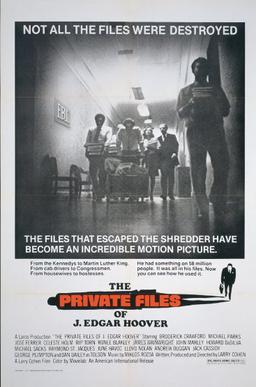
18 Days of Paranoia #3: The Private Files of J. Edgar Hoover (dir by Larry Cohen)


The 1977 film, The Private Files of J. Edgar Hoover, opens in 1972.

J. Edgar Hoover, the much-feared and long-serving director of the FBI, has just been found dead at his home and it seems like the entire city of Washington, D.C. is scrambling.  Not only are people jockeying for Hoover’s job but they’re also wondering what might be found in his secret files.  As quickly becomes apparent, Hoover had a file on everyone.  While Presidents lauded him and the press portrayed him as hero, Hoover spent nearly 50 years building up a surveillance state.  Hoover said it was to fight criminals and subversives but mostly, it was just to hold onto his own power.  Even President Nixon is heard, in the Oval Office, ordering his men to get those files.

Hoover may have known everyone’s secrets but, the film suggests, very few people knew his.  The film is narrated by a former FBI agent named Dwight Webb (Rip Torn).  Dwight talks about how he was kicked out of the FBI because it was discovered that he not only smoked but that he was having an adulterous affair with a secretary.  “You know how Hoover was about that sex stuff,” he says, his tone suggesting that there’s more to the story than just Hoover being a bit of a puritan.

We flash back to the 1920s.  We see a young Hoover (James Wainwright) as a part of the infamous Palmer Raids, an early effort by the Justice Department to track down and deport communist subversives.  Though Hoover disagrees with the legality of the Palmer Raids, he still plays his part and that loyalty is enough to eventually get him appointed, at the age of 29, to be the head of the agency that would eventually become the FBI.  Hoover may start out as a relatively idealistic man but it doesn’t take long for the fame and the power to go to his head.

Hoover (now played by Broderick Crawford) serves a number of Presidents, each one worse the one who proceeded him.  Franklin Delano Roosevelt (Howard Da Silva) is an avuncular despot while the Kennedy brothers (William Jordan as John and Michael Parks as Bobby) are two rich brats who think that they can control Hoover but who soon discover that Hoover is far more clever than they realize.  Hoover finds himself a man out-of-place in the 60s and the 70s,  Suddenly, he’s no longer everyone’s hero and people are starting to view the FBI as being not a force for law enforcement but instead an instrument of oppression.

Through it all, Hoover remains an enigma.  He demands a lot of from his agents but he resents them if they’re too successful.  Melvin Purvis (Michael Sacks) might find fame for leading the manhunt that took down Dillinger but he’s driven to suicide by Hoover’s cruel treatment.  Unlike Clint Eastwood’s film about Hoover, The Private Files of J. Edgar Hoover suggests that Hoover was not gay but that instead, that he was so repressed that he was essentially asexual.  When one woman throws herself at him, he accuses her of being a subversive and demands to know how anyone could find him attractive.  He’s closest to his mother and when she dies, he shuts off his emotions.  His own power, for better and worse, becomes the one thing that he loves.  He’s married to the FBI and he often behaves like an abusive spouse.

The Private Files of J. Edgar Hoover is an interesting film.  It’s an attempt to do a huge American epic on a less than epic budget.  At the start of the film, the low budget is undeniably distracting.  The 1920s are essentially represented by a back lot and two old cars.  The scenes of the FBI dealing with gangsters like Dillinger and Creepy Karpis feel awkward and slapdash.  But, as the film’s timeline gets closer to what was then the modern era, the film’s story tightens up and so does Larry Cohen’s direction.  (One get the feeling that Cohen was, perhaps understandably, more interested in the Hoover of the 60s and the 70s than the Hoover of the 20s and 30s.  There’s a sharpness to the second half of the movie that is just missing from the first half.)  Broderick Crawford gives a chilling performance as a man who is determined to hold onto his power, just for the sake of having it.  The scenes were Hoover and Bobby Kennedy snap at each other have a charge that’s missing from the first half of the film.  Michael Parks does a great job portraying RFK as basically being a spoiled jerk while Crawford seems to relish the chance to play up the resentful, bitter old man aspects of Hoover’s personality.  The film ultimately suggests that whether the audience previously admired RFK or whether they previously admired Hoover, they were all essentially duped.

Though the film never quite overcomes the limits of its low budget, it works well as a secret history of the United States.  In 1977, it undoubtedly took guts to make a film that portrayed Roosevelt and Kennedy as being as bad as Nixon and Johnson.  (It would probably even take guts today.  One need only rewatch something like The Butler or Hyde Park on Hudson to see the ludicrous lengths Hollywood will go to idealize presidents like Kennedy and dictators like FDR.)  While this film certainly doesn’t defend J. Edgar Hoover’s excesses, it often suggests that the president he served under were just as bad, if not even worse.  In the end, it becomes a portrait of not only how power corrupts but also why things don’t change, regardless of who is nominally in charge.  In the end the film’s villain is not J. Edgar Hoover.  Instead, the film’s villain is the system that created and then enabled him.  The man may be dead but the system remains.

Previous entries in the 18 Days of Paranoia:

  1. The Flight That Disappeared
  2. The Humanity Bureau