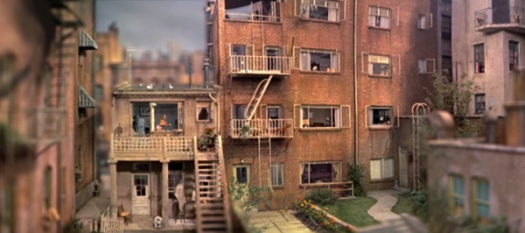
When you go out to the neighborhood cinema, you’re indulging in a voyeuristic experience, watching the lives of people unfold before you on the screen. The theme of viewer as voyeur, peeping in on the privacy of total strangers, has never been done better than in Alfred Hitchcock’s REAR WINDOW, nor more entertainingly. Like James Stewart’s protagonist L.B. Jeffries, we the audience are the voyeurs in the shadows watching from afar, stumbling onto things not meant for our eyes, and powerless to stop them without outside assistance. Hitchcock is not only the Master of Suspense, but a master of audience manipulation, and this dazzling piece of moviemaking is not only a hell of a thrill ride but a technical marvel as well.
The world of globetrotting photojournalist Jeffries has been boiled down to the view of the courtyard outside his apartment window, just as the audience’s world is now focused on…
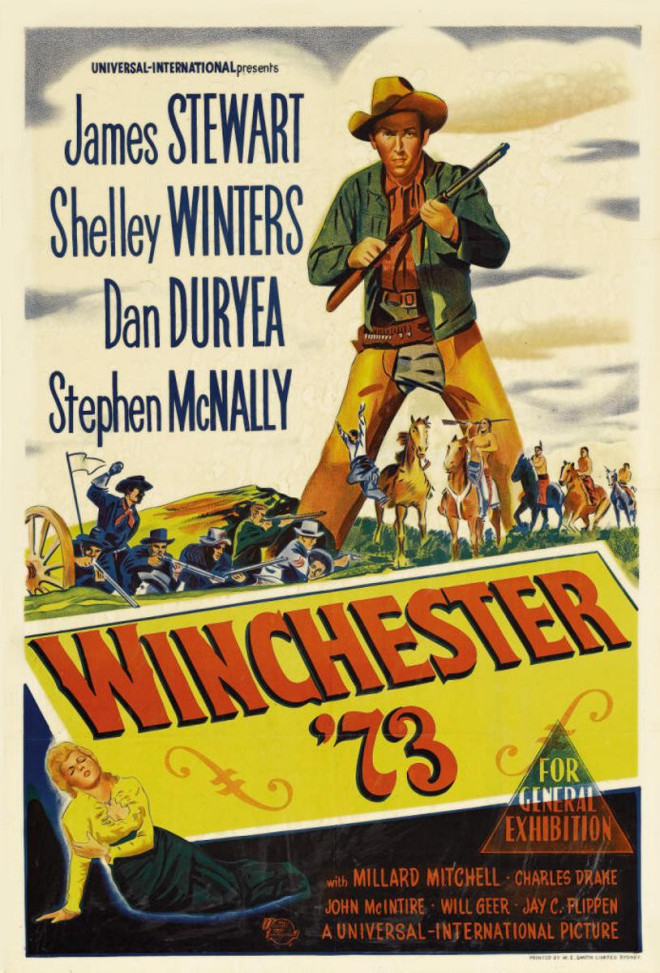
James Stewart and Anthony Mann made the first of their eight collaborations together with the Western WINCHESTER ’73, a film that helped change both their careers. Nice guy Stewart, Hollywood’s Everyman in Frank Capra movies like MR. SMITH GOES TO WASHINGTON and IT’S A WONDERFUL LIFE, took on a more mature, harder-edged persona as Lin McAdam, hunting down the man who killed his father, Dutch Henry Brown (Stephen McNally ). As for Mann, after years of grinding out B-movie noir masterpieces (T-MEN, RAW DEAL ), WINCHESTER ’73 put him on the map as one of the 1950’s top-drawer directors.
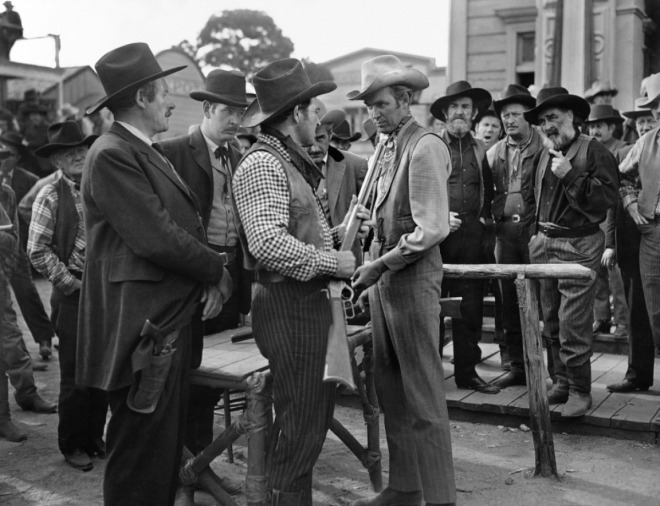
The rifle of the title is the movie’s McGuffin, a tool to hold the story together. When McAdam and his friend High Spade (the always welcome character actor Millard Mitchell) track Dutch Henry to Dodge City, the two mortal enemies engage in a shooting contest judged by none other than Wyatt Earp (Will Geer)…
It may seem strange, on Valentine’s Day, to share a scene that I love from a Christmas movie. Well, we’re all about being strange here at the Shattered Lens!
Add to that, George and Mary share one of the greatest romances ever put on the big screen. It may be a Christmas movie but it’s also a love story.
So, for your viewing pleasure, here’s how it all started…
Last night, NBC broadcast the classic 1946 film It’s A Wonderful Life and…
What?
You missed it?
Well, don’t worry — we’ve got you covered!
Presented for your listening enjoyment, here is the 1947 radio version of It’s A Wonderful Life! This was an episode of the Lux Radio Theater and it featured Jimmy Stewart and Donna Reed recreating their film roles!
At this very moment, NBC is broadcasting the classic 1946 film, It’s A Wonderful Life! They show it every Christmas Eve and every year, I watch.
Why?
Because I love this movie so much that I could watch it a million times and then a million times more! There is no movie that makes me happier than It’s A Wonderful Life. There is no movie that brings tears to my mismatched eyes as quickly as It’s A Wonderful Life. I love this film so much that I even watch it outside of December. If I’m depressed, this is the movie that I’m going to watch.
And who can blame me? The scene below is one that I love but, to be honest, there’s not a single scene in It’s A Wonderful Life that I don’t love. I even love those scenes with old Sam Wainwright going, “Hee haw!” Sam may have been a jackass but he was a good guy underneath it all.
(Plus, he made a fortune in plastics! Money can excuse all sorts of obnoxious behavior!)
As for the scene below, it’s the final ten minutes of It’s A Wonderful Life. To me, nothing exemplifies the joy of the holidays better than Jimmy Stewart running down the snow-filled streets of Bedford Falls and shouting “Merry Christmas” to everyone, even mean old Mr. Potter. (“And a happy new year to you — IN JAIL!”) This is a great scene and wonderfully acted by James Stewart, Donna Reed, Lionel Barrymore, Ward Bond, and everyone else in the film!
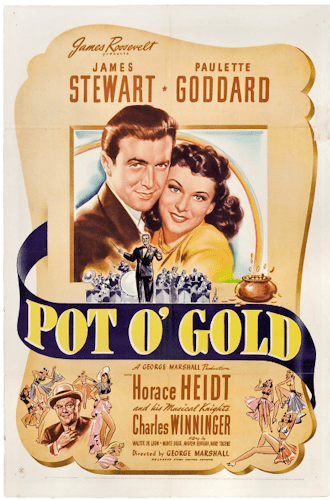
The 48th film in Mill Creek’s Fabulous Forties box set was 1941’s Pot O’ Gold. At first, I was really excited about watching Pot O’ Gold because it starred James Stewart, one of my favorite of the Golden Age stars. “Wow,” I thought, “James Stewart never made a bad movie! This is going to be great!” However, before watching the film, I looked Pot O’ Gold up on Wikipedia and I discovered that apparently, James Stewart considered Pot O’ Gold to be the worst film that he ever made.
After having watched the film, I think that Jimmy may very well have been correct in his assessment.
Pot O’ Gold is a musical comedy. Stewart plays Jimmy Haskell, the owner of a music store. Jimmy loves music but he’s a terrible businessman. Despite the fact that his store always seems to be full of quirky characters playing musical instruments, it still goes out of business. Jimmy is forced to go to work for his uncle, C.J. Haskell (Charles Winninger). C.J. not only owns a health food company but he also produces a radio show.
And, on top of all that, C.J. hates music!
Unfortunately, considering how much C.J. hates music, he lives right next door to the McCorkles, a family of Irish musicians. The McCorkles are constantly practicing in front of C.J.’s store and, as a result, C.J. is constantly forced to call the cops to make them go away.
When Jimmy first arrives at the store, he befriends the McCorkles. He even falls in love with Molly McCorkle (Paulette Goddard). Unfortunately, none of the McCorkles know that he is C.J.’s nephew and C.J. doesn’t know that his nephew secretly continues to love music. Meanwhile, C.J. is trying to catch the mysterious person who threw a tomato at him. What he doesn’t realize is that the tomato was thrown by … JIMMY!
And it just keeps going on and on from there. C.J. conspires to get rid of the McCorkles. Jimmy tries to bring peace between the two sided without the Molly discovering that he’s related to C.J. and without C.J. realizing that Jimmy threw that tomato. Jimmy eventually goes on C.J.’s radio show and soon, he’s using the show as a way to give away money to the needy. Meanwhile, he struggles to forge peace between the McCorkles and C.J. without Molly discovering his true identity and without C.J. finding out he threw that tomato. Will C.J. ever learn to love music and will it ever occur to anyone that this whole mess could easily be resolved by everyone making an effort not to randomly break out into song every time C.J. happens to be walking down the street?
Pot O’ Gold is an amazingly silly movie and I don’t mean silly in a good way. This is one of those films where every issue could be resolved if people just showed a little intelligence. It’s also a movie where everyone breaks into song every few minutes. The key to a successful musical is that the songs have to feel like the grow organically out of the action. The songs in Pot O’ Gold feel like they’re just there to be there.
Personally, I think James Stewart is one of those actors who can make any movie worth seeing. He is his normal, likable self in this film but Pot O’ Gold never seems worthy of his famous persona.
Incidentally, Pot O’ Gold’s credited producer was James Roosevelt, FDR’s wastrel son. I don’t know how much he had to do with the actual production but I’ve always wanted an excuse to use the word “wastrel” in a review.
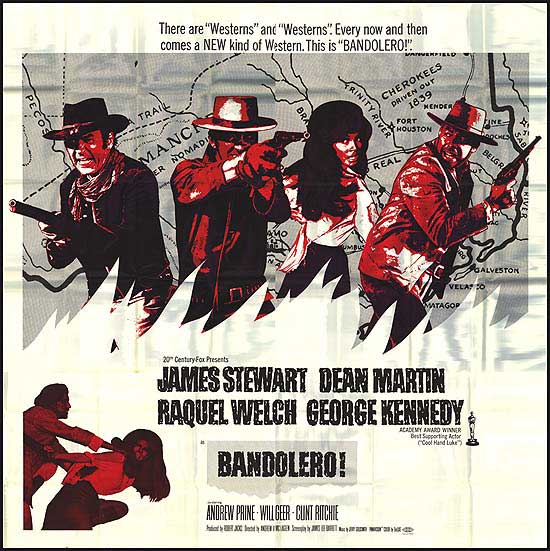
BANDOLERO! was made at an interesting time in the history of Western movies. Sergio Leone’s “Man With No Name” trilogy had begun to exert their influence on American filmmakers (HANG EM HIGH, SHALAKO). Traditional Hollywood Westerns were still being produced (FIRECREEK, 5 CARD STUD), but in a year’s time, Sam Peckinpah’s THE WILD BUNCH would change the Western landscape forever. Andrew V. McLaglen’s BANDOLERO! is more on the traditional side of the fence, though it does exhibit a dash of Spaghetti flavor in its storytelling.
Outlaw Dee Bishop and his gang attempt to rob a bank in Valverde, Texas. The heist is going well until rich Nathan Stone walks in with his beautiful Mexican wife, Maria. Stone tries to break it up, and gets shot for his troubles, thus alerting the attention of Sheriff July Johnson and his deputy, Roscoe. The lawmen successfully catch the gang as they’re leaving the bank. Stone dies, and Dee and…
THE SHOOTIST is John Wayne’s valedictory statement, a final love letter to his many fans. The Duke was now 69 years old and not in the best of health. He’d had a cancerous lung removed back in 1964, and though the cancer was in remission, Wayne must’ve knew his days were numbered when he made this film. Three years later, he died from cancer of the stomach, intestines, and spine. There were worries about his ability to make this movie, but Wayne loved the script and was determined to do it. The result is an elegy to not only the aging actor, but to the Western genre as a whole.
The movie begins with footage of older Wayne westerns (EL DORADO, HONDO, RED RIVER, RIO BRAVO) narrated by Ron Howard (Gillom). “His name was J.B. Books…he wasn’t an outlaw. Fact is, for a while he was a lawman…He had a credo that…
“When the legend become fact, print the legend.” — Maxwell Scott (Carleton Young) in The Man Who Shot Liberty Valance (1962)
Though I understand and respect their importance in the history of both American and Italian cinema, I have never really been a huge fan of westerns. Maybe its all the testosterone (“A man’s got to do what a man’s got to do…”) or maybe it’s all the dust but westerns have just never really been my thing.
However, I will always make an exception for The Man Who Shot Liberty Valance, which is not just a great western but a great film period.
But you already knew that. It’s a little bit intimidating to review a film that everyone already knows is great. I even opened this review with the exact same quote that everyone uses to open their reviews of The Man Who Shot Liberty Valance. To a certain extent, I feel like I should have found a quote that everyone hasn’t already heard a thousand times but then again, it’s a great quote from a great film and sometimes, there’s nothing wrong with agreeing with the critical consensus.
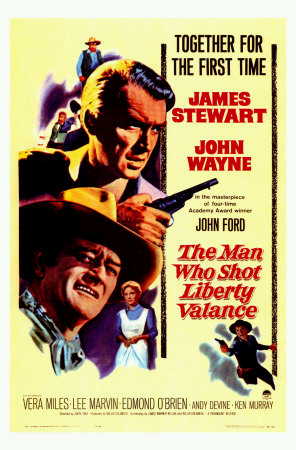
The Man Who Shot Liberty Valance opens with a train stopping in the small western town of Shinbone. The residents of the town — including newspaper editor Maxwell Scott (Carleton Young) — are shocked when Sen. Rance Stoddard (James Stewart) and his wife Hallie (Vera Miles) get off the train. Sen. Stoddard is considered to be a front-runner to become the next Vice President of the United States. Scott is even more shocked to discover why the Stoddards are in town. They’ve come to Shinbone to attend the funeral of an obscure rancher named Tom Doniphon (played, in flashback, by John Wayne).
Sitting in the funeral home with Doniphon’s coffin (and having reprimanded the local mortician for attempting to steal Tom’s boots), Rance tells Scott why he’s come to pay respect to Tom Doniphon. We see, in flashback, how Rance first came to Shinbone 25 years ago, an idealistic lawyer who — unlike most of the men in the west — refused to carry a gun. We see how Rance was robbed and assaulted by local outlaw Liberty Valance (a wonderfully intimidating and bullying Lee Marvin), we discover how Rance first met Hallie while working as a dishwasher and how he eventually taught her how to read, and we also see how he first met Tom Doniphon, the only man in town strong enough to intimidate Liberty Valance.
At first, Rance and Doniphon had an uneasy friendship, epitomized by the condescending way Doniphon would call Rance “pilgrim.” Doniphon was in love with Hallie and, when he attempted to teach Rance how to defend himself, he was largely did so for Hallie. Rance, meanwhile, was determined to bring law and society to the west.
And, eventually, Rance did just that. When Shinbone elected two delegates to the statehood convention in the territory’s capitol, Rance attempted to nominate Doniphon for the position but Doniphon refused it and nominated Rance instead, explaining that Rance understood “the law.” When Liberty Valance attempted to claim the other delegate spot, Rance and Doniphon worked together to make sure that it instead went to newspaper editor Dutton Peabody (Edmond O’Brien). And when Liberty Valance attempted to gun Rance down in the street, Rance shot him.
Or did he?
That’s the question that’s at the heart of The Man Who Shot Liberty Valance. However, as a film, The Man Who Shot Liberty Valance is far less interested in gunfights than it is in politics. Perhaps the most important scene in the film is not when Rance and Liberty meet out on that dark street. Instead, it’s the scene at the statehood convention where the reformers (represented by Rance) and the cattlemen (represented by John Carradine) battle over who will be the territory’s delegate to Washington. Between John Carradine orating, the horses riding in and out of the hall, Edmond O’Brien drinking, James Stewart looking humble, and John Wayne glowering in the background, this is one of the best political scenes ever put on film.
When Rance first arrives in the west, there is no political system in place. With the exception of the ineffectual town marshal (Andy Devine), there is no law. The peace is kept by men like Tom Doniphon and, oddly enough, by Liberty Valance as well. (Whether he realizes it or not, Shinbone’s fear of Liberty has caused the town to form into a community.) What little official law there is doesn’t matter because the majority of the Shinbone’s citizens can’t read.
When Rance arrives, he brings both education and the law. He makes Shinbone into a town that no longer needs Liberty Valance but, at the same time, it no longer need Tom Doniphon either. Hence, it’s Rance Stoddard who goes from dishwasher to U.S. Senator while Tom Doniphon dies forgotten. Rance represents progress and unfortunately, progress often means losing the good along with the bad things of the past.
(It’s no coincidence that when Rance and Hallie return to Shinbone, the first person that they see is the former town marshal, who no longer wears a star and who, we’re told, hasn’t for years. Time has passed by.)
It’s a bittersweet and beautiful film, one that features four great performances from Stewart, Wayne, Marvin, and Vera Miles. Personally, I like to think that maybe Sen. Stoddard had a daughter who married a man named Smith and maybe they had a son named Jefferson who later made his way to the Senate as well.
So, when you read that I was going to be reviewing 94 political films here at the Shattered Lens, you probably knew that one of them would have to be the 1939 best picture nominee, Mr. Smith Goes To Washington.
So, we all know that story right? The senator from an unnamed state dies. The weak-willed Governor (Guy Kibbee) has to appoint a new senator. Political boss Jim Taylor (Edward Arnold) demands that the governor appoint one of his cronies. The state’s reformers demand that the Governor appoint a never-seen crusader named Henry Hill (who, whenever I hear his name, makes me think of Ray Liotta snorting cocaine in Goodfellas). The Governor’s children demand that he appoint Jefferson Smith (James Stewart, of course!), who is the head of something called the Boy Rangers. The Governor flips a coin. The coin lands on its edge but it also lands next to a newspaper story about Jeff Smith.
So, of course, Mr. Smith goes to Washington.
Now, as the movie quickly makes clear, Jeff Smith is immediately out-of-place in Washington. For one thing, he’s actually excited to be there. He’s convinced that he’s there to make America a better place. When a bunch of drunken reporters (led by the great Thomas Mitchell) make Smith look foolish, Smith responds by running around Washington and punching them out. (That whole sequence probably serves as wish fulfilment for a lot of politicians.) When his cynical legislative aide Saunders (Jean Arthur) tells him that he’s too naive to survive in Washington, he wins her over with the purity of his idealism. When his mentor, Senator Paine (Claude Rains), is revealed to be a part of Washington’s corrupt culture, Smith is stunned. When Taylor tries to destroy his political career, Smith responds by giving the filibuster to end all filibusters. He’s one man standing up against a culture of corruption and…
And there’s a reason why, 76 years later, aspiring political candidates still attempt to portray themselves as being a real-life, modern Jefferson Smith.
This is one of those films that everyone seems to agree is great and, of course, there’s many reasons to love Mr. Smith Goes To Washington. There’s the lead performance of Jimmy Stewart, of course. While this may not be his best performance (I prefer the more layered characterization that he brought to It’s A Wonderful Life and Anatomy of a Murder), it is Stewart at his most likable and, most importantly, he makes you feel Jeff Smith’s pain as he discovers that Washington is not the great place that he originally assumed it to be. Claude Rains was always great when it came to playing good men gone wrong and he’s perfect as Sen. Paine. Thomas Mitchell and Jean Arthur are perfectly cast and I always enjoy seeing the bemused smile on the face of Vice President Harry Carey as Smith conducts his filibuster.
But I think the best thing about Mr. Smith Goes To Washington is that it actually makes you believe that there are Jeff Smiths out there who actually could make a difference. And, until Judd Apatow gets around to remaking the film with Adam Sandler, audiences will continue to believe.





 Through the Shattered Lens