Horror Film Review: The Black Phone (dir by Scott Derrickson)


“Arm like a mint!” a character exclaims at a key moment in 2021’s The Black Phone and I’ll admit right now that, when I heard that line, I rolled my eyes so violently that I’m lucky that I didn’t lose one of them.

It’s one of those lines that reminds us that we’re watching a movie that’s based on a short story and that the dialogue that works in a piece of literature can often sound awkward and forced when heard on film.  It’s a line that, at least for a few moments, took me right out of the movie’s reality and reminded me that I was watching was indeed just a movie.

There’s actually a few moments like that in The Black Phone but, fortunately, there’s more than enough that works about this movie to make up for what doesn’t work.

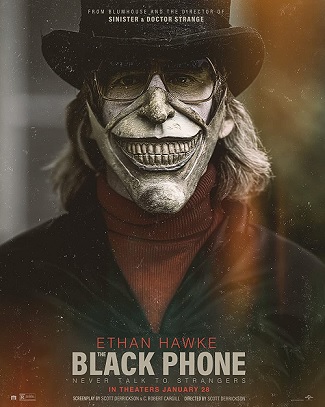
Taking place in a Denver suburb in 1978, The Black Phone deals with the evil activities of a serial abducted and murderer who is known only as The Grabber (Ethan Hawke).  The Grabber (who really should demand a better nickname) has spent years grabbing children off of the street and then holding them prisoner in his basement before killing them.  The Grabber drives a van and he usually wears a mask.  The mask is creepy but it also tells us something about The Grabber’s personality.  Obviously, when he talks the kids into getting into his van (or getting close enough for him to grab them), the Grabber can’t wear his mask so he’s not wearing the mask so he won’t be identified.  Instead, he wears the mask as perhaps a way to keep his “normal” life separated from his life as The Grabber.  Maybe that’s how this middle-aged man justifies being everyone’s worst nightmare.  Perhaps he tells himself that he’s not responsible for what he does when he puts on the mask.  Once he puts on the mask, anything bad that happens is the fault of The Grabber.

The Grabber’s latest victim is Finney (Mason Thames).  While Finney waits in the basement, his father (Jeremy Davies) struggles with his own alcoholism and his sister, Gwen (Madeleine McGraw), tries to get someone — anyone — to take her psychic visions seriously.  Gwen is determined to find and rescue her brother but, early on, the audience realizes that only Finney can save himself.  Fortunately, Finney has some help in the form of the ghosts of the Grabber’s other victims, all of whom call Finney on a black phone in the basement.  They offer Finney advice on how both to survive and how to fight against The Grabber.  Some of the ghosts are angry.  Some of them are surprisingly cheerful.  All of them are understandably eager to help Finney fight their murderer.

It’s an effective film, even if it does feel a bit overlong.  The film is based on a short story and it’s hard not to feel that the story would have been better served by a 30-minute short film than an obviously extended feature film.  That said, The Grabber is a genuinely creepy villain and the film leaves you feeling as if anyone in the film could easily become his next victim if Finney doesn’t figure out a way to get out of that basement.  Interestingly, by casting the handsome Hawke as a child abducted and murderer and the nervous Jeremy Davies as an imperfect father who wants to do better, the film challenges our assumptions about both characters.  The Black Phone is a film that effectively captures the terror of everyday life.

V/H/S/85 (dir. by Various Artists)


The full list of directors for Shudder’s V/H/S/85 includes David Bruckner (The Night House), Gigi Saul Guerrero (Bingo Hell), Scott Derrickson (The Black Phone), Natasha Kermani (The Imitation Girl), and Mike P. Nelson (2021’s Wrong Turn).

I’m not completely familiar with the V/H/S series. I stopped after the very first one, with the “I Like You” segment rattling me enough to never want to delve into that found footage mayhem again. It only caught my interest because Scott Derrickson (and by extension C. Robert Cargill and Gigi Saul Guerrero were involved. Cargill and Derrickson have worked together since Sinister (as far as I know). Guerrero’s Bingo Hell was a fun watch, as horror films go. While the found footage format still bothers me when used in large doses, the effect here really makes sense. You’re working in the 80s, pre-cell phones and most major technology. Home movies were common back then as well.

The format for the film is similar to most horror anthologies (like Tales From the Darkside), where there are 4 or 5 mini tales and another that you see in between those. David Bruckner covers the main story with “Total Copy”, where a strange specimen in a lab is kept under close study. Of all the stories in the group, this one really didn’t hold me very well, though it does work well as filler between the other, stronger tales.

Mike Nelson’s “No Wake” starts us off with a camping trip to a nearby lake. Despite discovering No Trespassing signs, the crew of young adults set out for a nice time in the water. This ends up becoming rather treacherous and the result leaves them wanting to take revenge on their perpetrators. It was a strange and refreshing take on a familiar tale that I liked, though it was somewhat short.

We move on to Gigi Saul Guerrero’s “God of Death”, which I enjoyed. This tale follows a cameraman during an earthquake in Mexico, as a rescue crew tries to evacuate a collapsing building. Guerrero is in this piece as the reporter, Gabriella, and if you watch close enough, you’ll see a picture of her father on one the walls, looking like the Mayor of the town. I thought that was sweet. There’s quite a bit of blood and gore, as much as Shudder likes to give.

Natasha Kermani’s “TKNOGOD” was the only one in the series that I didn’t care for. Not that I was bothered about the argument of God vs. Technology, but it felt more like those slam poetry sessions you find in Manhattan. I understand what it was trying to convey, and it does get somewhat chilling. Still, I kind of glossed over it and waited for the next entry. It was filmed well, at least. That I will give it.

“Ambrosia” brings us to a family reunion and celebration, though the family itself might not have the best intentions at heart. This one surprised me a bit and I liked the connection to earlier events.

And finally, we have a Sinister reunion of sorts with Director Scott Derrickson, writer C. Robert Cargill, and actor James Ransome (Deputy So & So himself) in “Dreamkill”. Working in a similar vein to Sinister, Dreamkill focuses on some deadly murders occurring in a town that also happen to be recorded on home video before the events take place. A detective (Freddy Rodriguez, Grindhouse’s Planet Terror) tries to piece together the clues before more victims are lost. This was the best of the bunch, by far, I felt.

Overall, if you can handle the shaky cam of the V/H/S films, 85 is a treat. While I personally wished some these weren’t using the cam, the film finds a way to keep the floating camera in the picture. It’s an interesting set of scares if you have the time to watch.

The Final Trailer for IT: Chapter Two


With the 50th Annual San Diego Comic Con in full swing, Warner Bros. is wasting no time in showcasing their wares. Here we have the final trailer for Andy Muschietti’s IT: Chapter Two. The more I see of this, the more I’m amazed by the casting choices. James Ransome (Eddie) and Bill Hader (Richie) really feel like the perfect matches for their roles so far. Granted, the trailer is just a taste of what we’ll see later on, but I’m hopeful.

IT: Chapter Two finds the members of the Loser’s Club returning to Derry, 27 years after their first encounter with Pennywise the Clown (Bill Skarsgard). Will they be able to get past their fears? Can they recreate the magic they had? Will they avoid the deadlights?

It: Chapter Two, also starring Jessica Chastain, James McAvoy, Jay Ryan, Andy Bean, and Isaiah Mustafa, opens in theatres on September 6th.

Enjoy!

Trailer: Oldboy (Red Band)


OldboyRemake

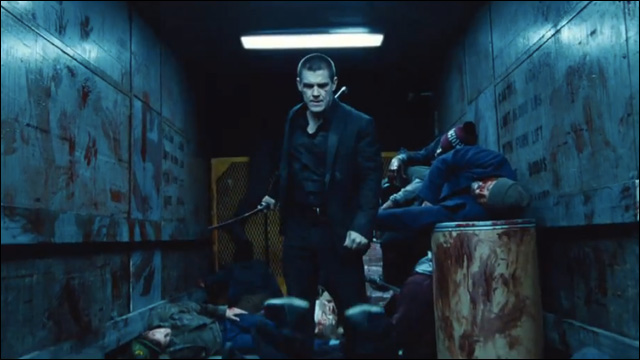
Today saw the release of the red band trailer for the remake of Park Chan-wook’s classic neo-noir Oldboy. This remake by Spike Lee already looks to pay homage (or imitate) the look and feel of Park’s adaptation of the Japanese manga of the same name by Garon Tsuchiya and Nobuaki Mineshigi. We see quick glimpses of the hallway fight scene and a montage of the main character’s 20 years spent locked up in an unknown hotel room.

There’s a great chance for Spike Lee to make this remake his very own by using the Park film as a template but not as gospel. The Park adaptation itself took some liberties with the story told in the manga. Lee and the screenplay by Protosevich could do same to allow this Oldboy a chance to stand on its own instead of becoming another Gus Van Sant Psycho.

Though I wouldn’t mind to see what Lee has in mind as Josh Brolin’s character’s first choice of a meal once getting out.