October True Crime: Guilty Until Proven Innocent (dir by Paul Wendkos)


This 1991 made-for-TV movie opens with a murder in a Brooklyn park.  The year is 1979 and a group of teenagers are accosted by two men carrying guns.  The men rob the teenagers of their drugs and guns.  One person is killed.  When the police arrive, almost everyone says that it was too dark to see anything.  However, a 15 year-old named Jimmy O’Neill (Tristan Tait) says that he saw the faces of the men.

At the police station, the detective (Mark Metcalf) shows him a picture of a man named Billy Ferro (Zachary Mott) and Jimmy identifies him as one of the gunmen.  The detective then produces a picture of a 19 year-old named Bobby McLaughlin (Brendan Fraser) and asks if Bobby was the other man.  When Jimmy hesitates, the detective says that McLaughlin has been arrested with Billy in the past.

Of course, the truth of the matter is that, while Bobby has been arrested in the past, he’s never been arrested for anything as serious as murder and he’s never met Billy Ferro.  The man who had been arrested in the past with Ferro was named Harold McLaughlin.  The detective accidentally grabbed the wrong picture.

Bobby, a high school drop-out who lives with his foster parents (played by Martin Sheen and Caroline Kava), is arrested and charged with second degree murder.  It doesn’t matter that Bobby passes a polygraph because the results are not admissible in court.  It doesn’t matter what Bobby has an alibi because the prosecutor portrays all of his friends as being a collection of stoners and losers.  It doesn’t matter what Bobby has never even met Billy Ferro because Ferro isn’t going to help anyone out, even someone who he knows is being falsely convicted.  Bobby is convicted of second degree murder and sent to prison.

For the next seven years, while Bobby tries to survive prison, his foster father attempts to prove his son’s innocence.  With the police refusing to help, Bobby’s father is forced to launch his own investigation but it seems like no matter what he discovers, it’s not enough to get Bobby out of prison.  Still, neither he nor Bobby gives up.  Neither one will accept a system in which you’re guilty until proven innocent….

For most people who choose to watch this film, I imagine it will be because of that “Introducing Brendan Fraser” credit.  Fraser gives a very good performance in this film, playing Bobby as basically well-meaning but directionless teenager who finds himself trapped in a nightmare.  Of course, the majority of this film is Martin Sheen yelling about the injustice of it all.  This is the type of crusader role that Sheen has played often.  As was often the case when he was cast in films like this, there’s nothing subtle about Sheen’s performance but it’s not really a role that needs or demands subtlety.

Though this was made-for-television and, as such, is never quite as critical of the system as perhaps it should be (if anything, the film argues that one should trust the system to eventually do the right thing, even if it does so seven years too late), it still shows how one cop’s mistake can ruin an innocent’s man life.  It’s all the more effective because it’s based on a true story.  Of course, I immediately knew the cop shouldn’t be trusted because he was played by Mark Metcalf.  Niedermeyer as a cop?  That’s definitely not going to end well.
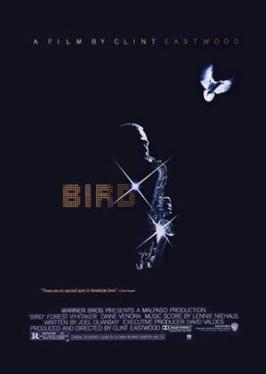
Bird (1988, directed by Clint Eastwood)


Forest Whitaker stars as the legendary saxophonist Charlie “Bird” Parker.  The film, which is structured around flashbacks and time jumps and features some of the most beautifully-done transitions that I’ve ever seen, follows Parker as he plays his saxophone, challenges the jazz purists who his own individual style, and looks for work in both America and France.  Along the way, we watch as he befriends and learns from Dizzy Gillespie (Samuel Wright), mentors a young trumpet player named Red Rodney (Michael Zelniker), and has a complex relationship with a white jazz lover named Chan Parker (Diane Venora).  Throughout his life, Charlie Parker struggles with his addiction to heroin and alcohol, occasionally getting clean to just then fall back into his habit.  To its credit, the film avoids most of the biopic cliches when it comes to portraying Parker’s addiction.  Parker accepts that he’s an addict, just as he accepts that he has a talent that is destined to revolutionize American music.

Director Clint Eastwood has always been a fan of jazz and he actually saw Charlie Parker perform when he was a young man.  His love of jazz had been present in almost every modern-era film that he has directed, staring with Play Misty For Me’s lengthy trip to the Monterey Jazz Festival.  Bird was a passion project for Eastwood, the first film that Eastwood directed without also appearing in.  (Eastwood doesn’t star in his second directorial effort, Breezy, but he does have a brief and silent cameo as a man standing on pier.)  Eastwood takes a nonlinear approach to telling the story, eschewing the traditional bopic format and instead putting the focus on Parker’s music.  Eastwood was able to get several never bef0re-released recordings of Parker performing and, when Whitaker is blowing into his saxophone in the film, we’re actually hearing Parker.  Eastwood’s direction captures the smoky atmosphere of the jazz clubs where Parker and Gillespie made their name while the nonlinear style reflects the feeling of just letting a song take you to wherever it’s going.  This is a movie about jazz that plays out like a jazz improvisation.

Forest Whitaker gives an amiable and charismatic performance as Charlie Parker, playing him as someone who has found both an escape and peace in his music, even as he physically struggles with the ravages of his drug addiction.  Whitaker won the Best Actor at Cannes for his performance in Bird.  Eastwood received the Golden Globe for Best Director.  Bird feels like it was labor of love for both of them.  Bird may not have set the box office on fire when it was originally released but it remains one of the best jazz films.

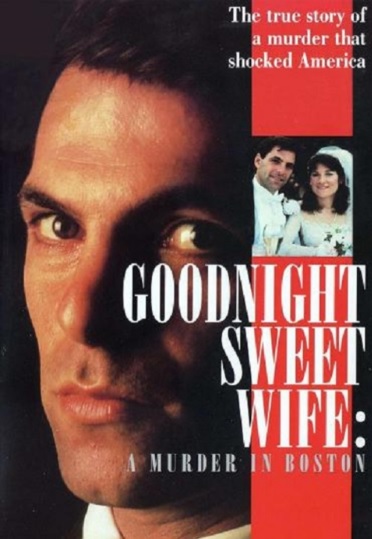
October True Crime: Goodnight Sweet Wife: A Murder In Boston (dir by Jerrold Freedman)


1990’s Goodnight Sweet Wife opens with a frantic 9-11 call.

A man named Charles Stuart (Ken Olin) calls the Boston Police Department and says that he and his pregnant wife have just been shot.  He says that he got lost while trying to drive home and that a black man got in the car, made Charles drive to a remote location, robbed Charles and his wife, and then shot them.  When the police finally manage to track Charles down, he’s nearly dead as a result of having been shot in the stomach.  Carol was shot in the head and is pronounced dead shortly after arriving at the hospital.  Her baby, named Christopher, is delivered via C-section but dies a few days later.

The city of Boston is outraged as the crime makes national news.  The story that thousands hear is that Charles Stuart, a hard-working and financially successful man who has never had any trouble with the police, took one wrong turn, ended up in a “bad” neighborhood, and lost his wife and his son as a result.  As Charles recovers in the hospital, the police make capturing his assailant their number one priority and soon, black men are being stopped and frisked in the streets.

With the entire world mourning the loss of Carol and Christopher Stuart, there are only a few people in Boston who are willing to take a careful look at Charles’s story.  There are quite a few inconsistencies in Charles’s story, not the least of which was his claim that he was shot in a nearly deserted area of town when the neighborhood is actually one of Boston’s busiest.  Some start to suspect that Charles killed his wife and then shot himself to make it look like a robbery and the fact that Charles nearly died from his wound is not proof that Charles was actually the victim but instead just a sign that Charles didn’t know where to shoot himself in order to not nearly die.  However, even with all of the inconsistencies in Charles’s story, the police still announce that they’ve arrested a man for the crime.  Charles even identifies the suspect, William Bennett, as being the murderer.

Of course, as is revealed in flashbacks, Charles Stuart is a murderer and he’s not a particularly clever one.  He’s the type of murderer who openly talked to people about how he was considering committing a murder.  He’s the type who roped his own brother into helping him fake the robbery.  Far from being the successful professional that he presented himself as being, Charles was mediocre broker who depended on his wife’s salary to finance his lifestyle.  With Carol pregnant and planning on quitting her job to be a full-time mother, Charles decided to kill her for the insurance and he also figured that he would be able to get away with it as long as he blamed the crime on a black man.

Tragically, it turned out that Charles Stuart was almost right.  In both the movie and in real life, Charles Stuart was believed because he didn’t look like what most people thought a criminal looked like.  He was a young, handsome, middle class white guy and because he couldn’t face the prospect of having to cut back financially, he killed his wife and his son and he nearly put an innocent black man in prison.  The film does a good job of depicting the consequences of both Stuart’s crime and the rush to judgment on the part of the police.  Ken Olin plays Charles Stuart as being outwardly friendly but empty on the inside, a cold sociopath who is incapable of truly caring about anyone but himself.  In real life, Stuart chose to jump into the Mystic River rather than face the consequences of his actions.  Stuart’s brother, who helped Charles fake the robbery and later turned Charles into the police, died in a homeless shelter 30 years later.  Carol’s family set up a scholarship fund in her name to aid students in Mission Hill, the neighborhood where Charles claimed he had been hijacked.  One of the scholarship’s first recipients was the daughter of William Bennett.

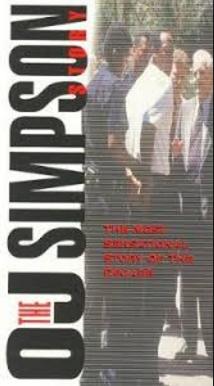
A Movie A Day #193: The O.J. Simpson Story (1995, directed by Alan Smithee)


Long before O.J.: Made In America

Before The People vs. O.J. Simpson

Before American Tragedy

Before today’s live, televised parole hearing…

There was The O.J. Simpson Story.

In 1994, shortly after O.J. Simpson was charged with the murders of Nicole Brown Simpson and Ron Goldman, Fox rushed The O.J. Simpson Story into production.  It was one of many “true life” stories that showed up as television movies during the 90s.  There was a movie about Woody Allen and Mia Farrow’s divorce.  There was a movie about David Koresh and the Branch Davidians, which actually aired while the siege in Waco was still ongoing.  There were three movies about Amy Fisher.  So, of course, O.J. would get a movie.

Though the movie was produced in 1994, it was not allowed to air in 1995 so that it would not prejudice any of the jurors in the case.  (After all, they might have done something crazy like ignore all of the DNA evidence and let O.J. go free.)  I think the legal authorities may have been giving The O.J. Simpson Story too much credit.  There were many bad made-for-TV movies made in the 90s but The O.J. Simpson Story may very well be the worst.  The only thing it could prejudice some against is television.

Opening with the discovery of the murders in Brentwood, The O.J. Simpson Story mixes scenes of O.J. (played by Bobby Hosea, who shows not a hint of O.J.s famous charisma) talking to the police and his lawyer, Bob Shapiro (Bruce Weitz, slightly more credible than John Travolta was in The People vs. O.J. Simpson) with flashbacks to O.J.’s youth, first marriage, and his relationship with Nicole (blandly played by Jessica Tuck, who, beyond the color of her hair, looked nothing like Nicole).  The film also devotes some time to O.J.’s friendship with A.C. Cowlings, who, as a young man, is played by Terrence Howard.

Several of the famous incidents of the case are wanly recreated.  The famous bronco chase is there, of course.  O.J. is shown beating Nicole in the infamous 1989 incident, which the movie suggests was triggered by Nicole telling O.J. that he would never win an Oscar for appearing in The Naked Gun.  But, since the movie was rushed into production before the trial even began, it is remarkable how much is left out.  There’s no Mark Furhman finding the black glove.  There’s no Kate Kaelin, Faye Resnick, Johnnie Cochran, or even Marcia Clark.  Because the movie was made before the trial had even begun, it does not even take a stand on whether or not O.J.’s guilty.  Narratively, it is an incomplete movie and evidence of why movies that claim to tell true stories should not be rushed into production before the story itself has been completed.

As for the film’s dialogue, when O.J. first meets Nicole, he asks her, “Any problem with going out with a brother?”

“Yeah,” Nicole says with a smile, “I’m in the Ku Klux Klan.”

Not surprisingly, The O.J. Simpson Story was directed by Alan Smithee, which was the pseudonym used by directors who felt that their movie has been so butchered by outside interference that they should not even be credited with the final result.  The O.J. Simpson Story is one of the worst Smithee films that I have ever seen.  Compared to The O.J. Simpson Story, Smithee’s work on Let’s Get Harry was Oscar-worthy.

As for the real life O.J. Simpson, earlier today, he was granted parole from the Nevada Parole Board.  He will be released from prison on October 1st.  He has said that he hope to be allowed to move to Florida after being released.  The real-life O.J. Simpson story continues.

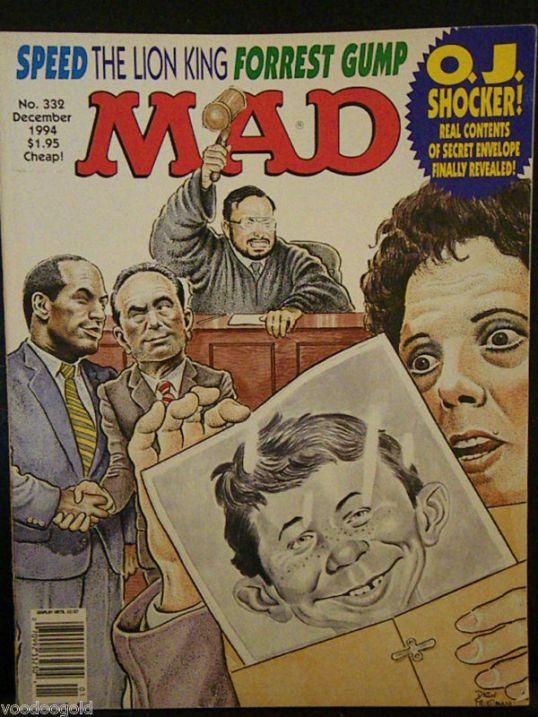
When it comes to the long saga of O.J. Simpson, it seems appropriate to give the last word to MAD Magazine:

Cleaning Out The DVR #12: Bad Sister (dir by Doug Campbell)


bad-sister-9

Last night, after I finished with Going My Way, I decided to stick with the Catholic theme by rewatching Bad Sister.  Bad Sister aired on Lifetime on January 3rd.  Having seen several wonderfully sordid commercials, I watched it and I loved every minute of it.  I was really looking forward to watching it again but apparently, there was some sort of screw-up with my usually ultra-dependable DVR.  It only recorded bits and pieces of Bad Sister.

I was so disappointed!  Fortunately, however, I still remember Bad Sister well enough to review it.  For instance, who could forget this scene?

Okay, technically, that was a scene from the episode of King of the Hill where Peggy pretends to be a nun so she can get a job teaching at a Catholic school.  (“Sister Peggy, will my cat go to heaven?”  “Well, I’ve heard that all dogs go to Heaven so I’m pretty sure that cats do not.”)  For whatever reason, I couldn’t find any Bad Sister clips on YouTube but really, the movie has pretty much the same plot.  It’s just, in the case of the movie, the fake nun is also a sociopath who starts to obsess on one of her students.

From the minute Sister Sophia (Alyshia Osche) shows up at her new job as a teacher at a Catholic boarding school, it’s obvious that she’s not like the other nuns.  For one thing, she’s awfully enthusiastic about her students, especially the male ones.  Plus, there’s not many nuns who specifically make it a point to strip down to sexy red lingerie while being watched by a teenage boy.  Even beyond that, Sophia refuses to take part in Morning Prayer and she doesn’t seem to know much about … well, anything Catholic.  Is Sister Sophia just young and naive or is it possible that she’s actually an escaped mental patient named Laura?  And could it be that, perhaps at the start of the movie, Laura murdered the real Sister Sophia and stole her identity?

Well, this is a Lifetime movie so, of course, that’s exactly what happened!

As a result of seeing him sing on YouTube, Sister Sophia is obsessed with Jason (Devon Werkheiser, the star of Ned’s Declassified School Survival Guide, all grown up).  Jason’s a student who dreams of being the next Justin Bieber.  However, to get to Jason, Sister Sophia has to deal with not only Jason’s girlfriend (Sloane Avery) but also Jason’s suspicious sister, Zoe (Ryan Newman).  And, of course, there’s Sister Rebecca (Helen Eigenberg), another nun who is starting to suspect that Sophia might not be who she says she is…

Bad Sister was a totally over-the-top masterpiece of Lifetime moviemaking.  Director Doug Campbell is one of my favorite Lifetime directors and he doesn’t disappoint with Bad Sister, playing up the sordid melodrama while, at the same time, never making the mistake of taking this story too seriously.  Alyshia Osche was brilliant as Sister Sophia.  One of the most entertaining parts of the film was watching her switch back and forth from being the enthusiastic Sister Sophia and the perpetually annoyed Laura.  (Just watch the scene where she goes through the real Sister Sophia’s stuff and discovers the boring, dowdy underwear that she’s expected to wear.  The look of total and thorough annoyance that flashes across her face is absolutely brilliant acting on Osche’s part and, within seconds, totally and completely defines the character of Laura/Sister Sophia.)

Bad Sister was the first great Lifetime film of 2016!  Keep an eye out for it.

(I should add that you probably don’t have to come from a Catholic background to enjoy Bad Sister.  But it definitely helps!)

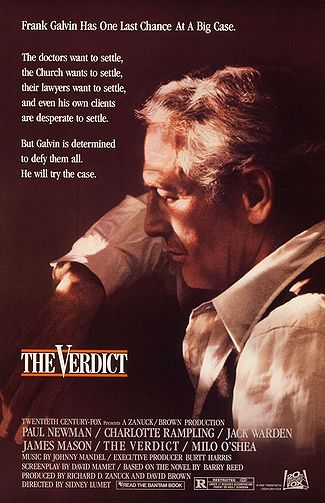
Lisa Watches An Oscar Nominee: The Verdict (dir by Sidney Lumet)


Verdict1

Speaking of the good, old-fashioned star power of Paul Newman, The Hustler and Butch Cassidy and the Sundance Kid were not the only films to receive an oscar nomination as the result of his charisma.  There’s also The Verdict, a 1982 best picture nominee that would probably be forgotten if not for Paul Newman’s performance.  However, since Paul Newman did play the lead role in The Verdict and he did give an amazing lead performance, The Verdict was nominated for best picture and, 33 years later, it ended up on TCM where I just watched it.

That’s the power of good acting.

Paul Newman plays Frank Galvin, a Boston-based attorney.  At one time, Frank was a lawyer at an elite firm.  But he has since fallen on hard times.  Now, he’s the type of attorney who crashes funerals and hands out his card.  He spends his spare time at his favorite bar, playing pinball and telling long jokes while stumbling about in a drunken haze.  In many ways, Frank represents everything that people hate about personal injury attorneys but, since he’s played by Paul Newman, you know that he’s going to turn out to be a good guy.

Frank only has one friend left in the world, his former mentor Mickey (Jack Warden).  Looking to help Frank out, Mickey sends Frank a medical malpractice suit.  A woman at a Catholic Hospital was given an anesthetic during child birth that has led to her now being brain dead.  Both the woman’s family and the Archdiocese are looking for a settlement.  The family needs the money to pay for her medical care.  The Archdiocese just wants the case to go away.  All Frank has to do is accept whatever settlement deal is offered…

However, something has changed for Frank.  He’s visited the comatose woman and, looking at her trapped in a vegetative state, he’s decided that the hospital needs to be held responsible for its mistake.  He rejects the settlement and takes the case to court, looking for both justice for the victim and redemption for himself.

That’s easier said than done, of course.  The Archdiocese has hired Ed Concannon (James Mason, perfectly cast), one of the best and most powerful attorneys in Boston.  Ed has a huge legal team working on the case.  Frank has Mickey.  As well, the Judge (Milo O’Shea) makes little effort to hide his contempt for Frank.

Probably the only bright spot in Frank’s life is that he’s met a woman.  Laura (Charlotte Rampling) meets him in a bar and soon, they’re lovers and Frank is confiding in her about the case.  What he doesn’t suspect is that Laura herself is a spy, hired by Concannon.

It looks like all is lost but then Frank discovers that there is one nurse (Lindsay Crouse) who might be willing to tell the truth about what happened at the hospital…

In many ways, The Verdict is a predictable film.  From the minute we first meet him, we know that Frank is going to be redeemed.  From the minutes that we hear about the case, we know who we’re supposed to root for and who we’re supposed to hiss.  Just about every courtroom cliché is present, right down to a surprise witness or two…

But no matter!  The Verdict may be predictable but it works.  As he proved with 12 Angry Men, Director Sidney Lumet knew how to make legal deliberations compelling and the entire film is full of small but memorable details that elevate it above its simplistic storyline.  As a director, Lumet gets good performances from his cast and, as a result, this is a film where the hero is flawed and the antagonists aren’t necessarily evil.  Even the Bishop of the Archdiocese of Boston (who, in most films, would have been a cardboard villain) is given a scene where he’s allowed to show some humanity.

And, of course, Paul Newman is great in the role of Frank.  When we first meet Frank, he looks and sounds terrible.  Indeed, it’s strange to see Paul Newman playing a character who is essentially such a loser.  (Even Eddie Felson in The Hustler had an appealing swagger about him.)  It’s during the scenes where Frank considers the woman in a coma that Newman starts to reveal that there’s more to Frank than what’s on the rough surface.  By the end of the film, Frank may be a hero but Newman doesn’t play him as such.  He’s still has that alcoholic rasp in his voice and his eyes still betray hints of insecurity and a fear that, at any minute, he’s going to screw up and mess everything up.  It’s a great performance, one for which Newman received a nomination for best actor.

Speaking of star power, Bruce Willis also shows up in The Verdict.  He’s an extra who appears as an observer in the courtroom.  He’s sitting a few rows behind Paul Newman.  (He’s also sitting beside Tobin Bell, the Jigsaw Killer from the Saw films).  It’s probably easiest to spot Willis towards the end of the film, when the verdict is read.  Bruce breaks out into a huge grin and almost looks like he’s about to start clapping.  Bruce only gets about 10 second of screen time but he acts the Hell out of them!

Thanks to Paul Newman, The Verdict is a memorable and entertaining film.  Be sure to watch it the next time it shows up on TCM.