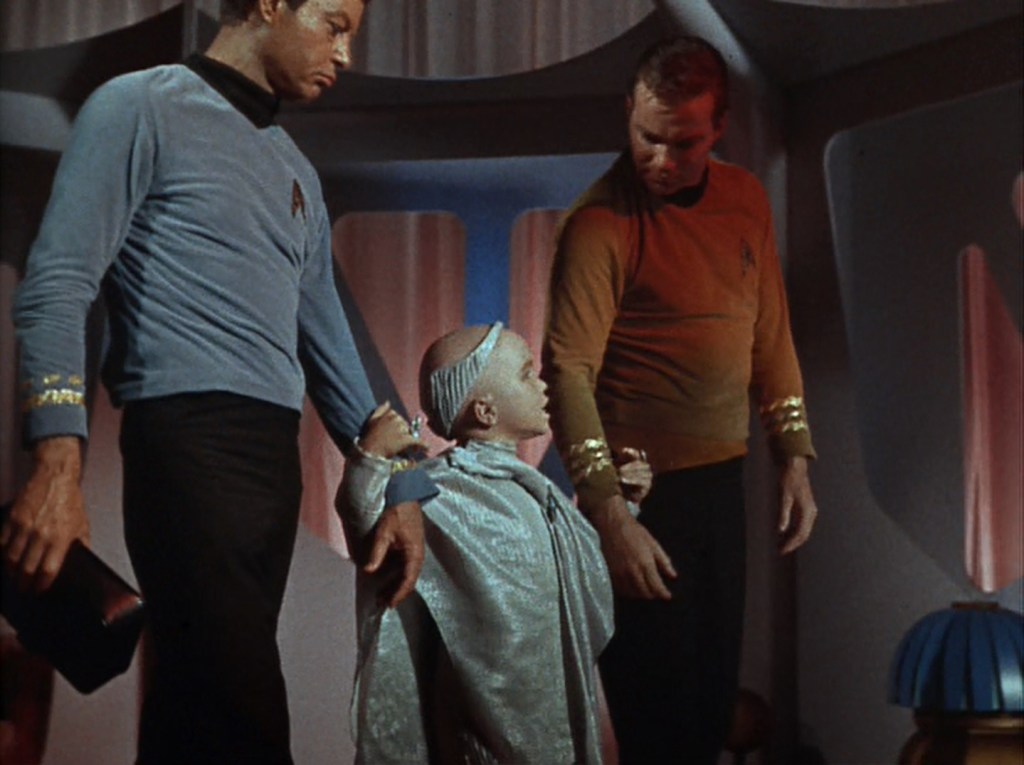
“The Corbomite Maneuver,” one of the earliest of the original STAR TREK episodes ever filmed, first aired on November 10, 1966. In this episode, the Enterprise, under Captain Kirk’s command, encounters a mysterious cube blocking its path in uncharted space. When attempts to communicate fail, the cube emits radiation, forcing the crew to destroy it. This action provokes a powerful alien vessel, the Fesarius, commanded by Balok, who accuses the Enterprise of trespassing and announces its imminent destruction. Kirk, facing a seemingly unbeatable foe, bluffs by claiming the Enterprise is equipped with a fictional “corbomite” device that would destroy any attacker. As a tense standoff takes place, Kirk’s gamble pays off when Balok blinks first and initiates contact, leading to a somewhat surprising conclusion.
I’ve watched some of the STAR TREK movies and TV shows over the years, but I’m nowhere near what someone would call a “Trekkie.” I do remember watching and liking STAR TREK II: THE WRATH OF KHAN (1982) when I was a kid, and as an adult, I enjoyed the 2009 reboot from J.J. Abrams. I recently read Ron Howard and Clint Howard’s memoir, THE BOYS, and Clint talked about how often fans would bring up his appearance in this specific episode of STAR TREK. Since today, September 8th, is “Star Trek Day,” and the original series is streaming on Paramount Plus, I decided I would see what all the fuss is about. I did think it was pretty cool when I saw that the episode was directed by Joseph Sargent, who would go on to direct a couple of my favorite movies of the early 70’s, WHITE LIGHTNING (1973) and THE TAKING OF PELHAM ONE TWO THREE (1974).
I had a lot of fun watching “The Corbomite Maneuver” for the first time today. From what I’ve read online, many consider this a really strong episode of the original series, and I can see why. The episode builds some pretty strong tension as Balok’s vessel seems so much stronger than the Enterprise, and it seems believable that the crew is really in danger. The special effects seem to be well done for the time period, with the “glowing cube” especially interesting. While there is not a lot of action in the episode, there are solid dramatics and a sense of humor rears its head from time to time. The main cast of William Shatner as Captain Kirk, Leonard Nimoy as Spock, and Deforest Kelly as Bones McCoy provide many of their classic character traits that would lead to them becoming pop culture icons. Shatner’s Kirk exudes extreme confidence amid a seemingly hopeless situation, while Nimoy’s Spock offers his unquestionable logic, and Kelley’s McCoy provides his gruff but loyal empathy. When a seven year old Clint Howard finally shows up as the real Balok in the last five minutes of the episode, I was ready. I got quite the kick out of watching Clint, whose voice is dubbed by a guy named Walker Edmiston, serve the guys a delicious drink named Tranya, a drink he truly relishes. As the episode was ending, my mouth was watering for the tasty looking alien beverage!
Happy Star Trek Day friends. I truly enjoyed joining in on the celebration for the first time in my life today!
59 years ago today, the first episode of Star Trek aired in America.
There’s been a lot of different StarTrek shows and crews over the decades. I have to admit that I’ve always preferred the Original Series, with Kirk sleeping with every alien he met, McCoy and Spock bickering about logic, and Scotty warning that the engines can’t take much more. The Next Generation was strong as well, especially in the later seasons. The subsequent series have been hit-and-miss for me.
I was born long after the Original Series went off the air so, like a lot of people, my real introduction to Star Trek came through watching the films. This weekend, I sat down and watched all fourteen of the Star Trek films in order, from The Motion Picture to Section 31. Here are my thoughts.
Star Trek: The Motion Picture (1979, directed by Robert Wise)
In the first Star Trek film, Voyager returns to Earth, now known as V’ger. James T. Kirk (William Shatner) returns to the Enterprise with his old crew and takes command from Decker (Stephen Collins). Spock (Leonard Nimoy) returns from Vulcan is not happy about it.
Directed by Robert Wise, the first Star Trek film feels out-of-place amongst the films that followed it. It’s long and slowly paced and it doesn’t have the sense of humor that runs through the best of the films featuring the original cast. The film favors Kirk and Spock, with the rest of the original cast being largely used as bit players. Even the costumes are different from the uniforms worn in the later films, making Star Trek: The Motion Picture feel like an entry from an alternate universe.
Despite mixed review, Star Trek: The Motion Picture made the most money of any of the pre-reboot films at the box office. Because the film itself was so expensive, it was still judged to be a box office disappointment. The Star Trek films would continue but in a new direction.
Star Trek II: The Wrath of Khan (1982, directed by Nicholas Meyer)
Featuring a character-driven script, exciting action, the best villain in the history of the franchise, and an ending that will bring tears to the eyes of the most cynical viewer, The Wrath of Khan is the film that set the standard for the Star Trek films that would follow.
Ricardo Montalban, recreating a character that he originally played in the television series, is a compelling villain as the vengeance-driven Khan. Montalban and William Shatner make for perfect rivals, two sides of the same coin. At the same time, the other members of the original cast all get their moments to shine, especially Walter Koenig as Chekhov. Kirstie Alley is the sexist Vulcan to ever appear in the franchise and even the revelation that Kirk has a son is handled effectively. Kirstie Alley, Bibi Besch, and Merritt Butrick all fit in with the original crew.
But the thing everyone remembers about The Wrath of Khan is the death of Spock. Even though the movie features plenty of hints that Spock will return (including his command of “Remember” to McCoy), it’s impossible not to get emotional when Spock sacrifices himself for the crew. “I have always been your friend.” To quote George Costanza, that was hell of a thing when Spock died. In that scene, Leonard Nimoy shows that he was the (logical) heart of the franchise. Just as Spock brought out the best in the rest of the crew, Nimoy brought out the best in his co-stars. Shatner was never better than when he was mourning Spock.
Star Trek III: The Search For Spock (1984, directed by Leonard Nimoy)
Spock’s back! It’s not a surprise. I think everyone knew, at the end of Wrath of Khan, that the Genesis Project would bring back Spock. Star Trek III isn’t bad. Christopher Lloyd reminds us of how brutal the Klingons were before their Next Generation makeover. The self-destruction of the Enterprise is a powerful moment. I just wish that a film about Spock being given a new life hadn’t featured so much death. Both the revelation that David Marcus tampered with the Genesis Project and his subsequent death feel like missteps. Robin Curtis takes over the role of Saavik and Kirstie Alley is very much missed. DeForest Kelley playing McCoy possessed by Spock was, for me, the highlight of the film.
Star Trek IV: The Voyage Home (1986, directed by Leonard Nimoy)
Returning home after rescuing Spock from the Genesis Planet, the Enterprise crew is instead sent back into the past so that they can bring two whales into the future. The Voyage Home might not be the best Star Trek film (that honor belongs to Wrath of Khan) but it is the most likable and the most entertaining. Every member of the cast gets something to do in 20th Century San Francisco. The film is full of classic moments, from Chekhov looking for the “nuclear wessels” to Scotty trying to speak to the computer. The moment with the punk on the bus is a crowd-pleaser. I always laugh at Spock’s “One damn minute, Admiral.” After the violence in The Search for Spock, The Voyage Home‘s humor, gentle sincerity, and emphasis on the efforts of the entire ensemble is a welcome development.
Star Trek V: The Final Frontier (1989, directed by William Shatner)
Leonard Nimoy got his chance to shine as the director of the previous two Star Trek films so William Shatner was allowed to direct The Final Frontier. The Enterprise crew is brainwashed by a religious fanatic (Laurence Luckinbill) who is also, improbably, Spock’s brother. Only Kirk is able to resist and confront the entity claiming to be God. “What does God need with a starship!?” Kirk demands. It’s such an obvious question that I can’t believe the entity didn’t already have an answer worked out.
The Final Frontier gets no respect and it was probably doomed as soon as Shatner was announced as director. Shatner also developed the story and it’s probably not surprising that the main theme is that Kirk was the only person on the Enterprise strong enough to not be brainwashed by the film’s fake God. Laurence Luckinbill gave a good performance as Sybok but this film really does feel like an unfortunate episode of the original television series.
Star Trek VI: The Undiscovered Country (1991, directed by Nicholas Meyer)
Star Trek VI featured the final appearance of the Original Series cast as a group and they get a send-off worthy of their legacy. Having been previously established as the Federation’s greatest enemies, the Klingons finally pursue peace. Just as only Nixon could go to China, only Kirk and the original Enterprise crew can go to the Klingons. This movie is what Star Trek was all about, with enough world-building and continuity for the hardcore fans and a story that was interesting enough to hold the attention of the casual viewers. By featuring the start of the era of peace between the Federation and the Klingons, this film also filled in some of the Next Generation‘s backstory. The Final Frontier was meant to be the final Star Trek film featuring any of the original cast and it would have been the perfect entry for Captain Kirk to go out on. Unfortunately, that didn’t happen.
Star Trek Generations (1994, directed by David Cason)
William Shatner meets Patrick Stewart as one Star Trek crew passes the torch to the new Star Trek crew. Malcolm McDowell is the latest villain with an ill-defined plan. Picard and Kirk team up to stop McDowell’s villain. They succeed but at the cost of Kirk’s life. As opposed to Spock’s death in Wrath of Khan, Kirk’s death feels pointless and tacked on for no reason other than to signify the arrival of The Next Generation to the films. Seeing Shatner and Stewart together is interesting. Stewart may have been the better actor but Shatner still dominates their scenes together. Not giving Kirk a better send-off was one of the franchise’s biggest sins.
Star Trek: First Contact (1996, directed by Jonathan Frakes)
After the disappointing Generations, Picard and his crew finally got a film worthy of them with First Contact. Not only do the Borg return but the crew goes back into their past and experience a key date in the history of the Federation. After being outshone by Shatner in Generations, Patrick Stewart takes control in this film, giving a multi-layered and commanding performance that still gives the rest of the cast room to shine. Director Jonathan Frakes not only handles the action well but he also shows that he understands what makes the characters click. This was, without a doubt, the best of the Next Generation films and one the best of the Star Trek films overall.
Star Trek: Insurrection (1998, directed by Jonathan Frakes)
Entertaining but forgettable, Insurrection features Picard pulling a Kirk and defying orders from from a superior officer (played by Anthony Zerbe) and going out of his way to save Data from being decommissioned. Insurrection feels like an extended episodes of the Next Generation television series and lacks the epic scale of First Contact. Under the direction of Jonathan Frakes, the ensemble is strong and watching them interact feels like spending time with a group of old friends. F. Murray Abraham and Anthony Zerbe make for effective villains.
Star Trek: Nemesis (2002, directed by Stuart Baird)
Just as the Original Series crew sought peace with the Klingons in The Undiscovered Country, the final Next Generation film finds Picard, Riker, and the rest seeking peace with the Romulan Empire. Tom Hardy plays a clone of Picard who is now the leader of the Romulans. Data sacrifices himself in a move that tries too hard to duplicate the death of Spock. Picard retires. Director Stuart Baird emphasizes action over the chemistry of the Next Generation cast and the end result is a disappointing finale that left critics and audiences underwhelmed.
Star Trek (2009, directed by J.J. Abrams)
I think people forget about what a big deal this Star Trek reboot was when it first came out. Today, people focus on things like Kirk being a Beastie Boys fan and they forget how exciting it was to see Chris Pine, Zachary Quinto, Karl Urban, Simon Pegg, Anton Yelchin, John Cho, and Zoe Saldana all effortlessly stepping into the roles of the younger versions of the original cast. The storyline is predictable and Eric Bana’s a bland villain but the scenes between Leonard Nimoy and Zachary Quinto were a reminder of how important Spock was and is to Star Trek.
Star Trek wasn’t perfect, of course. In retrospect, I think creating an alternate timeline was a mistake because it created a situation where, even if someone died, it was just an alternate version dying and not the version that audiences knew and cared about. The alternate timeline would also lead to one of the biggest missteps in the history of the franchise.
Star Trek Into The Darkness (2013, directed by J.J. Abrams)
After the surprising success, both critically and commercially, of his Star Trek reboot, J.J. Abrams. Robert Orci, Alex Kurtzman, and Damon Lindelof wasted most of that good will by messing around with one of the franchise’s most memorable characters.
There are some good things to be said about Star Trek Into The Darkness. I like the action sequences and the climatic battle in the film’s futuristic version of San Francisco. But casting Benedict Cumberbatch, of all people, as Khan is a misstep that can’t be overcome. That the movie brought back Khan instead of exploring “strange new worlds” exposed the weakness of Abrams entire reboot. For all the hype, did the Star Trek reboot actually have anything new or original to offer? The answer here seemed to be no.
Star Trek Beyond (2016, directed by Justin Linn)
The final (for now) Star Trek theatrical film featured a memorable villain in the form of Idris Elba and a plot that felt like it could have just as easily been an episode of the original series. In retrospect, the film is mostly memorable for featuring the announcement of the death of Ambassador Spock. (The film was released a year after the death of Leonard Nimoy.) The death of Spock, this time with no Genesis Project around to bring him back, makes this installment feel like right place to end the films. For many of us, Nimoy was Star Trek.
Stark Trek: Section 31 (2025, directed by Olatunde Osunsanmi)
Though there have been many subsequent televisions shows, there hasn’t been a Star Trek theatrical release since 2016. The next installment has been in pre-production limbo for nearly ten years. (Quentin Tarantino was supposedly attached at one time.) Instead of coming to theaters, the latest Star Trek movie came to Paramount Plus.
I debated whether or not to include Section 31 in this list, both because it was a “made-for-TV” movie and also because it was so bad that I think most Star Trek fans would rather forget about it. A mediocre heist film that wastes star Michelle Yeoh and which doesn’t feel like it belongs in the Star Trek universe, Section31 may still represent the way forward for the franchise. With theaters having never recovered from the COVID shut-downs and more and more people preferring to stream their entertainment at home, the future of the Star Trek films could very well be a collection of assembly line Paramount Plus movies.
Finally, Case turned me onto this short film:
765874: Unification (2024, directed by Carlos Baena)
A collaboration between Otoy, a VFX company, and The Roddenberry Archive, with support from Paramount, 765874: Unification is a 10-minute short film that imagines Kirk meeting Spock in the afterlife. Shatner returns as Kirk, de-aged with CGI. Just as Kirk and Spock were friends in the film, the same was true of Shatner and Nimoy in real life. (You only have to compare Nimoy’s comments about Shatner with George Takei’s endlessly bitter takes to see what true class actually is.) This short film gives both characters the finale that they deserved.
It’s possible that we may never see another true Star Trek film. Most of the original cast is gone now. Patrick Stewart will always be Picard but even he is now approaching 90. But whatever the future may hold, I’m happy for the films that Star Trek gave us.
To quote George Costanza, “That was a hell of a thing when Spock died.”
That we all know that Spock was restored to life by the Genesis Project does not make this scene from Star Trek II: The Wrath of Khan any less effective. Spock, who was ruled by logic and often accused of not having any feelings, made the ultimate sacrifice for his ship and, even more importantly, for his friends.
Welcome to Retro Television Reviews, a feature where we review some of our favorite and least favorite shows of the past! On Tuesdays, I will be reviewing the original Fantasy Island, which ran on ABC from 1977 to 1984. Unfortunately, the show has been removed from most streaming sites. Fortunately, I’ve got nearly every episode on my DVR.
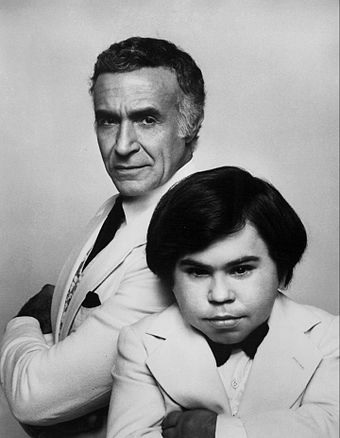
This week, Tattoo’s rich!
Episode 6.9 “Naughty Marietta/The Winning Ticket”
(Dir by Don Weis, originally aired January 8th, 1983)
Let’s get the boring storyline out of the way first.
Overbearing Beatrice Solomon (Jayne Meadows) wants her daughter, Alison (Dorothy Hamill) to become an actress. Beatrice’s husband (David Doyle) wishes that Beatrice would just back off. Mr. Roarke sends Alison into the past, where Alison finds herself transformed into Marietta, the subject of the operetta Naughty Marietta. Lorenzo Lamas plays Captain Richard Warrington, who is trying to track down a notorious pirate on behalf of the Governor of Louisiana (James Doohan). There’s a lot of singing and the costumes are nice but it’s also kind of boring because ice skater Dorothy Hamill was a terrible actress and she has next to no chemistry with Lorenzo Lamas. The fantasy ends with everyone brought back to the present, including Lamas who, it turns out, was actually just a guest having a fantasy of his own. It’s nothing we haven’t seen before and I don’t want to talk to much about it because the other story is …. A TATTOO STORY!
After years of being the sidekick and Mr. Roarke’s enigmatic frenemy, Tattoo finally gets a story of his own. When Margaret Stanton (Hope Lange) comes to the Island to award a check to an employee who won the Irish Sweepstakes, Roarke is saddened to inform her that the man, a groundskeeper named Ambrose, passed away shortly after winning. Roarke assigns Tattoo to find out who Ambrose’s closest friend was on the Island. Tattoo takes his job seriously. Afterall, Tattoo was one of the few people who regularly checked on the curmudgeonly old man, always stopping by to talk and to make sure that he was feeling okay. As a matter of fact, you could even say that Tattoo was a true friend to the old man. In the end, he was truly the old man’s best friend….
OH MY GOD, TATTOO’S RICH!
After reading the deceased man’s diary, Roarke and Tattoo realize that Ambrose would have wanted Tattoo to have the money. Tattoo now has a million dollars and Roarke decides that this means that Tattoo is now a guest at Fantasy Island. Tattoo moves into the most spectacular guest bungalow. Tattoo orders a fancy meal and leaves a huge tip. Tattoo is having a wonderful time until Mr. Roarke informs him that guests are not allowed to live on the Island….
WAIT, WHAT!?
Okay, first off, it wasn’t Tattoo’s idea to be a guest. It was Roarke’s idea. Roarke also mentions that Tattoo is the one who came up with the idea of not allowing guests to live on the Island but, over the past few seasons, we’ve seen many guests decide to never leave the Island and Roarke has never had a problem with it! Seriously, I thought Tattoo and Mr. Roarke were finally getting along. Suddenly, it seems like Mr. Roarke has decided to kick him out. “I will miss you,” Mr. Roarke says. Well, then don’t make him leave! Can’t Mr. Roarke do whatever he feels like doing?
Tattoo, for his part, says that he will miss being on the Island. He’ll miss Mr. Roarke. He’ll miss the rest of the staff. He’ll miss everything. Tattoo decides that rather than leave the Island, he’ll donate the money to build a retirement home in England. And that’s nice and all but I still don’t understand why Tattoo would have had to leave in the first place. Maybe Mr. Roarke just wanted to teach Tattoo about generosity but Tattoo is already extremely generous.
As the show ends, Mr. Roarke mentions that Tattoo still needs to pay for his stay in the bungalow and for all the food he ordered. DON’T START, MR. ROARKE!
This was a weird episode but it was still nice to see Tattoo get his moment in the spotlight. I still think he should have allowed to keep the money and stay on the Island. I mean, seriously, this Island is full of eccentric rich people living in haunted mansions. Why should Tattoo miss out on all the fun?
In this comedic western, gambler Benjamin Calhoun (Dale Robertson) wins big in a poker game. Not only does he walk away with several thousand dollars but he also now owns his own railroad, the BP;S&D. Calhoun celebrates the biggest win of his career by tossing ten dollar bills at the townspeople, recruiting a worshipful young assistant (Bob Random), and commandeering a private railcar that belongs to wealthy Burton Standish (John Anderson). In the car, he finds Marta Grenier (Diana Hyland), a “working woman,” who has been hired to provide company for Standish.
Calhoun and Marta ride off to check out Calhoun’s new railroad. What he discovers is that the railroad that he won is not only not completed but the workers are striking because they haven’t been paid in two weeks. The quick-thinking Calhoun offers to make all of the workers part-owners of the railroad. With construction once again starting, Calhoun tries to figure out how to keep his new business open. He also meets a strong-headed storekeeper named Joanna Royce (Sandra Smith).
When Standish finally shows up, it turns out that he was originally planning on buying the BP;S&D. Will Calhoun hold onto the railroad and honor the promise he made to the workers or will he sell out to Standish?
For all the talk about completing the railroad, Scalplock ends with most of the work undone. That’s because Scalplock was a pilot for The Iron Horse, a television series that lasted for two seasons in the 60s. Scalplock (and The Iron Horse) is mostly a showcase for Dale Robertson, a low-key but always convincing actor who specialized in westerns. Usually, Robertson was cast as an upstanding citizen and law enforcement agent. In Scalplock, he’s playing the type of genial rogue that James Garner played on Maverick and later in The Rockford Files. Robertson is likable in Scalplock and even convinces us that Calhoun would choose his workers over a quick payday. Fan of the genre will enjoy Scalplock, as long as they don’t get too invested in witnessing that last track of rail laid into the ground.
Dale Robertson, who started his career in the 40s, continued to act through the 90s, though usually as a guest star instead of a series lead. Robertson eventually retired to Oklahoma where he owned a ranch that was home to over 200 horses. He passed away in 2013 at the age of 89.
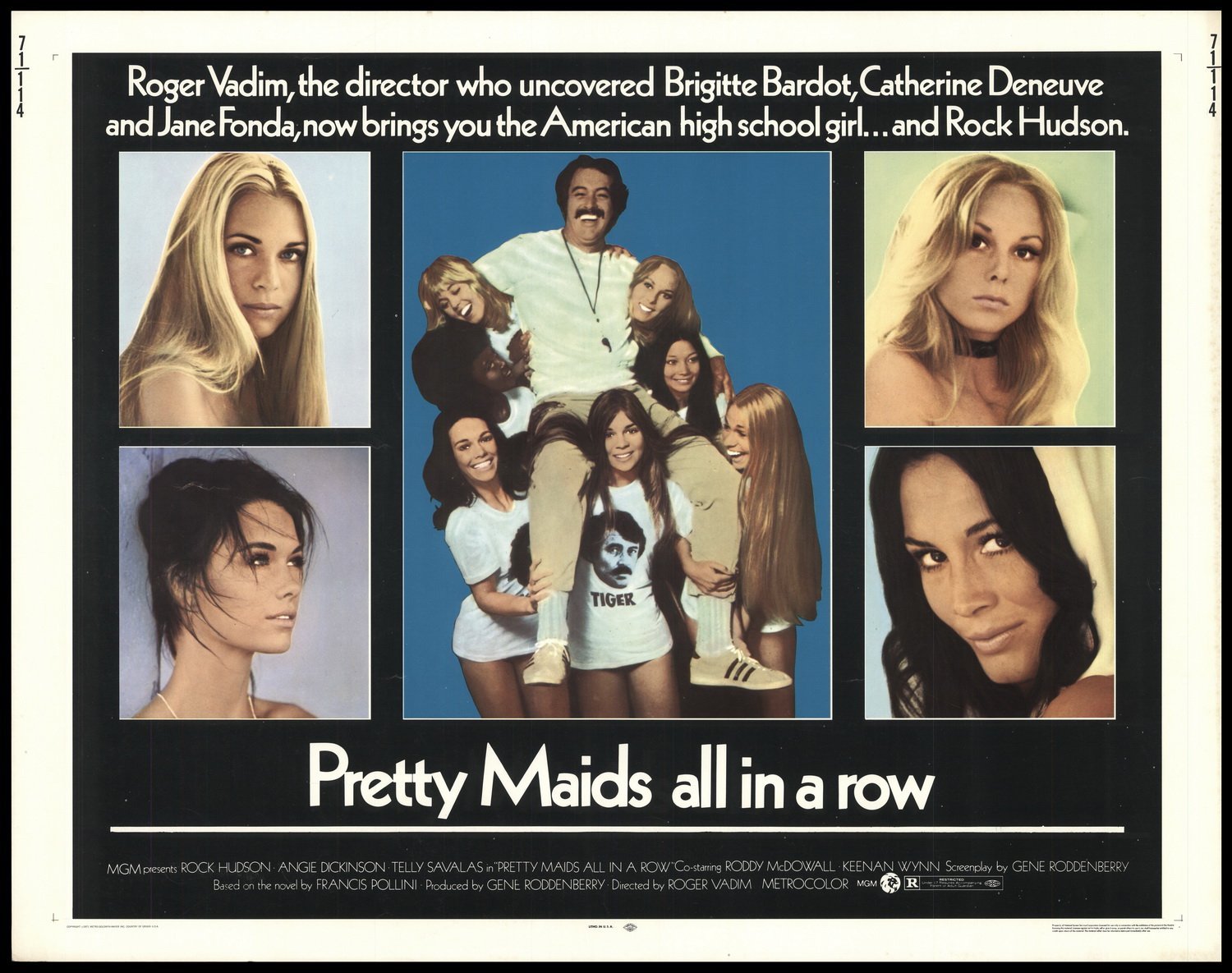
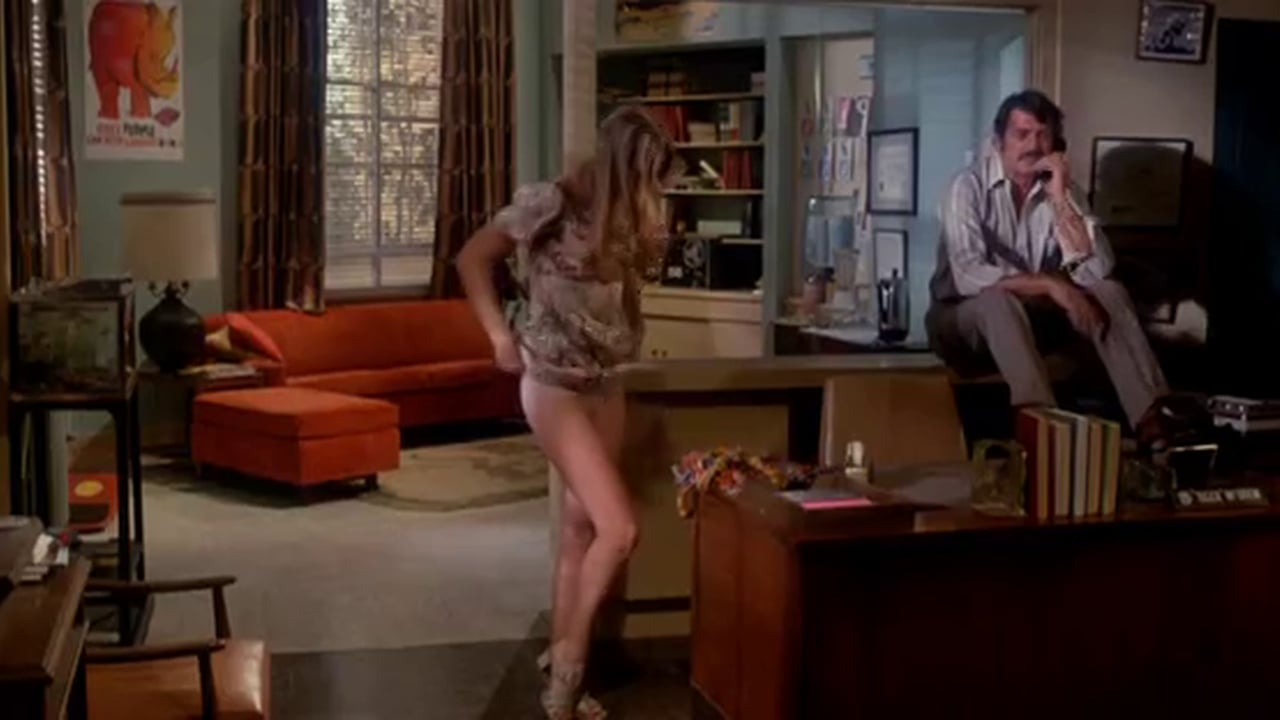
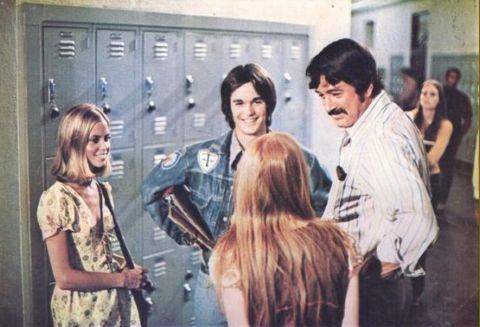
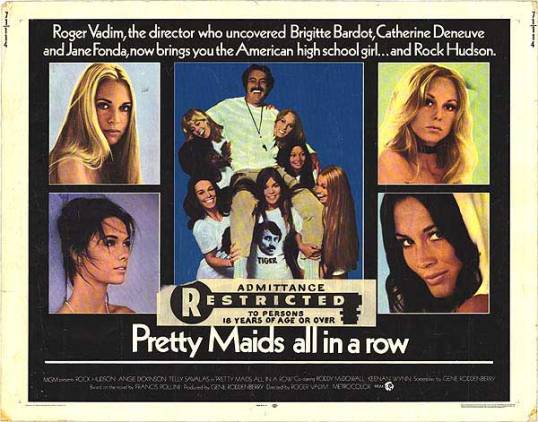
Gene Roddenberry’s post-STAR TREK career had pretty much gone down the tubes. The sci-fi series had been a money loser, and Roddenberry wasn’t getting many offers. Not wanting to be pigeonholed in the science fiction ghetto, he produced and wrote the screenplay for PRETTY MAIDS ALL IN A ROW, a black comedy skewering the sexual revolution, with French New Wave director Roger Vadim making his first American movie. The result was an uneven yet entertaining film that would never get the green light today with its theme of horny teachers having sex with horny high school students!
All-American hunk Rock Hudson was in the middle of a career crisis himself. After spending years as Doris Day’s paramour in a series of fluffy comedies, his box office clout was at an all-time low. Taking the role of Tiger McGrew, the guidance counselor/football coach whose dalliances with the cheerleading squad leads to murder…
Pretty Maids All In A Row, which — as should be pretty obvious from the trailer above — was originally released in 1971, is a bit of a historic film for me. You see, I love movies. And, as a part of that love, I usually don’t give up. Regardless of how bad a movie may turn out to be, once I start watching, I stick with it. I do not give up. I keep watching because you never know. The film could suddenly get better. It could turn out that what originally seemed like a misfire was actually brilliant satire. If you’re going to talk or write about movies, you have an obligation to watch the entire movie. That was a rule that I had always lived by.
And then, one night, Pretty Maids All In A Row popped up on TCM.
Now, I have to admit that I already knew that Pretty Maids was going to be an extremely 70s film. I knew that it was probably going to be more than a little sexist. I knew all of this because the above trailer was included on one of my 42nd Street Forever DVDs. But I still wanted to see Pretty Maids because the trailer hinted that there might be an interesting hiding underneath all of the cultural baggage. If nothing else, it appeared that it would have some sort of worth as an artifact of its time.
(If you’re a regular reader of this site, you know how much I love my cinematic time capsules.)
So, the film started. I logged onto twitter so that I could live tweet the film, using the hashtag #TCMParty. And from the moment the film started, I knew it wasn’t very good. It wasn’t just that the film’s camerawork and music were all extremely 70s. After all, I like 70s music. I don’t mind the occasional zoom lens. And random psychedelic sequences? WHO DOESN’T LOVE THOSE!? No, my dislike of the film had nothing to do with the film’s style. Instead, it had to do with the fact that there was absolutely nothing going on behind all of that style. It wasn’t even style for the sake of style (which is something that I usually love). Instead, it was style for the sake of being like every other “youth film” that came out in the 70s.
And then there was the film’s plot, which should have been interesting but wasn’t because director Roger Vadim (who specialized in stylish decadence) had no interest in it. The film takes place at Oceanfront High School, where the only rule is that apparently nobody is allowed to wear a bra. We meet one student, Ponce De Leon Harper (played by an amazingly unappealing actor named John David Carson), who is apparently on the verge of having a nervous breakdown because, at the height of the sexual revolution, he’s still a virgin.
(Because, of course, the whole point of the sexual revolution was for losers like Ponce to finally be able to get laid…)
Ponce is taken under the wing of high school guidance counselor Tiger McDrew (Rock Hudson, complete with porn star mustache). Quickly figuring out exactly what Ponce needs, Tiger sets him up with a teacher played by Angie Dickinson. However, Tiger has other concerns than just Ponce. Tiger, it turns out, is a sex addict who is sleeping with nearly every female student at the school. But, American society is so oppressive and puts so much pressure on the American male that Tiger has no choice but to kill every girl that he sleeps with…
This is one of the only film I can think of that not only makes excuses for a serial killer but also presents him as being a heroic character. And, while it’s tempting to think that the film is being satirical in its portrayal of Tiger and his murders, it’s actually not. Don’t get me wrong. The film is a very broad comedy. The high school’s principal (Roddy McDowall) is more concerned with the football team than with all of the girls turning up dead at the school. The local sheriff (Keenan Wynn) is a buffoon. The tough detective (Telly Savalas) who investigates the murders gets a few one liners.
But Tiger, most assuredly, is the film’s hero. He’s the only character that the audience is expected to laugh with, as opposed to at. He is the character who is meant to serve as a mouthpiece for screenwriter Gene Roddenberry’s view on America’s puritanical culture. If only society was less hung up on sex, Tiger wouldn’t have to kill. Of course, the film’s celebration of Tiger’s attitude towards sex is not extended towards the girls who sleep with him. Without an exception, they are all presented as being empty-headed, demanding, shallow, and annoying, worthy only of being leered at by Vadim’s camera until Tiger finally has to do away with them.
(The film’s attitude towards women makes Getting Straight look positively enlightened.)
Rock and Angie
ANYWAY! I spent about 40 minutes watching this movie before I gave up on it. Actually, if you want to be technical about it, I gave up after 5 minutes. But I stuck with it for another 35 minutes, waiting to see if the film was going to get any better. It didn’t and finally, I had to ask myself, “Why am I actually sitting here and wasting my time with this misogynistic bullshit?” So, I stopped watching and I did so with no regrets.
What I had forgotten is that I had set the DVR to record the film while I was watching it, just in case I later decided to review it. So, last week, as I was preparing for this series of Back to School posts, I saw Pretty Maids All In A Row on my DVR. I watched the final 51 minutes of the film, just to see if it ever got better. It didn’t.
However, on the plus side, Rock Hudson does give a good performance in the role of Tiger, bringing a certain seedy desperation to the character. (I’m guessing that this desperation was Hudson’s own contribution and not an element of Roddenberry’s screenplay, which more or less presents Tiger as being a Nietzschean superman.). And beyond that, Pretty Maids serves as evidence as to just how desperate the Hollywood studios were to makes movies that would be weird enough to appeal to young people in the early 70s.
Watching the film, you can practically hear the voices of middle-aged studio executives.
“What the Hell are we trying to do with this movie!?” one of the voices says.
“Who cares!?” the other voice replies, “the kids will love it!”





 Through the Shattered Lens