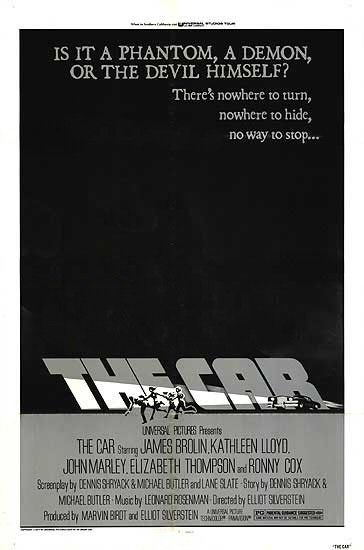
— Captain Wade Parent (James Brolin) in The Car (1977)
Yes, that’s right! The car is in the garage and it’s hunting for blood!
The Car is a pretty stupid movie that doesn’t really work but at least it’s enjoyably stupid. From the minute I started watching this movie, I knew that the only way I could recommend it would be if James Brolin shouted, “The car is in the garage!” at some point. When he did, I had to cheer a little. I love being able to recommend a movie.
The Car takes place in the small desert town of Santa Ynez. Nothing much ever seems to happen in Santa Ynez, which perhaps explains why the police force is so large. (Why wouldn’t you want to be a police officer in a town with no crime? It wouldn’t be a very demanding job.) Sheriff Everett Peck (John Marley) keeps the peace and sends his time talking about how much he hates bullies. Wade Parent (James Brolin) is his second-in-command and has a 70s pornstache. Wade’s best friend is Deputy Luke Johnson (Ronny Cox), a recovering alcoholic with impressive sideburns. And then there’s a few dozen other cops. Seriously, this tiny town has a HUGE police force.
One day, however, the police finally get something to do. A black Lincoln Continental has suddenly appeared, stalking the roads around the town. It doesn’t have a licence plate and the windows are tinted a dark red so it’s impossible to see who — if anyone — is driving. Stranger still, the car’s doors have no handles. When the car does show up, it seems to appear out of nowhere and once it’s run someone over, it seems to vanish just as quickly.
When the car first appears, it runs down two cyclists. A few hours later, it kills an obnoxious hippie hitchhiker (John Rubinstein). The only witness was alcoholic wife beater Amos Clements (R.G. Armstrong). When Amos goes to the police, the car tries to run him over as well but instead, it ends up killing Sheriff Peck.
Now, Wade is in charge and he has to do something about the car. Unfortunately, Wade’s girlfriend, Lauren (Kathleen Lloyd), made the mistake of screaming insults at the car when the car attempted to run down the school marching band. Now, the car is stalking her. Meanwhile, Luke is convinced that the car is being driven by none other than devil. Wade says that’s impossible. Luke points out that the car refuses to drive through consecrated ground.
And eventually, the car does show up in the garage…
The Car is one of the stupider of the many Jaws ripoffs that I’ve seen. You’ll be rooting for the car through the entire film, which is good since the car kills nearly everyone in Santa Ynez. (If any of them were likable, The Car wouldn’t as much fun to watch.) It’s dumb but the film does have an appropriately silly ending and James Brolin does get to yell, “The car is in the garage!”
I have mixed feelings about Steven Soderbergh. On the one hand, his talent cannot be denied and you have to respect the fact that he’s willing to take chances and make films like The Girlfriend Experience and The Informant. On the other hand, he’s also the director who has been responsible for overrated messes like Contagionand utter pretentious disasters like Haywire. And it doesn’t help that Soderbergh’s fanbase seems to be largely made up of the type of hipsters who end up leaving comments under the articles at The A.V. Club. Some people mourned Soderbergh’s retirement. Personally, I think he made the right decision. He retired before his misfires ended up outnumbering all of his masterpieces.
The thing about Soderbergh is that his good films are so good that it makes it all the more frustrating to watch his failures. If Soderbergh was just your typical bad director than a film like Contagion wouldn’t be as annoying. But this is the man who also gave us Traffic!
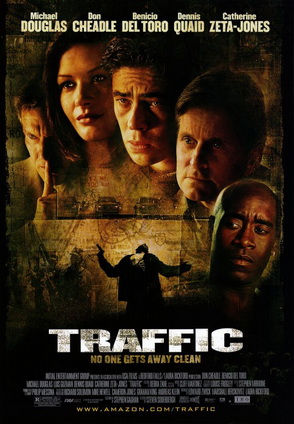
And Traffic is a very good film.
First released in 2000, Traffic attempted to deal with the American war on drugs, a war that the film suggests might not even be worth fighting. (Full disclosure: I support the legalization of drugs and, for that matter, just about everything else. And yes, I am biased towards films that agree with me. So is every other film critic out there. The difference is that I’m willing to admit it.) Traffic won four Oscars, including Best Director and Best Supporting Actor for Benicio Del Toro. It was also nominated for best picture but lost to Gladiator.
Traffic tells three, barely connected stories. Each story is given its own distinct look, feel, and color scheme. And while it takes a few minutes to get used to film’s visual scheme, it ultimately works quite well. Though all of the film’s characters share the same general existence, they live in different worlds. The only thing linking them together is drugs.
Judge Andrew Wakefield (Michael Douglas) is a judge on the Ohio Supreme Court who has recently been named as the new drug czar. However, while Judge Wakefield is going around the country and talking to politicians (Harry Reid shows up playing himself and is just as creepy as always), his daughter Caroline (Erika Christensen) is dating Seth (Topher Grace) and getting addicted to cocaine and heroin. When Caroline run away, Judge Wakefield recruits Seth and, using him as a guide, searches the ghetto for his daughter.
The Wakefield scenes are bathed in cold and somber blues. They’re beautiful to look at but, in some ways, they’re also some of the weakest in the film. The whole plotline of Caroline going from being an innocent honor’s student to being a prostitute who sells her body for heroin feels a lot like the notorious anti-drug film Go Ask Alice. At the same time, it’s interesting and a little fun to see Topher Grace playing such a little jerk. Grace gets some of the best lines in the film, especially when he attacks Wakefield’s feelings of smug superiority.
In the film’s second storyline, two DEA Agents (Don Cheadle and Luis Guzman) arrest drug trafficker Eddie Ruiz (Miguel Ferrer). Eddie works for the Ayala syndicate and, once he’s arrested, he turns informant. Drug lord Carlos Ayala (Steven Bauer) is arrested. While Carlos sits on trial, his pregnant wife (Catherine Zeta-Jones) and his sleazy business associate (Dennis Quaid) struggle to hold together the business and find a way to kill Ruiz before he can testify.
This storyline is filmed in bright and vibrant colors and why not? The Ayalas are rich and, unlike the Wakefields, they don’t feel the need to hide their material wealth. This is actually probably my favorite storyline, largely because it’s the best acted and the most entertaining. Miguel Ferrer, in particular, steals every scene that he’s in. The scene where he explains the economics of being a drug trafficker is fascinating to watch.
The Ayala storyline may be my favorite but the film’s most thought-provoking storyline is the third one. Taking place in Mexico, it stars Benicio Del Toro as Javier Rodriguez, a casually corrupt police officer who gets recruited to work for General Salazar (Tomas Milian), who is heading up Mexico’s war on the cartels. Following the orders of Salazar, Javier captures assassin Frankie Flowers (Clifton Collins, Jr.) who is then savagely tortured by Salazar until he turns informer. Javier comes to realize that Salazar is actually working for one of Mexico’s cartels. When he decides to inform on Salazar, he puts his own life at risk.
The Mexico storyline is also the harshest and visually, it reflects that fact. The heat literally seems to be rising up from the desert and the streets of Tijuana. It takes a few minutes to adjust to the look of the Mexico scenes but, once you do, they become enthralling.
And Traffic, as a film, is undeniably enthralling as well. Soderbergh deftly juggles the multiple storylines and brings them together to create a portrait of a society that’s being destroyed by the efforts to save it. Hopefully, if Soderbergh ever does come out of retirement, he’ll give us more films like Traffic and less films like Contagion.
Last night, the temperature plunged here in Texas. When I woke up this morning, I was confronted with a world that was literally frozen. Needless to say, nobody in Dallas went to work today. Instead, we all sat in our houses and tried to keep ourselves entertained. I kept myself occupied by watching a film that was initially released way back in 1978 and which takes place in my home state.
The name of that film was Capricorn One and it’s the latest entry in the 44 Days of Paranoia.
Capricorn One begins with three astronauts preparing to take the fist manned space flight to Mars. James Brolin is the stoic leader. Sam Waterston is the guy who has a joke for every occasion. And O.J. Simpson is … well, O.J. really doesn’t have much of a personality. He’s pretty much just along for the ride.
However, it turns out that there really isn’t going to be a ride. Just as the countdown begins, the astronauts are ordered to leave the capsule. They are then transported to secret base in the Texas desert. It’s here that they have a meeting with the Head of NASA, who is played by Hal Holbrook. (It’s simply not a 70s conspiracy film if Hal Holbrook isn’t somehow involved). Holbrook proceeds to deliver a stirring monologue where he talks about how he and Brolin have always dreamed of sending a manned flight to Mars. However, as Holbrook explains, the life support system on the crew’s ship was faulty. If Holbrook had allowed them to be launched, they would have died as soon as they left the Earth’s atmosphere. However, if the mission had been canceled then there was a chance that the President would use that cancellation as an excuse to cut NASA’s funding.
So, as Holbrook explains, an empty spaceship has been launched into space. As far as the American public is concerned, the three astronauts are currently on their way to Mars. Now, in order to save the space program, they are going to have to fake the mission. In a studio, a fake alien landscape has been set up and it’s from that studio that Brolin, Waterston, and Simpson will pretend to explore Mars.
Brolin, Waterston, and Simpson reluctantly agree to cooperate with the plan. However, after doing the first fake broadcast, Brolin starts to have second thoughts. Realizing that he can’t trust the three astronauts to keep a secret, Holbrook announces that the capsule’s heat shields failed during re-entry and that the crew of Capricorn One is now dead. Now, all he has to do is have the three of them killed for real.
Meanwhile, a NASA technician (Robert Walden) stumbles onto evidence of the deception. He subsequently vanishes but not before he tells reporter Elliott Gould about his suspicions. While the three astronauts try to escape from Holbrook’s agents, Gould tries to find out what really happened to Capricorn One.
It’s probably half-an-hour too long, the plot is full of holes (the least of which being why Holbrook waited until after he had announced the fake deaths to order the real deaths), and director Peter Hyams allows a few scenes to run on and on while others seem to end with a jarring abruptness. However, for the most part, Capricorn One is a well-acted and solidly entertaining film. However, there are two things that make Capricorn One especially memorable.
First off, Capricorn One features one of the most exciting action sequences that I have ever seen. It occurs while Gould is investigating Walden’s disappearance. After visiting Walden’s apartment and discovering that it’s inhabited by a woman who claims to have never heard of his friend, Gould is driving away when he discovers that his brakes have been disabled. The car then starts to accelerate and Gould finds himself desperately trying to regain control as the car careens through the streets of Houston. The scene is shot almost entirely from Gould’s point-of-view and, for five minutes, we watch as everything from other cars to unlucky pedestrians come hurtling towards the car. For those few minutes, when the viewer and Gould become one, Capricorn One is not only exciting but it feels genuinely dangerous as well.
Secondly, Capricorn One features some of the oddest dialogue imaginable. Peter Hyams not only directed the film but he also wrote the screenplay as well. Watching the film, one gets the feelings that Hyams was so in love with his dialogue and with all of his quirky characters that he simply could not bring himself to cut anything or anyone. As a result, the film is full of lengthy monologues. When the characters speak to each other, they don’t have conversations as much as they trade quips. Characters like Gould’s ex-wife (played by Karen Black) and his editor (David Doyle) show up for a scene or two, deliver monologues that are only tangibly related to the film’s plot, and then vanish. Sam Waterston ends up telling the world’s longest joke while he climbs a mountain in the desert. Towards the end of the film, Telly Savalas (who was in my favorite Mario Bava film, Lisa and the Devil) shows up as a foul-tempered crop duster and engages in a long argument with Gould who, despite being a reporter, never bothers to question why Savalas would have a crop dusting business in the middle of the desert.
But here’s the thing — it works. As odd as some of the dialogue may be and as superfluous as some of the action is to the overall plot, it still all works to the film’s benefit. The constant quirkiness works to keep the audience off-balance and to give Capricorn One its own unique rhythm.
Capricorn One — see it now before Michael Bay remakes it.
Earlier this month, we featured an episode of Beyond Belief: Fact or Fiction that was hosted by Jonathan Frakes. What I did not mention, in that post, is that Frakes was not the 1st person to host this show.
The first season was hosted by veteran scenery-chewer James Brolin. Whereas Frakes brought a bemused appreciation to the absurd to his role of host, Brolin’s approach was far more earnest.
And, in appreciation of that earnestness, here’s the very first episode of Beyond Belief: Fact or Fiction? This originally aired on May 25th, 1997 and it’s worth watching just to compare Brolin’s blandly sincere approach to the far more snarky approach of Jonathan Frakes.
 Through the Shattered Lens