An Offer You Can’t Refuse: Dragnet (dir by Jack Webb)


1954’s Dragnet opens with a gangland slaying.  We watch as a man is brutally gunned down in a field in Los Angeles.  The rest of the film deals with the efforts of the LAPD to track down and arrest the killers.

Based on the televisions show that gave birth to the whole “cop show” format, Dragnet features Jack Webb as Sgt. Joe Friday, calmly and efficiently investigating the slaying.  Working with Friday is Officer Frank Smith (Ben Alexander) but the film (just like the show) is ultimately about how the whole criminal justice system works together as a machine designed to protect the citizenry and to punish crime.

Or, at least, that’s the way it’s supposed to work.  Especially if you’re only familiar with Dragnet from its late 60s incarnation and the countless parodies that followed, the 1954 Dragnet can seem surprisingly cynical and rough-edged.  The killings are violent, the criminals are ruthless, and the cops are often frustrated in their attempts to solve crimes.  In this film, at least, justice is not guaranteed.

The shooting victim is identified as a low-level gangster named Miller Starkie and Friday and Smith immediately suspect that he was killed on the orders of West Coast mob boss Max Troy (Stacy Harris).  Friday and Smith know that Troy is guilty and they even figure out who worked with Troy to kill Starkie.  But, throughout the film, they struggle to get any sort of concrete evidence tying Max to the crime.  Dragnet is a police procedural that follows every bit of the investigation, including the attempts to convince a grand jury to indict Max.  One of the more interesting moments in the film is when Friday gives his grand jury testimony and it becomes obvious that the district attorney was right to be skeptical about trying to bring charges.  Friday really doesn’t have enough evidence to justify arresting Max for the crime that everyone knows he committed.  To the film’s credit, it doesn’t attack the grand jury system or suggest that the system is unfairly rigged for the criminals.  Friday may be frustrated but he understands that the system has to protect the rights accused first.  One has to be presumed innocent until proven guilty even when everyone knows that person is guilty.

That said, Friday and Smith and the entire LAPD end up harassing Max Troy in a way that would probably not fly if the film were made today.  At one point, a line of police cars park in front of Max’s house and then all shine their lights into his windows.  Friday and Smith end up following Max everywhere that they he goes, stopping him and randomly frisking him before ordering him to empty his pockets.  Today, I imagine this would lead to lawsuit.  Even in the film, it doesn’t exactly pay off.

What does pay off is sending a police woman (played by Ann Robinson) into Max’s nightclub undercover, with a recording device.  This whole sequence is interesting because it’s apparent that the idea of a tiny recording devices — something that we take for granted nowadays — was apparently a new and exciting concept in 1954.  (Indeed, the one used in this film actually looks a bit bulky.)  For a few minutes, the action stops so Dragnet can show off the LAPD’s latest toy.

I liked Dragnet.  It’s an nicely-paced time capsule and, despite its docudrama style and television origins, director Jack Webb manages to come up with a few memorable visuals.  As someone who has binged the late 60s version of Dragnet, it was interesting to see a tougher and much more cynical version of the series.  While Webb was hardly an expressive actor, his dour demeanor serves him well as Joe Friday and Stacy Harris is appropriately sleazy as the crime boss.  Despite all of Friday’s frustrations, the case eventually comes to a conclusion in the 1954 film, even if it’s not the one that Friday and his bosses wanted.  Max may be able to escape the police but he can’t escape his own health.  Friday and Smith move on to investigate the next case.  As always, the names will be changed to protect the innocent.
Scene That I Love: Jack Webb Sets The Hippies Straight


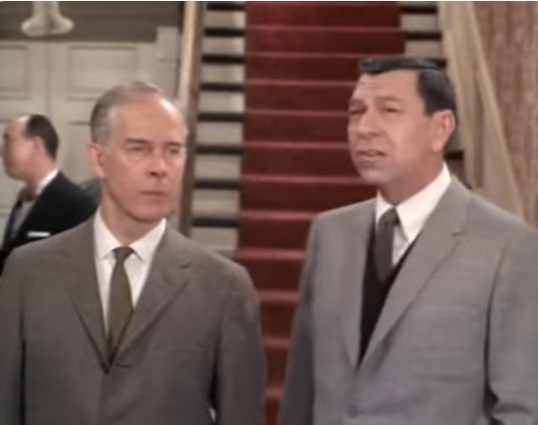
Today’s scene that I love comes from a 1968 episode of the iconic cop show, Dragnet.  A group of hippies want to leave the United States and start their own country.  Joe Friday (Jack Webb) and Bill Gannon (Harry Morgan) set them straight!

It’s always kind of easy to laugh a little at these episodes of Dragnet because it’s obvious that Webb had never actually met or dealt with any real hippies.  But I don’t know.  This episode, entitled The Big Departure, and this speech still feels relevant, even if I doubt it actually changed the mind of anyone planning on starting their own nation.


A Blast From The Past: A Force In Readiness (dir by Col. William L. Hendricks)


105 years ago today, Jack Webb was born.

Webb appeared in a handful of films but he’s probably best remembered for developing, directing, and starring in America’s first cop show, Dragnet.  As Sgt. Joe Friday, Webb dealt with crimes both big and small.  In the late 60s, he dealt with hippies and other anti-American forces.  A few years ago, I binged the 60s version of Dragnet and I have to admit I got totally addicted to it.  It was somehow both effective and totally camp at the same timeThat takes skill!

Webb is the narrator of today’s Blast From The Past.  1961’s A Force In Readiness is a 30-minute short film about the Marines.  Seen today, it seems like a lengthy commercial but, when it was first released, the director was awarded a special Oscar “for his outstanding patriotic service in the conception, writing and production of the Marine Corps film, A Force in Readiness, which has brought honor to the Academy and the motion picture industry.”

Webb provides the narration in his trademark style.  If the Greatest Generation could all speak in one voice, that voice would probably sound a lot like Jack Webb’s.

A Blast From The Past: Dragnet 1970 4.22 “D.H.Q.: Night School” (dir by Jack Webb)


Dragnet began as a radio program in 1949 before making it’s way over to television in 1951. Each episode starred (and the majority were directed by) Jack Webb, who played a no-nonsense cop named Joe Friday. Friday narrated every episode, dropping trivia about the history of Los Angeles while also showing viewers how the cops went about catching criminals. Despite what is commonly believed, Joe Friday never said, “Just the facts, ma’m,” but he did investigate each case with the cool determination of a professional who kept his emotions under control. The majority of Dragnet’s episodes were based on actual cases that were worked by the LAPD, hence the opening declaration of, “The story you are about to see is true.”

On television, Dragnet originally ran from 1951 to 1959, during which time Dragnet also became the first television series to be adapted into a feature film. Jack Webb decided to relaunch Dragnet in 1966 and he produced a made-for-television movie that followed Friday and his latest partner, the far more talkative Bill Gannon (Harry Morgan), as they worked multiple cases over the course of one long weekend.  That made-for-television movie led to a series that ran from 1967 to 1970.

The second television series is the best-remembered version of Dragnet, beloved for its scenes of Friday and Gannon debating the issues with a motely collection of hippies, campus radicals, and pipe-smoking academics.  Jack Webb viewed Friday as being the voice of the common American, who supported the troops, supported the president, and who wanted to spend the weekend grilling in peace.  Friday was the middle-aged suburbanite who wanted to the kids to stay off the grass, whether it was on his front lawn or being sold on a college campus.  These episodes were often campy.  It’s hard not to smile while listening to Friday and Gannon deadpan their way through conversations with flakey long-haired hippies.  It was often obvious that the writers of Dragnet had never actually had any experiences with the hippies, beyond what they saw on the evening news.  And yet, as silly as things often were, the show is an interesting time capsule of the era in which it was made.  If nothing else, it’s a chance to see the turbulent 60s through the eyes of the other side.

Last year, I shared my favorite episode of Dragnet.  For the new year, I’m sharing my second favorite, an episode that originally aired on March 19th, 1970.  In Night School, Joe Friday is attending a night class where he and his classmates sit in a circle and just “rap” about the issues of the day.  No one knows that Joe is a cop but Joe feels that he is still on duty and when he sees that the guy sitting across from him has a baggie of weed in his notebook, Friday makes an arrest.  The professor, who says “There’s nothing wrong with marijuana, I smoke it myself!,” attempts to kick Sgt. Friday out of his class.  “Would you rather be known as good ol’ friendly Joe, the class narc?” the professor asks.  Joe fights for his right to get an education and a man with an eyepatch emerges as an unlikely voice of reason.

Why do I like this episode?  There’s something undeniably entertaining about seeing straight-laced, deadpan Joe Friday attending a class with at least three hippies.  It always amuses me that, on this show, Joe Friday loosening up just means that Joe trades his suit for a sweater.  Also entertaining is Leonard Stone’s over-the-top performance as the villainous professor.  And how can you not smile at Bill Gannon’s weary claim of “I just knew there was no way you could get a B sitting around talking?”  Or Jack Webb’s delivery of the line, “That’s my thing, keeping the faith, baby?”  Or Jack Curtiss’s hyperactive performance as campus drug pusher Jerry Morgan?  “Hey, that’s just oregano!”  Whatever you say, Jerry.

Today’s blast from the past certainly does feel like a trip in a time machine.  Step on in and take a look at California in 1970!

A Blast From The Past: Dragnet 1968 3.1 “Public Affairs: DR-07” (dir by Jack Webb)


May 1st is a day of many holidays, including Law Day.

President Dwight D. Eisenhower first proclaimed May 1st to be Law Day in 1958 and apparently, it’s been celebrated every year since.  On Law Day, Americans are meant to reflect on the role of law in the foundation of the nation and also consider its importance to the social order.

To observe this year’s Law Day, I’m happy to present our readers with my favorite episode of Dragnet 1968.  

Dragnet began as a radio program in 1949 before making it’s way over to television in 1951. Each episode starred (and the majority were directed by) Jack Webb, who played a no-nonsense cop named Joe Friday. Friday narrated every episode, dropping trivia about the history of Los Angeles while also showing viewers how the cops went about catching criminals. Despite what is commonly believed, Joe Friday never said, “Just the facts, ma’m,” but he did investigate each case with the cool determination of a professional who kept his emotions under control. The majority of Dragnet’s episodes were based on actual cases that were worked by the LAPD, hence the opening declaration of, “The story you are about to see is true.”

On television, Dragnet originally ran from 1951 to 1959, during which time Dragnet also became the first television series to be adapted into a feature film. Jack Webb decided to relaunch Dragnet in 1966 and he produced a made-for-television movie that followed Friday and his latest partner, the far more talkative Bill Gannon (Harry Morgan), as they worked multiple cases over the course of one long weekend.  That made-for-television movie led to a series that ran from 1967 to 1970.

The second television series is the best-remembered version of Dragnet, beloved for its scenes of Friday and Gannon debating the issues with a motely collection of hippies, campus radicals, and pipe-smoking academics.  Jack Webb viewed Friday as being the voice of the common American, who supported the troops, supported the president, and who wanted to spend the weekend grilling in peace.  Friday was the middle-aged suburbanite who wanted to the kids to stay off the grass, whether it was on his front lawn or being sold on a college campus.  These episodes were often campy.  It’s hard not to smile while listening to Friday and Gannon deadpan their way through conversations with flakey long-haired hippies.  It was often obvious that the writers of Dragnet had never actually had any experiences with the hippies, beyond what they saw on the evening news.  And yet, as silly as things often were, the show is an interesting time capsule of the time in which it was made.  If nothing else, it’s a chance to see the 60s through the eyes of the other side.

My favorite episode was the show’s third season premiere.  It originally aired on September 19th, 1968 and it features Joe and Gannon appearing on a talk show.  The subject of the show: “The Fuzz Who Needs Them?”  Joe and Gannon argue on behalf of the fuzz.  Appearing on the other side of the panel are a pipe-smoking academic (Stacy Harris) and the publisher (Howard Hesseman, credited as Don Sturdy) of an underground newspaper.  Questions are asked from the audience.  John Dietz (played by Lou Wagner, who also plays Harlan Arliss on CHiPs) wants to know why drug are illegal.  Mondo Mabamba (Dick Anthony Williams) wears blue glasses and demands to know why the cops are always sitting in squad cars.  Overseeing the show is the evil Chuck Bligh (Anthony Eisley).  Friday struggles to hold back his disgust as the newspaper publisher throws a “Make Love Not War” pin at him.

This an interesting episode, if just because both sides are allowed to make their case and, in a rarity for Dragnet, neither Friday nor Gannon change anyone’s mind.  On the one hand, the academic and the publisher are both portrayed as being fairly obnoxious.  On the other hand, Howard Hesseman delivers his lines with such sharpness that his character cannot be as easily dismissed as the usual Dragnet hippie.  Chuck Bligh’s talk show predicts the political panel shows of today and it’s interesting to see how we’re still debating many of the same issues that were raised in this episode.

Here is today’s Blast From The Past:

Retro Television Reviews: Dragnet 1966 (dir by Jack Webb)


Welcome to Retro Television Reviews, a feature where we review some of our favorite and least favorite shows of the past!  On Sundays, I will be reviewing the made-for-television movies that used to be a primetime mainstay.  Today’s film is 1969’s Dragnet 1966!  It can be viewed on YouTube!

“This is the city….”

So begins Dragnet, a television movie version of the classic cop show that was the Law & Order of it’s day.  Dragnet began as a radio program in 1949 before making it’s way over to television in 1951.  Each episode starred (and the majority were directed by) Jack Webb, who played a no-nonsense cop named Joe Friday.  Friday narrated every episode, dropping trivia about the history of Los Angeles while also showing viewers how the cops went about catching criminals.  Despite what is commonly believed, Joe Friday never said, “Just the facts, ma’m,” but he did investigate each case with the cool determination of a professional who kept his emotions under control.  The majority of Dragnet’s episodes were based on actual cases that were worked by the LAPD, hence the opening declaration of, “The story you are about to see is true.”

On television, Dragnet originally ran from 1951 to 1959, during which time Dragnet also became the first television series to be adapted into a feature film.  Jack Webb decided to relaunch Dragnet in 1966 and he produced a made-for-television movie that followed Friday and his latest partner, the far more talkative Bill Gannon (Harry Morgan), as they worked multiple cases over the course of one long weekend.  The pilot movie did lead to a new show, one that lasted from 1967 to 1970 and which is today fondly remembered for scenes of Friday and Gannon debating the merits of the legal system with hippies.  However, for whatever reason, the 1966 pilot movie was not actually aired until 1969.

The made-for-TV movie features Friday and Gannon searching not for LSD dealers and draft dodgers but instead for a crazed photographer (Vic Perrin) who hires women to pose for him and then ties them up and takes their picture right before her murders them.  The photographer is based on real-life serial killer Harvey Glatman and Perrin is perfectly creepy in the role.  Though Friday never loses his composure, his disgust at the photographer and his crimes is palpable and it adds an extra charge to the scene where, in the middle of a drenching rain storm, Friday tries to sneak up on the trailer where he believes the photographer is holding his latest victim.  It’s actually a pretty exciting scene and definitely one that will take by surprise anyone who thinks of the 60s Dragnet as just being a campy exercise in establishment resentment.

Of course, catching a serial killer is not all that Friday and Gannon deal with.  It’s a long weekend so Friday and Gannon end up investigating the murder of a French tourist and Friday helps a younger, black detective deal with a racist criminal.  (The scene where Friday stands up to the racist was obviously meant to answer those who claimed the LAPD was a racist organization.)  At the start of the film, Joe almost gets collared into working security for a visiting Russian diplomat and the Russian’s paranoid security team is contrasted to the level-headed and capable men of the LAPD.  Some of these scenes are better than others.  The French tourist subplot features some truly risible acting and the scene with the racist is well-intentioned but still feels a bit condescending in its portrayal of the black detective needing Friday to help him deal with the suspect.  That said, I did enjoy listening to Bill Gannon talking about his plans for retirement and how working for the LAPD was destroying his teeth.  Harry Morgan’s folksy humor was always the perfect counterpart to Jack Webb’s perpetually rational Friday.

Finally, I appreciated that the movie featured a scene with Friday and Gannon went undercover at a lonely hearts club.  If you’ve watched the 1960s version of Dragnet, you know that, for all the times that Friday and Gannon went undercover, they never really put much effort into it.  I mean, they didn’t ever bother to take off their jackets!

Though I was disappointed by the lack of hippies, Dragnet 1966 was still not only a good police procedural but also a fun time capsule of its era.

30 Days of Noir #20: He Walked By Night (dir by Alfred L. Werker and Anthony Mann)


The 1948 film noir, He Walked By Night, opens with a policeman named Rawlins on his way home from work.  As he drives down the street, he sees a man walking alone at night.  Because there’s been a number of recent burglaries in the area and the man’s a stranger, Rawlins decides to pull over and ask the man for his ID.

What Rawlins doesn’t realize is that the man is Roy Morgan (Richard Basehart) and yes, Roy is indeed the burglar.  Roy is something of a mystery man.  (Needless to say, Morgan is not his real last name.)  In the pre-Internet age, he has very carefully and very meticulously avoided leaving any sort of paper trail.  He lives, by himself, in a small apartment, his only companion being an adorable dog and the police scanner that Roy uses to always stay a few steps ahead of the cops.  When Rawlins pulls him over, it’s the closest that Roy has ever come to being caught.  Roy get out of the situation by shooting the cop and then running into the night.

The rest of the film deals with the efforts of two police detectives (played by Scott Brady and James Cardwell) and their captain (Roy Roberts) to discover who shot Rawlins and bring him to justice.  It’s not easy because not only has Roy done a good job of obscuring his very existence but his police scanner always gives him advanced warning whenever they cops start to close in on him.  The only lead that the cops have is a salesman named Paul Reeves (Whit Bissell).  Reeves has been buying and reselling the electronic equipment that Roy’s been stealing from houses all over Hollywood.  When Reeves tells the cops that he had no idea the stuff was stolen, the cops all share a weary roll of the eye.  No matter whether Reeves is telling the truth or not, he’s now the key to tracking down a cop killer….

He Walked By Night is a police procedural and, while the plot may sound familiar, the film is elevated by the atmospheric direction of Alfred Werker and an uncredited Anthony Mann.  As visualized by Werker and Mann, the streets of Los Angeles have never been darker and more menacing.  Roy emerges from the fog to commit his crimes and then disappears back into the mist, like some sort of paranormal spirit.  The film reaches its high point when the police chase their quarry through the sewers of Los Angeles, a scene that will remind many of the famous finale of The Third Man.

Though the film offers up clues to Roy Morgan’s motivation, he remains an enigma for much of the film.  Richard Basehart plays him as a paranoid man who only seems to be confident and happy when he’s stealing or when he’s outsmarting the police.  In many ways, regardless of whether he escapes the police or not, Roy’s destined to spend his life trapped in a prison of his own design.  Even hiding out on the fringes of society, Roy knows that his time is limited.  There’s only so many times one person can escape their fate.  Until he’s either captured or killed, Roy is destined to always walk the night, alone.

A Blast From The Past: Red Nightmare (directed by George Waggner)


Hi there!  Happy Labor Day!

Now, I have to be honest.  I’m not really sure what the point of Labor Day is.  I have no idea what we’re supposed to be celebrating today.  I’ve got the day off, which seems kind of unfair when you consider that people who have far worse jobs than me — i.e., the actual laborers — are having to work.

Like many Americans, I spent this weekend hanging out with my extended family.  On Sunday, I did a poll of every cousin, aunt, uncle, sister, niece, and nephew that I could find and almost every single one of them agreed with me that Labor Day sounded like something tedious that Jesse Myerson would come up with and then demand that everyone celebrate.  In short, it sounded communistic.

So, with that in mind, I think the best way to start out Labor Day would be by watching this educational film from 1962.  In Red Nightmare, Jerry Donavon (Jack Kelly) takes his freedom for granted.  So, Jack Webb shows up and casts a magic spell, which causes Jerry to have a dream about what it would be like to live in a communist society.  In fact, you could even say that Jack Webb gives Jerry a red nightmare!

So, there’s two ways to review a film like Red Nightmare.  We can either debate the film’s politics and get into a big discussion about economics and policy and all that crap and OH MY GOD, doesn’t that just sound perfectly tedious?  Or, we can simply enjoy Red Nightmare for what it is, a histrionic but sincere time capsule of what was going on in the psyche of 1962 America.

Red Nightmare!  Watch it before getting brainwashed by Labor Day!

http://www.youtube.com/watch?v=LyCPtzZRh5I

Embracing the Melodrama Part II #19: Sunset Boulevard (dir by Billy Wilder)


Sunset Boulevard

“All right, Mr. De Mille, I’m ready for my close-up!”

— Norma Desmond (Gloria Swanson) in Sunset Boulevard (1950)

First released in 1950 and nominated for Best Picture, Billy Wilder’s Sunset Boulevard is one of the greatest and most influential films of all time.  It’s also something of a difficult film to review because, in order for one to truly understand its greatness, it needs to be seen.  A description simply will not do.  You have to experience, first hand, the performances of Gloria Swanson, William Holden, and Eric Von Stroheim.  You have to see, with your own eyes, the way that Billy Wilder perfectly balances drama, satire, and horror.  I can tell you about how cinematographer John F. Seitz perfectly contrasts the empty glossiness of Hollywood with the dark shadows that fill the ruined mansion of Norma Desmond but, again, it’s something that you owe it to yourself to see.  You need to hear the perfectly quotable dialogue with your own ears.  You need to experience Sunset Boulevard for yourself.

And, while you’re watching it, think about how easily one bad decision could have screwed up the entire film.  Sunset Boulevard is famous for being narrated by a dead man, a screenwriter named Joe (William Holden).  When we first see Joe, he’s floating in a pool.  Originally, however, the film was to open with the dead Joe sitting up in the morgue and telling us his story.  Reportedly, preview audiences laughed at the scene and it was cut out of the film.  And Wilder made the right decision to remove that scene.  Sunset Boulevard may be famous for being a strange film but, when you actually watch it, you realize just how controlled and disciplined Wilder’s direction actually is.  Sunset Boulevard may be weird but it’s never less than plausible.

Joe Gillis is a former newspaper reporter-turned-screenwriter.  He may have started out as an idealist but, as the film begins, he’s now just another Hollywood opportunist.  While trying to hide from a man looking to repossess his car, Joe stumbles upon a dilapidated old mansion.  The owner of the mansion is none other than Norma Desmond (Gloria Swanson), a silent film star who has sent been forgotten but who still dreams of making a comeback.  (When Joe tells her that she used to be big, Norma famously responds that she’s still big and it’s the pictures that have gotten small.)  Norma has written a script and the opportunistic Joe convinces her to hire him as a script doctor.

Joe moves into the mansion and discovers a world that has never moved past the 1920s.  Norma’s butler and former director, Max (played by Gloria Swanson’s former director Erich Von Stroheim) writes letters that he claims were sent by Norma’s fans.  Norma spends her time watching her old movies.  Occasionally, other forgotten silent screen stars (including Buster Keaton) drop by to play cards.

Encouraged by Joe’s vapid flattery and a mysterious phone call from a Paramount exec, Norma has Max drive her down to the studio.  Greeted by the older employees and ignored by the younger, Norma visits with director Cecil B. DeMille (who plays himself).  In a rather sweet scene, she and DeMille remember their shared past.  DeMille obviously understands that she’s unstable but he treats her with real respect, in contrast to the manipulative Joe.

As for Joe, he’s fallen for a script reader named Betty (Nancy Olson) and wants to escape from being dependent on Norma.  However, Norma has invested too much in her “comeback” to just allow Joe to leave…

Sunset Boulevard is a wonderful mix of film noir and Hollywood satire.  And, though the film may be narrated by Joe and told from his point of view, it’s firmly on Norma’s side.  As easy as it is to be dismissive of Norma’s delusions, she’s right in the end.  It is the pictures that have gotten small and, as she proves towards the end of the film, she is still as capable of making a grand entrance as she ever was.

Joe may have been too stupid to realize it but Norma Desmond never stopped being a star.

http://www.youtube.com/watch?v=Y3P0Zpe-2og