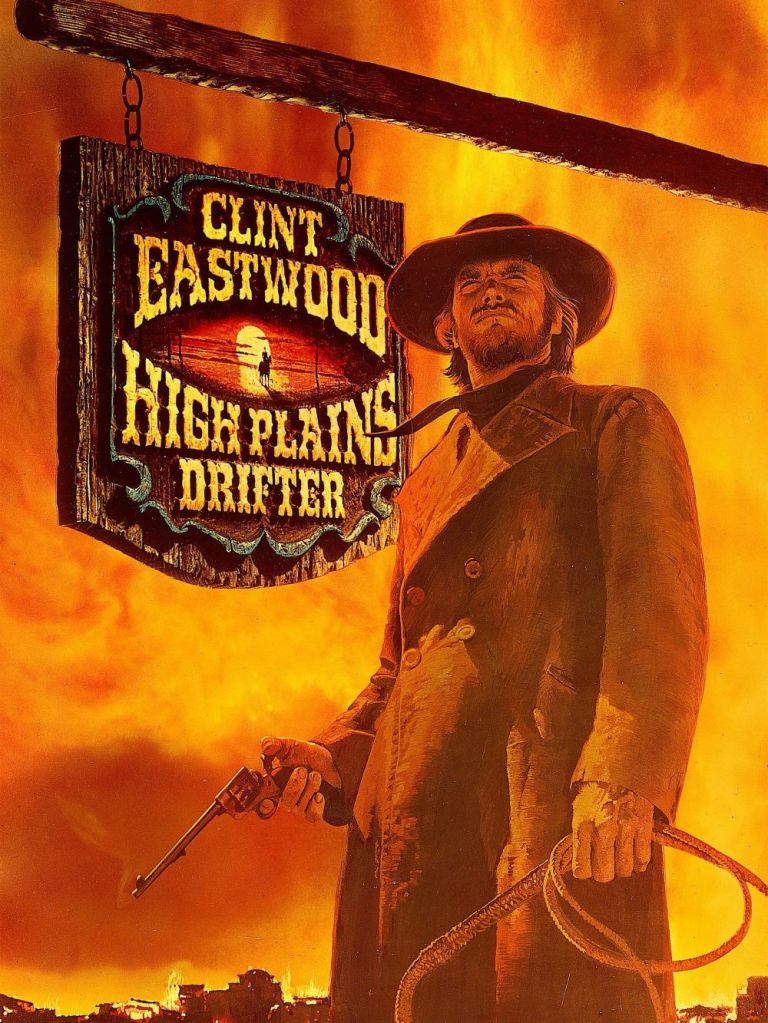
Horror Review: High Plains Drifter (dir. by Clint Eastwood)


“Don’t count on me to make you feel safe.” — The Stranger

High Plains Drifter stands as one of the bleakest, most enigmatic entries in Clint Eastwood’s filmography—a Western that bleeds unmistakably into the realms of psychological and supernatural horror. This 1973 film is not just another dusty tale of lone gunfighters and frontier justice. It’s a nightmare set in broad daylight, a morality play whose hero is more monster than man.

Eastwood’s Stranger comes riding into the town of Lago from the shimmering desert, a silhouette both akin to and apart from his famed Man With No Name persona. The townsfolk are desperate, haunted by fear—less afraid of imminent violence, more of the sins they’ve half-buried. This is a place where a lawman was brutally murdered by outlaws while the townspeople looked away, their silence paid for with cowardice and greed. When the Stranger assumes command, he does so with often-gleeful sadism—kicking people out of their hotel rooms, replacing the mayor and sheriff with the dwarf Mordecai, and ordering that the entire town be painted red before putting “Hell” on its welcome sign.

There’s a surface plot: the Stranger is hired to protect Lago from the same three outlaws who once butchered its marshal. But he’s there for far more than that. The story unspools through dreamlike sequences, flashbacks that suggest the Stranger may well be an avenging spirit or a revenant—the dead lawman, spectral and merciless, returned to claim what the townsfolk owe to Hell itself.

The horror here isn’t about jump scares or gothic haunted houses. The supernatural lurks everywhere and yet nowhere. The Stranger moves with the implacable calm—and violence—of a slasher villain, transforming Lago into his personal stage for retribution. His nightmares, full of images of past atrocities, are painted with the same vivid brutality as the daytime violence. Eastwood’s use of silence, the squint of a face, the twitch of a pistol replaces musical cues in amplifying dread. The sound design evokes otherness—a howling wind, footsteps echoing across empty streets—that builds a shadow of terror around the Stranger’s presence.

This violence is hurried and brutal; its sexual politics unflinching. When the Stranger enacts revenge, he punishes not just the outlaws, but the townsfolk complicit in their crimes. There is little comfort in his sense of justice—the pleasures he takes border on sadistic. The film’s moral ambiguity cuts deeper than most Westerns or horrors: this is not a clear-cut tale of good versus evil, but a brutal reckoning of collective guilt, cowardice, and corruption.

Lago itself acts almost like a town stuck in purgatory—a holding pen between redemption and eternal damnation. The infamous “Welcome to Hell” sign the Stranger paints at the town’s entrance serves as a grim message. It’s no welcome to law and order, but a symbolic beacon to the very outlaws the Stranger is hired to confront, suggesting that Lago is a place where sin festers and punishes itself. The town’s dance with Hell is both literal and metaphorical. The inhabitants aren’t just awaiting judgment; they have invited it in their desperate attempts to hide their cowardice and greed under the guise of civilization.

This notion of Lago as purgatory stands in sharp contrast to other recent horror Westerns, which serve as prime examples of the genre’s thematic spectrum. These films tend to focus on the primal terror of nature barely held at bay by the fragile veneer of civilization the settlers claim. They pit human beings against the ancient, untamed forces of the wilderness—whether monstrous creatures or surreal phenomena—emphasizing that the supposed order and progress of the West remain fragile and constantly threatened. This dynamic symbolizes the uneasy balance between civilization’s reach and nature’s primal power, often revealing how thin and tenuous that barrier truly is.

Among these, Bone Tomahawk and Ravenous stand out as vivid examples. Bone Tomahawk confronts menacing cannibals lurking in the wild, reminding viewers that the West’s order is fragile and under perpetual threat from untamed wilderness. Ravenous uses cannibalism and survival horror as metaphors for nature’s savage predation hidden beneath the polite façade of civilization—nature’s horrors masked but not erased.

By contrast, High Plains Drifter directs its horror inward, exposing the corruption that manifest destiny imposed on settlers themselves. Instead of fearing nature as an external force, the film presents settlers as haunted by their own moral failures and complicity in violence and betrayal. The Stranger’s vengeance is a reckoning with the darkness festering inside the community, a brutal meditation on guilt, collective cowardice, and the price of greed disguised as progress.

Eastwood’s film strips away the mythic promises of the American West as a land of freedom and opportunity, revealing instead the brutal reality of communities locked in complicity, violence masquerading as justice, and the moral rot at the heart of manifest destiny. This moral ambiguity and psychological depth give High Plains Drifter a unique position in the horror Western subgenre, elevating it beyond simple scares to a profound exploration of American cultural myths.

The Stranger is not a traditional hero but a spectral judge, embodying divine or supernatural retribution. His calm yet ruthless punishment exposes the cruelty, cowardice, and malevolence within Lago’s population, meting out a justice that is neither neat nor forgiving. His supernatural aura and sadistic tendencies make him an unforgettable figure of terror and fate.

Visually, the film’s harsh daylight contrasts with the romanticized Western landscapes of earlier films. Instead of shadows hiding evil, blinding light exposes the town’s moral decay. Characters are reduced to symbols of greed, fear, and cruelty, highlighting that the true horror lies within human nature and the failure to uphold justice.

High Plains Drifter operates on multiple levels—a Western, a ghost story, a horror film, and a dark morality play. It is a relentless meditation on justice and punishment and a dismantling of the traditional Western hero myth. Through layered narrative, stark visuals, and Eastwood’s chilling performance, it remains an essential entry in the horror Western canon.

For those seeking a Western that doesn’t just entertain but unsettles and challenges, High Plains Drifter offers an unforgiving descent into darkness. It strips away the comforting myths of the frontier and exposes the raw, rotting core beneath. Unlike other modern horror Westerns such as Bone Tomahawk and Ravenous, which confront external terrors lurking in the wilderness, this film turns its gaze inward—on the moral decay, guilt, and violence festering within the settlers themselves. It’s a brutal, haunting reckoning, and Eastwood’s Stranger is the cold, relentless agent of that reckoning. This is a journey into a hell both literal and psychological, where justice is merciless and safety is a long-forgotten promise.
Film Review: High Plains Drifter (dir by Clint Eastwood)


In 1973’s High Plans Drifter, Clint Eastwood plays …. The Stranger.

No, not the Man With No Name.  The Stranger has a name but he chooses not to share it.  That said, when one person says that he doesn’t even know the Stranger’s real name, the Stranger replies, “Yes, you do.”  The Stranger appears to emerge from the heat of the desert, riding into the small mining town of Lago and gunning down the three bullies that the townspeople hired to protect them after the murder of their town marshal.  With no other option, the townspeople accept the Stranger as the town’s new protector.

The Stranger is drawn to the town and the townspeople but he doesn’t seem to particularly like any of them, with the exception of Mordecai (Billy Curtis), the dwarf that the Stranger appoints as the town’s new sheriff.  The townspeople, the majority of whom are cowardly and motivated by greed, aren’t particularly likable themselves.  The Stranger rules the town like a dictator, kicking everyone out of the hotel so that he can have it for himself and ordering that every building in the town be painted red.  Over the town’s welcome sign, he paints one word: “Hell.”  When the townspeople see how well the Stranger can shoot, they celebrate in the belief that they’ll always be safe.  The Stranger responds by leaving town just as three sadistic outlaws, led by Stacey Bridges (Geoffrey Lewis), approach.  The Stranger may be looking for revenge on Bridges but he also seems as if he wants to make the town suffer for its sins as well.

Much as with the case of The Man With No Name, the Stranger is not motivated by kindness or any sort of concern for the safety of the townspeople.  He often shows a cruel-streak when it comes to dealing with the cowardly townspeople.  He doesn’t attack unless he’s attacked first but once you’re on his bad side, he’ll gun you down without a hint of emotion.  When the Stranger sleeps, he is haunted by nightmares of the previous marshal (played by Buddy Van Horn, Clint Eastwood’s stunt double) being murdered by Bridges and his men while the townspeople stood by and did nothing.  We learn that the townspeople, worried that it might be bad for their business interests, didn’t even give the late marshal a decent headstone after his death.  One woman mentions that spirits can’t rest unless they have a proper marker….

Getting the idea?

High Plains Drifter is probably the closest that Eastwood has ever come to making a supernatural horror film.  The Stranger may or may not be a vengeful ghost (the movie leaves that for you to decide) but he turns the small town of Lago into his own personal version of Hell and, when he attacks the men who killed the marshal, he moves with the ruthless determination of a slasher villain.  The scene where Bridges and his men ride into the town is like a filmed nightmare.  This is a dark film, one in which Eastwood’s Stranger is not the hero because he’s particular heroic but just because everyone else in the film is so bad.

This was also Eastwood’s second film as a director (following Play Misty For Me) and also the first of many westerns that Eastwood would direct.  The imagery is often haunting, all the more so because some of the most violent scenes take place in broad daylight.  The scenes where the Stranger seems to materialize out of the desert’s heatwaves perfectly capture the mythology of the old west and its “heroes.”  Eastwood gets good performances out of his ensemble cast and, even more importantly, he shows that Eastwood the director had a perfect understanding of Eastwood the actor.  As the Stranger, Eastwood says more with a snarl or a half-smile than most actors could say with a multi-page monologue.

High Plains Drifter is violent, often disturbing, and ultimately unforgettable.

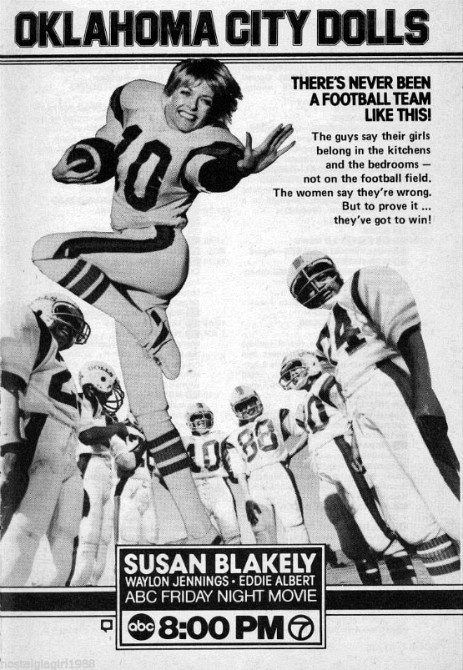
The Oklahoma City Dolls (1981, directed by E.W. Swackhamer)


At an Oklahoma manufacturing plant, the women are always expected to put in extra hours while their male co-workers practice as a part of the company’s football team.  Shop steward Sally Jo (Susan Blakely) files a complaint with the EEOC.  John Miller (Robert Hooks) pays a visit to the plant and says that the women have to be given the same opportunities and benefits as the man, including recreation time.  The plant’s foreman, J.D. Hines (David Huddleston), agrees.  The woman can have recreation time as long as they’re doing what the men are doing and that’s playing football.  Determined to show up Hines and all of her sexist co-workers (and her boyfriend, played by Waylon Jennings), Sally Jo puts together a football team and even gets a broken-down former NFL coach (Eddie Albert) to serve as their trainer.

There actually was a woman’s football team called The Oklahoma City Dolls.  They played in the National Women’s Football League and they won the league’s championship three times.  However, they don’t appear to have anything to do with this movie, which is as much about Sally Jo trying to get a fair treatment for the workers as it is about hitting the field and running it in for a touchdown.  There are some parts of the movie that work.  I liked Eddie Albert’s performance as the alcoholic coach and the scene where he discovered that his community service would include coaching a group of women who had never played football before.  Folk singer Ronee Blakley was good as the team’s emotionally fragile wide receiver.  I even liked that the women didn’t all automatically become the world’s best football players.  The movie’s main weakness was that Susan Blakely just wasn’t believable as someone who lived in a trailer park, used “ain’t” in every sentence, and spent her time organizing a union.  She was too glamorous for the role and her scenes with Waylon Jennings all felt overwritten and overacted.  The story couldn’t decide if it wanted to be a drama about working in a factory or a football comedy and it was pretty uneven as a result.  The good thing is that the movie’s heart was in the right place, even if it didn’t always score a touchdown.

As for the real life Oklahoma City Dolls, they were active from 1976 to 1979.  An attempt to revive the team in 1982 failed when their financial backers pulled out at the last seconds.  The National Women’s Football League folded in 1988.

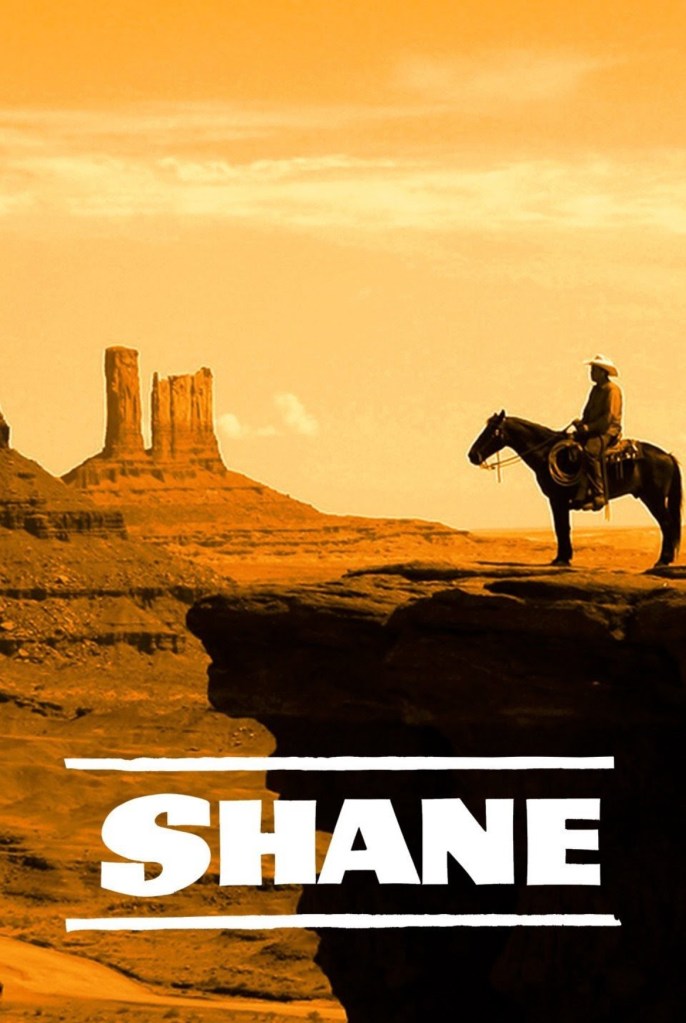
SHANE (The TV Series) – Episode 12: The Silent Gift (originally aired November 26th, 1966)


Episode 12 opens with Shane (David Carradine) and Rufe Ryker (Bert Freed) looking over a beautiful Appaloosa colt. Shane wants to buy it for Joey (Christopher Shea) and offers Ryker $50. Ryker gets a good laugh at that, but he does make Shane a counteroffer: if Shane will work at his cattle ranch for one month, he’ll then let Shane have the colt for $50. Shane doesn’t really want to do it, but it’s important to him to get Joey the colt, so he agrees. Ryker allows Shane to go ahead and take the colt to the Starett ranch and give him to Joey. Of course, Joey is ecstatic and can’t wait to start taking care of him. Marian Starett (Jill Ireland) isn’t that happy with Shane about the deal to work for Ryker for a month, but it’s soon clear that no amount of protesting from her will stop Shane from doing this for Joey. 

The next day Shane is moving into Ryker’s bunkhouse for the month, and we begin getting a feel for the various men working for Ryker. The foreman Kyle (Jack Ging) immediately takes a disliking for Shane for no particular reason other than jealousy, I guess. He’s a real jerk, and he seems to have some kind of inferiority complex. In more modern times, it seems possible that Kyle might drive a big truck with swinging testicles attached to the trailer hitch. We also meet Jingles (J. Pat O’Malley), an older man who the other cowboys pick on for sport. He takes it because he doesn’t want to ruffle any feathers or get turned out by Ryker. Jingles tells Shane that this job is the only thing he has in life, and he doesn’t know what he’d do if he were to lose it. That night Ryker comes into the bunkhouse and tells Shane that there will be no fighting, and that if he puts his hands on one of his men, he’ll be fired and the deal for the colt is off. Shane just wants to keep his head down and work out his month and then get back to his life at the Starett ranch. Even though Shane works extremely hard and proves to be a good “hand,” it becomes clear that foreman Kyle is going to do everything he can to make his life a living hell. Will Shane be able to finish out a month at Ryker’s place and pay for Joey’s gift? Will Jingles tell the truth when Kyle picks a fight with Shane? Will Joey learn valuable lessons in life from the colt? Will Marian admit to Shane how much she misses him when he’s gone? All good questions: episode 12 has the answers! 

While it may be a slight step down from the sheer awesomeness of the prior installment, episode 12, “The Silent Gift,” is another fine episode of the Shane TV series. I mention the name of the episode because its use of the word “silent” captures part of what I enjoy so much about the series. Shane doesn’t say a lot throughout the entire series, but he continuously lets his actions prove out who he is as a person. In this case, his love for Joey is on full display because of what he does for him in this episode. Now don’t get me wrong, words are important, and I still tell my wife and children that I love them daily. But words are hollow if they’re not backed up by actions. Shane always backs up his words. Shane’s motives are the antithesis of a person like the foreman Kyle, who’s outwardly all bluster and bravado, but whose actions are fueled completely by lies and deceit. The character of Jingles, who seems like a nice enough old guy, is also shown to be in sharp contrast to Shane. Jingle’s life is controlled by fear and his actions are all about self-preservation. The sad truth is the fact that there are a lot more Kyle’s and Jingle’s in this world than there are Shane’s. On a positive note, the character arc of Jingles ultimately gives us hope that it’s never too late for any of us to do the right thing. 

The main guest stars in this episode, Jack Ging and J. Pat O’Malley, both caught my attention. Ging, who played foreman Kyle, looked very familiar to me. A look at his filmography shows he was the dad in WHERE THE RED FERN GROWS (1974) and appeared in three different Clint Eastwood films a few years after appearing in this episode. One of the first books I remember reading purely for pleasure was “Where the Red Fern Grows.” I loved it so much and watched the movie many times growing up. To be honest, I haven’t thought about it for years, but now I’m hankering for a rewatch. And O’Malley, who played Jingles, also has an interesting filmography. He provided voiceover work for many classic animated films like ONE HUNDRED AND ONE DALMATIONS (1961) and THE JUNGLE BOOK (1967). And what really amazes me is the fact that he voiced characters in Disney’s “Pirates of the Caribbean” attraction, including one of the prisoners coaxing the dog with the keys in his mouth. When you’ve been to Disney World as many times as I have, I now see O’Malley as a rock star! 

Shane’s relationship with Marian has one really good moment in this episode. When Shane is visiting the Starett ranch one night, Marian tells him how much they miss him, how much SHE misses him, when he’s gone. I believe she would have been open to a big kiss if Shane would have gone for it, but instead he just said “that’s nice to hear” before saying goodnight. Here’s one time I don’t agree with the action Shane takes. With only five more episodes to go, the romantic in me is still hoping for a big-time payoff in love! 

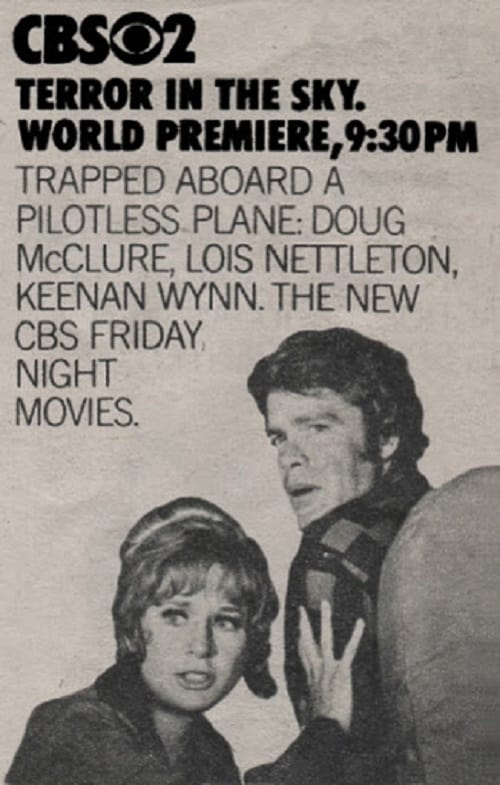
Retro Television Reviews: Terror In The Sky (dir by Bernard L. Kowalski)


Welcome to Retro Television Reviews, a feature where we review some of our favorite and least favorite shows of the past!  On Sundays, I will be reviewing the made-for-television movies that used to be a primetime mainstay.  Today’s film is 1971’s Terror In The Sky!  It  can be viewed on YouTube.

On a flight heading from Minneapolis to Seattle, several passengers suddenly start to get ill.

Luckily, there’s a doctor on the plane.  Sporting sideburns and wearing a turtleneck, Roddy McDowall is quite chic in the role of Dr. Baird, the dedicated medical professional who comes to realize that the passengers are suffering from food poisoning.  As Dr. Baird explains it to head flight attendant Janet Turner (Lois Nettleton), everyone who had the chicken for dinner is about get severely ill.  Uh-oh …. both of the pilots had the chicken!

Is there anyone on the plane who has any flying experience?  George Spencer (Doug McClure) flew a helicopter in Vietnam but, as George explains, it’s an entirely different type of flying all together.  George has no confidence about his ability to land the plane but he’s the only chance the passengers have.

On the ground, gruff Marty Treleavan (Leif Erickson) has been summoned to the airport so that he can help to talk George through the landing.  Marty explains what all of the instruments do to George.  He tells George that he needs to stay in the air for a few hours so that he can get comfortable with the plane.  But the people on the plane are getting more ill and George says that he might be ding things up a little but he’s going to land this plane!

Does this sound familiar to anyone?

As I watched this film last night, I found myself saying, “Oh my God, this is just a serious version of Airplane!”

And actually, it is.  Terror In The Sky was based on Zero Hour, the 1957 film that also served as the basis for Airplane!  (The directors of Airplane! even bought the rights to Zero Hour so that they freely borrow whatever they wanted to from the film.)  Indeed, much of the dialogue in both Zero Hour and Terror In The Sky also shows up in Airplane!  Even the musical cues in Terror In The Sky and Airplane! are similar.

Terror In The Sky is not a bad film.  It’s an efficient made-for-TV film that features several made-for-television veterans, including Keenan Wynn and Kenneth Tobey.  Doug McClure grimaces heroically in the role of George Spencer and Roddy McDowall is as likable as ever as the doctor who hates to fly.  It’s a very earnest movie about a group of people doing everything that they can to save hundreds of lives.  They’re doing the right thing!

But it’s also totally impossible to take the film seriously because you spend the entire movie waiting for Roddy McDowall to say, “Don’t call me Shirley,” or for Leif Erickson to say that he picked the wrong week to stop sniffing glue.  Every moment and every line makes the viewer think of something funny from Airplane!

Personally, I think they bought their tickets.  They knew what they were getting into.  I say …. well, you get the idea.

And yes, I did rewatch Airplane! as soon as I finished up Terror In The Sky.

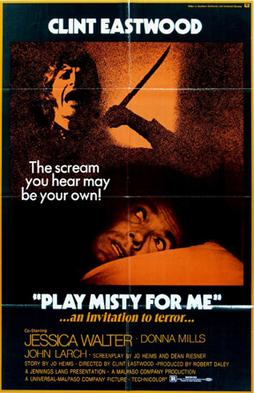
The Unnominated: Play Misty For Me (dir by Clint Eastwood)


Though the Academy of Motion Picture Arts and Sciences claim that the Oscars honor the best of the year, we all know that there are always worthy films and performances that end up getting overlooked.  Sometimes, it’s because the competition too fierce.  Sometimes, it’s because the film itself was too controversial.  Often, it’s just a case of a film’s quality not being fully recognized until years after its initial released.  This series of reviews takes a look at the films and performances that should have been nominated but were, for whatever reason, overlooked.  These are the Unnominated.

In 1971, Clint Eastwood made his directorial debut with Play Misty For Me.

Eastwood plays Dave Garver, a DJ at a Carmel-By-The-Sea jazz station who has ambitions to some day go national.  Every night, a woman named Evelyn (Jessica Walter) calls Dave and asks him to “Play Misty for me.”  Eventually, Dave meets Evelyn in a bar and he takes her home with him.  After sleeping with her, Dave tells Evelyn that he’s only interested in having a casual relationship.  Evelyn, however, reveals that she has a far different interpretation of casual.  Soon, Evelyn is dropping by Dave’s house unannounced and acting rather clingy, even appearing to attempt suicide when Dave tries to tell her that he’s not interested in having a serious relationship with her.

At first, it’s hard not to feel bad for Evelyn.  Yes, she’s obviously unstable.  Yes, she’s clingy.  Yes, the scene in which she intentionally ruins Dave’s interview for a national job is difficult to watch.  But there’s something so sincere and desperate about her need to have someone in her life that, again, it’s hard not to have sympathy for her.  When she claims that Dave took advantage of her when they first met, she’s got a point.  Dave obviously felt that Evelyn was a one-night stand that he would never have to see again.  Evelyn feels differently.

Things chance when Dave eventually runs into his former girlfriend, Tobie Williams (Donna Mills).  Dave and Tobie tentatively restart their relationship.  When Evelyn finds out, she goes from being clingy to be homicidal.  She goes from trashing Dave’s place to attacking Dave’s housekeeper to attacking Dave and Tobie themselves.

An assured directorial debut, Play Misty For Me shows that Eastwood had a strong directorial sensibility from the start.  (It also shows, during an extended sequence in which Dave and Tobie attend a jazz festival, that Eastwood was always capable of being rather self-indulgent.)  Eastwood uses the film to deconstruct his own confident persona, with Dave going from being a somewhat callous womanizer to ultimately being terrified for his life.  The film is dominated by Jessica Walter’s performance as Evelyn.  Walter is sad and terrifying, often in the same scene.  Though the film doesn’t dig into what happened in Evelyn’s past to drive her to such extremes, Jessica Walter’s performance leaves no doubt that she’s someone who has been hurt by the world and is now so desperate for love and protection that she’ll strike out at anyone who she feels is denying it to her.

As a horror movie that was directed by an actor who, at the time, was still not a favorite of the critics, it’s perhaps not surprising that the Academy ignored Play Misty For Me.  Still, it’s a shame.  If nothing else, Jessica Walter’s performance was far more memorable that Janet Suzman’s nominated turn in the painfully dull Nicholas and Alexandra.  It’s a brave performance and one that more than deserved to be honored.

Previous entries in The Unnominated:

  1. Auto Focus 
  2. Star 80
  3. Monty Python and The Holy Grail
  4. Johnny Got His Gun
  5. Saint Jack
  6. Office Space