Today’s song of the day comes the 1967 winner for Best Picture, Norman Jewison’s In The Heat of the Night.
Today’s song of the day comes the 1967 winner for Best Picture, Norman Jewison’s In The Heat of the Night.
4 (or more) Shots From 4 (or more) Films is just what it says it is, 4 (or more) shots from 4 (or more) of our favorite films. As opposed to the reviews and recaps that we usually post, 4 (or more) Shots From 4 (or more) Films lets the visuals do the talking.
Today would have been Norman Jewison’s birthday. It’s time for….
4 Shots From 4 Norman Jewison Films
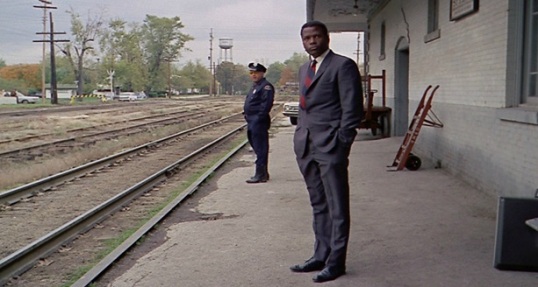
In The Heat of the Night (1967, dir by Norman Jewison, DP: Haskell Wexler)
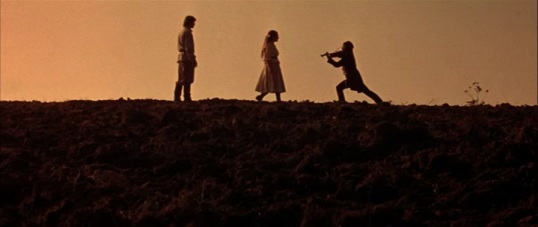
Fiddler on the Roof (1971, dir by Norman Jewison, DP: Oswald Morris)
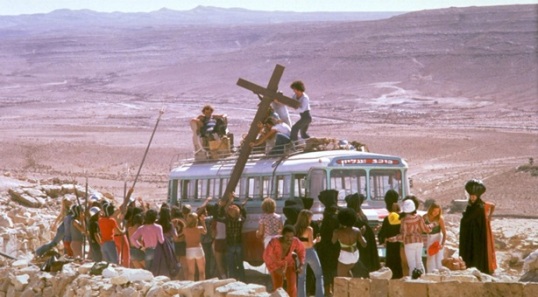
Jesus Christ Superstar (1973, dir by Norman Jewison, DP; Douglas Slocombe)
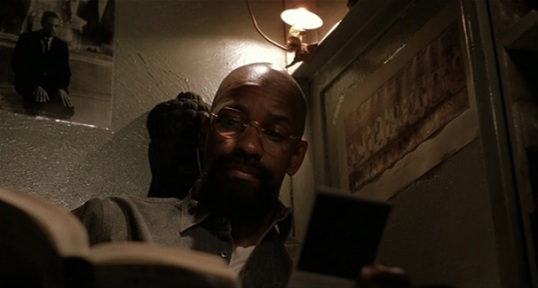
The Hurricane (1999. dir by Norman Jewison, DP: Roger Deakins)
4 Shots From 4 Films is just what it says it is, 4 shots from 4 of our favorite films. As opposed to the reviews and recaps that we usually post, 4 Shots From 4 Films lets the visuals do the talking!
Today, I’m using this feature to take a look at the history of the Academy Award for Best Picture. Decade by decade, I’m going to highlight my picks for best of the winning films. To start with, here are 4 shots from 4 Films that won Best Picture during the 1960s! Here are….
4 Shots From 4 Best Picture Winners: The 1960s

The Apartment (1960, dir by Billy Wilder, DP: Ernest Laszlo)

Lawrence of Arabia (1962, dir by David Lean, DP: Freddie A. Young)
In The Heat of the Night (1967, dir by Norman Jewison, DP: Haskell Wexler)

Midnight Cowboy (1969; Dir by John Schlesinger, DP: Adam Holender)

Today, we observe what would have been Sidney Poitier’s 97th birthday.
Today’s scene that I love comes from the 1967 Best Picture winner, In The Heat of the Night. In this film, Poitier plays Virgil Tibbs, a Northern cop who reluctantly finds himself helping a Southern sheriff (Rod Steiger) investigate a murder. Tibbs’s number one suspect is Eric Endicott (Larry Gates), who owns what was then a modern-day plantation.
In this scene, Tibbs interrogates Endicott, a paternalistic racist who simply cannot believe or accept that he is being questioned by a black man. When Endicott responds to one of Tibbs questions by slapping him, Tibbs slaps him right back.
While Endicott’s slap was in the original script, Tibbs’s response was not. At first, Tibbs was meant to turn the other cheek and leave the plantation without saying a word. Wisely, Poitier approached director Norman Jewison and objected to that, insisting that Tibbs would respond in kind. The scene was rewritten and it became one of Poitier’s best moments in the film.
4 (or more) Shots From 4 (or more) Films is just what it says it is, 4 (or more) shots from 4 (or more) of our favorite films. As opposed to the reviews and recaps that we usually post, 4 (or more) Shots From 4 (or more) Films lets the visuals do the talking.
Rest in Peace, Norman Jewison, a director who believed in the power of cinema to change the world.
4 Shots From 4 Norman Jewison Films
In The Heat of the Night (1967, dir by Norman Jewison, DP: Haskell Wexler)
Fiddler on the Roof (1971, dir by Norman Jewison, DP: Oswald Morris)
Jesus Christ Superstar (1973, dir by Norman Jewison, DP; Douglas Slocombe)
The Hurricane (1999. dir by Norman Jewison, DP: Roger Deakins)
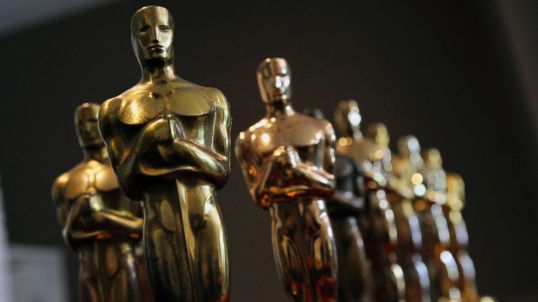
Ah, the 60s. Both the studio system and the production code collapsed as Hollywood struggled to remain relevant during a time of great social upheaval. The Academy alternated between nominating films that took chances and nominating films that cost a lot of money. It led to some odd best picture lineups and some notable snubs!
1960: Psycho Is Not Nominated For Best Picture and Anthony Perkins Is Not Nominated For Best Actor
To be honest, considering that the Academy has never really embraced horror as a genre and spent most of the 60s nominating big budget prestige pictures, it’s a bit surprising that Psycho was actually nominated for four Oscars. Along with being nominated for its production design and its cinematography, Psycho also won nominations for Alfred Hitchcock and Janet Leigh. However, Anthony Perkins was not nominated for Best Actor, despite giving one of the most memorable performances of all time. The film literally would not work without Perkins’s performance and, considering that Perkins pretty much spent the rest of his career in the shadow of Norman Bates, it’s a shame that he didn’t at least get a nomination for his trouble. Psycho was also not nominated for Best Picture, despite being better remembered and certainly more influential than most of the films that were.
1962: The Man Who Shot Liberty Valance Is Almost Totally Snubbed
The Man Who Shot Liberty Valance was not totally snubbed by the Academy. It received a nomination for Best Costume Design. But still, it deserved so much more! John Ford, James Stewart, John Wayne, Lee Marvin, Vera Miles, and the picture itself were all worthy of nominations. Admittedly, 1962 was a year full of great American films and there was a lot of competition when it came to the Oscars. Still, The Man Who Shot Liberty Valance definitely deserved a best picture nomination over the bloated remake of Mutiny on the Bounty. Today, if the first Mutiny on the Bounty remake is known for anything, it’s for Marlon Brando being difficult on the set. But The Man Who Shot Liberty Valance is still remembered for telling us to always print the legend.
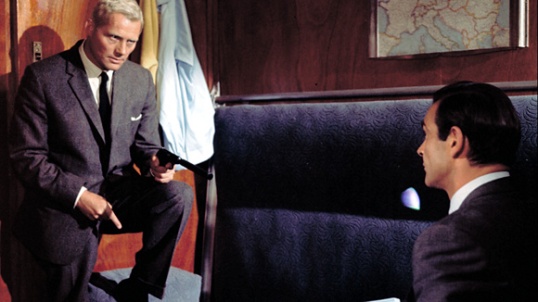
1964: From Russia With Love Is Totally Snubbed
The same year that the Academy honored George Cukor’s creaky adaptation of My Fair Lady, it totally ignored my favorite James Bond film. From Russia With Love is a Bond film that works wonderfully as both a love story and a thriller. Sean Connery, Lotte Lenya, Robert Shaw, and Terence Young all deserved some award consideration. From Russia With Love was released in the UK in 1963. In a perfect world, it would have also been released concurrently in the U.S., allowing From Russia With Love to be the film that gave the the Academy the chance to recognize the British invasion. Instead, Tom Jones was named the Best Picture of 1963 and From Russia With Love had to wait until 1964 to premiere in the U.S. It was snubbed in favor of one of old Hollywood’s last grasps at relevance.
1964: Slim Pickens Is Not Nominated For Best Supporting Actor
Playing three separate roles, Peter Sellers dominates Dr. Strangelove: Or How I Learned To Stop Worrying And Love The Bomb. But, as good as Sellers is, the film’s most memorable image is definitely Slim Pickens whooping it up as he rides the bomb down to Earth. George C. Scott and Sterling Hyaden also undoubtedly deserved some award consideration but, in the end, Pickens is the one who brings the film to life even as he helps to bring society to an end.
1967: In Cold Blood Is Not Nominated For Best Picture
In Cold Blood, though not a perfect film, certainly deserved a nomination over Dr. Doolittle. In Cold Blood is a film that still has the power to disturb and haunt viewers today. Dr. Doolittle was a box office debacle that was nominated in an attempt to help 20th Century Fox make back some of their money.
1967: Sidney Poitier Is Not Nominated For Best Actor For In The Heat Of The Night
In 1967, Sidney Poitier starred in two of the films that were nominated for Best Picture but somehow, he did not pick up a nomination himself. His restrained but fiercely intelligent performance in In The Heat Of The Night provided a powerful contrast to Rod Steiger’s more blustery turn. That Poitier was not nominated for his performance as Virgil Tibbs truly is one of the stranger snubs in Academy history. (If I had to guess, I’d say that the Actors Branch was split on whether to honor him for In The Heat of the Night or Guess Who’s Coming To Dinner or even for To Sir With Love and, as a result, he ended up getting nominated for none of them.)
1968: 2001: A Space Odyssey and Planet of the Apes Are Not Nominated For Best Picture
Neither one of these classic science fiction films were nominated for Best Picture, despite the fact that both of them are far superior and far more influential than Oliver!, the film that won that year.
1968: The Good, The Bad, and the Ugly Is Totally Ignored
Not even Ennio Morricone’s score received a nomination!
1968: Petulia Is Totally Snubbed
Seriously, I don’t know what was going on with the Academy in 1968 but it seems they went out of their way to ignore the best films of the year. Richard Lester’s Petulia is usually cited as one of the definitive films of the 60s but it received not a single Oscar nomination. Not only did the film fail to receive a nomination for Best Picture but Richard Lester, George C. Scott, Julie Christie, Shirley Knight, Richard Chamberlain, and the film’s screenwriters were snubbed as well.
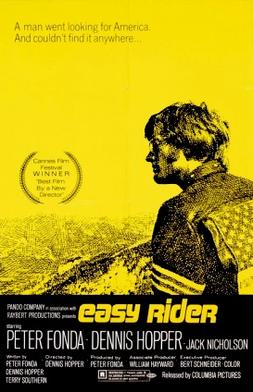
1969: Easy Rider Is Not Nominated For Best Picture
Yes, I know. Easy Rider is a flawed film and there are certain moments that are just incredibly pretentious. That said, Easy Rider defined an era and it also presented a portrait of everything that was and is good, bad, and timeless about America. The film may have been produced, directed, and acted in a drug-razed haze but it’s also an important historical document and it was also a film whose success permanently changed Hollywood. Certainly, Easy Rider’s legacy is superior to that of Hello, Dolly!
Agree? Disagree? Do you have an Oscar snub that you think is even worse than the 10 listed here? Let us know in the comments!
Up next: It’s the 70s!
4 Or More Shots From 4 Or More Films is just what it says it is, 4 shots from 4 of our favorite films. As opposed to the reviews and recaps that we usually post, 4 Shots From 4 Films lets the visuals do the talking!
Earlier, today, it was announced that Sidney Poitier had passed away at the age of 94.
Poitier was, of course, the first black actor to win the Oscar for Best Actor. He won that award for 1962’s Lillies of the Field. He would go on to star in the Oscar-winning In The Heat of the Night, where he delivered the famous line, “They call me Mr. Tibbs!” Poitier was one of the first black actors to be acknowledged as a movie star. In the 70s and the 80s, he chafed at the limited selection of roles that he was being offered in mainstream productions and he started to produce and direct his own films. He also served as a diplomat, serving as the Bahamian ambassador to both Japan and UNESCO.
In honor of Poitier’s life and legacy, here are….
4 Shots From 4 Sidney Poitier Films
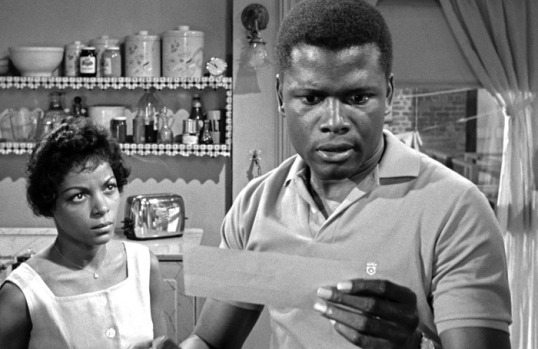
A Raisin in the Sun (1961, dir by Daniel Petrie, DP: Charles Lawton Jr.)
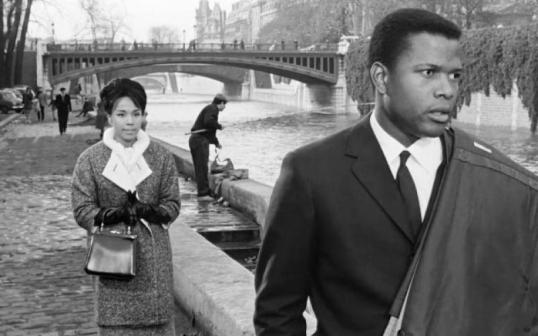
Paris Blues (1961, dir by Martin Ritt, DP: Christian Matras)

In The Heat of the Night (1967, dir by Norman Jewison, DP: Haskell Wexler)

Brother John (1971, dir by James Goldstone, DP: Gerald Perry Finnerman)
The 1967 film, In the Heat of the Night, tells the story of two very different men.
Chief Gillespie (Rod Steiger) is the police chief of the small town of Sparta, Mississippi. In many ways, Gillespie appears to the epitome of the bigoted Southern cop. He’s overweight. He loses his temper easily. He chews a lot of gum. He knows everyone in town and automatically distrusts anyone who he hasn’t seen before, especially if that person happens to be a black man or from the north.
Virgil Tibbs (Sidney Poitier) is a black man from the north. He’s a detective with the Philadelphia Police Department and he’s as cool and controlled as Gillespie is temperamental and uncouth. Tibbs has no patience for the casual racism that is epitomized by lawmen like Chief Gillespie. When Gillespie says that Virgil is a “fancy name” for a black and asks what people call Virgil in Philadelphia, Virgil declares, “They call me Mister Tibbs!,” with an authority that leaves no doubt that he expects Gillespie to do the same.
Together …. THEY SOLVE CRIMES!
For once, that old joke is correct. When a Chicago industrialist named Phillip Colbert is discover murdered in Sparta, Chief Gillespie heads up the investigation and, assuming that the murderer must be an outsider, orders Deputy Wood (Warren Oates) to check out the train station for any suspicious characters. When Wood arrives at the station, he discovers Virgil standing on the platform. Virgil is simply waiting for his train so that he can get back home to Philadelphia. However, Wood promptly arrests him. Gilespie accuses him of murdering Colbert, just to discover that Virgil’s a police detective from Philadelphia.
Though neither wants to work with the other, that’s exactly what Gillespie and Virgil are forced to do as they investigate Colbert’s murder. Colbert was planning on building a factory in Sparta and his wife (Lee Grant) makes it clear that, if Sparta wants the factory and the money that comes with it, Virgil must be kept on the case. Over the course of the investigation, Gillespie and Virgil come to a weary understanding as both of them are forced to confront their own preconceived notions about both the murder and life in Sparta. In the end, if it’s impossible for them to truly become friends, they do develop a weary respect for each other. That is perhaps the best that one could have hoped for in 1967.
I have to admit that it took me a few viewings before I really appreciated In the Heat of the Night. Though this film won the Oscar for Best Picture of 1967, it’s always suffered when compared to some of the films that it beat. One can certainly see that the film was superior to Doctor Dolittle and Guess Who’s Coming to Dinner. But was it a better film than The Graduate or Bonnie and Clyde? Did Rod Steiger really deserve to win Best Actor over Dustin Hoffman and Warren Beatty? (Amazingly, Poitier wasn’t even nominated.)
To be honest, I still feel that In The Heat of the Night was probably the 3rd best of the 5 films nominated that year, superior to the condescending Guess Who’s Coming To Dinner but nowhere near as groundbreaking as Bonnie and Clyde or The Graduate. The first time I watched In the Heat of the Night, I thought Steiger blustered a bit too much and the film’s central mystery didn’t really hold together and, to a large extent, I still feel like that.
But, at the same time, there’s a lot to appreciate about In the Heat of the Night. On subsequent viewings, I came to better appreciate the way that director Norman Jewison, editor Hal Ashby, and cinematographer Haskwell Wexler created and maintained an atmosphere that was so thick that you can literally feel the Mississippi humidity while watching the film. I came to appreciate the supporting cast, especially Warren Oates, Lee Grant, Scott Wilson, Anthony James, and Larry Gates. (Gates especially makes an impression in his one scene, playing an outwardly genteel racist who nearly cries when Tibbs reacts to his slap by slapping him back.) I also came to appreciate the fact that, while the white cop/black cop partnership has subsequently become a bit of a cliche, it was new and even controversial concept in 1967.
And finally, I came to better appreciate Sidney Poitier’s performance as Virgil. Poitier underplays Virgil, giving a performance of tightly controlled rage. While Steiger yells his way through the film, Poitier emphasizes that Virgil is always thinking. As in the same year’s Guess Who’s Coming To Dinner, Poitier plays a dignified character but, here, that dignity is Virgil’s way of defying the demands and expectations of men like Gillespie. When Virgil does strike back, it’s a cathartic moment because we understand how many times he’s had to hold back.
In the Heat of the Night may not have been the best film of 1967 but it’s still one worth watching.
 Through the Shattered Lens