Today’s horror scene that I love comes from Lucio Fulci’s 1981 masterpiece, The Beyond.
In this memorably gruesome scene, Joe the Plumber (Tonino Pulci) comes back to life. Having previously lost an eye in the basement of the film’s haunted hotel, he proceeds to claim an eye for himself. I’ll tell you right now that if I ever stepped into a house or a hotel or anywhere that had a sink that looked like that, I would quickly leave and never come back.
“You think those are bats?” someone said as we all stood out on the balcony of a hotel in the mountains of Switzerland.
I was 18 years old, a recent high school graduate who was spending my summer in Europe with my sisters. We were in Switzerland and had just eaten dinner at our hotel. I had stepped out onto hotel’s balcony, joining several other tourists who were looking up at the evening sky. The sky was was full of shadowy, winged creatures that seemed to be circling the hotel. As I stared up at the creatures and listened to the people around me wonder what they could be, I thought to myself that they very well could be bats. That freaked me out a little. Growing up in the Southwest, I had seen my share of bats. I’ve seen bats get trapped in garages. I’ve seen bats come flying out of tunnels. I’ve never been attacked by a bat. In fact, you have to be pretty obnoxious to attract the attention of a non-rabid bat. But that doesn’t make the sight of them any less frightening or the thought of them sucking your blood any less alarming.
We all stood out on the balcony, staring up at the bats and wondering if we were about to be attacked.
“Those are definitely bats,” someone else said, “Is it safe to be out here?”
By this point, my sister Megan had come out onto the balcony in order to make sure that I hadn’t fallen off.
“What’s everyone looking at?” she asked.
“Those are bats!” an old woman exclaimed, pointing at the sky.
“Those are birds,” Megan replied.
The “bats” chirped in agreement.
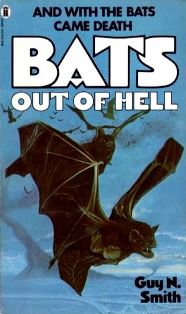
I found myself thinking about that Swiss evening as I read the 1978 horror paperback, Bats Out Of Hell. This novel opens with Professor Brian Newman developing a new virus as part of an attempt to find a cure for Meningitis. Unfortunately, he has tested his virus on a bunch of bats at the laboratory and now, they’ve all become increasingly aggressive. Since the virus also appears to ultimately be fatal to the bats, Newman can’t help but feel guilty about what he’s putting the bats through. Even though he’s told he just be happy that the bats are going to die eventually, he can’t stop thinking about their accusatory stare. He knows that the bats blame him and well they should!
An argument with his girlfriend leads to Brian falling and accidentally setting free all of the infected bats. The bats swarm across the British countryside, attacking everyone that they see and spreading the virus. The government reacts by declaring martial law and trying to isolate the bats to one city. Soon, rioters are taking to the streets and vigilantes are enforcing their own violent interpretation of the law.
That’ll teach humanity to try to cure Meningitis!
Bats Out Of Hell is a pulpy read, one that works because bats are scary and author Guy N. Smith keeps the action moving quickly. The novel is at its best when envisioning a world where fear of disease has led to mass panic and a suspension of civil rights. Hmmm …. why does that seem so familiar? It’s amazing how science fiction can eventually become science fact.
Taking place in Victorian-era London, 2023’s Ripper’s Revenge tells the story of Sebastian Stubb (Chris Bell.)
Sebastian Stubb is a journalist, writing stories for one of the many sleazy tabloids that keep the people of London in a state of constant agitation. Just a few months ago, things were going well for Stubb and his fellow reporters. Jack the Ripper was terrorizing the city and sending bloody letters to both the police and the newspaper. Every day, there was a new detail to be reported and a new panic to stoke. Stubb and his colleagues left London obsessing over the crimes and the motivation of the mysterious Jack the Rippe, to such an extent that Stubb now feels that his reporting probably inspired more murders than it stopped.
Jack the Ripper’s killing spree has come to an apparent end and the Ripper himself has disappeared, though Londoners still continue to speculate about who he could have been. (In real life, the police rather infamously claimed that an obscure lawyer named Montague Druitt was the murderer but there really wasn’t much evidence for that, beyond the fact that the murders appear to have ended at the same time that Druitt committed suicide. Personally, I suspect that the assassin was an American con artist named Francis Tumblety, who fled back to America shortly after the final murder was committed.) Stubb is now struggling financially. While his girlfriend, Iris (Rachel Warren), walks the streets just as the victims of Jack the Ripper once did, Stubb searches for the next big story.
Then, one day, Stubb gets a letter. The letter is from someone claiming to be Jack the Ripper. The writer apologizes for having not written sooner and then tells Stubb that his latest victim can be found in a warehouse. Though believing the letter to be a hoax, Stubb goes to the warehouse and discovers a dead prostitute. At the same time, Stubb is himself discovered by the London police and is hauled off to jail.
Now, at this point, I should mention that Ripper’s Revenge is a sequel to a film called Ripper Untold. That film also featured Chris Bell as Stubb and apparently, it featured him investigating the original Ripper murders. I point this out because I haven’t seen Ripper Untold, so I don’t know how directly Ripper’s Revenge follows the story from the first film. It doesn’t really matter, though, This is a case where you can follow the sequel’s plot without having seen the original.
We know Stubb is not the Ripper but who is? Because this is a low-budget film, there really aren’t that many suspects. Inspector Wingate (Carl Wharton) seems to have a nasty puritanical streak. Junior reporter Lenny (Rafe Bird) seems to be almost too eager to help out Stubb. And even Iris seems to be really excited about the idea of the murders starting again, if just so Stubb can make more money. Who is the murderer? I won’t spoil it, beyond to say that the ending has so many twists that it almost starts to feel like a parody of a surprise ending.
That said, this low-budget and rather talky film is actually surprisingly effective. Bell, Warren, Wharton, and especially Rafe Bird all give excellent performances and the film really does capture the claustrophobic desperation of living on the fringes of acceptability, (This is a case where both the low budget and the limited amount of locations really work to the film’s benefit.) The discussion about whether or not the Ripper would have existed without the press shows that this film has more on its mind than just exploiting the crimes of history’s first celebrity killer. As I said, the ending is a twisty one and it doesn’t quite make sense but things rarely do when it comes to Jack the Ripper.
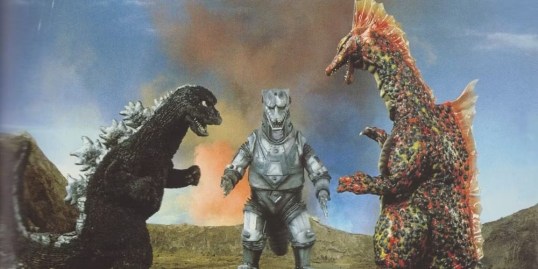
The robot version of Godzilla, Mechagodzilla made his debut in 1974’s Godzilla vs. Mechagodzilla. In that film, it was revealed that Mechagodzilla was built and controlled by a bunch of aliens who wanted to use him to subjugate humanity so that the aliens could take over the Earth. The real Godzilla put an end to those plans, not only saving the world from an alien invasion but also tossing Mechagodzilla into the ocean.
Unfortunately, it would appear that Godzilla didn’t do a good enough job taking care of his robotic counterpart because, in 1975’s Terror of Mechagodzilla, the aliens are able to resurrect Mechagodzilla and they once again sent it out to destroy humanity, starting with Japan. Working with the aliens is a mad scientist named Dr. Mafune (Akihko Hirata). Mafune’s daugther, Katsura (Tomoka Ai0), is a cyborg who has a mechanical and mental connection to Mechagodzilla. Whenever her eyes glow, Mechagodizlla does something destructive. The aliens team Mechagodzilla up with a new monster, the fearsome Titanosaurus.
Mechagodzilla and Titanosaurus work together to once again destroy Japan and it must be said that they appear to be quite capable of doing just that. Say what you will about the special effects in these films, the scene where Mechagodzilla blows up an entire city block does pack a punch. If Mechagodzilla is laser-focused on blowing stuff up, Titanosaurus just seems to be looking for a fight with someone. Titanosaurus is a very enthusiastic monster, like a previously bullied kid who has just hit a growth spurt and now can’t wait to beat up everyone on the playground. Eventually, Godzilla shows up to give Titanosaurus the fight that he’s looking for.
This film is one of the ones where Godzilla is firmly established as being humanity’s champion. The atomic beast who once represented the trauma of the nuclear attacks on Hiroshima and Nagasaki is now a friend to all humans. That said, it’s hard not to notice that it takes Godzilla a while to actually show up. He allows Mechagodzilla and Titanosaurus to blow up a lot of buildings and probably kill a lot of people before he finally puts in an appearance and orders them to stop. It’s nice that Godzilla showed up in time to save a group of children from Mechagodzilla but you have to wonder how many of those children are now orphans because Godzilla wasn’t willing to do anything while Mechagodzilla was blowing up apartment buildings.
The majority of this film centers not on Godzilla but instead on some Interpol agents who are trying to figure out what the professor and the aliens are planning on doing. (To me, it seemed pretty obvious that the aliens were planning on using a bunch of giant monsters to destroy humanity but maybe Interpol had some information that I didn’t.) The agents do eventually manage to track down the aliens and the professor. There’s some sub-James Bond style action as the agents attack the evil lair. Despite everything that Interpol does in this film, it’s obvious that Godzilla is man’s only hope.
This was the last of the original Godzilla films. After this film came out, it would be nearly ten years before the monster was revived and returned to once again being a threat to humanity as opposed to being a friend. Sadly, Terror of Mechagodzilla doesn’t feature enough giant monster action. When the monsters are onscreen and fighting, this movie is a lot of fun. Godzilla’s visible frustration with having to deal with Mechagodzilla again is very endearing. Unfortunately, the majority of the film gets bogged down with the humans searching for the bad guys and trying to figure out their extremely simple plot. In the end, the movie leaves the viewer thankful for Godzilla but also frustrated that he didn’t get more to do.
6 Shots From 6 Films is just what it says it is, 6 shots from 6 of our favorite films. As opposed to the reviews and recaps that we usually post, 6 Shots From 6 Films is all about letting the visuals do the talking.
Today, the 2nd of October, the TSL honors of the greatest of all Italian horror directors, the one and only Lucio Fulci!
6 Shots From 6 Lucio Fulci Films
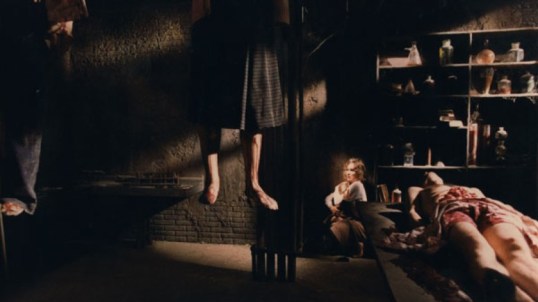
A Lizard In A Woman’s Skin (1971, dir by Lucio Fulci, DP: Luigi Kuveiller)
Zombi 2 (1979, dir. Lucio Fulci, DP: Sergio Salvati)
The Beyond (1981, dir by Lucio Fulci, DP: Sergio Salvati)
The House By The Cemetery (1981, dir by Lucio Fulci, DP: Sergio Salvati)
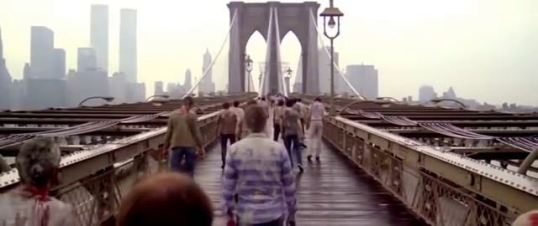
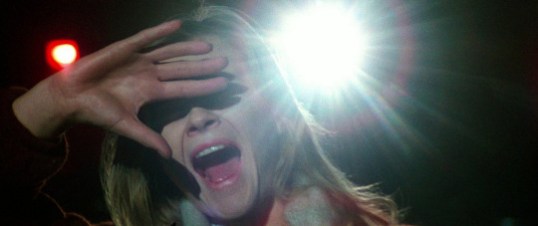
The New York Ripper (1982, dir by Lucio Fulci, DP: Luigi Kuveiller )
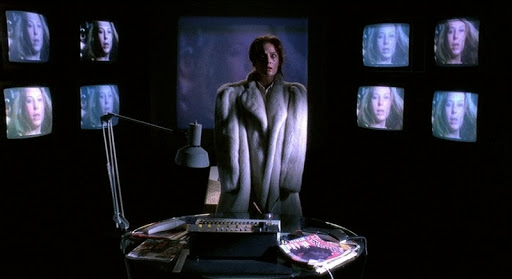
Murder Rock (1984, dir by Lucio Fulci, DP: Guiseppe Pinori)
About fifty minutes into this movie, an adorable calico kitty cat is killed for no good reason. We’re not supposed to care because the cat belonged to an annoying neighbor, the cat had a silly name (Mr. Nibbles, though considering that the cat’s a calico, it really should have been named Ms. Nibbles), and the cat was trespassing in the main character’s house. But, to tell you the truth, I’ve had it with movies that feature animals being killed for nothing more than shock value. Don’t get me wrong. I know that cat wasn’t really killed and the cat’s owner probably got paid for her services but I’ve seen so many movies with so many dead pets that it just feels lazy at this point.
As for the rest of the film, it tells the story of Emma (Katia Winter) and her daughter, Isla (Leya Catlett). Emma, a recovering alcoholic and a recent widow, has recently gotten custody of Isla. They live in a gigantic house, one that I’m not sure how Emma affords on her salary as a waitress. While Emma tries to bond with the uncommunicative Isla, strange things start to happen around the house. Doors seem to open and close on their own. The home security system keeps going off. Things keep disappearing. People keep disappearing. Isla starts to talk about “the lost ghost” who apparently lives in her closet. Isla explains that the lost ghost is “always here” and he’s always watching Emma. Along with the ghost, Emma is haunted by memories of her past and an obsessive stalker who keeps showing up at inopportune moments.
You’re Not Alone actually gets off to a good start. Haunted house films are almost always effective because everyone can relate to them. We’ve all had the experience of lying in bed and wondering if someone is wandering around outside or if the sounds are just in our imagination. You don’t even have to live in a house to have that fear. Even when you’re living in an apartment, things get creepy once you turn out the lights, Katia Winter gives a good and sympathetic performance as Emma and you’re on her side from the minute you see her having to deal with a snooty woman at the custody hearing. The early scenes of Emma trying to keep calm and do her best even while her life seems to be falling apart are the best in the film.
But You’re Not Alone loses its way as it continues. The cat dies. A visit to a church feels like it was lifted from a hundred other horror films. Emma’s best friend disappears in the closet but Emma never seems to notice her absence and Isla, who witnessed the disappearance, never mentions it to her. A bunch of flies invade the house because someone’s seen The Amityville Horror. The film commits the unpardonable sin of getting boring and a sudden twist ending can’t change that fact.
Call it the Curse of Mr. Nibbles. Kill the cat and your film falls apart.
X: The Man With The X-Ray Eyes (1963, dir by Roger Corman, DP: Floyd Crosby)
Eyes. They’re one of the most important parts of our body but they’re also frightening easy to damage. Unlike the heart or the liver or the brain, they don’t have a protective covering of skin and bone. They sit exposed and are easily injured. They can be ripped out of one’s head, which is a scary thought. As well, they tend to grow weaker over time. I love my multi-colored eyes and I think they’re one of my best features but I still spend a lot of time wishing that they weren’t quite as vulnerable as they are. I often say that I’m blind without my contacts or my glasses. That’s not quite true, of course. I can see enough to get by if I forget to put in my contacts but I still have to do a lot of squinting, enough so that most people can take one look at me and say, “You forgot to put in your contacts, didn’t you?” In my case, my eyesight has definitely gotten even worse over the past few years. I’ve been told that’s normal but it still freaks me out. I worry about waking up one day and not being able to see anything at all.
Director Lucio Fulci, a diabetic who was slowly going blind during the final years of his life, was infamous for including scenes of eyes being either pierced or gouged out in his films. The New York Ripper even featured one scene where an eye was slit in half with a razor blade. (This occurred in a close-up, no less!) In Joe D’Amato’s Beyond the Darkness, there’s a scene where a mad taxidermist replaces the eyes of his dead fiancée with glass and for me, that’s one of most disturbing elements of the film. Horror directors understand the vulnerability of the eyes and the sadness when life is extinguished from those eyes. Eyes are said to be the windows to soul and when those eyes are lifeless, it’s a reminder that a living soul is a fleeting thing.
Perhaps that’s why 1963’s X: The Man With The X-Ray Eyes is such an effective work of art. Directed by Roger Corman, the film tells the story of Dr. James Xavier (Ray Milland), a doctor who has developed eye drops that, when taken, allow one to have x-ray vision. Dr. Xavier claims that the eye drops will allow doctors to more easily diagnose their patients and certainly, he has a point there. His friend, Dr. Sam Brant (Harold J. Stone), points out that the eyes are directly connected to the brain and that using experimental eye drops on them could potentially drive a person mad. Dr. Xavier proves Dr. Brant’s point by losing his tempter and accidentally pushing him out of a window.
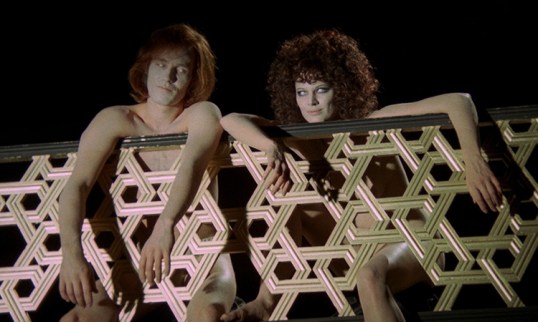
Ah, x-ray vision. It all starts out fun. Dr. Xavier is performing miracle surgeries and seeing what everyone looks like naked. (The swinging jazz party scene is a classic example of how 60s B-movies teased audiences while never quite showing everything.) But once he’s forced to go on the run from the police, Xavier finds himself making a living as a carnival psychic while still trying to refine his eyedrops. Xavier’s sleazy manager (Don Rickles) tries to turn Xavier into a faith healer but, with Xavier’s x-ray vision growing more erratic and more intense, Xavier ends up running off to Vegas with a former colleague, Dr. Diane Fairfax (Diana Van der Vils).
And again, it’s all fun and games as Xavier uses his powers to cheat at cards. But then the megalomania kicks in and, after Xavier basically announces that he’s cheating, he finds himself being chased through the desert by a police helicopter and freaking out as more and more of the universe is revealed to him. Much like a Lovecraftian protagonist who has been driven mad by the sight of the Great Old Ones, Xavier finds himself overwhelmed by the center of the universe. At a tent revival, a preacher shouts, “If thine eye offends thee, pluck it out!”
The film’s final image is a shocking one and it stays with you. (There were rumors that the film originally ended with Xavier shouting, “I can still see!” but Corman himself said that never happened.) Even without that final image, this would be one of Corman’s best films, a surprisingly intelligent and rather sad story about a man who, in trying to see what is usually hidden, was driven mad by what he discovered. Ray Milland was well-cast as Dr. Xavier and watching him go from being a somewhat stiff but good-hearted scientist to a raving madman at a revival is quite an experience, a testament to the vulnerability that all humans share. In the name of science, Xavier goes from being a respected researcher to being chased through the desert by a helicopter. The man who wanted to be able to see everything finds himself wishing to be forever blinded. Sometimes, the film suggests, it’s best not to be able to see everything around us. Sometime, the mysteries of the universe should remain mysteries and the rest of us should respect our own vulnerabilities.
Have you ever woken up and thought to yourself, “I’d love to see a movie where a youngish Jack Nicholson played a French soldier who, while searching for a mysterious woman, comes across a castle that’s inhabited by both Dick Miller and Boris Karloff?”
Of course you have! Who hasn’t?
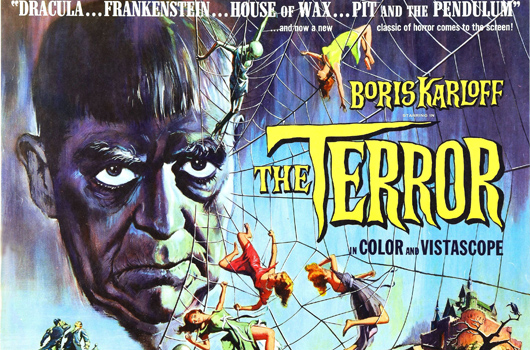
Well, fortunately, it’s YouTube to the rescue. In Roger Corman’s 1963 film The Terror, Jack Nicholson is the least believable 19th century French soldier ever. However, it’s still interesting to watch him before he became a cinematic icon. (Judging from his performance here and in Cry Baby Killer, Jack was not a natural-born actor.) Boris Karloff is, as usual, great and familiar Corman actor Dick Miller gets a much larger role than usual. Pay attention to the actress playing the mysterious woman. That’s Sandra Knight who, at the time of filming, was married to Jack Nicholson.
Reportedly, The Terror was one of those films that Corman made because he still had the sets from his much more acclaimed film version of The Raven. The script was never finished, the story was made up as filming moved alone, and no less than five directors shot different parts of this 81 minute movie. Among the directors: Roger Corman, Jack Hill, Monte Hellman, Francis Ford Coppola, and even Jack Nicholson himself! Perhaps not surprisingly, the final film is a total mess but it does have some historical value.
(In typical Corman fashion, scenes from The Terror were later used in the 1968 film, Targets.)
Both this song and this artist were unknown to me until I searched YouTube for “scary music video.” This video was one of the first that came up and I decided to go with it. It’s a video that captures the spirit of Halloween and the importance of doing it all yourself. Maddy Ellwanger not only wrote and performs the song but she also directed, produced, animated, filmed, and edited this video.
The video features Karla Partida in plenty of strange situations, whether she’s playing with an oversized brain or posing like Vampira. According to the description of the video on YouTube, Karla Partida is not only Karla The Strange but also Miss Black Lagoon.




 Through the Shattered Lens