Retro Television Review: Homicide: Life on The Street 1.7 “A Dog and Pony Show”


Welcome to Retro Television Reviews, a feature where we review some of our favorite and least favorite shows of the past!  On Sundays, I will be reviewing Homicide: Life On The Street, which aired from 1993 to 1999, on NBC!  It  can be viewed on Peacock.
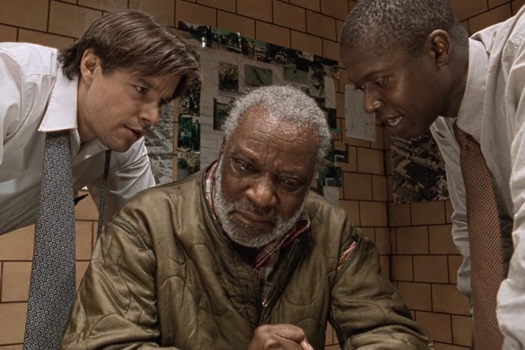
This week, everyone gets something to do!

Episode 1.7 “A Dog and Pony Show”

(Dir by Alan Taylor, originally aired on March 10th, 1993)

Still struggling to accept their failure to get the arraber to confess to the murder of Adena Watson, Bayliss and Pembleton find themselves investigating another mysterious death.  Jake, a healthy and apparently beloved member of the Baltimore police, has been found dead in a park.  No one is sure about the cause of death but Pembleton suspects that Jake may have been poisoned.  When Pembleton asks Jake’s partner (played by Nick Olcott) if Jake had any enemies, he replies, “Maybe just the Pekingese next door.”

Pembleton is determined to solve the mystery of Jake’s death.  Bayliss is less concerned with the case, largely because Jake was a dog.  Of course, as a member of a K-9 unit, Jake was also a member of the force.  Because Jake was a member of law enforcement, the Homicide unit is required to investigate his death.  Bayliss thinks that Pembleton’s interest in the case is just trying to show Bayliss up in front of Giardello but Pembleton claims that his only concer is seeing that justice is done.  Add to that, Pembleton just happens to like dogs.

And Pembleton does solve the case.  It turns out that Jake got loose and was picked up by an overworked animal control officer (Joy Ehrlich) who, back at the pound, mixed Jake up with another dog who was scheduled to be put down.  She only realized her mistake after Jake died.  In a panic, she dumped Jake’s body in the park.  Having solved Jake’s death, Pembleton and Bayliss attend his funeral.  As Jake’s partner dumps Jake’s ashes into a lake, Bayliss suddenly gets emotional.  He explains that he’s thinking about Adena.  Pembleton, for once, shows some sympathy for Bayliss.  It looks like the two are finally starting to bond and become true partners.  All it took was the death of one dog.  (I’m getting teary-eyed just writing that sentence.)

Meanwhile, Bolander continues to stress out about his relationship with Carol, which is a subplot that I find less and less interesting with each episode in which it is featured.  This time, Bolander and Munch take Carol’s teenage son, Danny (Stivi Paskoski), on a ride-along.  Bolander is disturbed at just how excited Danny gets about seeing a dead body.  When Danny says that he’d love to commit a murder and get away with it, Bolander decides that the kid is mentally disturbed.  He also lets Carol know that he thinks Danny is a bit sick in the head.  I get the feeling this relationship is not going to last much longer and that’s fine with me because Bolander’s love life (or lack thereof) is honestly the least interesting part of this show so far.

While all of that is going on, Crosetti tries to comfort the now blind Chris Thormann, who does not react well to the news that his wife (played by Edie Falco) is pregnant.  I’m not really a huge fan of the Thormann storyline, largely because I find it to be almost unbearably depressing.  But I do have to say that Jon Polito, Lee Tergesen, and Edie Falco all really gave great performance in this episode.

Howard and Felton investigate the murder of a drug dealer’s girlfriend.  This storyline was pretty typical of what you’d expect to see on a cop show.  The most interesting thing about it was the presence of Lawrence Gilliard, Jr. as an associate of the suspect.  Years later, Gilliard would play the tragic D’Angelo Barksdale on the first two seasons of The Wire, a show that feels like a direct descendant of Homicide.  (And, indeed, Richard Belzer did have a cameo as John Munch during The Wire‘s final season so the two shows do take place in the same universe, though it should be made clear that Gilliard is not playing D’Angelo in this episode.)

Finally, a retiring shift commander (played by Michael Constantine) warned Giardello that the bosses want to force out all of the veteran commanders so that they can be replaced by younger men.  As usual, Kotto shined in the role of Giardello, playing him as being the ideal boss.  In a police force where almost everyone else seems to be looking out for themselves, Giardello genuinely cares about the people working under him.

After the emotional intensity of the previous episode, A Dog and Pony Show feels a bit more like a traditional crime show.  It’s definitely an ensemble piece, with everyone getting something to do.  (Even Lewis gets to help out Felton and Howard while his usual partner, Crosetti, tends to Thormann.)  Though this episode doesn’t grab the viewer in the same way as the previous few episodes, it still gives the cast a chance to show off their strengths and it still features enough unexpected moments of mordant wit to keep things from getting too bleak.  (It’s hard not to smile at Bayliss and Pembleton bickering over dogs or at Yaphet Kotto’s delivery of the line, “I’m starting to dislike both of you.”)  This episode shows that, even with a somewhat conventional episode, Homicide could still get the job done without sacrificing its own unique identity.

Retro Television Review: Homicide: Life On The Street 1.6 “Three Men And Adena”


Welcome to Retro Television Reviews, a feature where we review some of our favorite and least favorite shows of the past!  On Sundays, I will be reviewing Homicide: Life On The Street, which aired from 1993 to 1999, on NBC!  It  can be viewed on Peacock.

This week, we finally meet the arraber.

Episode 1.6 “Three Men and Adena”

(Dir by Martin Campbell, originally aired on March 3rd, 1995)

This week’s episode opens with Tim Bayliss and Frank Pembleton preparing to interrogate Risley Tucker (Moses Gunn).  Tucker is the arraber who Bayliss believes is responsible for murdering Adena Watson.  Adena used to work for Tucker, helping him take care of his horse before her mother told Adena that she didn’t want her spending so much time with Tucker.  As Tucker himself puts it, people tend to view arrabers (men who sell fruits and vegetables from a horse-drawn carriage) as being nomads.  As Tucker himself is a recovering alcoholic who was previously charged with (but not convicted of) statutory rape, it’s understandable why Adena’s mother didn’t want her spending time alone with him.  It’s also easy to understand why Bayliss is convinced that Tucker is guilty.  Pembleton, meanwhile,  is not as convinced.

Bayliss and Pembleton have already brought Tucker down to the station three times and interrogated him.  Giardello also points out that Tucker has been interviewed a total of 10 times about the case and, if he’s not charged after his latest interrogation, he’ll have grounds for a harassment suit.  Bayliss and Pembleton have fourteen hours to interrogate Tucker one final time and try to get a confession out of him.  After fourteen hours, they have to either arrest Tucker or send him home.  Giardello says that regardless of what happens, Bayliss has to go back into the regular rotation after this interrogation.  Bayliss’s time of exclusively investigating the Watson case is coming to an end.

Tucker arrives at the station and Bayliss and Pembleton get to work, trying to manipulate him into slipping up and confessing.

Considering how much they initially disliked each other, it’s interesting to watch how smoothly Bayliss and Pembleton work together in this episode.  Bayliss takes on the role of the “bad cop,” flat out accusing Tucker of killing Adena and shoving what little evidence they have in Tucker’s face.  At first, Pembleton plays the “good cop,” asking Tucker about what it’s like to be an arraber before moving on to discussing Tucker’s alcoholism.  Tucker says that he hasn’t had a drink in sixteen months.  Even when Pembleton asks if it’s possible that he slipped up and had a drink and blacked out on the night that Adena died, Tucker insists that he hasn’t touched a drop in sixteen months.

Bayliss and Pembleton work well together but Tucker remains adamant that he did not kill Adena.  Even when Bayliss threatens to press Tucker’s face against a hot pipe, Tucker swears he didn’t kill Adena.  Even when Pembleton gets Tucker to admit that he had feelings for Adena, Tucker says he didn’t kill Adena.  Tucker defiantly demands to take a polygraph and he passes it.  Bayliss, knowing that polygraphs are inadmissible in court and are hardly reliable arbiters of the truth, tells him that he failed.  At one point, the emotionally exhausted Tucker says that he’s not even sure if he’s innocent or not anymore.  That’s as close as Tucker comes to confessing.

As the interrogation wears on, Tucker starts to fight back and it’s somewhat jolting to realize that he’s been aware of how Bayliss and Pembleton have been manipulating him from the start.  He accuses Pembleton of thinking that he’s better than other black people.  He accuses Bayliss of having a dark side, pointing out that Bayliss was prepared to torture him to get a confession to a crime that Tucker insists he didn’t do.  It’s obvious that, in both cases, Tucker has correctly read both men.  Pembleton and Bayliss react by ganging up on Tucker, bombarding him with questions.  Tucker breaks down and starts to cry but, as time runs out, he continues to insist that he didn’t kill Adena Watson.

In the end, Tucker ends up sitting in the break room, watching television and waiting for someone to take him home.  Bayliss packs up all of the evidence in the Watson case, knowing that he failed to get the confession that he needed.  Despite not getting the confession, Bayliss has finally won Pembleton’s respect.  Pembleton tells Bayliss that he now believes Tucker is guilty.  Bayliss admits that he’s no longer as sure as he once was.

It says something about the strength of this episode that I’m not fully convinced of Tucker’s guilt as well.  When the episode started, I was sure that the arraber was guilty.  By the time it ended, my feelings were a bit more mixed.  For all of the emotional turmoil that Tucker went through over the course of the interrogation, he remained adamant that he didn’t kill Adena Watson.  Tucker confessed to being an alcoholic.  He confessed to having gotten into fights in the past.  He confessed to having pedophiliac feelings towards Adena.  But the only time he even slightley wavered in his claim that he didn’t kill Adena was when he was so exhausted that he barely knew what he was saying.  As well, the evidence against him was almost entirely circumstantial.  Evidence was found that Adena had been in Tucker’s barn but there was no way to prove that she was there the night she died.  Tucker’s barn did mysteriously burn down after Adena’s murder but there was no way to prove that Tucker burned it down to hide evidence.  I suspect Risley Tucker probably was guilty.  But if I was on a jury, I’d probably have to say that, without a confession, there was too much reasonable doubt.

By the end of the interrogation, all three men are exhausted.  The viewer is exhausted too!  This is an intense episode, one that plays out like a particularly kinetic, three-person play.  Kyle Secor and Andre Braugher continue to prove themselves to be a brilliant team but, in this episode, they’re equally matched by Moses Gunn, who keeps you guessing as far as Risley Tucker’s guilt or innocence is concerned.  Gunn, who died a few months after this episode aired, gives a performance that leaves you feeling as conflicted about Tucker as the two detectives.  If Tucker is guilty, then he’s a soulless monster who has gotten away with murder.  If Tucker is innocent, then we’ve just spent 50 minutes watching an elderly, recovering alcoholic go through a truly Hellish experience.  As the episode ends, the viewer is aware that all three of the men will be changed forever as a result of the 14 hours they spent in the box.

This was an outstanding episode, one that ended on a note of sadness.  Adena Watson’s killer will never be caught.  If Tucker did it, he got away with it.  If Tucker didn’t do it, Bayliss and Pembleton’s obsessive pursuit of him means that the real killer is probably already far away from Baltimore.  Not every case gets solved and not everyone gets justice.  To quote Casino’s Ace Rothstein, “And that’s that.”


Lisa Marie’s Week In Television: 11/3/24 — 11/9/24


2024 U.S. Presidential Election Coverage (Tuesday and Wednesday)

On Tuesday, I swore to myself that I was going to vote and then we were going to go up to the lake and my plan was to basically stay off the grid until Friday.  I wasn’t even going to think about the election.  That did not last.  As much as I tried to avoid the news, I still saw a few updates on twitter and soon, I was switching back and forth from Fox to CNN to MSNBC and then to all the other news stations.

To be honest, I kind of suspected Donald Trump was going to win after Kamala Harris picked Tim Walz for her vice president.  The week leading up the election, however, I started to think that Harris was probably going to win.  I started remembering how 2022 seemed like it was going to be  a big year for Republicans, just for the Red Wave to fizzle on election night.  I thought about how polls have never accurately reflected either Trump’s support or how Dobbs turned a lot of people into one-issue voters.  I thought Harris would sweep Pennsylvania, Michigan, and Wisconsin and win the election.  It turns out that I was wrong about most of that!

This was the third presidential election in a row where I swore to myself that I wouldn’t think about it after I voted, just to later find myself then obsessively watching as the results came in.

American Sports Story: Aaron Hernandez (FX, Tuesday Night)

The ninth episode focused on how the women who knew Aaron Hernandez dealt with him being arrest for murder.  And to that, I can only say, “Who cares?”  After nine hours of this show, the only lesson that I’ve learned is that Aaron Hernandez was a tremendous dumbass and the same can be said of the majority of the people around him.

I was super-excited because I thought this week’s episode was the series’ finale.  It turns out that there’s one more episode to go.  Next week, this show will finally wrap up and I won’t have to complain about it anymore.

Bar Rescue (Paramount, Weekday Mornings)

On Tuesday, I watched an episode in which Jon Taffer turned a failing Irish bar into a failing western saloon.  It wasn’t as much fun as the Pirate Bar episode.

Baywatch Nights (YouTube)

I wrote about Baywatch Nights here!

Check it Out! (Tubi)

My review of this week’s episode of Check It Out! will be posted in about 30 minutes.

CHiPs (Freevee)

I wrote about CHiPs here!

Degrassi Junior High (YouTube)

I wrote about Degrassi Junior High here!

Dragnet (YouTube)

On Tuesday, I took a break from the election coverage and rewatched my two favorite episodes of Dragnet, the talk show episode and the night school episode.

Fantasy Island (DVR)

I wrote about Fantasy Island here!

Friday the 13th: The Series (YouTube)

You can read my review here!

Good Times (Get TV, Weekday Afternoons)

I watched two episodes of this 70s sitcom on Monday afternoon.  Carl, a grumpy old man, discovered that he had cancer and he left Chicago for Arizona so that he could deal with it.  The most memorable moment of the two episodes came when Carl told Florida that he felt they should break up.  “Oh my God!” someone in the studio audience shouted.

Hell’s Kitchen (Fox, Thursday Night)

Just as happened last week, the Blue Team triumphed and the Red Team crashed and burned.  I’m enjoying this season.  I like the fact that they’re all strong chefs.  At this point, I feel like anyone could win.

Highway to Heaven (Tubi)

I wrote about Highway to Heaven here!

Homicide: Life on the Street (Peacock)

I wrote about Homicide here!

King of the Hill (FXX, Weekday Morning)

Before I left to vote on Tuesday, I watched four episodes of King of the Hill.  What a great show, that was.  To be honest, the fact that King of the Hill was canceled but Family Guy is still in production is all the evidence you need about the decline of American culture.  As for the episodes I watched, my favorite was the one where Luanne became a boxer and George Foreman appeared as himself.  “Novelty grill!?”

The Love Boat (Paramount+)

I watched The Love Boat on Tuesday night, while sitting outside on the deck of my family’s lakehouse.  That’s the best way to watch anything!  I wrote about The Love Boat here.

Malibu, CA (YouTube)

I wrote about Malibu, CA here!

The Megyn Kelly Show (YouTube)

On Friday, I watched the post-election episode of the Megyn Kelly Show.  Whether you love her, hate her, or if you’re indifferent to her (as I often am), it was hard not to agree with her post-mortem on the election and the Harris campaign.

Miami Vice (Prime)

I wrote about Miami Vice here!

Monsters (YouTube)

I wrote about Monsters here!

St. Elsewhere (Hulu)

You can read my review here!

TV 2000 (Night Flight Plus)

I watched an episode of this old 80s music video program on Friday night.  The music was good.

Welcome Back, Kotter (Tubi)

I can’t believe I paid money to watch this episode.  You can read my review here.

Retro Television Review: Homicide: Life On The Street 1.5 “A Shot In The Dark”


Welcome to Retro Television Reviews, a feature where we review some of our favorite and least favorite shows of the past!  On Sundays, I will be reviewing Homicide: Life On The Street, which aired from 1993 to 1999, on NBC!  It  can be viewed on Peacock.

This week, the murders continue and two detectives continue to obsess.

Episode 1.5 “A Shot In The Dark”

(Dir by Bruce Paltrow, originally aired on February 24th, 1993)

As I watched this week’s episode of Homicide, it occurred to me that I really don’t care about Stanley Bolander’s relationship with Dr. Carol Blythe.

Seriously, I really did try to give this storyline a chance.  Bolander is played by the great character actor Ned Beatty.  Dr.  Blythe is played by Wendy Hughes.  Both Beatty and Hughes are no longer with us but they were both very good actors and I’m always in favor of giving good actors a plotline.  But, my God — Bolander is so whiny!  I mean, I get it.  He’s newly divorced and he’s unsure of himself and he’s a lot more comfortable investigating death than actually living life.  However, Dr. Blythe obviously likes him and Bolander had a fairly good date with her during the previous episode so why did he spend this episode afraid to talk to her on the phone?  During this episode, Bolander and Munch were investigating the murder of a drug dealer.  The only witness was a high-class prostitute who ended up hitting on Bolander, largely because she wanted him to buy her some food.  It was an interesting-enough case but instead of focusing on that, the whole thing was Munch telling Bolander to call Blythe and Bolander getting mad as a result.  It got old.

While Bolander whined about his relationship issues, Lewis and Crosetti continued to investigate the shooting of Officer Thormann.  Crosetti was convinced that Thormann had been shot by Alfred Smith (Mojo Gentry), largely because a man named Charles Flavin (Larry Hull) fingered Smith as being the shooter.  Lewis thought that Flavin was a more likely suspect, especially after Flavin failed a lie detector.  In the end, it was not superior police work that led to the arrest of Charles Flavin but instead his girlfriend telling Crosetti and Lewis that Flavin shot Thormann because he had a headache.  When confronted, Flavin immediately confessed and then started complaining about his migraine.

(As for Officer Thormann, he survives being shot in the head but he is now blind.)

Everyone is happy that Thormann’s shooter has been arrested but Crosetti finds himself wracked with guilt and self-doubt over the fact that he nearly arrested the wrong man.  In a wonderfully-acted moment, Crosetti tells Lewis that Giardello was right.  Crosetti was too close to Thormann to work the case.

Speaking of getting too involved in a case, Bayliss continues to obsess over the Adena Watson case.  After the incompetent Captain Barnfather (Clayton LeBouef) goes to a community meeting and reveals that a pipe was used to kill Adeena (and, in the process, ruins Bayliss’s plan to interrogate the man who he suspects is the murderer), Bayliss calls Barnfather and calls him a — cover your ears, if you’re young — “butthead.”  Barnfather is so offended that he comes to the station to demand that Bayliss be taken off the case.  Giardello tells Bayliss that he can either apologize or he can find another job.  Giardello also acknowledges that Barnfather’s an idiot and Bayliss has every reason to be upset.  Bayliss, who has a cold and is running a fever, apologizes and then tells Giardello that he’s willing to step down as primary and let Pembleton have the case.  Giardello, who really is the perfect boss, tells Bayliss to go home and get some sleep.

While Bayliss is losing his temper, Felton and Pembleton are investigating a man who lived in the neighborhood where Adeena’s body was found.  Felton’s theory is that the man killed Adeena and then kept her body in the trunk of his car before dumping her in the back yard where she was found.  The man’s car has subsequently been repossessed and Pembleton and Felton spend a night searching for the car on various impound lots.  When they finally find the car, they also find no evidence linking it to the Watson murder.  The focus of these scenes was less on the search for the car and more on listening to Pembleton and Felton bicker.  The two men sincerely dislike each other and Homicide deserves a lot of credit for acknowledging that working with someone is not the same thing as respecting them.  Pembleton views Felton as being a racist.  Felton views Pembleton as being a snob.  As they look for the car, they argue about everything, from the renaming of a street after Martin Luther King to Felton’s belief that Pembleton takes everything too personally.  Their argument is fascinating to listen to, largely because of the obvious disdain that each man has for the other.  Neither man is portrayed as having a monopoly on the truth.  Pembleton may be right about Felton’s prejudices but Felton is equally correct when he suggests that Pembleon is more concerned with showing up Bayliss than with investigating the case.  It’s the type of thing that you would never hear on television today.

In the end, the neighbor and his car prove to be a dead end.  But lab results come in that suggest that Bayliss’s suspicion that Adeena was killed by the local arabber may be correct.  While the rest of the squad celebrates the arrest of Charles Flavin, Pembleton and Bayliss prepare to bring in the arabber.

(According to Wikipedia, an arabber is a street vendor who sells fruits and vegetables from a horse-drawn cart.  Apparently, they’re a Northeastern thing and specifically a Baltimore thing.  Having grown up in the Southwest, I have to admit that I had never even heard the term before watching Homicide.)

All of the Bolander nonsense aside, this was a good episode that took a look at the mental strain involved in being a homicide detective.  Crosetti allowed himself to become so obsessed that he nearly arrested the wrong guy.  Bayliss allowed himself to become so obsessed that he nearly lost his job as a result.  Interestingly enough, Thormann’s shooter is captured because his girlfriend turned him in and not because of any superior policework.  Meanwhile, it’s easy to laugh at Pembleton and Felton spending an entire day chasing down a false lead but, in doing so, they eliminate the neighbor as a viable suspect and help to make the case against the arabber even stronger.  In the end, it’s a thankless job but this episode makes the viewer glad that someone’s doing it.

Next week, we finally meet the arabber!

Retro Television Review: Homicide: Life on the Street 1.4 “Son of a Gun”


Welcome to Retro Television Reviews, a feature where we review some of our favorite and least favorite shows of the past!  On Sundays, I will be reviewing Homicide: Life On The Street, which aired from 1993 to 1999, on NBC!  It  can be viewed on Peacock.

This week, things get emotional on Homicide!

Episode 1.4 “Son of a Gun”

(Dir by Nick Gomez, originally aired on February 10th, 1993)

Officer Chris Thormann (Lee Tergesen), a patrol officer who is friendly with the Homicide detectives and who is a bit of protegee to Steve Crosetti, has been shot.  While Thormann lies in surgery with a bullet in his brain, his wife (Edie Falco, in one of her first television appearances) waits for news from the doctors and tries to avoid the members of the callous press.  Crosetti demands to be put in charge of the investigation into Thormann’s shooting and when Giardello points out, quite correctly, that Crosetti is too close to the victim to be objective, Crosetti strips down to his boxers and shows Giardello the scars left behind by every time that he’s been shot.

It’s an odd scene, one that seems to come out of nowhere in an episode that, up until that moment, had been pretty serious.  Kotto does a great job of capturing Giardello’s horror as Crosetti drops his pants.  It’s obvious that this is not the first time that Crosetti has shown off his scars to get assigned to a certain case.  It’s a scene that shouldn’t work but it does work because not only is it well-acted by Yaphet Kotto and Jon Polito but it also captures the insanity of being a homicide detective.  Just four episodes in, Homicide has already shown that it can be a funny show but the humor is rooted in the darkest corners of the human experience.  To survive as a homicide detective, you have to harden yourself to the point of being callous and you have to be able to see the humor in just about everything.  Crosetti, with his constant analysis of the Lincoln assassination and his inventory of bullet scars, may seem crazy but actually, he’s doing what he has to do to survive.

The episode ends with Thormann alive but in a coma and possibly brain-damaged.  And it ends with the shooter still at large.  Crosetti has received an anonymous tip from someone saying that the killer was a man named Alfred Smith.  But who knows if that’s true.

The Adeena Watson case remains open, as well.  Bayliss and Pembleton are still struggling to figure out how to work together.  Bayliss is too obsessed with the case.  Pembleton is too determined to show up the new guy.  A raid on the apartment where it’s believed Adeena was murdered turns up nothing but more evidence of human misery.  That said, a cheerful guy (played by Paul Schulze) who claims to be an agent for hitmen does give up several of his clients, allowing Howard and Felton to close even more cases.  Even Calpurnia Church (Mary Jefferson), the “black widow” from the pilot, is finally arrested due to the agent’s testimony.

Finally, Stanley Bolander goes on his first date with Dr. Blythe.  Before going on his date, he meets his neighbor, Larry Molera (Luis Guzman).  Larry is a carpenter.  He’s built a coffin that is currently sitting in living room.  Bolander’s date goes well but the nervous Bolander turns down Blythe’s offer to go back to her place with her.  Bolander returns to his apartment, where he discovers that Larry is dead and lying in his coffin.  (Much, who was called when Larry’s body was discovered, is shocked to see Bolander.  Bolander is not happy that Much now knows where he lives.)  Larry’s death inspires Boland to return to Dr. Blythe’s apartment.

This was an emotional episode.  Thormann is clinging to his life while his wife and Crosetti wait for him to wake up.  The recently divorced Bolander finally found the courage to go out with Dr. Blythe.  Bayliss appears to be so obsessed with the Adeena Watson case that he’s struggling to think straight.  This episode takes a look at the mental strain that comes from dealing with crime and death on a daily basis.  It’s well-done, even if it’s not quite as memorable as Night of the Dead Living.  (The stuff with Larry and his coffin was a bit too self-consciously quirky to be as emotionally devastating as the show obviously meant for it to be.)  If I took anything away from this episode, it’s that fate is random.  Officer Thormann has been shot in the head but he survived hours of surgery.  Larry seemed to be healthy but he suddenly died while Bolander was on his date.  Adeena’s killer may never be caught while Calpurnia Church was caught because of an initially unrelated investigation.  Some of the detectives are skilled.  Some of them are not.  But, in the end, they’re all at the random mercy of fate.

Lisa Marie’s Week In Television: 10/20/24 — 10/26/24


Wow, the story of Aaron Hernandez gets less and less interesting with each week.  American Sports Story got off to a strong start but, this week, I found myself watching the latest episode and wondering why anyone should care about Aaron and his problems.  Seriously,  I get that Aaron Hernandez was abused as a child.  I get that he struggled as a gay man in a hypermasculine, homophobic industry.  I get that he didn’t grow up privileged.  I’ll even agree with the show’s criticisms of the NFL.  But in the end, who cares?  As portrayed on this show, Aaron Hernandez comes across as being an idiot.  Beyond the fact that he played professional football, there’s nothing particularly interesting about Hernandez or his crimes.  He’s not a compelling character at all.

I was far more entertained by Hell’s Kitchen this week.  Gordon Ramsay and his terrified chefs are compelling characters.  Ramsay was in a surprisingly supportive mood this week.  That’s fine with me.  I like it when Chef Ramsay’s nice.  No one went home this week.  Yay!

Let’s see, what else did I watch this week?  I watched that old episode of Dragnet where Friday and Gannon went on the talk show.  I actually watched that episode several times.  It amused me.  Plus, the episode’s debate was a lot more interesting than any of the real debates that are currently going on.

I watched and reviewed Miami Vice, The Love Boat, and Homicide.  I watched a Halloween episode of Friday the 13th.  I watched and shared several episodes of One Step Beyond.  And, finally, I watched an episode of Dr. Phil where a man said his wife had run off with a cult.

And that’s it!  Most of my attention was devoted to horror films this week.

Retro Television Review: Homicide: Life on Street 1.3 “Night of the Dead Living”


Welcome to Retro Television Reviews, a feature where we review some of our favorite and least favorite shows of the past!  On Sundays, I will be reviewing Homicide: Life On The Street, which aired from 1993 to 1999, on NBC!  It  can be viewed on Peacock.

This week, the Homicide Squad works the night shift on the hottest night of the year.

Episode 1.3 “Night of the Dead Living”

(Dir by Michael Lehmann, originally aired on March 31st, 1993)

On the hottest night of the year, Giardello’s homicide squad works the night shift.  Everyone comes in grumpy.  Munch has just broken up with his girlfriend.  Bolander is trying to work up the courage to call Dr. Blythe.  Bayliss is still obsessing on the Adeena Watson case and he and Pembleton are still trying to figure out how to work together.  Kay’s sister is having trouble at home.  Felton’s wife hates him.  Crosetti worries about his teenage daughter and her boyfriend.  Giardello tries to figure out why the air conditioner is only blowing out hot air on what Lewis claims is the hottest night in history.

Despite the heat and the statistics that show that most homicide occur at night, no calls come in.  Bayliss is convinced he’s cracked the Watson case when he discovers that the fingerprints on Adeena’s library book belongs to someone named James.   He sends Thorson out to arrest James.  James turns out to be a seventh grader who thinks he’s being arrested by not paying a library fine.  (James did check out the book, when he was in the fifth grade.)

A drunk man dressed as Santa Claus is brought in and later falls through the ceiling when he attempts to escape custody.  A baby is found in the station’s basement but it turns out to the cleaning lady’s baby.  She brings him to work with her to protect him from the rats that live in their apartment building.  Eventually, Bolander works up the courage to call Blythe and Bayliss and Pembleton figure out that Adeena’s body was found where it was because her killer brought the body down a fire escape.  At the end of the shift, Giardello assembles his detectives on the roof and joyfully sprays them with the water hose.

It’s an episode that feels like a play, taking place in one location and featuring a lot of monologuing.  Each member of the squad gets a their chance in the spotlight, with the episode revealing that every one of them is a bit more complex than they initially seem.  Even Munch, the misanthrope, is shown to light a candle in memory of “all those who have been killed.”  It’s one of those episodes that makes you understand why Homicide is considered to be classic while also showing you why it struggled in the ratings.  In this episode, Homicide revealed itself to be not a cop show but instead a show about people who happened to be cops.  Most shows about detectives end with an arrest.  This episode ends with Giardello showing his love for the people who work for him.  After spending an hour with everyone sweating and complaining, it’s nice to see them happy on the roof of the station house.  Yaphet Kotto’s joy in the final scene is a wonder to behold.  And yet, it’s easy to imagine how confused audiences, whose expectations had been set by more traditional crime show, would have been.

This episode was meant to be the third episode of the series.  NBC decided that it worked better as the finale of the first season and instead made it the ninth episode.  Peacock has this episode placed where it originally belonged and, with this review, that’s what I’m going with as well.


Lisa Marie’s Week In Television: 10/13/24 — 10/19/24


I watched a lot of  horror movies this week but I didn’t watch much television.  Starting on November 1st, I’m going to have a lot of shows to get caught up on.

I caught the latest installment of American Sports Story: Aaron Hernandez.  Like a lot of Ryan Murphy’s recent miniseries, American Sports Story started out strong but the last few episodes have felt like padding.  It’s not that the episodes aren’t contributing to the story.  This week, we watched as Aaron committed what was apparently his first murder and as he started to show signs of CTE.  But it’s still hard not to feel as if each episode is basically 20 minutes worth of story stretched out to 50 minutes.  We’re halfway through this series and it has yet to really give us a reason why we should care about Aaron Hernandez.  He just comes across as being an idiot, regardless of his athletic skills, his terrible childhood, or his status as a self-hating gay man trying to survive in a homophobic culture.  He doesn’t seem to be worth all of this trouble.

I watched Hell’s Kitchen.  The chefs continue to compete at a high level and they continue to have disastrous dinner services.  Hell’s Kitchen is one of the few reality shows not to have massively changed its format over the past four years.  The producers know there’s no need to fix something that’s already working.  If only the producers of Big Brother and Survivor understood that!

I watched an old episode of Night Flight on Friday.  It featured Elvis snarling at the camera.

I watched the episode of Dr. Phil in which Phil and cult expert Rick Ross confronted a guy who said he wasn’t a cult leader despite the fact that he clearly was.  There’s a lot negative things that can be said about Dr. Phil’s show but the episodes where he exposed cults and their leaders were always entertaining and worth watching.

I watched and reviewed Homicide, Miami Vice, and The Love Boat!  I also watched and shared several episodes of One Step Beyond.

And that’s it!

Retro Television Review: Homicide: Life on the Street 1.2 “Ghost of a Chance”


Welcome to Retro Television Reviews, a feature where we review some of our favorite and least favorite shows of the past!  On Sundays, I will be reviewing Homicide: Life On The Street, which aired from 1993 to 1999, on NBC!  It  can be viewed on Peacock.

This week, the search for Adeena Watson’s murderer begins.

Episode 1.2 “Ghost of a Chance”

(Dir by Martin Campbell, originally aired on February 3rd, 1993)

There’s been a murder in Baltimore.  That, in itself, is not news.  The pilot firmly established that murder is a fact of life in Baltimore.  But, the victim of this crime is an 11 year-old girl named Adeena Watson, who left her home to go to the library and who never returned.  The press is covering every detail.  The police brass want an arrest and they want an arrest quickly.  And the primary detective on the case is rookie Tim Bayliss, who has never even worked a murder case on his own before.  Giardello refuses to replace Bayliss but he also makes it clear that he needs Bayliss to bring him something.

As for Bayliss, he spends most of this episode struggling.  Not only does he not have the respect of his fellow detective but he also, as a rookie, doesn’t even have a desk until Giardello, in a fit of anger, knocks everything off an unoccupied desk and awards it to Bayliss.  (So, was that desk just sitting there the whole time?  I thought they didn’t have any available desks.)  Because this crime is what is known as a “red ball,” (i.e., a murder that has attracted the attention of the media and the public), every detective is looking for Adeena’s murderer.  While Bayliss obsesses on who Adeena was before she was killed, the rest of the squad does the practical things, like talking to neighbors and bringing in all of the city’s sex offenders for interrogation.

My heart broke for Bayliss while watching this episode.  Kyle Secor did a good job of capturing both Bayliss’s outrage over the crime and his fear of failing to solve his first case as a primary.  While Bayliss stared at Adeena’s body in the alley, Munch, Lewis, and Crosetti debated sports.  And while their attitude may have seemed callous, this episode established that disconnecting is the only way to handle working Homicide.  Bayliss, having not learned how to disconnect, grows more and more obsessed with Adeena.  I cheered a little when Bayliss finally stood up for himself and even won the grudging respect of Frank Pembleton.  That said, the change in Bayliss happened almost too quickly to be credible.  Apparently, all it took was for Giardello to give him a desk for Bayliss to go from being meek and overwhelmed to being a confident and take-charge detective.

While Bayliss searched for Adeena’s killer, Much and Bolander dealt with a murder that happened in a wealthy neighborhood.  The killer (Gwen Verdon) was a wife who snapped after 60 years of marriage.  As she explained to Bolander and Munch, she and her husband had earlier promised each other that they wouldn’t get a divorce until the children died.  Bolander has a crush on the coroner, Dr. Blythe (Wendy Hughes), but he’s worried about getting back in the dating game after his own divorce.  When Munch asks Bolander how old he is, Bolander replies, “48.”  Ned Beatty was a great actor and I’ve never seen a bad Ned Beatty performance.  That said, it’s also hard for me to think of any film where he looked a day under 50.

Meanwhile, Kay tries to get a confession from a guy who is about to go on trial for murder.  Felton laughs when Kay says that she was visited by the ghost of the guy’s victim.  However, Felton makes up for being a jerk by helping Kay find the murder weapon.  This whole subplot was odd to me, largely because Kay really doesn’t come across as the type to believe in ghosts.  But whatever works, I guess!  Melissa Leo and Daniel Baldwin did a good job in this episode, selling a storyline that had the potential to be a little bit too cute for its own good.

As the episode ended, the killer of Adeena Watson had yet to be captured.  While the other detective drank at a wharf bar, Bayliss went to Adeena’s memorial service and stared at her coffin, haunted.  It was a powerful moment but one that left the viewer worried about Bayliss’s sanity.  Earlier in this episode, Pembleton said that a murder that goes 72 hours without being solved will never be solved.  Bayliss is running out of time.


Lisa Marie’s Week In Television: 10/6/24 — 10/12/24


Here’s my thoughts on what I watched this week.

Abbott Elementary (Wednesday Night, ABC)

Abbott‘s back.  Jeanine and Gregory are dating and they’re a cute couple.  That said, I can’t help but remember how The Office kind of started to become less interesting once Pam and Jim officially became a couple.  Single, neurotic people are always funnier than stable people in love.

It’ll be interesting to see how this season goes.  Last season, I got annoyed with Jeanine working for the district and the show itself occasionally got a bit heavy-handed in a way that it hadn’t during the previous seasons.  At the time, I choose to believe that season’s weaker moments were due to the season being shortened by all the strikes that were going on.  I’m hoping this new season will prove me correct.

Ava continues to be the best character on the show.

Accused (Tuesday Night, FOX)

After an incredibly uneven first season, Fox’s crime anthology show is back for a second season.  The first episode featured a psychic accused and on trial.  Felicity Huffman (who hasn’t really been seen much ever since she was implicated in the so-called Varsity Blues scandal) and William H. Macy provided some star power but the overall results were still pretty dull. I’m not a huge fan of anthology shows in general.  They always seem to be trying a bit too hard.

American Sports Story: Aaron Herndanez (Tuesday, FX)

This week, Aaron started to find fame as a pro football player with the New England Patriots, while continuing to deal with stress by hanging out with lowlifes and criminals.  While struggling to maintain the squeaky clean image that the NFL demanded from its players, Hernandez also beat up his abusive stepfather.  Much as with last week, this episode was well-done but it still feels as if the show is dragging out the story a bit too much.  This episode was about 20 minutes worth of story stretched out over 50 minutes.  Needless to say, it did start to feel a bit repetitive after a bit.  The attempt to use Aaron Hernandez’s stupidity as a way to comment on American society continues to feel a bit half-baked.

Dr. Phil (Pluto TV)

“Shut up!” Kaye yelled, when confronted about her Nigerian boyfriend, who she has never actually met despite selling her house and sending him the money.  I know Kaye was embarrassed but yelling shut up isn’t going to get her money back.

Hell’s Kitchen (Thursday Night, FOX)

One chef left the show to go to the hospital.  Another hurt his back and voluntarily withdrew from the competition.  The Blue Team had a terrible dinner service and a Chef Ramsay sent another chef home.  The Red Team is getting pretty cocky, which I’m going to assume means that they’re going to fall apart next episode.  Getting cocky is always the worst thing that any chef can do on Hell’s Kitchen.  Hell’s Kitchen remains one of the few reality shows to remain as entertaining today as when it first aired.  The show has been smart enough to stick to its formula and not change things up just to satisfy whatever the current cultural trend may be.

Homicide: Life On The Streets (Peacock)

I wrote about Homicide here!

Law & Order (Thursday Night, NBC)

This week’s episode saw SVU‘s Mariska Hargitay making a guest appearance on Law & Order and it really does show just how much things have changed as far as this franchise is concerned.  At one time, SVU was kind of like Law & Order‘s sordid and little-acknowledged bastard cousin and it was a big deal if anyone from L&O lowered themselves to make an appearance on SVU.  Now, things are reversed.  Law & Order is still struggling to find its voice in  the 2020s and it’s SVU that’s providing some star power to its struggling cousin.

On another note, I’m surprised that there’s any tech gurus left in New York as they seem to be the number one victim of choice on Law & Order.  If they’re not getting murdered, they’re going to jail.

I continue to miss Jack McCoy.

The Love Boat (Paramount Plus)

I wrote about The Love Boat here!

Miami Vice (Amazon Prime)

I wrote about Miami Vice here!

Night Flight (Night Flight Plus)

On Friday, I watched an episode from 1988.  The first half of the episode featured music videos, including X’s Devil Doll.  The second half took a look at “upcoming” films, including one in which Arnold Schwarzenegger and Jim Belushi teamed up to fight crime.  No, it wasn’t The Principal.

One Step Beyond (YouTube)

This week, I have continued to watch and share episodes of this old anthology show.  I’ve been having a lot of fun watching this show.