For years, banker Jack Dundee (Robin Williams) had been haunted by a pass that he dropped in high school. The pass was perfectly thrown by quarterback Reno Hightower (Kurt Russell) but Jack couldn’t bring it in and, as a result, Taft High lost to its rival, Bakersfield. Adding to Jack’s humiliation is that he now works for The Colonel (Donald Moffat), a confirmed Bakersfield fan who also happens to be Jack’s father-in-law. When Jack visits a “massage therapist” (Margaret Whitton) and tells her about his problems, she suggests that he needs to replay the game. Getting everyone interested in replaying the game is not easy. No one wants to be humiliated a second time and Reno, who now fixes vans for a living, fears the he’s lost his edge. Jack dresses up in the Bakersfield mascot’s uniform and vandalizes the town. Finally, everyone is ready for the game. Now, it’s a matter of town pride.
The Best of Times is a likable comedy about getting older and wishing you could have just one more chance to be young again and to have your entire future ahead of you. Jack is haunted by that one dropped pass, feeling that it has cast a cloud over his entire life. Reno is still a town hero but he’s struggling financially and in debt to Jack’s bank. Replaying the game isn’t going to fix their lives but it is going to give them one last chance to relive their former glory and maybe an opportunity to learn that, even if they are getting older, they’re still living in the best of times. The world that these two men live in is skillfully drawn and believable, with character actors like Moffat, M. Emmet Walsh, R.G. Armstrong, and Dub Taylor adding to the local color. Jack and Reno’s wives are played by Holly Palance and Pamela Reed and they are also strong and well-developed characters. Finally, Robin Williams and Kurt Russell are a strong comedic team. Russell is perfectly cast as the aging jock and Williams gives one of his more restrained performances as Jack, allowing us to see the sadness behind Jack’s smile.
The stakes aren’t particularly high in The Best Of Times. It’s just a football game between some middle-aged men looking to regain their youth. But the story sticks with you.
After someone is obviously meant to be Henry Kissinger (played by Ron Moody) is assassinated when he loses his diary and extends the wrong greeting to a welcoming party in the Middle East, someone claiming to be a direct descendant of the infamous Prof. Moriarty sends a letter to the U.S. President (Joss Ackland) taking responsibility and claiming that it’s the first step in a plan to control the world.
Who better to stop the descendant of Moriarty than the descendant of Moriarty’s greatest enemy? Arthur Sherlock Holmes (John Cleese) operates out of Baker Street with Dr. Watson (Arthur Lowe), who is bionic, and their housekeeper, Miss Hudson (Connie Booth). Holmes solution to bringing out Moriarty is to host a gathering of the world’s greatest detectives and to dare Moriarty to try to take them out with one fell swoop. Soon, everyone from Sam Spade to Columbo to McCloud is showing up at Baker Street.
This is a joke-a-minute comedy. The jokes that work are funny but, unfortunately, there aren’t many of them. Some bits, like Joss Ackland’s impersonation of Gerald Ford, start off well and then go on for too long. Other bits, like the famous TV detectives showing up at Baker Street, have potential but fail due to poor execution. Unfortunately, much of the humor is just not that clever to begin with, which is not something that anyone would expect from a script co-written by John Cleese. As an actor, John Cleese is funny but underused, playing Sherlock Holmes as being an even denser version of Basil Fawlty. Arthur Lowe’s comedic befuddlement is consistently amusing but I wish the script has done more with the idea of him being bionic. Connie Booth is both funny and sexy and the best reason to watch this misfire.
A few days ago, Arleigh shared the theme song from 1976’s The Omen as Monday’s horror song of the day. As I sat there and listened to Jerry Goldsmith’s award-winning hymn to Satan, it occurred to me that I happen to have all five of the Omen films sitting in my movie collection. Seeing as how this is Halloween and how the world seems to be getting closer to ending with each passing day, I decided that this would be the perfect time to rewatch the entire franchise and consider whether or not The Omen films are truly as scary as a lot of people seem to think.
So, that’s what I did.
How did things turn out?
Well, in the long history of sequels and remakes, The Omen franchise is one of the more uneven collections. This is one of those franchises where things tend to get less impressive with each subsequent entry. However, 38 years after its initial release, the first Omen remains effective and, in its way, genuinely scary.
If you’re a horror fan, you probably know the general plot of The Omen regardless of whether you’ve actually watched it or not. It’s one of those films that has been so frequently imitated that it’s almost possible to watch it by osmosis.
The film opens in Rome with diplomat Robert Thorn (Gregory Peck) being rushed to the hospital where his wife, Kathy (Lee Remick), has just given birth. A priest (Martin Benson) tells him that his son died shortly after being born but that he can always just go home with an orphaned newborn that he just happens to have handy. Robert agrees and decides not to tell his wife the truth about the child. Robert and Kathy raise the boy and they name him Damien. Four years later, the politically ambitious Robert is named as Ambassador to the Court of St. James.
The Thorns move to London and soon, odd things start to happen. Damien (now played by Harvey Spencer Stephens) is a quiet boy with a piercing stare who throws a fit whenever he’s taken inside of a church. When Kathy takes Damien to the zoo, they’re attacked by angry baboons. A large Rottweiler mysteriously appears on the grounds of the Ambassador’s estate. A mysterious and sinister nanny (Billie Whitelaw) shows up and explains that she’s been sent by an “agency.” A crazed priest (Patrick Troughton) starts to stalk the Ambassador, demanding a chance to speak with him and insisting that Damien’s mother was actually a jackal.
Even more mysteriously, people start dying in the strangest of ways. A young woman (Holly Palance) smiles as she shouts, “Damien, it’s all for you!” and then hangs herself, thoroughly ruining Damien’s fifth birthday party. A freak lightning storm leads to a man being impaled by a weather vane. Another person who suspects that there might be something wrong with Damien ends up losing his head in a graphic sequence that — even in this age of Hostel and Saw — is difficult to watch.
The Ambassador is contact by Keith Jennings (David Warner), a nervous photographer who fears that Damien may be planning on killing him. Soon, Thorn and Jennings are flying to Italy and to the Middle East and discovering evidence that five year-old Damien might very well be the Antichrist. Speaking of Damien, he and that nanny have been left alone with poor, victimized Kathy.
(“Oh, leave her alone,” I muttered as Damien attempted to kill Kathy for the hundredth time…)
As I watched The Omen, I tried to figure out why this film has held up so well. It certainly wasn’t due to the performance of Gregory Peck who, quite frankly, seemed to mostly be going through the motions. David Warner, on the other hand, gave such a good performance that it was almost difficult to watch. (Don’t get attached to any character who appears in an Omen film.) Some of the film’s effectiveness was undoubtedly due to Jerry Goldsmith’s intense score. Anything’s scary when you’ve got a hundred voice shouting “Ave Satani” at you.
But, ultimately, I think the reason why The Omen still works is because the film generates such a palpable sense of doom. This is one of those films that leaves you convinced that anyone can die at any minute and, considering that happens to be true in both this movie and in real life, that makes the horror of The Omen feel very real. By the time the film ends, you’re left with little doubt that nobody in the film had the least bit of power or control over his or her own destiny. Instead, they were all just pawns in a game that they had no hope of ever winning or understanding. Is there anything scarier than feeling powerless?
All I know is that, having rewatched The Omen, I will never look at a plane of glass the same way again.
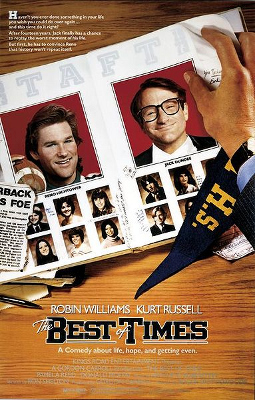 For years, banker Jack Dundee (Robin Williams) had been haunted by a pass that he dropped in high school. The pass was perfectly thrown by quarterback Reno Hightower (Kurt Russell) but Jack couldn’t bring it in and, as a result, Taft High lost to its rival, Bakersfield. Adding to Jack’s humiliation is that he now works for The Colonel (Donald Moffat), a confirmed Bakersfield fan who also happens to be Jack’s father-in-law. When Jack visits a “massage therapist” (Margaret Whitton) and tells her about his problems, she suggests that he needs to replay the game. Getting everyone interested in replaying the game is not easy. No one wants to be humiliated a second time and Reno, who now fixes vans for a living, fears the he’s lost his edge. Jack dresses up in the Bakersfield mascot’s uniform and vandalizes the town. Finally, everyone is ready for the game. Now, it’s a matter of town pride.

 Through the Shattered Lens