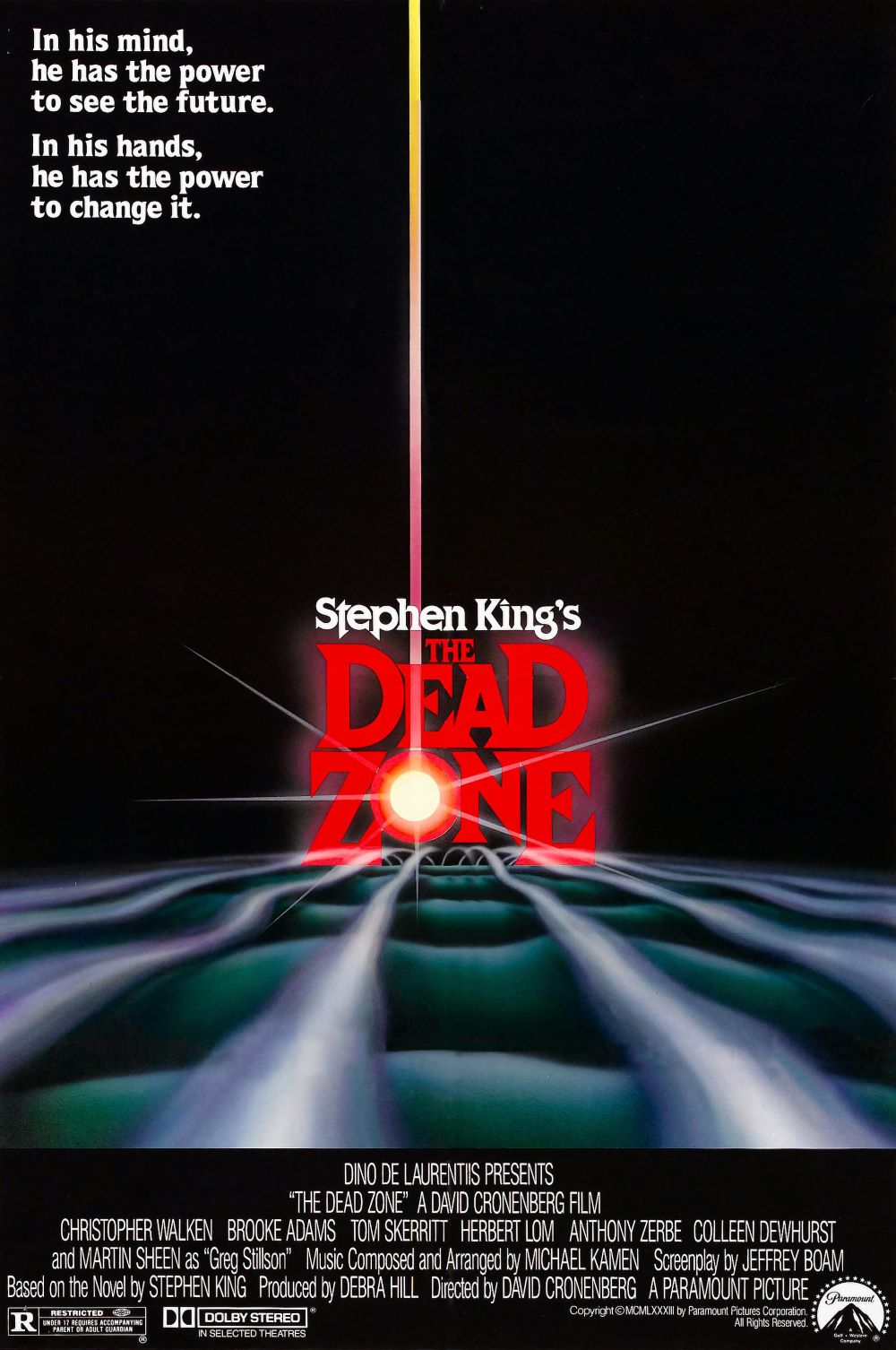
Horror Review: The Dead Zone (dir. by David Cronenberg)


“Bless me, Father, for I have sinned. I had the power… and I tried to prevent what I saw.”Johnny Smith

In 1983, David Cronenberg adapted Stephen King’s The Dead Zone with a distinctive emphasis on mood, morality, and psychological depth rather than traditional horror spectacle. The film follows Johnny Smith (Christopher Walken), a small-town schoolteacher whose life transforms irrevocably after a traumatic car accident leaves him in a five-year coma. Upon awakening, Johnny discovers he possesses psychic abilities that allow him to see the past and future by touch. Rather than a gift, this power becomes a heavy burden, isolating him and forcing him into wrenching moral choices.

Cronenberg’s direction is meticulous and deliberately restrained. The film’s muted color palette and stark winter landscapes visually echo Johnny’s emotional isolation and the fragility of human existence. His careful, often gliding camera movements create a mounting sense of quiet dread, while minimalistic sound design underscores moments of revelation with haunting subtlety. This subdued style elevates the film’s psychological impact, transforming it into a thoughtful and melancholy meditation on the cost of harrowing knowledge.

Significantly, The Dead Zone marks a departure from Cronenberg’s signature body horror. Instead of the grotesque physical transformations and visceral mutations that characterize much of his other work, here Cronenberg turns inward. The real horror lies in the malleability of the mind and the elusive nature of perception—how reality, memory, and the future are unstable constructs that can shift and fracture under psychic strain. This thematic focus on the impermanence and distortion of mental reality touches on some of Cronenberg’s deepest artistic fascinations.

The restrained treatment of body horror in The Dead Zone previews the director’s later, more psychologically driven films such as A History of ViolenceEastern Promises, and A Dangerous Method, where character studies and narrative depth take precedence over startling visuals. In this early pivot, Cronenberg demonstrates that his mastery lies not only in visual spectacle but in probing the profound emotional and moral dilemmas faced by his characters. The vision-focused horror here is cerebral and grounded, rooting supernatural phenomena in human frailty and ethical complexity.

Christopher Walken’s nuanced portrayal is the emotional heart of the film. He captures Johnny’s vulnerability, weariness, and profound solitude, portraying a man burdened by a cursed knowledge that isolates him from the world. Martin Sheen plays Greg Stillson, the ambitious and morally bankrupt politician whose rise Johnny must foretell and who embodies the film’s central threat. The supporting cast, including Brooke Adams as Johnny’s lost love Sarah and Tom Skerritt as Sheriff Bannerman, delivers compelling and authentic performances that humanize the film’s intimate, small-town environment.

Several changes from King’s novel sharpen the film’s thematic focus. The novel’s sprawling plot, including a serial killer subplot and a brain tumor storyline symbolizing Johnny’s mortality, is pared down or omitted. Despite this trimming, the serial killer element retained in the film remains chilling and effective. It highlights the darker repercussions of Johnny’s psychic gift and injects a tangible sense of dread, reinforcing the psychological weight Johnny carries. This subplot grounds the supernatural within a disturbing reality, illustrating the violent and tragic circumstances Johnny must grapple with as part of his burden.

The concept of the “dead zone” itself shifts in meaning. Originally, the term referred to parts of Johnny’s brain damaged by the accident, blocking certain visions. Cronenberg reinterprets it as a metaphor for the unknown and unknowable parts of the future—the gaps in psychic clarity that allow for free will and change. This subtle shift reshapes the narrative toward a more ambiguous, hopeful meditation on destiny and human agency.

Compared to King’s novel, Cronenberg’s Johnny is more grounded and isolated. The novel frames Johnny’s struggle within a broader spiritual and fatalistic context, highlighted by the looming presence of a brain tumor and a nuanced exploration of hope versus resignation. The film, by contrast, focuses on the emotional and moral fatigue induced by Johnny’s psychic gift, emphasizing his loneliness and reluctant responsibility rather than supernatural destiny.

Walken’s restrained, haunting performance strips away mythic grandeur to reveal a deeply human character. The film’s narrowed narrative tightens focus on Johnny’s internal anguish and his difficult ethical choices, making his plight intimate and richly relatable.

On a thematic level, The Dead Zone contemplates fate, free will, and sacrifice. Johnny’s psychic abilities act as a draining, almost chthonic force, transforming him into a reluctant prophet who is tasked with intervening in grim futures at great personal cost. The film’s bleak winter setting visually reflects Johnny’s alienation, while its deliberate pacing highlights the exhaustion and heartbreak that comes with such knowledge.

Ultimately, Cronenberg’s The Dead Zone goes beyond supernatural thriller conventions. It is a profound meditation on empathy, sacrifice, and the human condition—where the greatest horrors are internal, and the cost of knowledge is both psychic and emotional. Johnny Smith emerges as a tragic, flawed figure wrestling with unbearable burdens.

Cronenberg’s direction and the impeccable performances make The Dead Zone a standout in King adaptations. The film’s enduring impact lies in its rich thematic texture, its moral ambiguity, and its unflinching exploration of human frailty, all conveyed through a director shifting skillfully from physical body horror to psychological and existential terror. The film remains as haunting and resonant now as it was upon release, a testament to the synergy of Cronenberg and King’s extraordinary talents.
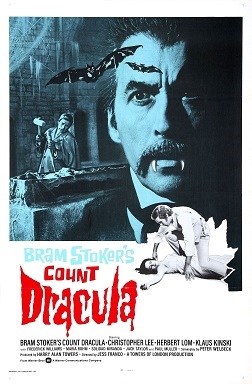
International Horror Review: Count Dracula (dir by Jess Franco)


Christopher Lee played Dracula in seven horror films and he often said that he hated almost every single one of them.

Christopher Lee, you have to understand, was a fan of Bram Stoker’s original novel and he always wanted to play Dracula the way that Stoker wrote him, as a member of the old nobility who got younger each time he drank blood.  As Lee often explained it, he spent years vainly trying to convince Hammer to do a Dracula film that was faithful to Stoker’s novel but Hammer instead preferred to use Dracula as an almost generic villain, one who was frequently plugged into equally generic films.

At some point, in the late 60s, producer Harry Alan Towers approached Christopher Lee and asked him to play Dracula in a non-Hammer film about the world’s most famous vampire.  At first, Lee refused.  If he was bored with playing Dracula for Hammer, why would he want to play him for someone else?  However, Towers then explained that his version of Dracula would be the first Dracula film to actually be faithful to Stoker’s book.  In fact, along with the presence of Christopher Lee, that would be the film’s major selling point!  Hearing this, Lee agreed.

The resulting film was 1970’s Count Dracula, a German-Spanish-British co-production that was directed by none other than Jess Franco.  Jess Franco, of course, is a beloved figure among many fans of Eurohorror and a bit of a controversial filmmaker.  Some people admired him for his ability to direct atmospheric films while spending very little money.  Others complained that Franco’s films were frequently amateurish and narratively incoherent.  When it comes to Franco, both camps can make a compelling argument.  Personally, I tend to come down on the pro-Franco side of things, particularly when it comes to the films that he made with Towers in the 70s.  For his part, Christopher Lee said he enjoyed working with Franco and they would go on to collaborate on several more films together.

So, what type of film is Jess Franco’s Count Dracula?  Well, Towers did not lie to Lee.  For the most part, Count Dracula remains faithful to plot of Bram Stoker’s Dracula.  There’s a few minor differences, of course.  A few characters are combined, which is understandable given that you sometimes need a scorecard to keep up with everyone in the novel.  The ending is a bit more abrupt in the film than it is in the book.  This probably has something to do with the fact that Franco ran out of money before he finished the film.  That was a fairly frequent occurrence on Franco’s films.

That said, film sticks close to the novel.  Jonathan Harker (Frederick Williams) goes to Transylvania and meets Dracula (Christopher Lee, with a mustache), an aging nobleman.  Harker soon finds himself being held prisoner in the castle, a victim of Dracula and his brides.  Though Harker does manage to escape (though not before finding Dracula asleep in his coffin), he ends up at a psychiatric hospital in London.  He meets Dr. Seward (Paul Muller) and Prof. Van Helsing (Herbert Lom).  Eventually, his fiancee Mina (Maria Rohm) and her best friend, Lucy (Soledad Miranda, who was Franco’s muse until he tragic death in a car accident) come to visit him.  Accompanying Lucy is Quincy Morris (Franco regular Jack Taylor), who, in the film, is a combination of two of the novel’s characters, Quincy and Arthur Holmwood.  Meanwhile, a madman named Renfield (Klaus Kinski) babbles about his master and eats bugs.

That said, while the story may stick close to Stoker, this is definitely a Franco film.  The action plays out at its own deliberate pace.  Depending on how much tolerance you have for Franco’s aesthetic, you’ll find this film to be either dream-like or slow.  Personally, I liked the amospheric images and the somewhat ragged editing style.  Whether it was Franco’s intention or not, they gave the film a hallucinatory feel, as if one was watching a nightmare being dreamt by Stoker himself.  At the same time, I can imagine others getting frustrated by the film and I can understand where they’re coming from.  Franco, with his habit of mixing the sensual with a deep sense of ennui, is not for everyone.

Still, it was interesting to see Lee giving a much a different performance as Dracula than he did in the Hammer films.  The Hammer films portrayed Dracula as being animalistic, driven by only his craving for blood.  In Count Dracula, Lee plays with the idea of Dracula being a relic of the old world, someone who has no choice but to watch as civilization changes around him.  While Dracula is undoubtedly evil, Lee plays him with hints of dignity.  Gone is the snarling and growling monster of the Hammer films and instead, this movie features a Dracula who takes an almost Calvinistic approach to his affliction.  He’s accepted his fate.  As he tells Harker, Harker can either choose to enter the castle or not.  In the end, it makes no difference because eventually, someone will enter.  The film also retains the idea of Dracula growing younger in appearance as he drinks blood, which adds a whole other dimension to Dracula’s cravings.  Blood is life and youth, two things that Dracula no longer possesses.

As for the rest of the cast, Klaus Kinski, not surprisingly, throws himself into the role of Renfield.  Reportedly, he ate real bugs for the role.  Herbert Lom seems a bit bored with the role of Van Helsing.  He doesn’t have any of the eccentric energy that we typically associate with the role.  Of course, some of that is due to the fact that, because of scheduling conflicts, Lom and Lee were never on set at the same time.  The scenes where Dracula and Van Helsing confront each other were created through some editing sleight-of-hand.  As is typical with Franco films, sometimes it works and sometimes, it’s extremely obvious that Lom wasn’t actually looking at Lee (or anyone other than the cameraman) when he delivered his lines.

Count Dracula is an interesting take on the story.  It’s a bit uneven, though that’s perhaps not a surprise considering that the production was apparently beset by budgetary problems from the start.  This film is Franco at his least lurid and it’s hard not to miss some Franco’s more sordid impulses.  Watching the film, you get the feeling that Franco was holding back.  But, the visuals are wonderfully dreamy, Kinski is compelling in his insane way, and Lee finally appears to be enjoying the role of Dracula.  It’s actually kind of nice to see.

Horror Scenes That I Love: Dracula vs. Van Helsing in Count Dracula


The 1970 film, Count Dracula, is unique in that it’s a film that stars Christopher Lee but it wasn’t produced by Hammer.  Instead, it was directed by Lee’s friend, the Spanish director Jess Franco.  It was sold as being a far more faithful adaptation of the Dracula story than anything that had been filmed up to that point.  Lee, who frequently bemoaned the quality of the Hammer films, later described Count Dracula as being a personal favorite of the many films in which he appeared.

In the scene, Dracula confronts Herbert Lom’s Prof. Van Helsing.  Lee gets more dialogue in this scene than he did throughout the entirety of Hammer’s Dracula, Prince of Darkness.

Enjoy!

King Solomon’s Mines (1985, directed by J. Lee Thompson)


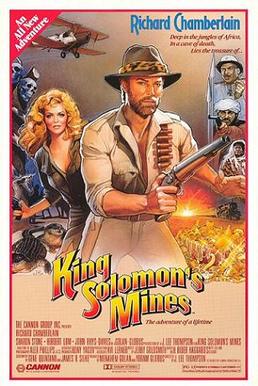
After her archaeologist father disappears while searching for the fabled mines of King Solomon, Jesse Houston (Sharon Stone) hires famed explorer Allan Quartermain (Richard Chamberlain) to help her find him.  After walking around in the jungle and exploring a nearby village, Allan and Jesse discover that her father has been kidnapped by a German military expedition who want to use King Solomon’s treasure to fund their war effort.  Working with the Germans is Allan’s old enemy, Dogati (John Rhys-Davies).  Allan and Jesse find themselves in a race against time to find the mines before the Germans.  Along the way, they steal an airplane, fight German soldiers on a train, and nearly get cooked alive in a giant cauldron.

Because this is a Cannon film and it was made at the height of Indiana Jones’s popularity and it stars John Rhys-Davies and it has a score that sounds like it was written by someone trying too hard to be John Williams, you might be tempted to think that King Solomon’s Mines is a rip-off of Raiders of the Lost Ark.  However, there are some crucial differences between Raiders and King Solomon’s Mines.  For instance, Raiders of the Lost Ark took place during World War II.  King Solomon’s Mines takes place during World War I.  Raiders of the Lost Ark had angels that melted a man’s face.  King Solomon’s Mines has a lava pit that makes you explode if you fall into it.  Raiders of the Lost Ark has a big fight in an airfield while King Solomon’s Mines has a big fight at an airfield …. well, wait, I guess they do have a few things in common.

Probably the biggest difference between Raiders of the Lost Ark and King Solomon’s Mines is that Raiders had Harrison Ford and Karen Allen while King Solomon’s Mines has to make due with Richard Chamberlain and Sharon Stone.  (If the imdb trivia section is to be believed, Sharon Stone was cast because Menahem Golan mistook her for Kathleen Turner.)  Along with generating zero romantic sparks, neither Chamberlain nor Stone come across as if they’ve ever even seen a jungle, much less explored one.  The only time that the two of them are credible as anything other than actors slumming on Cannon’s dime is when they’re yelling at each other.  There’s also a scene where they’re trying to steal an airplane and Chamberlain tells Stone to “reach between your legs and grab it.”  That was funny, I guess.

Along with trying to be an adventure, King Solomon’s Mines also tries to be a comedy.  As a general rule, Cannon films are great when they’re unintentionally funny but not so much when they actually try to be funny.  The film’s idea of comedy is Richard Chamberlain having to do an impromptu jig while someone shoots at his feet.  Add in a healthy dose of casual racism as Allan and Jesse run into a tribe in Africa who want to cook them in a giant stew pot and you’ve got a film so bad that you’ll hardly believe it could have been produced by the same people who gave us Delta Force, which is, of course, the greatest film ever made.

Golan and Globus had enough confidence in King Solomon’s Mines that they shot a sequel before the first film was even released.  Tomorrow, I will force myself to watch and review Allan Quartermain and The Lost City of Gold.  And, after that, I’ll probably go sit in a corner and think about what I’ve done.

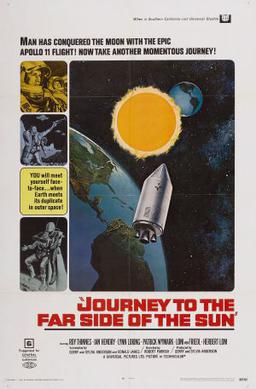
Journey to the Far Side of the Sun (1969, directed by Robert Parrish)


In the year 2069, the European Space Exploration Council discovers that there is a planet on the other side of the Sun, one that orbits the same path as the Earth.  Unfortunately, a spy transmits this information to the communists so America and Europe team up to make sure that they reach the planet before the Russians!

(Remember, production started on this movie in 1967, when America and Soviet Union were still competing to see who would be the first to land on the moon.  Of course, by the time Journey to the Far Side of the Sun was released in 1969, America had already landed on the moon and the Russian space program was no longer taken seriously.)

Two astronauts are assigned to a manned mission to explore the new planet.  Glenn Ross (Roy Thinnes) is American.  John Kane (Ian Hendry) is British.  After spending three weeks in suspended animation, Ross and Kane awaken to discover themselves orbiting a planet that appears to have much the same atmosphere as Earth.  When their ship crashes into the planet, Kane is fatally injured and Ross is retrieved by a human rescue team!  He’s told that the ship crashed in Mongolia.  Kane and Ross were orbiting Earth all along!

Or were they?  Even though Ross is reunited with his wife and debriefed by Jason Webb (Patrick Wymark), the head of the mission, he soon discovers that things are different.  People who were once right-handed are now left-handed and text is now written from right-to-left instead of left-to-right.  People drive on the wrong side of the road and, after Ross makes love to his wife, she feels like something was different about him.  Ross realizes that he’s on a counter-Earth!

It’s an intriguing premise but, unfortunately, Journey to the Far Side of the Sun doesn’t do much with it.  It’s not as if Ross has landed on the Bizarro world, where people say, “Bad Bye” and root for the bad guys at the movies.  Instead, it’s just a world where right-handed people are now left-handed and everyone drives on the opposite side of the road.  Ross theorizes that everything that happens on Earth also happens on Counter-Earth, which means that the other Ross is on Earth, realizing the exact same thing that the first Ross is realizing but who cares because there’s not really any major differences between the two Earths.  Maybe if Counter-Earth had an alternate history where Rome never fell or the Germans won World War II, the movie would be more interesting or at least more like an old episode of Star Trek.  Instead, the movie is all about Ross trying to convince the people on Counter-Earth that he didn’t intentionally abort the mission and that he should be given a chance to return to his Earth.   It’s the driest possible way to approach an interesting premise.

I will say that Journey to the Far Side of the Sun also has one of the strangest endings that I’ve ever seen.  I won’t spoil it here, other than to say that I wonder if the ending was written before or after 2001 made confusing conclusions cool again.

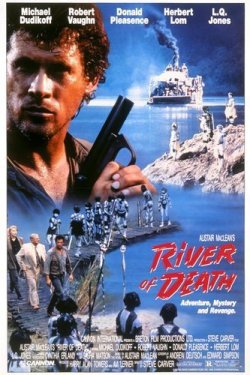
A Movie A Day #307: River of Death (1989, directed by Steve Carver)


In the Amazon, natives are dying of a mysterious disease.  Could it have anything to do with a German war criminal named Wolfgang (played by Robert Vaughn) who is living in a cave that is decorated with a Nazi flag?  A scientist (Victor Melleney) and his daughter, Anna (Sarah Maur Thorp), are determined to find out.  They hire a tough explorer, John Hamilton (Michael Dudikoff), to lead them up the river but John does not do a very good job because the scientist ends up dead and Anna ends up kidnapped.
Everyone tells John to forget about Anna.  Colonel Diaz (Herbert Lom) says that she is dead.  John’s best friend, an arms dealer named Eddie (L.Q. Jones), says that she’s dead.  John refuses to accept that and he organizes an expedition to help track them down.  A strange man (Donald Pleasence) and his assistant (Cynthia Erland) approach John and offer to help.  What John does not know is that the man is actually Heinrich Spaatz, yet another Nazi war criminal.

River of Death is a ridiculous movie but it is entertaining in a way that only a late 80s Michael Dudikoff movie can be.  Though River of Death was a Cannon film, it was produced by the legendary Harry Alan Towers, which is probably why the production standards are higher than the average Menahem Golan quickie.  Dudikoff does a passable imitation of Indiana Jones (and he even gets to do some Apocalypse Now-style narrating) but the real reason to watch the film is to watch veteran actors like Robert Vaughn, Donald Pleasence, Herbert Lom, and L.Q. Jones ham it up.  Vaughn doesn’t even attempt to sound German while Pleasence gives a performance that is strange even by his own considerable standards.

One final note: River of Death was the second-to-last film directed by Steve Carver, who also did Capone, and Big Bad Mama, along with helping to make Chuck Norris a star by directing Lone Wolf McQuade and An Eye For An Eye.

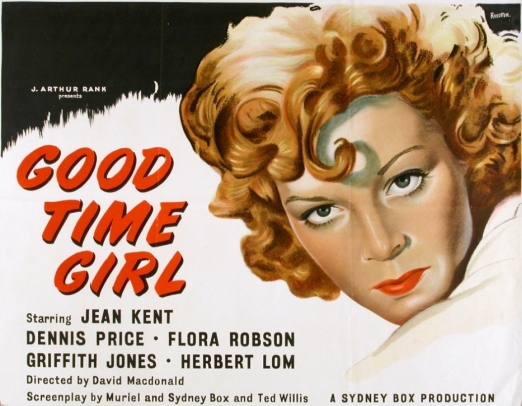
Embracing the Melodrama Part II #17: Good Time Girl (dir by David MacDonald)


Good-Time_Girl_FilmPoster

The 1948 film Good Time Girl is currently available on Netflix and I have to admit that, based on the name alone, I was expecting it to be another somewhat campy exploitation film about juvenile delinquency, something along the lines of Damaged Lives and Gambling With Souls.

And that’s certainly how the film began.  A troubled teenager named Lyla (Diana Dors) has been arrested and is sent to the juvenile court where the concerned Miss Thorpe (Flora Robson) tells Lyla that if she doesn’t change her ways, she could end up just like Gwen Rawlings.  Who is Gwen Rawlings?  That’s what we spend the rest of this short film finding out.

The film shows how Gwen (Jean Kent) was raised in an abusive household and how, at the age of 16, she ran way from home.  The first person she met was the handsome and charming Jimmy (Peter Glenville) who turns out to be a low-level gangster.  (His pinstrip suit and mustache give him away.)  Jimmy gets Gwen a job as a hat-check girl at a club run by the enigmatic Maxey (Herbert Lom).  Gwen meets and falls in love with a musician named Red (Dennis Price) but Red explains that he’s not only too old for her but he’s married as well.  Soon, Gwen is living with Jimmy and Jimmy is regularly abusing her.  When Maxey sees that Jimmy has given her a black eye, he has Jimmy beaten up and fired.  Jimmy responds by slashing Maxey’s face and then framing Gwen for jewelry theft.

Gwen is sent to reform school, where she falls under the influence of the somewhat demonic Roberta (played, in a genuinely menacing performance, by Daniel Day-Lewis’s mother, Jill Balcon).  Reform school only succeeds in making Gwen tougher and angrier.  When a mini-riot breaks out in the cafeteria, Gwen takes advantage of the confusion and escapes.

Back on the streets and with the police searching for her, Gwen falls in with a succession of different criminals.  When she meets two military deserters, it leads to the type of tragedy that could just as easily befall Lyla if Lyla doesn’t change her ways.

This is one of those films where the worst possible thing that could happen always happens and, as a result, it’s all rather melodramatic.  But, as opposed to a film like Reefer Madness or Sex Madness, it never gets so melodramatic that it becomes implausible.  Instead, it’s actually a very watchable portrait of people living on the margins of acceptable society.  Director David MacDonald fills the screen with menacing images and the pace never lags.  The film is also full of great performances from character actors that you’ll probably recognize from countless Hammer horror films.  Herbert Lom is especially impressive as the quietly intimidating Maxey.

I wasn’t expecting much from Good Time Girl but it’s definitely worth watching.

http://www.youtube.com/watch?v=pO1wB-MMaKk

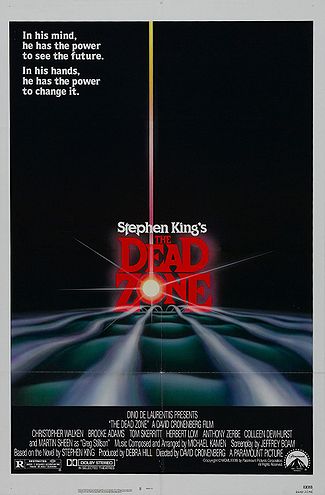
Shattered Politics #49: The Dead Zone (dir by David Cronenberg)


The_Dead_Zone

So, it seems like every time that I write a review of any film based on a novel by Stephen King, I always have to start out by explaining that I think, while King’s success is undeniable, the fact that he’s overrated is also undeniable.  It’s a comment that I always make and then I have to deal with people going, “But, Lisa, everyone loves Stephen King!  He’s the most commercially successful author ever!  He’s a modern-day Charles Dickens!”

Bleh.

Make no mistake, I think that Stephen King is a talented writer.  However, I don’t think that he’s the greatest writer that has ever lived and that’s where I often come into conflict with King’s fans.  (Stephen King fans tend to be like religious fanatics when it comes to defending their belief.)  Having read both King’s earlier work and his more recent books, it’s hard for me not to feel that Stephen King has been growing steadily complacent.  There’s a certain self-importance to his prose and his plotting that, for me, is the literary equivalent of nails on chalk board.  If anyone is guilty of believing the most fawning praise of his biggest fans, it would appears to be Stephen King who, to judge from his twitter feed, appears to also believe that he’s our most important cultural critic as well.

(To be honest, I’d probably have more tolerance for King’s attempts at cultural and political criticism if he wasn’t so  predictable about it all.  Stephen King may write best sellers but that doesn’t mean he has anything interesting or unique to say about current events.)

Anyway, since I don’t feel like having to deal with all of that shit all over again, I’m not going to start this review by saying that I think Stephen King is overrated.  In fact … whoops.

Okay, so much for that plan.

Even I have to admit that The Dead Zone is one of Stephen King’s better books.  First off, it’s less than a 1,000 pages long.  Secondly, the hero isn’t a writer who spends all of his time whining about the political preferences of his neighbors.  Third, it deals with all of the “big” issues of faith, destiny, and morality but it does so in a far less heavy-handed manner than most of King’s books.

The Dead Zone is also the basis for one of the better films to be adapted from a Stephen King novel.  Directed by David Cronenberg and starring Christopher Walken, the film’s plot closely follows the novel.  Johnny Smith (Christopher Walken) is a high school teacher who, after a horrific car crash, spends five years in a coma.  When he finally wakes up, he discovers that his girlfriend, Sarah (Brooke Adams), has married another man.  His mother has become a religious fanatic.  And, perhaps most importantly, whenever Johnny touches anyone, there’s a good chance that he’ll see either the person’s past or a possible future.

Needless to say, Johnny struggles with how to deal with his new powers.  After he helps to catch a local serial killer, Johnny goes into seclusion.  However, when he discovers that Sarah is now volunteering for ambitious politician Greg Stillson (Martin Sheen), Johnny goes to a Stillson rally, shakes the man’s hand, and has a vision.  Johnny discovers that, if Stillson is elected to the senate, he’ll eventually become President and then he’ll destroy the world.

Much like The Shining, The Dead Zone benefits from being directed by a filmmaker who was both confident and strong enough to bring his own individual style to the material.  (Usually, when a King adaptation fails, it’s because it followed the source material too closely, as if the film’s producers were scared of upsetting any of King’s constant readers.)  Though the film’s plot may closely follow the novel, the movie itself is still definitely more of a product of David Cronenberg than Stephen King.  Whereas King’s novel devoted a good deal of time to Johnny and Sarah’s relationship, it’s treated as almost an afterthought in Cronenberg’s film.  Whereas King’s novel presented Johnny Smith as being an everyman sort of character, Cronenberg’s film gives us a Johnny who, from the start of the film, is a bit of an outsider even before he starts to see the future.  Whereas King put the reader straight into Johnny’s head, Cronenberg approach is a bit more detached and clinical.  Cronenberg’s Johnny is a bit more of an enigma than King’s version.

Fortunately, Cronenberg was fortunate enough to be able to cast Christopher Walken in the role of Johnny Smith.  King’s preference for the role was Bill Murray.  As odd as it may sound, you can actually imagine Bill Murray in the role when you read King’s book.  But, for Cronenberg’s more detached vision, Walken was the perfect choice.  People tend to spend so much time focusing on Christopher Walken’s quirky screen presence that there’s a tendency to forget that he’s actually a very talented actor as well.  He’s very likable and sympathetic as Johnny and brings a humanity and a sense of humor to the role, which provides a good balance to Cronenberg’s sense of detachment.

The Dead Zone is a good book and it was later turned into an occasionally good (and, just as often, not-so-good) television series.  However, the film is still the best.

http://www.youtube.com/watch?v=lmC5oPc7L3M