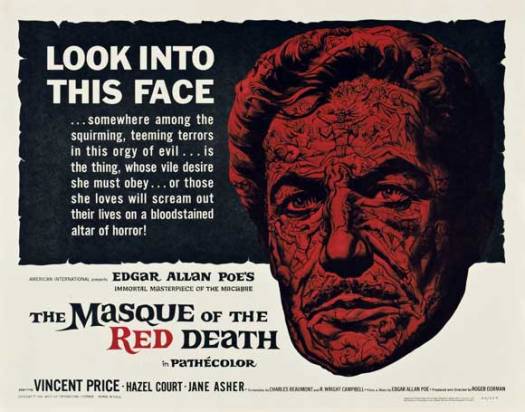
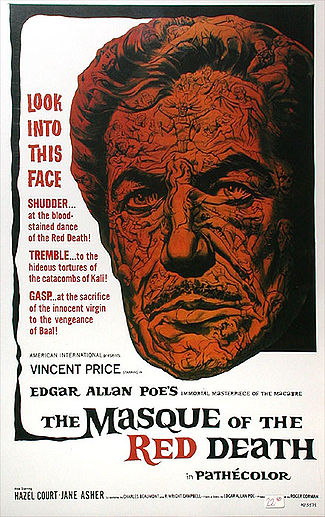
Horror Film Review: The Masque of the Red Death (dir by Roger Corman)


In 1964’s The Masque of the Red Death, Vincent Price stars as Prospero.

Prospero is a nobleman in medieval Italy, a decadent tyrant who rules his villages with an iron hand and who proudly and openly worships Satan.  When an old woman in one of the villages dies of the plague, Prospero orders the village to be burned to the ground.  He returns to his castle where, with his mistress (Hazel Court), he plans to throw a masquerade for the local nobility.  His plan is for everyone to hide out in the castle until Death has passed.  The problem, of course, is keeping Death from sneaking into the castle and claiming everyone within.

Prospero also abducts three villagers, Ludovico (Nigel Green), his daughter Francesca (Jane Asher), and Francesca’s boyfriend, Gino (David Weston).  The three villagers find themselves in a decadent world, where Prospero and his attendants are motivated by their own greed and petty jealousies.  Keeping Death from entering the castle would probably be a lot easier if the people in the castle would stop trying to kill each other.  It’s an odd atmosphere within the castle.  Everyone fears Death and yet, everyone seems to be doing all that they can do invite it in with them.  Can anyone, even a worshipper of the Damned liked Prospero, truly escape Death?

The Masque of the Red Death is not only the best of Roger Corman’s Edgar Allan Poe adaptations but it’s also the best film that Corman ever directed.  Working with cinematographer Nicolas Roeg (who was himself destined to have quite a career as a director of enigmatic films), Corman fills the screen with vivid colors and scenes of medieval decadence.  Price gives one of his best performances, playing Prospero as someone who is in love with his own amoral nature but whose arrogance quickly gives way to fear when he starts to suspect the Death has somehow managed to enter the castle.  The inhabitants of the castle are all memorably eccentric and, in many cases, evil.  A man in an ape costume is burned to death and hardly anyone seems to notice or care.  Prospero and his nobles think that they’re above death because of their wealth and their place in society but, of course, no one can escape Death.

David Weston and Jane Asher are both well-cast as the two lovers, though Asher is clearly more a product of the swinging sixties than medieval Italy.  Patrick Magee and Skip Martin are both memorable as members of Prospero’s court, with Skip Martin giving an especially diabolical performance as a murderous court jester.  In the end, though, this film truly belongs to Price, Corman, and Roeg.  Roeg’s cinematography is dazzling, with the use of red foreshadowing his later film, Don’t Look Now.  Corman’s direction puts the viewer right in the center of Prospero’s court.  And Vincent Price gives one of his best performances as the self-amused but unashamedly evil Prospero.  The Masque of the Red Death remains a classic of 60s pop art and the best of Corman’s many films.
Horror Film Review: Premature Burial (by Roger Corman)


Poor Guy Carrell (Ray Milland!)

The character at the center of the 1962 Edgar Allan Poe adaptation, The Premature Burial, Guy spends his days terrified of being buried alive.  Like his father before him, Guy suffers from a disease that can make him appear to be dead despite actually being alive.  Guy is convinced that his father was buried alive and swears that he could even hear his father crying for help inside of his tomb.  Though his fiancée, Emily (Hazel Court), insists that Guy is driving himself mad with his fears, Guy continue to spend his time trying to invent a coffin from which one can easily escape.  Even after Emily and Guy are married, Guy continues to obsess.

Finally, faced with the prospect of opening his father’s tomb to discover whether or not his father truly was buried alive, Guy appears to drop dead of a heart attack.  But is he really dead or is he about to be buried alive!?  And who is responsible for the series of mysterious events that apparently drove Guy to collapse of fright?  Watch the film to find out!  Or read the Edgar Allan Poe short story.

This was the third of Roger Corman’s Edgar Allan Poe adaptations and it’s the first one to not feature Vincent Price as the lead character.  For the most part, the members of the small cast all do a good job with their roles.  Ray Milland is both sympathetic and a little frightening as the obsessed Guy.  Heather Angel is properly enigmatic as Guy’s overprotective sister and Hazel Court will keep you guessing as far as her character’s motivations are concerned.  Dick Miller has a small but key role as a grave digger who seems to take just a little bit too much enjoyment from his work.  The film’s atmosphere is properly gothic and, if the film isn’t as visually audacious as the first two Poe films, Corman still finds time to include a creepy and psychedelic dream sequence.

That said, Vincent Price is still very much missed.  Corman reportedly wanted to use Price but, because Corman produced and financed the film  himself, Corman’s former business partners at American International Pictures would not allow Price to appear in the film.  (Price was under exclusive contract to AIP.)  By the time Corman and AIP worked out their disagreements and again joined forces, Ray Milland had already been cast in the lead role.

While the actors all do a good job, it’s hard to deny that Guy Correll would have been an ideal role for Vincent Price, even if it would have meant essentially re-doing his performance from The Pit and the Pendulum.  It’s not just that the film misses Price’s theatrical acting style.  The film also misses the energy that Price brought to the previous two Poe films.  The Premature Burial moves at a stately pace and, in the end, it’s a bit too slow and respectable for its own good.  Price would have jazzed things up and made a decent film into a truly memorable one.  Fortunately, Price would return for the later Poe adaptations.

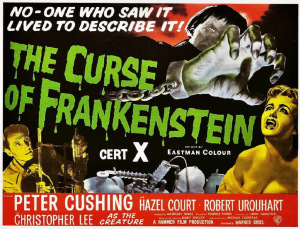
Horror Film Review: The Curse of Frankenstein (dir by Terence Fisher)


First released in 1957 and one of the films that put Britain’s Hammer Films on the map, The Curse of Frankenstein opens in Switzerland in the 19th century.  It’s a time of superstitious villagers, judgmental priests, aristocrats who dabble in science, and lots of cleavage.  It’s also a time when justice is harsh.  That’s something that Baron Victor Frankenstein (Peter Cushing) has discovered as he sits in a cell in prison, awaiting his execution date.

Baron Frankenstein has been convicted of the murder of a maid named Justine and the public is eager to see this haughty and eccentric aristocrat put to death.  Victor, however, claims that he is innocent of Justine’s murder.  As Victor explains to a visiting priest (Alex Gallier), he is guilty of many things but he didn’t kill Justine.

The story that Frankenstein tells the priest is a familiar one.  Victor inherited the Frankenstein estate when he was fifteen and, having always been interested in science, his hires a scientist named Paul Krempe (Robert Urquhart) to mentor him and ultimately collaborate with him on his experiments.  Even as he falls in love with and become engaged to his cousin, Elizabeth (Hazel Court), Victor becomes obsessed with the idea of creating a human being from perfect parts collected from the dead.

Victor puts his creation together, piece by bloody piece.  He has no trouble using a the body of a robber and the hands and eyes that purchases from the workers at the local morgue.  But when it come time to pick a brain, he wants to use the mind of a distinguished scientist.  Unfortunately, the scientist is still alive so Victor pushes him over a bannister.  That kills the professor but the removal of the brain does not go quite as smoothly as Victor was hoping.  The brain gets damaged when it’s removed.  The Creature (an intimidating Christopher Lee) is eventually brought to life but, with that damaged brain, all it wants to do is destroy and kill.  Victor isn’t happy about that but soon, he discovers that having a killer Creature has its uses.

As opposed to the well-meaning but obsessed version of the character that Colin Clive played in the original Frankenstein, The Curse of Frankenstein presents us with a Baron who is rather unstable from the start.  It’s not just that the Baron is obsessed with bringing the dead back to life.  It’s that he is fully willing to kill people for his experiment.  Perhaps his only redeeming quality could have been his love for Elizabeth but he screws up even that by having an affair with the ill-fated Justine (Valerie Gaunt).  From the start, the Baron’s main obsession is with his own power.  Elizabeth is ultimately just another pawn for him to control.

Considering how evil this film’s version of Baron Frankenstein is, it’s a good thing that he’s played by Peter Cushing.  Cushing gives an intense but charismatic performance as the Baron, capturing not only the character’s ruthlessness but also his fierce intelligence.  The tragedy of the film’s version of the story is not that the Baron’s experiment goes wrong but that the Baron did actually have the potential to do a lot of good for the world.  He’s smart and he’s determined but he’s lacking a conscience.  If anything, the Creature he builds is a representation of his own dark thoughts and desires.  The Baron is an aristocrat and the Creature is built out of common thieves and people who died in debt but they’re both different sides of the same coin.

Gory and fast-paced, The Curse of Frankenstein was a huge hit and it made stars out of both Cushing and Lee.  I tend to prefer Hammer’s Dracula films to its Frankenstein film but The Curse of Frankenstein holds up well as a portrait of what happens when madness and science collide.

Horror Film Review: The Raven (dir by Roger Corman)


“Shall I ever see the rare and radiant Lenore again?” — Dr. Erasmus Craven (Vincent Prince)

“How they Hell should I know?” — Dr. Adolphus Bedlo (Peter Lorre)

This exchange comes from Roger Corman’s 1963 film, The Raven, and it pretty much epitomizes the film.  Very loosely based on the poem by Edgar Allan Poe, The Raven was one of the many Poe adaptations that Corman did with Vincent Price.  As opposed to the other films in Corman’s Poe cycle, The Raven was a flat-out comedy, one that parodied the other films in the cycle.  Reportedly, Peter Lorre improvised his response to Vincent Price’s question about Lenore.  In fact, Lorre improvised a good deal of his performance and his jokes sometimes even took Corman by surprise.  As a result and despite the fact that Richard Matheson did write a script for the film, The Raven is one of those films that feels like it was made up while the camera was rolling.

The Raven is a film about three sorcerers who are always fighting and arguing with each other.  Dr. Erasmus Craven (Vincent Price) spends his time mourning the late Lenore.  The evil Dr. Scarabus (a frail-looking Boris Karloff) has his own castle where he lives with the ghost of the late Lenore (Hazel Court).  Dr. Adolphus Bedlo (Peter Lorre) is a sarcastic ne’er-do-well who saw Lenore in Scarabus’s castle and was transformed into a talking raven as a result.

In raven form, Dr. Bedlo flies over to Craven’s castle and convinces Craven to transform him back into human form.  After informing Craven that Scarabus has Lenore’s ghost in his castle, the heart-broken Craven decides to head over to Scarabus’s castle and get some answers.  Accompanying the group is Craven’s daughter, Estelle (Olive Sturgess) and Bedlo’s son, Rexford (Jack Nicholson, looking somewhat lost in the role of a boring young man).

At the castle, Scarabus puts on an act of being a friendly and gracious host but the opposite soon turns out to be true.  In fact, the entire castle is full of secrets and it quickly turns out that hardly anyone — with the exception of Estelle and Rexford — are who they actually claim to be.  It leads to a battle in magic between Craven and Scarabus.  I nearly described their battle as being “epic” but that’s probably not the right world.  It’s epic by the standards of Roger Corman but actually, the big battle is just as jokey as the rest of the film.

The Raven is definitely not a film that’s meant to be taken seriously.  One gets the feeling that Corman knew that the presence of Price, Karloff, and Lorre would make the film a success no matter what the film was like so he decided to have some fun with it.  (Price and definitely Lorre appear to have been in on the joke while Karloff was perhaps a bit less so.)  To be honest, the film’s only earnest moments come courtesy of Oliva Sturgess and Jack Nicholson but, because Nicholson is Nicholson, you watch those earnest moments waiting for Rexford to arch an eyebrow or flash that devilish grin.  Unfortunately, he doesn’t.  Jack is pretty boring here.

The Raven, if we’re going to be honest, is probably too jokey for its own good but it’s still hard to resist the charm of Price, Lorre, and Karloff.  The film is a chance to see three horror icons acting opposite each other and, as a result, it’s a fun film for horror fans.  Vincent Price breaks the fourth wall at the end of the film and it’s hard not to love it.

Creature Double Feature 5: THE MASQUE OF THE RED DEATH (AIP 1964) and THE TOMB OF LIGEIA (AIP 1965)


gary loggins's avatarcracked rear viewer

Boston’s WLVI-TV 56 ran it’s ‘Creature Double Feature’ series from 1972 to 1983. Though fans remember it mostly for those fabulous giant monster movies starring Godzilla and friends, CDF occasionally featured some monsters of a different kind… 

Roger Corman and Vincent Price had teamed to make five successful Edgar Allan Poe adaptations for American-International Pictures, beginning with 1960’s HOUSE OF USHER (there was a sixth, THE PREMATURE BURIAL, that starred Ray Milland rather than Price). Studio execs James Nicholson and Sam Arkoff, always on the lookout for ways to cut costs, joined forces with Britain’s Anglo-Amalgamated Productions (makers of the CARRY ON comedies) and shipped Corman and company to jolly ol’ England for the final two, THE MASQUE OF THE RED DEATH and THE TOMB OF LIGEIA. Both turned out to be high points in the Corman/Price/Poe series.

1964’s MASQUE OF THE RED DEATH is a sadistic, psychedelic nightmare of…

View original post 878 more words

Halloween Havoc!: THE RAVEN (AIP 1963)


gary loggins's avatarcracked rear viewer

Let’s kick off the third annual “Halloween Havoc” with Vincent Price, Peter Lorre, Boris Karloff, Hazel Court, young Jack Nicholson , director Roger Corman , screenwriter Richard Matheson , and an “idea” by Edgar Allan Poe. How’s that for an all-star horror crew? The film is THE RAVEN, Corman’s spoof of all those Price/Poe movies he was famous for, a go-for-the-throat comedy guaranteed to make you spill your guts with laughter!

Sorcerer Erasmus Craven (Price ), still pining for his late, lost Lenore, hears someone gently rapping on his chamber door… er, window. It’s a raven, a talking raven, in reality Adolpho Bedlo (Lorre ), who’s been put under a spell by the Grand Master of magicians, Dr. Scarabus (Karloff ), who like Craven is adept at “magic by gesture”. After Craven mixes up a potion to reverse the spell, Bedlo tells him he’s seen Lenore alive at Scarabus’s castle.

The…

View original post 505 more words

Gods of the Hammer Films: Peter Cushing, Christopher Lee, and THE CURSE OF FRANKENSTEIN (1957)


gary loggins's avatarcracked rear viewer

curse4

When Britain’s Hammer Films began in the early 1930’s they were just another movie production company. After finding some success with the 1955 sci-fi adaptation THE QUARTERMASS EXPERIMENT, they chose to make a Gothic horror based on Mary Shelley’s classic 1818 novel about a man obsessed with creating artificial life. FRANKENSTEIN had been filmed many times before, most notably Universal’s 1931 version that brought eternal fame to Boris Karloff. This time however, the producers shot in vibrant color, with blood and body parts on gory display. Tame stuff compared to today’s anything goes horrors, but in the fifties it was considered quite shocking.

Peter Cushing and Christopher Lee had appeared in two films before, Lawrence Olivier’s 1948 HAMLET and John Huston’s 1952 MOULIN ROUGE, though not as a team. Once CURSE OF FRANKENSTEIN was unleashed upon the public, they were paired another nineteen times, making Cushing and Lee terror’s all-time tandem. HORROR OF DRACULA came next, with…

View original post 613 more words

Horror Film Review: Omen III: The Final Conflict (dir by Graham Baker)


Omen_III_the_final_conflict

Originally, it had been planned that the Omen franchise would be made up of six or seven films and that each movie would check in on another year in the life of Damien Thorn, a bit like an apocalyptic version of Boyhood.  However, after Damien: Omen II failed to perform up to expectations, plans were changed.

Instead of continuing the story of Damien’s adolescence, the 1981 film Omen III: The Final Conflict jumps straight into Damien’s adulthood.  Now 32 years old and played by a very young (and handsome) Sam Neill, Damien Thorn is now the CEO of Thorn Enterprises.  With the help of his loyal assistant Harvey Dean (Don Gordon), Damien has become one of the most popular and powerful men on the planet.  Thorn Enterprises, having followed Paul Buhler’s scheme from the second film, is now responsible for feeding a good deal of the world.  Damien is seen as being a humanitarian and a future President.  When the U.S. Ambassador to the United Kingdom reacts to spotting a black dog in the park by committing suicide, Damien is appointed to the position.

(Needless to say, everyone in London is happy to see Damien.  Nobody says, “I just hope you don’t end up going crazy and dying a violent death, like everyone else in your family and immediate circle of acquaintances.”  But they’re probably thinking it…)

Now in London (and also appointed to be head of the United Nations Youth Organization, which just goes to show that your crazy uncle is right and the United Nations is a conspiracy), Damien pursues a rather creepy romance with journalist Kate Reynolds (Lisa Harrow) and makes plans to prevent the Second Coming by killing every single baby born on the morning of March 24th.  (But Harvey’s son was born on March 24th — wow, could this lead to some sort of conflict?)

Meanwhile, a group of priests (led by an embarrassed-looking Rossanno Brazzi) have recovered these damn daggers of Megiddo and are now all attempting to assassinate Damien.  Unfortunately, none of them are very good at their job.  (“You had one job, Father!  One job!”)

Bleh.

The Final Conflict is not that good.  It’s boring.  The plot is full of holes.  For instance — and yes, these are SPOILERS — why have we sat through two movies listening to characters insist that Damien has to be stabbed by all seven of the daggers when apparently, just one dagger will do the job?  Why, after being told that Jesus is going to be reborn as a child, does he then appear as an adult at the end of the film?  And finally, why does nobody ever seem to find it strange that everyone that Damien knows end up suffering a freak accident?

I will say that there are two good things about The Final Conflict.

First off, Sam Neill gives a good performance as Damien Thorn.  He’s handsome, he’s charismatic, and he’s not afraid to be evil.  But, unfortunately, Damien’s just not that interesting of a character anymore.  In the first Omen, he was interesting because he was an evil five year old.  In the second Omen, he was at least occasionally conflicted about his role.  In the third Omen, Damien is just evil and evil without nuance is boring.

Secondly, there’s that sequence where Damien’s followers go after the babies born on March 24th.  Oh my God, that was so disturbing and it was one of the few moments when The Final Conflict actually became horrific.

Otherwise, The Final Conflict is a thoroughly forgettable sequel to a memorable film.

Horror on The Lens: The Masque of the Red Death (dir by Roger Corman)


MasqueOfTheRedDeath(1964film)

So here we are, 24 days into October, and I have yet to share an old Vincent Price film!  It’s not October without at least a little contribution from Vincent.  Well, allow me to correct that with today’s horror on the lens, the 1964 Roger Corman film The Masque of the Red Death.

Based on the classic story by Edgar Allan Poe, this film features Vincent Price giving one of his best performances as the doomed and decadent Satanist Prince Prospero.  The film’s cinematographer was future director Nicolas Roeg and The Masque of the Red Death is probably one of the most visually impressive of all of Corman’s films.

Enjoy!

http://www.youtube.com/watch?v=uCazBlhBs_Q