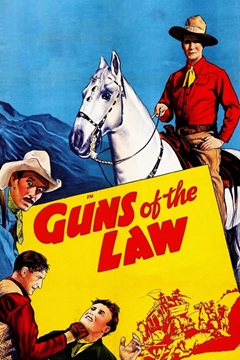
Three Texas Rangers — Tex Wyatt (Dave O’Brien), Jim Steele (James Newill), and Panhandle Perkins (Guy Wilkerson) — ride into a small town. They each arrive separately and they all sing while sitting on their horses. They’re in town to help out Jed Wilkins, who was Panhandle’s superior officer during the Civil War. Jed is having a nervous breakdown because a crooked surveyor (Jack Ingram) and shifty lawyer (Charles King) are trying to cheat him out of his land. Jed thinks that he’s serving in the war again so Panhandle has to wear his old Confederate uniform to keep Jed from losing it any further.
The Texas Rangers starred in a series of B-westerns. This one is mostly amiable, though I think modern viewers will probably have a more difficult time with the Confederate uniform than viewers did in 1944. Having watched enough of these movies, I’ve lost track of the number of crooked lawyers that Charles King played over the years. He was one of the great B-movie villains, that’s for sure.
I don’t really know what to make of the singing cowboy genre. Why are they singing while riding through the wilderness and trying not to get shot? Do all of the Texas Rangers sing or is it just these three? This movie raises so many questions. What’s odd is that the songs in this movie are actually really catchy. I can still remember the tunes, if not all of the lyrics. Don’t break the law, the Rangers sang as they rode out of town at the end of the movie. Don’t break the law.
In this Poverty Row western, the Texas Rangers, a trio of western do-gooders who appeared in a handful of films, are sent to a small town to stop the Yackey Gang, led by the town’s saloon keeper (Ray Bennett).
The Texas Rangers are led by Tex Haines (Tex Ritter), who is known as the Idaho Kid despite apparently being from Texas. Tex goes undercover as a lawyer and tries to rally the community to stand up the Yackey Gang. Tex also sings some songs because he’s a singing cowboy along with being a cowboy who can hold his own in bar brawl. Maybe if he didn’t sing so much, there wouldn’t be as many brawls. Dave Wyatt (Dave O’Brien) is the younger Ranger who goes undercover and joins that Yackey Gang. Panhandle Perkins (Guy Wilkinson) is the comic relief, who loses a lot of money at Yackey’s casino but only to help Dave maintain his cover. The film was an obvious rush job and the plot is far more difficult to follow than any 54-minute film should be. The kids at the matinee probably enjoyed it, though. It delivers exactly what fans of the old B-westerns expect, including Charles King as yet another villain.
Tex Ritter, who appeared in a lot of these films, was also the father of actor John Ritter. In 1970, long after the days of the poverty row westerns, Tex Ritter ran for the Senate in Tennessee but he lost the primary. If he had won, he would have been the Republican candidate against Al Gore’s father. That would have been a battle for the ages.
In the 18th century, the inhabitants of Arkham, Massachusetts yank Joseph Curwen (Vincent Price) out of his mansion and tie him to a tree. They accuse Curwen of being a warlock who is in league with the devil and who has been bringing young women to his “palace,” and putting them in a trance. They burn Curwen alive but, before the flames are lit, they also give Curwen a chance to speak and curse both them and their descendants.
You really do have to wonder about the logic behind witch (and warlock) burnings. They seem counter-productive because they always give the accused just enough time to cast one final curse before being burned to a crisp. Indeed, you have to wonder why witches and warlock were allowed any final words to begin with. I mean, at some point, you would think everyone would notice that the final words were always a curse.
Anyway. 110 years later, Joseph Curwen’s descendant, Charles Dexter Ward (Vincent Price, again) rides into town with his wife, Anne (Debra Paget). He is stunned to see that Arkham has apparently fallen on hard times, with many of the town’s people being horribly disfigured. It’s explain to him that the disfigurements and the poverty are all a result of his ancestor’s curse. That’s going to make things a bit awkward, considering that Charles Dexter Ward has not only inherited the Palace but he’s also inherited a copy of Necronomicon and a legacy of messing with Cthulhu. The townspeople don’t want Ward around but he and Anne decide to spend the night in the Place regardless.
Of course, it doesn’t take long for Curwen’s spirit to possess Charles. Soon, Charles is trying to resurrect Curwen’s mistress, Hester (Cathie Merchant) and pursuing Curwen’s goals of breeding a race of super humans by forcing the women of the town to mate with the fearsome Yog-Sothoth. Charles also seeks vengeance on the descendants of those who burned Curwen at the stake, as if all of the poverty and the deformities aren’t punishment enough. Again, this is why you don’t give warlocks and witches a chance to get out one last curse before being executed.
Though The Haunted Palace is usually considered to be a part of Roger Corman’s Edgar Allan Poe cycle, the story itself is actually based on H.P. Lovecraft’s The Case of Charles Dexter Ward. (In Lovecraft’s novella, Ward seeks out his evil ancestor whereas, in the film, Ward is more or less an innocent victim.) The film’s title comes from a Poe poem, which is recited at both the beginning and the end of the film. But the film itself, with its references to the Cthulhu mythos and its hideous New England setting, is definitely a work of Lovecraftian horror.
Fortunately, it’s an effective work of Lovecraftian horror, one that captures the feeling of people unwisely trying to control a force of evil that they cannot begin to comprehend. Roger Corman keeps the action moving quickly and creates a gothic atmosphere of impending doom. Vincent Price, toning down his usual theatrics, is chillingly evil as Curwen and sympathetic as Charles. The film’s strongest performance, however, comes from Debra Paget, who desperately tries to free her husband from Curwen’s control. Any woman who has suddenly felt as if she can no longer recognize the man who she once loved will be able to relate to Paget’s performance.
The Haunted Palace is a strong entry in the films of Roger Corman and Vincent Price and one of the better adaptations of the work of H.P. Lovecraft.
So, I guess I should explain why I’m including the classic 1962 film (and best picture nominee), To Kill A Mockingbird, in this series of reviews of films about politicians. After all, while To Kill A Mockingbird dealt with the issue of racism in Alabama in a surprisingly honest manner, it doesn’t feature any elected officials. Nobody shows up playing Gov. Benjamin J. Miller or President Franklin Roosevelt. Instead, this film is about a wise lawyer named Atticus (Gregory Peck), an innocent man named Tom (Brock Peters), a girl named Scout (Mary Badham) and her older brother Jem (Philip Alford), and a mysterious recluse named Boo (Robert Duvall).
However, if you’ve read Harper Lee’s wonderful novel, then you know that Atticus is not just the smartest man in Maycomb, Alabama. He’s also a member of the Alabama state legislature and his political career is a fairly important subplot in the book, with him occasionally having to leave home so he can go down to Montgomery and help to write the budget. (Incidentally, Harper Lee’s father actually was a member of the Alabama House of Representatives.)
In the film, no mention of Atticus being a member of the state legislature is made but I still choose to believe that he was. Because, as played by Gregory Peck, Atticus Finch is exactly the type of man who you would want to think of as serving in government. He’s wise, compassionate, and firm. For much of To Kill A Mockingbird, he is literally the only sane adult in Maycomb. He’s the only attorney willing to defend Tom Robinson when Tom is accused of raping a white girl. When a mob shows up to lynch Tom, Atticus is the only adult willing to stand up to them. (Fortunately, Jem also runs up and shames the mob by reminding them that she goes to school with their children.) And, in court, it is Atticus who proves that Tom is innocent.
When Tom is still convicted, what makes it all the more devastating is that wise and compassionate Atticus doesn’t seem to be surprised as all. If even Atticus feels that there is no hope for a black man to get a fair trial from an all-white jury, the film seems to be saying, then there truly is no hope.
Of course, the film is not just about Atticus. It’s about Scout and Jem and their friend Dill (John Megna) and how the three of them grow up and learn the truth about their world. Watching them from behind the closed doors of his house is the mysterious and reclusive Boo Radley. When Boo shows up towards the end of the film, I always find tears in my mismatched eyes. Boo is played, in his film debut, by Robert Duvall. Duvall doesn’t say a word but he still makes an incredible impression as the shy and withdrawn Boo.
So, I may be cheating a lot by including To Kill A Mockingbird in this series of reviews. Oh well. Who am I to turn down a chance to rewatch it? To Kill A Mockingbird is just a great film.
In this episode of Thriller, two brothers from up north (played by Brandon De Wilde and David Whorf) have car trouble while driving through Louisiana and, naturally, they decided to spend the night in a deserted mansion that happens to be sitting in the middle of a swamp. Needless to say, as is usually the case whenever Yankees get stranded in the bayou, bad things happen….
Pigeons From Hell is actually a surprisingly effective horror story. Director John Newland creates a pervasive atmosphere of dread and De Wilde makes for a sympathetic protagonist. This episode was originally broadcast on June 6th, 1961 and watching it today, it’s hard not to suspect that a lot of the kids who watched Pigeons From Hell later grew up to the be the directors who made the slasher films of the late 70s and 80s.
Incidentally, Pigeons From Hell is based on a short story by native Texan Robert E. Howard. Apparently, Stephen King once said that this was one of his favorite TV shows ever but we won’t hold that against it.
Along with starting each day of October with a horror film here at the Shattered Lens, we’re going to end each day with a horror-themed television show.
While I had previously caught a few episodes of the Twilight Zone during one of the annual holiday marathons on SyFy, I didn’t truly appreciate the show until I first exchanged e-mails with my friend in Australia, Mark. Among other things, Mark expressed a very eloquent appreciation for The Twilight Zone and that inspired me to watch quite a few episodes that have been uploaded to YouTube and Hulu. Along with being an essential piece of television history, the best episodes of the Twilight Zone remain watchable and entertaining 50 years after they were first broadcast.
Considering the esteemed place that the Twilight Zone continues to occupy in American culture, it seems appropriate to feature it during Horror Month here at the Shattered Lens.
We start things off with an episode that was originally broadcast on November 18th, 1960. The Nick of Time tells the story of what happens when two newlyweds stop off at a small town cafe and the superstitious husband (William Shatner) starts to play with a memorably creepy fortune telling machine. Now, I should warn you that, since this episode is not available on YouTube, I’m having to embed it from Hulu. That means that you’ll have to sit through a few commercials but it’s still a good episode.
 Three Texas Rangers — Tex Wyatt (Dave O’Brien), Jim Steele (James Newill), and Panhandle Perkins (Guy Wilkerson) — ride into a small town. They each arrive separately and they all sing while sitting on their horses. They’re in town to help out Jed Wilkins, who was Panhandle’s superior officer during the Civil War. Jed is having a nervous breakdown because a crooked surveyor (Jack Ingram) and shifty lawyer (Charles King) are trying to cheat him out of his land. Jed thinks that he’s serving in the war again so Panhandle has to wear his old Confederate uniform to keep Jed from losing it any further.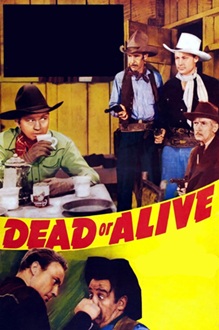


 Through the Shattered Lens