LAST OF THE DOGMEN – One of my favorites!


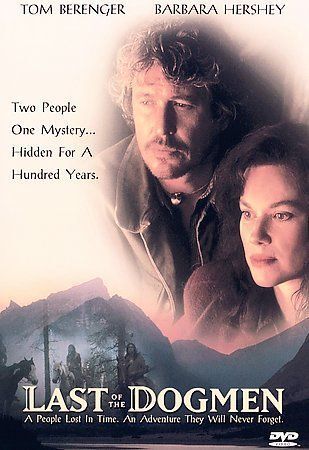
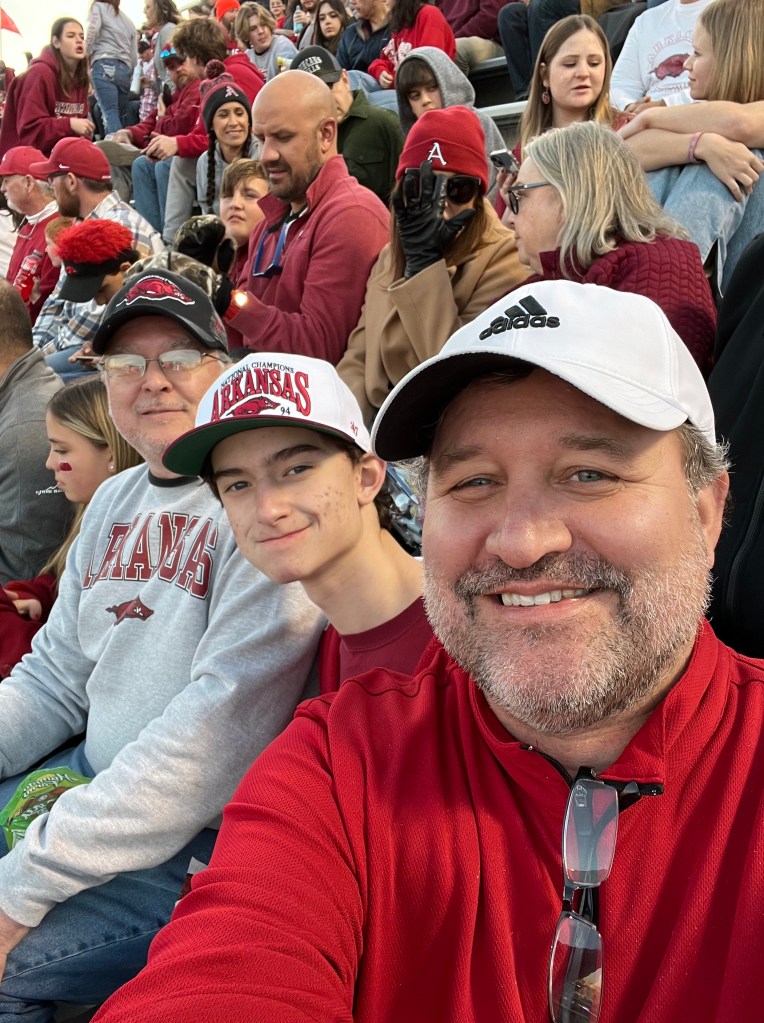
I don’t hear a lot about LAST OF THE DOGMEN, the 1995 modern day western starring Tom Berenger, Barbara Hershey and Kurtwood Smith. I love the movie, and I have for years. My buddy Chuck, his son Carter, and I recently drove up the hill to Fayetteville to watch the Arkansas Razorbacks play football. We had a great day! We ate at the Catfish Hole for lunch and then watched the Razorbacks beat Louisiana Tech 35-14. It was fun (See picture below for the happy crew). We had about a 3-hour drive home so we were talking about things we both love, like the Andy Griffith Show. Out of nowhere, Chuck said, “Do you want to know a movie I love? It’s called the LAST OF THE DOGMEN.” It was the last thing I was expecting to hear. I also love the movie. We talked about it and had a good time, but I made a mental note to watch it again soon. So here we are. 

LAST OF THE DOGMEN opens with Sheriff Deegan (Kurtwood Smith) trying to find three escaped convicts in Northwest Montana. Deegan calls in the best tracker he knows, Lewis Gates (Tom Berenger), to go into the mountains to find the convicts. The two men have a history as Gates was married to the sheriff’s daughter, and the daughter died. The sheriff clearly doesn’t like Gates and blames him for his daughter’s death, but he knows he’s the man for the job. With Gates and his genius dog Zip right on their tails, the convicts are mysteriously killed by a group of men on horses who shoot them with arrows. Gates see the men riding off through a fog and is convinced they are Indians. He ends up seeking out the help of Native American historian Lillian Sloan (Barbara Hershey) to help him understand what he may have seen. He’s able to convince Lillian to ride into the mountains with him because he needs a translator if he actually finds anyone, and the two head off into the Oxbow. After a week of roughing it, they’re about to give up when they suddenly find themselves surrounded by the Indian dog soldiers. They’re taken as prisoners to the Indian camp, where the leader of the dog soldiers, Yellow Wolf, has a sick son. It seems he was shot by one of the escaped prisoners. Gates heads back to town to get penicillin for the son, which ultimately saves his life. Gates and Lillian spend some time getting to know and respect this isolated Cheyenne tribe. Meanwhile, Sheriff Deegan, unable to forgive Gates for the death of his daughter, gathers a group of men and they head into the Oxbow to find Gates. Will the Indians be able to have peace and live their lives like they did in the 19th century, or will they be discovered and forced to live out the fates of their ancestors? Well, if you haven’t seen it, just watch and enjoy!

As I said earlier, I’m a big fan of LAST OF THE DOGMEN. I was initially interested in the movie because I like Tom Berenger as a leading man. His SHOOT TO KILL with Sidney Poitier is a big time personal favorite. I also like him in PLATOON, SOMEONE TO WATCH OVER ME, BETRAYED, MAJOR LEAGUE, SHATTERED, SNIPER and THE SUBSTITUTE. He had been a big sex symbol earlier in his career. By the time of this film, he’s getting a little too old and heavy to be a sex symbol. In THE LAST OF THE DOGMEN, he’s actually very funny, and I really enjoy watching him have fun on screen. I’ll also go ahead and say that I’ve never been a huge fan of the actress Barbara Hershey, but she keeps showing up in movies I love. Outside of this, she’s also in HOOSIERS, and it’s one of my favorites. While there’s something about her I don’t really like, she is pretty good, and I do like her chemistry with Berenger. When they finally share a big smooch towards the end of the film, I liked it. And what can I say about Gates’ Australian cattle dog Zip? He’s an integral part of the story and saves Gates & Lillian’s asses on multiple occasions. At one point in the story, Lillian says “it’s disconcerting to know that the smartest member in our expedition is a dog!” It’s true!

I think the thing I like the most about the LAST OF THE DOGMEN is the idea that a group of Cheyenne Indians could be living out their lives the way they did a century ago. Something about that is romantic and magical to me, and it gave me an emotional interest in the film. Isn’t that why we really love movies? The best ones can reach into our souls and find something that’s valuable to us. I love the idea of Cheyenne Indians living out their heritage and protecting it at all costs. There’s something simple and meaningful about that. Director Tab Hunter really leans into this emotional truth. It’s the only film he would direct, and it seems to share the one message that meant the most to him. Most of us would give anything to have an opportunity to share with the world who we really are. Hunter got that opportunity and shared this movie. That’s pretty cool to me.

Retro Television Review: Pigs vs. Freaks (dir by Dick Lowry)


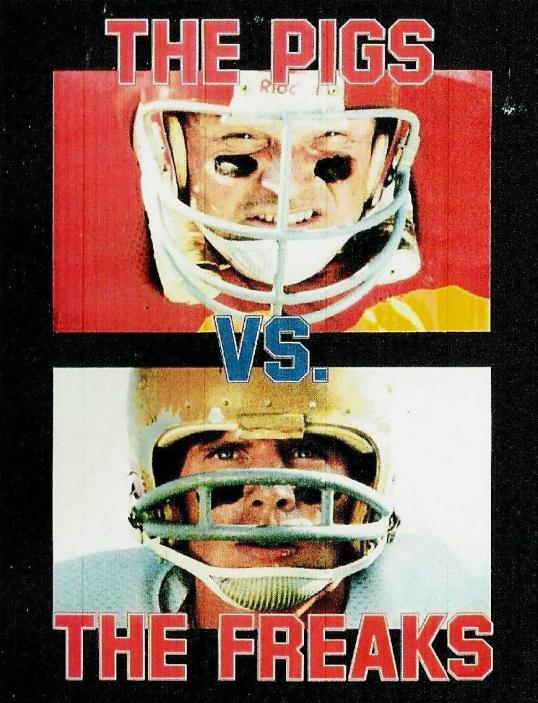
Welcome to Retro Television Reviews, a feature where we review some of our favorite and least favorite shows of the past!  On Sundays, I will be reviewing the made-for-television movies that used to be a primetime mainstay.  Today’s film is 1984’s Pigs vs. Freaks!  It  can be viewed on YouTube.

In the late 1960s, a small town is divided between the conservative older generation and their rebellious hippie children.  Former high school football star Doug Zimmer (Patrick Swayze) has just returned from fighting in Vietnam and, unlike many of his former classmates, he is firmly on the side of the establishment.  He wears his hair short.  He has a job as a cop.  He tries to keep his younger sister, Janice (Penny Peyser), from hanging out with hippies like his former best friend, Neal (Grant Goodeve).

Neal is also the son of the local police chief, Frank Brockmeyer (Eugene Roche).  Though Frank and Neal have different political beliefs and Frank is always telling Neal to get a haircut, they still have a respectful relationship.  When Neal complains that cops like Doug and his partner, Sgt. Cheever (Brian Dennehy), are always harassing the hippies who want to play football in park, Frank suggests a football game between the hippies and the police.  When Neal agrees, the game becomes known as “Pigs vs. Freaks.”

While Frank coaches the Pigs and signs a few former athlete as police reservists, Neal recruits his former little league coach, a bearded guru who now goes by the name of Rambaba Organimus (Tony Randall) to serve as the Freak’s coach.  He also places a call to a former football star named Mickey South (Adam Baldwin) and talks him into coming down from Canada to play in the game.  Of course, Mickey is wanted by the FBI for dodging the draft so it might not seem like a great idea for him to risk federal prison for an exhibition football game but no matter!  Who cares that there are now two federal agents watching the Freaks practice?  There’s a game to be won!

Pigs vs. Freaks is an amiable mix of comedy and drama.  Some of the comedy, like Tony Randall’s bearded guru and Stephen Furst’s perpetually frantic hippie linebacker, is a bit too broad but there’s enough moments of dramatic insight that it’s easy to overlook those flaws.  I appreciated the fact that both the Freaks and the Pigs are treated fairly, with both sides getting a chance to make a case for themselves.  When they first appear and start harassing the hippies for playing football in the park, it’s easy to dismiss both Doug and Cheever as fascists but a later scene, which is very well-played by both Brian Dennehy and Patrick Swayze, establishes them as just being two men who are confused by the direction of the world.  Swayze, in particular, gives a strong performance that reveals the vulnerability underneath Doug’s tough exterior.  As for the hippies, Mickey South is no self-righteous crusader but instead someone who feels the Vietnam War is wrong but who is also someone who both misses and loves his home country.  Adam Baldwin does a wonderful playing him and is well-matched with Grant Goodeve, who plays the most reasonable hippie that one could hope to meet.

It’s a likable film and well-intentioned, a portrait of two opposing groups brought together by the love of one game.  Some will cheer for the Pigs.  Some will cheer for the Freaks.  I cheered for both.

Retro Television Reviews: The Love Boat 1.17 “Winner Take Love / The Congressman Was Indiscreet / Isaac’s History Lesson”


Welcome to Retro Television Reviews, a feature where we review some of our favorite and least favorite shows of the past!  On Wednesdays, I will be reviewing the original Love Boat, which aired on ABC from 1977 to 1986!  The series can be streamed on Paramount Plus!
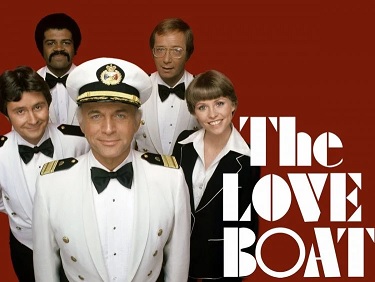
This week, things get awkward as we set sail on The Love Boat!

Episode 1.17 “Winner Take Love / The Congressman Was Indiscreet / Isaac’s History Lesson”

(Dir by Jack Arnold, originally aired on January 28th, 1978)

It’s the most awkward cruise ever!

A beauty contest is being held on the ship!  The winner becomes Ms. Pacific Princess and, along with getting a lot of money, she also sacrifices a year of her life so that she can go on free cruises and promote the Pacific Princess line.  Along with being beautiful, the winner is also expected to be “virtuous.”  Of course, judging from The Love Boat, the cruise line seems to specifically cater to people who are desperately looking to get laid so the rules seem to be a bit hypocritical.

The head of the contest, Waldo Linden (Graham Jarvis), recruits Captain Stubing to act as host.  Unfortunately, after Stubing gets a few laughs from the jokes that Waldo has written for him, the Captain turns into a prima donna.  He starts punching up the script on his own.  Waldo, however, has even more to worry about than the captain.  Suzy (Maureen McCormick), one of the contestants, is secretly traveling with her boyfriend, Rick (Bobby Sherman).  When Waldo tries to disqualify Suzy for not being “virtuous,” another contestant, the klutzy Jeanette (Priscilla Barnes), asks that Waldo help her zip up her dress and, after Waldo kisses her, she points out that Waldo hasn’t been living up to his own standards.  Due to Jeanette’s blackmail, Suzy is allowed to compete and she wins!  But then she refuses the crown so that she can marry Rick and, as a result, Jeanette becomes Miss Pacific Princess.

While that’s going on, scandal-plagued Congressman John Whitcomb (Dick Van Patten) falls in love with Robin Brandt (Vickie Lawrence).  What the Congressman doesn’t know is that Robin works for a tabloid newspaper and Robin’s editor expects Robin to report on whether or not allegations of an affair are going to led to Whitcomb resigning his seat. 

All of that is certainly awkward but it’s nothing compared to the third storyline.  Almost everyone loves passenger Virgil Gibson (played by the engaging Scatman Crothers), who is always the life of the party and who loves to make people laugh.  The only person who doesn’t like him is Prof. Stephanie Hayden (Vernee Watson), who is on the cruise to work on a study about African-American history.  Hayden feels the Virgil is acting like a fool and playing into all of the demeaning stereotypes that white people have about black people.  Hayden encourages Isaac to learn more about his background and soon, Isaac is being rude to Virgil and telling him not to call people “boss.”

Captain Stubing notices this.  He approaches Isaac — while Isaac is working — and says, “I notice you’ve been reading a lot of black history.”

AGCK!  As soon as the very white Captain Stubing says those words to Isaac, the cringing begins.

Stubing goes on to explain that Virgil was a pitcher in the Negro Baseball Leagues and that, if not for him, blacks would never have made it into the major leagues.  “And I wouldn’t be serving drinks on this cruise,” a remorseful Isaac says.  “And I wouldn’t be teaching,” Stephanie agrees.  Stubing goes on to explain that Virgil is acting the way he acts because that’s the way blacks were expected to behave when Virgil was a young man.  After being chastised by the ship’s white authority figure, Isaac and Stephanie agree that they were wrong to judge Virgil.

And, in many ways, Captain Stubing does have a point about judging people and Isaac and Stephanie were being a bit harsh in their dismissal of Virgil.  But that doesn’t change the fact that this episode features the extremely white Captain Stubing explaining black history to not only the ship’s only black employee but also a black college professor who has spent her entire academic career researching and writing about black history.  Stubing is essentially telling two black people how they should interpret and feel about black history.  It’s incredibly weird to watch and one has to wonder why the writers thought that Stubing — as opposed to Virgil himself — was the correct character to explain Virgil’s past and Virgil’s character.  It just doesn’t feel right, at all.

That said, there was a lot to like about this episode.  Scatman Crothers shows the same charm here that he showed in The Shining.  As cringey as Captain Stubing is when he lectures on black history, the plotline of him turning into a diva was actually pretty funny and Gavin MacLeod seemed to be having fun playing up the pompous side of the character.  The beauty pageant subplot was dumb but Maureen McCormick actually gave a pretty good performance as Suzy.  This episode had its moments though, in the end, it will always be defined by the awkwardness.


Film Review: Cold Turkey (dir by Norman Lear)


The 1971 satire, Cold Turkey, is the film that boldly explores just how much into the ground one joke can driven.

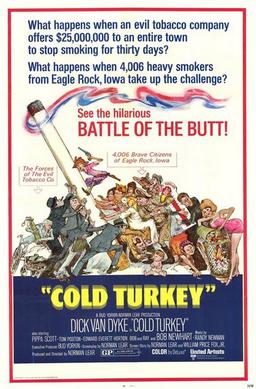
It’s a film that imagines what would happen if a big tobacco company decided to try to improve its image by giving people an incentive to quit smoking.  In the real world, of course, they ended up funding Truth.org and coming up with anti-smoking commercials that were so lame that they would make viewers want to go out and buy a pack of cigarettes just to spite the self-righteous people lecturing them during the commercial breaks.  In the film, however, Marwen Wren (Bob Newhart) comes up with the idea of offering to pay 25 million dollars to any community that can completely stop smoking for 30 days.

Wren figures that no large group of people will be able to just give up smoking for a month.  Not in 1971!  However, Wren didn’t count on the single-minded determination of the Rev. Clayton Hughes (Dick Van Dyke).  Hughes is the stern and self-righteous minister of Eagle Rock Community Church in Eagle Rock, Iowa.  He knows that Eagle Rock could really use that money so he sets off on a crusade to convince all 4,006 of the citizens of Eagle Rock to take the pledge to quit smoking.

As I said at the start of this review, Cold Turkey is pretty much a one-joke film.  The joke is that everyone in the movie — from the tobacco company execs to the citizens of Eagle Rock to Rev. Hughes — is an asshole.  They start the film as a bunch of assholes and, once they try to quit smoking, they become even bigger assholes.  Soon, everyone in town is irritable and angry.  The only people happy are the people who never smoked in the first place, largely because they’ve been set up as a sort of paramilitary border patrol.  Even though his anti-smoking crusade lands him on the cover of Time, Rev. Hughes is also upset because he started smoking right before it was time to quit smoking.  He deals with his withdraw pains through sex and frequent glowering.

Wren is concerned that the town of Eagle Rock might actually go for a full 30 days without smoking so he attempts to smuggle a bunch of cigarettes into the town and then runs around with a gigantic lighter that looks like a gun.  It’s a storyline that doesn’t really go anywhere but then again, you could say that about almost all of the subplots in Cold Turkey.  There’s a lot of characters and there’s a lot of frantic overacting but it doesn’t really add up too much.  Storylines begin and are then quickly abandoned.  Characters are introduced but then never do anything.  For a while, It seems like the film is at least going to examine the Rev. Hughes’s totalitarian impulses but no.  Those impulses are clearly there but they’re not really explored.

If I seem somewhat annoyed by this film, it’s because it really did have a lot of potential.  This could have been a very sharp and timeless satire but instead, it gets bogged down in its own frantic storytelling and the film’s comedy becomes progressively more and more cartoonish.  By the end of the movie, the President shows up in town and so does the military and it all tries to achieve some Dr. Strangelove-style lunacy but the film doesn’t seem to know what it really wants to say.  It seems to be setting itself up for some sort of grandly cynical conclusion but instead, it just sort of ends.  One gets the feeling that, at the last minute, the filmmakers decided that they couldn’t risk alienating their audience by taking the story to its natural conclusion.

Admittedly, while watching the film, I did find myself comparing Hughes and his bullying mob to the same people who are currently snapping at anyone who suggests that maybe the Coronavirus lockdowns were a bit excessive.  It’s easy to think of some modern politicians and media figures who probably would have had a great time in Eagle Rock, ordering people around and shaming anyone who wants a cigarette.  But otherwise, Cold Turkey was just too cartoonish and one-note to really work.

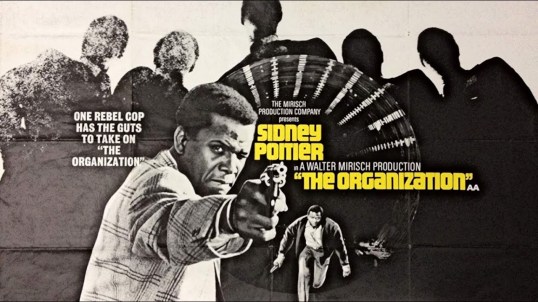
18 Days of Paranoia #14: The Organization (dir by Don Medford)


Sidney Poitier played Detective Virgil Tibbs for the third and final time in the 1970 film, The Organization.

This time, Virgil is investigating a murder at an office building in San Francisco.  It’s a very odd murder, in that an executive was shot, a security guard was bludgeoned, and even though it looks like there was a robbery taking place, nothing appears to have actually been stolen.  Since neither the company nor the executive were believed to be involved in anything shady, Virgil finds himself perplexed as to why any of this has happened at all.

Fortunately, the local urban revolutionaries are here to help!  They contact Virgil and Virgil reluctantly agrees to meet with the group, which is made up of the usual collection of angry 1970s activists — i.e., a dissident preacher, a reformed drug dealer, a guy who won’t stop yelling, and a woman who is obviously going to be killed before the movie is over.  The revolutionaries explain that they were the ones who broke into the office but they also say that they didn’t kill anyone.  Instead, they broke into the office because they wanted the police to investigate the break-in and discover that the company was a front for a bunch of drug dealers.  “The Organization” is flooding poor and minority neighborhoods with heroin and the revolutionaries want to stop them.  In fact, the revolutionaries have stolen four million dollars worth of heroin.  Now, they want Virgil to help them.

Even though Virgil is sympathetic to the revolutionaries, he’s still a cop and he can’t get directly involved with illegal activities.  Instead, he agrees to not arrest the revolutionaries and to continue his investigation, in the hope of bringing down the Organization.  It’s not going to be easy, of course.  There’s evidence that the Organization may even have agents inside the San Francisco police department.

As far as the Virgil Tibbs movies are concerned, The Organization is slightly better than They Call Me Mister Tibbs! but it’s nowhere near as good as the one that started it all, In The Heat of the Night.  Probably the biggest flaw with The Organization is that Virgil has to share the spotlight with the revolutionaries.  With the exception of Raul Julia (who plays a former drug dealer named Juan), none of the revolutionaries are particularly memorable characters and their plan for taking down The Organization is so unnecessarily convoluted that it’s hard to believe that Virgil would go along with it.

On the plus side, The Organization works fairly well as a conspiracy thriller.  It does manage to create a consistent atmosphere of unease and mistrust.  This is one of those films where people are constantly getting shot by unseen gunmen mere minutes after getting arrested and the fact that even cool and in-control Virgil Tibbs can’t save them does a lot towards creating a nice sense of paranoia.  The films end on perhaps the most downbeat note of all of the Virgil Tibbs movies, suggesting that, in the end, everything we’ve just watched was for nothing.


Other Entries In The 18 Days Of Paranoia:

  1. The Flight That Disappeared
  2. The Humanity Bureau
  3. The Private Files of J. Edgar Hoover
  4. The Falcon and the Snowman
  5. New World Order
  6. Scandal Sheet
  7. Cuban Rebel Girls
  8. The French Connection II
  9. Blunt: The Fourth Man 
  10. The Quiller Memorandum
  11. Betrayed
  12. Best Seller
  13. They Call Me Mister Tibbs


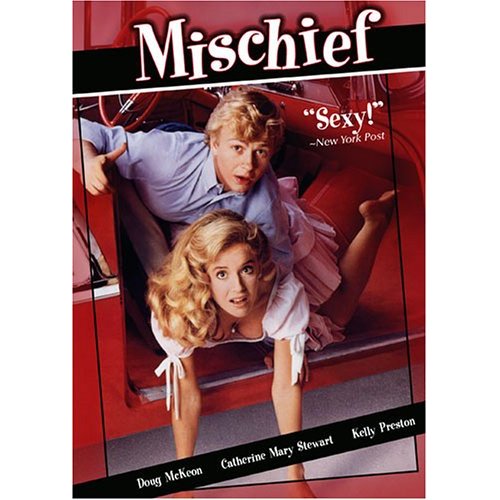
Back to School #36: Mischief (dir by Mel Damski)


Mischief

Have you ever noticed how, occasionally, a totally obscure film that was made several decades ago will suddenly show up on either Starz or Encore and, the next thing you know, it’s only like every other day?  That was the case a few months ago when, at times, it seemed as if the only thing playing on cable was a teen comedy from 1985 called Mischief.

After I saw it listed in the guide a few dozen times, I thought to myself, “Somebody at that station must really like that movie.”  So, one night, I actually took the time to watch it and discovered why that mysterious person loved this movie.  Mischief may not be as well-known as some of the other films in this series of Back to School reviews but it’s still a pretty good movie.

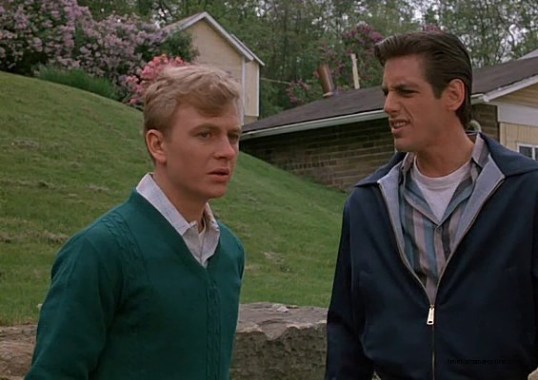
Like so many of the teen films that were released in the 70s and 80s, Mischief takes place in the 1950s.  (I assume that’s because most films about teenagers are made by adults who want to both relive and perhaps change the past.  I suppose that’s one reason why so many films released today are set in the 1990s.  In another ten years or so, all of the new high school films will be set in 2003.)  The very shy and clumsy Jonathan (Doug McKeon) has a crush on the beautiful but unattainable Marilyn (Kelly Preston).  Fortunately, Jonathan is befriended by Gene (Chris Nash) who is the prototypical rebel without a cause.  Gene wears a leather jacket.  Gene rides a motorcycle.  Gene doesn’t get along with his alcoholic, violin-playing father (Terry O’Quinn, in full asshole mode here).  Gene even stands up to the school bully (D.W. Brown) and starts dating the bully’s ex-girlfriend, Bunny (Catherine Mary Stewart).  Most importantly, Gene helps Jonathan finally develop the confidence necessary to ask Marilyn out.

And, for a while, Gene & Bunny and Jonathan & Marilyn make for the perfect foursome.  But, as we all know, perfection can never last in a coming-of-age story.  Jonathan starts to discover that he and Marilyn are not quite as compatible as he originally assumed that they were.  As for Gene, he has to deal with his increasingly violent and drunken father…

That last paragraph probably makes Mischief sound a lot more dramatic than it actually is.  Make no mistake about it — while Mischief does deal with some serious issues — it is primarily a comedy and a pretty good one at that.  McKeon is endearingly clumsy in his initial attempts to get Marilyn to notice him and Nash — even though he’s playing a very familiar character — is likable as well.  Perhaps the smartest thing that Mischief did is that it made Gene cool but it didn’t make him too cool.  The film’s best scenes are the ones where Gene momentarily surrenders his rebel facade and reveals that he’s just as confused as everyone else.  Catherine Mary Stewart and Kelly Preston are well-cast as well, with Preston especially doing a good job at making a potentially unsympathetic character likable.

In many ways, Mischief is a pretty predictable film.  I think it features probably every single cinematic cliché that one would expect to see in a film about the 50s.  But the film itself is so likable and good-natured that it doesn’t matter if it’s predictable.  It’s just a good, enjoyable movie and what’s wrong with that?

(Incidentally, the screenplay for Mischief was written by Noel Black, who also directed the previously reviewed Private School.)

1327550371_1447726