Ted 2 Sucks!


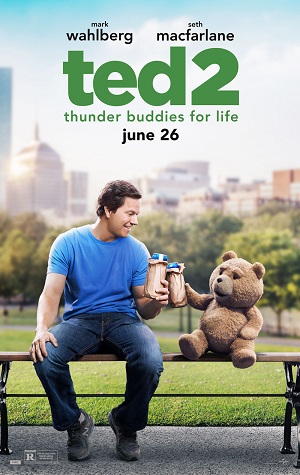
Ted_2_posterWell, I think the title of this review pretty succinctly sums up my reaction to Seth McFarlane’s latest film, Ted 2.  Thanks for reading and have a good…

Oh, really?

Okay, I’ve been told that I have to try to think up at least 300 words to say about Ted 2.  Otherwise, in the eyes of Rotten Tomatoes, we’re not a legitimate film blog.

*sigh*

Okay.

Anyway, Ted 2 is the story of a talking teddy bear (voice by Seth McFarlane) who likes to smoke weed and … well, that’s about it.  He’s just gotten married to Tami-Lynn (Jessica Barth) and they’re having trouble because Tami-Lynn wants a baby but Ted, being a teddy bear, doesn’t have any reproductive organs.  So, he and his friend John (Mark Wahlberg) decide to give Tom Brady a handjob so they can still his sperm.  But, it turns out, none of that was important because the state of Massachusetts claims that Ted is not even a person.  Instead, he’s just “property.”  So, now, John and Ted and their lawyer, Sam (Amanda Seyfried), are fighting the courts to win Ted his civil rights.  And then Giovanni Ribisi wants to kidnap Ted and Morgan Freeman shows up and says a few words.  And the film is narrated by Patrick Stewart because it’s funny to hear Patrick Stewart curse and…

Oh!  And Liam Neeson shows up.  He’s a customer at the store where Ted works as a cashier.  Liam wants to know if Trix are only for kids.  The joke here is that it’s Liam Neeson and he’s asking about cereal.  Ha ha.

Oh!  And there’s two guys who shows up at New York Comic Con so that they can beat up “nerds.”  During every scene set at Comic Con, they’re in the background beating people up and insulting them.  And the two guys are gay!  See, they’re bullies and they’re gay!  And they’re beating up random people at Comic Con, just because they can!  Hilarious, right?

Ted 2 spends a lot of time trying to convince us that Ted’s struggle to be recognized as a person is actually meant to be a metaphor for the American civil rights movement.  But, honestly, I get the feeling that McFarlane relates more to the bullies than he does to any oppressed minority.  As he previously proved with his TV shows and A Million Ways To Die In The West, McFarlane is only interested in going after easy targets.  He’s your typical white male hipster who thinks that, because he voted for Obama, he can get away with telling racist jokes.

And, before anyone misunderstands, I wouldn’t mind McFarlane’s humor if it was at least funny or original.  But instead, it’s the same stupid jokes that he always tells.  Seth McFarlane’s comedic technique is to basically drag things out until viewers laugh from pure exhaustion.  Is it effective?  Well, there are people who continue to praise and defend him and Seth certainly has made a lot of money off of his act.  So, obviously, there are people who respond to this.  But to me, Seth McFarlane’s humor just feels lazy.

Ted 2 lasts 128 minutes.  That’s over two hours devoted to a concept that feels more appropriate for a five-minute skit.  Interesting enough, the first Ted was tolerable because it focused on Mark Wahlberg’s Johnny.  Ted was just a supporting character and he worked as a metaphor for Johnny’s struggle to choose between growing up or being a happy slacker.  (The first Ted was all about Johnny falling in love with Mila Kunis, whose character is rather cruelly dismissed at the start of Ted 2.)  In Ted 2, Ted is the central character and once you get over the fact that he’s a teddy bear who drops multiple F bombs, there’s really not much to the character.  It helps, of course, that we only have to listen to McFarlane.  We don’t have to look at his imminently punchable, oddly lineless face.  But, to be honest, even McFarlane’s voice has become grating.  It’s just so self-satisfied and smug.

I saw Ted 2 with the blogger also known as Jedadiah Leland.  Over the course of 128 hours minutes (it just felt like hours), we each laughed once.  Not surprisingly, both laughs were inspired by Wahlberg’s dumb-but-sweet performance.  Now, I will admit that the rest of the audience laughed a bit more than we did.  But still, there was a definite atmosphere of resignation in the theater.  You could literally hear the people thinking, “Oh, Ted just made a joke about black people.  Better laugh now so everyone knows that I get whatever the Hell this is supposed to be.  After all, those tickets weren’t free…”

What’s the word count now?

758?

Cool.

That’s enough words for me to say, “Ted 2 sucks!”


Scenes I Love: Saving Private Ryan


SavingPrivateRyan

Today marks the 71st Anniversary of the Normandy Landings on D-Day. As the day winds down I thought it best to share one of my favorite scenes from a film that tried to capture the chaos and death of the fateful day on June 6, 1944. The film in question is Steven Spielberg’s Saving Private Ryan. This is the film which won him his second Best Director Oscar (I still think the film should’ve won Best Picture over Shakespeare In Love) and the film which helped redefine not just how war films were shot from 1998 on, but also de-glorify World War II on film.

This scene showed the opening moments of the D-Day Landings on Omaha Beach in Normandy, France. It’s a scene that’s over 22-minutes in length and shows the utter chaos and destruction heaped on American troops as they attempted to land on the beach to take their objectives. While there have been war film before Saving Private Ryan that depicted war as the hell it truly is they were mostly about the Vietnam War. Rarely did we ever get a World War II-based war film which showed war in realistic fashion. Spielberg broke that taboo by making the battle scenes in his film — especially this extended opening sequence — done as realistic as possible without actually having people killed for real on-screen.

When this film first came out in the summer of 1998 no one knew what to make of it. This opening sequence became the talk of everyone who went to see the film. To say that they were shocked by what they saw was an understatement. Even now with over a decade since the film was released and people having seen this scene over and over again it still retain it’s impact. It’s not even the grand scale of the production required to film this action sequence which made this scene so memorable. It were the little things. Like a mortally wounded American GI crying out to his mother while trying to keep his blown out insides from spilling out. Then there’s the scene of another young soldier praying furiously with his rosary beads as men around him die by the score.

This scene also showed what most World War II films of the past failed to do. It showed both sides behaving barbarically. In the past, only the Germans were shown in a bad light. In Saving Private Ryan, we see that American soldiers were also prone at shooting surrendering troops and/or not mercy-killing enemy soldiers being burned alive (actions that have been well-documented by historians). This scene also showed just how courageous the young men of this generation which Tom Brokaw has called “The Greatest Generation”. Men who went off to war not for material gains, but for an idea that they had to stop evil (Nazi and Hitler) from taking all of Europe and, maybe, the world itself.

There’s a reason why Saving Private Ryan is in my list for greatest films of all-time and why this scene remains one of my all-time favorites.

Back to School #59: The Virgin Suicides (dir by Sofia Coppola)


the-virgin-suicides-the-virgin-suicides-189395_1020_576

For the past three and a half weeks, I’ve been taking a chronological look at some of the best, worst, most memorable, and most forgettable teen and high school films ever made.  We started with two films from 1946, I Accuse My Parents and Delinquent Daughters.  Therefore, it seems somewhat appropriate that we close out both the 90s and the 20th Century by taking a look at a film about both delinquent daughters and accusatory parents.  That film is Sofia Coppola’s 1999 directorial debut, The Virgin Suicides.

Much like Wes Anderson, Sofia Coppola seems to divide viewers and, in many ways, for the exact same reasons.  You either get her films about upper class ennui or you don’t.  Everyone seems to love Lost in Translation but viewers and critics seem to be far more polarized when it comes to rest of her films.  It seems the people either love them or hate them.  Well, you can count me among those who love her films.  (Yes, even Somewhere.)  To me, Sofia Coppola is one of the most consistently interesting filmmakers working today and the dismissive reaction that many (mostly male) critics have towards her films has little do with her talent and much more to do with her gender and her last name.

So there.

In The Virgin Suicides, Coppola tells the story of the five Lisbon sisters.  They live in an upper middle class suburbs in the 1970s.  Their parents — math teacher Ronald (James Woods) and his wife (Kathleen Turner) — are devoutly Catholic and very protective.  The Lisbon sisters are rarely allowed to leave the house and, as a result, the neighborhood boys are obsessed with them.  (Though the film centers on four unnamed boys, there’s only one narrator, voiced by Giovanni Ribisi,  who continually refers to himself as being “we,” as if all four boys are telling the story in the same voice.)  When the youngest Lisbon daughter commits suicide, Ronald and his wife become even more protective.

At the start of the school year, the oldest daughter, Lux (Kirsten Dunst), meets and starts to secretly date the wonderfully named Trip Fontaine (Josh Hartnett).  Lux is even allowed to attend the homecoming dance with Trip but, after she breaks curfew, Mrs. Lisbon reacts by pulling Lux and her sisters out of school and basically making them prisoners in their own home.

(In one of the film’s best moments, we flash forward to see present day Trip talking about his date with Lux. Needless to say, Trip did not age well.)

With the Lisbon sisters even more isolated, the neighborhood boys become even more obsessed with them.  One day, the boys get a note from the girls, asking for their help in escaping.  The boys go to meet the girls, leading the film to its haunting conclusion…

Full of themes of sin, sexuality, repression guilt, redemption, and martyrdom, The Virgin Suicides is one of those films that you don’t have to be Catholic to appreciate but it probably helps.  James Woods, Josh Hartnett, and Kirsten Dunst all give good performances while Sofia Coppola fills the movie with dream-like and sensual images, all designed to challenge the viewer’s perception of whether or not we’re watching reality or just the idealized memories of someone still struggling to comprehend a mystery from the past.

The Virgin Suicides is the perfect movie to end with the 90s on.

1

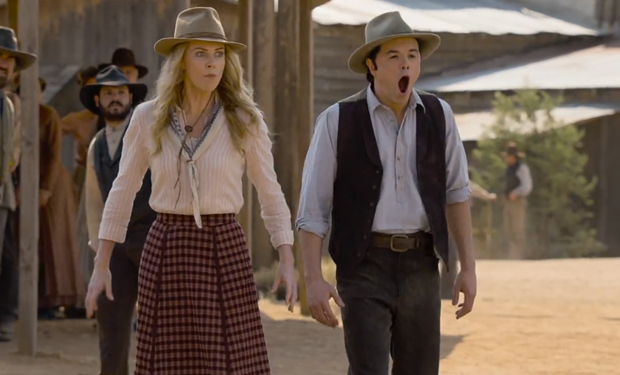
Lisa’s Homestate Reviews: New Mexico and A Million Ways To Die In The West


million-ways-fix

My family lived in Carlsbad, New Mexico from January of 1991 to July of 1992.  I was only 5 years old when we arrived and 6 when we left so I really can’t say that I remember that much about Carlsbad, beyond the fact that my mom was always worried about rattlesnakes, I was excited about going to kindergarten and that, when my Dad announced that we were moving to Oklahoma, I cried and cried because, even at that age, I knew that meant I’d never get to see my friends again.

So yeah, some of my memories of New Mexico are a little traumatic.  But are they as traumatic as watching Seth McFarlane’s A Million Ways To Die In The West, a film that was shot in New Mexico and which is an early front-runner for claiming the title of worst of 2014?

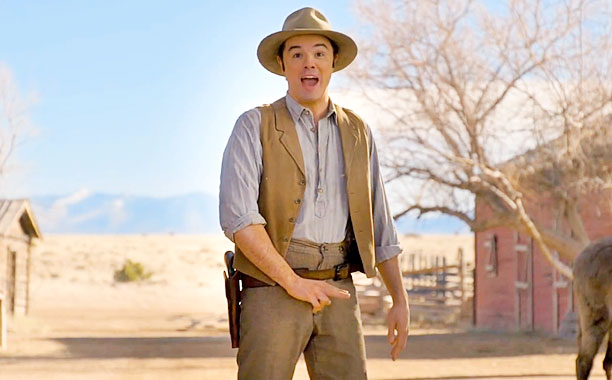
Written by, produced by, directed by, and starring Seth McFarlane, A Million Ways To Die In The West tells the story of a sheep farmer named Albert (played by Seth McFarlane) who basically spends the entire movie whining about how much he hates living in the old west.  His girlfriend leaves him for … well, look, the plot is stupid.  You knew the plot was going to be stupid when you first saw the trailer earlier this year.  You probably even knew the film wasn’t going to be that good.  However, as bad as you might think the film is, it’s nothing compared to how bad the movie actually is.  And the blame pretty much rests with Seth McFarlane.

Seth McFarlane has got cold, dead eyes and a curiously unlined face that, when taken along with his ever-present smirk, tends to make him look like one of those horror movie mannequins that comes to life once the store closes and murders horny teenagers.  I understand that it’s always been a part of McFarlane’s act to present himself as being an asshole with a heart of gold but, for the most part, that works best when you only have to deal with his voice.  The minute that you see his smug face, which is as immobile as his voice is expressive, the heart of gold part disappears.  All your left with is an asshole who insists on telling the same joke over and over again.  As both a comedic writer and director, McFarlane’s technique is to basically beat the audience into submission, dragging jokes out to such an interminable length that you eventually laugh because you simply cannot believe that you’re wasting so much time watching this crap.  Some people have mistaken that technique for genius.  Those people should be forced to watch A Million Ways To Die In The West in much the same way that Malcolm McDowell was forced to watch violent movies in A Clockwork Orange.

(And I write all of that as perhaps the only woman in the world who was not offended by Seth McFarlane singing The Boob Song at the Academy Awards, if just because the joke was clearly meant to be at the expense of McFarlane and the overage frat boys who seem to make up his fan base.)

A Million Ways to Die In The West is full of familiar faces.  Liam Neeson goes totally overboard as the film’s villain.  Neil Patrick Harris, as usual, is fun to watch, or at least he is until he’s forced to take part in one of McFarlane’s trademark endless musical numbers.  Eventually, Harris’s character gets slipped a laxative and it’s just as disgusting as it sounds.  Giovanni Ribisi plays McFarlane’s best friend and his joke is that he’s a Christian (yes, Seth takes on Christianity — what a rebel!) and that his girlfriend (Sarah Silverman, who deserves better) is a prostitute who is willing to have sex with everyone but him.  Amanda Seyfried has the thankless task of playing McFarlane’s girlfriend while Charlize Theron plays the enigmatic woman who teaches Seth how to shoot a gun.  (Theron gives a far better performance than this movie deserves and it was hard not to wish that the entire film had just been about her character.)  There are also several celebrity cameos — Ryan Reynolds, Christopher Lloyd, and even Jamie Foxx show up.

But, ultimately, the entire film is about Seth McFarlane.  He wrote it, he directed it, and he stars in it.  Seth McFarlane dominates this film and that’s the problem.  What might be slightly amusing in a 22-minute cartoon is not going to be funny enough to sustain a nearly two-hour film.  For a rambling and often aimless film like A Million Way To Die In The West to succeed, it needs a star who is both skilled at comedy and likable enough that he’ll be able to anchor the mayhem.  (Seth Rogen, for instance.)  Instead, we’re given a smirking Seth McFarlane and the end result is a film that somehow manages to be both forgettable and a disaster.

Now, you may be wondering how I ended up watching this film.  Well, originally I wasn’t planning on ever seeing it but then I started to read reviews about how terrible it was and I was like, “This is a film that I definitely need to see for myself, so that I can see if the film is actually a misunderstood masterpiece or if it’s a film that I’m going to have to keep in mind when I’m compiling my annual list of the year’s worst films.”  (Plus, when I arrived at the theater, The Fault In Our Stars was sold out.)  But anyway, I sat through it and I forced my sister Erin to watch it with me and I think Erin may be on the verge of finally forgiving me.

Finally, what was more traumatic?  Leaving behind my friends or watching this movie?

Too close to call.

A-MILLION-WAYS-TO-DIE-WEST

Film Review: Gangster Squad (dir by Ruben Fleischer)


Gangster Squad

Do you remember Gangster Squad?

This film, which tells the story of hard-boiled cops and psychotic gangsters in 1940s Los Angeles, was originally meant to be released in September of 2012 but the release date was moved back because the film originally featured a gun battle in a movie theater.  After the real-life movie theater shooting in Aurora, Colorado, that scene was reshot and the release of Gangster Squad was delayed until January of this year.  The critics absolutely hated it, audiences stayed away, and Gangster Squad was the first high-profile flop of 2013.

I was among those who ignored the film when it was first playing at theaters.  After all, it was January and I was more interested in following the Oscar race than going to see a film that, by all accounts, was somewhat terrible.  However, now that Gangster Squad is showing up on a nearly nightly basis on Cinemax, I recently got a chance to see the movie and you know what?

The critics were wrong.

Gangster Squad tells a familiar story.  In fact, the film features not a single character or plot twist that hasn’t shown up in another movie.  The setting is Los Angeles in the 1940s.  Ruthless gangster Mickey Cohen (a totally over-the-top Sean Penn) is the king of the city’s underworld.  How crazy is Mickey Cohen?  He’s so crazy that, when we first see him, he’s watching as another gangster is literally ripped in half.  He’s so crazy that, in the middle of a gun battle, he yells, “Here comes Santy Claus!” as he fires his machine gun.  That’s how crazy Mickey Cohen is.

Sean Penn in Gangster Squad

Seriously crazy.

Fortunately, righteous police chief William H. Parker (Nick Nolte) refuses to allow a little thing like due process to keep him from pursuing Mickey.  Parker calls Sgt. John O’Mara (Josh Brolin) to his office and, after delivering a long and flowery monologue that verges on incoherence, he finally explains that O’Mara’s mission is to put together an elite squad of cops and to take Mickey out by any means necessary!  (Usually, I try to exercise some restraint when it comes to punctuation but Gangster Squad is one of those films that demands exclamation points.)

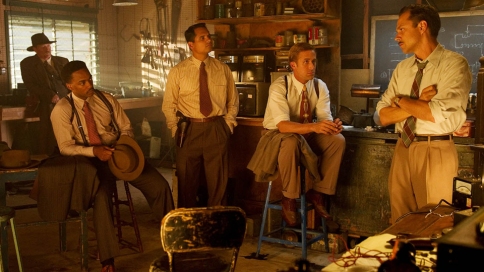
This is followed by a series of properly colorful scenes in which O’Mara recruits his gangster squad.

Jerry Wooters (Ryan Gosling) is a cynical World War II veteran who is, at first, skeptical of O’Mara and his squad.  Wooters, however, changes his mind after a saintly shoeshine boy is gunned down in front of him.  Wooters is also having an affair with Grace Faraday (Emma Stone), who happens to also be Cohen’s girlfriend.

Coleman Harris (Anthony Mackie) is a black cop who is good with a knife and who lost his cousin to the heroin distributed by Cohen’s mob.  Watching the friendly and playful interaction between Harris and all of the film’s white characters provides us with one of our first clues that Gangster Squad is not necessarily aiming to be a historically accurate portrait of America in the 1940s.

Conway Keeler (Giovanni Ribisi) is a wiretapper and a family man.  Keeler’s fate is pretty much sealed the minute that he tells O’Mara that he’s willing to risk death just to make the world a better place for his son.

Max Kennard (Robert Patrick) is a former old west gunslinger who now spends his time killing gangsters.  Max, we’re told, may be old but he’s also personally shot over a 100 gangsters.  Max also has a younger partner, an honest cop named Navidad Ramirez (Michael Pena).

GANGSTER SQUAD

The Gangster Squad

As you can probably guess at this point, there’s not a single cliché that is not employed by Gangster Squad.  However, and this is what I think several critics missed, the film deliberately takes its clichés to such an extreme that they go from being flaws to being strengths.  By so enthusiastically going overboard in its embrace of the conventions of the gangster film genre and, at the same time, acknowledging the fact that the audience is also familiar with those clichés, Gangster Squad creates its own vibrant and compulsively watchable fantasy world.  The world of Gangster Squad has little to do with any sort of historical reality.  Instead, it’s a  world constructed solely out of other gangster movies.

Taking all of this (and the fact that the film is directed by Ruben Fleischer of Zomieland and 30 Minutes or Less fame) into consideration, it’s pretty obvious that Gangster Squad is not a film that’s meant to be taken seriously.  And yet, that’s what so many critics did when the film was first released in January.  Instead of appreciating the film for paying over-the-top homage to the gangster films of the past, critics attacked it for being an example of style over substance.

And, to give the critics their due, they were exactly right.  There is no substance to Gangster Squad.  Instead, the film is a total celebration of style.

And what style!  In Fleischer’s hands, 1940s Los Angeles is a colorful wonderland of pure excess, a vibrant landscape of dark alleys and swanky nightclubs that literally glow on-screen and are populated by tough men and sultry women in clothing that might not have been found hanging in every closet in the 40s but should have been.  (Seriously, when Emma Stone first appears on-screen, she’s wearing a red gown that is simply to die for.)

This Christmas, I want both Ryan Gosling and the dress.

This Christmas, I want both Ryan Gosling and the dress.

For the viewer who is willing to give themselves over to the film’s over-the-top aesthetic and are willing to appreciate it for what it is (as opposed to condemning it for what it isn’t), Gangster Squad is a watchable, entertaining, and fun movie.  And what’s so bad about that?

I’m glad that I finally got a chance to see Gangster Squad.  Is it one of the great gangster films?  No.  The great gangster films have both style and substance but, quite frankly, if I can only have one than I would prefer something stylish and fun like Gangster Squad to something like Killing Them Softly.

(Then again, I would prefer just about anything to sitting through Killing Them Softly for a second time.)

So, enjoy Gangster Squad.  Watch it for the style.  Have fun.  And most importantly, remember that critics are as often wrong as they are right.

Emma Stone in Gangster Squad

A Quickie With Lisa Marie: The Rum Diary (dir. by Bruce Robinson)


My sister Erin and I went and saw The Rum Diary on Tuesday and wow, was it ever a disappointment.  The commercials make it look like a wild comedy featuring Johnny Depp looking all sexy and decadent but, in reality, the film is kind of a mess that is almost schizophrenic in its attempts to be more than the sum of its parts.

Johnny Depp plays Paul Kemp, an alcoholic writer who goes to Puerto Rico in the early 60s and takes a job writing horoscopes for the local newspaper.  The job leads to him drinking a lot and hanging out with characters who are sweaty and so generally grimy that it’s borderline revolting to even see them on-screen.  (Giovanni Ribisi, giving a distressingly bad performance, is the main offender.)  Paul also ends up kinda befriending (but not really) a businessman named Sanderson (Aaron Eckhart), who you know is a bad guy because he’s the only character who dresses in pastels.  Anyway, Sanderson has a girlfriend named Chenault (Amber Heard) and Chenault really has no purpose for existing other than for Paul to fall in love with her and save her from a terrible future of being married to a rich, handsome man.  The film starts out as a comedy and then, after about an hour, it suddenly turns all serious and preachy.  It’s as if the film can’t decide whether it wants to be an unfunny comedy or a laughable drama.

Luckily, Johnny Depp is on screen for nearly the entire film and, as we watched, Erin and I quickly learned that the best way to enjoy The Rum Diary is just to allow yourself to be carried away by the Deppness of it all.  Don’t think about how the film’s kind of a mess and how Aaron Eckhart is more of a designated villain than a real villain and ignore the fact that Chenault is a sexist fantasy and tune out the preachy dialogue and try not to think about how everyone appears to have had more fun making the film than you’re having watching it, and just concentrate on Johnny Depp being all kinds of sexy.  

If you do that, The Rum Diary is a tolerable 2 hours.