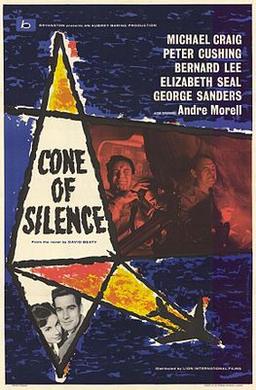
Cone of Silence (1960, directed by Charles Frend)


Cone of Silence is a very British film about aviation.

George Sanders plays an investigator who is looking into a crash of a “Phoenix” jetliner.  The crash has been blamed on the pilot, Captain George Gort (Bernard Lee).  Because Gort was killed in the crash, he is not around to defend himself.  Gort had a previous crash on his record and had also been reprimanded for flying to low when he landed a flight in Calcutta.  To Phoenix Airlines, Gort is the perfect scapegoat but a series of flashbacks reveals that Gort was a good pilot and that the cowardly Captain Clive Judd (Peter Cushing) was responsible for the incident in Calcutta.  Captain Hugh Dallas (Michael Craig) tries to exonerate Gort’s name before another crash occurs.

Cone of Silence is named not for the famed listening device from Get Smart but instead for a key part of Gort’s certification process, where he has to fly a plane without being able to hear anyone or anything else around him.  That Gort manages to do so is one of the things that leads to Dallas believing the Gort couldn’t have been responsible for the later crash.  Bernard Lee is best-known for playing James Bond’s unflappable superior, M, and it’s interesting to see him playing a much more neurotic character in Cone of Silence.  Gort is a good pilot but he knows that, after his first crash, no one trusts his judgment and everyone is expecting him to fail and it gets to him.  It does not help that he has to deal with the weaselly Captain Judd, who is looking to blame anything that happens on Gort.  Cushing does a good job of playing Judd as someone who is outwardly friendly but who is ultimately only looking out for himself.

Cone of Silence was released at a time when jet travel was still considered to be a luxury and pilots were viewed as being the men who could do the impossible.  Not surprisingly, the film is full of lengthy scenes in which Captain Dallas and others explain every step that goes into flying a jet.  Great care was taken to get every detail right, even if it meant limiting the film’s dramatic potential.  This may have been fascinating to audiences in 1960, many of whom had never traveled on a plane, but today, Cone of Silence can feel dry and overly talky.  It’s good to see Sanders, Lee, and Cushing all in the same film but Cone of Silence is never as compelling as its cast.
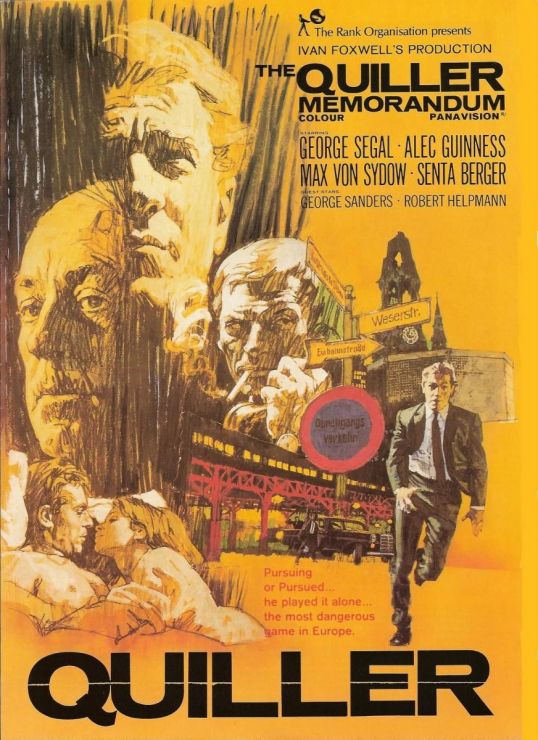
18 Days of Paranoia #10: The Quiller Memorandum (dir by Michael Anderson)


The 1966 film, The Quiller Memorandum, is a diabolically clever little spy thriller.

The film opens with a British secret agent getting gunned down while trying to make a call from a phone booth in Berlin.  While we never learn the exact name of the agency that the man was working for, we do discover that they don’t take kindly to their agents getting gunned down in phone booths.  They send in another agent, an American named Quiller (George Segal), to take his place.

In Berlin, Quiller’s boss is a man named Pol (Alec Guinness).  Pol explains that the man in the phone booth was actually the second of his agents to be assassinated in Berlin.  All of the agents were looking for information about a Neo-Nazi group called Phoenix.  Pol tells Quiller that it is vitally important they discover just where, in Berlin, Phoenix is headquartered.  Quiller is given a few items that were found on the dead man in the phone booth: a bowling alley ticket, a swimming pool ticket, and a newspaper article about a school where it was discovered that one of the teachers had Nazi sympathies.

Though The Quiller Memorandum was undoubtedly produced with the hopes of capitalizing on the popularity of the Bond films, Quiller is no James Bond.  We know that as soon as we see him.  It’s not just that Quiller’s an American while Bond was British.  It’s also that James Bond was played by the cool and calculating Sean Connery while Quiller is played by George Segal.  Whereas Connery’s Bond never loses his confidence, Segal’s Quiller comes across as being, at first, a bit cocky and, as a result, we worry about him.  Whereas Connery’s Bond rarely gave his actions a second thought, Segal brings a slightly neurotic edge to Quiller.  You take one look at Connery’s Bond and you know that he’s going to survive no matter what.  Quiller, however, you never get that feeling.  When he’s in danger, you worry about him because it’s easy to imagine him turning up like the man in the phone booth.

And, indeed, it doesn’t take long for Quiller to get captured by the members of Phoenix.  A man bumps him with a suitcase, injecting a drug into his system that makes Quiller become drowsy.  When Quiller awakens, he’s being interrogated by an erudite man named Oktober (Max von Sydow).  Oktober’s an aristocrat.  He speaks in a very calm tone, rarely showing any hint of anger.  The only thing that betrays his evil nature are his eyes, which are cold and soulless.

Even though Quiller survives the interrogation, it’s tempting to give up on him.  After all, Quiller got captured so easily and Oktober seems so clever that you kind of find yourself wondering if maybe the agency made a mistake when they gave this mission to Quiller.  That’s where The Quiller Memorandum surprises you, though.  Quiller turns out to be a lot more clever and resourceful than anyone gave him credit for being and, for that matter, the film itself turn out to have a few more twists and turns in store for the viewer.

It’s a clever and enjoyable spy film, featuring wonderful performances from Segal, Guinness, von Sydow, and Senta Berger as the teacher who may be in love with Quiller or who may have an agenda of her own.  The film may be a spy thriller but Michael Anderson directs it as if its a film noir, full of shadowy streets and morally ambiguous characters.  The script, by Harold Pinter, encourages us to trust no one and Anderson’s direction reminds us that we made the right decision.  On the dark streets of Cold War Berlin, no one is who they seem.

The Quiller Memorandum is a must-see for fans of 60 spy films.  Watch it with someone who you think you can trust.

Other Entries In The 18 Days Of Paranoia:

  1. The Flight That Disappeared
  2. The Humanity Bureau
  3. The Private Files of J. Edgar Hoover
  4. The Falcon and the Snowman
  5. New World Order
  6. Scandal Sheet
  7. Cuban Rebel Girls
  8. The French Connection II
  9. Blunt: The Fourth Man 

Cleaning Out the DVR Pt. 23: Spring Cleaning Edition


gary loggins's avatarcracked rear viewer


Continuing my quest to watch all these movies sitting in my DVR (so I can record more movies!), here are six more capsule reviews for you Dear Readers:

FIFTH AVENUE GIRL (RKO 1939; D: Gregory LaCava) – A minor but entertaining bit of screwball froth revolving around rich old Walter Connolly , who’s got  problems galore: his wife (the criminally underrated Veree Teasdale) is cheating on him, his son (Tim Holt in a rare comedy role) is a polo-playing twit, his daughter (Kathryn Adams) in love with the socialism-spouting chauffer (James Ellison ), and his business is facing bankruptcy because of labor union troubles. On top of all that, no one remembers his birthday! The downcast Connolly wanders around Central Park, where he meets jobless, penniless, and practically homeless Ginger Rogers, and soon life on 5th Avenue gets turned upside-down! Ellison’s in rare form as the proletariat Marxist driver, 

View original post 810 more words

Lisa Reviews An Oscar Nominee: Ivanhoe (dir by Richard Thorpe)


Welcome to England in the 12th century!

That’s the setting of the 1952 best picture nominee, Ivanhoe.  It’s a green and healthy land, full of chivalrous knights and corrupt royalty and outlaws who steal from the rich and give to the poor.  King Richard the Lion Heart (Norman Wooland) left on a crusade and he hasn’t been seen for a while.  Richard’s evil brother, the cowardly King John (Guy Rolfe), rules the country and has little interest in making sure that Richard returns.  Even when Wilfred of Ivanhoe (Robert Taylor) discovers that Richard is being held for ransom, John declines to do anything about it.

Ivanhoe is determined to raise the money to pay the ransom and restore Richard to the throne of England, even if he has to secretly compete in a tournament to do it.  Of course, before he can do that, he’ll have to buy a horse and some armor.  Fortunately, he comes across Isaac (Felix Aylmer) and his daughter, Rebecca (Elizabeth Taylor).  Isaac and Rebecca give Ivanhoe the money necessary to purchase a good horse and equipment.  Rebecca falls in love with Ivanoe, despite the fact that Ivanhoe is in love with Rowena (Joan Fontaine, who spends most of the movie looking rather bored).

Speaking of love, the king’s favorite knight — the hot-headed but honorable Sir Brian De Bois-Guilbert (George Sanders) — has fallen in love with Rebecca.  That, of course, complicates matters when the anti-Semitic King John attempts to have the Jewish Rebecca burned at the stake for witchcraft.  When Ivanhoe invokes the “wager of challenge,” in an effort to save Rebecca’s life, Sir Brian is chosen as the court’s champion.  Needless to say, this leads to some awkward moments….

Listen, I would be lying if I said that it was easy for me to follow the plot of Ivanhoe.  It seemed like every few minutes, someone else was plotting against either Ivanoe or King John and it got a bit difficult to keep track of what exactly everyone was trying to accomplish.  By the time Robin Hood (Harold Warrender) showed up, I have given up trying to make sense of the plot.

Instead of worrying about the exact details of the plot, I decided to just enjoy the film as a spectacle.  If nothing else, Ivanhoe is gorgeous to look at.  The colors are lush and full and the costumes and the sets are all wonderfully ornate.  Apparently, 12 Century England was a very colorful place.  There’s a lot of battles and jousts and sword fights.  I couldn’t always keep track of who was fighting who but at least the film moved at a steady pace.

Robert Taylor and Joan Fontaine make for a dull leading couple but a young Elizabeth Taylor is stunning in the role of Rebecca and George Sanders transforms Sir Brian into a truly tragic figure.  Guy Rolfe is memorably evil as King John, though he’s perhaps not as much fun as Oscar Isaac was in Robin Hood.  Everyone in the movie looks good in their period costuming.  Really, that’s the most important thing.

Ivanhoe was nominated for Best Picture but lost to The Greatest Show On Earth.

Cleaning Out the DVR #17: Film Noir Festival 3


gary loggins's avatarcracked rear viewer

To take my mind off the sciatic nerve pain I was suffering last week, I immersed myself on the dark world of film noir. The following quartet of films represent some of the genre’s best, filled with murder, femme fatales, psychopaths, and sleazy living. Good times!!

I’ll begin chronologically with BOOMERANG (20th Century-Fox 1947), director Elia Kazan’s true-life tale of a drifter (an excellent Arthur Kennedy ) falsely accused of murdering a priest in cold blood, and the doubting DA (Dana Andrews ) who fights an uphill battle against political corruption to exonerate him. Filmed on location in Stamford, CT and using many local residents as extras and bit parts, the literate script by Richard Murphy (CRY OF THE CITY, PANIC IN THE STREETS, COMPULSION) takes a realistic look behind the scenes at an American mid-sized city, shedding light into it’s darker corners.

Andrews is solid as the honest…

View original post 1,048 more words

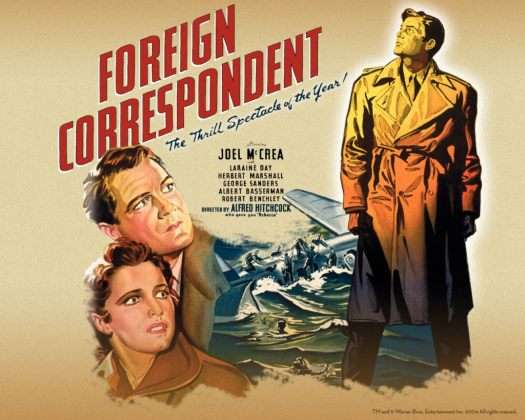
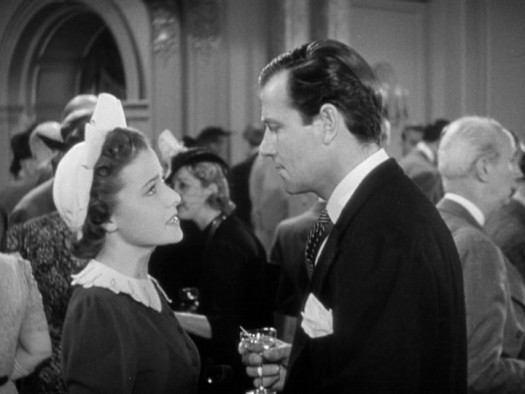
Windmills of Your Mind: Alfred Hitchcock’s FOREIGN CORRESPONDENT (United Artists 1940)


gary loggins's avatarcracked rear viewer

(When Maddy Loves Her Classic Films invited me to join in on the Alfred Hitchcock Blogathon, I jumped at the chance! I’ve just completed the Ball State/TCM 50 YEARS OF HITCHCOCK course, and have been knee-deep in his movies for a month now!)

Alfred Hitchcock’s second American film found the Master of Suspense back in the spy game with FORGEIGN CORRESPONDENT, this time with American star Joel McCrea caught up in those familiar “extraordinary circumstances” we’ve all come to love. Like REBECCA that same year, this film was nominated for Best Picture, an extraordinary circumstance indeed for a director new to these shores. Offhand I can only think of three other directors to hold that distinction – John Ford (also in ’40), Sam Wood (1942), and Francis Ford Coppola (1974). Good company, to say the least! (And please correct me if I’m wrong, any of you film fans out there).

Crime beat reporter…

View original post 644 more words

Gothic Art: Alfred Hitchcock’s REBECCA (United Artists 1940)


gary loggins's avatarcracked rear viewer

REBECCA is unquestionably a cinematic masterpiece. I remember watching it for the first time in a high school film class, enthralled as much by its technical aspects as the story itself. This was Alfred Hitchcock’s  first American film, though with a decidedly British flavor, and his only to win the Best Picture Oscar. There’s a lot of film noir shadings to this adaptation of Daphne DuMaurier’s  Gothic novel, as well as that distinctive Hitchcock Touch.

“Last night I dreamt I went to Manderley again”, begins Joan Fontaine’s narration, as the camera pans down a dark road overgrown with brush and weeds, fog rolling in all around, as we come up on the once majestic castle called Manderley, now lying in ruins. This first shot was all done with miniatures, another wonderful example of Hitchcock’s innovative use of the camera, looking and feeling totally believable (take that, CGI!). Flashbacks bring us to when Fontaine’s character, who’s…

View original post 570 more words

Horror on the Lens: The Lodger (dir by John Brahm)


Today’s horror on the lens is 1944’s The Lodger, a remake of Hitchcock’s silent classic.

This creepy little story of paranoia and murder in the London fog features an excellent performance from Laird Cregar and is definitely one of the best films ever made about Jack the Ripper!

Enjoy!

Horror Film Review: The Picture of Dorian Gray (dir by Albert Lewin)


picture-of-dorian-gray-32

Hello and welcome to the start of TSL’s annual October horrorthon!  All through the month of October, our focus will be on horror.  We will be sharing reviews and thoughts on some of the best (and worst) horror films ever made!  I have to admit that this is my favorite time of the year.  I love horror … like all good people!

I want to start things off by taking a look at a film from 1945.  The Picture of Dorian Gray is based on the famous novel by Oscar Wilde (a novel that some people think was inspired by the Jack the Ripper murders).  Dorian Gray (played by Hurd Hatfield) is a young and handsome aristocrat who lives in 19th century London.  When we first meet him, Dorian is intelligent, kind and virtuous.  He’s also more than a little boring.  He is the bland face of the establishment, a man destined to be celebrated for his position in society and largely forgotten after his death.

Dorian is posing for a painting that’s being done by his friend, an artist named Basil Hallward (Lowell Gilmore).  One day, Lord Henry Wotton (George Sanders) stops by the studio while Basil is painting Dorian.  Lord Henry is everything that Dorian Gray is not.  He’s a worldly and cynical man and he is very proud to live a life devoted to complete and total hedonistic pleasure.  He immediately sets out to corrupt Dorian and it turns out to be a lot easier than he was expecting.  Henry convinces Dorian that he can have everything that he wants as long as he’s young and handsome.  Dorian announces that he wishes the painting could age instead of him…

Now, here’s where the film takes a huge departure from Wilde’s novel.  In the novel, the painting ages while Dorian stay young.  No specific reason is given.  Instead, it’s just something that happens.  In the film, it turns out that Basil owns an ancient Egyptian statue and that the statue has mystical powers.  Dorian makes his wish in front of the statue and that’s why the painting starts to age.  Personally, I think the bit with the Egyptian statue is unnecessary and a little bit silly.  To me, the story is a lot more effective if the painting starts to age without an explanation.  The filmmakers obviously disagreed.

But no matter!  In the end, the Egyptian statue isn’t that important.  What is important that, freed from getting old or physically suffering for his actions, Dorian transforms into a different person.  Soon, he’s even more hedonistic than Lord Henry.  When he breaks the heart of a tragic singer named Sybil Vane (Angela Lansbury, in a poignant and Oscar-nominated performance), Dorian sees that the painting is now cruelly smirking while his own face remains innocent and untouched.  When Dorian eventually commits a murder to keep his secret from getting out, the blood appears on the painting’s hands while his own remain clean.

And the years pass.  Dorian finds himself both being hunted by Sybil’s brother (Richard Fraser) and falling in love with the niece (Donna Reed) of a man that he earlier murdered.  Dorian never ages but his portrait becomes more and more twisted.  What’s particularly interesting is that we see little of Dorian’s evil actions.  Instead, we watch and listen as other characters whisper about the horrific things that he’s done.  Physically, Dorian remains an innocent and young aristocrat.  But all we have to do is look at the picture and we can see what a monster Dorian has become…

The Picture of Dorian Gray is an absolutely gorgeous film, one that is full of elaborate sets that are often cast in shadow.  (It’s interesting to note that the more corrupt Dorian becomes, the darker and more shadowy his estate becomes.)  The film is in black-and-white, with the exception of three scenes in which the portrait is revealed in all of its Technicolor glory.  If that sounds like a gimmick … well, it is.  But it’s an amazingly effective gimmick.

The Picture of Dorian Gray is a classic exercise in psychological horror.  See it the next chance you get!

portrait-de-dorian-gray-1945-01-g

The Fabulous Forties #27: Sundown (dir by Henry Hathaway)


40s

You may remember how, back in April, I started on a mission to review all 50 of the films included in Mill Creek’s Fabulous Forties box set.  I actually got off to a pretty good start and, by the end of the month, I was about halfway through.  Yay me!

However, then the month of May began.  And May turned out to be a very, very busy month.  As I sit here writing this, it’s been 27 days since I last posted a Fabulous Forties review.  That review was …. well, I can’t even remember what it was.  After I post this, I’ll click on this link to find out.

However, things have calmed down a bit and now I can go ahead and finish up the Fabulous Forties box set.  And that’s a good thing because, between me and you, I am more than ready to move on to the Nifty Fifties box set!

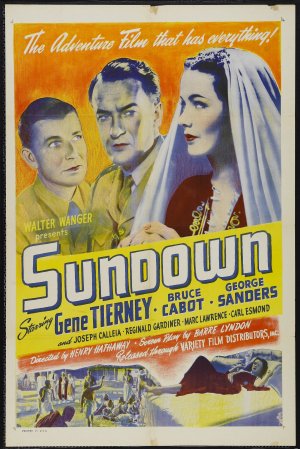
Anyway, without further ado, let’s consider the 27th film in Mill Creek’s Fabulous Forties, 1941’s Sundown!

Poster_of_the_movie_Sundown

Sundown was released by United Artists in 1941.  It’s a propaganda film, telling the story of British soldiers in North Africa and their attempts to both maintain the peace among the natives and to keep the Axis powers from arming the local rebels.  Bruce Cabot is the experienced soldier who knows how things work in Africa.  George Sanders is the new commander who is a bit more by-the-book.  At first, you think that the film is going to be dominated by the rivalry between Sanders and Cabot but actually it’s not much of a rivalry.  For the most part, they get along just fine and I guess that’s to be expected considering that the film was made at a time when the emphasis was on everyone remaining unified against the Nazis.

Speaking of the Axis powers, they’re always in hovering in the shadows of the film but it’s rare that we actually see any enemy soldiers.  Perhaps this is because the film was made at a time when the United States was technically neutral.  Joseph Calleia plays a prisoner of war who has rejected fascism and instead just wants to sing opera and cook for Sanders and Cabot.  Calleia’s character is specifically identified as being an Italian.  If not for that (and the fact that the film was made in 1941), it would be just as easy to assume that Sanders and Cabot were fighting the French or maybe the Russians.

There’s an enemy agent in one of the tribes and it’s up to Sanders and Cabot to figure out who.  Helping them out is the local big game hunter, played by Harry Carey.  And, on top of that, there’s also a mysterious native woman played by Gene Tierney.  Gene Tierney is totally miscast but that adds to this film’s odd charm.

And, for modern viewers, it definitely is an odd charm.  I watched Sundown twice and I’m still not sure exactly what happened in the film.  Sundown is one of those films that doesn’t so much have a plot as it just has a lot of scenes that kind of tell a story, assuming that you have the patience and concentration to figure out how they all link together.  Between Cabot’s roguish smile, Sanders’s stiff upper lip performance, Calleia’s enjoyable overacting, and Gene Tierney’s otherworldly beauty, Sundown is unexpectedly dream-like.  The film even features a sudden sermon in which a clergyman (Sir Cedric Hardwicke) exhorts everyone to fight.  The clergyman is never seen again.

Sundown was a strange movie, one that I often found myself struggling to follow.  It was also apparently a box office bomb, though it did receive 3 Oscar nominations.  One of those nominations was for Charles Lang’s cinematography and it was definitely deserved.  Even the version I saw (which suffered from a typically poor Mill Creek transfer) was still impressive to look at.